The crew of a Japanese oil tanker have used powerful fire hoses to fend off an attack by pirates in the Singapore Strait.Three times in three weeks? That sounds like a pattern.
The International Maritime Bureau said pirates in seven fishing boats accosted the east-bound tanker near Indonesia’s Karimun Islands on Tuesday afternoon -- the third attack on a Japanese vessel in three weeks in the busy shipping lane which carries more than a quarter of world trade.
VertRep

Saturday, February 04, 2006
Oil tanker fights off pirates
Reported here:


Guesses on the causes of the Red Sea ferry disaster
The BBC is not shy about guessing about what caused the al-Salam Boccaccio '98 to sink as seen here. Design flaws to terrorism... covers the water front so to speak...
Friday, February 03, 2006
Latest ONI World Wide Threat to Shipping (to 1 Feb 06)
For the latest ONI WWTTS go here and click on the date. Highlight:
1. SOMALIA: An unidentified bulk carrier was fired upon 27
Jan at 0645 local time while underway in position 11:55.0N 051:19.0E,
off Cape Guardafui, Somalia. Five pirates armed with machine
guns and rocket launchers in a speedboat fired at the bulk carrier.
Master took evasive maneuvers and activated SSAS; crew
mustered and started fire hoses. Pirates firing caused damage
to bridge windows and accommodation. They restocked
ammunition from a nearby wooden fishing boat and resumed firing.
An additional black steel hulled fishing boat came close and also fired
at the ship. A coalition warship responded to the alert and at 0740
local time a helicopter arrived and pirates ceased firing. At 0810
local time a coalition warship arrived at the scene (IMB).
Navy Coastal Warfare Squadron 5 Joins the fleet

Reported here:
The squadron is the first of its kind since the Vietnam War, extending the reach of a Navy that has long dominated the deep-water oceans into the shallow coastal regions.Not a new concept, as noted, and one most recently filled by the Navy Reserve Mobile Inshore Undersea Warfare Units and their affilated boat groups...see, for example, Naval Coastal Warfare Group 2 and this on the NCW Squadron mission. And a recent deployment.
The squadron's job is to protect harbors and ships from terrorist attacks like the one that crippled the destroyer Cole in Yemen almost six years ago. While it can aid the Coast Guard in protecting U.S. ports including San Diego, most of the squadron's work will take place in overseas hot spots such as Korea, the Persian Gulf and the Horn of Africa.
“We've had to expand to this battle space, because that's where the terrorists are,” said Rear Adm. Donald Bullard, commander of the newly created Naval Expeditionary Combat Command in Norfolk, Va., which oversees the squadron. “We need to interdict. We need to go find, fix and kill.”
Coastal warfare has been around since the Navy's earliest days, when ships guarded colonial harbors against the British during the Revolutionary War and defeated the Barbary pirates off the coast of Libya in the early 19th century.
But since small Swift Boats fought the Viet Cong in Vietnam's Mekong Delta nearly four decades ago, the Navy delegated its low-priority coastal work to reserve units. Al-Qaeda's attacks against the Cole in October 2000 and U.S. landmarks on Sept. 11, 2001, spurred the Navy to focus on coasts as well as the oceans.
“The global war on terror is in the harbor, the near-shore, the inland waterways,” Bullard said. “We need a dedicated force so we don't have things like the Cole.”
Once at full strength, the squadron's 325 sailors will go to war in a fleet of speedy 34-foot, aluminum-hull boats equipped with .50-caliber and 7.62mm machine guns and grenade launchers. The boats, each costing $500,000, can be loaded quickly aboard Air Force C-17 transport jets for quick transport to trouble spots...
...Recruiting sailors and officers to the unit has posed no problem, said 1st Lt. T. Wilkes Coleman of Tuscaloosa, Ala., the squadron's information technology officer.
“It's completely different than being on a ship,” said Coleman, 28. “We're about as point-of-the-spear as you can get.”
Petty Officer 2nd Class Johnny Fleming had served 14 months in Bahrain before transferring to Squadron 5 last year.
“I got to choose. I wanted to do something different,” said Fleming, 26, of Salem, Mass.
Neither he nor his buddies had heard about coastal warfare. His friends kidded him about the switch.
Somali pirate suspects plead "innocent"
As might have been anticipated, the 10 alleged pirates captured by a US Navy destroyer are claiming to be innocent victims of kidnapping by the US Navy as reported here:
Ten suspected Somali pirates captured by the U.S. Navy last month pleaded their innocence on Friday at the start of a trial intended to deter rampant piracy off the lawless Horn of Africa nation.I suppose the 16 Indian hostages rescued by the Navy ship may have some differing testimony...
During the unprecedented judicial hearing in the Kenyan port of Mombasa, the ten men argued that they had been illegally kidnapped by a U.S. ship patrolling in waters that have seen an upsurge of attacks and hijackings in the last year.
"We are poor people who were abducted, up to now we don't know where we are," said Hassan Mohamed, who was formally charged with piracy along with the other nine. "We wish a representative from our government to be availed for us."
Egyptian Passenger Ship Missing in Red Sea

A backroad to avoid? Leaping croc hits car...

Reported here:
This was an auto accident with a difference. A two-metre-long saltwater crocodile leapt out of a roadside culvert and slammed into the side of a passing car, authorities said Thursday.Not, apparently, all that strange, from a scientific point of view, but I don't think I'd hike down that particular road.
The crocodile died in the collision and was given to local Aborigines, who ate it, said Garry Lindner, crocodile management officer at the Kakadu National Park in northern Australia.
Thursday, February 02, 2006
"We have taken control of your ship, and we will be obeyed"
Interesting product testing press release notice here: 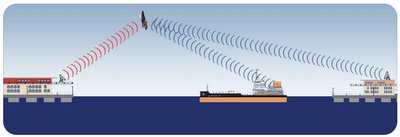
Picture from the VIP Industrial Solutions web site
VIP Systems™ technology will allow the ship to be viewed from the central U.S. Port control location, at any time, and in the event of any terrorist takeover of the ship, the technology will allow the control location to turn-off the ship's engines and thereby disabling it.
All commands will be given through SkyPort International, Inc.'s robust secure satellite link which allows the operator to see the marine vessel at any time, or place in the world.

Picture from the VIP Industrial Solutions web site
Marine Video Security allows you to view a Cargo vessel/Tanker/Ship prior to its approach to a Country’s territorial waters. Marine Video Security allows you to be able to identify a respective Ship’s crew prior entering the Country’s territorial waters.Biometrics? Sort of like a really fancy OnStar for ships, I suppose...
VIP Systems™ has pioneered an advanced new video surveillance system (Patent pending) that allows US Ports / Coast Guards real time monitoring and video/biometric data on all passenger and cargo ships’ / tankers’ the captain, crew, and civilians from virtually any point around the globe. The confirmation of biometric data along with real time video surveillance monitoring of crew, captain, and passenger is multi-casted (transmitted) from a satellite dish onboard the vessel. This data will be matched with registered files previously obtained and stored with the Port authority. In case of emergency the system offers capabilities to shutting-down the engines via the VIP ACTIVE ACTION CONTROL LINK. This system can play a vital role in the new security regulations and guidelines imposed by Congress related to the improvement in our homeland security structure.
EU official: Be wary of the Strait of Malacca
One day its the Commander of the US Pacific Fleet, and the next it's the"anti-terrorism coordinator as reported here:
EU anti-terrorism coordinator Gijs de Vries says the Malacca Strait, the world's busiest shipping lane, is still vulnerable to terrorist attacks.
De Vries noted that the number of pirate attacks has declined in the strategic waterway, where more than half the world's oil and a third of its commerce passes annually. But he said the shipping lane is still a potential target for terrorists.
"The number of acts of piracy in the Straits has gone down significantly, which is testimony to the improvement in regional cooperation in that part of the world," he said. "But I think no one is under any illusion: the Straits are a potential target. And it is important therefore for regional cooperation to continue to be strengthened further."
The US and modern pirates
Odd title, but this has some useful information on the US Navy and Coast Guard anti-piracy efforts.
"The number of reported incidents of piracy and armed robbery against ships in waters off the coast of Somalia has increased alarmingly ... and is becoming increasingly common," an official said. "Most of the incidents have reportedly occurred at distances ranging up to 180 nautical miles off the Somali coast, and the reported information suggests a pattern of well-organized and coordinated activities."Well, it's nice to read that the "sea services" are recognizing the problem exists.
The U.S. Navy is attacking the issue head-on. In an attempt to make the seas safer for commerce and to thwart terrorist activities, the Navy conducts maritime security operations in various parts of the world, officials said.
"The primary focus of (such operations) is preventing terrorists from using the seas as a venue from which to launch an attack or to move people, weapons or other material that support their efforts," Naval Forces Central Command spokesman Cmdr. Jeff Breslau said. But "our maritime task forces are always prepared to respond to mariners in distress, whether they are under attack by pirates, experience engineering causalities, or have medical emergencies."
Most recently, the Navy captured a suspected pirate vessel in the Indian Ocean about 54 miles off the coast of Somalia and detained 10 alleged pirates Jan. 21.
Several other incidents of piracy aimed at international shipping off the Somali coast have been reported over the past year, including an attack on a Western cruise ship in November and a Jan. 22 incident in which pirates reportedly fired on a commercial cargo ship before hijacking the vessel. The pirates are currently demanding ransom for the release of the 20 crewmembers and the vessel, International Maritime Bureau officials said.
Pirates have even hijacked humanitarian aid vessels, such as a ship loaded with foodstuff headed to Somalia under the auspices of the U.N. World Food Program, IMO officials said.
"In today's world, ship safety and security are inseparable. Events have made us all aware of the vulnerability of transport networks and the potential they hold to be either the targets or the instruments of terror," IMO officials said.
Even though acts of piracy are not common in American waters, the U.S. Coast Guard is vigilant in preventing them from becoming so. Aside from combating drug trafficking and protecting U.S. ports and marine transportation system from terrorism, Coast Guard officials emphasize the importance of stopping the spread of piracy into American waters to protect U.S. citizens and the flow of commerce.
"By its very definition, piracy is about stealing. Our job is law enforcement," Dan Tremper, a Coast Guard spokesman, said. "We're always on patrol -- 24/7. We've got sharp eyes on the water with the goal of protecting the American people and our economic interests."
Skipper's eye view of piracy
Reported here:
Capt Rodrigues took command of a small container ship after it was attacked en route from Australia to Singapore.
When the 10-men crew heard shots in the night most of them locked themselves in their cabins but the captain and chief officer were later found shot dead.
Captain Rodrigues: You are defenceless once they are on board
It is believed they were killed after the pirates demanded money. The unmanned ship continued on its course for an hour and a half before the crew emerged to find their shipmates killed.
The survivors were first accused of having mutinied but were later accepted as victims.
When Capt Rodrigues took over the helm he had a new crew as the other men were too traumatised to return.
"We agreed everyone was on piracy watch. I never had to force anyone to go out. They were always up on the bridge."
On first boarding the ship, he said: "I told myself lightning doesn't strike twice."
But he may have thought he had spoken too soon when one night a few months later the ship was approached by a couple of speedboats off the Indonesian islands, south of Singapore.
"We got out the search lights and torches and sounded the alarms," he recalled.
The measures worked as the speedboats gave up their pursuit.
But he later heard pirates had boarded another ship, tied up the chief engineer and ransacked the vessel
Palestinian militants claim attack on Israeli ship
Reported here:
Palestinian militants said they fired missiles at an Israeli naval ship in the Mediterranean Sea near the southern town of Rafah on Wednesday, but the Israeli military said it was unaware of any attack.Is it an attack if the alleged victim is unaware the it has been attacked?
Islamic Jihad and the al-Aqsa Martyrs Brigades, an armed group in President Mahmoud Abbas's Fatah faction, issued a statement saying they fired two missiles at a navy gunboat.
Wednesday, February 01, 2006
Latest ICC Commercial Crime Services (to Jan 30, 2006)
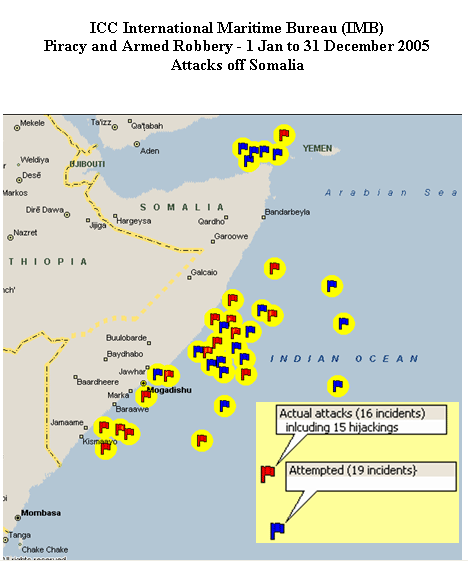
Latest ICC Commercial Crime Services Weekly Piracy Report here. Highlights: 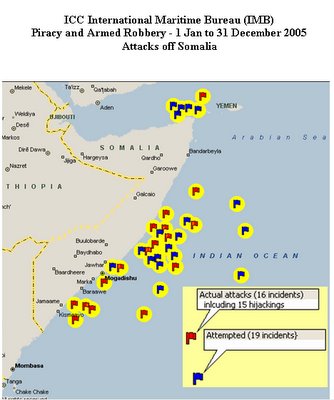
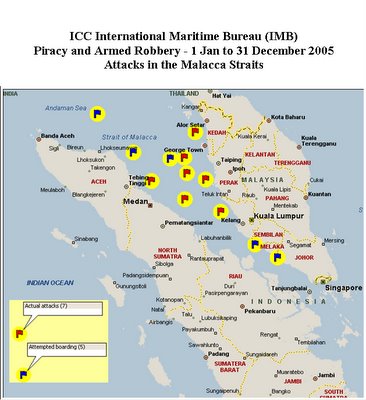
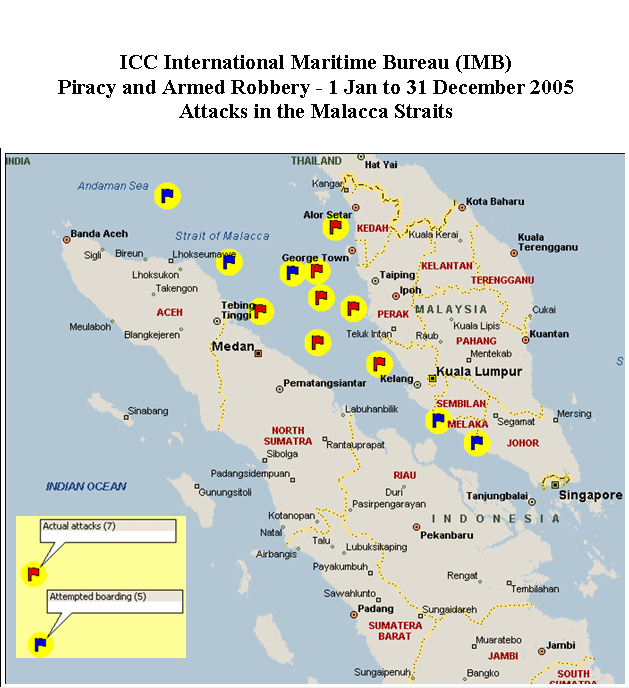
27.01.2006 at 0645 LT in position 11:55.0N - 051:19.0E, off Cape Guardafui, Somalia.You might like to look at the 2005 piracy maps, a couple of examples of which follow (attacks off Somalia and in the Strait of Malacca during 2005):
Five pirates armed with machine guns and rocket launchers in a speedboat fired upon a bulk carrier underway. Master took evasive manoeuvres and activated SSAS; crew mustered and started fire hoses. Pirates continued firing causing damage to bridge windows and accommodation. They restocked ammunition from a nearby wooden fishing boat and resumed firing. Another black steel hulled fishing
boat came close and also fired at the ship. A coalition warship responded to the alert and at 0740 LT a helicopter arrived and pirates ceased firing. At 0810 LT a coalition warship arrived at the scene.
25.01.2006 at 0152 UTC in position 13:27.6N - 042:59.0E, southern Red Sea.
An unlit speedboat chased a container ship underway. Boat increased speed to 35 knots and came within 1.5 nm. Ship altered course and crew directed search lights. Craft reduced speed and aborted chase.
11.01.2006 at 1600 LT in position 04:49N - 005:21E, 8 miles SW of Dodo River, off EA oilfield, Nigeria.
40 persons armed with guns in three canoes boarded a pollution control ship underway. They vandalized ship's equipment and kidnapped four expatriate personnel. The ship was engaged in a security role with 14 naval personnel onboard. So far the pirates have made no demand. Authorities informed.
Another offshore LNG project for California?
Reported here:
A second Australian company has surfaced with plans to anchor a liquefied natural gas terminal somewhere off the coast of Southern California, but the company will not say exactly where the terminal will be placed, although the Malibu coast is a possibility...
...LNG opponents have noted that the possibility of catastrophic terrorist attacks, industrial accidents or midsea collisions would remain under either plan, risking explosive venting of huge amounts of methane that some critics say would spread over miles of open ocean and, if ignited, burn structures onshore.
US Navy and pirates
An interesting report here:
In ordering a U.S. Navy destroyer to capture and board a suspected pirate ship on the high seas in the Indian Ocean, the United States has fired a warning shot across the bow of would-be terrorists who might lash up with pirates in the Asia-Pacific region...
..."This was a maritime security operation," said a navy officer informed of events in the Indian Ocean. That effort, broadly defined, includes tracking thousands of ships, much as aircraft are monitored, knowing what cargoes the ships are carrying, driving off pirates when they attack a ship, or recovering the ship if it is seized...
...The issue is politically sensitive as leaders of Asia-Pacific nations have asserted that they do not want outside powers, notably the U.S., operating in their sovereign waters where many pirate assaults occur. Many Asian naval officers argue that combating piracy is the job of law enforcement, not navies.
Many U.S. Navy officers agree but assert that some Asian nations lack the proper ships -- small, high-speed and adequately armed -- to defeat or capture pirates. Moreover, coordination and intelligence sharing among the littoral nations has not been fully developed...
...On the other hand, U.S. President George W. Bush's war against terror is where much of the action is today and many U.S. Navy officers contend that their service needs to be involved, if for no other reason than to preserve its standing among the U.S. armed forces.
Thus, said a navy officer, "there is no overall policy on going after pirates." Rather, an internal debate seems to be rumbling through the navy.
Greenpeace "battle plan"
Reported here, a plan to take on West African fishing "pirates."
West Africa? Why not take on the illegal fishing off Somalia in East Africa? It'd be more fun for the rest of us...
West Africa? Why not take on the illegal fishing off Somalia in East Africa? It'd be more fun for the rest of us...
Sierra Leone Navy captures pirate

Reported here:
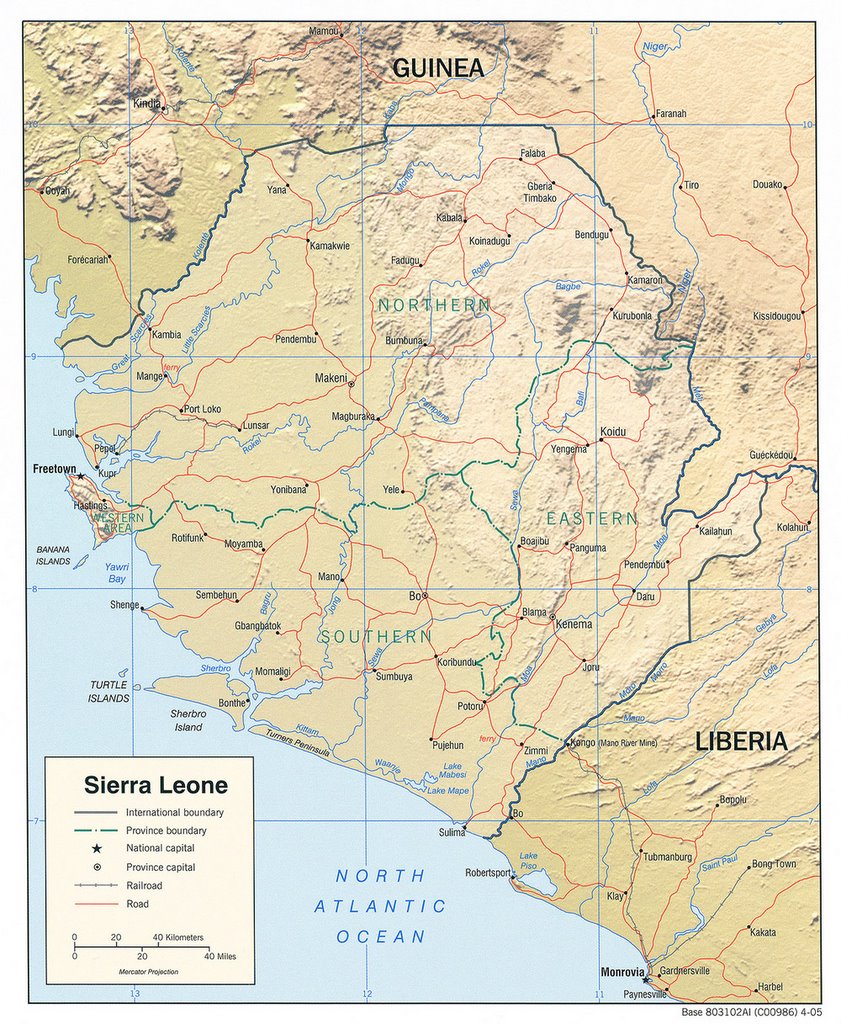
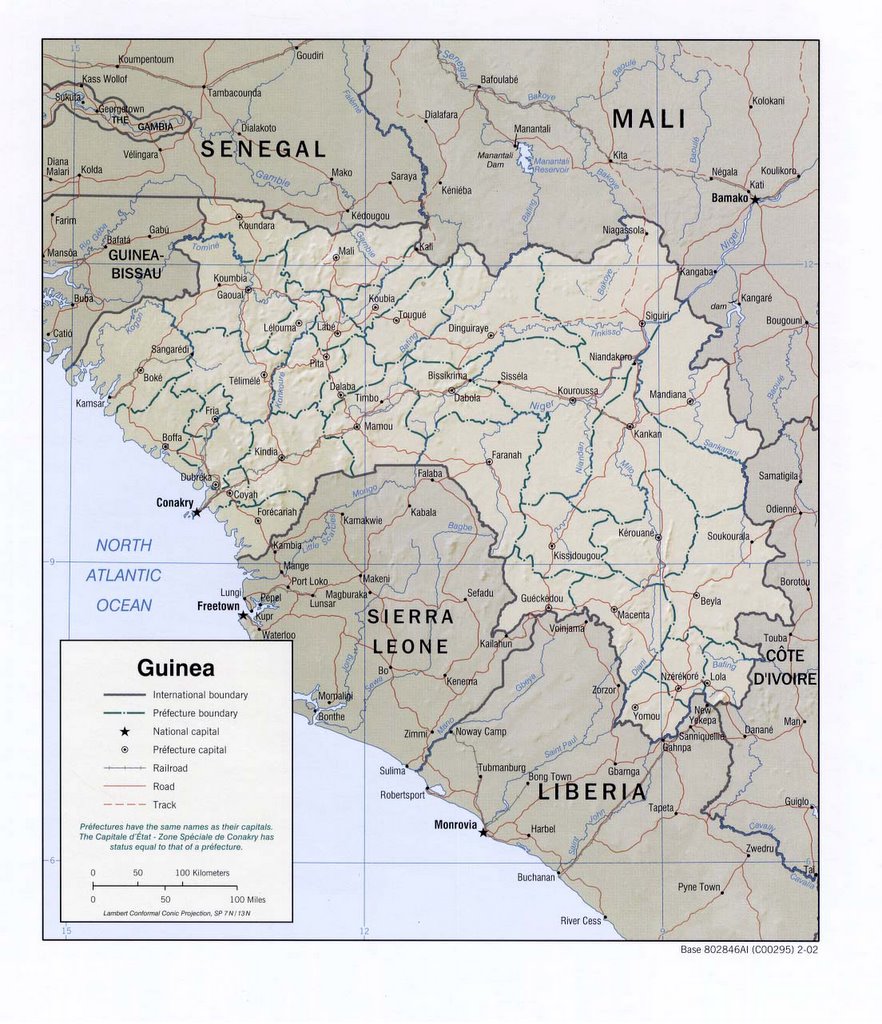
As Guinean pirates continue to cause havoc at sea in Sierra Leone’s territorial waters, reports monitored by this press have so far indicated that the Sierra Leone Navy (SLN), an arm of the Republic of Sierra Leone Armed Forces (RSLAF), has put certain anti pirate and other anti terrorist measures in place with a view to protecting and safeguarding the territorial integrity of the country.Judging by the last two paragraph in the article, Guinea and Sierra Leone seem to be having some difficulties:
This latest move in this regard bore fruit, when on Friday, January 27 2006 a team of Sierra Leone Navy personnel quashed an attempted sea piracy at the Yeliboya Forward Operational Base (FOB) by a group of 14 Guinean pirates and ending with the capture of one of the said pirates.
Meanwhile, the captured pirate, who gave his name as Abdul Karim Sillah, has been turned over to the police for further interrogation. This latest capture amounts to two such Guinea pirates that have been apprehended by the Sierra Leone Navy in the last two months. Both captured pirates claim to be registered vigilantees of the Guinean Armed Forces (GAF).
The spate of Guinean pirates illegally encroaching in Sierra Leonean territorial waters to carry out criminal activities has been deemed by many as a real provocation. According to some observers, something must be done at the strategic level to put a decisive stop to this persistent provocation.
Threat of Strait of Malacca terrorism catch PacFlt's eye
Reported here:
"The Strait of Malacca is the heaviest trafficked strait in the world, and for that reason any disruption to that commerce, not only would it affect the region, I would suggest it would have global implications," Roughead told Reuters in an interview.
"I am not sure it would have to be of great magnitude. The fact that a vulnerability has been demonstrated is enough to affect trade," Roughead, head of United State's biggest naval fleet, said on the sidelines of a major naval conference in Sydney.
Tuesday, January 31, 2006
Chinese aircraft carrier?
Reported here, some speculation over the Chinese Navy and a possible aircraft carrier: 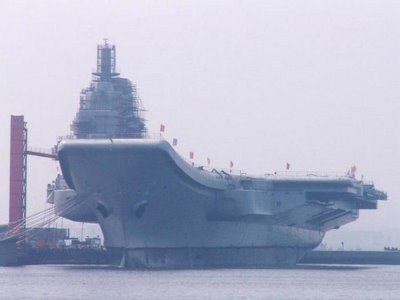
I love a mystery.
Varyag World also posts links to articles dealing with the fate of other other Russian aircraft carriers like Minsk (amusement park?) and Kiev (tourist attraction?). Sort of like the USS Alabama, I suppose. but it seems odd to use a ship from another country's navy...
There is tight security surrounding the Varyag in Dalian harbor, but work on the vessel is clearly visible from nearby highways.More on the Varyag here at Varyag World.com, including this photo, which I have liberated:
Recent photographs show extensive repairs or maintenance to the carrier's superstructure and deck.
"There is a lot of work happening on that thing which is not consistent with a gambling casino," Fisher said.

I love a mystery.
Varyag World also posts links to articles dealing with the fate of other other Russian aircraft carriers like Minsk (amusement park?) and Kiev (tourist attraction?). Sort of like the USS Alabama, I suppose. but it seems odd to use a ship from another country's navy...
Philippines: Beach terror alert

Reported here:
Newly assumed PNP provincial director Sr. Supt. Omar Buenafe may have his first bap tism of fire, courtesy of the rebel movement after intelligence reports say that three southern towns are due for attack by the NPAs.
These towns are Dauin, Siaton and Zamboanguita of southern Negros.
Incidentally, these are also the towns where beach resorts owned by foreigners with Filipina spouses, are splattered all over.
Buenafe did not cite specific targets but police stations and beach resorts are the primary areas on the watch list by the police and a special task force.
Only recently, President Arroyo ordered the formation of a special air, land and sea task force from the air force and navy to guard the shorelines of the province and that of Siquijor, Panglao, in Bohol, Apo island, and those in Dipolog for possible sea criminals, pirates and kidnappers. One of the modus operandi of terrorists is to pose as soldiers, riding on commandeered government vehicles, pretend to hold inspections and make a surprise attack.
Subscribe to:
Posts (Atom)