VertRep

VertRep

Thursday, November 16, 2006

Night helo ops


From here:
An Aviation Boatswain’s Mate Handler signals to a flight deck member to remove chocks and chains from an MH-60S Seahawk helicopter before it is directed to lift off the flight deck of amphibious assault ship USS Saipan (LHA 2) during night vision flight operations. Saipan is currently on deployment in the 5th Fleet AOR conducting Maritime Security Operations (MSO). U.S. Navy photo by Mass Communication Specialist Seaman Patrick W. Mullen III

Latest ICC CCS Piracy Report (to 13 Nov 06)

Found at ICC Commercial Crime ServicesWeekly Piracy Report:
08.11.2006 at 0202 LT in position 06:41.4S - 039:20.7E, 6 miles off Dar es Salaam, Tanzania.
One robber boarded a container ship waiting to embark pilot. Alert crew raised alarm and the robber escaped empty handed.

08.11.2006 at 0302 UTC in position 21:52N - 091:40E, Kutubdia Roads, Bangladesh.
Ten robbers armed with steel bars and knives in a wooden boat boarded a bulk carrier at the stern. They broke into lockers and stole ship's stores. D/O raised alarm and robbers escaped. Local authorities informed.

09.11.2006 at 0200 UTC in position 08:45.8S - 013:16.8E, Luanda Anchorage, Angola.
Two robbers in a small open boat boarded a LPG tanker at the forecastle. They broke into bosun’s store and compressor room. Alert crew raised alarm and robbers escaped with ship’s equipment.

13.11.2006 at 0010 UTC in position 05:36.4N - 000:02.9E, Tema Outer Roads, Ghana.
Ten robbers armed with knives boarded a refrigerated ship at anchor.
They overpowered a crew member and assaulted him. However, he
managed to raise the alarm and alerted other crew.
Robbers jumped overboard and escaped in a small boat with stolen items.

House Democrats disrespect Murtha

Okinawa Jack smacked down. Reported here:
Democrats picked Rep. Steny Hoyer (news, bio, voting record) to be House majority leader on Thursday, spurning Rep. Nancy Pelosi (news, bio, voting record)'s handpicked choice moments after unanimously backing her election as speaker when Congress convenes in January.

A Marylander and 25-year veteran of Congress, Hoyer defeated Rep. John Murtha (news, bio, voting record) of Pennsylvania in a vote of 149-86.
"I didn't have enough votes and so I'll go back to my small subcommittee I have on Appropriations," Murtha said after the vote.
Jack, an island in the Pacific needs you. Now. Hurry.

UPDATE: Greyhawk has reasons.

Probably worth keeping an eye on


Interesting -Police: Nuclear Info Found During Airport Arrest
A man was arrested at Detroit Metropolitan Airport after officials said they found him carrying more than $78,000 in cash and a laptop computer containing information about nuclear materials and cyanide.
Keep alert for a Thanksgivng surprise!

What he says


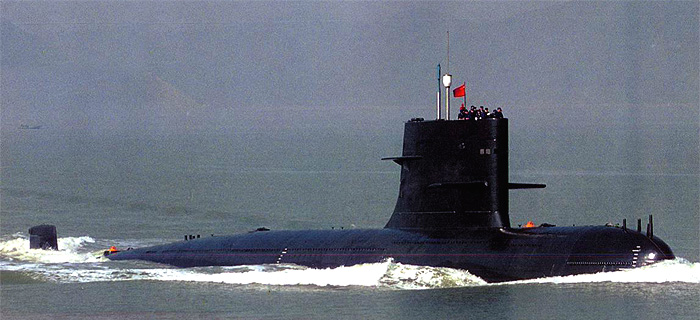
USS Kitty Hawk and the Song from China - well covered at Murdoc Online and the places he points to, like In from the Cold, and DefenceTech.

CDR Salamander has some thoughts (note the comments, especially AW1 Tim, who hits on logistics as professional should).

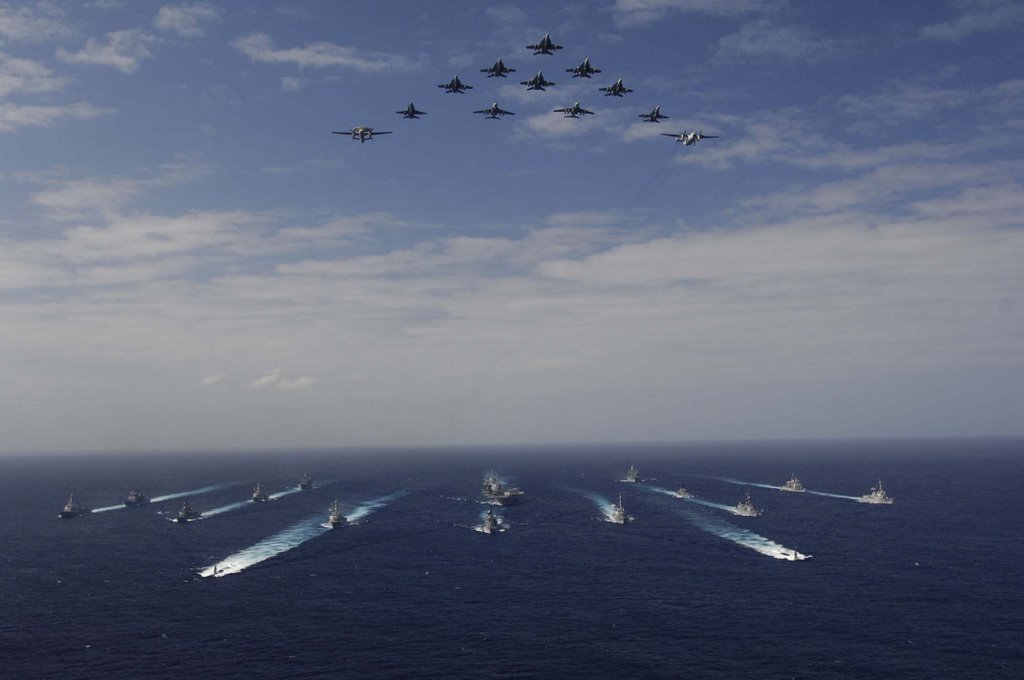
Kitty Hawk photo info:
Aircraft from Carrier Air Wing 5 fly over a group of 18 U.S. and Japanese Maritime Self-Defense Force ships Nov. 14, at the conclusion the two nations' exercise ANNUALEX. ANNUALEX kicked off Nov. 9 and included more than 85 JMSDF and 13 U.S. ships and submarines, plus dozens of air wing and shore-based aircraft. About 8,500 U.S. personnel took part. Ships taking part in the exercise-ending photo shoot were the aircraft carrier USS Kitty Hawk (CV 63), two guided-missile cruisers, two Military Sealift Command oilers, two submarines, seven guided-missile destroyers and four JMSDF destroyers. Two helicopters flying above the ships carry the Japanese and U.S. flags. The aircraft, which operate from Naval Air Facility Atsugi, Japan, are deployed aboard the Kitty Hawk. Kitty Hawk and most of the U.S.-participating ships operate from Fleet Activity Yokosuka, Japan; the remainder is based in the United States. U.S. Navy photo by Mass Communication Specialist 3rd Class Jarod Hodge
And yes, I was tempted to photoshop the Song into the picture as a formation trail, but I resisted...

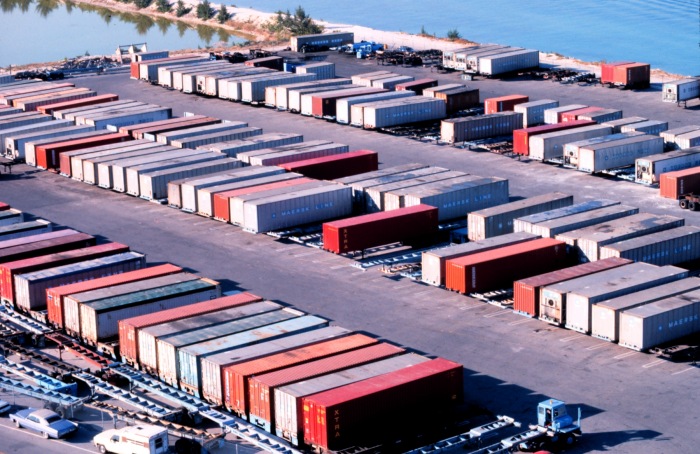
Interesting idea for checking shipping containers


Reported here, and excellent idea for a tool to be used in ports.
A device that can check shipping containers for radiation as they're unloaded will be tested at the Port of Oakland next year in the continuing effort to prevent a terrorist attack.

Dubbed the VeriSpreader, the instrument should give U.S. Customs agents the ability to detect and identify any radiation lurking inside containers shipped here from all over the globe.

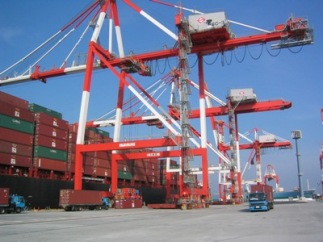
The VeriSpreader is essentially a network of detectors that could be outfitted on a standard shipping crane hoist. It should be able to quickly tell the difference between a container filled with bananas and one filled with a dirty bomb. Speed, as well as safety, is of the essence in the shipping trade.

Creators of the device advertised its virtues Wednesday morning in hopes of eventually winning government approval tosell the VeriSpreader to other ports throughout the nation.

"It is an extremely cost-effective solution," said John Alioto, chairman and chief executive officer of Veritainer, the company that invented the device. "It is here to protect American ports."

Currently, ports check for radiation using Radiation Detection Portal Monitors, which are giant, upside down, u-shaped towers that trucks drive through as they enter or leave a marine terminal.

While the portal monitors can scan for radiation levels, they cannot pinpoint what type of radiation is coming from the container. That can be problematic because many items naturally emit radiation, such as bananas, cat litter and clay tiles.

In addition, each portal monitor must be staffed by a Customs agent who must constantly analyze the statistics produced by the scan.

But with the VeriSpreader, a computer does all the checking and can output analysis to show whether the container has cat litter or a nuclear weapon.

In the future, Alioto said, the device could read a ship's manifest to tell whether it is supposed to be carrying items that emit radiation.
Cool.

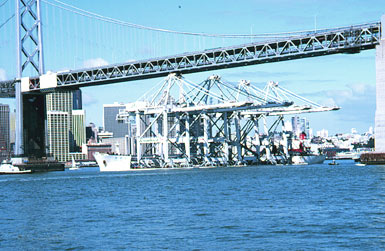
UPDATE: Veritainer website here. And a photo of the thing itself:

President Bush in Singapore


Speech here:
As we work for a Korean Peninsula free of nuclear weapons, we're also strengthening defense cooperation in the Asia Pacific region. Unlike Europe, where our security cooperation takes place through the NATO Alliance, America's security cooperation in Asia takes place largely through bilateral defense relations.

America places the highest value on these partnerships. We're committed to strengthening our existing partnerships and to building new ones. With Japan, we continue to work closely to field a missile defense system to protect both our countries and others in the region from rogue regimes threatening blackmail and/or destruction. With South Korea, we have upgraded our deterrent capabilities, while reducing our footprint and repositioning U.S. troops stationed in the country. With Australia, we're working to improve joint training of our forces, and increase cooperation in areas such as intelligence and missile defense research. With the Philippines, we're working to improve the capabilities of the nation's armed forces to fight terrorism and other threats. With India, we signed an historic agreement to expand defense cooperation, increase joint exercises and improve intelligence sharing. With Vietnam, our Navy has made four port calls over the past three years, the first visits by U.S. military ships since the Vietnam War. And with Singapore, we signed a new strategic framework agreement that provides for joint military exercises and cooperation in military research and development.

By building new defense relationships and strengthening existing alliances, we are ensuring that the forces of freedom and moderation in this region can defend themselves against the forces of terror and extremism.

In addition to these bilateral defense relationships, America welcomes the growing multilateral security cooperation in this region. Today, Singapore, Malaysia, Thailand and Indonesia are coordinating patrols in the Strait of Malaka, and working to combat terrorism, piracy and human trafficking. Through the Proliferation Security Initiative, 80 countries are cooperating to stop the spread of weapons of mass destruction and related materiel through air, land and sea.

APEC members know that advancing trade and opportunity throughout the Pacific requires safe travel and transport, so we will continue to work together to improve the security of our ports and airports and transportation routes.

With all these efforts, the nations of this region are answering the threats of the 21st century. And in doing so, we are laying the foundation of security and peace for generations to come. In the long run, the surest path to security is the expansion of liberty and freedom. History shows that free societies are peaceful societies. Democracies do not attack each other. Governments accountable to voters focus on building roads and schools, not weapons of mass destruction. Young people who have a say in their future are less likely to search for meaning in extremism. And nations that commit to freedom for their people don't support terrorists and extremists, but, in fact, will join together to defeat them.

America is committed to advancing freedom and democracy as the great alternatives to repression and radicalism. We will take the side of democratic leaders and reformers. We will support the voices of tolerance and moderation across the world. We will stand with the mothers and fathers in every culture who want to see their children grow up in a caring and peaceful society.

We recognize that every democracy will reflect the unique culture and history of its people. Yet, we recognize that there are universal freedoms, that there are God-given rights for every man, woman and child on the face of this Earth. The people of Asia have faith in the power of freedom because you've seen freedom transform nations across your continent.

At the beginning of World War II, this side of the Pacific had only two democracies: Australia and New Zealand. Today, millions of Asians live in freedom. Freedom has unleashed the creative talents of people throughout Asia. Freedom has helped prosperity sweep across the region.

In all that lies ahead, the people of this region will have a partner in the American government and a friend in the American people. Together, the people of America and Asia have endured dark and uncertain hours. Together, we've seen modern nations rise from the rubble of war and launch dynamic economies that are the envy of the world. Together, we will confront the challenges of the new century and build a more hopeful and peaceful and prosperous future for our children and our grandchildren.
UPDATE: Singapore gets basing rights in the U.S.?

Wednesday, November 15, 2006

Kill the bad guys? Hmmm.


Sometimes Ralph Peters gets it right as he does here:
With Iraqi society decomposing - or, at best, reverting to a medieval state with cell phones - the debate in Washington over whether to try to save the day by deploying more troops or withdrawing some is of secondary relevance.

What really matters is what our forces are ordered - and permitted - to do. With political correctness permeating our government and even the upper echelons of the military, we never tried the one technique that has a solid track record of defeating insurgents if applied consistently: the rigorous imposition of public order.

That means killing the bad guys. Not winning their hearts and minds, placating them or bringing them into the government. Killing them.

If you're not willing to lay down a rule that any Iraqi or foreign terrorist masquerading as a security official or military member will be shot, you can't win. And that's just one example of the type of sternness this sort of fight requires.

With the situation in Iraq deteriorating daily, sending more troops would simply offer our enemies more targets - unless we decided to use our soldiers and Marines for the primary purpose for which they exist: To fight.
You know, that just might work.

A defense of Friedrich Hayek


Betsy's Page presents a counter to a Jeffrey Sachs' "higher taxes can save the world from poverty" push and attack on Hayek here.

I like her bottom line:
I think I'll stick with Hayek and Milton Friedman. The solution to world poverty is not in massive programs run by the U.N.

I note that our domestic War on Poverty has been going on for 42 years. A couple of years ago, Thomas Sowell took a look at the results:
Never had there been such a comprehensive program to tackle poverty at its roots, to offer more opportunities to those starting out in life, to rehabilitate those who had fallen by the wayside, and to make dependent people self-supporting. Its intentions were the best. But we know what road is paved with good intentions.

The War on Poverty represented the crowning triumph of the liberal vision of society -- and of government programs as the solution to social problems. The disastrous consequences that followed have made the word "liberal" so much of a political liability that today even candidates with long left-wing track records have evaded or denied that designation.

In the liberal vision, slums bred crime. But brand-new government housing projects almost immediately became new centers of crime and quickly degenerated into new slums. Many of these projects later had to be demolished. Unfortunately, the assumptions behind those projects were not demolished, but live on in other disastrous programs, such as Section 8 housing.

Rates of teenage pregnancy and venereal disease had been going down for years before the new 1960s attitudes toward sex spread rapidly through the schools, helped by War on Poverty money. These downward trends suddenly reversed and skyrocketed.

The murder rate had also been going down, for decades, and in 1960 was just under half of what it had been in 1934. Then the new 1960s policies toward curing the "root causes" of crime and creating new "rights" for criminals began. Rates of violent crime, including murder, skyrocketed.

The black family, which had survived centuries of slavery and discrimination, began rapidly disintegrating in the liberal welfare state that subsidized unwed pregnancy and changed welfare from an emergency rescue to a way of life.
***
While some good things did come out of the 1960s, as out of many other decades, so did major social disasters that continue to plague us today. Many of those disasters began quite clearly during the 1960s.

But what are mere facts compared to a heady vision? Liberal assumptions -- "two Americas," for example -- are being recycled this election year, even by candidates who evade the "liberal" label.
I wonder how much damage could be done to the world with UN supervision?

UPDATE: An earlier article by Dr. Sachs from The Economist here:
The idea that the UN system could provide real leadership on the great development challenges will strain credulity in some quarters. A steady drumbeat of criticism about the UN agencies during the 1990s, led by right-wing leaders in Congress, has left the impression of nearly moribund institutions, busy securing patronage slots for friends and relatives, and disconnected from the rapid advances in technology, finance and globalisation. Indeed, when I began my own intensive work with the UN agencies three years ago, as chairman of a commission for the World Health Organisation, and then more recently as a special adviser to the secretary-general for the Millennium Development Goals, I was unsure what to expect within the specialised agencies of the United Nations.
Tried and tested

The truth is almost the opposite of what the UN bashers say. Despite a decade of criticism and budget cuts, the specialised UN agencies have far more expertise and hands-on experience than any other organisations in the world. Even the World Bank, with its knowledge base and ability to disburse and monitor funds in some of the most difficult settings in the world, can address problems of health or environment or other specialised concerns only in partnership with UN agencies that have expertise in these specific areas. No bilateral donor agency can substitute for the scale of UN expertise and engagement, though these agencies can be important partners in a global effort.
No bilateral donor agency can substitute for the scale of UN expertise and engagement

This under-appreciated capacity is why the UN system has vastly outperformed expectations in Kosovo, East Timor and other tough assignments in recent years.
Kosovo? From here:
- Kosovo. The commission looks forward to a significant EU role in Kosovo's development once its status has been resolved. The report notes that little progress has been made in reforms; administration and rule of law remain weak; the position of minorities unsatisfactory; and little progress has been achieved in establishing a functioning market economy.
The most recent UNMIK Fact Sheet (10/06) (pdf downloadable here) shows unemployment in Kosovo at 35-50%, a declining GDP and hundreds of milions of "aid being poured in by donor states (over 13% by the US). Another study (ahere (pdf) deals with the impact of UN spending in Kosovo and the efect of potential down-sizing, the conclusions (found on page 46) are that the UN has dumped a lot of money into Kosovo and had a significant impact on the economy and if the UN downsizes, that could have an impact on Kosovo, including the loss of over 1,000 jobs.

East Timor? From The New Republic:
But in reality, Timor, the world's newest nation, was never the U.N. triumph it appeared to be. After 1999, when tiny Timor voted to separate from Indonesia, which had taken over the territory when Portugal left in 1975, militias linked to the Indonesian army leveled East Timor, leaving much of the country in ruins. The United Nations stepped in, taking a mandate in Timor until 2002, the first time in history the United Nations had completely run a nation. After Timor officially gained its independence in 2002, the United Nations maintained a sizable presence in the country, along with a hydra of other major non-governmental organizations.

By the end of 2005, the United Nations and other agencies were showering themselves with praise for their work in Timor. Timor seemed relatively stable, and it appeared to have developed a vibrant civil society and a nascent democracy. One of the former U.N. negotiators involved in Timor's transition published a memoir showing how the United Nations had overcome major odds and helped Timor onto the path of success. When World Bank President Paul Wolfowitz visited Timor this April, he lavished plaudits on the country for its "functioning economy and vibrant democracy." In last year's U.N. progress report on Timor, delivered to Secretary General Kofi Annan, the organization announced, "The overall situation [in Timor] ... remained calm and stable."

But this praise concealed serious problems--problems the United Nations seemed to ignore or even make worse. Despite Wolfowitz's praise, in reality the Timorese government had done little to promote broader economic growth, and has shown worrying signs of high-level corruption--trends some staff in Wolfowitz's own organization had warned about.

Indeed, today Timor is the poorest nation in Asia, with unemployment rates topping 50 percent. Though the United Nations' presence initially created thousands of jobs for locals and pumped money into the economy, the organization did little to help ensure that these Timorese would be able to find work after the blue helmets left. When the United Nations began to draw down some of its operations in 2002, many Timorese immediately lost their source of employment, and the U.N.-created economic bubble collapsed, with Timor's economy actually shrinking.
UN outperfomed expectations in Kosovo and East Timor? Only if they were remarkably low to begin with...

Tuesday, November 14, 2006

Nominate someone you love

Ta da! It's that magical time of the year again, when bloggers need your nomination for The 2006 Weblog Awards.

Yes, you can make a lonely blogger feel appreciated by nominating his or her blog for consideration by the voting public in the 2006 Weblog Awards. Directions for nominations are here. Nominations close 11/24 and voting begins in early December.

Top 10-15 Finalists in each category can proudly display their status on their blog. See the display on this blog from 2005, for example.

Just so you know, I self-nominated in the Best of the Top-3501-5000 Blogs and look forward to begging for your votes when the polls open.

In the meantime, find some one else and share the love.

Ooops! Not too late to catch Maritime Monday 33 at Fred Fry International!


Hey, did you remember to head over to Fred Fry International: Maritime Monday 33 on your own?

If not, go now!

Something for Mother, something for Father, something for everyone...

Fred even covers LASH! (and I don't mean Lash LaRue, either)

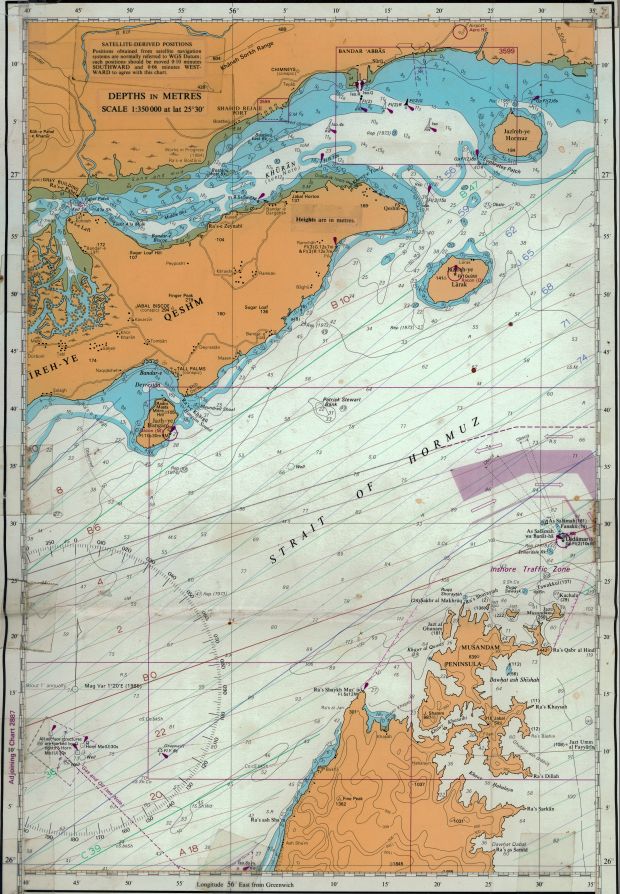
"Countering Iran's Oil Weapon"


From the Hertiage Foundation, some helpful hints on keeping Iran from ruining the global economy at Countering Iran's Oil Weapon. Hints include:
-Recognize and prepare for the threat.
-Maintain a strong U.S. and allied naval pres­ence in the Persian Gulf.
-Improve U.S. naval capabilities, including minesweeping and anti-ship missile defense.
-Create a contingency plan for the domestic energy market.
First you have to decide that yapping them to death probably won't work. Then you have to fund stuff for the military (a good luck on that with the new crowd in charge) and then you have to find the will to stand up to the neighborhood bully.

Color me cynical.

Asymmetic weakness- provoking attacks


What happens when the biggest, strongest guy on the beach starts letting 98-pound weaklings kick sand in his face? Investor's Buisness Daily says it well here (subscription?):
A weak America can never buy conciliation and peace. Weakness is a provocation, an invitation to our foes to confront us. How quickly we are relearning that old lesson in the wake of last week's election.
Although the editorial focuses on two overhyped examples of potential enemies surveilling a couple of our aircraft carriers (the Chinese submarine surfacing within "range of its torpedoes" near the Kitty Hawk and the Iranian drone video), it fails to mention that apparent loss of will can cause allies to decline to hitch themselves to a wagon that seems to be in retreat - the post election South Korean decline to participate in the UN authorized searching of North Korean ships, the increase in al Qaeda taunts...

Does no one in Washington remember that from bin Laden's view of history the U.S. lacks the guts to take casualties? Vietnam, Beirut, Somalia, etc all seem to support his view. How much good does it do to win every major battle only to lose your nerve and concede the battlefield to you enemy? It's a big "L" on history's scorecard. Not since the Japanese fleet with its powerful battleships turned around at the Battle of Leyte Gulf has defeat been so readily grasped by a winninng side.

The IBD piece continues:
This week, not surprisingly, al-Qaida is practically giddy at the prospects of a Democratic Congress reining in President Bush.
***
On Monday, Abu Hamza al-Muhajir, the terrorist leader of al-Qaida in Iraq, said "The American people . . . voted for something reasonable in the last elections."
Rapprochement between the U.S. and al-Qaida? Hardly. Al-Muhajir went on to say al-Qaida would blow up "the filthiest house — which is called the White House."
By the way, al-Qaida claims to have 12,000 fighters ready for death in Iraq. Once we leave and it takes over, it won't be the end — not by a mile. As al-Qaida said Monday, next it wants to topple Lebanon's democratically elected regime.
So much for the Democrats' notion that only Afghanistan represents "the real war on terror."
So in case you're thinking maybe this new era of appeasement and walking away from our enemies will work, it pretty much looks like the answer is no.
Our enemies, real and potential, seem to think the U.S. is weaker today than it was before the election.
It will be up to us as a nation — and to our newly shifted Congress — to prove them wrong.
Time to find that spine we had after 9/11 and before the media and the "peace at any price" crowd went to work. The troops in the field have proved they have it, but the awful lesson of Vietnam seems to be playing out again. Freedom's enemies, far weaker but fighting a better media war (with help from the inside), are on the march again in real countries where real people will die because they thought that the U.S. was serious in wanting to help them live free.

And terrorism- that tactic of inferior forces- gathering momentum as the greater struggle with Islamic fascism continues.

Monday, November 13, 2006

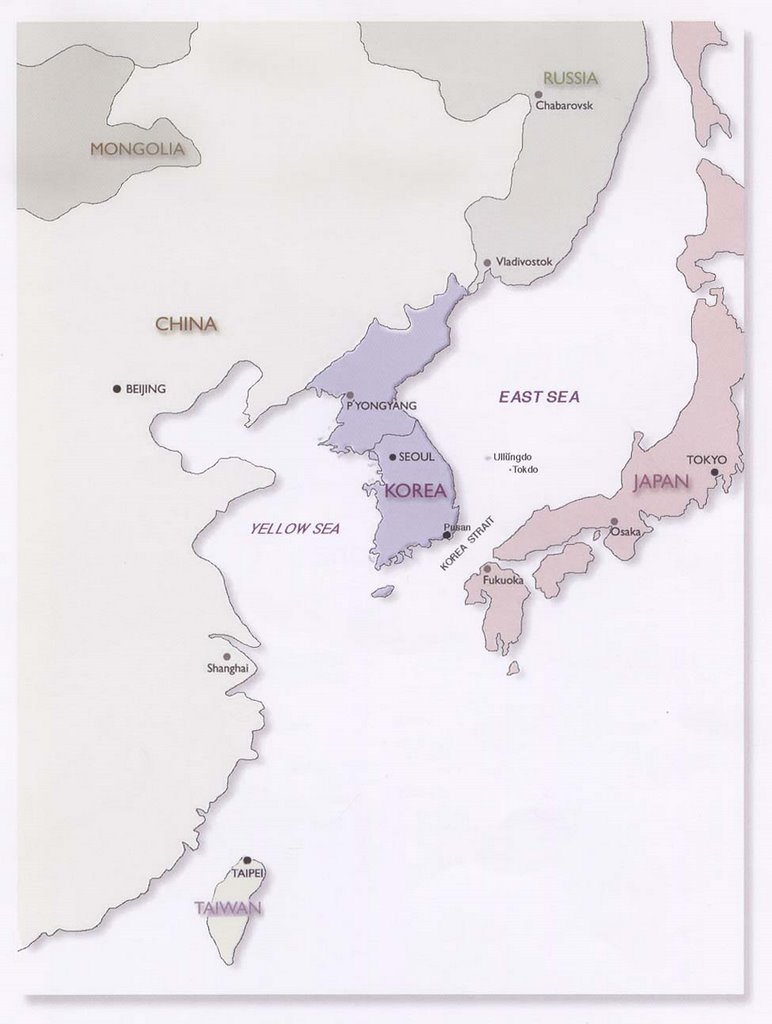
South Korea says "No" to PSI and DPRK Sanctions


Unhelpful is how I would describe the decision described here:
Seoul on Sunday announced its final decision against full participation in the Proliferation Security Initiative (PSI), which Washington has urged Seoul to join after Pyongyang's detonation of a nuclear device last month. "We agree on the principle of the PSI, but we made the decision considering the special circumstances on the Korean Peninsula,” an official said. The PSI is a loose coalition of countries aimed at stopping and searching North Korean vessels suspected of carrying weapons of mass destruction and related materials in international waters.
***
Nor will the government announce any additional measures under UN Security Council Resolution 1718 in a report to be submitted to the UNSC sanctions committee on Monday. "The UNSC sanctions committee came up with a list of restricted items based on five strategic goods control agreements including the Nuclear Suppliers Group (NSG) which we have already joined,” an official said. “It has not determined what organizations and individuals fall under special restrictions, so there are no specific additional measures we need to take." As for luxury goods banned with the aim of reducing the regime’s creature comforts, Seoul will look at what other countries are doing and "reflect the measures in its future North Korea policy.”

Pirates of the modern day variety - LA Times take


LA Times on piracy here:
The 550-mile-long channel, flanked by Singapore and Malaysia to the east and the Indonesian island of Sumatra to the west, is one of the world's most strategic international waterways and its busiest shipping lane. Each year, 60,000 vessels, the equivalent of nearly half the world's entire merchant fleet, negotiate the funnel-shaped shortcut between the Pacific and Indian oceans. They range from mammoth supertankers as large as city skyscrapers to tugs and barges.

Such seaborne commercial traffic attracts a sophisticated brand of piracy that has moved far beyond the scabbards and cutlasses of the 17th century.

Many are opportunists, Choong said, impromptu gangs of poor fisherman who can't resist the allure of lumbering, unarmed vessels laden with cash and goods: "They realized that robbing unarmed sailors is a lot easier than robbing a bank." Others are more ambitious and well-organized, professionals who plunder ships for crime syndicates, warlords, corrupt government officials and even regional terrorist groups.

IN recent years, Choong says, emboldened pirates have become more sophisticated. They forge passports and other documents to turn working maritime vessels into slave- and drug-running ships. They use satellite phones and global positioning systems.

With high-speed fiberglass boats, they creep up from behind, using the cover of the ship radar's blind spot. With grappling hooks and expert climbing skills, they scale the vessel's mooring ropes and overpower isolated and vulnerable crews.

The pirates don't just use the cover of darkness. They also take advantage of national sovereignty laws.
***
Many pirate attacks are hit-and-run robberies. In others, crew members are kidnapped for ransom, even tortured and killed. Countless vessels have been hijacked, their nameplates and paperwork swiftly changed, and turned into ghost ships used by syndicates for drug and slave smuggling.
***
Although the last 12 months have brought an uneasy hiatus, Choong says recent incidents suggest piracy may be back — with an ominous new wrinkle.

In July, armed attackers boarded two United Nations-chartered vessels carrying tsunami relief supplies. In the first incident, six men in military fatigues brazenly stormed the ship before noon, one of the first reported daylight raids.

The next day, a dozen heavily armed men claiming to be attached to the Free Aceh Movement, an Indonesian separatist group, commandeered another U.N. ship. The same week, a gang of 35 pirates with machine guns and rocket launchers seized a fully loaded gasoline tanker and kidnapped its captain. He was later released with the vessel.

Choong and others believe such instances suggest the possibility of a major terrorist attack in the Strait of Malacca, which slices through the heart of a region rife with political and religious unrest.

International security experts also fear that militants might commandeer a giant crude oil tanker for use as a floating bomb.
A timely reminder.

"Sea pirates" arrested in Nigeria


Reported as Police arrest nine sea pirates in Rivers:
THE Rivers State Police Command weekend came to the aid of travellers on the Bonny - Port Harcourt route of the high sea when its men arrested about nine sea pirates allegedly troubling the sea routes.

Sunday, November 12, 2006

Iranian drone spying on US aircraft carrier?


Video here allegedly taken by Iranian drone. 4 minutes.

Confederate Yankee has more.

Looks to me like some crew member of a helo was taking some tourist shots during a training mission.

UPDATE: Next they'll be claiming this launch was theirs:

UPDATE2: The thingie is the upper right hand corner of the alleged drone video is like a "picture in picture" image that mirrors what is shown in the main picture.

UPDATE3: An Iranian UAV described here with the following note:
Iran has been attempting to develop a UAV industry, and some of its UAVs were used operationally in 1997 to shadow US Navy operations in the gulf. Iran has developed the tactical Ababil-5, a medium-range reconnaissance and surveillance UAV, the Ababil-T, a short/medium-range attack UAV, and the Ababil-B and -S. Iran recently announced the production of two new variants of its indigenously developed Ababil UAV, one of which, dubbed Ababil-S, was designed specifically for ISR operations.
Previous report of a "buzzing" of USS Ronald Reagan in the Arabian Gulf from June 2006 here. Or maybe May 2006 here.

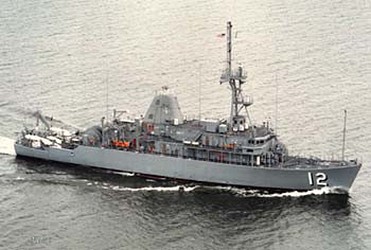
Somebody wake up? US Navy to retain Minesweepers


Reported at StrategyPage:
The growing potential for naval mine warfare by China, North Korea or Iran, or even terrorists, has caused the U.S. Navy to rethink its plan to retire its 14 Avenger-class minesweepers.
***
Now the thinking is more towards keeping the Avengers for as long as they are serviceable, and increasing the use of special mine clearing kits for the LCS and other ships. In a decade, it is believed hostile nations will have a lot of very capable naval mines.
I wonder how the AN/AQS-20A is progressing?

How about Iran? See here and Iran and sea mines and some info related to the "law" of war and sea mines here.

UPDATE: Info on Chinese manufactured mines here (EM-52), here (M2) and here (M4).

Some older info (1998) on Russian sea mines here, with the delightful note: "Russian naval mines are unrivaled for their performance characteristics, reliability and ease of operation. Russian scientists and designers of virtually all classes of mines have captured the lead in their development."

And the North Koreans and the Iranians might have reason to believe in the efficacy of naval mines - as set out here:
During the Korean War enemy mines caused 70 percent of all U.S. Navy casualties and sank the only four U.S. naval vessels lost in combat. The Korean War showed clearly that in the future the sea mine would be the weapon of choice for many of the U.S. Navy's adversaries and a fixture of late 20th century naval warfare.
And more here:
Since the beginning of the Cold War, at least 14 U.S. ships, including two in the last decade alone, have been damaged or sunk by mines during relatively small-scale mining operations. Four dated, low-technology mines - two of which were simple moored contact mines - caused hundreds of millions of dollars in damage to U.S. warships during both the Gulf Tanker War of the late 1980s and the 1991 Gulf War, and cost multinational forces tens of millions of dollars to counter them. In 1988, in the most serious incident, Samuel B. Roberts (FFG-58) nearly sank after striking an Iranian SADAF-02 contact mine, estimated to cost $1,500, causing nearly $96 million in damages.

The historical success of simple contact and influence mines suggests that these weapons will continue to challenge U.S. naval forces. These mines have twice complicated U.S. amphibious landings - first at Wonsan in 1950, then off Kuwait more than 40 years later. Although large-scale mining efforts ended with World War II, minefield effectiveness has not been compromised. During the Gulf War, for example, Iraq exhibited a significant mining capability by laying approximately 1,300 mines. Despite the fact that many of the mines were nonfunctional or ineffectively laid, three mines were successful in seriously damaging two U.S. warships, Princeton (CG-59) and Tripoli (LPH-10). Princeton activated an early-generation, Italian-manufactured Manta bottom-influence mine, estimated to cost $10,000, causing approximately $24 million in damages. Tripoli struck a LUGM-145 moored contact mine, estimatedto cost $1,500, causing nearly $3.5 million in damages. Currently, close to 90 percent of all countries with a mining capability have moored contact or moored influence mines in their inventories.
Effects? Here's a report of aid delivery being slowed during the early phases of the Iraq war:
The discovery of mines in the channel leading from Umm Qasr to the Persian Gulf delayed a British ship carrying humanitarian aid to the Iraqi people.

The British logistics vessel RFA Sir Galahad (L3005) was scheduled to deliver hundreds of tons of food, water and medical supplies to the Iraqi deep-water port on March 26. But British mine clearance ships, together with British and Australian naval divers, discovered "mine-like" objects in the channel.
***
Credit for discovery of mines in the lower Kwahr al Zubaya river estuary must go to the Royal Australian Navy's (RAN's) interception of a suspicious dhow. This was followed-up by members of the Special Forces conducting interdiction of barges. The US Navy intercepted three tugboats with barges containing 130 mines onboard. Pentagon officials said 68 mines were found on one tugboat, 50 on another and 19 on the third boat. Special Forces searching the waterways found more barges loaded with modern Italian-made Manta magnetic mines, and old-style Russian and North Korean origin contact mines. Customised dhows configured for mine-laying were found, with more than 90 mines onboard, while two other dhows, each containing six Mantas, were also found and have since been destroyed.

Upon discovery of the tugboats and mine-carrying barges, the US Navy expanded its search for mines beyond the al- Faw Peninsula. The US Navy's HM-5 "Blackhawks" squadron is deployed to the Gulf with MH-53E Sea Dragon minesweeping helicopters to sweep the channel to Umm Qasr port facilities, aided in spotting and destruction by two Cyclone Class patrol craft - USS Chinook (PC-9) and USS Firebolt (PC-10). The sled-towing MH-53 is ideal for estuary sweeping in confined waters, while four other American mine warfare craft remain engaged in coastal sweeping of the al-Faw Peninsula and Bubiyan Island, Kuwait.

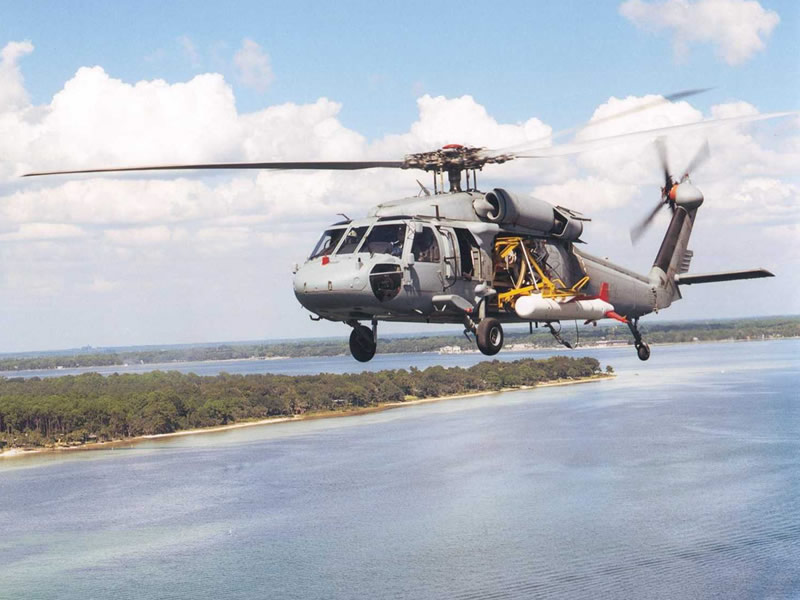
UPDATE2: The plan for the H-60S,as set out here:
Lockheed Martin received a contract in September 2003 to develop organic mine countermeasure systems on the MH-60S. The Block B capability in 2007 introduces the AN/AQS-232 AMNS (Airborne Mine Neutralization System) and RAMICS (the Rapid Airborne Mine Clearance System). The AN/ALQ-220 OASIS (the Organic Airborne and Surface Influence Sweep system) follows in 2008.

Derived from the German Seafox shipboard mine-neutralization system, the AMNS enables the MH-60S to relocate, identify and neutralize mines previously found by AQS-20 sonar, the ALMDS laser detector or other mine warfare platforms. The hovering helicopter deploys an expendable, self-propelled neutralizer steered to the suspected mine by the MH-60S operator. Sonar and video displays on the airborne console help identify a potential mine threat. Confirmed mines are destroyed or detonated with a shaped charge.

The RAMICS uses a laser-aimed 30 mm Bushmaster II cannon to neutralize near-surface, floating and shallow-bottom mines. The blue-green laser penetrates the water to target the mine for the stabilized, rapid-fire gun. Flat-nosed, super cavitating projectiles are designed to enhance range, speed and accuracy when entering the water. The high-velocity rounds penetrate the mine case and detonate the mine with a reactive charge.

The OASIS combines the acoustic and magnetic mine detonation functions now performed by noisemakers and magnetic sleds in a single towed body. Deployed from the helicopter, it emulates ship signatures in shallow water at speeds up to 40 knots.

Project Valour IT - Victory for all of us!


Thanks to all who gave. The goal of $180,000 total was exceeded as set out atProject Valour IT - A Soldiers' Angels Program.

Don't you feel good?

And Navy was first to $45,000. And the Navy-Marine Corps teams combined for over $97,000. Army exceeded the goal. And the Air Force...well, they're still collecting.

Saturday, November 11, 2006

Sunday Ship History: USS Cyclops (AC-4)

One of the great sea mysteries of all time - the loss of USS Cyclops in the "Bermuda Triangle" in 1918 has been offered up as one of the proofs of the Triangle's power...of course, the "Bermuda Triangle" includes some of the most heavily trafficked waters in the world, so the odds of a ship sinking would seem to be higher in high trafffic areas... be that as it may, the Cyclops is a more interesting tale than you might think:

Her specifications and history
(Collier: full load displacement 19,360; length 542'; beam 65'; draft 27'8"; speed 15 knots.; complement 236)

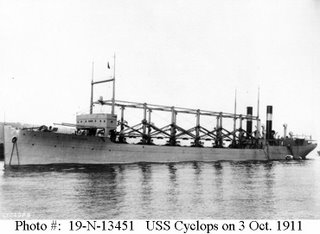
The...Cyclops, a collier, was launched 7 May 1910 ... and placed in service 7 November 1910, G. W. Worley, Master, Navy Auxiliary Service, in charge. Operating with the Naval Auxiliary Service, Atlantic Fleet, the collier voyaged in the Baltic during May to July 1911 to supply 2d Division ships. Returning to Norfolk, she operated on the east coast from Newport to the Caribbean servicing the fleet. During the troubled conditions in Mexico in 1914 and 1915, she coaled ships on patrol there and received the thanks of the State Department for cooperation in bringing refugees from Tampico to New Orleans.

With American entry into World War I, Cyclops was commissioned 1 May l917, Lieutenant Commander G. W. Worley in command. She joined a convoy for St. Nazaire, France, in June 1917, returning to the east coast in July. Except for a voyage to Halifax, Nova Scotia, she served along the east coast until 9 January 1918 when she was assigned to Naval Overseas Transportation Service. She then sailed to Brazilian waters to fuel British ships in the south Atlantic, receiving the thanks of the State Department and Commander-in-Chief, Pacific. She put to sea from Rio de Janiero 16 February 1918 and after touching at Barbados on 3 and 4 March, was never heard from again. Her loss with all 306 crew and passengers, without a trace, is one of the sea's unsolved mysteries.
Her Master/Captain was an interesting figure:
Investigations by the Office of Naval Intellegence revealed that Captain Worley was born Johan Frederick Wichmann in Sandstadt, Hanover Province, Germany in 1862, and that he had come to America by jumping ship in San Francisco in 1878. By 1898 he had changed his name to Worley (after a seaman friend), and succeeded in owning and operating a saloon in San Francisco's Barbary Coast. He also got help from brothers whom he had convinced to emigrate. During this time he had qualified to the position of ship's master, and had commanded several civilian merchant ships, picking up and delivering cargo (both legal and illegal; some accounts say opium) from the Far East to San Francisco. Unfortunately, the crews of these ships reported that Worley suffered from a personality akin to HMS Bounty captain William Bligh: the crew was often brutalized by Worley for trivial things.
Worley was a bit of a character, you might say:
Naval investigators discovered information from former crewmembers and others about Worley's habits. He would berate and curse officers and men for minor offenses, sometimes getting violent; at one point, he had allegedly chased an ensign about the ship with a gun. Saner times would find him making his rounds about the ship dressed in long underwear and a derby hat.
More on the long underwear and hat here:
It was from this incident that Conrad Nervig was to get to know Worley much better than any other of the crew or officers. Nervig recalled that Mr. Cain’s duty had been the mid-watch, the very lonely hours of the night and early morning. He now had to take over these duties. It was during this time that Worley came up from his cabin below the bridge and paid him the first of many visits. They were now in the tropics; the nights were balmy and calm. “I was somewhat startled to see him coming up the starboard ladder dressed in long woolen underwear, a derby hat, and a cane.” Nervig was worried about what he might have done wrong; yet Worley was “affable” and quite indifferent to Nervig’s crisp military salute “Good morning, Captain.” This was, in fact, a social call.
For some 2 hours Worley and he leaned on the forward bridge railing while “he regaled me with stories of his home and numerous incidents of his long life at sea. He had a fund of tales, mostly humorous. These nocturnal visits became a regular routine, and I rather enjoyed them. His uniform, if it could be so called, never varied from what he had worn on that first occasion. I have often wondered to what I owed these visits--his fondness for me or his sleeplessness.”
However,
The most serious accusation against Worley was that he was pro-German in war time; indeed, his closest friends and associates were either German or Americans of German descent. ONI contacted the U.S. consul on Barbados, the Cyclops' last port of call. Consul Brockholst Livingston replied in a letter that Worley was "referred to by others as damned Dutchman (for 'Deutch', i.e. German)." "Many Germanic names appear" Livingston continued, hinting that the ship, instead of sinking, may have been handed over to the Germans.[4] One of the passengers on the final voyage was Alfred Louis Moreau Gottschalk, the consul-general in Rio de Janeiro, who was as roundly hated for his pro-German sympathies as was Worley.[5] Speculation within the Navy and the State Department insinuated that Worley and Gottschalk had collaborated together to surrender the ship. After World War I, German records were pored over to ascertain the fate of the Cyclops, whether by Worley's hand or by submarine attack. Nothing was found.
One of the telegrams raising concerns about Worley can be found here. The implcation being, of course, that Worley had perhaps turned the ship over to the Germans. No evidence of this was found in post-war searches of German records.

Clive Cussler, the author of sea adventures, many of which involve sunken ships, sponsers an organization devoted to maritime archeology. Its website has much to say about Cyclops here:
Vincent Gaddis and Charles Berlitz have made fortunes touting barrel loads of bull s**t from their books on the mythical triangle while Larry Kusche, a library researcher at the Arizona State, wrote an admirable, in-depth work called "The Bermuda Triangle Mystery - Solved" and barely made beer money.

Kusche has soundly demonstrated that the Cyclops most likely went down between Cape Hatteras and Cape Charles under a heavy gale that struck the east coast on the 9th and 10th of March. During the raging winds and high seas, the ship's cargo of 10,000 tons of manganese probably shifted and she rolled over and sank without warning or time to send an SOS.
***
The Cyclops still remains the largest navy ship ever lost without leaving the slightest clue to her fate.

Interesting when you think about it. The only difference between a great sea mystery and a perfectly explainable ship sinking is one survivor.

No clue turned up until 1968 when master navy diver, Dean Hawes, descended on a large hulk lying in 180 feet of water about 40 nautical miles northeast of Cape Charles. Hawes was stunned. He found himself standing on a vessel unlike any he'd ever seen. The bridge sat on steel stilts above the deck and huge arms stretched upward along the main deck into the liquid gloom.
Despite this discovery the mystery wreck has not been relocated and may, in fact, be one of Cyclops's sister ships (we know it's not Jupiter because she was renamed Langley, converted to an aircraft carrier and sunk by the Japanese off Java in WWII).

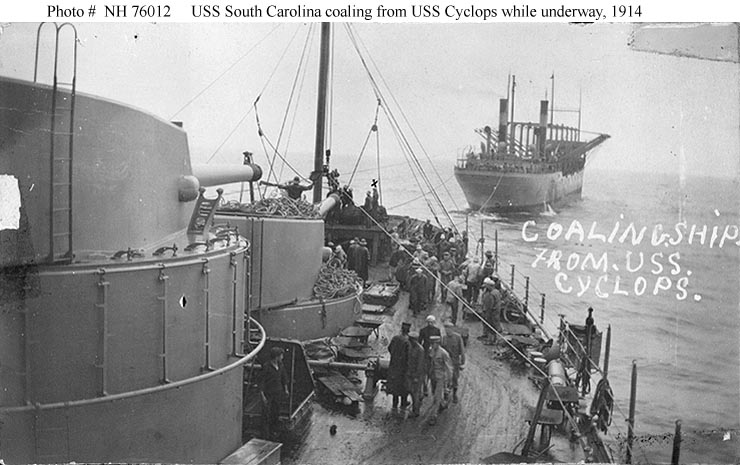
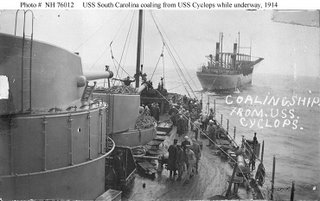
One more interesting aspect of Cyclops (especially for an old service force sailor) is that she was used to experiment with refueling at sea, as set out here in the description of the adjacent photo:
USS South Carolina (BB-26)and USS Cyclops (1910-1918)-Engaged in an experimental coaling while under way at sea in 1914. Rigging between the two ships was used to transfer two 800-pound bags of coal at a time. The bags were landed on a platform in front of the battleship's forward 12-inch gun turret, and then carried to the bunkers.
The donor, who served as a seaman in South Carolina at the time, comments: "it showed that this was possible but a very slow method of refueling. Nothing was heard of the test afterwards."
Whatever happened to Cyclops, she took all her crew with her and, today, we salute them.

UPDATE: A note on "The Bermuda Triangle" from here:
The Bermuda Triangle is a best-selling 1974 book by Charles Berlitz which popularized the belief of the Bermuda Triangle as an area of ocean prone to disappearing ships and airplanes. The book sold nearly 20 million copies in 30 languages.[1]

In the book, Berlitz lists several theories for the purported disappearances, although he only gives credence to theories that have natural background.

The book was the subject of criticism in Larry Kusche's 1975 work The Bermuda Triangle Mystery—Solved, in which Kusche cites errors in the reports of missing ships. [2] Lloyd's of London has determined the Triangle to be no more dangerous than any other piece of the ocean, and does not charge unusual rates of insurance for passage through the area. Coast Guard records confirm this determination. However, tales of missing ships, although promoted by Berlitz, existed prior to the book's publication.
UPDATE2: Kusche also has critics, as found here:
Kusche is all over the place concerning this great mystery, but seems completely ignorant of the sobering records extant at the National Archives. As such he seems to credit Conrad Nervig’s story, though the officer list at the NARA shows no Nervig. But we are now coming to some of the most famous mysteries of the Bermuda Triangle. Kusche seems to feel the pressure to solve one categorically. In doing so, he makes one comment that could make Ripley sit up and blink. “I confidently decided that the newspapers, the Navy, and all the ships at sea had been wrong, and that there had been a storm near Norfolk that day strong enough to sink the ship.” On top of this, he writes: “Contrary to popular opinion, there never was an official inquiry into the disappearance . . .Had there been any investigation, the weather information would surely have been discovered.”
The Cyclops is perhaps the most investigated case of the US Navy, lasting some 10 years. Anything being reported was still to be directed to ONI even this long afterward. There was no storm. The original weather logs are even in the documentation, which amounts to 1,500 pages in boxes 1068-1070 at the Modern Military Branch at the NARA. What is peculiar is that in Kusche’s bibliography he makes note of very select records there, but not to all the documentation available. Certainly, “research” required examining it all, especially NARA records? The Cyclops remains, as the Navy calls it, “the greatest mystery in the annals of the Navy” though Kusche feels “the missing missing part of the puzzle, a substantial reason for the disappearance, has finally been found—the overlooked storm of March 10.” His “storm” is the only thing missing.
P.S. The Cyclops was not due at Baltimore until the 13th and was therefore no where near Kusche’s “storm” of March 10 off the Virginia Capes. Kusche never even mentions an ETA date in his whole recital. Strange.
More on the Bermuda Triangle at Bermuda-Triangle.org, run by Gian Quasar. The portion of the somewhat chaotic website dealing with Cyclops is here.