
VertRep

VertRep

Thursday, June 21, 2007

Sri Lankan Navy takes on Tamil Sea Tigers


Reported here:
Sri Lanka's navy says it has destroyed five Tamil Tiger vessels after coming under attack from two dozen boats off the island's far northern tip, estimating it had killed dozens of separatist fighters.

Tuesday's clash at sea off Point Pedro in the northern army-held Jaffna peninsula, which is cut off from the rest of the island by separatist-held areas, was the latest in a string of land and sea battles and air strikes in recent months.

A navy spokesman said more than 40 Tigers were "presumed dead".

"We destroyed five boats and damaged seven to eight more.

"They were trying to attack our patrol boats, but they failed," DKP Dassanayake said, adding that no nav
StrategyPage take here:
Over the last two days, the navy engaged a fleet of two dozen LTTE boats off the northeast coast. The LTTE were trying to smuggle in people, explosives, weapons and ammunition. Four of the boats were rigged with explosives and manned by crews who planned to ram larger navy gunboats. About a third of the LTTE boats were sunk, and another third damaged. The navy suffered no losses, but most of the boats got away, heading back to India. The LTTE lost about 40 people, plus another thirty in unrelated land combat.

Very interesting video of Sea Tigers versus Sri Lankan Navy, with close ups of Tiger suicide boats ("design based on U.S. stealth bomber?") and a one-man suicide "torpedo" (image above is from video)...the torpedo seems to be guided by a diver operating handle bars and propelled by an outboard motor. The warhead appears to be three mortar rounds (?) at the bow, perhaps tied in with a larger round. The function of the snorkle thing in front of the motor eludes me. The thing is probably easy to stop if you see it coming, but seeing it coming might be a problem. I don't think its a weapon for use in open water, but might be a challenge in ports and restricted waters.

As I have noted before, this is not the first time that suicide boats or suicide submarines have been put to use. The Japanese had both and examples were captured during the capture of Okinawa.

The Kaiten submarine was described as "not so much a ship as an insertion of a human being into a very large torpedo." Suicide boats discussed here.

UPDATE: More on "torpedo" - the simplicity is stunning.

China and Burma


Burma falls under China's sphere of influence, as set out here:
Burma has now become China's most important ally in Asia. China's support for the Burmese junta has recently strengthened immeasurably, as the Chinese leaders have made Rangoon the cornerstone of their revised strategy towards Southeast Asia in the face of what it fears is the growing and unwanted influence of the United States in the region.
***
Some time ago China decided that Burma was crucial to its economic development, especially for the more backward southern regions of the country which have lagged behind the economic development along China's eastern coast. But until recently, China's leaders have feared that Burma's military junta lacked real legitimacy and could collapse overnight, leaving Beijing's military and economic investment in the regime worthless. There is no doubt that China's greatest fear remains Burma's stability. More than a million Chinese farmers, workers and businessmen have crossed into Burma in the last 10 years and are working and living there. The Chinese authorities fear that any upheaval in Burma would result in a mass exodus of Chinese back across the border, creating increased industrial and social unrest in their border regions.

In the past few years Chinese businessmen and provincial government enterprises have boosted their investment in Burma: Lashio, Mandalay and Muse are virtually Chinese cities now. Even in Rangoon, the Chinese are involved in building a special tax-free export zone around the port.

China already has major oil and gas concessions in western Burma, and is planning overland pipelines to bring it to southern China.

Burma is an important strategic transit point for goods produced in southern China. They want to transport these by road to the Rangoon port for shipment to India, the Middle East and eventually Europe. Repair work is under way on Burma's antiquated internal road system that links southern China, through Mandalay to Rangoon.
***
Already along the Burmese border with China, every small town has restaurants and stores run by migrants from China, many have been there for more than a decade. Chinese teachers are also being recruited to work in the Chinese-language and bilingual schools that are popping up in many of the major cities in northern Burma. Already in the major border towns in Shan state like Mongla and Muse, only the Chinese currency _ the renminbi or yuan _ is used; Chinese calligraphy dominates the landscape: billboards, street signs and shopfronts almost all use Chinese characters exclusively; very little Burmese writing can be seen.

In some towns along the border the clocks are set to Beijing standard time rather than Burma's clock to facilitate cross-border contact, according to local Burmese officials.

The Chinese authorities are planning to use Burma as a crucial transit point, not just for the products grown or manufactured in southwest China, but as a means of transporting goods from the country's economic power-houses along the eastern seaboard.

''By shifting the transit route away from the South China Sea and the Malacca Straits to using Burma's port facilities to reach South Asia, the Middle East and Europe they hope to avoid the dangers of crowded shipping lanes and pirates _ the Malacca dilemma as Beijing calls it,'' a senior Chinese analyst told the Bangkok Post on condition of anonymity.
Control of Burma would certainly simplify access to the Indian Ocean for China...

Wednesday, June 20, 2007

Secretary Chertoff at the National Small Vessel Security Summit

Comments by Secretary Chertoff at the National Small Vessel Security Summit:
The reason we are all here and the reason we are pleased to have you here is so that we can have a conversation about what we can do collectively as part of federal, state and local government, as part of the private sector, as the owners and operators of small boat vessels, to better understand the security risks that are associated with small vessels, and to talk about the steps we can take to reduce that risk across the maritime domain, as we continue to protect our nation against the threat of terrorism.

Now I recognize that small vessels are an important part of our economy, and I certainly don't mean to suggest there's an unusual or specific threat to the country coming from small vessels, but we also know that historically terrorists like Al Qaeda have used small vessels to carry out operations. We know they attempted to do so with respect to the USS The Sullivans. They successfully did so with respect to the USS Cole. They did so with respect to a French tanker, so that this is certainly a threat that has some historic legacy.

At the same time that we see the potential threat in small vessels, we recognize that you are also a very powerful asset, because you are the eyes and ears on the water, millions of eyes and ears that give us visibility and situational awareness about potential threats, threats that, by the way, would directly affect your livelihood as well as the welfare of this country.


So your safe operations and your continued operations are actually contributors to maritime security.
***
And this issue of dealing with security in the maritime domain is a particular challenge because of the number of vessels that we have on the waters. Over 17 million of these small vessels operate on our waterways. And they range from significant commercial enterprises to passenger ferries, to personal watercraft that are small and only carry a few people.

We also recognize that small vessels are not subject to the same kind of security regulations that apply to larger vessels under the Maritime Transportation Security Act or the International Ship and Port Facilities Security Code. Indeed, currently, small vessel regulations are almost exclusively focused on safety rather than security.

The protective measures required for larger vessels, like automatic identification systems and vessel security plans, which do make sense for large vessels, are not necessarily suited for smaller vessels that are less than 300 gross tons.

So our challenge is how do we find a way to address the security concerns we do have with smaller vessels in a way that doesn't simply treat them like large vessels, but also recognizes that we are no longer operating in an environment where safety is the only concern. Now we're operating in an environment where security is a concern as well.

And we want to make sure we implement our security measures and protocols in the area of small vessels in a way that doesn't fundamentally impair the commercial livelihood and the sheer pleasure of taking small boats out on the waterways and the seas that surround this country.

So this summit is an opportunity for all of us to come together, working in a spirit of collaboration and shared responsibility, to talk about what we can do to enhance protection and develop workable solutions over the short term and the long term.

So as we embark on this discussion, let's talk very specifically about what we're worried about. Well, first and foremost, we're concerned about the use of a small vessel as a conveyance to smuggle weapons, including a weapon of mass destruction, into the United States. Such a weapon could have a devastating consequence for this country.

Now, you know, we've had a lot of discussion about smuggling of weapons of mass destruction over the past couple of years, and there's been a lot of focus on the danger of smuggling a weapon of mass destruction through the maritime domain, but what's been a little bit remarkable to me is, virtually all of this public discussion has occurred in the context of our ports and the concern that someone might put a nuclear device or a dirty bomb or something similar in a container, and that that container might be used to smuggle that bomb into our ports.

And there's no question that that is a real thing to be concerned about. That's why we've invested very heavily in radiation detection equipment. We're going to have almost all of the containers that come into this country, into our seaports, scanned by radiation detection equipment by the end of this calendar year. That's why we're working very hard to gather information so we can target containers and know which ones need to be inspected.

But I have to tell you that if all we do is worry about containers, it's as if we're locking the front door and we're kicking the back door wide open. Because there's also a concern that we have that someone might seek to smuggle a weapon of mass destruction into a seaport or between the seaports, not using a container, but using a commercial vessel, including a vessel that is below 300 gross tons.

So if we're going to take this issue of maritime safety and security seriously, we can't only look at containers. We have to look at the whole range of methods in which someone might smuggle that weapon of mass destruction into the country.

By the way, if you have any doubt about the availability of such vessels for smuggling, I suspect – I suggest you ask yourself how a lot of the drugs that get into this country get smuggled in, because a lot of it does come through the maritime domain, and that's a cautionary fact for us to consider, because we have to worry about things in addition to drugs coming in through the same method.

Apart from the issue of smuggling dangerous items, and we have to also be considering the use of a vessel as being in and of itself a weapon, an improvised explosive device that is waterborne as opposed to land borne in the way we typically see land borne vehicles being used as IEDs in Iraq and other parts of the world.
***
want to underscore, we're here, and we've asked you to come here precisely because we don't believe that wisdom emanates from Washington across the country. We think that wisdom is involved in the collection of your experience and your knowledge so that we can integrate it and work with you collaboratively to disseminate it across this entire country.

I appreciate the time you've taken from your everyday pursuits to attend this summit, to share your thoughts, and to help us take this first very important step in improving security with respect to our smaller vessels and smaller boats.

You're our partners. We have a common interest both economic, but more important, as citizens and as people with loved ones and friends in our communities. Many of you live in ports and are near or on waterways, and therefore, your vulnerabilities are very much what we're talking about protecting. So I think we have a common interest on a personal level as well as on an economic level.

I know we've got a ways to go, and I know there are a lot of different viewpoints within this room. I think even if I were to take a survey of the various interests reflected here, I'd get probably a fair amount of disagreement, even with respect to safety matters. But nevertheless, we can't waste time beginning this discussion, and we can't waste time raising our level of security.

Because I will guarantee you one thing -- the enemy is not wasting time. The enemy is spending every day figuring out how they can get in here and how they can cause damage to us, and again, looking at their track record, because they do tend to return to successful plots.

Remind yourself about the Sullivans. Remind yourself about the Cole. Remind yourself about that French tanker, the Lindbergh. This attack technique is not one that is unknown to terrorists and to Al Qaeda. It is one they have used before. It is one that they will likely use again. Let us work together to make our protections against this as robust as they can be in a way that preserves the traditional freedom of the seas, our economic mobility and our continued pleasure and boating on our oceans and in our waterways.
Read it all, including the limited number of questions from the audience and the limited responses provided by the Secretary who is delegating the details of how to make a rather massive system work for our protection to the Coast Guard and other agencies under his purview, as he should.

President Bush addresses the commencement of the Coast Guard Academy


Remarks of the President at the graduation of the class of 2007, U.S. Coast Guard Academy, here:
I've often warned that if we fail in Iraq, the enemy will follow us home. Many ask: How do you know? Today, I'd like to share some information with you that attests to al Qaeda's intentions. According to our intelligence community, in January 2005, Osama bin Laden tasked the terrorist Zarqawi -- who was then al Qaeda's top leader in Iraq -- with forming a cell to conduct terrorist attacks outside of Iraq. Bin Laden emphasized that America should be Zarqawi's number one priority in terms of foreign attacks. Zarqawi welcomed this direction; he claimed that he had already come up with some good proposals.

To help Zarqawi in these efforts, our intelligence community reports that bin Laden then tasked one of his top terrorist operatives, Hamza Rabia, to send Zarqawi a briefing on al Qaeda's external operations, including information about operations against the American homeland. Our intelligence community reports that a senior al Qaeda leader, Abu Faraj al-Libi, went further and suggested that bin Laden actually send Rabia, himself, to Iraq to help plan external operations. Abu Faraj later speculated that if this effort proved successful, al Qaeda might one day prepare the majority of its external operations from Iraq.

In May of 2005, Abu Faraj was captured and taken into CIA custody. Several months later, in December 2005, Rabia was killed in Pakistan. Several months after that, in June of 2006, the terrorist Zarqawi was killed by American forces in Iraq. Successes like these are blows to al Qaeda. They're a testament to steps we have taken to strengthen our intelligence, work closely with partners overseas, and keep the pressure on the enemy by staying on the offense.

Despite our pressure, despite the setbacks that al Qaeda has suffered, it remains extremely dangerous. As we've surged our forces in Iraq, al Qaeda has responded with a surge of its own. The terrorists' goal in Iraq is to reignite sectarian violence and break support for the war here at home. And they believe they're succeeding. A few weeks ago, al Qaeda's number two, second in command, Zawahiri, issued a video in which he gloated that al Qaeda's "movement of violence" has "forced the Americans to accept a pullout -- about which they only differ in regard to its timing." We can expect al Qaeda to continue its campaign of high profile attacks, including deadly suicide bombings and assassinations. And as they do, our troops will face more fighting and increased risks in the weeks and months ahead.

The fight in Iraq is tough, but my point today to you is the fight is essential to our security -- al Qaeda's leaders inside and outside of Iraq have not given up on their objective of attacking America again. Now, many critics compare the battle in Iraq to the situation we faced in Vietnam. There are many differences between the two conflicts, but one stands out above all: The enemy in Vietnam had neither the intent nor the capability to strike our homeland. The enemy in Iraq does. Nine-eleven taught us that to protect the American people, we must fight the terrorists where they live so that we don't have to fight them where we live.

The question for our elected leaders is: Do we comprehend the danger of an al Qaeda victory in Iraq, and will we do what it takes to stop them? However difficult the fight in Iraq has become, we must win it. Al Qaeda is public enemy number one for Iraq's young democracy, and al Qaeda is public enemy number one for America, as well. And that is why we must support our troops, we must support the Iraqi government, and we must defeat al Qaeda in Iraq.

We're thankful to the military, the intelligence, and law enforcement personnel who work tirelessly to stop new attacks on our country. With every plot they foil, every terrorist they capture, we learn more about the enemy's plans and persistence. In the minds of al Qaeda leaders, 9/11 was just a down-payment on violence yet to come. It's tempting to believe that the calm here at home after September the 11th means that the danger to our country has passed. I see the intelligence every day. The danger has not passed. Here in America, we're living in the eye of a storm. All around us, dangerous winds are swirling, and these winds could reach our shores at any moment.

The men and women of the Coast Guard know how to navigate the storm. We're counting on you to help America weather the challenges that lie ahead. As you begin your Coast Guard careers, you can approach the future with confidence, because our nation has faced dangerous enemies before, and emerged victorious every time. Terrorists can try to kill the innocent, but they cannot kill the desire for liberty that burns in the hearts of millions across the earth. The power of freedom defeated the ideologies of fascism and communism in the last century, and freedom will defeat the hateful ideologies of the terrorists in this century.

Insurance and the pirates of Somalia

Insurance companies note the pirates of Somalia.

Tuesday, June 19, 2007

Graduation Day: What the commencement speaker didn't say

So, another graduation. This time out in the middle of some arid hell hole where the grads don't seem to have been able to grab a quick beer with their families and friends post ceremony.

Probably the soon-to-be departed class mentioned meeting in a "better place" -which, quite frankly, looking at the choice of graduation locales might not be too tough.

Video of the pomp and circumstance here. With all that white flag waving, I thought at first it was a Harry Reid rally. In fact, given the terrain, I really wasn't sure if it wasn't Searchlight, NV in the background. Not meaning any offense to the 600 or so hardy souls who occupy Searchlight, which I'm sure is just a couple of year away from becoming the next San Diego. You know, with a little water from the rising oceans...

Searchlight photo follows:

Be all that as it may, I'm pretty sure that the commencement speaker, Mansoor Dadullah, whose brother has gone bye-bye, focused his remarks on the short-term future of his graduates:
Taliban military commander Mansoor Dadullah, whose brother brother was killed by the U.S. last month, introducing and congratulating each team as they stood.

"These Americans, Canadians, British and Germans come here to Afghanistan from faraway places," Dadullah says on the tape. "Why shouldn't we go after them?"

The leader of the team assigned to attack Great Britain spoke in English.

"So let me say something about why we are going, along with my team, for a suicide attack in Britain," he said. "Whether my colleagues, companions and Muslim brothers die today or tonight, every drop of our blood will invigorate the Muslim (unintelligible)."
I have often said that an invigorated (unintelligible) is a real threat to the free world.

I suspect that Dadullah was exhorting his minions to charge off to their glorious deaths with visions of glorious extermination of innocents, though since I don't speak his language, I might be slightly off...

I do know what he didn't say, though. He didn't say anything like:
... Let the word go forth from this time and place, to friend and foe alike, that the torch has been passed to a new generation of Americans—born in this century, tempered by war, disciplined by a hard and bitter peace, proud of our ancient heritage—and unwilling to witness or permit the slow undoing of those human rights to which this Nation has always been committed, and to which we are committed today at home and around the world.
Let every nation know, whether it wishes us well or ill, that we shall pay any price, bear any burden, meet any hardship, support any friend, oppose any foe, in order to assure the survival and the success of liberty.
This much we pledge—and more.
***
To those new States whom we welcome to the ranks of the free, we pledge our word that one form of colonial control shall not have passed away merely to be replaced by a far more iron tyranny. We shall not always expect to find them supporting our view. But we shall always hope to find them strongly supporting their own freedom—and to remember that, in the past, those who foolishly sought power by riding the back of the tiger ended up inside.(source)
So, let this be a warning to us to keep our eyes open and our minds clear - for the enemy is out there and we need to get him first. So that he and his people may learn this about us, as the Marines say, "no better friend, no worse enemy."

Wing in Ground aircraft- another go?


With a hat tip to NOSI, a report about a new effort at "wing in ground" or "ground effects" aircraft found here:
What the SeaFalcon is really is a ground-effect vehicle. It flies only over water and only two metres above that water. This means the air beneath its wings is compressed, giving it additional lift. In effect, it is floating on a cushion of air. That makes it far cheaper to run than a plane of equivalent size, while the fact that it is flying means it is far faster—at 80-100 knots—than a ship of any size. Its designer, Dieter Puls, thus hopes it will fill a niche for the rapid transport of people and light goods in parts of the world where land and sea exist in similar proportions.

The theory of such vehicles goes back to the 1920s, when Carl Wieselsberger, a German physicist, described how the ground effect works. There was then a period of silence, followed by a false start. In the 1960s the Soviet Union's armed forces thought that ground-effect vehicles would be ideal for shifting heavy kit around places like the Black Sea. Its prototypes did fly, but were never deployed in earnest—and the craft's jet engines consumed too much fuel to be given serious commercial consideration when communism gave way to capitalism.

They did, however, prove the idea was practical. And two German engineers, Dr Puls and Hanno Fischer (who has two designs, the Airfish 8 and Hoverwing 20), have taken it up and made it work by using modern, light composite materials for the airframes, and propellers rather than jets for propulsion.

Part of the reason the Soviet design was so thirsty was that the power needed to lift a ground-effect vehicle is far greater than that needed to sustain it in level flight. The Soviet engineers built all that power into their jet engines, making them very heavy. The SeaFalcon, by contrast, uses a hydrofoil to lift itself out of the water while Hoverwing 20 uses what Dr Fischer calls a hoverwing. This is a system of pipes that takes air which has passed through the propeller and blasts it out under the craft during take-off.
SeaFalcon website here. Non flying video of what seems to be the SeaFalcon:

Earlier posts on WIG aircraft here, here, here, here.

UPDATE: Mustn't forget the Iranian WIG entry (also here).
And cousin Bubba's personal model.

Latest ONI Worlwide Threat to Shipping Report (to 13 June 07)

Latest ONI Worlwide Threat to Shipping Report (to 13 June 07) can be found here, though unlike recent reports, the latest is in .doc format and not a text file. To review the report, you must have Microsoft Word or an equivalent program (like the free OpenOffice which is available here).

Highlights from the report:
1. MARITIME SECURITY (PIRACY) POLICY: On 14 Jun, the Office of the White House
Press Secretary released a memorandum from the President approving a Policy for the
Repression of Piracy and Other Criminal Acts of Violence at Sea (Piracy Policy) for immediate
implementation, consistent with applicable law and subject to the availability of appropriations.
The policy shall be appended to the National Strategy for Maritime Security as Annex B. The
policy responds to the emergence of high-risk maritime areas that threaten U.S. interests. Recent
instances of piracy have highlighted the need for this policy in order to coordinate U.S.
Government response and to promote international solutions. This policy advances the U.S.
commitment to cooperate with other states, regional and international organizations, and the
maritime industry in order to counter this threat (whitehouse.gov).
.
2. NIGERIA: Members of the Nigerian Owners of Fish Trawlers Association raise alarm
over armed robbery attacks on their ships, per 12 Jun reporting, Lagos. The members allege that
they have lost N 1 billion and have had several personnel killed due to armed robbery gangs who
attack their ships from speedboats. However, according to Western Naval Command, only 11
ships have been reported to have been attacked in the past three months. These attacks on
vessels by suspected pirates were only brought to the knowledge of the Navy several hours after
they have been carried out, and taking several days before an incident is reported. In a meeting
between the Navy and the Association, it was agreed to form a committee, with members drawn
from the Nigerian Navy and members of the Association. Members of this committee will look
how to improve communication between the two groups as well as other issues (LM:
allafrica.com).
.
3. SOMALIA: The Transitional Federal Government of Somalia is planning to launch
operations to prevent pirates from carrying out hijackings on vessels, per 8 Jun reporting. The
Fishing and Marine Resources Minister, Hassan Abshir Farah, stated a decision was made to
purchase speedboats that will deter piracy as well as prevent ships from illegally dumping waste
into Somali waters. The Minister stated Government Marine Guards will be deployed along the
coast of Central Somalia and Puntland (LM).
***
4. SOMALIA: Cargo vessel (DANICA WHITE) hijacked likely on 01 Jun at an estimated
distance of 205 NM off the central east coast of Somalia. The U.S. dock landing ship (CARTER
HALL) had been on patrol in international waters under operational control of Combined Task
Force 150 when it encountered the (DANICA WHITE) on 02 Jun. No distress call had been
received by Coalition forces but it quickly became clear to the sailors aboard the (CARTER
HALL) that the vessel was under pirate control. The Carter Hall crew fired machine gun bursts,
first as warning shots and then disabling shots nearly destroying the three small pirate skiffs in
tow behind the hijacked vessel. The pirates, hiding behind hostages as human shields, forced the
vessel into Somali territorial waters where the Coalition warship could not enter due to rules of
engagement. The Danish flagged vessel was carrying building and construction materials to
Mombasa from Dubai with a crew of five Danish nationals. The vessel is believed to be anchored in the vicinity of five other hijacked vessels being held for ransom between Harardere and Hobiyo, Somalia. ONI COMMENT: Based on extrapolations of estimated time-distance variables, ONI assesses the hijacking likely occurred in the vicinity of 01:50N 050:02E sometime in the afternoon on 01 Jun. This location is approximately 70 NM NE of the reported
attack locations on the (IBN YOUNUS) (MUVUNO I) and (MAVUNO II) (see Para 5.G.9 and 10 of this message)(ONI, Navy Times, IMB, CNN, FOX).
***
1. ERITREA: Egyptian fishing vessel reportedly hijacked 7 Jun. An official with an Egyptian fishing syndicate stated gunmen in speedboats attacked the vessel with heavy gunfire while the vessel was fishing in international waters. The attackers forced the vessel in Eritrean
territorial waters before boarding the vessel and taking its 23 Egyptian crew captive. Baki Abu-al-Hassan, president of the Fishermen Association in Suez, appealed to the Egyptian government to intervene quickly to secure the release of the detained fishermen and their vessel. Sources at the Maritime Science Institute in Alexandria said that Egyptian fishermen are compelled to fish
outside Egyptian regional waters because there were no sufficient quantities of fish in Egyptian waters as a consequence of environmental pollution, whether as a result of chemical plants, vessel refuse, or unfair fishing practices. Last month, about 20 Egyptian fishermen were detained for fishing in waters belonging to the semi-autonomous Puntland region of Somalia without permission. They were ultimately released after Egypt reportedly agreed to pay a $250,000 fine (REUTERS, SAP).

Latest ICC CCS Piracy report (to 19 June 07)

The latest ICC Commercial Crime Services Weekly Piracy Report is here. Highlights of a relatively slow week:
- 13.06.2007: 0108 UTC: Posn 03:05N - 054:50E, Somalia.Three boats approached a tanker on converging courses. As the ship altered her course, the boats adjusted their course and continued to approach the ship. As the ship increased speed, the distance between the boats and ship increased which prevented the boarding.

- 10.06.2007: 0522 LT: Posn 06:00.6S - 106:53.2E, Jakarta, tanker anchorage, Indonesia. A few fishing boats diverted the attention of the watch keepers while two robbers boarded a tanker at anchor using grappling hooks. The robbers stole two life rafts and escaped. Port authorities informed, however no action taken.

- 07.06.2007: Off Eritrean waters, Eritrea.
Pirates attacked and fired upon an Egyptian fishing vessel underway and forced the vessel to stop. They hijacked the vessel to Eritrean regional waters and held 23 fishermen and sailors as hostages.

Monday, June 18, 2007

Border warfare: Illegals using fire to clear border

Oh what is the word for someone from across the border attacking your forces on your own land? War? What do you call what is allegedly happening along the U.S. border as set out here?
U.S. Border Patrol agents seeking to secure the nation's border in some of the country's most pristine national forests are being targeted by illegal aliens, who are using intentionally set fires to burn agents out of observation posts and patrol routes.
The wildfires also have resulted in the destruction of valuable natural and cultural resources in the National Forest System and pose an ongoing threat to visitors, residents and responding firefighters, according to federal law enforcement authorities and others.
In the Coronado National Forest in Arizona, with 60 miles of land along the U.S.-Mexico border, U.S. Forest Service firefighters sent in to battle fires or clear wild land fire areas are required to be escorted by armed law enforcement officers.
Armed smugglers of aliens and drugs have walked through the middle of active firefighting operations, the authorities said.
***
At least five fires were set below a Border Patrol observation post during the operation in an effort to burn the agents out, according to a Forest Service report. The fires were extinguished, and no one was arrested.
Wildfires are being set by alien and drug smugglers, authorities said, to create a diversion in an attempt to gain undetected access across the border. The fires correspond to a dramatic rise in assaults against Border Patrol agents -- up more than 100 percent over last year.
"Criminal activity by both illegal immigrants and citizens in forests near the border is a threat to members of the public trying to use their public lands and to our employees trying to manage these lands," Tina J. Terrell, a Forest Service supervisor told a House subcommittee in May.
She said law enforcement personnel have been assaulted, threatened with weapons and shot at, and their vehicles have been rammed by cross-border violators. Because of the remoteness of the area, she said, timely assistance from other law enforcement agencies is not always possible and communications limitations and active interference with radio frequencies in Mexico create additional safety risks.
"Even normal enforcement duties bring our officers in regular contact with cross-border violators," she said. "Our officers risk their lives every day to enforce the law in these remote federally managed lands."
I don't know if we have been so reluctant to guard our own people from hostile aliens. I do know, as I posted about in August 2005, that we need to get some people in there to fix the "broken windows" before things get worse. And, as I noted in that earlier post, we used to know how to patrol a border even when the terrain is rough:

Maritime Monday 64 at Fred Fry International

Fred's at it again, with Maritime Monday 64, an interesting look at the world of matters maritime- this week ranging from the Freeport of Riga to unsafe practices on a Philippines ferry.

Warning, one read and you may get hooked.

Sunday, June 17, 2007

Sunday Ship History: DESRON 23

In the beginning, there were cruisers and battleships escorted by anti-torpedo boats, which came to be known as "torpedo boat destroyers" - shortened to "destroyers." These were small, fast ships designed to protect larger warships. But as threats increased from torpedo boats to submarines and aircraft, the destroyers evolved, too, becoming larger, better armed. But the underlying principles of their employment remained the same, escort and protect other units. To provide a screen for the the larger warships. To scout ahead of the fleet. Destroyer operations were always closely tied to other fleet units.

Until, that is, the Solomon Island Campaign. Stung by Japanese success in night operations, including the destruction of the American cruiser force at the Battle of Tassafaronga, the Allies sought tactics that could defeat the landing of fresh Japanese troops and supplies. As is often the case in war, leaders rose to meet the challenge. One such leader was Captain Arleigh Burke, who developed the concept of independent destroyer operations:
On 23 October, Capt. Gillan was relieved by Capt. Burke, whose experience in the Solomon Islands (as division commander in DesRon 22 and, briefly, commodore of DesRon 12) and insight (from studying the Battle of Tassafaronga in particular) had led to development of a doctrine of independent destroyer operations first applied by Cmdr. Frederick Moosbrugger at the Battle of Vella Gulf.


Operating off Bougainville ... the eight ships of the squadron—now known as the “Little Beavers”—themselves put Burke’s doctrine to practice in battle off Bougainville’s Empress Augusta Bay, 1 November.
***
A few weeks later at Thanksgiving, in the waters between Bougainville and New Ireland’s Cape St. George, Ausburne, Claxton, Dyson, Converse and Spence routed five Japanese destroyers, sinking three and damaging a fourth in an “almost perfect surface action.”

Through 23 February 1944, the "Little Beavers" continued operations, prominently at Green Island, Rabaul and Kavieng plus Truk in the Caroline Islands, credited with sinking one cruiser, nine destroyers, one submarine and several smaller ships, and destroying approximately 30 aircraft as well as inflicting much damage via shore bombardment.
Captain Burke became famous:
The "Little Beavers" also earned the Presidential Unit Citation under Burke's leadership, and their commodore earned the Distinguished Service Medal (DSM) for his "indomitable fighting spirit and great personal courage." DesRon 23 daringly defied Japanese aircraft and closed strongly fortified shores to deliver sustained shellings of Japanese coastal defenses and cover amphibious assaults. Burke later earned the Legion of Merit for his leadership of DesRon 23 in battle off Kavieng, New Ireland, and Duke of York Island on 17 and 23 February 1944. The ships of his squadron destroyed two Japanese auxiliary vessels, one large cargo ship, a minelayer, and four barges in addition to inflicting severe damage on enemy shore installations. DesRon 23 effected a skillful withdrawal without damage.

Having earned the nickname "31-knot Burke" for his highspeed combat performance, he soon became chief of staff to Vice Admiral Marc A. Mitscher, Commander, Fast Carrier Task Force, TF 58, in March 1944.
His record deserves more detail:
In October, Burke was... ordered to command DESRON TWENTY THREE. During the next four months the squadron participated in 22 separate engagements and destroyed one Japanese cruiser, nine destroyers, one submarine, several smaller ships and approximately 30 aircraft. Between operations the U.S. surface combatants exercised at night high speed tactics, where, thus far, the Japanese had excelled. Burke was a leader in this effort.

Notable among these actions was the battle of Empress Augusta Bay, Bougainveille, in early November and later that month the Battle of Cape St. George, New Ireland, where Burke led his destroyers in night torpedo attacks on Japanese surface forces. This battle is regarded by many naval historians as the perfect naval engagement. He was awarded the Navy Cross for "extraordinary heroism in operations against an armed enemy" in the Battle of Cape St. George. The ships of the time were capable of 34 knots, but while enroute to a rendezvous prior to that battle, a boiler casualty had limited his group's top speed to 30 knots. When the fleet commander signalled him to make best speed, they mustered an extra knot and he answered "Proceeding at 31 knots" The response, addressed to "31-knot" Burke was a "rib", but captured the imagination of the press and the public and conveyed the image of a dashing, hard-charging combat commander - an accurate description of Arleigh Burke. Early in the new year the decision was made to bypass Rabaul in favor of the Admiralty Islands, 300 miles farther west. DESRON 23 supported landings at Cape Gloucester, in the Green Islands, and participated in the bombardment of Rabaul and its backup base at Kavieng. On the morning of 22 February, Burke's destroyers sank a large Japanese naval tug and rescued 73 survivors. When the captain, who had chosen to fight rather than capitulate, was not among the survivors, Burke ordered a brief prayer service in his honor, an action which gained him great respect in post-war Japan.

Eventually, then Admiral Burke became Chief of Naval Operations. And the squadron he led became one of the most famous of the war, the only destroyer squadron to be awarded the Presidential Unit Citation during WWII.
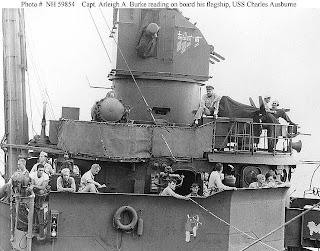
Nearby photo shows Captain Burke in his flag ship - note the "Little Beaver" logo.

But how did Destroyer Squadron 23 get the nickname "Little Beavers?" That's due to Burke, too:
During the Solomons campaign of 1943 all DESRON 23 ships were extraordinarily busy. Their nights were spent on patrol or bombarding Japanese positions; their days consumed with rearming and refueling. The crews were jokingly referring to themselves as "beavers" because they were so busy. During a squadron inspection by Commodore Burke in December 1943 he noticed that one of the sailors had drawn a picture of a little Indian boy on a torpedo mount, shooting an arrow in Prime Minister Tojo's...fanny. He liked it and decided to adopt it as the squadron logo. It was a picture of Little Beaver, the Native-American "sidekick" of Red Ryder, a popular comic strip character of that time. Little Beaver was heralded for his courage, fidelity and zeal. It was to become very famous as the logo of "The Little Beavers" of Destroyer Squadron 23. Official dispatches frequently referred to them by that nickname. Even today it is a widely known name in Naval circles. Each ship of the squadron has a Little Beaver painted on the side of the bridge.

And now, thanks to Tom Clyce (CLAXTON, WWII), webmaster of the CLAXTON website, we have some of the "rest of the story"...

"Some recent research has found out the name of the CLAXTON sailor that was painting the Little Beaver Logo when Commodore Burke was making his inspection aboard the ship. His name was James Bowler. He was not a torpedoman as was originally thought. We believe he was a seaman from another division and had prewar artist experience. It is not known as yet who had the original idea for the logo, its likely someone in the torpedo gang. Have been in touch with some of them, but no one can remember. Too many years have passed. It is also thought that he painted the logo on the other ships of the squadron later.
Bowler is now deceased."
Red Ryder? Information on the comic strip can be found
here. Red Ryder became a successful series of movies after the war as noted here. The actor playing "Little Beaver" acheived fame in other roles. His name - Robert Blake, TV's Baretta and Hollywood murder defendant.


DESRON 23 exists today, with Burke-class destroyers Higgins, John Paul Jones, Pinckney, and FFG-48 Vandegrift.

DESRON 23 even had a poem written about it, which follows:

As always, click on the art and photos to make it bigger.

Saturday, June 16, 2007

Talking 'bout Al Qaeda

Found as Symposium: Al Qaeda: What Next? by Jamie Glazov: Sample from Dr. Rohan Gunaratna:
The globalised world of the West with its material-centric norms has no emotional and dogmatic equivalent to the young host society Islamists who are amidst of an ethnic identity crisis or a racial or religious contention. The cognitive vacuum of the young Islamist is thus vulnerable to the messianic ideas of jihad and the epithets that encourage 'martyrdom' for the false promise of a heavenly inheritance. The promise is lucrative to the alienated young Islamic individual since the material milieu around him is deceptive and he is made to be convinced that the only hope is going to be the cyberspace emotive idea of being a devout Muslim in an irreligious world.
May I also suggest heading over here to the Combating Terrorism Center at West Point and downloading the "Executive Report" of their Militant Ideolgy Atlas which is in pdf format? As noted in the Foreward by General Wayne Downing:
Dr. William McCants and his team of researchers from West Point’s Combating Terrorism Center (CTC) help us understand this opponent with the publication of the Militant Ideology Atlas. This report, and its accompanying compendium, is the first systematic mapping of the ideology driving the actions of the terrorists responsible for the 9/11 attacks and other violent actions around the world. Using a robust research methodology and critical analyses of the Jihadis’ most widely read texts, the Atlas gives us a highly nuanced map of the major thinkers in the Jihadi Movement and their most salient areas of consensus and disagreement. In short, this report identifies who the most influential people are among the Jihadi thinking class, what they are thinking, and where the movement is most vulnerable ideologically.
Significantly, the report uses these empirical findings to identify powerful messages and influential messengers that can turn different constituencies against the Jihadis. These constituencies range from benign mainstream Muslims to the most violent Jihadis. The recommendations of this report establish a baseline against which strategic communications campaigns can be calibrated and adjusted.
An old adage warns, “If you don’t know where you are going, you’ll probably end up somewhere else.” The CTC’s seminal contribution offers a valuable resource that will greatly inform our assessment of where we want to go in this fight and the best routes to get there. It promises to be useful to policy makers and all those involved in charting the way ahead in this difficult struggle.
Some recurring themes noted by the CTC researchers:
1. Jihadis want unity of thought. They reject pluralism—the idea that no one has a monopoly on truth—and the political system that fosters it, democracy.
2. Jihadis will fight until every country in the Middle East is ruled only by Islamic law. Once they are in power, the punishments of the Qur’an (such as cutting off the hand of a thief) will be implemented immediately. Not even Saudi Arabia has it right; the Taliban state was the only state that was closest to their vision.
3. Jihadis contend that the violence they do to their own people, governments, and resources are 1) necessary, 2) religiously sanctioned, and 3) really the fault of the West, Israel, and apostate regimes.
4. The Jihadi cause is best served when the conflict with local and foreign governments is portrayed as a conflict between Islam and the West. Islam is under siege and only the Jihadis can lift it.
5. Countries in the Middle East are weak; they cannot remove tyrants or reform their societies without the help of outsiders. Jihad is the only source of internal empowerment and reform.
And, of course, I still find the thoughts of Eric Hoffer in The True Believer to be relevant:
The True Believer, though, is not solely concerned with the rise of Nazi Germany, but with the origination of all mass movements, destructive or creative. And more importantly, it is concerned with the main ingredient of such movements, the frustrated individual. The book probes into the psychology of the frustrated and dissatisfied, those who would eagerly sacrifice themselves for any cause that might give their meaningless lives some sense of significance. The alienated seek to lose themselves in these movements by adopting those fanatical attitudes that are, according to Hoffer, fundamentally "a flight from the self."
You can tie this mass movement process to the "non-integrating gap" as Thomas P.M. Barnett does in The Pentagon's New Map
Think about it: Bin Laden and Al Qaeda are pure products of the Gap—in effect, its most violent feedback to the Core. They tell us how we are doing in exporting security to these lawless areas (not very well) and which states they would like to take “off line” from globalization and return to some seventh-century definition of the good life (any Gap state with a sizable Muslim population, especially Saudi Arabia).

If you take this message from Osama and combine it with our military-intervention record of the last decade, a simple security rule set emerges: A country’s potential to warrant a U.S. military response is inversely related to its globalization connectivity. There is a good reason why Al Qaeda was based first in Sudan and then later in Afghanistan: These are two of the most disconnected countries in the world. Look at the other places U.S. Special Operations Forces have recently zeroed in on: northwestern Pakistan, Somalia, Yemen. We are talking about the ends of the earth as far as globalization is concerned.
And want do the Jihadis want? To remove the possiblity of shrinking the gap as their path to power.

Just some Saturday morning thinking linking.

Simple ignorance


Speaking of Senator Harry Reid - more on his ignorance here. Which proves that he knows energy facts as well as he "knows" military facts.

Friday, June 15, 2007

Friday Reading


Friday reading includes getting some Fullbore Friday from CDR Salamander with a look at the "tip of the spear" (or maybe the trip wire) in the late 1930's and Flightdeck Friday at Steeljaw Scribe's place wherein he discusses aerial aircraft carriers.

UPDATE: A slightly different Friday read here. Glad I'm not the only one who feels that the inmates have taken over big chunks of the asylum.

UPDATE2: Added the picture from here. Anything that makes me spew coffee like that needs to be shared.

From Chart of the Day- Crude Oil Price pattern


Found here:
Due in large part to ever increasing demand as well as geopolitical tensions, oil has rallied and now trades above $67 per barrel. While the geopolitical risks associated with the oil supply are difficult to predict, today's chart illustrates that the average monthly price of a barrel of West Texas Intermediate Crude has had a tendency to rise from July to October as more cars hit the road for the summer driving season. Increased risks on the supply side (i.e. supply disruptions) occurring in unison with increased demand make for a volatile mix indeed.

Al Jazeera on Fighting Piracy On The High Seas

Found as Fighting Piracy On The High Seas:
Piracy on the Malacca Strait, the waterway between Indonesia, Singapore and Malaysia, has historically threatened the safe transport of manufactured goods and commodities.

The three countries now maintain a strong naval presence in the Strait, one of the busiest shipping lanes in the world. Al Jazeera’s Hamish MacDonald stepped aboard one of the patrol boats.

It is late afternoon on the Malacca Strait, but the day has only just begun for the crew of Malaysia's new maritime enforcement agency.

These men patrol the busiest shipping lane in Asia, trying to provide safe passage for half of the world's oil and a third of the world’s trade.

"We are patrolling day and night, 24 hours patrolling," Siva Kumar Vengadasalam, the patrol's commanding officer, told Al Jazeera.
Technically, the patrols do not take place on the "high seas" but rather in the territorial waters of Malaysia and the other littoral states of the Malacca Strait. Still, it is nice to see the efforts reported.

Memorandum from the President on Maritime Security (Piracy) Policy


President Bush has issued a memorandum on piracy at sea at Memorandum from the President:
SUBJECT: Maritime Security (Piracy) Policy

The attached Policy for the Repression of Piracy and Other Criminal Acts of Violence at Sea (Piracy Policy) is approved for immediate implementation, consistent with applicable law and subject to the availability of appropriations. The policy shall be appended to the National Strategy for Maritime Security as Annex B.

This policy responds to the emergence of high-risk maritime areas that threaten U.S. interests. Recent instances of piracy have highlighted the need for this policy in order to coordinate U.S. Government response and to promote international solutions. This policy advances our commitment to cooperate with other states, regional and international organizations, and the maritime industry in order to counter this threat. The United States has long been a leader in the protection of navigational rights and freedoms. Our objectives consistently have been to promote and facilitate peaceful international uses of the oceans. We recognize that all nations have an interest and responsibility in protecting those rights and freedoms.

GEORGE W. BUSH

# # #

Attachment Tab 1 Policy for the Repression of Piracy and Other Criminal Acts of Violence at Sea

Annex B
Policy for the Repression of Piracy and other Criminal Acts of Violence at Sea

I. PURPOSE

This document establishes United States Government policy and implementation actions to cooperate with other states and international and regional organizations in the repression of piracy and other criminal acts of violence against maritime navigation.[1]

II. BACKGROUND

Piracy is any illegal act of violence, detention, or depredation committed for private ends by the crew, or the passengers, of a private ship and directed against a ship, aircraft, persons, or property on the high seas or in any other place outside the jurisdiction of any state. Piracy also includes inciting or facilitating an act of piracy, and any act of voluntary participation in the operation of a ship with knowledge of facts making it a pirate ship. Piracy is a universal crime, and all states are obligated to cooperate to the fullest possible extent in the repression of piracy.[2]

Piracy threatens U.S. national security interests and the freedom and safety of maritime navigation throughout the world, undermines economic security, and contributes to the destabilization of weak or failed state governance. The combination of illicit activity and violence at sea might also be associated with other maritime challenges, including illegal, unlawful, and unregulated fishing, international smuggling, and terrorism.

Criminal and terrorist activities not defined as piracy also occur at sea and similarly threaten U.S. economic and national security interests. These acts of violence endanger the safety of maritime navigation and may involve weapons of mass destruction. The prevention, interdiction, and punishment of those acts occurring in territorial seas are generally the responsibility of the coastal state. Prevention and punishment of acts occurring in international waters likely will require international cooperation and adequate domestic legal systems, most recently reflected in the 2005 Protocols to the 1988 Convention for the Suppression of Unlawful Acts against the Safety of Maritime Navigation and the Protocol for the Suppression of Unlawful Acts against the Safety of Fixed Platforms located on the Continental Shelf.

The policy set forth in this annex fosters both increased interagency coordination and international cooperation and is consistent with, supports, and builds upon existing maritime security efforts for piracy repression.

III. POLICY

The United States strongly supports efforts to repress piracy and other criminal acts of violence against maritime navigation. The physical and economic security of the United States -- a major global trading nation with interests across the maritime spectrum -- relies heavily on the secure navigation of the world’s oceans for unhindered legitimate commerce by its citizens and its partners. Piracy and other acts of violence against maritime navigation endanger sea lines of communication, interfere with freedom of navigation and the free flow of commerce, and undermine regional stability.

Piracy endangers maritime interests on a global scale, and the responsibility for countering this threat does not belong exclusively to the United States. Consequently, the United States will engage states and international and regional organizations to develop greater resources, capacity, and authorities to repress piracy and maximize inclusion of coalition assets in piracy repression operations.

Piracy repression should include diplomatic, military, intelligence, economic, law enforcement, and judicial actions. Effectively responding to piracy and criminal activity sends an important deterrent message and requires coordination by all departments and agencies of the U.S. Government in order to ensure that those responsible are brought to justice in a timely manner.

It is the policy of the United States to repress piracy, consistent with U.S. law and international obligations, and to cooperate with other nations in repressing piracy through the following actions:

* Prevent pirate attacks and other criminal acts of violence against U.S. vessels, persons, and interests;

* Interrupt and terminate acts of piracy consistent with international law and the rights and responsibilities of coastal and flag states;

* Reduce the vulnerability of the maritime domain to such acts and exploitation when U.S. interests are directly affected;

* Ensure that those who commit acts of piracy are held accountable for their actions by facilitating the prosecution of suspected pirates and ensure that persons suspected of committing acts of violence against maritime navigation are similarly held accountable by flag and littoral states and, in appropriate cases, the United States;

* Preserve the freedom of the seas, including high seas freedoms;

* Protect sea lines of communication; and

* Continue to lead and support international efforts to repress piracy and other acts of violence against maritime navigation and urge other states to take decisive action both individually and through international efforts.

Responses to these threats will vary according to geographic, political, and legal environments. The scope of the mission and the defined nature of the threat also will affect the choice of response.

IV. IMPLEMENTATION

The Assistant to the President for National Security Affairs and the Assistant to the President for Homeland Security and Counterterrorism shall lead an interagency process to accomplish the following tasks:

* Incorporate this policy into the Maritime Operational Threat Response Plan (Protocols), as appropriate;

* Oversee the development of specific guidance and protocols for the prevention of and response by the United States Government to piracy and other acts of violence against the safety of maritime navigation;

* Review existing U.S. laws against or relating to piracy and prepare for consideration such amendments as may be necessary to enhance our ability to prosecute pirates in U.S. courts;[3] and

* Seek international cooperation, consistent with the International Outreach and Coordination Strategy of the National Strategy for Maritime Security, to enhance the ability of other states to repress piracy and other criminal acts of violence against maritime navigation and to support U.S. anti-piracy actions.

[1] The National Security Strategy (2006) and the National Strategy for Maritime Security identify these maritime threats.

[2] Articles 14-15, Convention on the High Seas (1958), and Articles 100-101, Law of the Sea Convention (1982).

[3] U.S. Constitution, Article I, Section 8; 18 USC 7(1) (Special Maritime and Territorial Jurisdiction of the United States); 18 USC 111 (Assault on Federal Officials); 18 USC 113 (Assault on the high seas); 18 USC 371 (Conspiracy); 18 USC 844(i) (Use of explosive against property used in foreign commerce of the United States or against any property used in an activity affecting foreign commerce of the United States); 18 USC 1651 (Piracy on the high seas); 18 USC 1659 (plundering a ship); 18 USC 2111 (Robbery on high seas); 18 USC 2280(a)(1)(A),(B), and/or (H) (Maritime violence/hijacking of a ship); 18 USC 2232 (Assaults on U.S. nationals overseas); 18 USC 2232a (Use of WMD against U.S. nationals outside of the U.S.)
White House photo by Chris Greenberg.

Somali pirates beware.

Thursday, June 14, 2007

Happy 232nd!


232nd United States Army Birthday

My dad started out in the Army. On horses. My father-in-law was a tanker. So to all of you who served or who have served in the U.S. Army - Happy Birthday!

Official Army song:
Official Song of the U.S. Army

written and adapted by H. W. Arberg


March along, sing our song,
With the Army of the free
Count the brave, count the true,
Who have fought to victory
We're the Army and proud of our name
We're the Army and proudly proclaim

First to fight for the right,
And to build the Nation's might,
And The Army Goes Rolling Along
Proud of all we have done,
Fighting till the battle's done,
And the Army Goes Rolling Along.

Refrain:
Then it's Hi! Hi! Hey!
The Army's on its way.
Count off the cadence loud and strong,
For where e'er we go,
You will always know
That The Army Goes Rolling Along.

Valley Forge, Custer's ranks,
San Juan Hill and Patton's tanks,
And the Army went rolling along
Minute men, from the start,
Always fighting from the heart,
And the Army keeps rolling along.
Refrain:

Men in rags, men who froze,
Still that Army met its foes,
And the Army went rolling along.
Faith in God, then we're right,
And we'll fight with all our might,
As the Army keeps rolling along.
Refrain:
Although maybe I'm old enough that we always sang it with caissons...

Hugo Chavez and the World of Tomorrow: Venezuela sub force


Venezuela needs submarines because?

The Russians don't care why- they need a contract see Venezuela mulls purchase of Russian submarines for a Hugo Chavez Crazed Dictator World of Tomorrow saga:
Venezuela is close to striking a deal with Russia on the procurement of several diesel submarines for its Navy, a source in the Russian shipbuilding industry said Thursday.

The South American country has been vigorously pursuing modernization of its naval fleet to counter a possible U.S. blockade of its oil fields and prepare for direct military confrontation with Washington.

"At present, military experts from Venezuela are conducting active consultations with Russian colleagues on the purchase of a large number of submarines," the source said, adding that the number and type of submarines and their delivery schedule had not yet been determined.

He said the negotiations were focused on the procurement of the new Amur-class diesel submarines and Project 636 low-noise submarines with Club-S integrated missile systems.

Meanwhile, Russia's popular Kommersant daily reported Thursday that Venezuela had approached Russia with a request to build nine diesel submarines, five of the Project 636 and four of the project 677 Amur.

The value of the contracts, depending on the final size of the order, is estimated at $1-2 billion, the paper cited its own sources in the defense industry.
***
2005-2006, Venezuela ordered weaponry from Russia worth $3.4 billion, including 24 Su-30MK2V Flanker fighters, Tor-M1 air defense missile systems, Mi-17B multi-role helicopters, Mi-35 Hind E attack helicopters and Mi-26 Halo heavy transport helicopters.

The country also purchased 100,000 AK-103 Kalashnikov assault rifles from Russia in 2005.

With the addition of arms contracts signed in 2006-beginning 2007, Venezuela has become the world's second largest importer of Russian weaponry after Algeria, which signed arms deals with Russia worth $7.5 billion.

Kommersant said that the submarine deal could be finalized during the visit by Venezuelan President Hugo Chavez to Russia on June 29, prior to President Vladimir Putin's visit to the United States.

The submarine contract, if concluded, could become an additional irritant in the already testy relations between Moscow and Washington, the paper said.
Yeah, maybe.