VertRep

VertRep
Showing posts with label Dutch Navy. Show all posts

Friday, October 12, 2012

Somali Pirates; Dutch Navy, doing NATO work, nabs some suspected pirates

HMS Rotterdam
Reported as "Dutch navy detains Somali pirates":
Dutch sailors taking part in NATO's piracy-busting operation Ocean Shield on Thursday detained seven suspected pirates off the coast of Somalia after an attack on a Spanish vessel.

The alleged pirates were intercepted by Dutch amphibian transport HMS Rotterdam after the Izurdia was ambushed by a skiff off the Horn of Africa, the Dutch defence ministry said in a statement.
Here's the Netherlands Defence Ministry statement, as translated, more or less, by Google:
Netherlands MOD photo
Hr. Ms. Rotterdam has this morning put an end to the activities of a group of suspected pirates from Somalia. The suspected pirates men and their boat on board the Rotterdam taken pending further besluitvorming.De quest for the pirate group began yesterday afternoon when the Spanish fishing vessel Izurdia reporting an attack by a skiff called. "The timely and complete reporting of the Izurdia enabled us focused action. Following coordination between the staffs of NATO and EU task forces was eventually Rotterdam who suspected pirates managed to intercept," said Commander Bekkering, commander of NATO Task Force 508.

Schoten
"During our search is suspicious skiff by the crew on the bridge seen after the Cougar helicopter and boarding team are deployed," says the commander of Rotterdam, captain, sea Huub Hulsker know. "From the helicopter, the suspect skiff with warning shots to stop forced. The boarding team has seven suspects taken to Hr. Ms.. Rotterdam where they are retained."

508
Hr. Ms. Rotterdam has its patrol for Operation Ocean Shield, NATO's contribution to the international anti-piracy mission in the waters around the Horn of Africa, meanwhile prosecuted. Aboard the flagship of NATO Task Force 508 are located about 350 soldiers from all armed forces and from 8 different NATO countries.

Monday, April 04, 2011

Somali Pirates: Dutch Marines and Navy Take Out Two Pirates, Capture 16

In a rescue effort involving an Iranian fishing boat, Dutch marines kill 2 pirates off Somali coast, capture 16 more:
Dutch Marines
Dutch marines killed two pirates and captured 16 others during an operation to free a hijacked Iranian fishing boat off the coast of Somalia, the Defense Ministry said Monday.

The deadly firefight marked the first time Dutch forces have killed suspected pirates while patrolling the Gulf of Aden as part of an international anti-piracy flotilla.

HNLMS Tromp (F803)
Marines from the frigate HMS Tromp opened fire on the pirates on the hijacked Iranian boat Sunday after they shot at two Dutch inflatable speedboats sent to investigate the fishing vessel, the ministry said.

Ten suspected pirates were captured as they tried to flee in a high-speed skiff and six more were detained on the fishing boat. The bodies of two suspected pirates killed in the firefight also were recovered on the vessel.
Press release (and photos) from Netherlands Ministry of Defense, here (Google translation with my corrections):
Dutch Marines approach dhow (NL MOD Photo)

Surrender of pirates  (in bow of dhow with hands on heads) (NL MOD Photo)

Dutch Marines overpower attempted escape effort by pirates (NL MOD photo)
Yesterday morning while approaching a suspect fishing boat two RHIB from HMS Tromp were fired upon. Marines on the RHIB's (Rigid-hulled inflatable boat) and others in the Tromp answered the fire. In a second approach 10 Somalis left the fishing boat with a fast skiff with the purpose of avoiding capture. After the Marines fired warning shots, the escape attempt stopped and the Somalis were captured. Some among them had injuries.
Cleaning the sea of pirates
After it appeared that the remaining Somalis on board the hijacked fishing boat (called a dhow) wanted to surrender, a boarding team from the Tromp boarded the suspect vessel.

In addition to the 16-member crew, there were two dead Somalis and 6 living Somalis. The two dead were likely killed by the gunfire. These six suspects, together with the other 10 are now being held. Evidence of piracy was found on board the hijacked dhow.

While searching the liberated dhow, Hr. Ms. Tromp was approached by a previously pirated merchant ship apparently seeking to free the dhow. With a number of shots from the Tromp across the bow of the merchant this effort by the pirates failed. The hijacked merchant vessel turned back toward the berth where she came from.
Well done.

UPDATE: Judging by the firepower evident on the Dutch side, the pirates who fired the shots at the RHIBS might have been a trifle over confident.

Revised title of post to reflect reality.

UPDATE2: Dead Pirates Buried at Sea:
The bodies of the two Somali pirates who were probably killed in a firefight with marines from the HNLMS Tromp have been buried at sea. The frigate’s captain took the decision after in consultation with the defence ministry in The Hague.

A spokesperson for the defence ministry said that the decision was motivated by a number of factors, including the high temperatures in the region and the possibility to return the bodies to next of kin. The bodies of the two Somalis were examined before being buried at sea.
Perfect.

Saturday, January 22, 2011

Taking it to the Somali Pirates: Dutch frigate opens fire on pirate ship

Radio Netherlands reports "Dutch frigate opens fire on pirate ship":
The Dutch frigate HNLMS De Ruyter has opened fire on a ship carrying pirates in the Arabian Sea, according to the Dutch Ministry of Defence.

At the end of the afternoon, a helicopter discovered a suspected pirate mother ship 40 kilometres away from the frigate. The ship did not respond to radio signals to identify itself and failed to stop when warning shots were given.

As the Dutch frigate could not be certain there were no hostages on board the pirate ship, marksmen destroyed a skiff on the deck of the mother ship rendering it impossible for the pirates to carry out attacks on other vessels. Pirates off the east coast of Africa often use smaller boats to attack merchant ships in the vicinity of mother ships.

The Dutch, once again, show some creativity (and some common sense) in fighting the Somali pirates.

UPDATE: Photos and a (Babelfish translation) from the Netherlands Defense site on the event:
Pirate Mother Ship: Name on Stern and Bow is Japan 555


Circle on Photo Indicates Location of Pirate Skiff

Warning Shot
Hr. M. The Ruyter acted yesterday in the Arab sea against a mother ship that it is used at piracy action for attacks on passing by sailing through ship.

Skiffs on board of mother ship, were made harmless with precision fire. Hr.Ms. The Ruyter warned mother ship with a shot for the stem.
At the end of the afternoon the Ruyter's helicopter discovered the suspected mother ship about 40 kilometres distance from Hr. M. The Ruyter. The ship suspected of piracy did not respond to radio calls and did not stop after giving warning shots with the ship's gun.

Because of the possible presence of hostages it was not possible overpower the mother ship. Instead, tt was decided to destroy the engine block-system of the skiffs by a sharpshooter of the special forces of the Marines.

By rendering these skiffs harmless, it is impossible for the pirates on board the mother ship to carry out other attacks. At present pirates in the whole Indian ocean use more and more mother ships as from they carry out attacks with skiffs on passing merchantmen.

The presence of hostages on board of the mother ships, makes fighting of this a complicated matter. Eliminating the skiffs is a way pirate activities are disturbed and eliminates the possible harm to hostages. ****

Friday, April 30, 2010

Somali Pirates: Dutch Navy in Action

With a hat tip to GvG (who posts over at Information Dissemination).

You might note the Obama flashlight found among the pirates' stuff in the first video which cover activity posted about here:


The second video has to do with forces from theDutch ship Tromp retaking the vessel Taipan as set out here:

Monday, April 26, 2010

Somali Pirates: The Netherlands Trying New Tactic Against Pirates

GvG has the post: Information Dissemination: The Netherlands Trying New Tactic Against Pirates describing the use of numerous, albeit slow landing craft to patrol waters close inshore with some success. And in there is a revealing lesson:
By using their landing crafts to patrol the pirate infested waters, the Dutch are showing that quantity has quality of its own.
And I would think that it should be easier to catch the pirates closer to were they left, because the area to look for pirates is smaller (although still quite large) compared to trying to find them when they are 700NM away from the Somali coast.
Well, some of us have been arguing for just this sort of thing for some time - see, for example, Department of Crazy Ideas: How about a cheap inshore fleet?, How to Make the Navy Bigger, Sooner, Cheaper, If the "'Sea [is] too large to prevent all piracy,' admiral says"--then you have to make the sea smaller....

So, good for the Dutch! Now, if everyone else would just join in and blockade the pirate havens...

UPDATE: Dutch Navy site report here: (Google translation)
Gade Beaten from the Johan de Witt bring two landing craft seized a pirate ship amphibious transport op.Het Hr. Ms. Johan de Witt is by applying a new tactic, possibly due to its landing craft, all 2 times pirate activities successfully disrupted. Johan de Witt patrol for only a few days off the Somali coast.
The successful patrols done differently than hitherto. The amphibious transport ship of the Navy may, in its landing craft operate closer to shore. Instead of waiting to detect pirates on the open ocean, patrolling the Johan de Witt famous pirates near cities and prevented the pirates since the departure.
 

"That's exactly what happened," said Major of Marines Theo Manure Rini, who leads a group of landing craft. He has his cabin on board temporarily exchanged for a cot on the deck of a landing craft. "Early in the morning we suddenly noticed a large fishing boat. It was close to a pirate village, where we last nights activities had seen everything." After approval of the commander of the Johan de Witt was called the Whaler approached. "It soon turned out here to go to a Whaler as mother ship for pirates is used. They were about to leave the ocean. We have thus nipped in the bud".
It was the second successful campaign in just 4 days. Now are two former pirate boats on the deck of the Johan de Witt. The crew returned to shore. "The Johan de Witt has six landing craft with him, put the commander Ben Bekkering. "We can always a large part of the coast coverage. This kind of commitment is entirely new. It's a different part than we're used to, but it shows the flexibility of the ship and its vessels to."
Somali pirates make it difficult actions taken hostage by the shipping in the Gulf of Aden and off Somalia. Therefore, the navies of many countries for some time active in the area to combat piracy. Johan de Witt participates in the anti-piracy mission Atalanta of the European Union. The success of the approach demonstrated by the fact that the pirates operate further from home and the number of successful attacks decreases.
UPDATE: From November 2008:
In the September 2008 issue of the United States Naval Institute's magazine Proceedings, the Secretary of the Navy looked at the issue of "An Affordable Naval Presence." It has a sub-head of "We need a more cost-effective Fleet."

The piece lays out the requirements imposed by our maritime nature:
Our nation's maritime strategy reaffirms the use of sea power to influence actions and activities at sea and ashore, including the need for our naval forces to support humanitarian operations, counter piracy, and assist in capacity building and training of partner nations. The requirement to support these missions moves us to adopt persistent global presence as a key tenet of our strategy. The increasing desire for U.S. Navy presence is one of the driving factors behind our decisions on Fleet size and composition.
 The value of presence is under-appreciated by many, for they fail to recognize the role of maritime security in support of the world economy to protect it against the vulnerabilities that terrorism and rogue nations pose. Clearly, most would agree that the world is far more connected and interdependent than in years past. Nations have moved away from the idea that they must possess economic self-sufficiency and have largely recognized the value of trade and specialization.
***
The more dispersed nature of today's world trade patterns has major implications for our view of maritime security . . .
Ah, there's the rub. Too much ocean, too many shorelines, too many needs, too few ships. What's a navy to do?

Secretary Winter wants analysis of the right ships to build and a more efficient process to build them. All of which is fine, but - there is a faster, cheaper path to get bigger, sooner at lower cost - putting hulls in the water while awaiting that analysis.

Here's my modest proposal:
  1. Take $250 million dollars and put it aside;
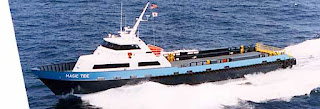
  2. Of that $250 million, use $100 million to buy or lease 50 to 100 offshore crew boats as currently used in the offshore oil industry (many of them are reaching the end of their expected useful life in the industry - you might be able to pick up some bargains).
  3. Invest $50 million in refurbishing the boats and in getting weapons for their decks. Turn them into "navalized" vessels. Make 22 knots the minimum acceptable speed. (UPDATE: Or 15 kts - just bring some "go fasts")
  4. Do not try to make these low cost littoral combat ships into battleships for all conditions. Talk to the LCDRs who will be squadron commanders and the LTs who will be the commanding officers about what they would need to provide a presence, fight in a low threat environment against modestly armed pirates and the like, support occasional missions ashore and interdict drug smuggler semi-submersibles. Give them what they need in terms of state of the art comms using COTS (heck, load put a communication van on board if so that no time is wasted trying to rewire the little ships more than needed). Put in some comfortable berthing suited for the sea states in which these things (I call them Special Purpose Vessels or SPVs) will operate.
  5. Under no cirmcumstance should the total U.S. Navy investment in any single SPV exceed $2 million, excluding the cost of adding weapons systems (adding a M-1 Abrams, for example) and the personnel costs.
  6. Make the project a 12 month "emergency" - and kill the bureacracy that would ordinarily take on this job - find a hard charging Captain, make him or her report directly to SecNav and tell them what the mission and the budget will be. Then get out of the way except for monthly status reports.
  7. Find a group of O-3s who are ready for command and who can think for themselves and train the heck out of them by letting them go to sea in the type of ships that you are acquiring, let them learn from the masters of current offshore supply and crew vessels. Find some O-4s who can take hold of the idea of being a squadron commander of a 5 ship squardron and train them in mission like that being conducted by the Africa station.
  8. Borrow some Army Rangers or fleet Marines and train them in the ship boardings, small boat ops, shipboard firefighting and ship defense. Treat them like the Marines of old. Stress people skills appropriate for counterterrorism work.
  9. Lease some ships to be used as "tenders" for the SPVs - small container ships on which the containers can be shops, supply warehouses, refrigerator units, etc. Bladders for fuel. Use the Arapaho concept to set up a flight deck for helo ops.
  10. Be generous with UAV assets - use the small "net recoverable" types.
  11. Don't limit the small boat assets to RHIBs. Experiement with M-ships, small go-fasts captured from drug dealers, whatever. The idea is to have boats that can operate in one sea state worse than the pirates, drug smugglers, etc.
  12. Use the old MIUW (Mobile Inshore Undersea Warfare) van concept for adding some sonar capability. TIS/VIS is a necessity.
Start with a couple of squadrons, tell your O-6 that you want them ready in 6 months for operational testing. Unleash the budget dollars. For op testing, send one squadron off to the coast of Somalia for anti-pirate work. Send the other off Iraq. Put those expensive great big cruisers and destroyers currently in the area to work doing blue water stuff.

Paint Coast Guard like stripe on the hull of the SPVs - but make it Navy blue. If the Coasties want to join in, give them a boat and paint the stripe orange. Make the SPVs highly visible. Nothing deters crime like a visible cop on the beat.

Show the flag.

Please let your thoughts be known.
Good advice then, good advice now. And the Dutch are proving it.

Tuesday, April 06, 2010

Somali Pirates: Dutch Warship Captain Avoids EU "Red Tape" Saves Merchant Ship


As reported yesterday, the Dutch warship HNLMS Tromp managed to effect a rescue of a ship and crew after a boarding by pirates. Now, we get more details, including a look at how a warship captain should act when faced with a bureaucracy that might slow his rescue to a stop. As reported in The Associated Press: Dutch sidestep EU red tape to rescue German ship:
Gaining fast on the pirates who had seized a German freighter, Dutch naval captain Col. Hans Lodder had no time to waste on bureaucracy.

Sidestepping the command of the European Union's anti-piracy task force, he went instead to his own government for authorization to recapture the ship by force.

Lodder first ascertained that the Taipan's crew had locked itself in a bulletproof room. Then he launched his ship's Lynx helicopter with a team of six special forces marines.

With troops providing cover fire from the helicopter, the marines rappelled onto the ship's deck of the MV Taipan to shoot it out, if need be, with the pirates. But they met no resistance. The 15-man crew was rescued, and 10 Somali pirates were captured.

"The pirates surrendered the moment they saw the marines," Lodder said in a telephone interview Tuesday from the Dutch frigate Tromp. No one was injured.

Monday's successful rescue showed that, when swift decisions are needed, it can be quicker to work around the European Union's command.

It was the first time a Dutch ship involved in the EU mission had used force to recapture a hijacked ship. An EU spokesman could not immediately recall any incident when troops under EU command had boarded a seized ship under the threat of fire.

Lodder said he decided to seek permission from his own command for an "opposed boarding" — one where pirates may resist — rather than act under procedures laid down by Brussels.
Well done, Captain Lodder! Your bold, decisive actions are in the best traditions of the Royal Netherlands Navy.

Photo of Captain Lodder and an explanation of the broom from here.
UPDATE: Photo of Dutch Marines fast roping onto merchant from Dutch Defense/Navy site.

Monday, April 05, 2010

Somali Pirates: Dutch Navy Ship Tromp and Crew Free German Cargo Ship, Arrest 10 pirates

Reported as Pirated German ship rescued – EU NAVFOR HNMLS Tromp retakes pirated MV Taipan :
MV Taipan, a German flagged and owned container ship of deadweight of 12612 tonnes, was on route to Mombasa from Djibouti when pirates attacked and took control of the ship.

On the morning of the 5 April, 500 nautical miles east off the Somali coast, a Pirate Attack Group (PAG) attacked and got onboard the MV Taipan. As the pirates boarded the ship the MV Taipan crew followed EU NAVFOR Best Management Practice, retreated to a secure strong room and locked themselves in; they were able to stop all engines and thereby disable the ship, before alerting EU NAVFOR that the ship had been taken. HNLMS Tromp was sent immediately to the scene and located the pirated ship.

Initially HNMLS Tromp attempted to negotiate with the pirates to avoid casualties but when it became clear that the pirates intended resistng, HNMLS Tromp launched a highly professional operation to recapture the ship. Marines from the TROMP have now boarded and retaken control of the ship from the pirates. The crew of 13 (2 German, 3 Russian and 8 Sri Lankan nationals) have been released unharmed. 10 pirates have been taken into custody.
Tromp continues its "pirate sweep!"

Well done!