VertRep

VertRep
Showing posts with label Hurricanes. Show all posts

Tuesday, October 11, 2016

Reducing U.S. Hurricane Deaths: Evacuate Early and Don't Drive into Water on the Road

People die in hurricanes, see here, which lists 21 deaths from hurricane Matthew. In North Carolina, we've had 14 of those deaths. The large majority of which involved people dying because they drove their cars into high water and got
trapped or swept away or otherwise put themselves in a position to drown.

Back when the death toll was slightly lower, there was this:
The 11 deaths in North Carolina included some victims who drowned after driving onto flooded roads.

"I cannot stress more: If you see a road that's flooded, do not take your car through that road," McCrory said. "If you see a barrier, do not go around that barrier."
More here:
Fourteen people have been killed in the state, most of them occurring when motorists were swept away on flooded roads, McCrory said during a Tuesday morning press conference.

One person was killed in Johnson County when their car was washed away, McCrory said Monday.

McCrory said during a press conference Saturday that one person died in Sampson County after their vehicle hydroplaned in heavy rain. Two others were killed in Bladen County when their vehicle became submerged.

A fourth victim drowned in Harnett County after the victim drove past a barricade and was swept away into a creek, the county sheriff told FOX8.
***
During a Sunday morning press conference, the governor said two deaths were also reported in Johnston County and one in Pittman County.

The News & Observer reported that one of the deaths was 19-year-old Diamond Shuntelle Bennett, whose car was swept away in flood waters on Interstate 95 near Four Oaks on Saturday night, according to Capt. Jeremy Johnson of the Four Oaks Fire Department.

One person died after five people were trapped inside a submerged Nissan Versa in Cleveland.

“Four escaped and were able to cling to trees until rescue arrived,” State Highway Patrol spokesman Lt. Jeff Gordon told The News & Observer. “The other they’re still looking for and is presumed deceased.”
In addition to the deaths, people driving into flood waters who do not get killed need to be rescued, which places their rescuers in dangerous situations.
A 63-year-old woman, who was on her way home from her nursing job at a long-term care facility, clung to a tree for three hours after floodwaters from Hurricane Matthew swept her car into a canal in Wilson, AP reports.
***
North Carolina Highway Patrol troopers helped 25 vehicles after they became stranded on Interstate 95 Saturday. The cars got caught on a stretch of road between two parts of the flooded highway.

State officials say emergency responders have conducted at least 77 water rescues from cars and homes in Fayetteville alone, according to The News & Observer, including the dramatic rescue of a woman and her child from a car that got caught up in the floodwaters.

If it's true for hurricanes, it's also true for thunderstorms, as set out here:
Each year, more deaths occur due to flooding than from any other thunderstorm related hazard. The Centers for Disease Control and Prevention report that over half of all flood-related drownings occur when a vehicle is driven into hazardous flood water. The next highest percentage of flood-related deaths is due to walking into or near flood waters. People underestimate the force and power of water. Many of the deaths occur in automobiles as they are swept downstream. Of these drownings, many are preventable, but too many people continue to drive around the barriers that warn you the road is flooded. A mere 6 inches of fast-moving flood water can knock over an adult. It takes just 12 inches of rushing water to carry away a small car, while 2 feet of rushing water can carry away most vehicles. It is NEVER safe to drive or walk into flood waters.
Want to reduce hurricane tragedies? Turn around, don't drown.

Oh, and when given the warning to evacuate before a storm, evacuate. When the water begins to rise around you, an attempt to drive out then may just kill you. So pack up all your valuables and get out early. There's always higher ground to be found before the storm.


Wednesday, August 19, 2009

Hurricane BILL

Now a Category 4 Hurricane and headed for some major shipping lanes - and Bermuda, see
Hurricane BILL

Friday, September 19, 2008

After Hurricane Ike


I keep waiting for major news about a hurricane striking the nation's fourth largest city. You know if it were LA or NY or Philly...

But it's not. It's the city that major media loves to forget, and there's no bowl or dome full of the "left behind" poor...

So, if you want coverage, go to local Houston media outlets:

KHOU TV

KTRK TV

KPRC TV

KRIV TV

Houston Chronicle

KTRH Radio

Navy and Galveston here

Photo captions:Upper:
080918-N-8132M-284 GALVESTON, Texas (Sept. 18, 2008) Boatswain's Mate Seaman Gregory Newland directs a utility landing craft from the amphibious assault ship USS Nassau (LHA 4) onto the beach near the port of Galveston, Texas to begin disaster relief efforts. Nassau is anchored off Galveston to render disaster response and aid to civil authorities as directed in the wake of Hurricane Ike. U.S. Navy photo by Mass Communication Specialist 3rd Class Kiona M. Mckissack (Released)


Lower:
080918-N-8132M-266 GALVESTON, Texas (Sept. 18, 2008) A light amphibious resupply cargo vehicle (LARC-V) drives onto the beach in Galveston, Texas to begin disaster relief response. Nassau is anchored off the coast of Galveston to render disaster response and aid to civil authorities as directed in the wake of Hurricane Ike. (U.S. Navy photo by Mass Communication Specialist 3rd Class Kiona M. Mckissack/Released)

Sunday, September 14, 2008

Hurricane Recovery: Getting the word out


An earlier idea still needed here.

Information is almost always the key to organizing messes like this. Broadcast relevant news on a specified channel every 20 minutes...

Why give them out? If people are unable to leave when a storm is coming, then they probably aren't able to provide for their own radios...

After the Hurricane

There are all sorts of post hurricane survival tips. Like this one on Living without power.

As I watch the news about Ike, I am plunged back into some post hurricane experiences. In the South, especially along the Gulf Coast, what is hard for television news to convey is the how hot and humid the areas are - after weathering Alicia in Houston, but going without power for a couple of weeks in 90+ degree weather- I can tell you that it just wears you out. Some of the people in the Houston area are looking at 4 weeks without power.

We were lucky enough to have a gas water heater and water for bathing - but modern houses are not built to let air flow through and the thin insulated walls are no match for the old style houses with big porches, shade and windows that opened off the porches to allow cooler air to flow.

Think about going two weeks without clean clothes because your washer and dryer don't work. No refrigerator, no TV, no lights except for oil or gas lamps (which, by the way generate a lot of heat - which is exactly what you don't need). Mosquitoes by the tens of thousands, fire ants, snakes. Roads blocked by downed limbs. And it's hot. Damn hot. Like that line from Good Morning Vietnam:

"It's hot. Damn hot! Real hot! Hottest things is my shorts. I could cook things in it. A little crotch pot cooking."
Let me hasten to add that those of you who have not experienced Houston's humidity will have not a clue about what is like. When my South Texas reserve unit deployed to coastal Saudi Arabia for Desert Storm, much of what we heard from our predecessors (Californians) was how hot and humid it was. My guys didn't see much of a difference between the Arabian Gulf and the Gulf of Mexico. Since we moved to North Carolina, we former Houstonians just laugh at people here who complain about the humidity here. There simply is no comparison. Well, perhaps a sauna.

Another thing about Houston that you can't see on TV is how big the place is - think about drawing a 100-mile radius circle around your town center and then you have an idea of how large the area is. Except it's bigger. Add in islands, swamps, bays, rivers. None of the TV coverage I've seen even comes close to capturing the sheer size of the region or geographic variation in what sometimes appears to be a flat landscape, but one in which a 50 foot elevation means the difference between flooding and not.

Did I mention the heat and humidity?

And travel issues - when visiting the Biloxi area after Katrina - bridges down, roads closed, and - after all- not many places to go...

You want to send something? Send money to the Salvation Army and send air conditioned tents or inflatable buildings so that one can be placed on each block to allow the elderly and the young to get some respite from that heat and humidity...


Examples of air conditioned tents. KoolerAire system, which needs ice. The AC Boot seems to allow a regular air conditioning unit (generator run?) to be used with regular tents...about $400 for a nine person tent...A small a/c unit runs about $300, and a decent generator around $400-700. So, for under $1500, some small degree of comfort could be brought to afflicted areas. Toss in a couple of portable shower units, and some buckets and plungers and Woolite for washing clothes (perhaps even one of these)and it would help a large number of folks.

Saturday, September 13, 2008

Houston Refiners Appear Spared


Reported here:
Hurricane Ike appears to have spared refineries from major wind and water damage, though the federal government is preparing for an extended period of tight fuel supplies as widespread power outages prevent any quick restart.

Refineries and chemical plants located along the Houston Ship Channel are reporting only minimum damage following Hurricane Ike, according to a Harris County official. The status of refineries in other areas is unclear as the last of the storm leaves the region.

Early Saturday morning, the eye of the Category Two storm passed directly over the ship channel, giving assessments crews about 30 minutes of calm to survey the damage, said David Wade, industrial liaison for Harris County. The crews reported only small signs of damage including down power lines, Wade said. He received the last report about 4 a.m. CDT.

Less is known about the status of refineries in the Beaumont-Port Arthur area, near the Louisiana border. Local media have reported extensive flooding in Port Arthur, and refiners have yet to conduct full assessments as the last of the storm passes over the region.

Refiners are expected to see the worst impact from the hurricane, which largely bypassed the major offshore production area in the Gulf of Mexico. Refiners responsible for 19.5% of U.S. capacity shut down ahead of Ike, reducing gasoline supplies across the southeast. Average gasoline prices spiked 23.5 cents in South Carolina between Friday and Saturday, with most other southern states seeing increases of 18 cents or more.

Friday, September 12, 2008

What if the Houston Ship Channel suffers damage?


The Houston Ship Channel is 50 mile long snake that is 45 feet deep and 530 feet wide (see here) and leads to the busiest petrochemical areas in the world. Suppose Hurricane Ike fills in portions of the channel?

It may take weeks for the refineries and other facilities to get back on line but it won't do much good if ships can't get crude to the refineries...

An earlier post on the Ship Channel here.

A look at Ike from NASA, "Image of Hurricane Ike from the International Space Station. Image credit: NASA."

Count on gasoline prices going way up...

Thursday, September 01, 2005

Katrina: Logistics

Everyone in the MSM is pounding on the idea that too little is happening quickly enough to clear New Orleans and help the trapped people. The problem is that the damaged logistics system is complicating matters. An example, as is shown here at NY Times map is that the normal routes to New Orleans are all broken.

How many roads available to bring supplies in and take people out?

Looks like one. On the satellite photo below, I have put symbols on the roads and bridges we know are closed. We also know that Slidell Louisiana at the top of the I-10 bridge is in ruins, the railroads are in ruins, the Intercoastal waterway is closed, the Mississippi River is closed. All water for the helpers has to be flown or trucked in, all food has to be flown or trucked in. Bring in more troops and you add to the logistics problems. Add more helicopters and you add more flight crews and support crews and fuel issues.

The right solution (maybe the only solution) is to clear the city as fast as possible. However, there is a limit on the number of buses available and buses in transit to Houston or San Antonio take at least 12 hours to transit back and forth (and need drivers who need water, food and rest. Because of the distances involved you may need 4 times the buses you would need to move people 100 miles (can't move them that short a distance there's no food, water, shelter, or electricity). And new people keep arriving to be transported. Can't take them by boat, because the river system is closed. Can't take them by air because the air system is closed.

Using self-contained assets (those that bring their own food, shelter and water) is vital. Right now, the best such platform is USS Bataan which is on station and working. Bataan seems to be limited by safe navigation issues to moving no closer than 80-90 miles off New Orleans. More ships will join her soon...

The ships enroute from Norfolk will arrive in a couple of days (note: A CNN newsreader is pounding some expert asking why all the "military" stuff is not already on scene - three days after the disaster- look, Lady, the Navy cannot teleport its ships- they have to sail from Norfolk, down the East Coast, around Florida and across the Gulf of Mexico - and there are already significant forces in place - where do you think the helicopters you are showing on your newscast came from?)


This is a hard problem and a time when experts talk logistics and work that end of the problem.

UPDATE: I have attempted to clean up this post to make my thoughts clearer. Part of what I'm saying is expressed by Austin Bay when he writes:
We’ve a million people dispossessed and they are suffering. Critics grouse that the response to Katrina’s devestation has been abysmally slow. Compared to what? Slow compared to our expectations is the correct answer. Compared to every other nation on the planet, we’re moving at warp speed to address a natural disaster of extraordinary magnitude.

UPDATE 2: . Photo shows one of the problems in moving suppies into New Orleans.

Tuesday, August 30, 2005

Hurricane Relief: Bring in the Navy!

Official U.S. Navy file photo of the amphibious assault ship USS Bataan (LHD 5). U.S. Navy photo by Photographer's Mate Airman Jeremy L. Grisham (RELEASED)
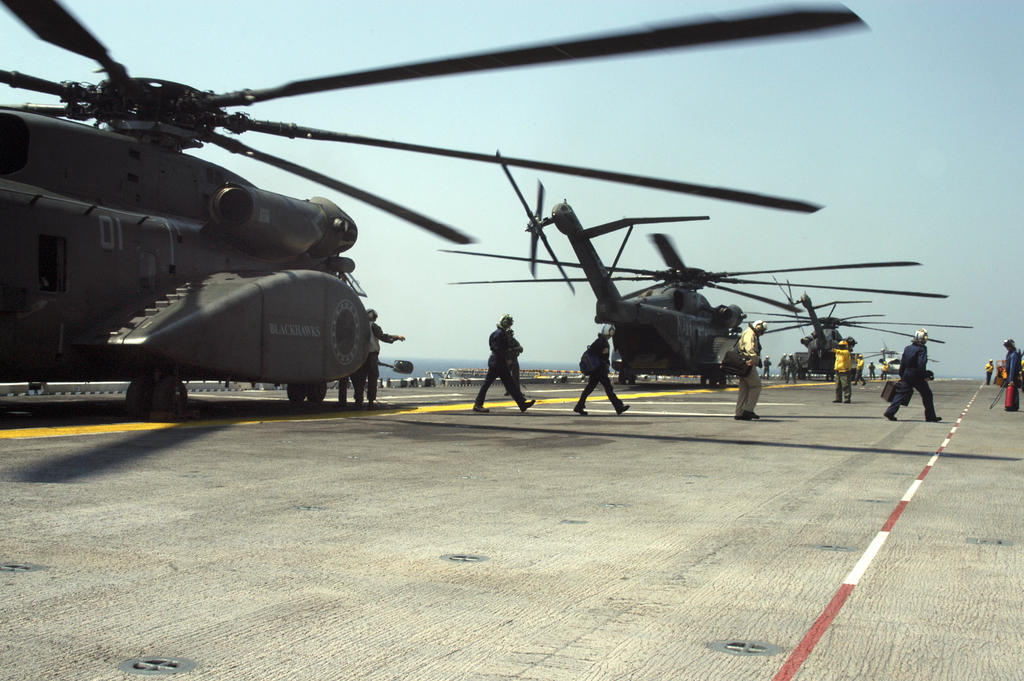
According to this Defense News.com article, the US Navy had the USS Bataan standing by to render hurricane aid
The Norfolk-based amphibious assault ship Bataan is standing by off the Texas coast to provide humanitarian assistance if called upon, 2nd Fleet spokesman Lt. Mike Kafka reported Aug. 29. Bataan, which recently completed a training exercise near the Panama Canal, “will remain in the vicinity of impacted areas until otherwise directed,” according to a 2nd Fleet statement.

At least two MH-60 helicopters are aboard the Bataan, and Kafka said three MH-53 helicopters out of Corpus Christi Naval Air Station, Texas, were to fly aboard Aug. 29, with another joining them Aug. 30.
As was shown during the tsunami relief effort, these large deck amphibs and their helicopter capabilities and their LCACs can perform a substantial role in getting aid into areas near the water where roads are out.

Bring 'em in!

UPDATE: Don't forget the Seabees! See this
Gulfport is home to 3,665 active-duty Navy people, and a total of 1,256, including Seabees, sailors training for guard duty at Guantanamo and some family members, remained behind. Some of the Seabees remained on station in order to start getting the base back in working order once the hurricane passed, said Navy spokeswoman Corey Schultz.

Dooling said it was too early to tell if the Seabees would be able to help fix hurricane damage in the surrounding community.

“They’re going to have to fix themselves before they can go out and fix the community,” he said.
And this and this.

UPDATE2: Martial law in New Orleans. Water rising. Send more amphibs, generators, water purification systems and portable fire fighting systems. Logistics, logistics, logistics.

UPDATE3: Photo caption:
Gulf of Mexico (Aug. 29, 2005) - Crew members assigned to the “Blackhawks” of Helicopter Mine Countermeasures Squadron Fifteen (HM-15), stationed at Naval Air Station Corpus Christi, Texas, prepare to unload personnel and equipment from MH-53E Sea Dragon helicopters on board the amphibious assault ship USS Bataan (LHD 5). HM-15 embarked three MH-53E helicopters in preparation for possible relief efforts along the Gulf Coast in the aftermath of Hurricane Katrina. The MH-53E Sea Dragon is capable of carrying 55 passengers and 16 tons of cargo 50 nautical miles. U.S. Navy photo by Photographer’s Mate Airman Jeremy L. Grisham
More photos here.

UPDATE4: 1st Army spools up
The First U.S. Army has deployed three disaster coordination teams equipped with satellite communications equipment to help federal relief efforts in Gulf Coast states hit by Hurricane Katrina.

Army Lt. Col. Richard Steele, a spokesman for the First U.S. Army, said the Defense Coordinating Elements teams deployed to Alabama, Florida and Mississippi. Each team has as many as 30 people. They are equipped with handheld Iridium satellite phones and military single channel tactical satellite communications terminals for voice communications.

The First U.S. Army handles disaster response east of the Mississippi River while the Fifth U.S. Army handles that mission west of the river, Steele said.

The Defense Coordinating Elements teams are also equipped with Inmarsat terminals and video teleconferencing systems made by U.K.-based Scotty Group, Steele said. A team deployed to Baton Rouge, La., has similar satellite communications capabilities.

The teams will handle requests for military support from the Federal Emergency Management Agency and state officials and pass on those requests to military officials. If they approve the requests, the teams will then control and manage any military assets or systems sent to the disaster areas.

Col. James Hickey, chief of staff for the First U.S. Army, said satellite communications are often critical in a hurricane’s aftermath. “One of the things we learned last year with the series of hurricanes that passed through Florida was the need for satellite communications,” Hickey said.


UPDATE5:
As usual, the US Coast Guard is doing a magnificent job. Their Katrina web site is here. Photo is from their site. Their aircraft have rescued over 1200 people.

UPDATE6: More on DOD effort here
The Army Corps of Engineers was preparing to support debris removal and laying plans to survey and begin emergency repairs on the levee system around New Orleans that partially gave way during the storm, Gene Pawlik, a Corps of Engineers spokesman, said.

As of 8 a.m. today, almost 3,800 Louisiana Army and Air Guard members were on duty to remove debris, provide security and shelter, distribute water, food and ice, and offer medical and law-enforcement support, National Guard Bureau officials said.

The Louisiana Guard was coordinating with Florida, Georgia and Texas to secure two UH-60 Black Hawk and five CH-47 Chinook helicopters to support their operations, officials said.

In Mississippi, more than 1,900 Guard troops were providing similar support, basing their operations at Camp Shelby.

The Mississippi Guard coordinated with the National Guards in Oklahoma, Pennsylvania and Arkansas to add four UH-60s and three CH-47s to the relief effort. In addition, the Alabama National Guard is contributing an engineer battalion and military police battalion to Mississippi's hurricane response.

In addition to the 300 military police and 500 engineers it is sending to Mississippi, the Alabama National Guard had another 800-plus troops on duty to support that state's Emergency Management Agency, Army Lt. Col. Bob Horton, an Alabama Guard spokesman, said. These troops are staging support equipment around flood-struck areas, and 450 of them will head to Mobile today to support law enforcement officials and enforce security, he said.

The Arkansas National Guard also mobilized 350 members to assist with hurricane relief efforts in Mississippi. The Arkansas troops include an engineer battalion, transportation company and military police company, officials said. In addition, two UH-60s plan to leave Camp Robinson, Ark., to support search-and-rescue operations.

The deploying troops will also contribute Humvees, dump trucks, 5-ton trucks, tractor-trailers, generators and lights to the effort, officials said.

In Florida, more than 700 Florida Guard members were on active duty, working out of logistical support sites in Miami and Homestead to provide ice and water distribution support.

The Guard was preparing to ship 1,000 cots to Louisiana to support relief operations there, officials said.

Krenke called the interstate cooperation a sign of the success of the Emergency Management Assistance Compact. This interstate agreement enables Guard troops from one state to support operations in another state and has significantly boosted the National Guard's response capability, she explained.

Through these agreements, 98,000 Guard troops from 12 states in or near the hurricane-stricken region are available to immediately support emergency operations, she said. Nationwide, an estimated 337,000 Guard troops are available to be deployed to states impacted by the hurricane.

UPDATE7: Michelle Malkin on military action.

UPDATE8:More on military activity: here.
The Pentagon effort includes the Navy amphibious assault ship USS Bataan, whose helicopters have been flying relief missions from off the Louisiana coast.

The ship, which resembles a small aircraft carrier, can produce large quantities of fresh water and is equipped with 600 hospital beds. (Watch video report on storm-related health risks)

Several other ships, including a rescue and salvage vessel and the USS Iwo Jima, another amphibious assault ship, are on their way from Norfolk, Virginia, the Navy said.

The USNS Comfort, a floating hospital based in Baltimore, Maryland, will depart in coming days. A medical crew from Bethesda Naval Hospital will staff the ship. It has full hospital capabilities, including operating rooms and hundreds of beds.

More than 125,000 National Guard troops have been activated in 19 states and Washington, D.C., to help local agencies with traffic control, security, distributing food, and search and rescue, a Guard spokesman said.

The Coast Guard, whose crews have been assisting in the rescue of people stranded by high water in the New Orleans area, is recalling 550 reservists to assist in the relief effort.

The Air Force said it was sending two large cargo planes to the region -- a C-5 Galaxy to Louisiana and a C-17 to Mississippi.

Besides humanitarian aid, the C-5 is bringing in swift boats, which can maneuver in shallow floodwaters to ferry rescue workers and victims. The C-17 is outfitted to evacuate 36 sick and injured people at a time.

The Air Force also deployed MH-60 Black Hawk helicopters to Mississippi for search and rescue efforts.


Technorati tags: ,