VertRep

VertRep
Showing posts with label Littoral Combat Ship. Show all posts

Wednesday, March 08, 2017

Arming the LCS with Real Weapons

USNI News reports on the effort to arm the Littoral Combat Ship with something to fend off attacks by $500 boats armed with RPGs and such. VIDEO: Navy Tests Anti-Swarm Boat Missile on Littoral Combat Ship USS Detroit
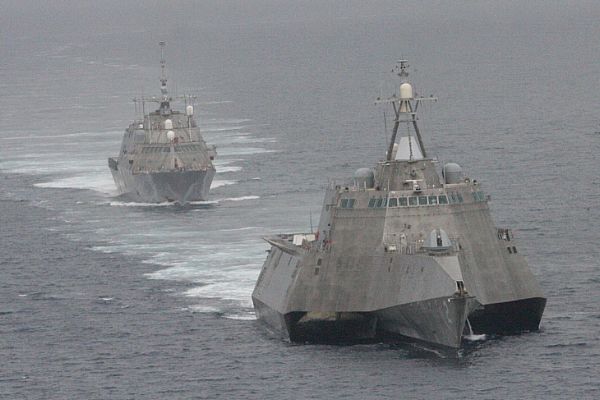
The Navy conducted its first test of a short-range missile system designed to protect a Littoral Combat Ship against swarming threats, Naval Sea Systems Command announced on Tuesday. The Feb. 28 test, off of Norfolk, Va., tested the Surface-to-Surface Missile Module (SSMM) aboard the Freedom-class Littoral Combat Ship USS Detroit (LCS-7), firing multiple Lockheed Martin AGM-114L Longbow Hellfire missiles.
The attached helicopter detachment is, in my opinion, still the main weapon system of the LCS.


I assume up-gunning the LCS involves major issues of weight and balance. We certainly don't need to add "tipsy" to the already unimpressive resume of the LCSs of either type.

I suppose the good thing about LCS speed is that Sir Robin would approve (no reflection the LCS crews, who I know are typically outstanding sailors driving a ship they didn't design):


I recall that at one time we followed a management guru who thought the main function of management was to make sure workers had the proper tools to do their job. Here area couple of his points:
3. Cease dependence on inspection to achieve quality. Eliminate the need for inspection on a mass basis by building quality into the product in the first place.
***
7. . . The aim of supervision should be to help people and machines and gadgets to do a better job.

Monday, March 31, 2014

Littoral Combat Ship: War Gaming Success?

Like a lot of people, I have done my share of bashing the Littoral Combat Ship.

As offset to that, here's an interesting blog post from Aviation Week's Michael Fabey concerning a recent U.S. Naval War College war game: "LCS Got Game":
Rowden [Rear Adm. Thomas Rowden, director of surface warfare], who has been locked away in for the wargames in the frigid New England wintry spring weather, took time to chat exclusively to Aviation Week about LCS’ performance thus far in the mid-2020s scenarios.

Stated simply, he says, the LCS give enemy fits.

“They are aware of where the carriers and amphibs are,” he says. “They had no of where the LCS was. They can give the enemy a helluva hard time.”

The LCS, he says, could swing out from the group, nearly unobserved, and deliver a sneak attack with missiles that can hit a target 120 to 130 nautical miles away. There are missiles now, he says, available or in development, that the Navy is confident will work with the ships.

LCS concept of operations, or conops, really open up, he says, when they are paired with other ships, like guided-missile DDG destroyers or Joint High Speed Vessels.

The LCS-DDG mating was particularly devastating, he says, for antisubmarine warfare (ASW). “The whole is significantly greater than its parts,” he says, combining three helicopters and an unmanned vertical lift aircraft.

Also, he says, LCS could be tasked to do some destroyer-type missions to free up the DDGs for other jobs.

Essentially, he says, when used the correct way – the way the ships were envisioned -- they can take a punch and deliver one.

“Are they lethal and survivable? Absolutely.”
Read the whole thing.

Your opinion may vary.

Wednesday, March 19, 2014

A Panel to Examine the Littoral Combat Ship

Breaking Defense has the tale of a Navy’s Littoral Combat Ship Panel :
Defense Secretary Chuck Hagel has told the Navy in no uncertain terms that he wants a second opinion on the controversial Littoral Combat Ship. Perhaps that’s why the newly formed “Small Surface Combatant Task Force” won’t be led by a sailor or even a Navy civilian. Instead, the “SSCTF” chairman will be Marine Corps Systems Command director John D. Burrow, according to a memo the Navy released today.
***
The Small Surface Combatant Task Force’s charter is to look at a range of alternatives, from all-new designs to existing ships. Both Navy Secretary Ray Mabus and Chief of Naval Operations Adm. Jonathan Greenert have repeatedly emphasized the fact that Hagel has by no means taken LCS off the table. To the contrary, both Hagel’s memo and this new one specifically mention the option of “modified LCS design.”

In fact, given the time and cost required to develop an all-new ship, a souped-up LCS may be the only practical option. The only other near-term options seem to be a military variant of the Coast Guard’s National Security Cutter or a foreign frigate, which even if license-built in the US would raise all sorts of patriotic hackles on Capitol Hill.
Any bets?

Friday, January 03, 2014

Thursday, June 20, 2013

Old news - Navy to add more "Coastal Patrol" ships to Arabian Gulf - Where are those Littoral Combat Ships? The World Wonders

Some older (May 10, 2013) news from the U.S. Navy:
Commander, U.S. Fleet Forces Command (USFF) will forward deploy five
USS Tempest - U.S. Navy photo by PH2 Danny Ewing Jr.
patrol coastal (PC) ships to U.S. Naval Forces Central Command (NAVCENT), Manama, Bahrain, May 14.


USS Tempest (PC 2), USS Squall (PC 7) and USS Thunderbolt (PC 12) are scheduled to arrive this summer. Two additional ships are expected to transfer next year. Commander, Patrol Coastal Squadron ONE (PCRON 1) along with a PC maintenance support team will also permanently move.

Five PCs have provided dedicated coastal patrol capability to the Commander, U.S. Fifth Fleet (C5F) area of operation (AOR) since 2006. The PCs currently stationed in Bahrain are manned with unaccompanied, rotational crews. The forward deployment resulted in the decision to shift from 6-month rotational crews to permanent crews stationed in Bahrain allowing families to accompany their Sailors to Bahrain. The shift alleviates the significant strain placed on the crews and their families while ensuring capacity and capability.

A total of ten PCs will be permanently stationed in Bahrain by the spring of 2014. Three PCs will remain stationed in the continental U.S.

PCs provide the U.S. Navy with a fast, reliable platform that can respond to emergent requirements in a shallow water environment. The primary mission of these ships is coastal patrol and interdiction surveillance, an important aspect of littoral operations outlined in the Navy's maritime strategy.
These small ships are about 20 years old and have never been favorites of the "Big Navy" which even foisted some of them off on the Coasties until their worth seemed to gain some appreciation.

Brought back from the brink of retirement, Danger Room notes that these little ships get a "fix up" for deployment:
Under a crash program valued at $4 million, the Cyclones — five of which are permanently stationed in Bahrain — are getting a new laser targeting system for their twin 25-millimeter cannons. The Mk-38 laser kit gives the “high-precision accuracy against surface and air targets such as small boats and unmanned aerial system,” according to contractor BAE Systems.

Well, why belatedly note this move? It struck me as a nice counter-piece to this bit of fluff about one of the expensive "Littoral Combat Ships" out gathering experience in Southeast Asia USS Freedom Brings Littoral Combat Ship Capabilities To CARAT Malaysia :
The littoral combat ship USS Freedom (LCS 1) accomplished several firsts
USS Freedom - U.S. Navy photo by MC1 Jay C. Pugh
to participate in exercise Cooperation Afloat Readiness and Training (CARAT) with the Royal Malaysian Navy (RMN), June 15.


Freedom was the first U.S. Navy ship assigned to Commander Task Group (CTG) 73.1 to pull straight into Kuantan's shallow pier.

"Being pierside at Kuantan Naval Base gave us the chance to make an instant impression, and show regional navies what this ship can do and how we can contribute to mutual interests at sea," said Cmdr. Timothy Wilke, commanding officer.
***
Fast, agile and mission-focused, LCS platforms are designed to operate in near-shore environments and employ modular mission packages that can be configured for three separate purposes: surfaces warfare, mine countermeasures or anti-submarine warfare. Freedom deployed to Southeast Asia with the surface warfare mission package.

During the at sea phase, additional events that will highlight Freedom's capabilities include an inbound fast attack craft drill; a search and rescue exercise with Freedom's MH-60R helicopter; and a visit, board, search and seizure drill with Freedom's embarked surface warfare mission package boarding team.
You might note that the LCS can land helicopters whereas the Cyclone-class PCs cannot. One would think that might be nice-to-have feature out there in the Arabian Gulf - but perhaps it is felt that there is enough air support in the vicinity that the PCs don't need to bring their own.

While I am aware that the LCS mission is part of a learning curve, it seems to me that if the Navy wants to practice the LCS's intended missions, playing with the small boys in a more realistic environment ought to send an LCS to share the fun in the Arabian Gulf - perhaps simply providing helicopters coverage for the PC crowd if nothing else. Then the CO of the LCS will have a chance to make a "instant impression" in some way other than mooring to a pier.

Wednesday, June 19, 2013

The "Evolving" Littoral Combat Ship Saga

A very special, stealthy LCS
Torn from the pages of the Aviation Week NavWeek blog "Return Of LCS Past" with this delightful

look at a GAO report on the "evolving" LCS saga - and what seems to amount to "reverse capability creep":
Particularly galling to some in Congress is the report’s Table 5 – “Evolution of Navy Statements About Littoral Combat Ship Capability,” which chronicles the changing narrative of the ship’s concepts and capabilities.

What the table shows, Congressional sources say, is how the Navy has changed its tune throughout the program – so much so, that it may be difficult to trust what service officials have to say now, especially in light of some of the unknowns highlighted in the other tables detailing potential factors that could affect LCS costs and operations.

Here’s the gist of the GAO report Table 5:

My version of the LCS with the amazing "jaws of death." Very scary.
Part of the much cheaper Iranian LCB force*
Concept: LCS’s capability against adversaries

Early (2004-2008): Primarily developed for use in major combat operations. Will gain initial entry and provide assured access—or ability to enter contested spaces—and be employable and sustainable throughout the battlespace regardless of anti-access or area-denial environments.

Current (2011-2012): Current LCS weapon systems are under-performing and offer little chance of survival in a combat scenario. Not to be employed outside a benign, low-threat environment unless escorted by a multi-mission combatant providing credible anti-air, anti-surface, and anti-submarine protection.

Concept: How LCS will deploy


Early (2004-2008): Will be a self-sufficient combatant.

Current (2011-2012): Lacks the ability to operate independently in combat. Will have to be well protected by multi-mission combatants. Multiple LCSs will likely have to operate in a coordinated strike attack group fashion for mutual support.

Concept: How mission packages swaps will be utilized

Early (2004-2008): Mission packages will be quickly swapped out in an expeditionary theater in a matter of days.

Current (2011-2012): Though a mission package can be swapped within 72 hours if all the equipment and personnel are in theater, swapping out mission packages overseas presents manning and potentially expensive logistical challenges. An LCS executing a package swap could be unavailable for between 12-29 days, and it may take 30-60 days or more for equipment and personnel to arrive in theater.
Somebody has some 'splaining to do.

*LCB? Littoral Combat Boat, of course.