"We must be ready to dare all for our country. For history does not long entrust the care of freedom to the weak or the timid. We must acquire proficiency in defense and display stamina in purpose." - President Eisenhower, First Inaugural Address
In addition to going after Puntland, SEMG has also gone after the maritime security industry, the CIA (which supports three antiterrorism units in country), the United States (which trains and supplies Somalia security forces), the TFG (for corruption), even aid organizations (for excess food sold) and the charcoal industry (the taxes on which funds al-Shabab). The arms embargo was originally created to stop the flow of weapons to warring militias. But two decades on there have been no significant or measurable reductions in the flow of arms to Somalia or any real penalty to pirates or al-Shabab. *** In a classic no-win situation, the Puntland government found itself being encouraged to fight piracy by the United Nations at the same time those very actions were being considered by another wing of the U.N. to be contributing to security destabilization. ***
Puntland
Just as the PMPF had the pirates on the run, the United Arab Emirates -- under massive U.N. pressure -- shut off their funding for the only anti-piracy program that had a real chance of success. As of June 6, Somali's largest indigenous attempt to control its own security appeared to be dead. To put the nail in the coffin, the SEMG then leaked its 2012 report on July 15, which vociferously demanded sanctions against the South African contractors -- but did not recommend sanctions on the pirates they were hired to defeat. When asked what their logic was for this conundrum, the SEMG response was "Pirate leaders cannot be sanctioned otherwise it would criminalize ransoms payments, (which) could have a negative impact on the release of crew members." At the very last moment, the good intentions of the United Nations had managed to save the pirates of Puntland and shut down Somalia's only land based anti-piracy program. ***
The Round Table of international shipping associations has called for the establishment of a United Nations force of armed military guards to tackle the current piracy crisis.
In a hard hitting letter to UN secretary-general Ban Ki-Moon, the International Chamber of Shipping (ICS), BIMCO, INTERTANKO and INTERCARGO demanded a "bold new strategy" to curb rising levels of piracy, which have resulted in the Indian Ocean resembling "the wild west".
The letter stated: "It is now abundantly clear to shipping companies that the current situation, whereby control of the Indian Ocean has been ceded to pirates, requires a bold new strategy. To be candid, the current approach is not working."
Regretting the increasing necessity for shipping companies to employ private armed guards to protect crew and ships, the letter continued: "It seems inevitable that lawlessness ashore in Somalia will continue to breed lawlessness at sea."
The shipping industry organisations - which represent more than 90% of the world’s merchant fleet – said that they fully support the UN's long-term measures on shore aimed at helping the Somali people but were concerned that these "may take years, if not decades, to have a meaningful impact on piracy."
Old School Armed Guards for Merchant Ships
Asking the UN to bring the concept of a UN force of armed military guards to the attention of its Security Council, the letter said: "The shipping industry believes that the situation can only be reversed with a bold approach that targets the problem in manageable pieces. We believe that an important element in this approach would be the establishment of a UN Force of Armed Military Guards that can be deployed in small numbers on board merchant ships.
“This would be an innovative force in terms of UN peacekeeping activity but it would do much to stabilise the situation, to restrict the growth of unregulated, privately contracted armed security personnel and to allow those UN member states lacking maritime forces - including those in the region most immediately affected - to make a meaningful contribution in the area of counter-piracy," the letter concluded.
If the UN funds armed guards then shipping companies won't have to, unless the UN charges them for the service, which it should.
Operating under a UN charter might make some of the legal aspects of armed ship guards easier.
The menace of piracy off the coast of Somalia was outpacing international efforts to stem it, B. Lynn Pascoe, Under-Secretary-General for Political Affairs, told the Security Council today, emphasizing: "Warships alone will not solve the problem."
Briefing the Council on the situation in Somalia, Mr. Pascoe said: "We need to continue to fight this battle in the broadest manner, focusing simultaneously on deterrence, security and the rule of law, as well as providing economic alternatives for Somali youth. We must also make piracy and robbery off the coast of Somalia costly by addressing impunity and building the capacity of the Transitional Federal Government to expand its authority and deal with law and order."
Presenting the Secretary-General's report on the situation in Somalia (document S/2010/556), he described the numbers as "appalling", citing International Maritime Organization (IMO) reports that more than 438 seafarers and passengers as well as 20 ships were held by pirates as of 4 November, an increase of almost 100 kidnapping victims in less than a month. Pirates were also taking greater risks and seeking higher ransoms, he said, recalling that just a few days ago, pirates had "brazenly" attacked a European Union warship escorting supplies for the African Union Mission in Somalia (AMISOM). The assault had been mounted from a large freighter, itself seized about a month ago, he said, pointing out that such actions continued to have serious effects on regional economies and those of the wider world.
He said the problems would be worse if not for the "very considerable" international anti-piracy efforts. Member States had put in place a strong naval presence with an unprecedented level of coordination among naval forces in the area. International naval coalitions off the Somali coast had disrupted more pirate operations and protected more vessels than ever before, amid increasing implementation of self-protection recommendations developed by the shipping industry and the IMO, he said. "But much more effort is required to tackle the root causes of piracy. Fighting piracy demands simultaneous action on three fronts: deterrence; security and the rule of law; and development."
U.N. Secretary-General Ban Ki-moon offered the Security Council seven options for grappling with the piracy problem, ranging from simple legal support for individual nations to a full international court established by the council, the U.N.'s most powerful body.
An effort instigated by the Russians, no less.
The seven options:
basic support for nations in prosecuting suspected pirates;
establishment of a Somali court, applying Somali law, in a third state in the region;
two variants for helping a regional state or states to establish a special court inside its existing judicial system to conduct piracy trials;
a regional court establishment by regional states and the African Union;
an international "hybrid" tribunal with national participation by a state in the region;
a full internatinal tribunal, established by the Security Council.
Number 3 counts as two options, I gather, thus giving a total of 7.
I suppose it might be useful to have an internationally recognized definition of piracy and/or armed assault at sea and some minimal level of required evidence needed to prove attempted piracy.
Further, there has to be some system in which sworn video evidence of mariners may be used in court so that shipping companies will not be forced to send deck hand or officers from remote corners of the planet to testify against "suspects."
Make it too hard to get the captured pirates to trial and you will just get a continuation of the current situation - a "catch and release" program for misguided Somali youth. Though some forms of this treatment are more harsh than others - see here.
My own personal option is a blockade of known Somali pirate ports and an announcement of "no warning shots" by the various international naval units in the area if a small boat is found firing on a ship at sea. Aim for the motors on the boat and let the survivors drift home. They better have life jackets and oars.
Of course, this probably violates their human rights.
I have an idea for a low-cost anti-pirate vessel with just the right weapon to take out small boats:
Somalia's hard-line Islamist Al Shabaab movement dismissed the decision by the UN's food agency to suspend its operation in southern Somalia over insecurity as "lies and propaganda."
The UN World Food Program (WFP) said Tuesday it was forced to suspend its operations in southern Somalia due to rising insecurity.
"The WFP said that it was suspending its operation in south Somalia because of insecurity that is lies and propaganda. The area controlled by Al Shabaab movement is one of the most peaceful areas in Somalia ," Ali Mohamoud Rage, spokesman for the Al Shabaab movement which controls southern Somalia, told reporters in Mogadishu.
WFP said in a statement that rising threats and attacks on humanitarian operations, as well as the imposition of a string of unacceptable demands from armed groups, have made it virtually impossible to continue reaching up to one million people in need in southern Somalia.
The Al Shabaab spokesman said they did not order the UN agency to leave, nor did they impose any restrictions on it. The movement only asked the WFP to buy grains from local farmers to give out to needy, he added.
"We have not ordered WFP to leave the country but we have only asked them to buy local people's produce to give outs as food aid, if it ever gives anything, so that our farmers become more productive which is in the interest of the farmers and the Somali Muslim people as a whole," the spokesman said. **** TThe Islamist group's spokesman said the movement considers the name of the UN agency to be against the teaching of Islam.
"First of all we tell the people that the name of World Food Program is against the Islamic doctrine because Islam believes that the program of feeding the world is for Allah only and it is He who feeds every living being on earth and no human being can do that."
The UN agency said its offices in Wajid, Buale, Garbahare, Afmadow, Jilib and Belet Weyne in southern Somalia are temporarily closed, and that food supplies and equipment have been moved, along with staff, to safer areas in order to ensure that food assistance continues to reach as many vulnerable people as possible.
He accused the agency of favoring American farmers over Somali farmers by refusing to buy grains from local farmers, but WFP saidlocal production in the last five years averaged only about 30 percent of food needs in the Horn of Africa nation, which has been without an effective central government for more than two decades. (emphasis added)
It's nice to know that Shabaab doesn't have anything against the WFP except its name and how it does business.
More on the WFP view here. And a show on where the food comes from here.
Suspected pirates off the coast of Somalia should be prosecuted under the supervision of the United Nations, according to a letter sent by Turkey to UN Secretary-General Ban Ki-moon and made public here on Wednesday.
In the letter, Turkey's permanent representative to the UN, Ertugrul Apakan, suggested the formation of a judicial system to punish perpetrators and deter potential pirates from a life of criminality.
"Turkey believes that it would be useful if a mechanism is put in place in one of the countries of the region, under the supervision of the United Nations, to effectively prosecute persons suspected of piracy and armed robbery at sea off the coast of Somalia," said Apakan.
Currently, no clear legal regime exists to hold pirates off the coast of Somalia accountable. Normally, under the United Nations' Law of the Sea Treaty, Somalia would try its citizens. But Somalia never ratified the treaty, and is largely deemed a lawless nation without a viable government.
To make do, countries like the United States and Britain have signed Memorandums of Understanding with the Kenyan court system to try suspected pirates in a kind of Hague international tribune.
But without a clear international legal framework, many countries, like Turkey, are calling for the United Nations to coordinate a comprehensive judicial mechanism.
Nice idea,though it shows a degree of faith in the UN that I personally don't see much justification for.
"Suspected pirates?" Unless and until it's an international crime to sail in international waters with rifles (which is currently is not), RPGs and ladders "suspects" are all you are going to have unless you catch pirates boarding or occupying a ship. "Catch and release" is a bad choice, but it may be the best choice currently available.
The U.N.'s World Food Programme (WFP) has suspended its work in much of southern Somalia due to threats against its staff and unacceptable demands by al Shabaab rebels controlling the area, a WFP spokesman said on Tuesday.
The WFP has been central to international efforts to address an acute humanitarian crisis in the drought- and conflict-torn Horn of Africa nation. Experts say half the population need aid.
"Unacceptable conditions and demands from armed groups have disrupted WFP's ability to reach many of the most vulnerable people in southern Somalia," spokesman Peter Smerdon told Reuters. "Despite this suspension, WFP remains active in much of central and northern Somalia, including the capital Mogadishu."
He added, however, that it was now virtually impossible to reach up to 1 million women, children and other highly vulnerable people. About three-quarters of the 3.76 million Somalis who need aid are concentrated in central and southern regions.
Most of those areas are controlled by the al Shabaab rebel group, which Washington says is al Qaeda's proxy in Somalia.
Go figure. An al Qaeda group making a power grab over food supplies to enslave a population. Who'd a thunk it?
Now, will the apologists for al Shabaab hold them accountable for each child that dies as a result of their actions?
Why do I doubt it?
Will the West get blamed? The Magic 8-Ball says: "Most likely."
14.000 tons of food have been delivered successfully to the starving people of Somalia from Mombasa, Kenya to Moqdisho in order to prevent the predicted famine in Somalia.
The humanitarian aid shipping, conducted by the merchant ship JAIPUR, was arranged by order and for account of the World Food Programme of the United Nations.
During the several day lasting journey the vessel was escorted by the European Union Naval Force warship FGS Rheinland-Pfalz, a German Navy frigate. This frigate is operating off the coasts of Somalia since February this year and is part of the EU led Operation Atalanta.
This shouldn't really be a story except that the Somali pirates have no sense of obligation to their fellow Somalis and will intercept unescorted food ships.
On the other hand, the UN ReliefWeb reports that new fighting in Mogadishu is creating even more refugees and strain on the UN systems - since Somalia is too fragmented to help itself (and has been that way for what. 20+ years?):
The UN refugee agency on Friday said it was "gravely concerned" about spiralling violence and the worsening displacement crisis in Somalia, where almost 170,000 people have fled the capital Mogadishu since a fresh wave of fighting erupted in early May.
"Fighting between government forces and the opposition Al-Shabaab and Hisb-ul-Islam, which erupted on May 7 in several north-west areas of the Somali capital Mogadishu, is leaving a trail of civilian casualties, destruction and renewed displacement," UNHCR spokesman William Spindler told reporters in Geneva on Friday.
According to records of local Somali hospitals, more than 250 civilians have been killed and at least 900 wounded during this period. "We estimate that since the start of the fighting in May more than 169,000 people have been forced to leave their homes and seek shelter elsewhere within Somalia or in neighbouring countries," Spindler said. Between last Friday and Monday alone, an estimated 33,000 were displaced from Mogadishu due to the heavy fighting.
The majority of the internally displaced people (IDPs), some 51,000, moved to safer districts within the city or makeshift IDP settlements on the outskirts of Mogadishu, while another 48,000 fled towards the Afgooye corridor to the west of the capital. They joined more than 400,000 civilians who have been displaced since 2007. A further 70,000 have gone to more distant locations, including the districts of Lower and Middle Shebelle, Lower Juba, Galgaduud, and Gedo.
The UN Relief people spend a lot of time being "gravely concerned" about Somalia.
Remember that ship alleged to be carrying Iranian arms to Gaza? See here for a refresher. The government of Cyprus, having availed itself of UN advice, has decided to unload the ship (and presumably let the ship go), as set out here:
Cyprus has begun to unload a detained ship allegedly carrying weapons-related material, which the government says was in "clear" breach of UN sanctions.
The government said the unidentified cargo would be stored on the island.
The containers were being transported to a naval base along the coast under heavy police guard, state radio said.
Israel says the ship, the Monchegorsk, was carrying Iranian arms destined for the Palestinian militant group, Hamas, in Gaza. Iran denies the accusation.
Iranian Foreign Ministry spokesman Hassan Ghasghavi stated on Wednesday: "The ship was not taking arms and weapons [to Gaza]."
Cypriot authorities had inquired about the ship's cargo and "if it was carrying weapons things would have been clear", he added. *** Later, Defence Minister Costas Papacostas told the Associated Press: "There are no weapons. There is material that could be used in the manufacture of munitions."
On Tuesday, Cypriot Foreign Minister Marcos Kyprianou said the UN committee had ruled that the Monchegorsk was in "clear" breach of UN sanctions, but he did not specify what had been found on board or name the cargo's destination.
For background, see here. Latest report from here:
Foreign Minister Markos Kyprianou has said that the government is still investigating whether weaponry carried by a Russian owned ship comes under UN resolutions banning arms exports by Iran.
The ship is now anchored about two nautical miles off the coast of Limassol pending further decisions by the Cyprus government.
Press reports said the ship may be brought into Limassol port so that a complete inspection on its cargo can by carried out.
Mr Kyprianou said he could not comment on this information and added that many of the details carried by news media were not correct.
He called for patience for a few days until the matter is resolved.
The "Monchegorsk", a Russian-owned ship which is registered in Cyprus, had been escorted to Cyprus by an American warship, on suspicion that it is carrying military equipment from Iran, in contravention of a UN security council resolution.
Russian authorities are dismissing american charges about arms trafficking.
U.S. military officials said personnel from the U.S. Navy last week boarded the vessel, travelling from Iran to Syria, and found a weapons shipment, but for legal reasons did not confiscate the cargo.
Well informed sources say the cargo of the ship includes specialised materials which could be used in the manufacture of rockets.
Just for fun, here's how the ship might look through a periscope:
A HIGH-level meeting of 17 States from the Western Indian Ocean, Gulf of Aden and Red Sea areas, convened by IMO in Djibouti to help address the problem of piracy and armed robbery against ships off the coast of Somalia and in the Gulf of Aden, has adopted a Code of Conduct concerning the Repression of Piracy and Armed Robbery against Ships in the Western Indian Ocean and the Gulf of Aden.
The Code of Conduct recognizes the extent of the problem of piracy and armed robbery against ships in the region. The counties involved have declared their intention to “co operate to the fullest possible extent, and in a manner consistent with international law, in the repression of piracy and armed robbery against ships, with a view towards sharing and reporting relevant information through a system of national focal points and information centres; interdicting ships suspected of engaging in acts of piracy or armed robbery against ships; ensuring that persons committing or attempting to commit acts of piracy or armed robbery against ships are apprehended and prosecuted; and facilitating proper care, treatment, and repatriation for seafarers, fishermen, other shipboard personnel and passengers subject to acts of piracy or armed robbery against ships, particularly those who have been subjected to violence”.
An IMO statement says that the participating countries intend to fully co-operate in the arrest, investigation and prosecution of persons who have committed piracy or are reasonably suspected of having committed piracy; seize suspect ships and the property on board such ships; and rescue ships, persons, and property subject to acts of piracy. These acts would be consistent with international law.
The Code also covers the possibilities of shared operations, such as nominating law enforcement or other authorized officials to embark in the patrol ships or aircraft of another signatory.
“The adoption of this instrument shows that countries in the region are willing to act concertedly and together, contributing to the ongoing efforts of the broader international community to fight the scourge of piracy and armed robbery against ships in the area,” UN International Maritime Organization (IMO) Secretary-General Efthimios E. Mitropoulos said of the Code of Conduct adopted yesterday at a high-level meeting in Djibouti convened by his agency.
Nine countries – Djibouti, Ethiopia, Kenya, Madagascar, Maldives, Seychelles, Somalia, Tanzania and Yemen – have already signed the Code, which calls for shared operations, such as nominating law enforcement or other authorized officials to embark in the patrol ships or aircraft of another signatory.
The meeting was attended by ministers and senior officials from Comoros, Djibouti, Egypt, Ethiopia, France, Jordan, Kenya, Madagascar, Maldives, Oman, Saudi Arabia, Seychelles, Somalia, South Africa, Sudan, Tanzania and Yemen, as well as observers from other IMO members, UN specialized agencies and international and regional inter-governmental and non-governmental organizations. The Code is open for signature by the 21 countries in the region.
“Like the Regional Cooperation Agreement on Combating Piracy and Armed Robbery against ships in Asia (RECAAP), which was concluded in November 2004 by 16 countries in Asia, I have every faith that the Code of Conduct will prove to be the starting point for successful cooperation and coordination in the region, which will bear fruit in the suppression of piracy and armed robbery against ships,” Mr. Mitropoulos said.
Representatives of States that have sent naval forces to protect shipping off Somalia, including China, France, Italy, Japan, Russia and United Kingdom, also attended the four-day meeting, as did the UN World Food Programme (WFP), whose chartered food aid ships have been hijacked on several occasions.
The UN has a lot of agencies and I have been critical of many of them. However, the UN Office on Drugs and Crime (UNODC) has an excellent idea as set out in "Ship riders": Tackling Somali pirates at sea:
As a result of the growing piracy threat, UNODC has proposed a number of measures to deter, arrest and prosecute pirates in the Horn of Africa to the United Nations Security Council in December 2008. The most immediate of these is to put forward international agreements allowing law enforcement agents from the Horn of Africa region to join warships as a 'ship riders' - as these are known - to circumvent legal impediments to arresting pirates on shared waters.
Traditionally used to combat drug trafficking and illegal fishing, shiprider agreements are designed to remove policing barriers in international maritime boundaries, and to stop smugglers and other criminals from taking advantage of shared territorial waters for illegal activities. The practice has been employed successfully in the Caribbean to fight drug traffickers. ***
"Ideally, suspects should be tried in the country where they came from, or in the country that owns the seized ship", says UNODC's Executive Director Antonio Maria Costa, "but the Somali criminal justice system has collapsed, and countries like Liberia, Panama and the Marshall Islands - where many of the ships are registered - do not want to deal with crimes committed thousands of miles away".
Shiprider agreements would make use of existing functional criminal justice systems in the region to be able to arrest and try pirates. "We must engage neighbouring States - where legal instruments deriving from current international agreements on piracy and transnational organized crime are in place and functioning - if pirates are to be brought to justice." Subject to a special agreement, a shiprider arrangement would allow a law enforcement officer from, from example, Djibouti, Kenya, Tanzania or Yemen, to join a warship off the Somali coast, arrest the pirate in the name of their country and have them sent to their national court for trial.
UPDATE: StrategyPage reportsUSS San Antonio (LPD-17) is the flagship for CTF-151, the anti-pirate task force. Though tagged as a "hard luck" ship due to construction issues, the choice makes sense. UPDATE2: An interview with a "pirate king" here:
"I have employees doing the business for me now. I am a financier. I get my money and I don't have to leave Eyl. I have not gone to sea to hijack in recent months.
"My group go to sea and I manage their finances. I buy speedboats and weapons, whatever they need.
"Usually, no disagreements come between us. Once, though, we disagreed. When we were holding two French nationals in Habo, some demanded to take them to Eyl while others disagreed.
"It's difficult to stay being a pirate but we have changed our previous strategies. We have transformed our operations in the Indian Ocean with new types of attacks, using modern equipment, including GPS, to show where warships are.
"At the moment we have a new, active young generation who want to take part in piracy. They mostly like money.
"If the UN gives approval to fight pirates on land, that will lead to the death of innocent Somalis because they cannot differentiate us from ordinary Somalis, as we dress alike.
"Piracy will not stop unless we get a government," said Dheere.
U.N. Secretary-General Ban Ki-moon said Wednesday that he disagrees with the United States that it is time to send U.N. peacekeepers to Somalia.
He said he has been trying over the past four months to respond to a Security Council request to establish a multi-national stabilization force for Somalia.
Mr. Ban said he has spoken to 50 countries, but the responses have "either been lukewarm or negative." He said no country has volunteered to lead such a mission and only one or two have expressed a willingness to contribute troops. Among Security Council members, he said just one country has stepped forward to offer funding and equipment - but not peacekeepers.
"Therefore, my efforts to establish international stabilization forces may not be materialized at this time. But I know that there are some member states of the Security Council, including the United States, who favor to establish United Nations peacekeeping operations there," he said. "I believe, and all my senior advisors and staff in DPKO [the Department of Peacekeeping Operations] and concerned departments, their assessment is the situation is not ripe, the conditions are not favorable to consider a U.N. peacekeeping operation."
The United States lacks the intelligence needed to pursue the fight against pirates on Somali soil, Defense Secretary Robert Gates said on Saturday.
His comments came days after the U.S. delegation at the United Nations circulated a draft resolution that would give countries the right to pursue pirates on land as well as at sea.
Analysts say that pursuing pirates on land is crucial to any military response to attacks that have targeted dozens of ships in the Gulf of Aden and Indian Ocean in recent months.
"With the level of information we have at the moment, we're not in a position to do that kind of land-based operation," Gates told a regional security conference in Bahrain. "Our first need is intelligence, (to know) who is behind it."
Referring to media reports that "two to three clans or extended families" were behind the pirate attacks on ships off the Somali coast, Gates said: "If we can identify who those clans are then we can operate on land under the auspices of the United Nations and seek out ways to minimize collateral damage."
The U.S. is asking the United Nations Security Council to authorize the pursuit of pirates operating off the coast of Somalia onto land, with permission from the nation’s provisional government, diplomats said.
A draft resolution has been given to some member governments on the panel, and a vote may be sought as early as next week, when U.S. Secretary of State Condoleezza Rice is scheduled to be at UN headquarters in New York, according to Chinese, French and Indonesia envoys. *** The draft will face concerns among council members such as Indonesia over concerns that pursuit of pirates onto land might violate provisions of the Law of the Sea. French Deputy Ambassador Jean-Pierre Lacroix said some countries might be “really very nervous” about authorizing landings and military engagements against pirates.
“We want to be sure we are not creating new international law,” Indonesian Ambassador Marty Natalegawa said.
Hmmm. Why would they be concerned about that? Seems like it's a throwback to the old days, when Marines went ashore in Tripoli and the French took out a Barbary pirate fortress...or even the U.S. Navy going after the Malay pirates.
If you are hosting "enemies of all mankind" I would argue that your sovereign rights (such right being suspect in the case of a failed state like Somalia anyway) are waived until the pirates, terrorists or whatever are cleaned up and if you are given the chance to do it yourself and fail, the UN members can offer to "help."
Does the UN community have the right to police a state that cannot police itself? What are the long-term ramifications of such an action?
Someone at the UN Satellite office went a lot of trouble to produce the pretty picture shown below (click on it to make it bigger). It comes from here (pdf).
Comment:
This 3D perspective map illustrates the relative spatial density of reported pirate incidents in the Gulf of Aden for 2008 (current as of 21 November). Incidents that have occurred within 5km of the Maritime Security Patrol Area (MSPA) following implementation on 26 August 2008 are identified. A spatial analysis of the pattern changes in attacks has also been conducted. Satellite imagery has been used in this analysis for the identification of suspected hijacked vessel locations, and to identify vessel traffic patterns through the Gulf of Aden. This work was done by UNOSAT in support of the ongoing humanitarian operations across the Horn of Africa, and in response to the UN Security Council Resolution 1816 (2008) adopted 2 June 2008, and IMO resolution adopted 29 Nov. 2007 calling for continued monitoring of Somali pirate activity. All piracy incident data has been obtained from open media sources, specifically the Piracy Reporting Center (PRC) of the International Maritime Bureau (IMB). Incidents are classified into 3 main types: ´Hijacking´ where pirates have taken control of a ship; ´Attempted Hijacking´ where pirates have deployed weapons & attempted to board a vessel but failed; ´Suspicious Approach´ where a vessel has followed or chased another ship; Note, a number of reported ´Suspicious Approach´ incidents may represent accidental vessel approaches misperceived as a pirate threat. This is an initial assessment and has not been independently verified.
UPDATE: My comment - If ship traffic moved its routing to be in or closer to the Maritime Security Patrol Area, you would expect that the pirates would have to move into or closer to the MSPA in order to find targets for their operations. In other words, if the ship tracks moved north, away from the Somali coast, I would expect the pirates to move north along with the traffic, just like fishermen move to where the fish are biting. UPDATE2: Further, I would think the major shipping route from the strait at Bab El Mandeb would tend toward hugging the coast of Yemen anyway, as that provides the shorter route to, say, the Strait of Hormuz. "That's where the ships are." UPDATE3: The UN map contains an inset which is of interest because it show the narrowing of the pirate attack areas as set out in its caption:
The implementation of the MSPA has had a dramatic influence on pirate activity in the Gulf of Aden. As this map illustrates, the spatial distribution of reported pirate attacks has contracted spatially in pursuit of transit vessels travelling through MSPA. There are several measurements of this change. The mean distance between reported attacks has fallen from 30.5km for events before MSPA to 24.6km after (from 26 Aug. -21 Nov). The standard deviational ellipse of attacks (a measure of event distribution) before the MSPA narrowed considerably after the MSPA along the north-south axis. Further, the mean center of attacks has shifted to the west by approximately 200km. The overall shift has thus been of a concentration of activity along the MSPA, towards the Yemeni coast and to the west.
I've captured the 2007 and 2006 piracy info from the same area as seen above. Not much info but make of it what you can:
UPDATE: NATO Map of 11-26-08: Source and comments:
There appears to be a lull in piracy activity: no new hijackings have been reported/can be confirmed since MV DELIGHT 18 Nov. Recent press reporting of Yemeni vessel hijacked [NB E1- see here] cannot be confirmed by independent sources and is being investigated. Most recent confirmed incidents were 2 approaches and one attack, all of which occurred in the Gulf of Aden during 23-24 Nov (As shown on slide) On 18 Nov Thai FV EKWATANAVA 5 was engaged and sunk by Indian Naval vessel TABAR. At the time of the engagement EKWATANAVA5 was under the control of pirates who probably intended to use her as a mother ship. 14 vessels remain hijacked comprising 12 merchant ships 1 fishing vessel and tug boat Yenegoa Ocean. The current slide displays last known position of hijacked vessels.
The total number of commercial vessels (including one tug)hijacked in Somali waters now stands at 14; over 200 merchant seamen are held by pirates. The use of mother-ships seems to be on the rise, and potentially, vessels are hijacked with the sole intention of using them as such.
In short, the trends in latest piracy incidents are as follows:
* Targeting larger cargo / oil / gas / chemical tankers * Approaches / attacks conducted from 2-3 small speedboats with 3-5 armed persons each. The number of boats involved in each incident seems to be increasing.
Left off the NATO and UN lists is a report of a captured chemical tanker.
Finally, a screen capture of the "Live Piracy Map" available here, zoomed in for a closer look at Somalia and its surrounding waters, I added the red arrow and label to show where the Saudi VLCC was taken. You might note there have been other attacks in the same area. You might further consider that, while the Somali pirates historically have gone after ships with low freeboard (space between water and the first open deck), pirates in the Strait of Malacca have long been boarding vessels like tankers with higher freeboard. It's a matter of technique.
Just days after foiling two attempted hijacks by heavily armed sea pirates off the coast of Somalia, India has called for a United Nations peacekeeping force to patrol the increasingly dangerous Gulf of Aden in the Arabian Sea.The Indian call - made Thursday at the twice-yearly Council meeting of the International Maritime Organization in London - is aimed at bringing current disjointed security patrols of individual countries under a unified command.
Senior shipping sources said the move follows a recent refusal by a Western naval patrol to protect an Indian merchant ship that felt “vulnerable” to attacks on what is perhaps the world’s most dangerous stretch of water.
“When the Indian captain asked for protection, he was asked, firstly, about which flag he was flying, then about the nationality of his crew, and finally about which cargo he was carrying,” said Shipping Corporation of India Chairman S. Hajara.
When informed that it was an Indian ship with Indian seafarers, the captain was told that he could not be provided immediate protection, Hajara, who is part of the Indian delegation to the IMO Council meetings, told IANS.
The 950-km stretch, straddled by Yemen on the north and Somalia on the south, is part of the vital Suez shipping route and patrolled by a multinational anti-terror naval task force comprising warships from the US, Britain, Germany and other countries.
India chose to stay out of the force because it is not under UN control and its call for UN leadership and coordination at the IMO Thursday received the backing of a large number of countries, said Shipping Secretary A.P.V.N. Sarma.
You know, international cooperation doesn't always have to have UN sanction unless you are looking for "top cover."
WFP today welcomed the decision by Canada to extend its naval mission protecting ships carrying humanitarian aid to Somalia for a further month.
Ships operating off the coast of Somalia have been targeted by pirates, jeopardising a vital humanitarian lifeline to the country where more than 3 million face hunger as a result of drought, conflict and high food prices.
"Millions of hungry people face a total break in their humanitarian food supply due to the scourge of pirates attacking ships," said WFP's Executive Director, Josette Sheeran. "Make no mistake - Canada's generous act of extending naval protection will allow us to get food in and will save lives. We urgently call on other nations to step up to the plate."
Sheeran called for a comprehensive approach by the international community to provide naval escorts as part of on-going anti-piracy operations off Somalia.
In Somalia about 1/2 the population depends on getting food from outside sources, especially the World Food Program. Now, not only are gangs (clans) attacking aid workers and other food distributors, one of the few successful Somali industries, piracy, is making matters worse. So bad in fact, that the WFP is contemplating engaging private contractors to escort its food ships - since the world's navies seem long on talk but short on action in supporting the WFP:
Gunmen in Somalia have shot dead three elders distributing aid in a refugee camp on the outskirts of Mogadishu.
The killings are being linked to a wave of apparently targeted attacks on humanitarian workers.
Meanwhile, the World Food Programme has warned that it may have to use private security companies to protect its vessels from pirate attacks in Somalia.
The agency has been sending food ships without protective escorts after a Dutch naval mission ended last month.
The WFP country director for Somalia, Peter Goossens, told the BBC the threat of piracy was putting at risk vital food aid for millions of people in Somalia.
"The problem is twofold - the ships themselves can get hijacked and we lose the food... my biggest problem is that I can't find enough vessels that are willing to do this work for me unless they get an escort," he said.
Mr Goossens warned that the country was at a dire crossroads, with the risk of a famine similar to the early 1990s, when hundreds of thousands died.
He added that the UN had spoken to various naval powers who might provide military escorts to aid WFP ships, including Britain, Sweden and India.
He said he was grateful for their expressions of interest, but now wanted action.
Private contractors may not be loved...but if the money is there along with immunity from Somali and other prosecution, then I would guess they may be the only reliable source to which the WFP can look for shipping security. Especially since no one from any first, second or third world country really wants anything that smacks anything like ownership of the failed state of Somalia.
In the meantime, hundreds of thousands of lives teeter on the brink because of the pirates of Somalia...
Earlier suggestion of using "UN Police" can be found here (and in the comments). At least one comment concerns the use of an armed fishing trawler as an escort - which might work, but I believe a little more speed would be desired for an escort ship.
According to this, Risk Consultants International may be buying patrol boats:
Risk Consultants International Ltd has bought six Hugin and Kaparen class patrol boats for "patrolling Africas coast". The boats is of course now stripped of gun and sensors but should be a fairly nice platform to add stuff to.
UPDATE: Aljazeera coverage: "Leading powers?" - there are enough other naval powers in the world to lend a hand - where are the navies of Turkey or Pakistan or Russia or China? Notice whose flag that is on the food bundles? How about some financial aid from the OPEC group?
UPDATE: (7/20/08) maybe it's just me, but I'm having trouble tying this headline U.S. targets Somali pirates with any content in the article suggesting that the headline is true:
In response to pirate attacks, the U.S. has stepped up its patrols to deter them and sometimes intervened to rescue hostages and ships. It also has increased its intelligence-sharing in the area, says Navy Lt. Nate Christensen, a spokesman for the 5th Fleet in Bahrain, which patrols Middle Eastern and African waters.
The U.S. is "very concerned about the increasing number of acts of piracy and armed robbery" off the Somali coast, he says. Somalia's weak government has admitted it can't control its territorial waters, and Nigeria is fending off a rebel group.
A U.N. Security Council resolution, pushed by the U.S. and passed June 2, allows the U.S. and its coalition allies to intervene by "all necessary means" for the next six months to stop piracy off the Somali coast. Coalition ships have since scared off pirates in at least two attacks, says the London-based International Maritime Bureau.
I dunno. To me "targeting" means just that.
Something like putting an AC-130 gunship into action along the known pirate havens in Somali.
It is barely two weeks after the United Nations Security Council members unanimously adopted a resolution to combat the attacks and hijacking along the coastlines of Somalia, pirates have vowed to shoot down the resolution.
The gangs have said that due to the fact that Somalia is not a member of the Security Council, it would be wrong for the country to agree to such a resolution which the pirates say is a clear breach of the sovereignty of the Horn of Africa country. The gangs mainly have their main bases in the northeastern regions of Somalia, known as Puntland.
The pirates have vowed to resist any move by any Security Council member to invade Somalia, saying such a move would be tantamount to breaching the sovereignty of the conflict-ridden nation.
It is however interesting that piracy along the Somali coast acts as a source of economic upkeep catering for a large population of people mainly the jobless residents.
The militias who are a result of lawlessness and unemployment have vested their energies in hijacking ships and vessels in the Indian Ocean waters for huge ransoms.
Mogadishu hosts at least four distinct groups of pirates, organized along clan backgrounds and are led by warlords, corrupt business people and even the town's local authorities.
According to sources privy to the ongoing in Mogadishu, Somali soldiers have allegedly joined forces with the pirates making the work of dealing with them even more difficult.
Gosh, someone ignoring UN resolutions? Who'd 've thunk it?

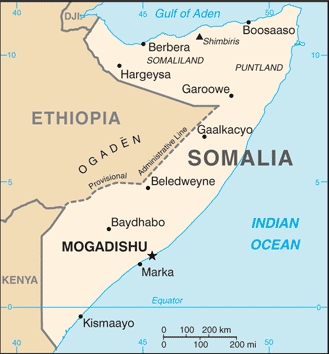 How an effort to do what virtually everyone agrees needs to be done - defeat the Somali pirate on the land side - was thwarted by a UN program and an apparently overzealous administrator, is nicely set out in Somali Report's Robert Young Pelton's Foreign Policy piece Hijacked: How the U.N. saved the Somali pirates from the brink of extinction:


.jpg)


