VertRep

VertRep
Showing posts with label Sea Lines of Communication. Show all posts

Friday, January 02, 2026

Revisiting China's Sea Lines of Communication

In 2007, I posted on my blog a look at Sea Lines of Communication (SLOCs)(here).

Most of the links in that post are now dead or moved, but the subject is one vital to the US and other countries. One of those links contained the following from Stanley B. Weeks, a frequent SLOC commenter: "The increasing importance of SLOC security and access for states in the East Asia region will result in their increased attention to both military and non-military concerns regarding freedom of navigation. The United States, which shares the interests of the East Asian states in regional SLOC security and access, would undoubtedly welcome increased cooperation, understanding and support of regional states in upholding traditional principles of freedom of the seas so vital to seaborne trade." (1997) Also cited was a 1996 work, "Maritime Economic Interests & the Sea Lines of Communication Through the South China Sea" which can still be found at here.


Amidst other pertinent issues has this excellent map setting out "SLOC Blockages and Alternate Routes" - though it does not discuss the developing Arctic sea route above Russia, probably because it was not thought likely to be available at the time of writing.

I urge you to examine this map and contemplate what the Chinese leadership is trying to do to protect those SLOCs of vital interest to China.

Among other things, China is strongly urging its rights to the Spratly Island and to a large portion of the South China Sea. It is also seeking to protect a sea route around Australia by developing an Antarctic base or base from which shore based assets could protect shipping. Forther, China is trying to develop relationships with many of the island nations to the east of Papua New Guinea, such as the Solomons, Nauru, and others. This include an airfield on "Woleai, a remote atoll roughly 400 miles south of Guam". It should be clear why they are doing what they do - by any means - to get what they need.

China knows its greatest strategic weakness lies in its lack of internal resources and its need to control and preserve its SLOCs. In order to do so, it must find ways around the chokepoints of the first island chain that hems it in. 

Blue arrows point to major chokepoints

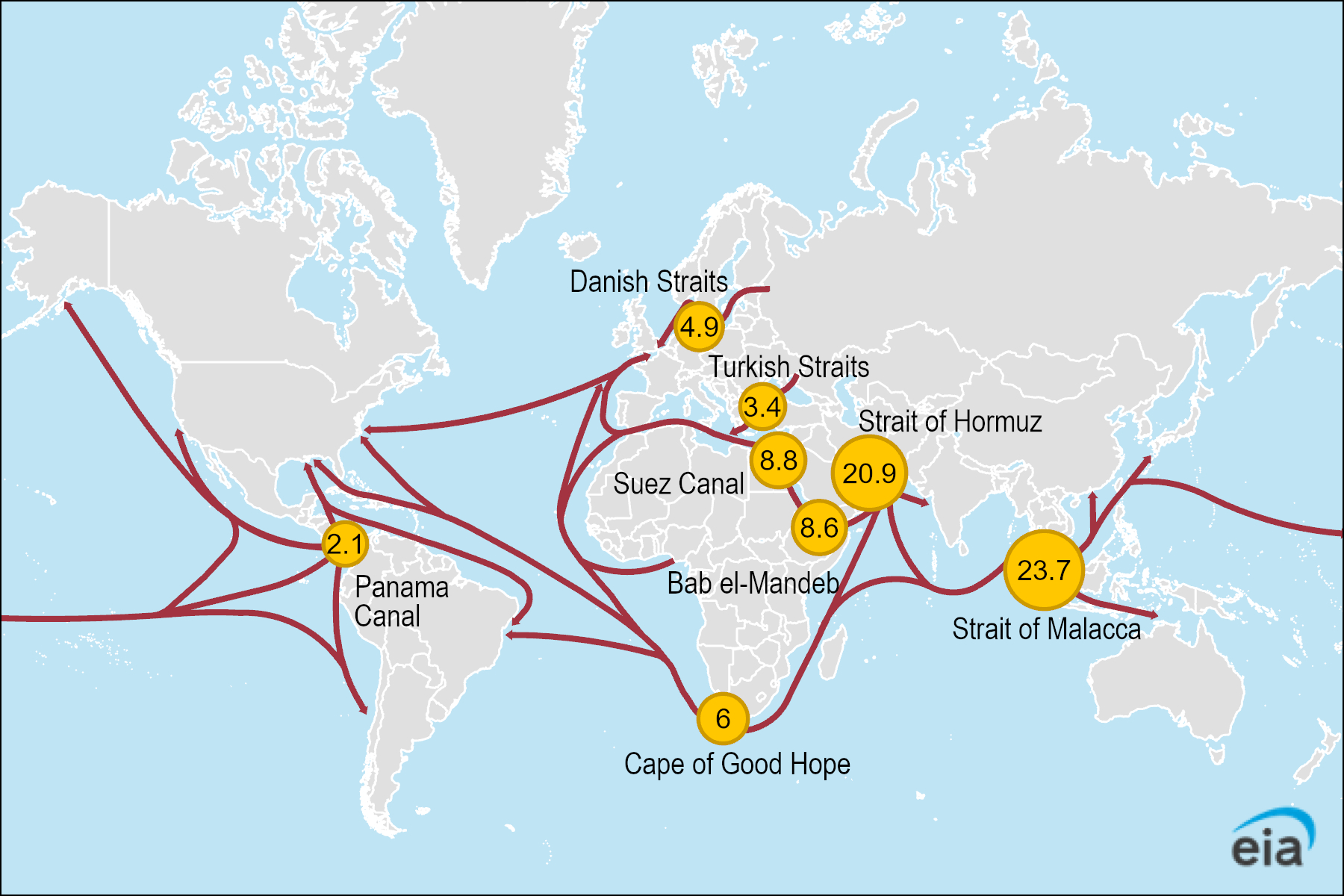
Figure 1. Daily transit volumes of petroleum and other liquids through world maritime oil chokepoints (million barrels per day) (2023)

Figure 1. Daily transit volumes of petroleum and other liquids through world maritime oil chokepoints (million barrels per day) (2023)

Data source: U.S. Energy Information Administration (EIA) analysis, based on Vortexa tanker tracking and Panama Canal Authority, using EIA conversion factors and calculations

Monday, December 04, 2023

China in the Suez Canal

Google Earth image of Suez Canal

Interesting report from Middle East Institute _"China’s growing maritime presence in Egypt's ports and the Suez Canal"
In recent years, China's presence in Egypt's strategic ports has grown noticeably. This includes the involvement of both private and state-owned Chinese companies in the partial acquisition, development, and operation of Egyptian seaports and terminals, with concessions of up to 38 years. In addition to a Chinese state-owned company holding stakes in two ports at the northern and southern entrances of the Suez Canal, a private Chinese firm also operates two strategic ports on Egypt’s Mediterranean coast and is developing and will eventually operate a third at Abu Qir Naval Base. This coincides with significant Chinese investments in the Suez Canal Economic Zone, a 455-sq-km special economic zone located along a maritime corridor of vital importance to global trade. While China's role in Egyptian ports reflects Beijing’s growing ambitions in the region, the opacity of the Sino-Egyptian agreements and the blurry lines between China's commercial ports and its military aspirations raise questions about the potential implications.


Read the whole thing. China is picking up its "presence" in a lot of key chokepoints of world trade.

Tuesday, March 30, 2021

Once Again, Chokepoints, SLOCs, the Importance of Navies

First off, what is a "chokepoint?" There is very nice definition by John Daly here:

Ever since men first put to sea, conflicts have swirled around narrow maritime passages known as choke points. A subset of the broader category of Sea Lines of Communication (SLOCs), maritime choke points act as funnels drawing in shipping from surrounding seas. As critical pressure points in naval struggles for "command of the sea," every navy seeks to secure them while denying their use to the enemy.

Oh, those "Sea Lines of Communication?" Back in 2011, I tried to clarify:

Back in the beginning days of this blog, I had a couple of posts about "sea lanes" and their importance. For example, from 2005, there was a post cleverly titled "Sea Lanes". I wrote then:

I keep posting about sea lanes. What are these things? Sea lanes are trade routes - almost like highways in the sea, where due to geography, ocean going vessels follow certain paths to avoid islands, shallows and other impediments to their travel. They are also generally the most efficient routes to get from Point A to Point B - as close to straight line travel as a ship can accomplish given the number of obstacles in its path.
Since then, there have been hundreds of posts here in which I refer to either "sea lanes" or "sea lines of communication" (see, e.g. Sea Lines of Communication (SLOCs)). There can be a difference between the two terms, since SLOC can have a military meaning that I have generally ignored here.

However, what is important to know about sea lanes or SLOCs is that they exist and that they are a major reason that nations interested in international commerce have navies - to keep the sea lanes open. In discussing maritime security, keeping sea lanes open is a major topic.

We hear a lot about how many things travel by sea. From crude oil to grain to large screen TVs to cars and much more, cheaper shipping has allowed the entire world to benefit from global product distribution (see here and here). Where do these products travel? Sea lanes. An excellent example of these sea lanes is shown on this Naval War College slide (which I have borrowed without shame):

There it is, a picture of world commerce. Those are not war ships wending their way across oceans, those are merchant ships moving the goods that make the world go. You might note that there are places where the traffic converges to pass through narrow areas. These are referred to as "chokepoints", "Chokepoints are narrow channels along widely used global sea routes . . ."

Large ships sail on rigid schedules, carrying parts from Japan to the U.S. or to Europe in such a reliable manner that warehouse costs are reduced by planning for "just in time" deliveries of products.

So, when there is a disruption in the smooth flow of goods, say from the recent earthquake in Japan, there are ripple effects that impact more than the Japanese part manufacturers.

A similar effect is caused by things that interfere with sea lanes. These might be something like a catastrophe that strikes a chokepoint like a closure of the Suez Canal.

Over 16 years ago,  I first discussed the importance of "chokepoints" on this blog.  During that period, we have seen the effects of pirates and nations interdicting ships headed to and from key chokepoints leading to and from the Indian Ocean, in the Straits of Malacca and Hormuz. 

After the recent ship grounding in the Suez Canal which is, after all,  both a very long "chokepoint" and a SLOC, some people seem to have finally taken note that there is a world-wide system of movement of trade goods and vital energy cargo that takes place on the oceans and seas of the world. 

If they had been paying attention, they could have referred to the U.S. Energy Information Agency and its World Oil Transit Chokepoints Analysis Brief from whence comes the below illustration:


All estimates in million barrels per day. Includes crude oil and petroleum liquids. Based on 2016 data.
Source: U.S. Energy Information Administration

In 1996, the U.S. National Defense University published Chokepoints: Maritime Economic Concerns in Southeast Asia which I have added below. While the data contained therein is no longer valid, and probably hugely understated given the growth of the economies of the countries of Asia, the concerns expressed are not outdated, and, like the data, probably understated.

Strategic Chokepoints of So... by lawofsea

How do we keep these vital SLOCs and chokepoints open? We have navies and coast guards that patrol the seas to thwart pirates and sea robbers. We worry about the effects of local rebel or national forces who occupy territory adjacent to chokepoints who might do damage to ships as they transit them, as we see with the Houti rebels in Yemen or the forces of countries like Iran. Remember the attempted attack on a U.S. Navy destroyer in 2016?

U.S. Navy photo by Photographer's Mate 2nd Class Peter J. Carney 

A U.S. Navy guided missile destroyer was targeted on Sunday in a failed missile attack from territory in Yemen controlled by Iran-aligned Houthi rebels, a U.S. military spokesman told Reuters, saying neither of the two missiles hit the ship.

***

The attempted strike on the USS Mason, which was first reported by Reuters, came just a week after a United Arab Emirates vessel came under attack from Houthis and suggests growing risks to the U.S. military from Yemen’s conflict.

***

Last week’s attack on the UAE vessel also took place around the Bab al-Mandab strait, in what the UAE branded an “act of terrorism.”

In 2013, more than 3.4 million barrels of oil passed through the 20 km (12 mile)-wide Bab al-Mandab each day, the U.S. Energy Information Administration says.

It was unclear what actions the U.S. military might take, but Davis stressed a commitment to defend freedom of navigation and protect U.S. forces.

"Defend fredom of navigation." Exactly. And which is why we need a large and strong Navy.

Monday, January 08, 2018

Protecting the Military Sea Logistics Stream

In an important but largely overlooked speech back in November 2017, the head of  U. S. Transportation Command discussed some of the real problems facing USTRANSCOM in its sealift role, as reported in SEAPOWER Magazine Online:
Military Sealift Command (MSC) is sailing in “contested waters” today and the military needs to consider changing the way it operates, such as relearning how to conduct armed escort missions as it did in World War II, the commander of the U.S. Transportation Command (TransCom) said Nov. 15.

TransCom also is in discussions with the Navy on how it could replace the badly aged ships in the sealift and prepositioning fleets, possibly by buying low-cost used merchant ships, Air Force Gen. Darren McDew said.
Damage to UAE operated vessel Swift after missile attack off Yemen

Speaking at an Air Force Association breakfast at the Capitol Hill Club, McDew was asked about the concerns of Vice Adm. Dee Mewbourne, commander of MSC — which is part of TransCom — that the growing threats from potential adversaries, such as China, Russia, Iran and North Korea, means that his ships will be sailing into “contested waters.”

“They doing that now,” McDew said, possibly referring to the missile attacks against two MSC ships operating off of Yemen earlier this year.

And the contested environment “doesn’t start when they get under way. It starts before they leave port,” he added, repeating his earlier warnings about the threat all of his command faces from cyber attacks and disruption of the space-based navigation systems.
***
McDew compared the potential threat to the MSC vessels to the horrific losses inflicted
"Armed Escort" FFGs in 1982
by German submarines on the Merchant Mariners crossing the Atlantic in World War II. Those civilian seaman “died at the highest rate of any U.S. force” in the war he said.


To help counter that threat, “in World War II, we had armed convoys,” he noted. “We haven’t had to worry about that since then. Maybe we have to look at what armed escort looks like.”

The general suggested that today’s cyber threats could equal the danger from World War II submarines.

The military will have to think differently because “those lines of communications will be contested.”
***
Asked about Mewbourne’s concerns about the advanced age of his sealift and prepositioning ships, McDew said he was in discussions with the Navy on how to modernize the sealift fleets.

He said the National Defense Authorization Act, which may be approved by Congress by the end of the month, has language that “would allow us to buy used vessels. There are ships on the market now that would cost one-half or one-third as much as new ships, and are available for pennies on the dollar.”

Those ships could be modernized and modified in U.S. shipyards, so “everyone wins,” he said.
McDew noted that he is “the largest owner of steam ships in the world,” but does not want that distinction, adding that virtually all the world’s commercial vessels have diesel engines, which are cheaper and require fewer Sailors.
Okay, let's look at the issues:


  1.  The threat environment has changed so that, at the very least, near shore sealift shipping is threatened by both state and non-state actors. This is true because of the proliferation of anti-shipping cruise missiles that can be transported by truck and operated with ease (see War Is Boring To Threaten Ships, the Houthis Improvised a Missile Strike Force ). While the most recent example is that of the cited missile attacks off Yemen, the issue has been very ripe since 2006 when Hezbollah, apparently aided by Iran, fired a C-802 missile at an Israeli warship. The threat of such missile attacks by state actors has, of course, been around much longer  (also Iran: Silkworm on the Hormuz).
  2.  The "sealift fleet" is old and too small. See Not Sexy But Important: "IG launches review of Military Sealift Command readiness problems".While it may be possible to modernize the sealift fleet by buying more modern used ships and refurbishing them for military use, there are issues in protecting those newer (and the current) ships both from cyber and sea-going threats. General McDew notes the need for "armed escorts." The U. S. Navy retired its last "designed to convoy" escort Perry-class FFG-7 frigates without replacements in 2015. Now the Navy is looking for a new FFX to fill the gap - and in seeming recognition that the Littoral Combat Ship is not a suitable vessel for the task - which it was never intended to perform.
  3. Underlying all of the above is the sound recognition that "sea control" in today's world is far more complex than it was in the time of a couple of near peer navies. With the land-based anti-ship cruise missiles, the safe haven of being "offshore" has moved much further from land than it used to be. Using a putative fisherman having a hand-held GPS and a radio, or using small drones flown from the beach, the targeting of shipping offshore does not really require expensive shore based or aerial targeting radars to launch missiles with their own target seeking capabilities.
  4. As a result, all those "chokepoints" so vital to sea lines of communication are threatened as never before. While the U. S. has long relied on "out-teching" adversaries, the speed with which technology changes to counter such tech is worrisome and requires both more hardware both of a counter-battery nature and defense to be spread to more vessels, including to those combat logistics force ships now operated by MSC as unarmed, mostly civilian manned units. It may be time, under the rules that govern arming such ships to return to the day when mnay such ships were manned by Navy officers and sailors, or at least to return to the days of "Navy Armed Guards" but with very modern weaponry to counter these threats. 
The most important point is to start now to address these issues. It is apparent that General McDew "gets it" - and the the Navy is moving to act - but Congress needs to understand th problems and find funding for the needed fixes now, before it's too late. 

    Thursday, August 10, 2017

    Maritime Trade Routes Are Vital, But "90% of World's Goods" Are Not Transported By Sea

    You can find this or something like it nearly everywhere shipping by sea is mentioned
    Maritime transport is essential to the world’s economy as over 90% of the world’s trade is carried by sea and it is, by far, the most cost-effective way to move en masse goods and raw materials around the world.
    Attempting to track down the source of that 90% figure is elsusive, as is trying to determine what that 90% covers. Is it in terms of "value" or "tonnage" or "volume" or some other quantity?

    Now, as you might gather if you've visited here before, I am as pro-seaborne commerce as anyone, but . . .

    Let's look at some common sense facts beginning with trade among neighboring states that share a border. Factoid from World Ocean Review:
    With respect to the value of the goods, about 23 per cent of world trade is between countries with a common border. This percentage has remained fairly constant over recent decades. Between continents, however, it differs a great deal depending on their level of development. In Europe and North America the proportion is the highest at 25 to 35 per cent. This trade is predominantly transacted by road and rail. Cargo between countries without a common border is carried mainly by sea, although increasing quantities of manufactured goods are being forwarded by air. Growth rates for air freight are more than double those for shipping in recent years. Which mode of transport handles how much cargo depends on the (relative) transportation costs and the value-to-weight ratio of the goods – the higher the value per unit of weight, the less significant the cost of transportation. Punctuality and reliability are considered more important for valuable commodities.
    Makes sense. For example, trade betwee the U.S. and Canada or Mexico does involve a lot of road and rail transport and includes pipelines, too. The EU and other countries have a lot of cross border trade. On the other hand, 90% might be a good number for countries like Great Britain or Australia, because they are islands without directly bordering states.

    That 23% "common border" trade  would seem to cut the amount of "world trade"carried by ships down to 77%, wouldn't it? Well, no. Even between countries with a common border, there may be ocean shipping of some products - like between the U.S. and Mexico. See below.

    Internal pipelines, river, rail and trucking also account for move of goods internally in the U.S. Some of which may distribute imported goods, but I seriously doubt that this statement from the Atlantic is accurate:
    Almost 90 percent of everything we buy arrives via ship, writes Rose George in her actually mind-blowing new book Ninety Percent of Everything, published tomorrow, which covers her months-long adventure with the shipping industry — the biggest business that you know nothing about.
    In addition to the fact that some of what is bought in the U.S.  is produced internally in the U.S. or in our adjoining North American countries, there is this information The Bureau of Transportation Statistics:
    Marine Transportation System transports the products that American businesses and 
    The residents use everyday. By value, vessels carry 53 and 38 percent of U.S. imports and exports, respectively (as shown in Figure 1)— the largest share of any mode.


    Figure 1—U.S. Imports and Exports Vessel Value by Mode of Transportation, 2011

    Percentages based upon millions of U.S. dollars
    Figure 1:

    So, by value, 53% of imports (2012 numbers) arive by ship and 47% by other means.

    The stuff that arrives by ship would have to be pretty vital if it is to account for "90% of what we buy."

    A couple of more figures:


    And one more showing NAFTA cross border trade increases from April 2016 to April 2017:


    So,what's it mean? To paraphrase a famous deposition quote, "It depends on what your definition of "world's trade" is."

    Now, it might mean "international trade" defined here as:
    The two main data items used in the concept of international trade are imports and exports.

    Imports of goods measures the value of goods that enter the domestic territory of a country irrespective of their final destination.

    Exports of goods similarly measures the value of goods which leave the domestic territory of a country, irrespective of whether they have been processed in the domestic territory or not.

    Imports (and exports) of services reflect the value of services provided to residents of other countries (or received by residents of the domestic territory).
    or perhaps this:
    International trade is any legal exchange of goods and services between countries. When a business in one country exports goods or services to consumers in another country, it is called international trade. International trade also takes place when consumers in one country import goods and services from a foreign producer.
    The first definition uses the word "value of goods."

    Then there is this from the World Shipping Council:
    The exchange of capital, goods and services across international borders is known as international trade and in many countries it represents a significant share of the nation's gross domestic product (GDP.) Liner ships transport approximately 60 percent of the value of seaborne trade or more than US $4 trillion worth of goods annually.
    "Liner ships" are container ships, Roll-On/Roll-Off, car and truck carriers and break bulk ships. It does not include tankers. But tanker of all types are significant as noted here:
    The single most significant type of cargo worldwide is crude oil, which alone accounts for roughly a quarter of all goods transported by sea.
    In addition to crude oil you can assume that refined petroleum products and other liquids as well as natural gas in various forms (LNG, LPG) also account for a big chunk of shipping.

    Add 60% for liner shipping and 25% for crude oil and you get 85% of the "value" of sea trade - or do you? What is the measure used in "a quarter of all goods transported by sea" when referring to crude oil? Volume? Value? Tonnage? Are we comparing apples to oranges?

    So, after all that, what do we know?

    Pretty sure that any one of the 90% figures referred to above is inaccurate - the number probably is somewhere around 70% at most.

    Your calculations may vary, but in my view it is not necessary to hype the value of sea shipping but it is a good idea to keep a doubtful eye on those who repeat a high number without supporting data.

    Monday, May 15, 2017

    U.S. Navy Office of Naval Intelligence Worldwide Threat to Shipping (WTS) Report 10 April - 10 May 2017 and HORN OF AFRICA/GULF OF GUINEA/ SOUTHEAST ASIA: Piracy Analysis and Warning Weekly (PAWW) Report for 4 - 10 May 2017

    In addition to the warnings below, Matime Executive reports Saudi Forces Find More Naval Mines Off Yemen:
    On Monday, the Royal Saudi Navy announced that its forces have located more floating mines off the coast of Yemen, likely placed by Houthi rebel militias.

    The latest mine sightings were off of Midi, a port on the Red Sea just south of the Yemeni-Saudi border. The Saudi military said that the mines were of simple construction, but they could pose a threat to civilian maritime traffic, including aid vessels.

    In mid-March, a Yemeni coast guard ship struck a mine near the port of Mokha, about 40 nm to the north of the strategically important Strait of Bab al-Mandeb. The ensuing blast killed two servicemembers and wounded eight. The Saudi navy said that it disabled several more naval mines near the port later in the month; images posted to social media at about the same time claim to show improvised mines recovered from Yemen’s Red Sea coast.
    Obviously, improvised sea mines constitute a cheap deterrent to naval operations in waters that for various reasons restrict ship movements. Not an encouraging development, but a not unexpected asymmetric means of warfare. See Houthi-Cast Naval Mines Threaten International Navigation near Midi, Yemen from whence the nearby photo came.


    Monday, March 06, 2017

    U.S. Navy Office of Naval Intelligence Worldwide Threat to Shipping (WTS) Report 30 January - 1 March 2017

    In addition to the execution of a German sea kidnap victim by a Philippine terrorist group, note:
    Red Sea, Bab-el-Mandeb Strait and Gulf of Aden Commercial vessels in the region of the Red Sea, Bab el Mandeb Strait and the Gulf of Aden should operate under a heightened state of alert as increasing tensions in the region escalate the potential for direct or collateral damage to vessels transiting the region. These threats may come from a variety of different sources such as missiles, projectiles or waterborne improvised explosive devices. Houthi rebels claimed responsibility for an 01 October attack on a UAE vessel. Vessels in the region should report hostile activities immediately and contact coalition naval forces via VHF bridge to bridge radio


    Monday, February 27, 2017

    U.S. Navy Office of Naval Intelligence Worldwide Threat to Shipping (WTS) Report 23 January - 22 February 2017

    Special warning from ONI:
    NGA Special Warning 134

    Red Sea, Bab-el-Mandeb Strait and Gulf of Aden Commercial vessels in the region of the Red Sea, Bab el Mandeb Strait and the Gulf of Aden should operate under a heightened state of alert as increasing tensions in the region escalate the potential for direct or collateral damage to vessels transiting the region. These threats may come from a variety of different sources such as missiles, projectiles or waterborne improvised explosive devices. Houthi rebels claimed responsibility for an 01 October attack on a UAE vessel. Vessels in the region should report hostile activities immediately and contact coalition naval forces via VHF bridge to bridge radio