China and Japan have started implementing a new mechanism to coordinate the movement of their warships in the Gulf of Aden to provide protection to cargo vessels from sea brigands, Press Trust of India (PTI) reported.Good.
The three countries operate independently in the Gulf of Aden to provide protection to cargo ships from pirates and are not part of the two groupings deployed there– the European EUNAVFOR and the US-led Task Force 151.
“Earlier what was happening was that the convoys of all these three countries would be spaced by few hours and there would be long hours in a day when no convoy was available for escorting the vessels,” Indian Navy’s Assistant Chief of Naval Staff (Foreign Cooperation and Naval Intelligence) Rear Admiral Monty Khanna told reporters here.
***
He said now the three countries have “evolved a mechanism under which it will be ensured that there is enough gap between the Indian, Chinese and the Japanese convoy and they are well-displaced” to be able to escort a greater number of ships in a day.
"We must be ready to dare all for our country. For history does not long entrust the care of freedom to the weak or the timid. We must acquire proficiency in defense and display stamina in purpose." - President Eisenhower, First Inaugural Address
VertRep
Showing posts with label convoys. Show all posts
Thursday, February 02, 2012
Somali Pirates: Convoy Coordination India, China and Japan
Reported as India, China, Japan coordinating in anti-piracy operations :
Friday, October 09, 2009
Somali Pirates: Protected in a Convoy
Japanese destroyers JDS HARUSAME (DD102) and JDS AMAGIRI (DD154) provide escort for a group of ships transiting the Gulf of Aden. A simple escorted convoy, it reduces the likelihood of success of pirate attacks. A helicopter overhead provides both scouting and quick reaction.
Here are photo of what it looks like from an escorted ship:


Photos courtesy of Bryan.
For more on convoys, click on the "convoys" label below.
Here are photo of what it looks like from an escorted ship:
Photos courtesy of Bryan.
For more on convoys, click on the "convoys" label below.
Monday, May 11, 2009
Somali Pirates: "Where are the Escorts?"
Kennebec Captain: Escorts for Group Transits asks that question.Go see.
And you might ponder this: Asymmetric Warfare: Terrorists, Small Boats, Explosives and Unarmed, Unescorted Ships. And, Pirates of Somalia: Asymmetric Warfare.
Wednesday, May 06, 2009
Somali Pirates: Good Weather for Pirating
Once again, as noted here, this time of year is good for the pirates operating off Somalia, whether in the Gulf of Aden or off the Somali east coast, in the pre-monsoon season.
Winds and waves are reasonable. Click on the image below to enlarge, but it shows the forecast for the winds and waves on 7 May 09 from here. Winds are calm to 15 knots and waves under 3 meters in most of the pertinent areas. Ship masters and crews should keep a sharp eye for pirates and, if possible, participate in convoys:
Tuesday, May 05, 2009
Somali Pirates: Convoys Work
An indication that ships proceeding in "convoy" (in the form of transiting an area protected by naval vessels) are less likely to be victimized by Somali pirates here (subscription):
JUST one vessel registered with the European Union’s anti-piracy operation was successfully hijacked in the first three months of the operation, according to the latest Brussels’ figures.The EU Horn of Africa website is here.
***
“Since 12 December 2008, 41 attacks have been confirmed in the area of operations, resulting in seven actual hijackings. Only one of the seven hijacked vessels was following EU Navfor recommendations,” said the EU Council of Ministers, referring to the period to March 1.
The EU Atalanta operation, the bloc’s first maritime venture, escorted 11 World Food Programme vessels over the period, carrying 60,000 tonnes of food each week to the strife-ridden nation.
Rather than being escorted, commercial vessels are organised into convoys which are then watched over by EU navy vessels stationed at strategic points. Ship operators register vessels over a website and are given convoy start times and locations.
“The EU mission is not alone in the region,” the Council of Ministers pointed out. “Efficient coordination both with the shipping industry and with other naval units deployed by maritime powers (Russia, China and India) or groups (US-led coalition TF 151 + NATO) is therefore essential.
Tuesday, April 14, 2009
Somali Pirates: "Convoys could work"
So says Peter D. Zimmerman on the op-ed side of the Wall Street Journal here:Pirates, like the Nazi submarines of World War II, do not hunt for their targets; they lie across the sea lanes where ships are likely to travel and simply wait for a victim to come over the horizon. And the same tactic which defeated the U-boats can put an end to the majority of pirate attacks. Merchant ships can be ordered to form convoys for their own protection.Of course, you may have already heard that "convoy" argument (or here). Or, you may know that World Food Program has been using escorts for some time to get food ships through the pirates. And that Canada was an early leader in using its ships to save lives by escorting food to the starving Somalis, along with other NATO forces:
Thirty thousand ships a year, roughly 100 a day, 50 in each direction, transit the waters off the coast of Somalia. One convoy in each direction, each day, alternating between fast ships and slower ones, and each accompanied by four or five escort vessels, would do the job. There would then be only two targets a day in each area of coast for the pirates to find, instead of 100. When marauders approach a convoy, they could be warned off by the escorts or destroyed if they attack.
Convoys have historically been the antidote to piracy on the open seas, and they can defend against these attacks once again. Modern naval escorts, equipped with helicopters, have the ability to establish a perimeter around the merchant ships, the firepower to stop a pirate, the legal jurisdiction to do so under the Convention on the Law of the Sea, and the ability to deliver their prisoners for trial.
The Netherlands and NATO have responded to an appeal from the United Nations World Food Programme for naval escorts to protect its ships carrying life-saving assistance from pirate attacks off Somalia. More than 2 million Somalis could go hungry without this protection.Now, the European Union has taken on the protection of food shipments into Somali ports, as set out here:
One convoy delivered 3 ships safely:A convoy of three World Food Program (WFP) chartered vessel is transiting form Mombassa towards Somali ports escorted by NATO ships, to deliver over 21,000 tons of humanitarian aids.
Two NATO navy ships operating in Operation Allied Provider are escorting these three vessels, in order to protect them against piracy.
The Hellenic frigate HS Themistokles is escorting MV Victoria (carrying 4.300 metric tons of aids) and MV Rabbana (carrying 6.000 metric tons of aids).
The Turkish frigate Gokova is escorting MV As Salaam, carrying 11.000 metric tons of aid.
You may be surprised to learn that Maersk Alabama was part of that feed the Somalis program:The EU’s “Operation Atalanta” includes naval escorts for WFP ships, escorts for commercial shipping, aerial surveillance and measures to deter, prevent and intervene in order to bring an end to acts of piracy and armed robbery off the Somali coast. It is the first-ever EU naval operation and was established under the French Presidency of the European Union.
Somali pirates are in danger of again threatening food supplies for the war-ravaged East African country, the UN food agency warned on Tuesday. "Piracy is a constant concern for the World Food Programme," said spokeswoman Emilia Casella - noting that 90 per cent of the aid to Somalia is delivered by sea.So, yes, convoys do work.
The Maersk Alabama with its American crew were captured last week as they were delivering food aid to Africa. More than half of the 200 containers on the ship were destined for the WFP.
Casella said the agency plans to give food to 3.5 million Somalis this year.
***
WFP ships or contracted vessels, like the Maersk Alabama, going to the Kenyan port of Mombasa, do not receive a military escort.
This was the first time a Mombasa-bound aid vessel had been captured, raising concerns that the delivery of humanitarian help could be affected.
About 200 ships with food aid arrived at the Kenyan port last year.
Deliveries from Mombasa to Somalia itself, however, are covered by Western warships, a programme seen as vital for the WFP.
"Without these escorts we'd be at risk of not being to bring food to Somalia," Casella said.
Before the escorts began in 2007, several WFP ships were hijacked by pirates. In the summer of 2008 there was a six week period when there were no warships to accompany the humanitarian vessels and all food delivery stopped until Canada arranged for escorts. Currently, the European Union has taken the responsibility of accompanying the food.
Photo captions: (credit German Navy)EU NAVFOR Atalanta prevents hijacking, 4 March 2009
Monday, April 06, 2009
How to Beat the Somali Pirates
It's been noted here (see here) and other places that the Somalia pirates have shifted some of their operations to a sea lane about 400 - 500 nautical miles off the east coast of Somalia. They are able to find ships in that area because despite the vast size of the Indian Ocean, most ships follow time tested routes that save time and fuel and carry them to ports. These routes are logical and well known.

Take a look at the nearby maps. At the top is an older map (Map 1) showing the dhow routes that have been sailed since ancient times. There's a pattern to the flow of dhows. Click on any of the maps to make them bigger.
The second map (Map 2) is my own presentation of modern sea lanes along the coast of east Africa - the red lines are the sea lanes. In the modern sea faring world ships, in theory, may have the freedom to choose their routes and the freedom of the open
sea, etc, etc, but the practical reality is that merchant ships are driven by the cruel masters of time and money. For the owners of merchant ships time is money and any ship's master who decides to wander all over the ocean instead of taking the shortest, fastest route from one port to another will quickly be out of a job. Since there can only be one "shortest, fastest, safest route between two ports" that route becomes a sea lane. The seemingly chaotic world of ocean shipping is in many ways quite predictable. It is this predictability that the Somali pirates now rely on.
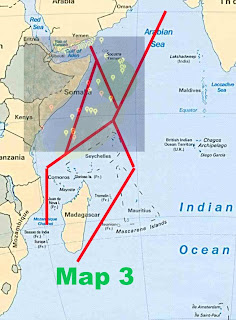
Map 3 superimposes on those sea lanes the most recent ships attacks and hijackings. While the maps I used don't mesh exactly (and I am too lazy to make them fit) the point I am making is clear. The pirate attacks happen along the sea lanes. Why? Because, to paraphrase Willie Sutton, "that's where the ships are."
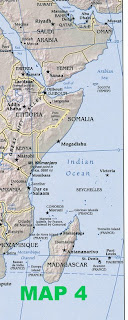
Map 4 shows that the east African shipping route area is sprinkled with islands that must be avoided - again ensuring that the routes to be taken by merchant ships, yachts and fishing trawlers are predictable, and well known to crews of boats native to the area. Shipping transiting the area does not have unlimited sea room in which to maneuver.
Given all of the above, Somali pirates and their confederates may lie in wait along these predictable routes and wait for ships to come to them - as they inevitably will.
How do you thwart these pirates at sea? One possibility, in use in the Gulf of Aden, is to flood the sea lanes with sea policemen or naval forces who serve to deter or stops assaults on shipping in their beat area. Another possibility, especially when you have limited naval assets, and which is also in use in the Gulf of Aden, is to provide escorts to single or multiple ships as they transit the risk areas during periods when the pirates are likely to be active (low winds, day light hours or during periods of a bright moon) or escort ships that have proven to be at risk (low freeboard ships, slow transit speeds).
Put helicopters and UAVs in the air and learn the local fishing patterns to find the "fishing boats" that don't acty like the others. Use the helicopters to scout routes ahead of merchant ships.
For the long transit down the eastern coast of Somalia, I propose a small variation on the convoy system. Points A, B and C on Map 5 become Ocean Convoy Collection Points (OCCPs) where ships desiring to transit piracy risk areas can gather for convoying to the other points.
Now, I know very well that what I said before about time and money are negative motivators for merchant ships to wait for convoys to be formed. And, after all, the odds of being nabbed by pirates are pretty slim. However, there are some risk adverse ship owners who will accept the convoys, especially if their insurance carrier will lower premiums for convoy participants.
I said it before and I'll say it again - given a chance - convoys work.
And, if you aren't going to invade Somalia to take out pirate havens, you don't really have a lot of other options.

Take a look at the nearby maps. At the top is an older map (Map 1) showing the dhow routes that have been sailed since ancient times. There's a pattern to the flow of dhows. Click on any of the maps to make them bigger.
The second map (Map 2) is my own presentation of modern sea lanes along the coast of east Africa - the red lines are the sea lanes. In the modern sea faring world ships, in theory, may have the freedom to choose their routes and the freedom of the open
sea, etc, etc, but the practical reality is that merchant ships are driven by the cruel masters of time and money. For the owners of merchant ships time is money and any ship's master who decides to wander all over the ocean instead of taking the shortest, fastest route from one port to another will quickly be out of a job. Since there can only be one "shortest, fastest, safest route between two ports" that route becomes a sea lane. The seemingly chaotic world of ocean shipping is in many ways quite predictable. It is this predictability that the Somali pirates now rely on.
Map 3 superimposes on those sea lanes the most recent ships attacks and hijackings. While the maps I used don't mesh exactly (and I am too lazy to make them fit) the point I am making is clear. The pirate attacks happen along the sea lanes. Why? Because, to paraphrase Willie Sutton, "that's where the ships are."
Map 4 shows that the east African shipping route area is sprinkled with islands that must be avoided - again ensuring that the routes to be taken by merchant ships, yachts and fishing trawlers are predictable, and well known to crews of boats native to the area. Shipping transiting the area does not have unlimited sea room in which to maneuver.Given all of the above, Somali pirates and their confederates may lie in wait along these predictable routes and wait for ships to come to them - as they inevitably will.
How do you thwart these pirates at sea? One possibility, in use in the Gulf of Aden, is to flood the sea lanes with sea policemen or naval forces who serve to deter or stops assaults on shipping in their beat area. Another possibility, especially when you have limited naval assets, and which is also in use in the Gulf of Aden, is to provide escorts to single or multiple ships as they transit the risk areas during periods when the pirates are likely to be active (low winds, day light hours or during periods of a bright moon) or escort ships that have proven to be at risk (low freeboard ships, slow transit speeds).
Put helicopters and UAVs in the air and learn the local fishing patterns to find the "fishing boats" that don't acty like the others. Use the helicopters to scout routes ahead of merchant ships.
For the long transit down the eastern coast of Somalia, I propose a small variation on the convoy system. Points A, B and C on Map 5 become Ocean Convoy Collection Points (OCCPs) where ships desiring to transit piracy risk areas can gather for convoying to the other points.Now, I know very well that what I said before about time and money are negative motivators for merchant ships to wait for convoys to be formed. And, after all, the odds of being nabbed by pirates are pretty slim. However, there are some risk adverse ship owners who will accept the convoys, especially if their insurance carrier will lower premiums for convoy participants.
I said it before and I'll say it again - given a chance - convoys work.
And, if you aren't going to invade Somalia to take out pirate havens, you don't really have a lot of other options.
Monday, February 23, 2009
African Pirates: South Africa's Navy to Start Escorting Ships
South Africa's Navy will be getting involved with African piracy matters, as set out here:South Africa's navy could be escorting billions of dollars worth of cargo through treacherous East African waters within weeks as attacks by pirates around the continent continue to escalate.Very interesting, as the loose ends are being tied up - limiting the safe areas for Somali pirates to operate in.
This was revealed on Friday during a media briefing by the South African National Defence Force's joint operations division in Pretoria.
In scenes reminiscent of convoy escorts during World War 2, the South African Navy could soon be involved in patrolling and escorting hundreds of vessels off the coast of Somalia and the rest of the continent's eastern coastline.
It is believed that South African ships would escort vessels from South Africa's territorial waters into Somali waters where other navies, currently patrolling those seas, would take over the escort duties.
It is believed that South Africa is being requested to escort ships between South Africa and Somalia because of fears that the attacks could move further south.
In June, the UN Security Council adopted a resolution allowing ships from foreign nations that co-operate with the Somali government to enter Somali territorial waters "for the purpose of repressing acts of piracy and armed robbery at sea".
On the map, the arrow points to South Africa, the "x" is off Somalia.
Thursday, February 19, 2009
Somali Pirates: Somalia Convoy Corridor?

Well, here's a proposed solution to inshore Somali piracy as reported here:
Somalia's new unity government will solve the problem of piracy by creating a maritime corridor through the country's territorial waters, the Somali ambassador to Russia said on Thursday.And we all know what to do with pirates and poachers . . .
Mohammed Mahmud Handule said at a RIA Novosti news conference that the Somali government had already worked out the legal and technical issues involved in opening the corridor.
"The new [Somali] government will rigorously work on this [problem of piracy]," he said. "We want to create a corridor where from Point A all ships will be put in groups of 5-7, and then our friends, including Russia, will escort them to Point B. Vessels not travelling through that corridor will be considered pirates or poachers."
Wait, who said "You are either with us or against us?"
Thursday, December 11, 2008
Somali Pirates: Convoys work
I don't know why David Axe limited his "convoy" reference to World War II, since convoys were a feature of anti-pirate operations going back over 500 years to the earliest days of ships carrying cargo from one point to another , but nonetheless, he writes New Anti-Pirate Tactic: World War II-Style Convoys :This weekend the first E.U.-escorted convoy will sail from Mombasa, with a French or British frigate providing the heavy firepower. "With escorts, we're getting more food in," Smerdon said. But don't expect the same tactic to work for commercial ships plying the Gulf of Aden. According to Wahutu, most commercial ships sail on strict schedules. "If you have to wait for a convoy to form up, you lose time." And time means money.Convoys do work, and you can lessen the time of waiting by having enough escorts available. See my earlier post calling for convoys.
So while the world's biggest food campaign piggybacks on World War II-style convoys, for-profit shipping is still going it alone, despite the risks.
UPDATE: A little Wikipedia history:
Naval convoys have been used for hundreds of years, and examples of merchant ships traveling under naval protection have been traced back to the 12th Century.[1] The use of organised naval convoys dates from when ships began to be separated into specialist classes and national navies were established.[2]NATO has an organization of personnel trained in setting up convoy operation under the name of Naval Coordination and Guidance to Shipping (NCAGS)(see here for some background and here).
By the French Revolutionary Wars of the late 18th century, effective naval convoy tactics had been developed to ward off pirates and privateers. Some convoy contained several hundred merchant ships. The most enduring system of convoys were the Spanish treasure fleets, that sailed from the 1520s until 1790.
When merchant ships sailed independently, a privateer could cruise a shipping lane and capture ships as they passed. Ships sailing in convoy presented a much smaller target: a convoy was no more likely to be found than a single ship. Even if the privateer found a convoy and the wind was favourable for an attack, it could hope to capture only a handful of ships before the rest managed to escape, and a small escort of warships could easily thwart it. As a result of the convoy system's effectiveness, wartime insurance premiums were consistently lower for ships which sailed in convoys.[2]
The U.S. has several reserve units devoted to worrying about such matters (and in which I toiled for many years), folded into the U.S. Fleet Forces Command (pdf). More on the U.S. NCAGS program here (pdf):
Naval Cooperation and Guidance for Shipping (NCAGS) definedThe NATO Shipping Centre is largely an NCAGS operation.
• NCAGS is a program that bridges the gap between operational forces and merchant shipping by providing a framework for communicating directions, advisories, concerns and information within a maritime region.
• The mission is to assist operational commanders in managing risk by providing situational awareness and near real-time information on the commercial shipping picture to help ensure the safe passage of merchant shipping and the safety of naval vessels. This is accomplished through the use of technology and cooperation between partner nations and commercial industry.
NCAGS is a component of the Maritime Strategy and helps build Maritime Domain Awareness
• NCAGS is an important part of the Maritime Strategy and provides a framework toward building Maritime Domain Awareness (MDA), an effective understanding of anything associated with the maritime domain that could impact the security, safety, economy or environment of the United States.
NCAGS Capabilities – Global Force Provider
• Organized under USFF, NCAGS units in the United States are located in Bronx, N.Y., Chicago, IL; Tacoma, Wash.; and Miami, Fla. Each unit is led by a Navy captain and includes 48 personnel from the Navy Reserve force. Many assigned personnel have extensive shipping industry experience or merchant marine qualifications.
• Liaison Officers (LNOs) -- Provide advice on NCAGS measures; senior liaison with civil maritime industry and fleet commanders.
• Shipping Coordination Team (SCT) -- Provides capability for a 24-hour watch at sea or ashore; flexible configuration adjusting to Combatant Commander needs.
• Shipping Coordination Center (SCC) -- Provides analysis capability supporting forward deployed LNOs and SCTs. SCCs are located in Dam Neck, Va., Key West, Fla., and Alameda, Calif., increasing MDA and facilitating the movement of goods and people into U.S. ports.
UPDATE2: Speaking of earlier pirate wars, how about Pompey vs. The Pirates circa 67 BC?
The pirates were at this time masters of the Mediterranean, and had not only plundered many cities on the coasts of Greece and Asia, but had even made descents upon Italy itself. As soon as Pompey received the command, he began to make his preparations for the war, and completed them by the end of the winter. His plans were crowned with complete success. Pompey divided the Mediterranean into thirteen separate areas, each under the command of one of his legates. In forty days he cleared the Western Sea of pirates, and restored communication between Hispania, Africa, and Italy. He then followed the main body of the pirates to their strongholds on the coast of Cilicia; after defeating their fleet, he induced a great part of them, by promises of pardon, to surrender to him.Cilicia is an old name for the Mediterranean coast of Turkey.
The Athenians used convoys way back when (4th Century BC, see pages 111-112):
. . . The grain did nobody in Athens any good until it arrived . . . and there were unscrupulous competitors. . .and pirates loose all over the seas. One of the reasons Piraeus was so important a center for the grain trade was that Athens had a navy large enough to supply escorts to convoy fleets of freighters . . .Can't beat those classic ideas.
UPDATE: Technically, unless the merchant ships are placed under military control, the proper word is not "convoy" but "accompaniment." See ATP2(B):
(1) Accompaniment. A voluntary arrangement in which merchant ships may be organised for passage through a specific area of increased risk in company with military assets. Details will be promulgated via navigational warning (NAVWARN).Accompaniment does not imply direct protection by military assets; however, the presence of military assets may act as a deterrent to any unlawful interference to merchant ships.As compared to:
(4) Convoy. NCAGS can recommend and facilitate convoy operations for merchant shipping. The purpose of convoy operations is to escort and to protect merchant ships by means of military assets through a specific area with higher risk due to unlawful interference. The safe passage of a convoy depends on the organisation before sailing, the management and control at sea and the skilful handling of each ship while in convoy. Ships in convoy sail under military command. Merchant ships under naval supervision have to follow the orders of the Convoy Commodore, other merchant ships cannot be forced to take part in a convoy organisation, but they can be integrated on a voluntary basis. Masters are at all times responsible for the crew, safe navigation and handling of their ship. Details will be promulgated via NAVWARN.A fine distinction, but . . . such is International Law.
Friday, May 30, 2008
Preventing Pirate Attacks- the Old-Fashioned Way

If you want to stop pirate attacks then you have to do more than just wring your hands and take resolutions to the UN. The proactive approach is to set up a convoy system.
It worked in the past:
By the French Revolutionary Wars of the late 18th century, effective naval convoy tactics had been developed to ward off pirates and privateers. Some convoys contained several hundred merchant ships. The most enduring system of convoys were the Spanish treasure fleets, that sailed from the 1520s until 1790.I guess 400 years of history is too easily forgotten. Convoy ops can be modernized to allow for radar, higher speed naval ships.
When merchant ships sailed independently, a privateer could cruise a shipping lane and capture ships as they passed. Ships sailing in convoy presented a much smaller target: a convoy was no more likely to be found than a single ship. Even if the privateer found a convoy and the wind was favourable for an attack, it could hope to capture only a handful of ships before the rest managed to escape, and a small escort of warships could easily thwart it.
Ship owners worried about time delays need to measure time vs. ransom fees.
Subscribe to:
Posts (Atom)

