VertRep

Showing posts with label Drug War. Show all posts
Showing posts with label Drug War. Show all posts
Monday, September 15, 2025


Thursday, August 08, 2019
Hey! Who keeps saying that pot is harmless? Well, pushers and others seeking to get rich off of it mostly. What if it isn't?
NY Post opinion piece by Miranda Devine The link between pot, shootings may be closer than we think
Even as evidence mounts of the health problems associated with marijuana, New York has insisted on joining other greedy states scrambling to legalize this deceptively dangerous drug.See also Another Threat to Society - "Marijuana, Mental Illness, and Violence":
It makes no sense at a time when American youth is suffering from an unprecedented mental health crisis.
And, in all honesty, we cannot rule out a connection between increasing marijuana use, mental illness and the recent spate of mass shootings by disturbed young males.
We don’t yet know much about the mental state or drug use of the El Paso or Dayton killers. But a former girlfriend of Dayton killer Connor Betts, 24, has indicated he was mentally ill, and two of his friends interviewed by reporters this week mentioned his previous drug use.
***
You can’t address the youth mental health crisis without considering the effect of rising teen marijuana use.
Among American teenagers, the drug’s “daily use has become as, or more, popular than daily cigarette smoking” according to the National Institute of Health’s 2017 Monitoring the Future study.
We’ve successfully demonized cigarettes while new laws send kids the message that marijuana is harmless.
Yet we’ve known for more than a decade of the link between marijuana and psychosis, depression and schizophrenia.
In 2007 the prestigious medical journal Lancet recanted its previous benign view of marijuana, citing studies showing “an increase in risk of psychosis of about 40 percent.”
A seminal long-term study of 50,465 Swedish army conscripts found those who had tried marijuana by age 18 had 2.4 times the risk of being diagnosed with schizophrenia in the following 15 years than those who had never used the drug. Heavy users were 6.7 times more likely to be admitted to a hospital for schizophrenia.
Another study, of 1,037 people in New Zealand, found those who used cannabis at ages 15 and 18 had higher rates of psychotic symptoms at age 26 than non-users.
A 2011 study in the British Medical Journal of 2,000 teenagers found those who smoked marijuana were twice as likely to develop psychosis as those who didn’t.
A really interesting article from the Hillsdale College publication Imprimis Marijuana, Mental Illness, and ViolenceThings are seldom as they seem, and, as with "feel good alcohol" use, there is a price to be paid down the road for the harm the purveyors of marijuana are doing with their "harmless buzz" pushing of their product.
Over the last 30 years, psychiatrists and epidemiologists have turned speculation about marijuana’s dangers into science. Yet over the same period, a shrewd and expensive lobbying campaign has pushed public attitudes about marijuana the other way. And the effects are now becoming apparent.If you are concerned about the effects on our society of the promiscuous use of legal and illegal drugs, then this article about the relationship of marijuana to mental diseases, you should read this article.
Almost everything you think you know about the health effects of cannabis, almost everything advocates and the media have told you for a generation, is wrong.
The issues raised need far more exposure.
Not only should we be concerned about what the research reported on by Mr. Berenson indicates, we should also be concerned about the long-term effects on the bodies of habitual users of marijuana - if inhaling tobacco smoke or chewing tobacco are known cancer risks, it seems pretty obvious that doing the same sort of ingestion with another substance must pose some risk - one that the users of today will tomorrow being suing the legal purveyors of their supply for "misrepresentation" of the health benefits of their product.
Tuesday, February 19, 2019
Another Threat to Society - "Marijuana, Mental Illness, and Violence"
A really interesting article from the Hillsdale College publication Imprimis Marijuana, Mental Illness, and Violence
The issues raised need far more exposure.
Not only should we be concerned about what the research reported on by Mr. Berenson indicates, we should also be concerned about the long-term effects on the bodies of habitual users of marijuana - if inhaling tobacco smoke or chewing tobacco are known cancer risks, it seems pretty obvious that doing the same sort of ingestion with another substance must pose some risk - one that the users of today will tomorrow being suing the legal purveyors of their supply for "misrepresentation" of the health benefits of their product.
Of course, the illegal suppliers will prove to be unlikely defendants in such trials.
Full disclosure - I graduated many years ago from the Navy's Drug And Alcohol Counselor School and was the director of one of the Navy Counseling and Assistance Center/Alcohol Rehabilitation Drydock facilities and thus have some practical experience in the drug and alcohol abuse world.
Over the last 30 years, psychiatrists and epidemiologists have turned speculation about marijuana’s dangers into science. Yet over the same period, a shrewd and expensive lobbying campaign has pushed public attitudes about marijuana the other way. And the effects are now becoming apparent.If you are concerned about the effects on our society of the promiscuous use of legal and illegal drugs, then this article about the relationship of marijuana to mental diseases, you should read this article.
Almost everything you think you know about the health effects of cannabis, almost everything advocates and the media have told you for a generation, is wrong.
The issues raised need far more exposure.
Not only should we be concerned about what the research reported on by Mr. Berenson indicates, we should also be concerned about the long-term effects on the bodies of habitual users of marijuana - if inhaling tobacco smoke or chewing tobacco are known cancer risks, it seems pretty obvious that doing the same sort of ingestion with another substance must pose some risk - one that the users of today will tomorrow being suing the legal purveyors of their supply for "misrepresentation" of the health benefits of their product.
Of course, the illegal suppliers will prove to be unlikely defendants in such trials.
Full disclosure - I graduated many years ago from the Navy's Drug And Alcohol Counselor School and was the director of one of the Navy Counseling and Assistance Center/Alcohol Rehabilitation Drydock facilities and thus have some practical experience in the drug and alcohol abuse world.
Friday, December 22, 2017
Follow the Money: Terrorism Financing, Drug Smuggling and U. S. Maritime Security
The Josh Meyer Politico article The secret backstory of how Obama let Hezbollah off the hook contains so many interesting trails that it is easy to forget the key point:
For example, let's take a look at the now nearly routine capture of "drug smuggling submarines" - see CBP, Coast Guard Seize Drug Smuggling Submarine from earlier this month:
AMERICA is fighting a new front in its war on drugs — locating, tracking and intercepting fleets of sophisticated homemade submarines loaded with cocaine.:
Notable is the amount of money involved in this trade Coast Guard in Florida offload $23 million worth of cocaine:
Clearly, by the amount of illegal drugs successfully entering the country, the capture rate, even of expensive semi-submersibles, is merely a "cost of doing business" in the lucrative trade.
While much has been made of the potential to use these routes for human smuggling of terrorists, perhaps the amount of money generated through illegal drugs is sufficient to make such efforts unnecessary because it is just as easy to fund locally grownn terrorists or import "refugees" who may be funded to perform acts of terror. At least, that is. so far.
The drug smugglers are innovative and well-financed. As a result, they freely experiment with new tech:
It's a problem and one that we need to find better solutions to handle.
The untold story of Project Cassandra illustrates the immense difficulty in mapping and countering illicit networks in an age where global terrorism, drug trafficking and organized crime have merged, but also the extent to which competing agendas among government agencies — and shifting priorities at the highest levels — can set back years of progress.In addition to funding terrorism, the routes used to smuggle illegal drugs into the U.S. are national security threats.
And while the pursuit may be shadowed in secrecy, from Latin American luxury hotels to car parks in Africa to the banks and battlefields of the Middle East, the impact is not: In this case, multi-ton loads of cocaine entering the United States, and hundreds of millions of dollars going to a U.S.-designated terrorist organization with vast reach.
For example, let's take a look at the now nearly routine capture of "drug smuggling submarines" - see CBP, Coast Guard Seize Drug Smuggling Submarine from earlier this month:
Customs and Border Protection based out of Corpus Christi said they captured a drug submarine attempting to smuggle nearly two tons of cocaine into the country.Or Jaime Seidel's
Crews from the CBP Air and Marine Operations tracked the sub last month while operating in international waters.
Officers tracked the sub for several days before a Coast Guard Cutter stopped it and arrested its crew.
Over 3,800 pounds of cocaine were seized and three suspects on board face multiple charges.
AMERICA is fighting a new front in its war on drugs — locating, tracking and intercepting fleets of sophisticated homemade submarines loaded with cocaine.:
BURIED deep in the jungles of South America are covert shipyards.U.S. Coast Guard video of a capture of a drug smuggling boat in June 2017:
They’re hand-building submarines. And they’re churning out dozens every year.
They have just one job to do.
Covertly carry tons of cocaine, along with crews of armed smugglers.
They skim just beneath the surface of the Carribbean and Pacific, out of sight and under the radar of law enforcement ships and aircraft.
PACIFIC OCEAN
06.08.2017
Coast Guard Cutter Waesche crewmembers intercept a suspected low-profile smuggling vessel seizing an estimated 5,550 pounds of cocaine worth more than $74 million while on patrol off the coast of Central America, June 8, 2017. Waesche is a 418-foot long National Security Cutter homeported at Coast Guard Island in Alameda, Calif., outfitted with the most advanced command, control, and communications equipment for detecting and disrupting transnational organized crime networks. U.S. Coast Guard video courtesy of Coast Guard Cutter Waesche/Released.
Notable is the amount of money involved in this trade Coast Guard in Florida offload $23 million worth of cocaine:
The Coast Guard Cutter Pelican brought ashore almost one ton of cocaine Monday.You will note that arrests are made in the Caribbean, the Gulf of Mexico and the Pacific, an indication of how wide-spread the the operations of these drug cartels are. Spreading the smuggling routes forces the law enforcement agenices to spread themselves thinner to cover larger areas with the same limited number of assets.
The cocaine is valued at $23 million, and along with the seizing of the drug, three smugglers were also arrested.
The cocaine came from a drug bust in the Caribbean Sea on Nov. 11, just south of Jaragua, Dominican Republic, say officials with the Coast Guard.
Clearly, by the amount of illegal drugs successfully entering the country, the capture rate, even of expensive semi-submersibles, is merely a "cost of doing business" in the lucrative trade.
While much has been made of the potential to use these routes for human smuggling of terrorists, perhaps the amount of money generated through illegal drugs is sufficient to make such efforts unnecessary because it is just as easy to fund locally grownn terrorists or import "refugees" who may be funded to perform acts of terror. At least, that is. so far.
The drug smugglers are innovative and well-financed. As a result, they freely experiment with new tech:
It's a problem and one that we need to find better solutions to handle.
Sunday, April 17, 2016
U.S. Navy Office of Naval Intelligence Worldwide Threat to Shipping (WTS) Report 15 March - 13 April 2016
Nigeria's "board ships and kidnap crews for ransom" season seems to be in full swing.
Nice 16 ton cocaine bust in Mexico.
Nice 16 ton cocaine bust in Mexico.
Wednesday, July 24, 2013
U.S. Coast Guard: Scratch one drug run
.jpg)
From CPO Judy Silverstein at Coast Guard Compass
USCG video.On the evening of Jul. 15, 2013, a Coast Guard HC-144 Ocean Sentry airplane from Air Station Miami detected a go-fast in the waters south of Mona Pass. Assisted by infrared capabilities, the sharp aircrew detected suspicious, square-shaped packages onboard and notified the command center at Sector San Juan, Puerto Rico.
Along with Coast Guard Cutter Legare, Coast Guard Cutter Robert Yered and a helicopter from the Helicopter Interdiction Tactical Squadron were diverted to assist in pursuit of the suspected smugglers. Once on scene, the helicopter crew asked the suspicious vessel to halt. When it failed to do so, warning shots were fired.
As the go-fast continued to flee and began tossing bales overboard, the helicopter fired disabling shots. What began as an adrenaline-laced pursuit resulted in an important seizure of 2,300 pounds of cocaine and the apprehension of four suspected smugglers. The street value of the seizure was estimated at $35 million.


Saturday, September 15, 2012
Weekend Reading
 |
| Krugman needs one of these |
North American energy independence possible, House panel told:
It’s not unrealistic to expect abundant oil and gas resources to help make North America energy independent within a decade, witnesses told a US House Energy and Commerce Committee subcommittee on Sept. 13.
“The United States has become the world’s second-largest oil producer,” said Harold G. Hamm, chief executive of Continental Resources Inc. in Enid, Okla. “We just passed Russia and are behind only Saudi Arabia. I don’t think a lot of people realize this.”
Hydraulic fracturing and horizontal drilling have helped the US reduce its crude oil imports from 60% of its total consumption a few years ago to 45%, he told the committee’s Energy and Power Subcommittee. US natural gas reserves have grown from a 7-year supply to one that’s more than a century, Hamm added.
“The technology that allows us to drill 2 miles down, turn right, go another 2 miles, and hit a target the size of a lapel pin has unlocked the resources that make energy independence a reality,” he said.

Iran is complaining about "terrorists" in Syria receiving shipments of weapons from stocks in Libya. "Terrorists" being those who oppose the Iranian-supported Assad regime. Irony knows no bounds.
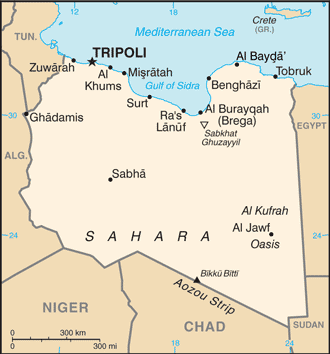
Over the past two months, at least three Iranian-linked container ships, all blacklisted by the U.S. Treasury, have called at the Libyan port of Benghazi.
***
The U.S. government has described Iran as the world’s “leading state sponsor of terrorism.” The U.S. State Department, in its most recent annual report on terrorism, released in July, noted that Iran had “increased its terrorist-related activity, likely in an effort to exploit the uncertain political conditions resulting from the Arab spring.” The same report noted that “Iran continued to provide financial, material and logistical support for terrorist and militant groups throughout the Middle East and Central Asia.” This includes “weapons, training and funding” for Palestinian terrorist groups, and “weapons and training” to help Syria’s Assad regime in a crackdown that has cost many thousands of lives.
***
In remarks Wednesday on the deaths of American personnel in Benghazi, Secretary of State Hillary Clinton reaffirmed that “A free and stable Libya is still in America’s interest and security, and we will not turn our back on that.” Surely, regardless of who was behind the Sept. 11 attack, the aspirations for a free and stable Libya are better served without the presence of blacklisted IRISL vessels dispatched from terror-linked ports in Iran.
Drug submarines continue to make news,
Use of sophisticated drug subs spikes in the Caribbean. There was a time when such drug running subs where operating only in the Pacific. Things change, but the threat is high:
American authorities have recently discovered at least three models of a new and sophisticated drug-trafficking submarine capable of travelling completely underwater from South America to the United States, and the use of these covert vessels has spiked in the Caribbean over the last year.And, as noted here,
Older models pressed into service by drug barons were only semi-submersible, requiring a snorkel for air intake, but three newer captured vessels were fully submersible, capable of hauling 10 tons of cocaine and, by surfacing at night to charge their batteries, could sail beneath the surface from Ecuador to Los Angeles.
***
“These vessels are seaworthy enough that I have no doubt in my mind that if they had enough fuel, they could easily sail into a port in the United States,” according to Cmdr Mark J Fedor of the US Coast Guard, who commands the cutter Mohawk, a 200-foot vessel whose fast boat and helicopter interdicted a submersible in the Caribbean last September.
Last year, interdiction missions coordinated by the joint task force captured 129 tons of cocaine en route to the United States — more than five times the cocaine seized over the same period by operations in the United States, where agents and officers stopped about 24 tons of the drug.
Despite these advances, three-quarters of potential drug shipments identified by the task force are not interdicted, simply because there are not enough ships and aircraft available for the missions. “My staff watches multi-ton loads go by,” Admiral Michel said.
The drug trafficking quandary is bad enough, but officials worry that these subs could also be employed by terrorists. “If you can carry 10 tons of cocaine, you can carry 10 tons of anything,” said Rear Adm. Joseph Nimmich of the Joint Interagency Task Force South, which polices drug-interdiction efforts in the waters south of the United States.Though I think it is safe to assume the drug kings would rather have a healthy U.S. economy to allow their profitable business to grow rather than a even more wounded U.S. . . .
Thursday, August 30, 2012
Drug War: U.S. Marines involved in international counter-drug operation
 |
| Staff Sgt. Travis A Jakovcic, a UH-1N Huey crewmember with Marine Light Attack Helicopter Squadron 467 looks back at another crew and aircraft during takeoff. Four UH-1N Huey helicopter crews and aircraft from HMLA-467 are part of Detachment Martillo of U.S. Marine Corps Forces, South and are participating in Operation Martillo. The detachment conducted a Mission Rehearsal Exercise prior to operations beginning in Guatemala. Detachment Martillo, under operational control of U.S. Marine Corps Forces, South, is comprised of a number of units from II Marine Expeditionary Force. Operation Martillo is an operation led by Joint-Interagency Task Force-South, of the U.S. Southern Command, and is designed to help stem the flow of narcotics through Central America and its Pacific and Caribbean coasts by denying transnational criminal organizations littorals used for illicit trafficking. (Official U.S. Marine Corps photo//Released) |
HuffPo reports as "Guatemala Drug War: 200 U.S. Marines Join Anti-Drug Effort":
The Marines are deployed as part of Operation Martillo, a broader effort started last Jan. 15 to stop drug trafficking along the Central American coast. Focused exclusively on drug dealers in airplanes or boats, the U.S.-led operation involves troops or law enforcement agents from Belize, Britain, Canada, Colombia, Costa Rica, El Salvador, France, Guatemala, Honduras, the Netherlands, Nicaragua, Panama and Spain.More at Danger Room:
The Marines’ share of the operation involves chasing drug traffickers with UH-1N Huey helicopters. The Marine contingent has four of the choppers, and the Marines are carrying weapons. “It’s not every day that you have 200-some Marines going to a country in Central and South America aside from conducting training exercises,” Staff Sgt. Earnest Barnes, the public affairs chief for Marine Corps Forces South, tells Danger Room. Prior to the Marines’ deployment, there were only a “handful” of Marines in the country, Barnes says.

However, the Marines can’t technically use their guns except in self-defense, and Barnes wouldn’t say whether they’re authorized to pursue drug traffickers on the ground. The description of what they’re doing, however, suggests that they probably can’t. Instead, they’ll be looking out for suspicious boats — including crude narco-submarines — and then radio the Guatemalans, who do the work seizing their drugs and arresting cartel members. That could be on rivers, or along Guatemala’s two coastlines, reports the Marine Corps Times.
Thursday, April 19, 2012
Drug Submarines: Coast Guard, partner agencies interdict 5th Western Caribbean drug sub
Good news from the Coasties -Coast Guard, partner agencies interdict 5th Western Caribbean drug sub:
The crews of the Coast Guard Cutter Decisive, Coast Guard Cutter Pea Island, Joint Interagency Task Force South (JIATF-S), and the Honduran Navy interdicted a drug smuggling, self-propelled semi-submersible (SPSS) vessel in the Western Caribbean Sea March 30.
A sinking self-propelled semi-submersible vessel was interdicted in the Western Caribbean Sea March 30, 2012 by the crews of the Coast Guard Cutter Decisive, Coast Guard Cutter Pea Island, Joint Interagency Task Force South (JIATF-S), and the Honduran Navy. The cutter Pea Island and Decisive's pursuit boatcrews interdicted the SPSS and detained four suspected smugglers. The SPSS sank during the interdiction in thousands of feet of water. U.S. Coast Guard photo.
SPSS vessels are used regularly to transport illegal narcotics in the Eastern Pacific, and this interdiction is only the fifth Coast Guard interdiction of an SPSS in the Caribbean. The Coast Guard’s first interdiction of a drug smuggling, SPSS vessel in the Western Caribbean Sea happened July 13, 2011: http://tinyurl.com/bouggn2.
Cutter Pea Island
A Coast Guard Air Station Miami aircrew, working in the Caribbean in support of JIATF-S Operation Martillio, spotted a suspicious vessel and notified 7th Coast Guard District watchstanders of the location.
The cutter Pea Island and Decisive diverted to the given position. The cutter Pea Island and Decisive's pursuit boatcrews interdicted the SPSS and detained four suspected smugglers. The SPSS sank during the interdiction in thousands of feet of water.
Cutter Decisive
"Medium endurance cutters like the Decisive are built for multi-week offshore patrols including operations requiring enhanced communications, and helicopter and pursuit boat operations," said Capt. Brendan McPherson, 7thCoast Guard District chief of enforcement. "When combined with patrol boats like the Pea Island, which has superior speed and flexibility, it helps us and our partners to provide the Coast Guard's unique blend of military capability, law enforcement authority, and lifesaving expertise wherever needed to protect American interests."
Built in the jungles and remote areas of South America, the typical SPSS is less than 100 feet in length, with four or five crewmembers, and carries up to 10 metric tons of illicit cargo for distances up to 5,000 miles. Drug traffickers design SPSS vessels to be difficult to spot and to rapidly sink when they detect law enforcement, thereby making contraband recovery difficult.
The U.S. Coast Guard, U.S. Navy, Customs and Border Protection, and partner nation aircraft and vessel crews work together to conduct counter drug patrols in the Caribbean Sea.
The Decisive is a 210-foot medium endurance cutter homeported in Pascagoula, Miss.
The Pea Island is a 110-foot patrol boat homeported in Key West, Fla.


Thursday, December 01, 2011
US Coast Guard - Busting Drug Runners
 |
| USCG photo |
The Coast Guard announced Thursday the interdiction of more than 2,470 pounds of cocaine, and the detention of 12 suspects, during three separate missions in the Eastern Pacific the week of Nov. 21.
The Coast Guard Cutter Bertholf, a national security cutter, and the Coast Guard Cutter Boutwell, a Secretary Class high endurance cutter, were on counter-drug patrols in the Eastern Pacific Ocean. Boutwell’s crew intercepted a drug-laden fishing vessel more than 200 miles west of Ecuador while Bertholf’s crew recovered cocaine jettisoned from a speed boat they were pursuing near the coast of Panama.
****
The Coast Guard executed 120 drug interdiction cases in fiscal year 2011, keeping 75.6 metric tons of cocaine and 17.3 metric tons of marijuana from reaching U.S. shores. More than 23 metric tons of cocaine have been seized since Aug. 29. The Coast Guard also seized 40 vessels and detained 191 suspects in fiscal year 2011, which ended Sept. 30.
****
The primary method of maritime drug smuggling remains the “go-fast” boat, which accounted for 58 percent of interdiction cases. Self-propelled, semi-submersible vessels, commonly referred to as drug subs, accounted for 19 percent, while fishing vessels accounted for four percent of maritime drug smuggling activity.
Boutwell’s interdiction began Nov. 23 when the cutter approached the Ecuadorian-flagged fishing vessel El Soberano, approximately 230 miles west of Ecuador. The Coast Guard crew observed suspicious packages on board, saw there was no fishing gear on the deck and noted the El Soberano was towing a smaller launch. The Boutwell’s boarding team conducted a search of the fishing vessel, discovering 40 bales of cocaine weighing between 50 to 56 pounds each. The boarding team detained all nine individuals aboard the two vessels and brought them aboard Boutwell.
USCG photo
"I couldn't be prouder of my crew for their vigilance and decisive actions during this interdiction," said Capt. Matthew J. Gimple, commanding officer of the Coast Guard Cutter Boutwell. "For more than 42 years, the U.S. Coast Guard Cutter Boutwell has safeguarded America’s maritime interests – at home and around the world – saving those in peril, defending our maritime border, and protecting the maritime transportation system, natural resources and the marine environment. We’ve had three interdictions this month, all of which were 200 miles or more offshore; the ability to operate multiple, over-the-horizon boats and aircraft from our cutter for sustained periods is key to success.”
Bertholf’s action began five nautical miles west of Punta Caracoles, Panama, while the cutter was on patrol in Panamanian waters under the authority of an embarked Panamanian shiprider. Bertholf was alerted by a maritime patrol airplane that a “go-fast” drug smuggling speedboat was in the area. The crew of the Bertholf located the “go-fast” using the ship’s Forward Looking Infrared sensor and radar. The cutter’s over-the-horizon boat was launched and its crew intercepted the suspect boat. The “go-fast” fled, jettisoning about nine bales, one of which was recovered by the crew of the pursuing Bertholf over-the horizon boat. The suspect boat eluded law enforcement using the cover of coves and islands in the area of the chase. The pursuit ended as the chase neared the territorial seas of Colombia. The marine patrol airplane identified a debris field from which seven bales and one kilo of cocaine were subsequently recovered.
Two nights prior, the crew of the Bertholf intercepted another “go-fast,” netting two bales of cocaine and three suspects who were turned over to SENAN, the Panamanian Maritime service.
"My crew's response was exceptional during the prosecution of this case, and I'm proud to report we foiled these drug smugglers and kept the narcotics from reaching their ultimate destination - the United States," said Capt. Thomas E. Crabbs, commanding officer of the Coast Guard Cutter Bertholf. “The Bertholf is one of the Coast Guard's newest cutters, unique to the United States and uniquely equipped to respond to all threats; it served the nation well during this case.”

Monday, November 14, 2011
U.S. Coast Guard: Drug Sub Busts
Footage of capture of crew of scuttled drug semi-submerisible from the USCGC Mohawk from Coast Guard Cutter Mohawk interdicts drug sub
Drug subs and semi-subs used to be a Pacific issue but recent months have seen their appearance in the Caribbean. First Caribbean drug sub bust:
Drug subs and semi-subs used to be a Pacific issue but recent months have seen their appearance in the Caribbean. First Caribbean drug sub bust:
Monday, August 01, 2011
Drug Submarines: First Interception Of “Drug Sub” In Caribbean
A US Coast Guard report of a drug semi-submersible being caught in the Caribbean at First interdiction of Western Caribbean drug sub and underwater recovery:
The crew of the Coast Guard Cutter Seneca, a medium-endurance cutter homeported in Boston, interdicted a drug smuggling, self-propelled semi-submersible (SPSS) vessel in the western Caribbean Sea July 13.
Diver recovering drugs
Used regularly to transport illegal narcotics in the Eastern Pacific, this interdiction is the first interdiction of an SPSS in the Caribbean and the first underwater drug removal of an SPSS.
A C-130 fixed-wing aircrew spotted a suspicious vessel and notified U.S. Customs and Border Protection (CBP) maritime patrol airplane to further investigate. The CBP crew spotted the SPSS while on patrol and alerted the Seneca crew of the location.
With the assistance of the CBP airplane, a Seneca-based Coast Guard helicopter crew and pursuit boatcrew interdicted the SPSS and detained its crew. The SPSS sank during the interdiction, but not before a quantity of cocaine was recovered.
The Seneca crewmembers commenced searching for the sunken SPSS on July 13. Several Coast Guard Cutters, the Honduran Navy and FBI dive teams conducted multiple search patterns. The SPSS was located by the crew of the Coast Guard Cutter Oak on July 26 using side-sonar equipment.
Recovered drugs
"The U.S. Coast Guard greatly appreciates the support and cooperation of the Honduran authorities as we worked together to recover the drugs from the sunken SPSS," said Capt. Brendan McPherson, Seventh Coast Guard District chief of enforcement. "In addition, the technical expertise of the FBI dive team was instrumental in the success of this unique operation in international waters, far from U.S. shores, that ultimately prevented tons of cocaine from reaching our streets and neighborhoods."
The FBI Laboratory's Technical Dive Team from Quantico, Va., was able to recover nearly 15,000 pounds of contraband worth an estimated street value of $180 million from the sunken SPSS.
"Working on a buoy deck is dangerous enough; but this unique mission involved blending dive operations, boat operations, and deck operations at the same time," said Lt. Cmdr. Peter Niles, commanding officer of the cutter Oak. "The equipment the FBI brought to the Oak and their dive teams were essential to locate the SPSS and recover its cargo."
Built in the FARC-controlled jungles of Colombia, the typical SPSS is less than 100 feet in length, with 4-5 crewmembers, and carrying up to 10 metric tons of illicit cargo for distances up to 5,000 miles. Drug traffickers design SPSS to rapidly sink when they detect law enforcement thereby making contraband recovery difficult. SPSS are responsible for the movement of nearly one-third of all cocaine in the transit zone.
"I am very proud of the brave efforts of the crew to stop the SPSS, apprehend the smugglers and obtain evidence prior to the vessel sinking," said Cmdr. Charles Fosse, commanding officer of the cutter Seneca. "The teamwork of the Coast Guard, Customs and Border Protection and Joint Interagency Taskforce South personnel during this case was excellent and it is gratifying to see this crew's exceptional skills, persistence and hard work yield such tangible results with direct impact on our communities back home."
The U.S. Coast Guard, U.S. Navy, CBP, Joint Interagency Task Force South, and partner nation aircraft and vessels work together to conduct counter drug patrols in the Caribbean.
"Medium-endurance cutters like the Seneca are built for sustained offshore patrols including those that require enhanced communications, and helicopter and pursuit boat operations such as this, they provide a key capability for the nation's homeland security operations at sea and allow us to fight the threats to our homeland security before they arrive at our doorstep," said Rear Adm. William Baumgartner, commander of the Seventh Coast Guard District headquartered in Miami. "Our goal is to interdict cocaine at sea when it is still concentrated in large loads before those drugs can be broken into small loads and smuggled across our border with Mexico."
The case is under investigation. The contraband will be turned over later to other U.S. law enforcement agencies for disposition.


 |
| Red arrow point to general area of sub sinking |
Sunday, March 06, 2011
Drug Wars: Another Drug Submarine Found in Columbia
Reported at The Telegraph (U.K.)Video: Drug submarine seized in Colombia:
According to the Colombian Navy, 63 submersibles have been discovered since 1993, the most recent of which was found in the remote jungle region of Cauca.
Thursday, March 03, 2011
U.S. Coast Guard Cutter Midgett Nabs Drug Submarine
 |
| Cutter Midgett with "Drug Sub" in foreground - US Coast Guard photo |
When law enforcement assets arrive on scene, no movement was visible on the SPSS. Cutter Midgett dispatched a boarding team in its small boat, attempted to hail the vessel in English and Spanish, and knocked on the hull with no response. After three hours alongside the vessel, night had fallen and for the safety of the boarding team it was decided that the vessel board would be delayed until the next day. Suddenly, the hatch atop the central conning tower swung open and hands were visible as one of the crewmembers slowly came out of the SPSS
Cutter Midgett’s law enforcement team closed with the vessel, and ordered all personnel out of the SPSS onto the hull. SPSS crews are known to scuttle their vessels upon evacuation, therefore Cutter Midgett prepared for people to be thrown or to jump into the water. Cutter Midgett immediately put its second small boat in the water, and the two law enforcement teams quickly brought all four SPSS crewmembers safely onboard the cutter.
Once onboard, the SPSS crew stated that the vessel was from Colombia and the purpose of the voyage was to transport cocaine.
The next morning, upon entry into the vessel, an estimated 300 bales of contraband was discovered. The boarding team removed one of the 20 kilogram bales from the SPSS and a sample tested positive for cocaine.
Saturday, October 02, 2010
Fearless Navy Bloggers Take to the Air: Episode 39 The Coast Guard and Counter Narcotics 10/3/2010
Here's a Midrats episode that ought to prove interesting as we talk about that other long-term war we've been fighting - the "War Against Drugs."
Join us at 5pm Sunday for Episode 39 The Coast Guard and Counter Narcotics on 10/3/2010 for a discussion of :
And they have that cool racing stripe.
Listen to Midrats
Join us at 5pm Sunday for Episode 39 The Coast Guard and Counter Narcotics on 10/3/2010 for a discussion of :
By way of background, a report on some of what Escanaba's crew has been up to at this Navy Times article Coast Guard boarding team engages in firefight. Really, though, expect the discussion to be broader than one incident. After all, from chasing "go fasts" to interdicting drug submarines to finding drug stashes on merchant ships, the Coast Guard has been involved in this fight a long time.. . . the U.S. Coast Guard's role in defending the USA from the flow of illegal drugs. Their guest will be CDR E. A. Westfall, CDR, USCG, Commanding Officer of the USCGC ESCANABA (WMEC 907).

And they have that cool racing stripe.
Listen to Midrats
Monday, August 09, 2010
Drug Subs: NatGeo looks at 'em
NatGeo looks Inside: Cocaine Submarines: Facts:
I spent a big chunk of the morning observing a criminal court and the number of charges of cocaine possession with or without the intent to distribute was impressive.
It is estimated that nearly 2.1 million Americans use cocaine regularly every year.
***
# In 2008, about 70,000 pounds of cocaine were seized from semi-subs.
***
# In the last three years over 120 drug subs have been detected between the coast of Colombia and Mexico.
I spent a big chunk of the morning observing a criminal court and the number of charges of cocaine possession with or without the intent to distribute was impressive.
Monday, July 12, 2010
Guatemala nabs drug sub

GUATEMALA'S navy captured a makeshift submarine loaded with five tonnes of cocaine bound for the United States, the Guatemalan military said on Sunday.Maps show Guatemala and drug sub possible routes as they follow the coasts up toward Mexico. Note the relatively shallow coastal shelf on the route on the map below:
The navy, which was working with the US Drug Enforcement Administration on the operation, stopped the 17m vessel on Friday off Guatemala's Pacific coast and arrested four Colombian men on board.
'There was a sleeping compartment, another (compartment) for the engine, and a third for cargo which was full of cocaine,' armed forces spokesman Byron Gutierrez told a news conference. The four men were taken into custody by DEA agents.


.
Wednesday, July 07, 2010
Drug Submarine: DEA Provides More Info, Photos

The twin-screw, diesel electric-powered submarine is about 30 meters long and about nine feet high from the deck plates to the ceiling. The sophisticated vessel also has a conning tower, periscope and air conditioning system.Worth noting:
DEA Andean Regional Director Jay Bergman stated: “Traffickers historically employed slow moving fishing boats, sail boats, pleasure craft and subsequently go-fasts. Eventually, when speed no longer won the day, traffickers to avoid detection, turned to parasitic devices on the bottom of ship hulls, towed array devices and ultimately low profile vessels and semi-submersible boats. The advent of the narco-submarine presents new detection challenges for maritime interdiction forces. The submarine’s nautical range, payload capacity and quantum leap in stealth have raised the stakes for the counter-drug forces and the national security community alike.”
The submarine was constructed in a remote jungle environment in an effort to elude law enforcement or military interdiction, and is currently located near a tributary close to the Ecuador/Colombia border. As a result of DEA intelligence, Ecuadorian authorities were able to seize the vessel before it was able to make its maiden voyage. This is the first seizure of a clandestinely constructed fully operational submarine built to facilitate trans-oceanic drug trafficking.


- Interesting camouflage pattern and colors;
- Use of commercial off the shelf stuff - like the Humminbird depth finder mounted in the interior (I added a red arrow to point it out - click on the photos to enlarge);
- Simplicity of design - not building a nuke submarine here, but a tool that can be expended after a run;
- Report here says this sub "cost" $4 million to build;
- "Tear drop" shape-- my guess is someone bought a model kit on which to base this design.


Monday, July 05, 2010
Another Drug Sub Seized (UPDATE) - A Real Submarine
Breitbart has it as DEA Seize Drug-smuggling Submarine. UPDATE: But, as noted in the comment, the captured sub was allegedly capable of "full submersion" (see here), a significant step up from the already troubling semi-submersibles already in use, as The Register's Lewis Page notes:
Earlier posts (dating back to 2006) on drug subs here, here, here, here, here. And, a post from 2008 featuring an interview with Commander Cameron Naron, Deputy Chief, Coast Guard Office of Law Enforcement regarding these drug subs here. At the time of the interview, no such boats had been seen in the Gulf of Mexico or Caribbean. This seems to have changed and here.
A good post by Alex Pasternack here with some good video on the "older" models of drug semi-submersibles.
A proper diesel-electric submarine like the one discovered at the weekend has the option of shutting down its engines and submerging fully to run on batteries. The sub is then completely invisible on radar and infrared: interdiction forces can then only locate it by using sonar, which is shorter-ranging, far less reliable, and very expensive to use on a large scale.Although some submarine hobbyists have long mocked the "drug subs" (see here) for being "crude" - an opinion that may require some re-thinking.
A modern military diesel-electric boat can travel some hundreds of miles on battery power, though with the disadvantage of moving at a crawl - it will travel less than a hundred miles in a day like this. Higher speeds are possible, but they slash range to a small fraction of the maximum.
The chances are that the Ecuadorian drug-sub had no such long-ranging fully submerged capabilities: it is probably only capable of shorter journeys entirely underwater, and intended to work in semi-submerged or surfaced mode much of the time, like a World War II German U-boat. In especially heavily watched waters, or if approached by law-enforcement units, the sub would dive and go slow on batteries, confident that it could no longer be followed.
Earlier posts (dating back to 2006) on drug subs here, here, here, here, here. And, a post from 2008 featuring an interview with Commander Cameron Naron, Deputy Chief, Coast Guard Office of Law Enforcement regarding these drug subs here. At the time of the interview, no such boats had been seen in the Gulf of Mexico or Caribbean. This seems to have changed and here.
A good post by Alex Pasternack here with some good video on the "older" models of drug semi-submersibles.
Monday, June 22, 2009
Solving Mexico's Drug Gang Problem
Scary piece about Mexico's descent into an unsafe, wobbly near narco state from CBS News - Mexico: The War Next Door.
You want to cut the legs out from drug gangs in Mexico or Afghanistan? The simplest (and probably simplistic) solution: Take the high profits out.
Legalize the stuff and put a smallish import and sales tax on it to fund rehab centers and funerals.
Drug thuggery is driven by drug demand and the biggest demander nation is the U.S.*
Of course, then the drug thugs will have to find other work.
*One article from The American Journal of Economics and Sociology asserts that legalizing drugs will do everything but cure the common cold:
Any war you've been fighting as long as we've been fighting the drug war ought to get a very close look.
You want to cut the legs out from drug gangs in Mexico or Afghanistan? The simplest (and probably simplistic) solution: Take the high profits out.
Legalize the stuff and put a smallish import and sales tax on it to fund rehab centers and funerals.
Drug thuggery is driven by drug demand and the biggest demander nation is the U.S.*
Of course, then the drug thugs will have to find other work.
*One article from The American Journal of Economics and Sociology asserts that legalizing drugs will do everything but cure the common cold:
The legalization of drugs would prevent our civil liberties from being threatened any further, it would reduce crime rates, reverse the potency effect, improve the quality of life in the inner cities, prevent the spread of disease, save the taxpayer money, and generally benefit both individuals and the community as a whole. Our arguments are based on a basic appreciation of the benefits provided by voluntary exchange and the role markets play in coordinating human activities. Legalizing drugs would eliminate many inconsistencies, guarantee freedoms, and increase the effectiveness of the government's anti-drug beliefs. The present war on drugs has not and will not produce a decisive victory. We advocate a new approach to this important social problem.Suggesting legalization has made for some odd bedfellows: Tom Tancredo and Nicholas Kristof.
Drug dealers are a thing of the past. Violent crimes and theft are greatly reduced. Drug-related shoot-outs are unheard of. The streets of America begin to "clean up." Communities pull themselves together. Youths and adults once involved in crime rings are forced to seek legitimate work. Deaths due to infected intravenous needles and poisonous street drugs are eliminated. Taxpayers are no longer forced to pay $10,000,000,000 to fund drug-related law enforcement. The $80,000,000,000 claimed by organized crime and drug rings will now go to honest workers . . .
Any war you've been fighting as long as we've been fighting the drug war ought to get a very close look.
Subscribe to:
Posts (Atom)