Mr. and Mrs. North was a radio mystery series that aired on NBC and CBS from 1942 to
1954. Alice Frost and Joseph Curtin had the title roles when the series began in 1942. The characters, publisher Jerry North and his wife Pam, lived in Greenwich Village at 24 St. Anne's Flat. They were not professional detectives but simply an ordinary couple who stumbled across a murder or two every week for 12 years. The radio program eventually reached nearly 20 million listeners.
VertRep

Saturday, October 01, 2016
Saturday Is Old Radio Day: Mr. and Mrs. North "Cry Foul"
About the show:


Friday, September 30, 2016
Thursday, September 29, 2016
Department of Change for the Sake of Change: "Navy Eliminating 241-Year-Old Rating System in New Enlisted Rank Overhaul"
Apparently the secretariat of the U.S. Navy has solved all the other problems facing the Navy and decided to rearrange the deck chairs on the Titanic or, as Sam LaGrone reports, "Navy Eliminating 241-Year-Old Rating System in New Enlisted Rank Overhaul":
If I had earned my way to be "Sonar Technician Second Class," I think I would prefer not to be confused with - oh, I don't know - a deck ape (and don't get me wrong, I personally enjoyed my time amongst the deck apes) or goodness knows, a Legalman.
Some people leave meaningful change in their wake and other just leave a trail of dumb.After more than 200 years, the Navy is making a fundamental change in how it will address its enlisted sailors, according to a notification on the new policy obtained by USNI News.
Sonar Tech
Starting today, the service will shelve the rating system it adopted from the U.K. Royal Navy, stop referring to sailors by their job titles and adopt a job classification in line with the Army, Marine Corps and the Air Force.
For example, under the new rules The Hunt for Red October character Sonar Technician Second Class Ronald “Jonesy” Jones – ST2 Jones for short – would be Petty Officer Second Class Jones or Petty Officer Jones. Machinist’s Mate First Class Jake Holman – MM1 Holman– from the novel and film The Sand Pebbles would be Petty Officer First Class Holman or Petty Officer Holman.
The change comes as Secretary of the Navy Ray Mabus has pushed the Department of the Navy to create gender-neutral titles for positions like rifleman and motorman.
A service official familiar with the process told USNI News Mabus’ gender-neutral push – examining ratings like Yeoman, Legalman and Damage Controlman – was the genesis of the look by the Navy’s personnel establishment.


If I had earned my way to be "Sonar Technician Second Class," I think I would prefer not to be confused with - oh, I don't know - a deck ape (and don't get me wrong, I personally enjoyed my time amongst the deck apes) or goodness knows, a Legalman.
Wednesday, September 28, 2016
Excellent Read: "China and Asian Maritime Security" Testimony of Heritage's Dean Cheng Before the HouseSubcommittee on Asia and the Pacific Committee on Foreign Affairs
You ought to read this testimony on China and Asian Maritime Security, which combines Chinese history and current strategy. Some good excerpts:
Hat tip to James Kraska
Really, read it all.The rise of Chinese maritime capabilities makes it the first new maritime power to take to the seas since the end of the 19th century. Unlike Wilhelmine Germany or the Soviet Union, both of which fielded substantial navies, the People’s Republic of China (PRC) actually relies upon the oceans for much of its economic activity. This dependence upon the sea also constitutes a radical break from that country’s millennia of history; the imperial treasure fleets of Admiral Zheng He were not nearly as central to Chinese power and livelihood. Thus, the transformation of the PRC from a land power to a maritime one constitutes one of the more fundamental changes in the international scene, certainly since the end of the Cold War, and arguably over the past century.
***
This growing dependence on the sea to operate various parts of its economy and maintain its society makes China unique. China is arguably the first continental power that is truly dependent upon the sea. Unlike Napoleonic France, Wilhelmine Germany, or the Soviet Union, China cannot look upon the sea as an optional area of operation, but as a vital area of national interest.
***
By contrast, since the rise of Deng Xiaoping in the 1980s and the diversification of China’s manufacturing base, China’s economic center of gravity has shifted toward the the coast. This has allowed such economic centers as Shenzhen, Shanghai, and Pudong to more easily access global trade routes for both imports of raw materials and exports of products. This has meant, however, that China’s recent economic development is also more vulnerable to potential attack from the sea.
***
An essential part of political warfare is legal warfare. From the Chinese perspective, legal warfare is not the “misuse” of the law, but rather, the exploitation of the law in support of broader political ends.
***
Such efforts also exploit not only the law, but also law enforcement agencies. For example, the use of the China Coast Guard (CCG) to enforce Chinese claims over the Senkakus, the Spratlys, and Scarborough Shoal not only serves to limit the potential for escalation, but also is a political statement. China is using law enforcement vessels to enforce its laws over its territories, reinforcing its claim to these various features.
***
As important, China’s conception of naval operations has steadily expanded. From “near-shore operations,” which roughly equate with coastal and brown-water duties, it has shifted emphasis to “near-sea” and now “far-sea” operations, roughly comparable to green water and blue water activities, respectively. These operations are not necessarily power projection–oriented, however.
The shift of China’s economic center of gravity to its coast, as noted earlier, means that Beijing is at least as interested in keeping foreign air and naval forces away from China’s shores. Indeed, Chinese anti-access/area denial (A2/AD) activities should be seen at least partly in this light. Given the range of modern precision-guided munition weapons, however, keeping an adversary away from China’s shores means being able to undertake A2/AD activities at ranges of a thousand miles or more.
To this end, China is likely to employ not only traditional naval forces, but civilian and commercial assets, in unorthodox ways that embody “hybrid” approaches to warfare. China’s fishing fleets, for example, include a substantial number of naval militia assets, essentially civilian vessels that respond to government (including military) assignments as necessary. Such forces could be exploited to provide everything from intelligence gathering to early warning for China’s navy.[16] CCG vessels, some of which were cascaded from the PLAN, can do the same. More disturbingly, China has reportedly installed radars typically found on patrol vessels on some of the oil rigs in the East China Sea.[17] This further blurs the line between military and civilian assets, and suggests a new means by which oil rigs can serve as “mobile national territory,” while further expanding China’s maritime situational awareness envelope.
***
The physical space of the South China Sea region itself is an invaluable resource, as it provides a strategic buffer. This is especially important as the PRC has built up the island of Hainan in the northwest corner of the South China Sea. Chinese military engineers have constructed a dock to handle its aircraft carriers, dedicated port facilities, including tunnels, for submarines, and a number of military airfields.[20] (The American EP-3 that collided with a Chinese fighter in 2001 crash-landed at one of these airfields.) In addition, China’s newest spaceport is located on Hainan Island, where it will be lofting future manned Chinese space missions. It is clearly not in the Chinese interest to allow foreign, and especially American, naval capability to make close approaches to Hainan.
Instead, it is in China’s interest to make the South China Sea as forbidding as possible, especially for American submarines, which remain qualitatively superior to their Chinese counterparts. It is therefore not surprising that there appears to be an effort to create a massive sonar surveillance network that would cover the region.[21] Indeed, military bases on the artificial islands China has built in the Spratlys, as well as in the Paracels and perhaps at Scarborough Shoal and Macclesfield Bank in the future, could provide convenient sites for processing data, and also for basing anti-submarine warfare aircraft and helicopters. Such deployments would make the deployment of American submarines into those waters far riskier.


Hat tip to James Kraska
Tuesday, September 27, 2016
Industrial Espionage - Old School Version Against China

Robert Fortune was a Scottish gardener, botanist, plant hunter - and industrial spy. In 1848, the East India Company engaged him to make a clandestine trip into the interior of China - territory forbidden to foreigners - to steal the closely guarded secrets of tea. For centuries, China had been the world's sole tea manufacturer. Britain purchased this fuel for its Empire by trading opium to the Chinese - a poisonous relationship Britain fought two destructive wars to sustain. The East India Company had profited lavishly as the middleman, but now it was sinking, having lost its monopoly to trade tea. Its salvation, it thought, was to establish its own plantations in the Himalayas of British India. There were just two problems: India had no tea plants worth growing, and the company wouldn't have known what to do with them if it had. Hence Robert Fortune's daring trip.Disguising himself, Fortune nabbed both tea plants and experts and secreted them from China to British controlled territories and changed the world - and not for the better for the Chinese.
Are we still feeling the effects of these 19th Century act of industrial espionage? Was this theft part of the "100 years of humiliation" ingrained in modern Chinese thought? What lessons did China learn from the British tea effort?
I commend the book to you as you examine such thoughts.
The book has been 6 years in print and is available used at reasonable prices or for Kindle. Very good audio edition, too.
See also here:
Widespread consumption of costly tea in England and the American Colonies combined with China’s lack of interest in purchasing western goods, results in a disastrous trade deficit, as millions in Mexican silver dollars are poured into China to pay for Chinese tea and other goods.
Britain’s solution to their trade deficit with China is to promote the sale of addicitve opium grown in India and smuggled into China for profit.
Eventually British intransigent violations of Chinese laws forbidding the sale and use of opium bring about the Opium Wars and the spiraling downfall of China in defeat from a previous position of unrivaled world trading power.
Monday, September 26, 2016
Saturday, September 24, 2016
Saturday Is Old Radio Day: Mind Webs with Kurt Vonnegut's "Harrison Bergeron" and Arthur C. Clarke's "The Haunted Space Suit"
Mindwebs explained here:
Here a couple of very famous SciFi short stories from a couple of great writers:
Mindwebs, produced by WHA Radio in Madison, Wisconsin, between 1976 and 1984,
was really less a radio show in the familiar sense and more a series of readings of short stories by amazing writers, such as Richard Matheson, Arthur C. Clarke and Ray Bradbury. Talented writing, wonderful accompaniment music and superb reading by Michael Hansen make the show one of our favorites. 150 shows were produced and aired.

Here a couple of very famous SciFi short stories from a couple of great writers:
Friday, September 23, 2016
Friday Fun Films: Navy Recruiting Videos
Navy destroyers:
Submarines:
Helo pilot:
SWCC:
Odd, where are the videos of the snipes, boatswain mates and cooks?
There are lots of jobs for the Navy team - not all of them video well enough to make recruiting videos - but all of them are important.
Royal Navy not so reluctant:
What the deck force does some of the time:
Submarines:
Helo pilot:
SWCC:
Odd, where are the videos of the snipes, boatswain mates and cooks?
There are lots of jobs for the Navy team - not all of them video well enough to make recruiting videos - but all of them are important.
Royal Navy not so reluctant:
What the deck force does some of the time:
Thursday, September 22, 2016
South of the South China Sea Fun: Indonesia and U.S. to Work Together Off Indonesian Waters

ABS-CBN News reports "Indonesia, US plan joint patrols on edge of Indonesian waters":
Indonesia and the United States have planned to carry out joint patrols around the outer maritime boundaries of Indonesian territorial waters in an effort to combat illegal fishing and human trafficking, Indonesia's Ministry of Marine Affairs and Fisheries said Wednesday.Indonesia has been cracking down on illegal fishing recently as set out by Nick Wadhams and Bill Faries of Bloomberg in"Blowing Up Boats Sets Indonesia’s Scarce Fish Swimming Again":
Since the end of that year, Indonesia has destroyed 220 foreign boats. It has also faced increased Chinese claims that waters surrounding the gas-rich Natuna Islands are part of traditional Chinese fishing grounds.See my previous posts on Indonesia and its push back against China's aggressive claim to SCS ownership China's Fishing Fleet: Apparently Only Chinese Waters Are Sovereign and Malaysia Complains About Chinese Fishing Fleet "Intruding" Into Its Waters, Indonesia Continues Protest of Chinese Incursions.
“We catch them and we sink them,” Pudjiastuti said of the boats. “That’s the new rule, the national consensus.”
“If you fish in my EEZ, that’s illegal fishing,” she said, referring to Indonesia’s 200-nautical-mile exclusive economic zone. “If that fish is in my EEZ, that’s mine. If that fish swims past the EEZ, that’s anybody’s.”
Why the fuss? Nice discussion of part of the issues in the SCS region at Fishing, not oil, is at the heart of the South China Sea dispute:
For a relatively small (around 3 million square kilometres) patch of the oceans, the South China Sea delivers an astonishing abundance of fish. The area is home to at least 3,365 known species of marine fishes, and in 2012, an estimated 12% of the world’s total fishing catch, worth US$21.8 billion, came from this region.Over-fished and vital to the local populations surrounding the SCS.
These living resources are worth more than money; they are fundamental to the food security of coastal populations numbering in the hundreds of millions.
Indeed, a recent study showed that the countries fringing the South China Sea are among the most reliant in the world on fish as source of nutrients. This makes their populations especially susceptible to malnutrition as fish catches decline.
These fisheries also employ at least 3.7 million people (almost certainly an underestimate given the level of unreported and illegal fishing in the region).
***
The South China Sea’s fisheries are seriously over-exploited.
Last year, two of us contributed to a report finding that 55% of global marine fishing vessels operate in the South China Sea. We also found that fish stocks have declined 70% to 95% since the 1950s.
Over the past 30 years, the number of fish caught each hour has declined by a third, meaning fishers are putting in more effort for less fish.
This has been accelerated by destructive fishing practices such as the use of dynamite and cyanide on reefs, coupled with artificial island-building. The coral reefs of the South China Sea have been declining at a rate of 16% per decade.
Even so, the total amount of fish caught has increased. But the proportion of large species has declined while the proportion of smaller species and juvenile fish has increased. This has disastrous implications for the future of fishing in the South China Sea.
Perfect source for conflict.
Indonesia has also entered into a joint patrol agreement with the Philippines:
The Coordinating Minister for Political, Legal and Security Affairs Wiranto said Indonesia and the Philippines have reached an agreement to conduct joint patrol on the Sulu waters in the Philippines.
“Joint maritime patrols will be carried out to monitor Sulu waters, which is prone to piracy,” Wiranto said yesterday, September 14, 2016, at Senayan Parliamentary Complex Jakarta.
According to Wiranto, the respective countries’ armed forces will be allowed to handle pirates in the Sulu waters. The agreement will enable Indonesian personnel to pursue and subdue pirates even if they crossed the Philippine borders. Previously, Indonesia had encountered difficulty for its inablility to cross the Philippine waters in hot pursuit of pirates. “It’s a key issue,” he said.
For those who may have forgotten, Indonesia is the world's fifth most populous country (if you count the EU as a single entity) with 255+ million people. 6000 inhabited islands (out of 17,000) and a bumper crop of volcanoes.
Wednesday, September 21, 2016
Once Again, China and Its Sea Lines of Communication
It's about time to revisit the importance of "sea lines of communication" or, as I referred to them back in 2005, "sea lanes":
As set out SLOC Security in the Asia Pacific by Professor Ji Guoxing (2000):
Through these chokepoints must flow the petroleum and other resources China needs to continue its growth.

However, none of these chokepoints are under Chinese control. Yet.
With the development of it artificial islands in the South China Sea, China is taking steps to be able to control access to that sea. There is an excellent piece by Thomas Shugart at War on the Rocks, China's Artificial Islands Are Bigger (And a Bigger Deal) Than You Think:
Should China have malice in their plans, you can seen that bases in the South China Sea give them some degree of control of access to not only the SCS but also threaten access to neighboring countries and limit the sea routes available in the region.
There are currently alternatives:
The cost or re-routing shipping, of course, is time and money. The other cost is the ability of China to force the nations within the range of its weapons to capitulate to China's demands or be cut off from the rest of the world. That might be a little uncomfortable for an old foe like Vietnam. Or for major cities that sit on the ocean:
China continues to insist these developments are not martial in nature. It is clear, however, that China is taking steps to protect its sea lines of communication, so China's assertions ought to invoke a "Oh, come on" response from the rest of the world.
I keep posting about sea lanes. What are these things? Sea lanes are trade routes - almost like highways in the sea, where due to geography, ocean going vessels follow certain paths to avoid islands, shallows and other impediments to their travel. They are also generally the most efficient routes to get from Point A to Point B - as close to straight line travel as a ship can accomplish given the number of obstacles in its path.China has a problem, though, in that all the approaches to its ports must first pass through various chokepoints - some of which are very narrow like the Strait of Malacca and some of which are wider.
Chokepoints: Maritime Economic Concerns in Southeast Asia Institute for National Strategic Studies, Washington,D.C. (National Defense University, 1996)
(color and bursts added)
Of particular interest in recent days are the sea lanes China is working to find ways to protect. As you can see from the following (which just reference crude oil shipments) these lanes are heavily travelled. In the first chart, I have marked U.S. allies in blue (yes, Singapore is oversized) and areas that China is making claims or working to establish relations as red bursts. Note that the red bursts sit athwart the sea lanes.

As set out SLOC Security in the Asia Pacific by Professor Ji Guoxing (2000):
The South China Sea provides shipping routes connecting Northeast Asia with Southeast Asia and the Middle East. The Spratly Islands are located in the southeast quadrant of the sea, an area known to seafarers as 'dangerous ground' due to the shallowness of the waters surrounding the islands and numerous submerged reefs around. Thus most merchant ships steer clear of the Spratlys, and major routes pass well west of the Spratlys. ''Through the South China Sea pass more than 41,000 ships a year, more than double the number that pass through the Suez Canal and nearly treble the total for the Panama Canal.''[2]
There are several straits of strategic importance in the region, such as the Straits of Malacca, Sunda, Lombok and Makassar in Southeast Asia, and the Straits of Tsushima, Tsugaru, Osumi, and Soya (La Perouse) in Northeast Asia. Major shipping routes in the Asia Pacific are through these key straits. Due to their potential for closure, these straits are known as chokepoints.
The Strait of Malacca, 600 miles long, is relatively shallow (only 21.8 meters) at some points. The maximum draught recommended by the International Maritime Organization (IMO) for passing ships is 19.8 meters. The navigable channel at its narrowest point in the Singapore Strait at its eastern end is only 1.5 miles wide. This creates a natural bottleneck, with the potential for collision, grounding, or oil spill.
The Strait of Malacca, being the main corridor between the Indian Ocean and the South China Sea, has as many as 220 ship movements in both directions per day at present, and would have 275 ship movements by the year 2000. ''About 26 tankers, including three fully loaded supertankers heading for Asian ports, pass through the strait daily.''[3] Tankers using the waterway by 2010 will be two to three times more numerous than today. ''If the strait were closed, nearly half of the world's fleet would be required to sail further, generating a substantial increase in the requirement for vessel capacity.''[4]
The Lombok Strait is wider and deeper than the Strait of Malacca, and passing through it is only 150 miles longer. As its depths are greater than 150 meters, it is not draught-limited, and its minimum passage width is 11.5 miles. It is thus used by largest ships over 100,000 DWT (dead weight tonnage). Most ships transiting the Lombok Strait also pass through the Makassar Strait, which has an available width of 11 miles and a length of 600 miles. Its depth is 930-3392 meters, mostly suitable for submarines and large ships.
The Sunda Strait is 50 miles long and is another alternative to the Malacca Strait. Its northeastern entrance is 15 miles wide. But because its northern part is relatively shallow with dangerous currents, it is not heavily used, and deep-draught ships of over 100,000 DWT do not transit the Strait.
The Strait of Tsushima, being part of the Korea Strait, is the major link between the East China Sea and the Sea of Japan. It is 137.9 miles long. Its narrowest point is 25 miles wide, and its deepest point is 129 meters. It is heavily used by vessels traveling to and from the east coast of South Korea, western Japan, and Vladivostok of Russia.
The Strait of Tsugaru, located between Japan's Hokkaido and Honshu Islands, connects the Sea of Japan with the North Pacific Ocean. It is 71.5 miles long. Its narrowest point is 10.1 miles wide, and the deepest point of the navigable channel is 521 meters.
The Osumi Strait is a major connection from the Yellow Sea and the East China Sea to the Pacific.
The Strait of Soya (La Perouse) connects the Sea of Japan with the Sea of Okhotsk. Its narrowest point is 20 miles wide, and its depth is 30-60 meters.
For straits used for international navigation, some regional countries have modified the width of their territorial sea. In spite of their declaration of 12 nautical miles (nm) territorial seas, both Japan and South Korea have modified their territorial seas to 3 nm in the Korea Strait, thus providing a high seas ''corridor'', through which ships may transit without entering the territorial seas of Japan and South Korea. Japan has also declared territorial seas of 3 nm wide in the Tsugaru, Osumi, and Soya (La Perouse) straits.
***
The Asian Pacific countries rely heavily on intra-regional and inter-regional trade for their economic development, and seaborne trade is the most efficient and economical means of transporting large volume and heavy weight cargoes. Shipping routes are thus described as the arteries of the regional economy.
Through these chokepoints must flow the petroleum and other resources China needs to continue its growth.

However, none of these chokepoints are under Chinese control. Yet.
With the development of it artificial islands in the South China Sea, China is taking steps to be able to control access to that sea. There is an excellent piece by Thomas Shugart at War on the Rocks, China's Artificial Islands Are Bigger (And a Bigger Deal) Than You Think:
But the potential combination of China’s premier anti-ship and anti-air capabilities — along with the sheer, breathtaking scale of China’s island-building — call for serious consideration of the faux islands’ potential impact to U.S. diplomacy and contingency planning, as well as the need to take all possible measures to prevent their full militarization.Ah, you ask, Why?" The best answer is this graphic from the Shugart article:
 |
| "Range arcs depicting potential coverage of HQ-9 SAMs, YJ-62 ASCMs, and DF-21 ballistic missiles from China’s larger South China Sea island bases." |
Should China have malice in their plans, you can seen that bases in the South China Sea give them some degree of control of access to not only the SCS but also threaten access to neighboring countries and limit the sea routes available in the region.
There are currently alternatives:
 |
| From "Maritime Economic Interests & the Sea Lines of Communication Through the South. China Sea: The Value of Trade in Southeast Asia," Noer and Gregory (1996) |
The cost or re-routing shipping, of course, is time and money. The other cost is the ability of China to force the nations within the range of its weapons to capitulate to China's demands or be cut off from the rest of the world. That might be a little uncomfortable for an old foe like Vietnam. Or for major cities that sit on the ocean:
 |
| UN GRID-Arendal graphic |
China continues to insist these developments are not martial in nature. It is clear, however, that China is taking steps to protect its sea lines of communication, so China's assertions ought to invoke a "Oh, come on" response from the rest of the world.
Monday, September 19, 2016
Saturday, September 17, 2016
On Midrats 18 September 2016 - Episode 350: 21st Century Patton, With J. Furman Daniel III
Please join us at 5pm (US EDT) on 18 September 2016 for Midrats Episode 350: 21st Century Patton, With J. Furman Daniel III:
Join us live if you can or pick the show up later by clicking here. You can also download the show later from our iTunes page here or from our Stitcher page here.Put the popular, and mostly accurate, image of the flamboyant General Patton, USA
given to us by popular culture to the side for a moment.
Consider the other side of the man; the strategic thinker, student of military history, and innovator for decades. This week's episode will focus on that side of the man.
For the full hour we will have as our guest J. Furman Daniel, III, the editor of the next book in the 21st Century Foundations series: 21st Century Patton.
Furman is an assistant professor at Embry-Riddle Aeronautical University, Prescott, Arizona. He holds a BA (with honors) from the University of Chicago and a PhD from Georgetown University.


Saturday Is Old Radio Day: Constitution Day - You Are There and "The Ratification of the U.S. Constitution"

Constitution Day commemorates the formation and signing of the U.S. Constitution by thirty-nine brave men on September 17, 1787, recognizing all who, are born in the U.S.
or by naturalization, have become citizens.
From this document and its amendments spring comes the structure of our government and a recognition of certain rights that the government is forbidden to interfere with.
Of course, the formation and signing of the Constitution was followed by the need to get the states to ratify it - as set out here:
It took 10 months for the first nine states to approve the Constitution. The first state to ratify was Delaware, on December 7, 1787, by a unanimous vote, 30 - 0. The featured document is an endorsed ratification of the federal Constitution by the Delaware convention. The names of the state deputies are listed, probably in the hand of a clerk. The signature of the President of Delaware's convention, Thomas Collins, attests to the validity of the document, which also carries the state seal in its left margin. Delaware's speediness thwarted Pennsylvania's attempt to be first to ratify in the hope of securing the seat of the National Government in Pennsylvania.
The first real test for ratification occurred in Massachusetts, where the fully recorded debates reveal that the recommendation for a bill of rights proved to be a remedy for the
logjam in the ratifying convention. New Hampshire became the ninth state to approve the Constitution in June, but the key States of Virginia and New York were locked in bitter debates. Their failure to ratify would reduce the new union by two large, populated, wealthy states, and would geographically splinter it. The Federalists prevailed, however, and Virginia and New York narrowly approved the Constitution. When a bill of rights was proposed in Congress in 1789, North Carolina ratified the Constitution. Finally, Rhode Island, which had rejected the Constitution in March 1788 by popular referendum, called a ratifying convention in 1790 as specified by the Constitutional Convention. Faced with threatened treatment as a foreign government, it ratified the Constitution by the narrowest margin (two votes) on May 29, 1790.

In honor of the day the world was presented with the U.S. Constitution, here's a dramatization of "The Ratification of the Constitution" from the show "You Are There" -
Friday, September 16, 2016
Friday Fun Film: "Fly High and Live"
World War II Navy training film. Makes breathing seem somehow. . . unexciting. But important.
Thursday, September 15, 2016
Fighting Zombies: The Peninsular Defense
I've been reading zombie books again, a nice series "The Remaining" by D. J. Molles.
Last time I went on a zombie fighting binge, I opted, true to my surface navy roots, for going boating. See Planning for that Zombie Attack: Littoral and "Brown Water" Defenses:
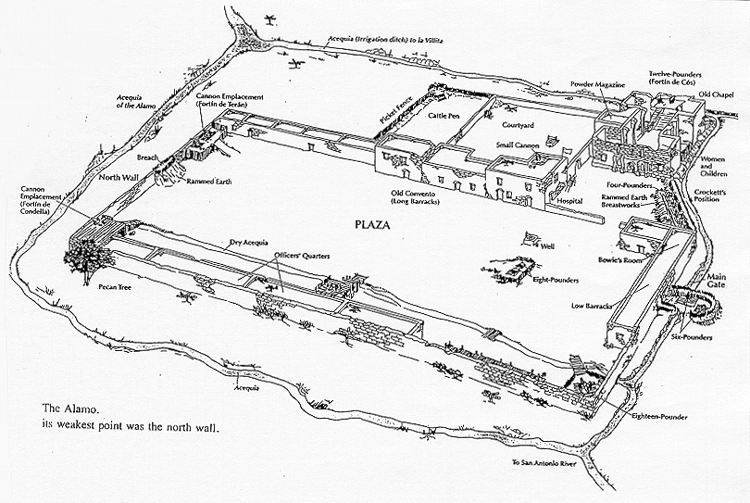
Let me put it this way - the Alamo was a terrible place to mount a defense because it could be surrounded. Being surrounded meant that even with interior lines, the limited number of defenders had a lot of area to protect and had no way out to get more food, water, ammo, people, etc. Their only hope was that outside forces would arrive in time to save them from their poor site selection.
So it seems in most zombie defense books. In the Mr. Molles books, his people develop a compound based around an old vehicle maintenance facility in a small town in central North Carolina (apparently HB2 is not an issue with zombies or "the infected") with roads leading into it and woods around at least part of it. It's a fort, and the bad things out there can get to it from all sides and can, if they so choose, cut off access to and from pretty easily. Those in the fort have issues with . . . clean water, food and etc.
Well, I live in central NC and got to thinking - if I was the guy planning defenses, where would I locate? Further, and this is not a spoiler, Mr. Molles' character has caches of good stuff scattered about NC - if I was the guy in charge of placing those, where would I put them?
 First off, I want a location on the water - fresh water so I have it at hand and won't die of thirst. In central NC we have couple of lakes that the U.S. Army Corps of Engineers set up. One of them is Jordan Lake located south of Durham and Chapel Hill and Southwest of Raleigh. It's a nice big freshwater lake containing fish and surrounded by woods that have deer and other game in them. And, no, the lake was not named after Michael Jordan.

 Now, I want to be surrounded by deep water as much as I can be and any land link that exists, I want to be narrow and defensible. To me that suggests a peninsula. A peninsula gives me access to water for both drinking and as an escape route should it be necessary.
A shore base gives me access to wood, wildlife and road systems.
In my planning, I am going to look for a marina at which I can "liberate" boats for survivors who are with me. Power boats are nice, but there is that fuel issue, so in addition to power boats, I want canoes and sail boats. There is a marina on the Jordan Lake that has such things. It's in the circled area in the image to the right. I might buy a small sail boat and keep it there stocked with necessities.
That marina does not look as defensible to me as other areas. For example, here's a nice peninsula:

And here's another:

The red lines across the peninsulas suggests areas where I would construct defenses - abatis, razor wire and such.
Unlike the troops at Bataan, the plan is not to wait for rescue by outside forces. The plan is to make the peninsulas chosen for defense to be both as secure as possible, defending lake access for water, food and resupply from caches (preferably also located on such peninsulas).
If a location is threatened with being overrun, then the solution is to retreat to open water until the zombies die from lack of brain food or whatever.
Now, does this thinking change if the event is not zombies but something like an EMP thingie? Nope, the logic is the same - water, food and safe shelter. Might have to worry about lake pirates, though.
Thus endeth the deep thinking of this day.
Last time I went on a zombie fighting binge, I opted, true to my surface navy roots, for going boating. See Planning for that Zombie Attack: Littoral and "Brown Water" Defenses:
Well, after reading more books which, by the way, seem mostly devoted to the proper selection of guns and ammo and less devoted to selecting good defensive positions (see, e.g. "Home series" by A. American), I am struck by how well some of the heroes set things up for survival with food, water, ammo, etc, and then try to defend a house or neighborhood which has no natural barriers to help the hero help himself by limiting the areas needed to be defended.I believe that this land-based approach is not as sound as a littoral or brown water zombie defense approach, which maximizes mobility, security and comfort.
Mobile zombie defense center - need some M2s on the corners
Now, in the classic land-based zombie defense posture, as repeated by Chuck, you seek a remote house and board yourself into it, while awaiting the inevitable zombie horde pounding on the windows and doors while you expend your ammo, food and foul water.
***
How much better to head for the local lake, river or ocean marina and "adopt" a boat onwhich you load, food, water, ammo, weapons and . . . fishing gear. While the zombies gather on the shore groaning at you, you proceed to open water and drop anchor (Note: water should be at least 20 feet deep - so zombies can't "piggy back" their way on board). While you wait out the zombies, you fish, drink beer and have the comforts of home. Practice "repelling boarders." Should the zombies show or develop nautical skills, weigh anchor and move to another, less infested area.
Using your "underwater zombie detector"


 |
| The Alamo (source) |
So it seems in most zombie defense books. In the Mr. Molles books, his people develop a compound based around an old vehicle maintenance facility in a small town in central North Carolina (apparently HB2 is not an issue with zombies or "the infected") with roads leading into it and woods around at least part of it. It's a fort, and the bad things out there can get to it from all sides and can, if they so choose, cut off access to and from pretty easily. Those in the fort have issues with . . . clean water, food and etc.
Well, I live in central NC and got to thinking - if I was the guy planning defenses, where would I locate? Further, and this is not a spoiler, Mr. Molles' character has caches of good stuff scattered about NC - if I was the guy in charge of placing those, where would I put them?


 Now, I want to be surrounded by deep water as much as I can be and any land link that exists, I want to be narrow and defensible. To me that suggests a peninsula. A peninsula gives me access to water for both drinking and as an escape route should it be necessary.
A shore base gives me access to wood, wildlife and road systems.
In my planning, I am going to look for a marina at which I can "liberate" boats for survivors who are with me. Power boats are nice, but there is that fuel issue, so in addition to power boats, I want canoes and sail boats. There is a marina on the Jordan Lake that has such things. It's in the circled area in the image to the right. I might buy a small sail boat and keep it there stocked with necessities.
That marina does not look as defensible to me as other areas. For example, here's a nice peninsula:

And here's another:

The red lines across the peninsulas suggests areas where I would construct defenses - abatis, razor wire and such.
 |
| Abatis (Source) |
Unlike the troops at Bataan, the plan is not to wait for rescue by outside forces. The plan is to make the peninsulas chosen for defense to be both as secure as possible, defending lake access for water, food and resupply from caches (preferably also located on such peninsulas).
If a location is threatened with being overrun, then the solution is to retreat to open water until the zombies die from lack of brain food or whatever.
Now, does this thinking change if the event is not zombies but something like an EMP thingie? Nope, the logic is the same - water, food and safe shelter. Might have to worry about lake pirates, though.
Thus endeth the deep thinking of this day.
Wednesday, September 14, 2016
Political Correctness and the NCAA: Everything is Political
"The Left Is Weaponizing Sports" writes David French at National Review. Not sure if it's "weaponized", but is certainly is becoming very politicized. As Mr. French writes,
Back in the 60's folks similar to those who push this current agenda used to say:
In short, some things might be personal, but somewhere out there is someone willing to take those things from you and make them into society's issues, because all of us live in society and we all interact with society.
So your obesity becomes a problem for the state because it increases your use of health benefits provided by Medicaid/Medicare or whatever, and that bumps up the costs of the health system and causes a need for tax increases to cover your additional (presumably avoidable costs), so the state has the right and perhaps the obligation to tell you to lose weight. And, if you don't, perhaps to take away your benefits until you do. Just like the esteemed British Government Health Care System British Government Hospitals To Bar Smokers & Overweight Patients From Surgery, Due To Budget Constraints.
Now, if some person self-identifies with a gender different from that appears on the birth certificate, it seems now that that person's bathroom preferences have moved from being a personal issue into being a societal issue. This requires all those who would prefer, on some basis or another, that there continue to be single sex public bathrooms/shower rooms for the vast majority of the people and, perhaps, a public bathroom/shower room set up for those who feel uncomfortable using the single sex public facility corresponding with their birth certificate, to be "otherized" and to be punished for their attitudes and beliefs.
Why? Because, as set out in this 2013 Sonny Bunch article from The Washington Beacon A Political Life vs. a Politicized Life:
I've written the North Carolina House Bill 2 before here:
Having decided to punish NC for its law put in place by a freely elected legislature, the unelected NCAA powers apparently can now punish other states for views that it decides are politically incorrect? "We don't like the fact that the Texas legislature has decided to allow concealed weapons are allowed on campus and in classrooms, so we are not allowing any NCAA championships in Texas?"
Oh, by the way, 29 other states do not provide any "discrimination protections for gay or transgender people". I guess were down to 21 states where the NCAA can hold its events.
The NCAA may suffer some, too, "NCAA may have to pay up for pulling championships out of North Carolina" according to Steve Berkowitz:
But, what the heck, it's all NC's fault.
Social-justice warriors, however, can’t leave well enough alone. Is the trend now that major sporting events can only occur in progressive-approved locations? Will we now be subject to a parade of progressive-approved (and only progressive-approved) player demonstrations? And spare me any argument that our sporting culture is opening itself up to free expression. I’m glad neither the NFL nor the San Francisco 49ers are punishing Colin Kaepernick, but just ask Curt Schilling how much the progressive sports elite values dissent from the social-justice orthodoxy. I don’t mind if individual players or owners express themselves, so long as it is clearly understood that all viewpoints are welcome. I mind, however, when the sporting elite decides to turn professional and college athletics into a sweatier version of a progressive college campus, speech codes and all. I mind when social-justice warriors try to wield the awesome economic power of sports — built via the pocketbooks of all Americans — to punish conservatives, especially Christian conservatives.Not that attempting to punish those deemed ideologically impure is anything new - Thomas Mann, the German writer is quoted from The Magic Mountain:
Everything is politics.Yes, well, to be blunt, that sucks.
Back in the 60's folks similar to those who push this current agenda used to say:
The personal is political.Which tracks back - sorta- to C. Wright Mills and his The Sociological Imagination which is summed up in this video:
In short, some things might be personal, but somewhere out there is someone willing to take those things from you and make them into society's issues, because all of us live in society and we all interact with society.
So your obesity becomes a problem for the state because it increases your use of health benefits provided by Medicaid/Medicare or whatever, and that bumps up the costs of the health system and causes a need for tax increases to cover your additional (presumably avoidable costs), so the state has the right and perhaps the obligation to tell you to lose weight. And, if you don't, perhaps to take away your benefits until you do. Just like the esteemed British Government Health Care System British Government Hospitals To Bar Smokers & Overweight Patients From Surgery, Due To Budget Constraints.
Now, if some person self-identifies with a gender different from that appears on the birth certificate, it seems now that that person's bathroom preferences have moved from being a personal issue into being a societal issue. This requires all those who would prefer, on some basis or another, that there continue to be single sex public bathrooms/shower rooms for the vast majority of the people and, perhaps, a public bathroom/shower room set up for those who feel uncomfortable using the single sex public facility corresponding with their birth certificate, to be "otherized" and to be punished for their attitudes and beliefs.
Why? Because, as set out in this 2013 Sonny Bunch article from The Washington Beacon A Political Life vs. a Politicized Life:
There’s nothing wrong with living a political life. That is, a life in which politics is one of your interests or your job, something you follow and keep track of and educate yourself on and argue about. The arena of politics is important; political decisions have consequences; and passionately arguing for your preferred political outcomes is nothing to be ashamed of."Thoughtcrimes" - I like that.
A politicized life is a different beast, however. It treats politics as a zero sum game or a form of total warfare in which the other side must be obliterated. It alters every aspect of your being: where you shop; what you watch on TV; what sort of music you listen to; who you associate with. If you’re not with the politicized being, you’re against him—and if you’re against him, he is well within his rights to ruin you personally and economically. You, the political other, are a leper to be shunned, lest your thoughtcrimes infect the rest of society.
As I wrote, I find this to be more than a little disturbing. I don’t worry too much about growing partisan gridlock, but I do worry somewhat about an America in which each half the country hates the other so viscerally that they won’t even interact. That’s a truly dangerous state of affairs. One I seem to recall happening before…
I've written the North Carolina House Bill 2 before here:
You might note the following: (1) the bill has no impact on private businesses (theaters, gyms, private schools, private universities, restaurants, coffee house, bars, private arenas where sports are played, hotels, motels, stores, shops, salons, barbershops, etc) which are free to allow their patrons to access restrooms and other facilities as they see fit)and here:
***
Now, some of rub comes when private activities occur in state or municipally owned facilities.
The NFL Carolina Panthers play in Bank of America stadium, which is privately owned. The ownership of that stadium would appear to be free to allow access to restrooms as they choose.
The NBA Charlotte Hornets, however, play in Time Warner Cable Arena, which is owned by the City of Charlotte. The area would appear to be barred from violating state law, either for basketball games or for any concerts held in this or other municipal arenas.
I leave it for you to decide whether the millionaire owners of sports teams should be subsidized in having arenas built at taxpayer expense and, thus, submitting themselves to state regulation of restroom usage.
And the same question can be asked of any city or county that owns such facilities.
"Militant open-mindness" really hates people with opposing views of "the right thing to do" doesn't it?So, the NCAA decides to change the venues of 7 NCAA championships out of NC to some other more politically correct location, what's the message? Conform or die? Screw the fact that the law was put in place because the elected legislature thought was needed and that the people of NC can throw all those in favor of this bill out at the next election? Grant the "big money" that goes with these events to more compliant states?
Having decided to punish NC for its law put in place by a freely elected legislature, the unelected NCAA powers apparently can now punish other states for views that it decides are politically incorrect? "We don't like the fact that the Texas legislature has decided to allow concealed weapons are allowed on campus and in classrooms, so we are not allowing any NCAA championships in Texas?"
Oh, by the way, 29 other states do not provide any "discrimination protections for gay or transgender people". I guess were down to 21 states where the NCAA can hold its events.
The NCAA may suffer some, too, "NCAA may have to pay up for pulling championships out of North Carolina" according to Steve Berkowitz:
The NCAA may face financial consequences for its decision Monday to relocate seven championship events from the state of North Carolina, according to a review of contract documents and interviews with local officials.Not the NCAA leadership's money, it belongs to all the NCAA schools and will probably result in the loss of scholarship money for some deserving kid who might not otherwise be able to afford college.
***
The lease and bid-specification contracts covering those events do not appear to allow the NCAA to terminate the arrangement for the reason it announced. USA TODAY Sports obtained the documents from the Greensboro Coliseum Complex under an open-records request.
***
The bid specification document states that in deciding where to award the games, the NCAA will consider factors including a site’s “ability to promote an atmosphere of respect for and sensitivity to the dignity of every person.”
But the termination provisions of the venue lease agreement state that the agreement can be terminated by the NCAA without liability to the NCAA only if one of three conditions are left unaddressed after the NCAA provides notice and a 30-day period to remedy the issue. The conditions include the venue’s failure to “retain its status in the industry as a top-tier facility … through a deterioration of physical structure” and “material breach by any one of the entities that made representations relied upon by the NCAA in awarding” the events.
But, what the heck, it's all NC's fault.
Tuesday, September 13, 2016
Fun with Iran: "Iran's Revolutionary Guard unveils high-speed catamaran" (hahahahahah)
Really? Really?
Iran's Revolutionary Guard unveils high-speed catamaran:
Iran's Revolutionary Guard unveils high-speed catamaran:
Iran's powerful Revolutionary Guard on Tuesday unveiled a new high-speed vessel the force says is capable of carrying a helicopter and up to 100 people, Iranian state TV reported.Hahahahahah.
The report follows a series of close encounters between American warships and Guard vessels in the Persian Gulf.
The TV showed a catamaran-type ship described as 55 meters (yards) long and 14 meters (yards) wide, carrying a light civilian helicopter, while the official IRNA news agency said its speed capability is 28 knots.
The vessel was painted with Supreme Leader Ayatollah Ali Khamenei's call for U.S. forces to "Go back to the Bay of Pigs." In May, Khamenei criticised the U.S. presence in the Persian Gulf region in an apparent reference to the 1961 failed invasion of Cuba's Bay of Pigs by 1,500 CIA-trained exiles.
Monday, September 12, 2016
Saturday, September 10, 2016
Friday, September 09, 2016
LCS Fun: "Navy Adjusts LCS Class Crewing, Readiness and Employment"
Navy press release inits entirety, Navy Adjusts LCS Class Crewing, Readiness and Employment:
"Payloads not platforms" - Mine hunting and clearing? More counter mine drones, helos and carriers for them.
Taxpayer money? Along with good intentions, this particular road to hell seems to be lined with it.
Well, as "The Big Admiral" says in In Harm's Way:From Commander, Naval Surface Force, U.S. Pacific Fleet
SAN DIEGO (NNS) -- The Navy announced Sept. 8 it will implement several key changes to the projected 28-ship littoral combat ship (LCS) Flight 0/0+ class over the next five years that will simplify crewing, stabilize testing and increase overseas deployment presence availability.
The projected 12 Frigates will be the next increment of LCS and will use the same manning, training, maintenance and operating concepts as those that have been approved as part of the LCS review. The decision to make these changes resulted from a comprehensive review of LCS crewing, training, maintenance and operations commissioned in March. While a total of 40 ships have been approved for the program, the Navy Force Structure Assessment still projects the need for 52 small surface combatants that LCS and Frigate address.
Beginning this fall, the Navy will start to phase out the 3:2:1 crewing construct and transition to a Blue/Gold model similar to the one used in crewing Ballistic Missile submarines, patrol craft and minesweepers. The LCS crews will also merge, train and rotate with mission module detachment crews, organizing as four-ship divisions of a single warfare area--either surface warfare (SUW), mine warfare (MCM) or anti-submarine warfare (ASW). Though organized this way, the LCS class will retain the technological benefits of modularity and the ability to swap mission packages quickly if needed. Aviation detachments will also deploy with the same LCS crew, but will remain assigned to their respective squadrons when in home port.
To facilitate these changes across the class, the Navy will eventually homeport Independence-variant ships in San Diego and Freedom-variant ships in Mayport, Florida, 24 of the 28 LCS ships will form into six divisions with three divisions on each coast. Each division will have a single warfare focus and the crews and mission module detachments will be fused. Each division will consist of three Blue/Gold-crewed ships that deploy overseas and one single-crewed training ship. Under this construct, each division's training ship will remain available locally to certify crews preparing to deploy. Few homeport shifts will be needed since only six LCS are currently commissioned while the rest are under contract, in construction or in a pre-commissioned unit status.
The first four LCS ships (LCS 1-4) will become testing ships. Like the training ships, testing ships will be single-crewed and could be deployed as fleet assets if needed on a limited basis; however, their primary purpose will be to satisfy near and long term testing requirements for the entire LCS class without affecting ongoing deployment rotations. This approach accommodates spiral development and rapid deployment of emerging weapons and delivery systems to the fleet without disrupting operational schedules.
Implementing these changes now and as more LCS ships are commissioned over the coming years will ultimately allow the Navy to deploy more ships, increasing overall forward presence. With the Blue/Gold model in place, three out of four ships will be available for deployment compared with one out of two under 3:2:1. The Blue/Gold model will also simplify ownership of maintenance responsibilities and enhance continuity as the same two crews rotate on a single ship. Single-crewed training ships will complement shore-based training facilities and ensure crews have enough time at sea before deployment. The findings and recommendations of the LCS review will allow the LCS program to become more survivable, lethal and adaptable as the LCS become regular workhorses in the fleet.
"As we implement these changes, we will continue to make iterative adjustments and improvements based on evolving fleet requirements and technological developments," said Vice Adm. Tom Rowden, commander, Naval Surface Forces. "Implementing the approved recommendations from this review and continuing to examine other areas for improvement will better position the LCS program for success - both now and in the future."

Well, we all know the Navy's never wrong. But in this case, it was a little weak on bein' right.So, now, these "frigates" will be one-trick ponies of three stripes. They had better be really, really good in those mission areas, otherwise we could have built more DD's which can do several missions at once.
"Payloads not platforms" - Mine hunting and clearing? More counter mine drones, helos and carriers for them.
Taxpayer money? Along with good intentions, this particular road to hell seems to be lined with it.
Subscribe to:
Posts (Atom)