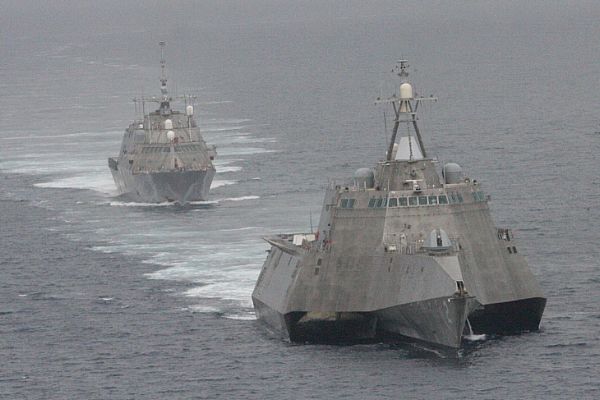
The Freedom variant littoral combat ship USS Milwaukee (LCS 5) conducted a live-fire missile exercise off the coast of Virginia May 11.
The Milwaukee fired four longbow hellfire missiles that successfully struck fast inshore attack craft targets.
During the evolution, the ship's crew executed a scenario simulating a complex warfighting environment, utilized radar and other systems to track small surface targets, simulated engagements and then fired missiles against the surface targets.
"The crew of the USS Milwaukee executed superbly and the test team ran the event seamlessly, both were critical in making this event successful," said Capt. Ted Zobel, LCS Mission Modules program manager.
This marks the completion of the first phase of the Surface-to-Surface Missile Module (SSMM) Developmental Testing (DT) for the LCS Mission Modules (MM) program. This was the first integrated firing of the SSMM from an LCS. Additionally, this was the second at-sea launch of SSMM missiles from an LCS. SSMM leverages the U.S. Army's Longbow Hellfire Missile in a vertical launch capability to counter small boat threats. Initial operational capability (IOC) and fielding of the SSMM is expected in 2019.
VertRep

Showing posts with label LCS Fun. Show all posts
Showing posts with label LCS Fun. Show all posts
Wednesday, May 16, 2018
Better Late . . .


Friday, September 09, 2016
LCS Fun: "Navy Adjusts LCS Class Crewing, Readiness and Employment"
Navy press release inits entirety, Navy Adjusts LCS Class Crewing, Readiness and Employment:
"Payloads not platforms" - Mine hunting and clearing? More counter mine drones, helos and carriers for them.
Taxpayer money? Along with good intentions, this particular road to hell seems to be lined with it.
Well, as "The Big Admiral" says in In Harm's Way:From Commander, Naval Surface Force, U.S. Pacific Fleet
SAN DIEGO (NNS) -- The Navy announced Sept. 8 it will implement several key changes to the projected 28-ship littoral combat ship (LCS) Flight 0/0+ class over the next five years that will simplify crewing, stabilize testing and increase overseas deployment presence availability.
The projected 12 Frigates will be the next increment of LCS and will use the same manning, training, maintenance and operating concepts as those that have been approved as part of the LCS review. The decision to make these changes resulted from a comprehensive review of LCS crewing, training, maintenance and operations commissioned in March. While a total of 40 ships have been approved for the program, the Navy Force Structure Assessment still projects the need for 52 small surface combatants that LCS and Frigate address.
Beginning this fall, the Navy will start to phase out the 3:2:1 crewing construct and transition to a Blue/Gold model similar to the one used in crewing Ballistic Missile submarines, patrol craft and minesweepers. The LCS crews will also merge, train and rotate with mission module detachment crews, organizing as four-ship divisions of a single warfare area--either surface warfare (SUW), mine warfare (MCM) or anti-submarine warfare (ASW). Though organized this way, the LCS class will retain the technological benefits of modularity and the ability to swap mission packages quickly if needed. Aviation detachments will also deploy with the same LCS crew, but will remain assigned to their respective squadrons when in home port.
To facilitate these changes across the class, the Navy will eventually homeport Independence-variant ships in San Diego and Freedom-variant ships in Mayport, Florida, 24 of the 28 LCS ships will form into six divisions with three divisions on each coast. Each division will have a single warfare focus and the crews and mission module detachments will be fused. Each division will consist of three Blue/Gold-crewed ships that deploy overseas and one single-crewed training ship. Under this construct, each division's training ship will remain available locally to certify crews preparing to deploy. Few homeport shifts will be needed since only six LCS are currently commissioned while the rest are under contract, in construction or in a pre-commissioned unit status.
The first four LCS ships (LCS 1-4) will become testing ships. Like the training ships, testing ships will be single-crewed and could be deployed as fleet assets if needed on a limited basis; however, their primary purpose will be to satisfy near and long term testing requirements for the entire LCS class without affecting ongoing deployment rotations. This approach accommodates spiral development and rapid deployment of emerging weapons and delivery systems to the fleet without disrupting operational schedules.
Implementing these changes now and as more LCS ships are commissioned over the coming years will ultimately allow the Navy to deploy more ships, increasing overall forward presence. With the Blue/Gold model in place, three out of four ships will be available for deployment compared with one out of two under 3:2:1. The Blue/Gold model will also simplify ownership of maintenance responsibilities and enhance continuity as the same two crews rotate on a single ship. Single-crewed training ships will complement shore-based training facilities and ensure crews have enough time at sea before deployment. The findings and recommendations of the LCS review will allow the LCS program to become more survivable, lethal and adaptable as the LCS become regular workhorses in the fleet.
"As we implement these changes, we will continue to make iterative adjustments and improvements based on evolving fleet requirements and technological developments," said Vice Adm. Tom Rowden, commander, Naval Surface Forces. "Implementing the approved recommendations from this review and continuing to examine other areas for improvement will better position the LCS program for success - both now and in the future."

Well, we all know the Navy's never wrong. But in this case, it was a little weak on bein' right.So, now, these "frigates" will be one-trick ponies of three stripes. They had better be really, really good in those mission areas, otherwise we could have built more DD's which can do several missions at once.
"Payloads not platforms" - Mine hunting and clearing? More counter mine drones, helos and carriers for them.
Taxpayer money? Along with good intentions, this particular road to hell seems to be lined with it.
Wednesday, August 31, 2016
Fast, Heavily Armed Littoral Combat Ships
Sometimes you kill a platform too soon. Sometimes you don't.
 Take the patrol hydrofoil ships that the Navy once had, for example. Fast, well-armed anti-surface ship hydrofoils meant to play in the littorals. Pretty reliable, too, and minimally crewed. Four officers, 17 enlisted. Eight Harpoon missiles, small gun (76mm) up front, 48 kts (55 mph). See here.
The downside? Well, according to this Popular Mechanics piece, When the U.S. Navy Had Tiny Hot Rods That Flew Over the Sea:The Pegasus class hydrofoils were a ship in search of a mission.
Couldn't do ASW? Couldn't do AAW? Perhaps not in the days the PHMs were designed, but they weren't designed for those mission. Nothing in the rule book says that you couldn't lay patterns of sonobuoys from a PHM and receive signals from them in an "ASW-configured" PHM with some torpedo tubes. Nothing said you couldn't provide anti-air missiles on "AAW-configured" PHMs. You could probably even have other platforms that could operate helicopters or unmanned aircraft from their decks. And perhaps have PHM tender lurking about to do the work that tenders used to do in the absence of shore bases.
A counter-argument to the PM piece from the Christian Science Monitor in 1983 The US Navy's daring new ship: Will six be enough?:
Nothing said you couldn't have squadrons of these things operate together in teams consisting of ASW, ASUW, and AAW units working together depending on the perceived threats in littoral and archipelago areas. Like, say, the Philippines . . . From Navysite:
Lack of imagination, I suppose, coupled with the aviation bias and big gray hull bias of "Big Navy." At any rate, instead of modifying the design to change "one trick" into "several tricks," PHMs died.
Too soon.
So 40 years later we screw around with much bigger, far more costly hulls which still await technology that will allow them to be AAW, ASUW and ASW competent, except for their main weapon system, the attached helicopter/Fire Scout detachment.
Too late.
Nice PHM history article at Hydrofoil World.

The downside? Well, according to this Popular Mechanics piece, When the U.S. Navy Had Tiny Hot Rods That Flew Over the Sea:The Pegasus class hydrofoils were a ship in search of a mission.
The six ships of the Pegasus class—Pegasus, Hercules, Taurus, Aquilla, Aries, and Gemini—could certainly sink big ships. But the Navy soon realized that was pretty much all they could do. They couldn't operate with the rest of the fleet, hunt submarines, shoot down enemy aircraft, or do all the other things corvettes, frigates, and destroyers could. Pegasus was a one-trick pony, and her trick could be done by other platforms, including missile-carrying aircraft that the U.S. Navy already had in the hundreds.Hmmm.
Couldn't do ASW? Couldn't do AAW? Perhaps not in the days the PHMs were designed, but they weren't designed for those mission. Nothing in the rule book says that you couldn't lay patterns of sonobuoys from a PHM and receive signals from them in an "ASW-configured" PHM with some torpedo tubes. Nothing said you couldn't provide anti-air missiles on "AAW-configured" PHMs. You could probably even have other platforms that could operate helicopters or unmanned aircraft from their decks. And perhaps have PHM tender lurking about to do the work that tenders used to do in the absence of shore bases.
A counter-argument to the PM piece from the Christian Science Monitor in 1983 The US Navy's daring new ship: Will six be enough?:
''They [the PHM vessels] can be a better use of resources,'' enthuses retired Capt. Gil Slonim, now president of the Oceanic Education Foundation in Falls Church, Va. ''Should the Navy assign a 3,000- to 10,000-ton ship costing $500 million plus to carry out a task which could be accomplished by a 250-ton ship costing $100 million and with far fewer people? In that context, there is a place for hydrofoils.
''You can't just think single-purpose ships. You have to think mission, the total fleet mission of controlling the seas and projecting power overseas for our island nation,'' Mr. Slonim continues. ''Hydrofoils point the Navy toward 21 st century technology.''
Nothing said you couldn't have squadrons of these things operate together in teams consisting of ASW, ASUW, and AAW units working together depending on the perceived threats in littoral and archipelago areas. Like, say, the Philippines . . . From Navysite:
The PHM project was started in early 1970 by CNO Admiral Elmo Zumwalt in an effort to increase the Navy's number of surface combatants. The project called for a cost-effective hydrofoil boat designed to operate in coastal waters and equipped to fulfill the missions of destroyers and frigates in those areas so that these larger ships could be deployed to areas where they are needed more. These missions included surface surveillance as well as immediate responses (SSM missiles for example) to any hostile actions conducted by enemy navies. (emphasis added)
Lack of imagination, I suppose, coupled with the aviation bias and big gray hull bias of "Big Navy." At any rate, instead of modifying the design to change "one trick" into "several tricks," PHMs died.
Too soon.
So 40 years later we screw around with much bigger, far more costly hulls which still await technology that will allow them to be AAW, ASUW and ASW competent, except for their main weapon system, the attached helicopter/Fire Scout detachment.
Too late.
Nice PHM history article at Hydrofoil World.
Thursday, July 21, 2016
Back to the Future: Harpoon Missiles on a High Speed, Minimally Manned Combatant?
Sometimes you just have to laugh instead of crying - here's the caption of the nearby photo:
As set out here, the Pegasus-class PHMs carried 2 quad Harpoon launchers - 39 years ago.

So, good move, LCS masters, on bringing the LCS up to 1977 weapons standards- sorta.
 Above are 6 PHMs zipping along - presumably with 48 Harpoon missiles available. Something tells me all 6 cost less that a single LCs. Probably much less.
According to Defense News, Coronado's deployment configuration will be one quad box launcher.
I guess it's a start.
Update: fixed a math error and Harpoons entered the fleet in 1977.
Roughly a zillion years ago we had high speed, minimally manned warships firing Harpoon missiles:USS Coronado (LCS 4), an Independence-variant littoral combat ship, launches the first over-the-horizon missile engagement using a Harpoon Block 1C missile. *** U.S. Navy photo by Lt. Bryce Hadley (Released)

As set out here, the Pegasus-class PHMs carried 2 quad Harpoon launchers - 39 years ago.

So, good move, LCS masters, on bringing the LCS up to 1977 weapons standards- sorta.

According to Defense News, Coronado's deployment configuration will be one quad box launcher.
I guess it's a start.
Update: fixed a math error and Harpoons entered the fleet in 1977.
Thursday, January 15, 2015
Hahahahaha - "LCS" is "transformationaled" into a Frigate!
 |
"If it's like a frigate, why don't we call it a frigate?" he said Thursday morning to a roomful of surface warfare sailors at the Surface Navy Association's annual symposium just outside Washington.Well, okay. If it walks like a duck, etc.
"We are going to change the hull designation of the LCS class ships to FF," Mabus said, citing the traditional hull designation for frigates. "It will still be the same ship, the same program of record, just with an appropriate and traditional name."
***
The fleet's last guided-missile frigates (FFGs) will be decommissioned in September, and the next number in that sequence is FFG 62. But unlike the Oliver Hazard Perry-class frigates being phased out, the LCS doesn't carry an area air-defense missile such as the Standard missile — the basis for the "G" — so the FFG series isn't entirely appropriate.
What's frigate, then? Back in the old days:
... [T]he term was soon applied less exclusively to any relatively fast and elegantsail-onlywar ship.
In its present configuration, given its best currently working weapons systems, I would call what we have "FFHs" or "Helicopter Frigates." As the promised miracle modules appear for them you can have FFM (mine warfare), FFA (ASW) and FFS (Surface Warfare). Given their current limited anti-air capabilities, you might also call them "needs an AAW escort."
Of course, up-gunned versions are on the planning board:


Gotta love it.
Thursday, January 23, 2014
This May Be the Dumbest Thing I've Read in Some TIme: "DOD TOPGUN Fights For Navy To Fight Like It Is 1986" by Craig Hooper

I don't remember the great wars of 1986*, but his "analysis" leaves much to be desired. I suggest reading one of the comments to his blog post before reading the post so as to better understand Dr. Hooper's line of baloney. Comment is by "Chris":
Chris January 22, 2014 at 9:58 amAnd then, after another person comments in agreement with Chris, Hooper offers up:
In may be technically accurate to say the LCS is not defenseless, but that is all. SeaRAM has a range of 5 nm. Foreign navies operate without air coBy way of comparison, Australian FFG-7, using that obsolete Mk 41 VLS carries ESSM with a range of 27 nm. Which would you prefer? Taking the comparison further, the FFG-7 also has a bigger gun (very passé) as well as carrying Harpoon. Harpoon’s 67nm range is also a lot bigger than the LCS anti-surface module’s Griffin or Hellfire range of about 3 nm. Which would you prefer?
VLS may date from the eighties, but the missiles it carries do not. That’s one of the central advantages of VLS. You can easily upgrade (i.e. it is modular) the missiles. Unfortunately, LCS is too small to carry it. Lockheed or Raytheon I am sure would be more than happy to try and invent a smaller, lighter, but more powerful missile to squeeze onto an LCS. Given enough time and money this magic missile might eventually materialize. Smaller missiles have smaller amounts of propellant and smaller warheads. It is physics. BTW, a technical point, all modern guns are breechloaders. Being a breechloader has nothing to do with the argument surrounding the efficacy of large caliber main batteries vs carrier aviation.
No reporting that I have seen, certainly not the Navy Times article, has said anything to back the hysterical comment that the Navy is abandoning rail guns and lasers. The LCS does not have the space or power margins for either of those systems. The Freedom variant has already had weight and stability issues that required bolt-on buoyancy fitting at its stern. The Independence variant cannot even accommodate a 76mm gun, so in what reality would a railgun be squeezed in? Furthermore, neither variant has an integrated power system that would be key to energy based weapons, only a DDG-1000 currently has that.
Perhaps the real story is that OSD finally threw the BS flag on buying upgunned Coast Guard cutters to form 1/6 of the fleet. If modularity and affordability are the goals, and laudable ones at that , look at the Danish STANFLEX system. STANFLEX was developed in dreaded 1980s, but it works and module swaps are a lot faster than those conceived under LCS’ reported CONOPS. The LCS is an example, like the JSF, of acquisition mal-practice. The Navy attempted to cross a frigate replacement with the Street Fighter concept mixed a little Rumsfeld transformation secret sauce to create two ships designs that can hunt pirates and make nice with small navies. Hardly key components for the battle fleet “pivoting” to the Pacific.
admin January 22, 2014 at 12:19 pmGolly gee, Dr. Hooper, I guess the LCS, being "horribly un-beweaponed" is a marvel of not needing logistics because of it long sea legs and ability to change modules at sea? If we are going to drag along at 10 knots to get better mileage, we wasted a heck of a lot of money creating a ship that can do 40 knots. Which is, after all, just a little faster than an old style Fletcher-class destroyer, except the Fletchers and the follow-on Gearings out gunned the LCS, carried torpedoes, had indigenous sonar and could operate UAV's from their FRAM'd flight decks. Of course they were designed 60 years ago, so you've got that going for you. Further, suppose your LCS is rigged for mine ops and you discover a sub threat? Are you gonna go back home for the ASW package? Send out another LCS with the ASW package?
Thanks for commenting.
I am always amused at how the advocates for a robust Navy always seem to forget logistics. They always come at you with a laundry list of cool stuff, but those peksy mundane (and vital) things like, oh, T-AO(X)s or the need for wide-ranging diplomatic support or wider presence never seem to get on the list.
Look, banging stuff up from an awesome, horribly-beweaponed cruiser is great fun. I’d love to have a Navy you describe. But, unfortunately, a lot goes into supporting the pointy end we both love.
And what on earth does this mean, ". . .the need for wide-ranging diplomatic support or wider presence never seem to get on the list." It seems to me that diplomatic support is on every nice to have Navy list I've ever seen - except we once had a Navy that could cut itself free from foreign shores even when we didn't have that support. In fact, It still can, so long as we have the logistics train to support it. What we did was we transferred that logistics support force to MSC, which has done a bang up job.
I have no idea what "wider presence" means in the context you used it.
I can tell you that the LCS is the epitome of a ship that needs both local shore support (can't change those modules at sea) and an armed escort to go into harm's way. You might look at SecNav's comments here:
“One of the things the CNO said the other day is one of the things the LCS can do is help prevent warfare,” Mabus said – by doing the day-to-day work of maritime policing and partnership building in accordance with the new global strategy, for example. But, he went on, “if there is a war, we aren’t going to have the LCS out there by itself.” Other, more robust vessels can provide cover against enemy warships, cruise missiles, and aircraft while the LCS conducts its specialized shallow-water missions sweeping mines, hunting submarines, or fending off swarms of small boats.
 Well, hell, under those conditions, I could send a pontoon boat to sea for "policing" and "partnership building."
However, if the balloon goes up, I like something a little more "beweaponed" and a little more robust under my feet.
*In fact, 1986 was a relatively peaceful year. If any warship ever was designed to operate in such relatively benign period, it's the LCS.
Subscribe to:
Posts (Atom)