VertRep

VertRep

Sunday, September 04, 2005

South Carolina"s Katrina hurricane lessons

Okay, rather than pointing fingers, some valuable "lesson learned" from South Carolina - lessons applicable to all the hurricane possible states are available here:
All plans are plans in motion. But here are 12 things that South Carolina can learn, so far, from the tragedy of Katrina:

NO. 1. PRE-POSITION SUPPLIES

In New Orleans and other affected areas along the Gulf Coast, few provisions had been pre-positioned for quick distribution.

In one instance, it took four days for the first shipments of water to get to a downtown parish.

But Randall Webster, Horry County’s emergency preparedness director, said there are problems with pre-positioning.

“You don’t want to position them so that they become part of the problem,” he said.

For instance, any pre-positioned supplies on the coast could be struck by the hurricane as well. Even warehouses in Columbia or Florence could be destroyed by spin-off tornadoes.

“I just know the warehouse with my stuff would be the first one hit,” Webster said.

The states of Florida and Georgia have an agreement to pre-position water and other supplies in neighboring states. That would be a good example for South Carolina.

2. IMMEDIATELY PREPARE FOR LOOTING — WITH FEDERAL TROOPS

Police and National Guardsmen were on the ground immediately after Hurricane Hugo. Looting was held to a minimum.

But Katrina shows the United States must have a standing military unit to respond to hurricanes if the situation gets beyond the abilities of local law enforcement, said Charleston Mayor Joe Riley, who led the Hugo recovery.

During hurricane season, the nation needs a military entity “that has all the resources we have in America, that is ready for a major hurricane-related disaster,” he said. “There needs to be one individual in charge who has the capacity and responsibility to deploy big-time resources.”

3. HAVE AMPLE BUSES FOR PEOPLE WITH NO TRANSPORTATION

New Orleans had no plan in place to evacuate its most vulnerable residents — people with no cars, the elderly and the sick.

South Carolina must have a ready fleet of buses to evacuate everyone when a mandatory evacuation is called. And there must be enough buses to reach people in rural areas.

Charleston’s Haynes said that city’s municipal bus system, the school district and private charter services might have enough buses to evacuate Charleston. But there’s no way to be sure.

The advantage in South Carolina is “we don’t have the numbers of people you see in New Orleans,” she said. “And we do have a plan in place.”

For instance, Charleston has prearranged pickup points around the city. But finding and evacuating shut-ins, for instance, is challenging. Getting the word out to self-contained Spanish-speaking communities is a concern as well.

“There are tremendous concerns about the evacuation of medical facilities and nursing homes just because of the amount of traffic on the roads,” Webster said.

4. RE-EVALUATE SHELTERS

In 1999, in an after-action study of Hurricane Georges by the New Orleans Times-Picayune newspaper, the New Orleans Superdome was deemed a “bad” shelter.

That evaluation proved eerily true last week. The Superdome and nearby convention center became “supershelters” of misery — more of a problem than a solution.

People are being bused as far as Houston and San Antonio to escape the inadequate buildings.

In Charleston County, according to Haynes, there is not enough shelter space to accommodate everyone.

The North Charleston Coliseum, the largest building in the area, doesn’t pass Red Cross muster because of its roof, she said. Instead, it is used as a shelter for pets, which aren’t allowed at most shelters.

“We only allow one family member to stay with the pet,” she said. “We don’t want a family of five in an unapproved shelter with Fluffy.”

Schools outside the flood zone are used for shelters. In Charleston’s case, schools as far inland as Columbia can be opened as needed, according to the state’s emergency plan. But people have to be able to get there.

Whether an inland “supershelter” is needed is a matter for consideration.

Webster said a supershelter only would be appropriate in the Midlands or the Upstate.

If it is too close to the coast, as in New Orleans, “You’re just asking for trouble,” he said.

Another matter for consideration: allowing pets in some shelters.

Many people will not abandon their animals, no matter how irresponsible that seems. Designating more shelters for families with pets could increase the number of people who would evacuate.

5. CONSIDER STRENGTHENING MANDATORY EVACUATIONS

It’s a morbid but effective story: If someone refuses to evacuate in Charleston County, officials ask them to fill out a form listing next of kin.

Why?

“So we know where to ship your body,” is the response.

“It works pretty well,” Haynes said.

But she notes that while it might be academically possible to force everyone out of coastal towns, marshes and barrier islands, it probably isn’t realistic.

New Orleans had a plan to reverse its traffic flow to evacuate the city but no system to enforce the mandatory evacuation. About 300,000 people chose to ride out the storm or didn’t have the means to evacuate. Thousands may have died because of that.

Mississippi state officials issued evacuation orders but didn’t have the manpower to enforce them. Up to 80 died in Harrison County alone.

“The governor can compel law enforcement to take people out of harm’s way, but I’ve never known that to happen,” Haynes said. “There are always going to be some people who flat won’t leave.”

Webster said you can’t make everyone go. “There just are not enough resources to go door to door and physically make people leave.”

Along the Gulf Coast, some residents who tried to evacuate ran into traffic and turned around, getting stuck in the storm.

In Horry County, home to Myrtle Beach, the problem would be jammed evacuation routes — as anyone who has tried to get to the beach on Memorial Day weekend can attest.

“The more we have growth along our beaches and barrier islands, shelter is always going to be an issue,” Haynes said.

6. DON’T EXPECT THE FEDS TO BAIL YOU OUT

Local and state governments need to accept the fact that they’re on their own for the first 72 hours. And they need to be prepared for it.

That is evident in New Orleans, where one downtown parish didn’t receive its first shipment of water until Thursday — days after the storm hit.

USC’s Cutter said the 80 percent evacuation rate in New Orleans was outstanding, especially considering the mandatory evacuation order didn’t go out until slightly more than 24 hours before the storm hit.

“But the 20 percent who were left ... were impoverished,” she said. “There was no safety net for them, no provisions.”

That’s nothing new.

In 1992, in the aftermath of Hurricane Andrew, a powerful but much smaller storm, an exasperated Miami-Dade County emergency manager pleaded with federal emergency response agencies, “Where the hell is the cavalry on this one?”

Charleston’s Haynes said federal emergency response always will be perceived as too slow because of the time needed to assess the situation, request aid and deploy appropriate resources — be it food, water or troops.

“But there’s room for improvement,” she said.

“Because of the way the (federal assistance) laws are set up, it takes an assessment and then a presidential declaration,” Horry’s Webster said. “And that takes time.”

7. FOCUS ON PUBLIC HEALTH

Haynes said the 72-hour rule also applies to individuals — especially those with heath concerns.

“The same hurricane that hit them also hit the fire station down the street, the police station down the street,” she said. “People have to be prepared to take care of themselves.”

She suggested stocking up on medicines, food and water prior to evacuation. But emergency responders must be prepared to reach and treat those who can’t help themselves.

Horry’s Webster goes even further. He advises everyone: “Prepare to be on your own for a week to 10 days at a minimum.”

As far as hospitals are concerned, two methods of evacuation are in place: complete evacuation inland or “vertical” evacuation, moving patients to higher floors to escape the storm surge and flooding.

In New Orleans, hospitals became islands of despair, surrounded in some cases by eight feet of water, and targets for looting. Generators keeping the sickest of the sick alive ran low or out of fuel.

Evacuating nursing homes may be the most challenging aspect of public health.

According to Jim Beasley of the S.C. Department of Health and Environmental Control, each facility is required to have an evacuation plan that covers transportation, food and shelter.

But whether all of the scores of individual plans will be adhered to is questionable.

“Every situation presents itself differently,” Beasley said. “Handling a disaster is never an easy thing.”

8. WORK ON COMMUNICATIONS

Katrina knocked out cell phones, land lines, text messaging devices and anything powered by electricity.

“Communication is always going to be an issue no matter what the disaster is,” Charleston’s Haynes said. “We’re all creatures of technology.

“And when something this large happens and knocks out normal communications, it’s just a problem.”

Police and emergency agencies in South Carolina have upgraded their communication systems and should be able to talk with one another. But communicating with residents will be a problem.

“You might have to resort to bull horns to communicate,” Haynes said. “It’s always going to be a problem.”

9. IMPROVE BUILDING CODES

Parts of Mississippi were flattened and swept out to sea. But some structures — likely the best built — still stood in places that weren’t directly hit.

For years, S.C. engineering experts have pushed for stronger building codes along the coast. Those efforts have been fought and, eventually, watered down by home-building companies.

Clemson engineering professor David Prevatt wonders if Katrina will prompt changes.

“When you have a fight to increase building codes, builders complain that it will add 2 percent in costs,” he said. “But it may reduce the likelihood of complete damage of the structure by 50 percent.”

Strong connections between the roof and wall, and between the wall and foundation can reduce wind damage. Building with more durable materials such as reinforced concrete also can prevent loss from wind and flooding.

10. REMOVE CORPSES IN TIMELY FASHION

South Carolina has a mass casualty plan, Haynes said. “But we don’t have enough facilities here to house the bodies” if hundreds lost their lives in a storm.

State emergency preparedness officials have body bags stored at central warehouses across the state. And if necessary, refrigerated trucks would be hauled in as temporary morgues.

But, as morbid as it might seem, clearing away the dead is not the first priority.

“It seems callous, but that’s the way it is,” Webster said. Saving lives “is the top priority.”

11. CENTRALLY COORDINATE RESCUE EFFORTS

Katrina’s rescue crews, especially in the first day or two, searched randomly for people stranded on rooftops, attics and on high ground. That meant people and in some cases, whole communities, have been overlooked.

Designating a central staging area or areas — a “mission control” — in advance of the storm would let rescuers and relief workers know where to gather without being told. The rescue operations could then be run from that central position, creating a better chance for a methodical, rather than random, check for survivors.

12. PLAN FOR THE WORST

Be prepared for nothing short of a worst-possible scenario.

For decades, New Orleans was warned that its levees weren’t ready to withstand even a Category 2 or 3 hurricane. Katrina was a Category 4.

In a special report in 2002, the Times-Picayune newspaper revealed that New Orleans’ levees needed immediate attention and that “flooding from even a moderate storm could kill thousands.”

But few were ready.

Walter Baumy, the New Orleans operations chief for the Army Corps of Engineers, said last week that none of the city’s disaster relief plans included “an event of this magnitude.”
My vote for the most important and neglected problem - communications- we need more, very robust systems for the first responders and the follow-on forces. Satellite systems, high speed video connections and trucks full of stuff like the television networks use.
I would suggest moving the Mobile Inshore Undersea Warfare Units to the top of the list of reserve units to activate and airlift in because they are essentially self-contained with excellent comm suites, but then again, I have a MIUWU bias having served in that community for five years.

UPDATE: And for putting something in the hands of the community so they can learn what is happening Radios for Peace...

35 Somali thrown overboard and die

35 Somali were killed when the crews of the boats they were in trying to get to Yemen threw them over the side as set out here:
More than 35 Somali nationals, including women and children, apparently drowned after being thrown overboard by Somali sailors off Yemen's coast. Independent Yemeni daily al-Ayyam reported Saturday that the victims were on board two sail boats carrying 250 illegal immigrants trying to reach Yemen.

The paper quoted a survivor as saying that the captains of the two boats asked a number of immigrants to leave the boats about three nautical miles off the Yemeni coast and when they refused they just threw them overboard.

At least 35 perished and many others were still missing.

Indonesia to install Malacca radar for shipping safety

Indonesia looks at another level of protection for the Malacca Strait as reported here:
Indonesia's navy said Sunday it plans to install radar stations at nine locations in the pirate-infested Malacca Strait to monitor ships and strengthen security in the world's busiest waterway.

Navy spokesman Adm. Abdul Malik Yusuf did not know when or where the stations would be installed, saying authorities still needed to conduct a survey.

The decision follows an agreement between Indonesia, Singapore and Malaysia to strengthen security in the strategic shipping lane, seen by many as a prime target for terrorists. The Southeast Asian nations will start coordinated air patrols over the Malacca Strait next month.

"The nine radars will help monitor the security situation in the waterway," Yusuf said. "These will also be points where crews can report problems like piracy and sea accidents."
Many countries have such systems for positive control of their waters.

CNO Vision:


Force for peace and some littoral thinking as set out here:
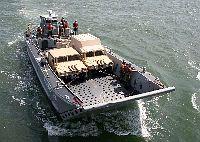
The new Chief of Naval Operations, Adm. Michael G. Mullen, wants to re-establish a riverine force the Navy last had in the Vietnam War. He's pushing for smaller ships that can sail close to the coast, and a naval infantry that could augment Marines and Army forces when needed.

He's also talking about new “mission sets” that might involve more undertakings such as the Indonesian tsunami relief effort, or taking an entire ship's crew and deploying it as a unit to help in an operation such as rebuilding and peacekeeping in Iraq and Afghanistan.

“A naval infantry?” muttered one Navy commander who left the Spruance Auditorium at the Naval War College after the speech last week in which Mullen unveiled his ambitious agenda. But he and others were also considering the possibilities.

That seems to have been the admiral's intent.

“I want to talk about sea power in this new century, what it is and, more importantly, what it can be,” Mullen said. “Without mastery of the sea — without sea power — we cannot protect trade, we cannot help those in peril, we cannot provide relief from natural disaster and we cannot intercede when whole societies are torn asunder by slavery, weapons of mass destruction, drugs and piracy.

“Without sea power we cannot hope — the world cannot hope — to achieve what President Bush has called ‘a balance of power that favors freedom,' ” Mullen continued. “But what, in this day and age, does sea power really mean? We have a pretty good idea of what we can't do without it, but do we really know all the things that we can accomplish with it?

“I am not so sure,” Mullen said. “But I do have a few ideas.”
Yes, yes, it seems he does. But the Navy is noted for its conservative ways and there are a lot of powerful constituencies that need to be convinced and moved if the outer limits of his vision are to be effectuated.

One such challenge to overcome is the Navy's traditional shipboard manning levels which are much higher that those found on modern merchant ships - and feature a certain level of redundacy to allow for battle damage control among other concerns. The current crew of the testbed FSF Seafighter is undergoing some testing to see how a "reduced manned" ship crew can respond to things like a fire at sea as set out here:
Thirteen Navy and Coast Guard crew members from the new Sea Fighter (FSF-1) based in San Diego and a host of technical and military personnel from various Navy commands spent three days in August conducting flight deck fire tests at Naval Air Warfare Center Weapons Division (NAWCWD), China Lake, Calif.
The test was designed to evaluate reduced team manning concepts for aviation firefighting aboard FSF-1 and LCS-1 class ships.
In addition to the 11 Sailors, Coast Guardsmen and their Commanding Officer, Lt. Cmdr. Brandon Bryan, test participants included NAWCWD Fire Sciences Office of the Weapons and Energetics Division, with support from the Fire Division, Fuel Farm and Safety Offices of the Naval Air Weapons Station (NAWS). Observers included Capt. John W. Riley III, commander of the Regional Support Organization in San Diego, and Cmdr. Michael Sasscer from the Afloat Training Group, Pacific (ATGPAC).
Sea Fighter’s commanding officer had praise for the NAWCWD support at China Lake.
“The facility has been fantastic,” Bryan said. “And I think it’s safe to say the tests have been successful so far.”
Well, Mr. Bryan, let's hope so.

UPDATE: Entire CNO speech -

Remarks as delivered by Adm. Mike Mullen
Naval War College
Newport, RI
31 August 2005

I've got some prepared remarks, but initially I would just like
us all to keep it in our thoughts and prayers all those people
who are suffering right now from Katrina.

As I left the Pentagon this morning, there is -- needless to say
-- a national emergency effort response, which is ongoing. It
involves clearly many, many government agencies, all the
services, and it 's difficult at this point obviously to figure
out exactly what's going to be required and exactly how long it
will last.

That said, at least at this point, it certainly is going to take
a while to really find out where we are. In the Navy over the
last 24 hours we have deployed a number of units, a number of
capabilities -- and again -- this is a team effort, we're not
alone in that regard, to be able to both assess and respond.

Many of you are aware obviously of the tragedy off Indonesia
earlier this year, and it's worth very little expectation that I
thought we would be having much of the same kind of response
here at home.

So again I ask that you to please keep those people in your
thoughts and prayers, and all of us will be working very
diligently to help there as much as possible and ease as much
pain as possible.

I would like to thank Admiral Shuford, this distinguished
faculty, and the many students who are beginning your first
weeks here at our Naval War College. It's a very special place
-- has been -- and always will be.

It doesn't seem that long ago that I was a student here in
Newport, although unlike you, or most of you, I was never going
to be a graduate. I was part of a short-lived, two-month course
where we crammed in one year worth of War College work, that
ended wisely soon after I finished it. I don't like to think
that my own academic performance in the two-month course had
anything to do with it. (Laughter)

But I do stand here a little jealous of the academic opportunity
that you have today, and the full experience of Newport that I
missed then, although I have been stationed here. It's a very
special place, and I would encourage you to take advantage of
the full experience of Newport ... including the agony and pain
associated with whether or not the Red Sox will repeat,
(laughter) the wonderful people who live in this part of the
country, as well as just the intellectual rigor and exchange
that you'll be allowed to participate in over the next year.

As I tell audiences everywhere I've been these last four weeks,
I've seen an awful lot of changes in our Navy since that day in
June when I first raised my right hand.

That was actually 1964 when I first came in.

We are a very different Navy today, in just about every possible
way.

When I came in it was all about big ships and blue water,
training for the big fight, training to fight the big, bad 10-
foot tall Soviets. That was it, except of course the brown-
water combat security capabilities that we were very much
involved in, in Vietnam.

But the line was, take your Navy to sea and sink the enemy
fleet. Period.

Ah, the simplicity of it all.

Well, it's not so simple anymore. Ask any Sailor who served
aboard USS COLE back in October of 2000.

Our world -- certainly our Navy's world -- changed that day.

Now, I'm not sure we recognized the change that actually
occurred on October twelfth. I believe nothing will ever be the
same again. It's a new era. It's a new time.

We face entirely new challenges, the likes of which we couldn't
have even imagined just a few short years ago. How we deal with
those challenges will affect not only America's freedom, but
also the freedom of millions of others -- women and men -- all
over the world.

Now, I love taking questions after I talk, especially when I get
to talk to Sailors. And I've doing quite a bit of that these
last few weeks, and it's the greatest part about this job.

Inevitably one of them will start a question with "Why won't
they do this?" or "When will they do that?" That's when I tell
them, "You're now talking to they." (Laughter)

I've been told I'm in charge, (laughter) I understand I'm in
charge, and I'm really going to act like I'm in charge. Some
people may think that's dangerous, but I am able to do some
things, make some decisions, and I'm very anxious to do so.

But I don't necessarily want to talk about me or they today but
rather we -- all of us and what we represent -- the decisions we
all need to start making about our future.

From the birth of our Nation, from the beliefs of our first
President, George Washington, we have understood the worth of
what he called "decisive naval force." For 230 years, we have
been, and remain today, a maritime nation, dependent upon the
sea -- and our power to use that sea -- to nurture and protect
the freedoms we cherish. Today, I want to talk about sea power
in this new century, what it is and more importantly, what it
can be.

I see many shades of service here -- green, light blue, and dark
blue -- as well as sisters and brothers in arms from all over
the world. I also see governmental agencies represented here,
agencies, people who feel just as strongly about national
security as any of us in uniform. You too wear the "cloth of the
nation" Your presence here underscores a powerful truth: that
today -- given the threats we face in this new world of ours --
only the global community can assure true security, freedom, and
prosperity.

And part of what you learn here in Newport, I hope, is that the
joint application of sea power is -- and should be considered --
a critical part of that global community and indeed a
significant competitive advantage.

Seventy percent of the world's surface is covered by water, and
more than 50% of the world's population lives within 16 miles of
it. It can nourish, it can devastate.

Our power sources -- food, clothing, and so many other
necessities of life are furnished more and more by world trade -
- and 90% of that trade is carried by international shipping.
The seas still unite the world.

Earlier this month, the navies of several nations -- including
ours -- worked together to assist Russia in a race for life
against time and the unforgiving nature of the deep.

My hometown newspaper, the LA Times, quoted Russian Defense
Minister Sergei Ivanov after the mini-sub was finally cut free:
"We have seen in deeds, not in words, what the brotherhood of
the sea means."

Without mastery of the sea -- without Sea Power -- we cannot
protect trade, we cannot help those in peril, we cannot provide
relief from natural disaster, and we cannot intercede when whole
societies are torn asunder by slavery, weapons of mass
destruction, drugs, and piracy.

Without sea power we cannot hope -- the world cannot hope -- to
achieve what President Bush has called "a balance of power that
favors freedom."

But what, in this day and age, does sea power really mean?

We have a pretty good idea of what we can't do without it, but
do we really know all the things that we can accomplish with it?
I am not so sure. But I do have a few ideas.

Say the those words sea power, close your eyes and think to
yourselves those words, and what image comes to mind?

Task forces filling up the horizon. Booming guns and storming
Marines. An aircraft carrier plowing through the deep blue
ocean. A submarine broaching the surface. A classic battle at
sea.

Well, there's probably a lot of truth in that image. We need to
be ready -- and to always be ready -- for that kind of fight.
But, as I said, life is not that simple anymore.

We need a new -- or as you will see, maybe a not so new but very
different -- image of sea power.

How about this?

Doctors and nurses healing the sick. Pipe fitters and mechanics
and electricians repairing a city's lost infrastructure.
Construction workers literally and figuratively mending fences
and building bridges.

Or this?

Small, fast watercraft crewed by highly technical Sailors
training and operating with international naval forces -- in
close, in country -- stemming the flow of illegal drugs, hunting
down pirates, making and keeping ports safe.

Or how about this?

A fleet of ships -- fully netted and connected -- not only to
each other, but integrated with the joint force, as well as DEA
or the FBI, or the Customs and Border Control agencies of any
number of other nations, not just our own.

A fleet with fully interoperable crews and teams of maritime
professionals spanning the full spectrum of operations.

Just imagine the power that would reside in that kind of fleet,
imagine the depth and the breadth of skills it would bring to
the table -- any table, anywhere.

Now imagine that fleet operating with the navies and naval
infantries of a host of other nations, again fully netted and
interoperable.

They could be anywhere the national and international political
leadership wanted them to be … ready to go at a moment's notice
-- and they could contribute in all manner of ways.

Not just a force to wage war, but a force to wage peace as well.
A force for good.

Now, some of you may say, "Hey Mullen, what's so new about
that?"

At some level, we always have and are still doing these sorts of
things.

Just look at the enormous success of NATO's Operation Active
Endeavor in the Mediterranean right now. I just came from a
command in Naples where that operation was a key part of what we
did. We had great success stemming the flow of illegal
immigrants and contraband into southern Europe. It's a real
testament to the changing face of NATO and to the flexibility
and adaptability of naval forces.

Maybe this new vision of sea power isn't really all that new at
all -- it's just that we've not thought about it in quite this
way, at least not in recent years. Sea power has too often been
about putting ordnance on target, about beating the other guy
down.

And I'm not suggesting here that we don't still need to preserve
those kinds of capabilities and skills. I'm on record saying,
and I truly believe, that we are first and foremost a
warfighting, sea-going service.

What I am suggesting here is that -- while warfighting is
certainly what we are about -- it is not and it cannot be -- all
we are about.

Not today, and not tomorrow.

Think back to December. Day after Christmas. The unthinkable
happened to hundreds of thousands of people living in Indonesia.
And what did we do? What did the international community do? We
sent help in any way we could.

For our part, in the U.S. Navy and Marine Corps, that help
consisted of a Carrier Strike Group and an Expeditionary Strike
Group -- dozens of ships and helicopters and thousands of
Sailors and Marines, all collected and connected for one
purpose: to save lives, provide security and restore a sense of
hope.

Let me say that again: to save lives, provide security and
restore a sense of hope.

We literally built a city at sea for no other purpose than to
serve the needs of other people. That was the Sea Base during
those critical days, when the entire world rushed to reach
suffering people in the midst of unthinkable devastation.

And guess what happened as a result? Aside from the lives we --
along with our international partners -- helped save, we started
changing some hearts and minds. We started showing a side of
American power to them that wasn't perceived as frightening,
monolithic or arrogant.

We showed them American power -- American sea power -- at its
finest, and at it's most noble.

And people have responded to that. I just recently came across
a poll published in The Economist that said before the tsunami,
nearly 70 percent of people living in Indonesia looked with
disfavor on the United States and our efforts in the war on
terror. When the relief effort was over, 70 percent of them had
an entirely different view of us and what were all about for the
positive.

That was one of the defining moments of this new century, and
shame on us, if even through benign neglect we allow those same
opinions to turn against our best intentions once again.

Make no mistake about it, I view relief efforts like that -- and
any number of other engagement activities we do -- as very much
a part of winning the war on terror. And we are at war.

We are up against people with absolutely no conscience, no
regard for life -- people with an entirely different vision of
the future than the one we embrace. They are not just our
enemies, but the enemies of all who cherish freedom and liberty.
They dream of closed societies and intolerance and injustice.
Theirs is a small world, led by small-minded men.

The chief problem, of course, is that their ambitions are not
small. Their ambitions are global in scope and deadly in
practice. It's unrestricted warfare that they preach. They
crave instability and look for opportunities to exploit it.
They observe no bounds. They are killing children. We should
make no more sacred pledge than to eliminate them.

Poverty, crime, illness, corruption, authoritarian governance
and disrespect for human rights all contribute to the kind of
instability and insecurity from which terrorism festers and
grows. If we can successfully use the sea and our capabilities
to as a means to prevent that instability, then we will have
gone a long way to deter acts of terror.

I'm not just interested in knocking the enemy to the canvas.
I'll do that if I have to. I want to prevent him from even
climbing into the ring.

The sea gives me access to where he is and just as importantly
where he isn't. It gives me dominance in short order. It takes
advantage of my ability to be persistent and, perhaps most
critically, it allows me to influence events ashore. And we
don't need anybody's permission to do it.

So, that's point one today -- we need to think more broadly
about this thing we call sea power.

Point two is we need a Navy that can effectively -- and
forcefully if need be -- bring that power to bear for decades
yet to come.

The Navy is in great shape today, thanks to my predecessor and
to all of you. We couldn't have done what we did in O-E-F and
O-I-F, couldn't have contributed to that relief effort in
Indonesia if we hadn't gone to such great lengths over the last
five years or so to improve our readiness. We are the most
ready we have ever been, and our Sailors are the best trained
and most highly skilled warriors I have ever seen.

Now, it's time, now it's my responsibility, to make sure we
don't squander that readiness for the future. I have spoke with
thousands of Sailors recently, their eyes sparkle they are
eager, ready, and they are executing the mission. It has fallen
to me, in my time, to build tomorrow's Navy, to make sure the
fleet we put to sea 10, 20, 30 years from now is just as capable
-- indeed, more capable -- than the one we have today.

You might have heard of the alternative shipbuilding plan I've
got folks working on down there in Washington. I can't put
forth a new way of thinking about sea power if I don't also
offer up some ideas about how to make it stick.

And that means we need to re-think both the number and the types
of ships we are building. We've got a great Navy right now, a
fleet that has proven its flexibility in a dynamic security
environment. It is a fleet that is particularly good at
leveraging the Joint application of Sea Power to fight and win
during major combat operations.

But we also need a fleet that can operate at the other end of
the spectrum. We cannot sit out in the deep blue, waiting for
the enemy to come to us. He will not. We must go to him.

We need a green water capability and a brown water capability
and quite frankly, I want a more robust onshore capability. I
want a balanced force in every sense of the word.

Balanced to face the challenges of our age: Piracy, drug
smuggling, transport of weapons of mass destruction over the
high seas, exploitation of economic rights, organized crime, and
yes, terrorism. As well as not taking our eye off the
requirement for major combat operations.

Balanced to operate in, and command, if need be, all things
maritime -- from the darkest corners of ungoverned waters, to
the well-sailed sea-lanes of world trade.

The correct balance will be a Navy with the right mix of
capabilities, manned by the right number of Sailors with the
right skills that matter in this century, a Navy built around
the right number of ships.

I want the ability to go close in and stay there. I believe our
Navy is missing a great opportunity to influence events by not
having a riverine force. We're going to have one.

I think Admiral Spruance had it just about right when he defined
sea power as "pushing our front lines as far forward as
possible." A naval force floating off the continental shelf
with no impact on shore is not decisive. We must go forward to
the very reaches of the sea, operating effectively in every part
of the littoral and beyond.

For example almost 30% of the water in the North Persian Gulf is
inaccessible by ships with drafts of more than 20 feet. Think
of the vast areas of the world covered by shallow water -- those
connected to the oceans by rivers, and harbors, and rugged
shorelines. These are the decisive strips of sea that make all
the difference. And we need to be there.

You hear a lot these days about virtual presence. Well, for
naval forces, virtual presence is actual absence. And we are
not going to be absent. If you're not there you can't do much.

Again, this is nothing new for us. Our history is replete with
stories of bravery and victory in the shallows -- from the
monitors of the Civil War to the PT boats of the South Pacific
to the patrol craft of the Mekong Delta. We know how to do
this. We just haven't done it for a while.

And with this riverine force, we can operate and exercise and
learn from many nations who do not need or desire a blue water
navy. We can be a better partner, and we can help extend the
peace to every shore.

And that's point three today: the need to look at sea power as a
team effort.

I think at many levels we already do this, certainly as it
regards the Marine Corps and our contributions to the joint
force.

Look at the possibilities -- I know I am -- of well-trained
Sailors deploying ashore as a unit, rather than individually,
using expertise we already possess.

Think of the crew of an aircraft carrier -- a self-sustaining
city at sea in its own right -- or the crew of another large
ship, or the staff of a naval station, all people with exactly
the type of skills to assist civil affairs efforts.

Who do we have in a crew? Doctors, nurses, pipefitters,
mechanics, electricians, and security personnel. We've taken to
calling our ships "cities at sea" for a long time and for good
reason. What if we took the citizens of that city and moved
them ashore to help relieve stress on our Joint partners and
make life a little better for people in need?

This is just one of the many possibilities I want to look at. I
ask you to put on your thinking caps and think about others.

Look also at the possibilities of new missions joined with our
Coast Guard, learning from their unique expertise. Look at the
possibilities for Maritime Domain Awareness, not just within the
lifelines of the Defense Department, but outside those
lifelines, to include our inter-agency and international
partners as well.

Here in Newport you are, and should consider yourselves to be, a
large part of pioneering those possibilities, with initiatives
such as the Joint Forces Maritime Component Commander Course,
which just graduated its first class last week.

I think the real potential of Sea Power lies in exploring those
kinds of possibilities, while developing global awareness. It
is about international maritime relationships founded on
understanding and trust, enduring relationships that bloom into
partnerships.

And as we build upon ideas like Theater Security Cooperation,
the Proliferation Security Initiative, the Regional Maritime
Security Initiative, we find that every nation has a stake in
security, and a distinct, unique capability -- as well as a
great desire -- to contribute.

Our vision is and ought to be to extend the peace through an
inter-connected community of maritime nations working together.
The enemy goes global. So should we.

I'm after that proverbial 1,000 ship Navy -- a fleet-in-being,
if you will -- comprised of all freedom-loving nations, standing
watch over the seas, standing watch over each other. Because I
believe, with every fiber of my being, that we are all united by
more than just fear.

I think of what Marine Colonel Thomas Hammes, now at the
National Defense University, wrote in his book, "The Sling and
the Stone," about the kind of war we face today.

It makes perfect sense to me. He wrote that we are fighting a
war of ideas.

And he stressed the strength of a message in the last page of
that book, an idea hundreds of years old; yet it is the most
powerful idea I know: that individuals are sacred, and have
intrinsic worth, and are born to be free men and women, and
strive for their dreams, for their children, and for their
grandchildren.

That is a message of hope and empowerment for all people, a
message I am proud to fight for.

Our Navy and Marine Corps team works to extend that message of
hope by defending the inherent freedom of the seas, and by
extending the peace through aid and comfort to those in need --
a true City at Sea. That City at Sea was a part of
international relief efforts in the Indian Ocean last winter
after the tsunami. But we shouldn't have to wait for disaster
to strike. And we aren't.

Earlier this spring, in a town called Tan Tan, in Morocco, we
sent almost 50 Seabees to build a five-room schoolhouse for 200
children, as well as other material improvements. And just two
weeks ago, we assisted the Philippine government in reaching the
towns of Batu Batu and Sanga Sanga, with Navy and Marine Corps
medical aid, facilitated by an amphibious landing by
Expeditionary Strike Group One.

We are operating in the Horn of Africa combating hunger, and
we've got forces in South America, combating the drug trade.

I believe that to be effective in this uncertain environment,
our Navy needs tools that are not only instruments of war, but
implements of peace -- to become a strong partner for a stable
global community.

One of our young Sailors in Sanga Sanga was Hospitalman Alicia
Tilley, who worked alongside an Armed Forces of the Philippines
Nurse Corps Colonel for two days. Together, they treated
hundreds of patients, mostly young children.

She later told a reporter how great it was to get a chance to
use all her training to help people, especially the kids. She
called it an honor to work alongside the Philippine doctors and
nurses.
"We learned from each other and developed a bond," she said.

To me, it is exactly this process of learning from each other,
relying on each other, and creating these profound human bonds
that define the true meaning of Sea Power.

Technology allows this next step. The acceleration of
communications, command, and control capabilities makes possible
-- for the first time in history -- an ocean with no dark
corner.

And one day, the massive areas beneath the surface of the oceans
may be made transparent as well. We may, one day, share a
common picture of the seas: a merchant shipping track, weather
information, geospatial mapping, seismic information, and
universally observed rules for conduct.

We have proven the awesome capability of the sea when used for
war. But we have yet to realize the full potential of the sea
when leveraged for peace, prosperity, increased understanding,
transparency and pervasive security.

This, to me, is the real meaning, the real potential of sea
power. It is the power of the sea to share and unite, to deter
and defeat, to protect and to endure.

We need to think about sea power in this new way for this
century. We need to build and put to sea a Navy that can
leverage that broad power, not only for our benefit but also for
the benefit of the joint force and the world at large.

We need to be a team player, a leader, for that 1,000 ship Navy
and a citizen in good standing for the city at sea.

Thank you again for inviting me, and I look forward to your
questions.(source)
Charge!

Chief Justice Rehnquist has died

Chief Justice Rehnquist has died

UPDATE: And the left goes ugly.

Saturday, September 03, 2005

High Speed Low Drag: Truman Starts Katrina Duty in the Morning


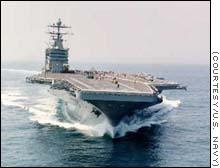
After making good time and getting replenished along the way, USS Harry S. Truman will arrive off the Gulf Coast on Sunday to start providing Katrina aid:
The SH-60 Seahawk and Army UH-60 Blackhawks scheduled to come aboard will fly to and from the ship with food, water and other supplies for those affected by Hurricane Katrina.

“We have more than 20,000 bottles of water and more than 17,000 [meals, ready to eat],” said Supply Officer Cmdr. John Palmer, of Lexington, Ky. We also have cots, sheets and blankets, said Palmer.

Truman is scheduled to arrive off the Gulf Coast early Sunday morning, and one of her tasks will be to support the helicopters bringing these items ashore.

“We are unsure of how many helos will come aboard, but it will probably be between 30 and 40,” said Truman’s Air Boss, Cmdr. Doug Carsten of Byron, Mich. “We talked with our counterparts on the West Coast, USS Abraham Lincoln (CVN 72), who helped in a similar mission during the tsunami relief. They were doing up to 90 missions a day. I think we can match that here aboard Truman.”

Katrina Rescue Operations

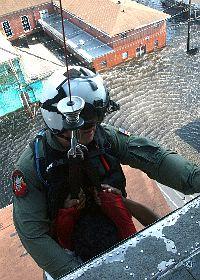
Putting a human face on what the Navy and Coast Guard Katrina helicopter teams are up to (from here) and what they see:


This morning, Fox News had some amazing images of the helos coming in to lift people from the New Orleans COnvention Center- a major military operation and being well-coordinated by very well trained personnel.

Canadian Navy to Louisiana

Our Northern naeighbor is sending ships and helicopters reported here.

Taiwan to pay pirates?

So says the The China Post:
Taiwan is negotiating a ransom payment with Somalian gunmen holding 48 crew members from three Taiwanese fishing vessels, the island's Foreign Ministry said Saturday.
Gunmen in the harbor of Kismayo have been holding the fishermen since Aug. 15, and are demanding a ransom of US$500,000... per ship, Taiwan's Ministry of Foreign Affairs has said.

Great job, Houston!

For 15 years, I called Houston home.

When I got there in the time of "oil boom" you could feel the energy and excitement - in the people, in the buildings, in the swagger.

I still have many, many friends there. But after several days of awful news, nothing has made me prouder to be an adopted Texan or a Houstonian than the way they have welcomed the downtrodden people of New Orleans. Houston has a big heart and this sentimenal American just wants to say "Thanks!"

I'm beginning to feel the energy again...even from afar. I think I'll swagger a little today, too.

God bless you all!

New elite Army unit for insurgent warfare

Reported here:
The unit was created last year as an extension of the Improvised Explosive Device Task Force, which was itself started to counter the threat in Iraq from roadside bombs.

Jennings is taking applications from NCOs in the pay grades E-7 through E-9, and officers O-4 and O-5. No one in the unit or its support staff will rank lower than E-5.

“It’s a very top-heavy unit,” he said.

The group is standing up at Fort Meade, Md., with new quarters and new equipment, Jennings said. About one-third of its members are civilians, all of them retired senior NCOs.

The centerpiece of the unit, Jennings said, will be its rapidly deployable field teams made up of active duty and retired E-8s and E-9s who will respond to emergencies such as kidnappings or car bombings around the world. The team members will be trained in advanced marksmanship, post-blast analysis, and catastrophic crime-scene investigation. They’ll work with military intelligence agents, the CIA and special forces.

The exact mission, Jennings said, is still being determined.
Mission to be determined? Right.

Military may let Louisiana unit leave Iraq early

Per Stars & Stripes:
Officials will try to speed up the return of a Louisiana unit already preparing a move back home from Iraq, to help its soldiers more quickly deal with family issues related to the hurricane damage, the commander of coalition forces in Iraq said Friday.

Lt. Gen. John Vines, commander of Multi-National Corps-Iraq, said officials “might be able to accelerate their rotations by a week or so to get them home to their families.” But units from Mississippi and Alabama in Iraq who aren’t already scheduled to return won’t be able to return early.

“The problem is the security mission here goes on,” he said. “If we take some troops out it puts others at risk. Unless someone is known to have a family member wounded or killed, there is not a provision for them to return.”

No food airdrops

According to Stars & Stripes:
Authorities are avoiding airdropping provisions into New Orleans — the traditional way of supplying disaster victims — out of fear of sparking riots, a state official said.

While the military has used helicopters to drop provisions to some stranded in New Orleans, authorities have not launched the massive supply airdrops seen in Afghanistan at the beginning of Operation Enduring Freedom.

Several C-130 Hercules aircraft are stationed at Little Rock Air Force Base, but authorities have not ordered them to drop supplies to flood victims, Arkansas Air National Guard officials said.

Airdropping supplies could actually worsen the situation, said Army National Guard Lt. Kevin Cowan, with the state Office of Emergency Preparedness.

“Just like Afghanistan, you drop food, it creates chaos,” Cowan said.

He said authorities are looking for a more controlled way to get badly need food and other supplies to people in the hurricane-ravaged region who need it.
Maybe it's a little too contolled right now...

Friday, September 02, 2005

More Seabees! Numbers to go to 3000

Navy says Seabee Hurricane Recovery Force to Reach 3,000:
The U.S. Navy Seabees are currently deploying additional personnel to the Gulf Coast to help with Hurricane Katrina recovery operations.

Two active-duty Seabee battalions from Port Hueneme, Calif., Construction Battalion Maintenance Unit (CBMU) detachments from both coasts, and Reserve Seabee volunteers from various areas will join those already in Gulfport, Miss., for a total Seabee force of up to 3,000.

As currently envisioned, their initial mission will be to clear roads so that civil organizations can reach hurricane victims and to set up logistics centers to distribute food and water as well as to provide emergency medical services. Concurrently, they will also assist military bases in the area to get back in operation.

Seabees from Naval Mobile Construction Battalion (NMCB) 40 are now arriving in Gulfport from Port Hueneme, Calif., with the remainder of the battalion to follow. They will be followed by Seabees from NMCB 4, who will also deploy from Port Hueneme. Seabees from CBMU 202 detachments in Virginia, Florida and Georgia are also planning to deploy in coming days, along with CBMU 303 detachments from Washington state, California and Hawaii.

Gulfport-based Seabees from NMCBs 1, 7 and 133 are currently clearing roads, removing debris and repairing fences at Construction Battalion Center Gulfport. They also cleared a path along 15th Street in Gulfport to provide access to Memorial County Hospital.

The Seabees continue work to clear Highway 90 to Pass Christian, along with other vital roads to help civil authorities gain access to residents.

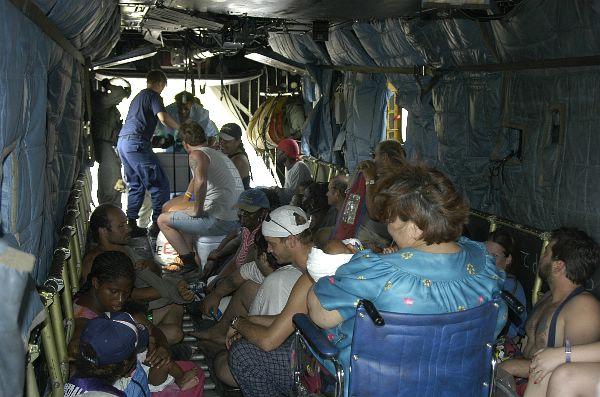
Another part of the Navy is hard at work doing rescue work. Photo caption:
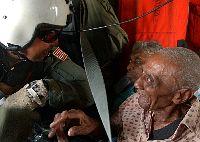
U.S. Navy air crewmen assigned to Helicopter Mine Countermeasures Squadron One Five (HM-15) stationed at Naval Air Station Corpus Christi, Texas, attend to hurricane victims on board an MH-53E helicopter. HM-15 is embarked aboard the amphibious assault ship USS Bataan (LHD 5), assisting in the post-Hurricane Katrina disaster relief efforts in downtown New Orleans. The Navy's involvement in the humanitarian assistance operation is led by the Federal Emergency Management Agency (FEMA), in conjunction with the Department of Defense. U.S. Navy photo by Photographer’s Mate Airman Pedro A. Rodriguez
More pictures here.

UPDATE: More military assets being brought to the US Gulf
Air Force

-Approximately 100 airmen and four HH-60G “Pave Hawk” helicopters from the 55th Rescue Squadron from Davis-Monthan Air Force Base in Arizona to Jackson, Miss., to conduct search and rescue missions.
-Twenty airmen from the 943rd Rescue Group, also from Davis-Monthan, to conduct rescue missions in the region.
-About 44 members of Pope Air Force Base’s 43rd Aeromedical Evacuation Squadron are headed to New Orleans for rescue work.
-Two aeromedical evacuation crews from the 932nd Airlift Wing at Scott Air Force Base in Illinois to New Orleans.
-The 5th Combat Communications Group from Robins Air Force Base to Keesler Air Force Base, Miss., and New Orleans. The group will provide Keesler and a makeshift hospital in New Orleans with communications networks.
-A 105-member Red Horse team from Hurlburt Field, Fla., assisting relief operations in the region. Red Horse is a heavy civil engineering construction unit.
Marine Corps

-Six CH-53E Super Stallions and two CH-46E Sea Knights from Marine Corps Air Station New River, N.C. These aircraft will work out of Naval Air Station Pensacola and regional airports around New Orleans.
-HMH-772, a Reserve squadron out of Willow Grove, Pa., has sent four CH-53E Super Stallions. No location given.
-HMLA-773 from Marietta, Ga., and Belle Chasse, La., have provided three UH-1N Hueys and one AH-1W Cobra to support the Air National Guard at Lafayette, La.
-The 4th Amphibious Assault Battalion, a Reserve unit out of Jacksonville, Fla., has deployed eight Amphibious Assault Vehicles (AAVs) to Gulfport, Miss.
-A Special Purpose Marine Air Ground Task Force comprising units from Marine Corps Base Camp Lejeune, N.C., to assist in the continued humanitarian assistance and disaster relief efforts. No location given.,

Convention Center Blues in NO

Aid was attempted to be delivered to the New Orleans Convention Center as reported here. However, there is a crowd control issue:
At the convention center, where thousands have camped in the streets since Monday awaiting buses out of the city, the despair feeds on itself like a voracious beast.

When National Guard helicopters attempt to land supplies in the parking lot, waiter Bob Vineyard joins a self-appointed ground crew attempting to set up a safe perimeter. The crowd surges past them with an almost feral intensity, and the chopper crew is forced to take off.

The soldiers drop cases of water and self-heating meals from 10 feet in the air. Many of the bottles burst on impact, the precious water left to evaporate in the hot sun.

"We would have had a whole helicopter full of food if you had stayed back!" Vineyard shouts at the crowd, with disgust. "Hey, y'all. I did my best."

Carl Davis wonders why someone can't just truck the food in and hand it out in an orderly fashion. Rather than taking comfort in the food drops, he finds the process insulting, demeaning.

"They're giving it to us like we're in the Third World," he spits. "This should never have happened. It didn't happen in Iraq, and it didn't happen in the tsunami."
I am confused as to why the highway overpass on which Fox's Shepard Smith is standing isn't receiving water and food for the people on it. There must be something we aren't seeing on the tv coverage.

UPDATE: I'm very confused over Geraldo's reporting tonight on the Convention Center and the alleged lack of aid in light of this:
With a cigar-chomping general in the convoy's lead vehicle, the trucks rolled through muddy water to reach the convention center. Flatbed trucks carried huge crates, pallets and bags of relief supplies, including Meals Ready to Eat. Soldiers in fatigues sat in the backs of open-top trucks, their rifles pointing skyward.

Guardsmen carrying rifles also arrived at the Louisiana Superdome, where a vast crowd of bedraggled people — many of them trapped there since the weekend — stretched around the entire perimeter of the building, waiting for their deliverance from the heat, the filth and the gagging stench inside the stadium.

"The cavalry is and will continue to arrive," said Lt. Gen. Steven Blum, commander of the National Guard. He said 7,000 Guardsmen would be in the city by Saturday.

But another commander warned it may yet be days more before evacuations from the convention center begin, because the first priority is bringing in food and water.

"As fast as we can, we'll move them out," said Army Lt. Gen. Russel Honore said. "Worse things have happened to America," he added. "We're going to overcome this, too. It's not our fault. The storm came and flooded the city."

Within minutes of the soldiers' arrival at the convention center, they set up six food and water lines. The crowd was for the most part orderly and grateful for the first major supply convoy to reach the arena.

Diane Sylvester, 49, was the first person through the line, and she emerged with two bottles of water and a pork rib meal. "Something is better than nothing," she said as she mopped sweat from her brow. "I feel great to see the military here. I know I'm saved."

Angela Jones, 24, began guzzling her water before she even cleared the line.

"Like steak and potatoes!" she said of the cool water. "I didn't think I was going to make it through that."

A rag shielding her from the searing heat and a cart holding her only belongings, 70-year-old Nellie Washington asked: "What took you so long? I'm extremely happy, but I cannot let it be at that. They did not take the lead to do this. They had to be pushed to do it."
Am I missing more than usual?

NorthCom

Profile of Northern Command.

More Robert Byrd Pork? W.Va. travel agent handles FEMA deployment

When the investigation on Katrina begins, make sure Sen. Byrd is there -if there are any questions about FEMA travel because W.Va. travel agent handles FEMA deployment.

Soooie!

"Ground truth" Logistics

Instapundit gets a "ground truth" email that lays out some of the problems trying to help New Orleans (and presumbaly Biloxi, etc) here
I run a trade association of tank truck carriers trying to assist in the relief efforts by transporting food and potable water. I'm in regular contact with many of the companies, and here are some "on the ground" facts:
1) Large trucks (80,000 lbs. gross weight) almost always have to use the Interstates. For trucks attempting to come in from outside the area, most of those roads (approaching the disaster area) are either closed or have bridges out. The so-called secondary roads may be somewhat passable, but their bridges (over rivers and streams) are not built to sustain such loads. Simply stated, you can't get there from here.

2) Trucks domicled in those areas (because that's where the companies traditionally serve customers) are still underwater, thus the equipment is not accessible;

3) Nobody in their right mind is going to take loads of gasoline and fuel oil into a city controlled by unfriendly folks carrying automatic weapons. A tank truck loaded with 8,000 gallons of gasoline can produce a very impressive fire;

4) Those local trucking companies can't contact their drivers. There's no power, thus (even) cellular is unavailable, and many of the drivers homes (in places like Kenner, Slidel, Metarie, etc) have been destroyed and families dispersed. I have one member with about 120 drivers and mechanics in that immediate area. To date, management has been able to contact 12. Those in the National Guard have been mobilized and are not available to drive.

5) Pumps -- needed to load the vehicles -- don't work because there's no power.
Supports what I was trying to say here:
Everyone in the MSM is pounding on the idea that too little is happening quickly enough to clear New Orleans and help the trapped people. The problem is that the damaged logistics system is complicating matters. An example, as is shown here at NY Times map is that the normal routes to New Orleans are all broken.

How many roads available to bring supplies in and take people out?

Looks like one. On the satellite photo below, I have put symbols on the roads and bridges we know are closed. We also know that Slidell Louisiana at the top of the I-10 bridge is in ruins, the railroads are in ruins, the Intercoastal waterway is closed, the Mississippi River is closed. All water for the helpers has to be flown or trucked in, all food has to be flown or trucked in. Bring in more troops and you add to the logistics problems. Add more helicopters and you add more flight crews and support crews and fuel issues.
and highlights some of John's point here:
Two. Life support. Remember, this place just got hammered. You have tens of thousands of refugees, milling around, and moving outward. This in an area which has had it's infrastructure hammered. Now you want to bring in thousands of more people. Where do they sleep? How do they get fed? Water? Toilets? Sanitation? So, in addition to having to find a way to feed clothe and house 10s of thousands of refugees on short notice in an area that is by definition under stress and possibly unable to cope - you have to *bring in* additional life support for the supporters. That takes time. And again, the tyranny of distance. FEMA keeps regional storage sites with the stuff they need - but it *still* takes time. Even more so if one of the regional storage sites is involved in the disaster. I don't know that that is the case here, I'm just pointing it out.

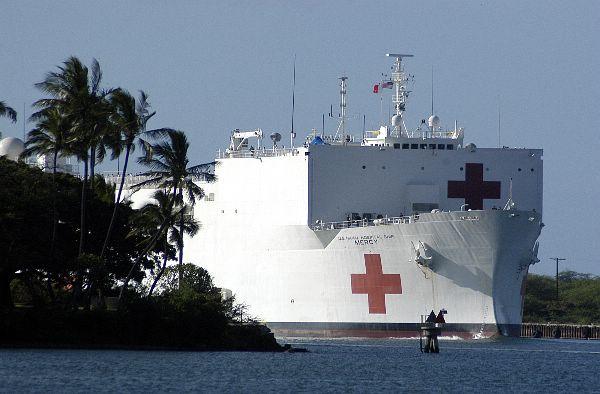
Another Navy Hospital Ship Heads to Gulf


Navy hospital ship Mercy is on the way from San Diego:
A second Navy hospital ship, the USNS Mercy, was preparing to respond to the Gulf Coast Friday, as the Pentagon continued to send resources to the battered region.

The Mercy, which is based ini San Diego, will be ready to depart Wednesday. It will take about two weeks to complete the trip.

The Pentagon announcement that it was dispatching the hospital vessel came amid growing criticism that the Bush administration has responded too slowly to the devastating aftermath of Hurricane Katrina. President Bush himself conceded Friday that the federal effort so far has been unacceptable.

Meanwhile, service members from across the military were flowing into Louisiana and Mississippi to help meet the growing humanitarian needs of the hundreds of thousand of residents left homeless and hungry by Katrina.

Three trucks carrying waters and 150,000 Meals-Ready-to-Eat were being distributed to refugees in the New Orleans Superdome, and military transport planes were scheduled to begin flying people from New Orleans to Lackland Air Force Base in Texas Friday. Altogether the military is sending 9.3 million MREs for refugees in Louisiana, Mississippi and Alabama.

In addition:

_ 600 25,000-pound sand bags were delivered Thursday and another 200 bags were expected Friday, to help shore up the broken levees around the city.

_ Eight Marine transport helicopters with 70 Marines left North Carolina for the Gulf Coast, and 150 more will leave this weekend.

_ Three trucks carrying drinking water were expected to arrive at the Superdome Friday


UPDATE: More people need rescuing
As they flew over the rooftops of New Orleans, plucking people from buildings and cars, the U.S. Navy helicopter crews from this base began to notice the other people, the ones who hadn't managed to punch holes through the roofs of their homes or wade into the streets.

"The problem is there are a lot of people still stuck in their house who don't have the ability to get out of their house," said Lt. Bryce Kammeyer, a pilot of a Navy Sea King helicopter who since Tuesday has been ferrying relief supplies and extracting survivors.

The Navy helicopter missions, increasing by the day, are just one piece of an aerial and land assault on the shorelines, towns, ports and cities that have been devastated and cut off by Hurricane Katrina.

The Pentagon shifted resources and equipment to Louisiana, Mississippi and Alabama in earnest Thursday, three days after the storm, and as it became clear that state and federal disaster plans had underestimated what it would take to rescue residents, deliver humanitarian relief and restore order.


UPDATE 2: Navy Seabees enroute, too:
Naval Mobile Construction Battalion (NMCB) 40 began deploying a detachment of 125 personnel to Gulfport, Miss., Sept. 1 to provide humanitarian assistance and conduct debris removal in the aftermath of the devastation caused by Hurricane Katrina.

The detachment will lend support to the 22nd Seabee Readiness Group in disaster recovery operations.
More Seabees is good.

UPDATE 3: John of Argghhh who used to work in this sort of planning looks at the sitution with a practiced eye here and finds things generally on track, albeit he doesn't approve of the initial Public Information effort...
1. The response *is* massive, and it's moving about as fast as it can, in aggregate, lots of details can be quibbled. But in the main, the machinery is in motion - and it's moving about as fast as it can. And this is about as good as we can expect in many respects, I think. It's simply not possible to have everybody in the response tail stood up ready for instant deployment every time a tropical storm manifests itself.

2. The politicians have fumbled badly thus far. In the end, they will in a sense get redeemed by the people who will clean up the mess. The Professionals who are doing their job at the moment. But, to this voter, The President and the Governor have done an abysmal job in their very public duties.

Thought on New Orleans mayor saying Fed aid "too slow"

How seriously should we take New Orleans mayor Ray Nagin when says the federal aid is too slow in arriving. My answer, as cold-hearted as it seems, is that we should not take it seriously. We should, instead, move on to geting his city evacuated and under control, two things he didn't manage to do, regardless of what may have been heroic efforts on his part.

I am reminded that in combat, almost every platoon leader under fire has the view that higher command is either willfully ignoring his specific plight or too stupid to undertand that the main thrust of the enemy is being directed at him. If we let the platoon leaders decide where reinforcements should go, chaos would result. Instead, leaders at the next level and even at the level above that have to have develop a clear sense of what is really happening on the field and allocate scarce resources accordingly.

With all due respect, the mayor -trapped in his city and lacking in communication eqiuipment - is in the worst possible position to know what is happening around him. He, despite being the mayor of a major city, is no better off than a rookie platoon leader facing fire for the first time. Comments like the following tend, I think, to prove my point:
In the radio interview, Nagin's frustration was palpable.

"I've been out there man. I flew in these helicopters, been in the crowds talking to people crying, don't know where their relatives are. I've done it all man, and I'll tell you man, I keep hearing that it's coming. This is coming, that is coming. And my answer to that today is BS, where is the beef? Because there is no beef in this city. "

Nagin said, "Get every Greyhound bus in the country and get them moving."

Nagin called for a moratorium on press conferences "until the resources are in this city."

"They're feeding the people a line of bull, and they are spinning and people are dying," he said.

"I don't know whether it's the governor's problem, or it's the president's problem, but somebody needs to get ... on a plane and sit down, the two of them, and figure this out right now," Nagin said.

"They thinking small, man, and this is a major, major deal," he said.

"Get off your asses and let's do something."

The mayor said except for a few "knuckleheads," the looting is the result of desperate people just trying to find food and water to survive.
If the mayor had a sense of the the larger picture he would grasp the difficulty in getting anything into his city since all major routes are closed and that his problems are simply one part of a devastated coastline that starts below New Orleans and runs to Pensacola. He might grasp the enormous problems facing the agencies and the leaders he is criticizing. Sometimes the soldier in the field is the worst person to talk to about how a battle is being waged (which is why we usually don't let platton leader Lt Smith talk directly to the President about how the total force should be deployed to solve Lt Smith's immediate problem on the front line).

This is one of those times.

I suspect that given the time, we could find plenty of people in the his constituency who would be quite vocal on the mayor's performance of his duties before and during this crisis, and many of them will be as ignorant of the big picture as the mayor seems to be.

Watching the news coverage and the finger-pointing, I am haunted by a line from an otherwise inapplicable Bob Dylan song, "The Lonesome Death of Hattie Carrol"
But you who philosophize, disgrace and criticize all fears,
Take the rag away from your face, now ain't the time for
your tears.
Now is not the time, Mr. Mayor, for your rhetoric. Work to solve the problems before you and point out areas that need special attention to those who are rushing to help you.

You can lambast whomever you please after the crisis is past.

UPDATE:
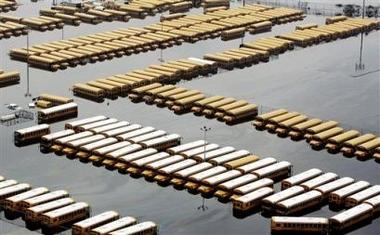
Interesting photo linked to by Jonah Goldberg at the NRO Corner. AP caption:
An aerial view of flooded school buses in a lot, Thursday, Sept. 1, 2005, in New Orleans, LA. The flood is a result of Hurricane Katrina that passed through the area last Monday.(AP Photo/Phil Coale)
. Hmmm. "Get every Greyhound bus in the country and get them moving." Glass houses, anyone? And yes, I am talking about before the hurricane hit. Wonder how much federal money was used to buy the buses?

Ted Koppel Plays the Blame Game

Just watched Nightline. Ted Koppel, a reporter I used to admire, took on the head of FEMA, Michael Brown.

Mr. Brown may or may not be in over his head in this crisis ( and, perhaps, anyone would be, given the nature of Katrina and New Orleans).

However, when Mr. Koppel began berating Mr. Brown for not sending in sufficient buses to evacuate the poor from New Orleans before the storm struck, I began to lose it.

Why blame FEMA for that? Why did not the local government take such action - using city buses to take people out of town to ...where exactly?

Perhaps to the refuge camps that Louisiana had not established for its own citizens knowing, as we all did, that it was not a matter of if a hurricane hammered New Orleans, but a matter of when it would happen... You know, the ones way not up north in the state...

FEMA is essentially a reactive agency (You know the name does include "Emergency Management").

I presume there are other agencies who might have planned for a threatened Cat 5 hurricane?

Perhaps the Louisiana Department of Protecting Louisiana's Citizens?

Or the CIty of New Orleans Department of Getting Our Residents to Safety?

Or maybe the elected officials at the state and city level? Where was the Mayor of New Orleans?

Why does Mr. Koppel finger Mr. Brown and give the others a pass?

Couldn't be political - I'm sure he is above that...Or maybe he'll get to them later...

However, let's get the solutions working and do the "lessons learned" after.

UPDATE: There might have been some buses available to move people out before the storm. See the update to this.

UPDATE 2: Much more coverage of these buses here at Junkyardblog. (Hat tip: Mudville Gazette)

UPDATE 3: Koppel Interview in Quicktime here, It's actually worse than I thought in that when Mr. Brown suggests it might have been the city's repsonsibility to provide buses prior to the storm, Mr. Koppel blows that off and asks about National Guard (Louisiana governor's call) and FEMA (not in charge yet). Koppel was either ignorant of the law or just indifferent to it. However, watch it and judge for yourself.

Thursday, September 01, 2005

Work Now - Blame Later

In the midst of what may be the largest natural disaster to ever strike the United States, as tons of material and personnel begin to pour into the area to render aid and help begin the rebuilding process, as brave people place their own lives on hold to come and help, as millions are dispaced, as power crew struggle to reassemble the grid, refinery workers try to clean up and get their plants restarted, as the ports are being surveyed, as the transportation system lies in a shambles, as tired pilots boat operators and their crews continue to pluck the living from the land of the dead, much, much work is to be done.

Let's get to it.

If you feel the need to lay blame or fault or point fingers - why can't you wait until the still living have been rescued and the dead have been recovered? Why not wait until refugees have been sheltered? The homelesss fed? The shelters built? Why not help solve the problem facing us now?

Donate- volunteer - please do something to ease the plight of those affected.

The following is reposted from an earlier date:

Pick one! (material is from the websites of the agencies)

donate
Red Cross
The American Red Cross has mobilized thousands of volunteers to respond in the aftermath of Hurricane Katrina, which completely devastated parts of Louisiana and left at least 55 people dead.

The Red Cross plans to send close to 2,000 volunteers in the area to begin the initial response in the next few days.

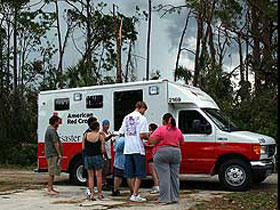
Red Cross emergency response vehicles (ERVs) will visit damaged neighborhoods like this one in Florida after Hurricane Charley last year. (Photo: Bonnie Gillespie).

“Volunteers are truly the lifeblood of the American Red Cross, and we are calling on them now by the thousands to help support relief efforts in Louisiana and other states after Katrina,” said Pat McCrummen, American Red Cross disaster spokesperson. “We are looking at a long term, very significant response to this storm.”

The Red Cross is mobilizing every available resource from across the country including thousands of staff and volunteers to respond to this storm. Red Cross volunteers and donors are neighbors helping neighbors.

Volunteers are already on the ground staffing shelters for tens of thousands of people in five states—Florida, Louisiana, Mississippi, Alabama and Texas.

The Red Cross is launching the largest mobilization of resources for a single natural domestic disaster, in part because the extent of the damage is so widespread over a large geographical area. New Orleans Mayor Ray Nagin including sending nearly 1,900 staff and volunteers into the field in the next few days, and sending more than 250 Emergency Response Vehicles (ERVs) out to provide food and water to affected residents.
donate
Salvation Army
The Salvation Army is prepared to serve 400,000 hot meals per day to residents and first responders in the aftermath of Hurricane Katrina. More than 200 volunteers, employees and officers will serve the meals from 72 mobile canteens that are able to provide up to 5,000 hot meals per day. In addition, the Army is prepared to move in two, 54-foot mobile kitchens that can provide 20,000 hot meals per day.

UPDATE:
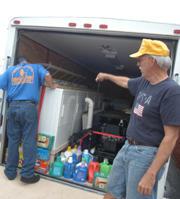
Southern Baptists gear up, too, including bringing laundries (a great idea for people who have been living in one set of clothes), see here (caption:
Laundry service
A Tennessee Baptist Disaster Relief crew headed to the Gulf Coast is equipped with a new laundry unit based out of First Baptist Church in Hendersonville, Tenn. David Acres, director of the state’s disaster relief teams, inspected the machines before departing from the staging area at Cherry Road Baptist Church in Memphis, Tenn. The system, capable of washing about 20 loads of laundry per hour, contains a hot water heater, four washer units and five dryer units, he said. Photo by Morris Abernathy )
More info on donations to the Baptists' North American Mission Board Diaster Relief here.

Technorati tags: ,

In the future: "Radios for Peace"


Several years ago I was involved with a refugee problem in the Kosovo, Albania, Macedonia area. Part of the job was working with the refugees - but communications was a huge problem. We joked about the Non-Governmental Organizations we would start...someday. Mine was "Radios for Peace."

The idea being that my NGO would acquire some really cheap small transistor radios (say 100,000) and and keep them packed tightly in a couple of shipping containers until needed. Along with these radios would be batteries (AAA). When a crisis arises, the radios would be distributed (aye, there's the rub) and the "authorities" could transmit useful information to the affected population such as how to get out of harm's way, find food, water, and so forth.

Watching the Katrina mess, I wish I had followed up on my idea...

In the future...

Housing the Displaced: Manufactured homes and RVs

Reported by Market Watch: FEMA looking for housing, RVs after Katrina
On Wednesday, the Federal Emergency Management Agency broadcast a call for the RV and manufactured housing makers to help the federal government deal with housing needs in New Orleans, where 80% of the city was flooded.

The trade group Manufactured Housing Institute, working with FEMA, asked retailers and manufacturers to "fax all available inventory" that's ready to ship to the agency and the Dept. of Housing and Urban Development.

Louisiana ranks seventh in the U.S. so far in 2005, representing 3.6% of mobile home industry shipments, with Alabama seventh and Mississippi 14th, according to BB&T analyst John Diffendal.

Diffendal estimated that FEMA used about 13,000 travel trailers in Florida and about 500 in Alabama after the 2004 hurricane season, "so this event could require some multiple of last year's needs."
We're looking a perhaps a million displaced people...I think the multiple will be a big one. But where will they put them?

Gas Line Facts: Colonial Pipeline Company

For those of you on the East Coast, as you wait in a gas line or pay new, higher prices, you'd might like to know something about how that gas to the pump. Click on Colonial Pipeline Company and look around or go here and look at the system map to see how the refined products you use flow from the refineries on the Gulf states.

Colonial is back up to 38% after restarting...
Colonial Pipeline delivers a daily average of 100 million gallons of gasoline, home heating oil, aviation fuel and other refined petroleum products to communities and businesses throughout South and the Eastern United States. Colonial has more than 5,500 miles of pipeline stretching from Houston to New York harbor.

With the return to service of additional electrical power in Mississippi later today, Colonial said it expects to operate at 61 percent of normal capacity by the end of Sept. 1. Both gasoline and distillates are currently being transported and delivered.

Somali Pirates take Chinese Fishing Boats

Somali pirates seize Taiwanese fishing boats - demand million+ ransom as reported here:
Three Taiwanese fishing boats have been hijacked off the coast of Somalia and rebel militias are threatening to kill dozens of crewmen unless the shipowners pay a total ransom of US$1.5 million, officials said yesterday.
The Chung Yi 218 from Kaoshiung County along with ships Cheng Ching Feng and Hsin Lien Fa 36 from Pingtung County were seized separately in mid-August, said Michel Lu, spokesman of Ministry of Foreign Affairs (MOFA).

"We received the appeal for help from the ships' owners on August 24," Lu said.

"They said the hijackers had demanded a ransom of 500,000 US dollars for each ship and the crew and threatened to kill them all if the demanded amount was not paid," he said, adding that details of the events were sketchy.

Lu said his ministry's diplomats stationed in Africa had already made contact with rebel militia leaders. He said the relevant Taiwanese ministries including the MOFA, Mainland Affairs Council, and the Fisheries Agency (FA) were working together and rescue efforts were underway.

He said the ship owners should immediately prepare the ransom amount and his ministry was also going through various diplomatic channels, such as international organizations, to find out more about the situation and come up with a plan.

There are about 20 crew on board each of the 95-ton ships. Lu said. Altogether there are 13 mainland Chinese sailors, 14 Indonesians, 12 Filipinos and four Vietnamese. The only Taiwanese were skippers and several senior officers.
These boats were taken a couple of weeks ago, but this is the first identiifcation of them I have seen.

Additional Ships Headed to U.S. Gulf Coast

Confirmation that USS Harry S. Truman and USS Whidbey Island are enroute to render aid here as reported posted yesterday.

UPDATE: More info on the load out the carrier is bringing to the afflicted area here:
The Navy loaded extra fuel, water, food and bedding onto a Norfolk-based aircraft carrier Thursday and sent it and another ship to join other military ships providing relief to residents along the hurricane-ravaged Gulf Coast.

The USS Harry S. Truman took along an additional 3 million gallons of fuel and will serve as a refueling station for helicopters rescuing stranded residents and taking supplies to the stricken area, said Cmdr. Doug Carsten, the carrier's air boss. He estimated 40 to 50 choppers could fit on the 4 1/2-acre flight deck.

"This is a very noble mission," Capt. Jim Gigliotti, the Truman's commanding officer, said from the pier at Norfolk Naval Station -- where hurried preparations were being made before departure at high tide.

The Truman's supply officer, Cmdr. John Palmer, said 30 to 40 tractor-trailers loaded the Truman in about 12 hours with rations for storm victims. The ship is taking an extra 20,000 bottles of water, 17,000 meals that are similar to combat rations and 9,000 frozen dinners, as well as cots and linens for 350.

If necessary, Gigliotti said, some of those left homeless by the storm could be housed on the carrier.

UPDATE 2: Seahawk helo
12 California based Navy helos enroute:
Twelve Navy helicopters and their crew took off Thursday from a San Diego-area Navy base to aid in Hurricane Katrina relief efforts.

The helicopters leaving Coronado, outside San Diego, include eight twin-engine Seahawks, the Navy's version of the Army's Blackhawk helicopter, and four Knighthawks, an update of the Seahawk. All can be used for search and rescue operations.

It will take two days for pilots and crew to fly the helicopters to Naval Air Station Pensacola, a staging area for military relief efforts, said Senior Chief Petty Officer Donna Corvin.

The helicopters are attached to three submarine-fighting squadrons and a sea combat squadron based on Naval Air Station North Island in Coronado.

About 120 maintenance and support personnel from Naval Air Station North Island departed on two C-40 Clipper aircraft bound for Florida. More personnel would be departing later in the day, Corwin said.

Katrina: Logistics

Everyone in the MSM is pounding on the idea that too little is happening quickly enough to clear New Orleans and help the trapped people. The problem is that the damaged logistics system is complicating matters. An example, as is shown here at NY Times map is that the normal routes to New Orleans are all broken.

How many roads available to bring supplies in and take people out?

Looks like one. On the satellite photo below, I have put symbols on the roads and bridges we know are closed. We also know that Slidell Louisiana at the top of the I-10 bridge is in ruins, the railroads are in ruins, the Intercoastal waterway is closed, the Mississippi River is closed. All water for the helpers has to be flown or trucked in, all food has to be flown or trucked in. Bring in more troops and you add to the logistics problems. Add more helicopters and you add more flight crews and support crews and fuel issues.

The right solution (maybe the only solution) is to clear the city as fast as possible. However, there is a limit on the number of buses available and buses in transit to Houston or San Antonio take at least 12 hours to transit back and forth (and need drivers who need water, food and rest. Because of the distances involved you may need 4 times the buses you would need to move people 100 miles (can't move them that short a distance there's no food, water, shelter, or electricity). And new people keep arriving to be transported. Can't take them by boat, because the river system is closed. Can't take them by air because the air system is closed.

Using self-contained assets (those that bring their own food, shelter and water) is vital. Right now, the best such platform is USS Bataan which is on station and working. Bataan seems to be limited by safe navigation issues to moving no closer than 80-90 miles off New Orleans. More ships will join her soon...

The ships enroute from Norfolk will arrive in a couple of days (note: A CNN newsreader is pounding some expert asking why all the "military" stuff is not already on scene - three days after the disaster- look, Lady, the Navy cannot teleport its ships- they have to sail from Norfolk, down the East Coast, around Florida and across the Gulf of Mexico - and there are already significant forces in place - where do you think the helicopters you are showing on your newscast came from?)


This is a hard problem and a time when experts talk logistics and work that end of the problem.

UPDATE: I have attempted to clean up this post to make my thoughts clearer. Part of what I'm saying is expressed by Austin Bay when he writes:
We’ve a million people dispossessed and they are suffering. Critics grouse that the response to Katrina’s devestation has been abysmally slow. Compared to what? Slow compared to our expectations is the correct answer. Compared to every other nation on the planet, we’re moving at warp speed to address a natural disaster of extraordinary magnitude.

UPDATE 2: . Photo shows one of the problems in moving suppies into New Orleans.

US Northern Command Katrina Update

Military work found here:
USNORTHCOM is providing and/or coordinating the following support:
Ongoing

• U.S. Transportation Command is providing medical airlift support to transport approximately 2,500 patients from New Orleans International Airport to National Disaster Medical System federal coordinating centers.

• Joint Forces Command is providing Department of Defense leased property at Old England Airfield as an intermediate staging base to support hurricane response in the state of Louisiana. This will serve as a staging point for National Guard personnel arriving from other states to support the Louisiana relief efforts.

• JTF-Civil Support (JTF-CS) is providing a joint planning augmentation cell to provide domestic chemical, biological, radiological, nuclear, or high-yield explosive (CBRNE) consequence management planning capabilities to JTF-Katrina.

• Defense Coordinating Officers (DCOs) and Defense Coordinating Elements (DCEs) in Clanton, Ala., Baton Rouge, La., Jackson, Miss., to liaison between U.S. Northern Command, FEMA and the Department of Defense. (Tallahassee DCO redeployed)

• Maxwell Air Force Base, Ala.; Naval Air Station Meridian, Miss.; Barksdale Air Force Base, La.; Alexandria, La.; and Ft. Polk, La.; as federal operational staging areas to expedite the movement of relief supplies and emergency personnel to affected areas.

• US Transportation Command flew eight swift water rescue teams from California to Lafayette, La. These California-based teams provide approximately 14 volunteer rescue personnel with vehicles and small rigid hulled boats who are highly trained and capable of rescuing stranded citizens from flooded areas.

• USS Bataan (LHD 5) and HSV Swift out of Naval Station Ingleside, Texas, sailed to the waters off Louisiana to provide support. Currently, the four MH-53s and two HH-60s off the Bataan are flying medevac and search and rescue missions in Louisiana. Bataan’s hospital may also be used for medical support.

• The Iwo Jima Expeditionary Strike Group (ESG) is sailing from Norfolk, Va. loaded with disaster response equipment. The (ESG) consists of USS Iwo Jima (LHD 7), USS Shreveport (LPD 12), USS Tortuga (LSD 46), and USNS Arctic (T-AOE 8). The ESG is expected to be operating off the Louisiana coast beginning Sept. 4.

• The hospital ship, USNS Comfort (T-AH 20), is departing Baltimore to bring its invaluable medical assistance to the Gulf region. The Comfort is expected to reach the area Sept. 8.

• There are plans to bring USS Grapple (ARS 53) to assist with maritime and underwater survey and salvage operations.

• Three Army Helicopters from III Corps in Fort Hood, Texas, are in Baton Rouge and two more are in Mississippi to assist with search and rescue and damage assessment.

• Five Air Force helicopters from the 920th Rescue Wing (RQW) at Patrick AFB, Fla., and the 347th RQW at Moody AFB, Ga., are in Mississippi for search and rescue missions. These aircraft are capable of nighttime search and rescue and will also transport FEMA’s Rapid Needs Assessment teams to gather critical information for state and federal emergency managers.

• USNORTHCOM established Joint Task Force Katrina to be the military’s on-scene commander in support of FEMA. Lt. Gen. Russel Honor, commander of the First Army in Fort Gillem, Ga., is the JTF-Commander. JTF-Katrina will be based out of Camp Shelby, Miss.

• Standing Joint Forces Headquarters-North is providing an augmentation cell and its command and control vehicle to JTF-Katrina.

• USNORTHCOM’s Joint Operations Center is on 24-hour duty in Colorado Springs, Colo., to facilitate any additional requests for assistance that may come from FEMA representatives.
The NORTHCOM site also contains information on the effect of the Posse Comitatus Act on the legal ability of the US military to act in law enforcement (i.e. controlling looters):
As stated in the Posse Comitatus Act, USNORTHCOM and the military may not act in a law enforcement capacity within the United States. Typical defense support of civil authorities in disasters includes logistics, communications and medical care. The Coast Guard, in peacetime, and the National Guard under state control are not bound by Posse Comitatus.
Just in case you were wondering why the 82nd Airborne isn't patrolling the streets.

What is not stated is the complexity of moving personnel into the area. Military planners have to account for the food, shelter, fuel, transportation, water and medical needs of every single soldier or sailor moved into the region. The troops must be self-sufficient and not add to the burden already being shouldered by local agencies and charities. In fact, one of the benefits of the Navy ship borne forces is that the ships are essentially self-sustaining.


Note that the HSV Swift is mentioned for what is, to my knowledge, the first time. Also, first indications of LCACs bewing used in this photo and caption:
A Landing Craft Air Cushion (LCAC) assigned to Naval Surface Warfare Center, Panama City, Florida approaches the stern gate of the Amphibious Assault Ship USS Bataan (LHD-5) August 31, 2005 as part of the disaster relief efforts at New Orleans, Louisiana. The two LCAC’s have been tasked to bring any type of cargo or personnel onboard or shore. Bataan’s involvement in the humanitarian assistance operations is an effort led by the Department of Defense in conjunction with the Federal Emergency Management Agency
Both the Swift and the LCACs offer high spped, shallow draft capabilities...

UPDATE:
USNS Arctic (T-AOE-8) also enroute to as act fuel source for Navy ships and aircraft. Post of "replenishment at sea" here. See also Chaotic Synaptic Activity's "Life in the Fat Ship Navy" series here.

The closed Mississippi

Way down in this article on the gas price increases is a another story of major importance:
Katrina's economic impact is being felt far from the Gulf Coast. Barge operators in Missouri and farmers in Iowa are worrying about how long the Mississippi River might be closed to barge and ship traffic.

"A lot of our grain here goes down the river to the Gulf of Mexico, and we don't know how long it is before the ports down there open," said LuAnn Robinson, a grain negotiator for the National Farmers Organization in Ames, Iowa. "There's going to be piles all over if we can't ship down the river."

Barge operators don't have anywhere to drop off the last stored grains, and the fall corn harvest begins in less than a month.

"All the facilities are knocked out. We can get everything but there are no facilities down there," said Bruce Engert, the general manager of the Missouri Barge Line Co. in Cape Girardeau, Mo.

Gulf Coast ports in Texas are scrambling to handle cargo that must be diverted from Alabama, Mississippi and Louisiana.

"This will not be cleaned up quickly. This is going to be a slow process," said Floyd Gaspard, the director of the Port of Port Arthur, Texas.


UPDATE: Related - Chiquita Brands relocates banana deliveries from Gulfport MS as noted here.
Chiquita also reported its 20 employees in Gulfport have been accounted for. That port handled about 25 percent of the company's banana imports to the U.S. last year. In all, Chiquita uses five ports in the States.
Just the tip of the iceberg...