VertRep

VertRep

Thursday, October 13, 2005

Somali pirates seize another UN food aid ship


Reported here:
Somali pirates have hijacked a second ship carrying United Nations food aid in the latest act of piracy to strike vessels plying the anarchic country's treacherous seas, the world body said on Thursday.
Six gunmen stormed the MV Miltzow freighter on Wednesday as its cargo of 850 tonnes of food aid was being offloaded in the port of Merka, 100 km (60 miles) southwest of the capital Mogadishu, the U.N. World Food Programme said.
Aboard were the crew of 10, including a Kenyan captain, Ugandan engineer and eight other Kenyans, WFP added.
The hijacking came 10 days after pirates released another ship laden with WFP food aid, the M.V. Semlow, which they seized at sea and held for nearly 100 days...
...Wednesday's capture of the Miltzow is the third time pirates have struck the Mombasa, Kenya-based Motaku Shipping Agency, which owns the two ships hired to carry WFP food aid and a third stormed by pirates over the weekend.
The third ship, the M.V. Torgelow, had been headed to the Somali port of El Maan carrying fuel and supplies to restock its sister ship the Semlow when it was taken.
The Semlow has yet to unload its cargo of 850 tonnes of rice destined for victims of the Dec. 26 tsunami. A dispute with El Maan port authorities has prevented the return of its exhausted 10-man crew to Mombasa, WFP said.
Motaku typically runs about two voyages a month to Somalia, but may abandon the route because of the risks.
WFP said it is considering sending food aid overland through Kenya and Djibouti since shipping firms now want armed escorts.
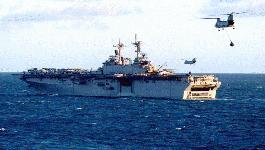
Image of what I suspect is the MV Miltzow from here.

UPDATE: Some unpleasant truths about the Somali pirates (and some hyperbole):
Their motives appear to be purely profit centered although many claim to be enforcing the sovereignty of Somalia's territorial waters in the absence of a formal navy or coast guard.

"There are pirates who are flatly sea robbers, others claim to be protecting Somali waters from overfishing and dumping of toxic material," said Andrew Mwangura of the Seafarers' Assistance Programme in Mombasa, Kenya, home port to at least two recently seized vessels.

"Others are hired to hijack ships for revenge," he said.

"The whole issue of piracy is about money and control of certain portions of the sea."

Mwangura and other industry sources say the pirates have grown bolder and more successful because they have stationed accomplices in various East African ports to notify them of ship departures and expected times of passage through Somali waters.

While not always successful and occasionally beaten off by crews with the help of passing US warships, the hijackers have claimed numerous prizes, holding vessels for months until their demands are met or negotiated down.

A group of pirates based near the town of Haradere, about 300km north of Mogadishu, held a Mombasa-based ship transporting World Food Programme (WFP) aid for Somali tsunami victims for nearly three months before abandoning it in early October.

While the WFP denies paying any ransom, local residents say it is likely money changed hands during negotiations with the Somali owner of another ship commandered by the same pirates in September.

"The pirates have collected millions of dollars in ransom since [1991]," said Abdi Aden Mahad, a businessman in Bossaso, the main port in the northern Somali enclave of Puntland.

"It's the best income-generating business I've ever seen," he said.

"It's like winning a lottery."

At least three well-known former pirate chieftains who have made fortunes from ship hijackings live in the Puntland fishing village of Marreray, according to local residents.

"They are now married and have decent lives without any fear or asking for forgiveness," said Marreray villager Abdi Mohamed.

"They earned more than $100 000 each from piracy."

Attempts to restore maritime security have been limited and fraught with difficulty amid power struggles between unruly land-based militia in control of various fiefdoms and the sea-borne pirates

"The warlords are powerless, they cannot do anything about piracy," said Mire Hassan Ibrahim, a trader in Somalia's bullet-scarred capital of Mogadishu. "They have failed to pacify the land let alone the sea."

"These pirates are very rich and could kill or overthrow a warlord who tries to expand his control offshore," he said.

A tussle between pirates and warlords has kept three hijacked Taiwanese commercial fishing vessels in captivity for more than two months off the southeastern port of Kismayo, about 500km from Mogadishu.
UPDATE2: Commentor Worker was kind enough to offer up this link which reports that the putative government of Somalia is asking for foreign help:
Somalia's prime minister called on neighboring countries Thursday to send warships to patrol his lawless nation's waters after pirates seized a third cargo vessel delivering food aid.

Prime Minister Ali Mohamed Gedi said in an interview with The Associated Press that his government — which has yet to take control of the country — does not have the resources to protect shipping along Somalia's coast.

Gedi said he would call for a meeting of every country that has an interest in securing Somalia's shipping lanes to organize an interim force to protect Somalia's waters.

Somalia's 1,880-mile coastline is Africa's longest, and the country has had no effective central government since opposition leaders ousted dictator Mohamed Siad Barre in 1991. They then turned on each other, transforming this nation of 7 million into a patchwork of battling fiefdoms ruled by heavily armed militias.
.

Wednesday, October 12, 2005

US Navy Birthday 13 October 1775


Only the Navy can make its own birthday dull. 230 years - sort of-
The United States Navy traces its origins to the Continental Navy, which the Continental Congress established on 13 October 1775 by authorizing the procurement, fitting out, manning, and dispatch of two armed vessels to cruise in search of munitions ships supplying the British Army in America. The legislation also established a Naval Committee to supervise the work. All together, the Continental Navy numbered some fifty ships over the course of the war, with approximately twenty warships active at its maximum strength.

After the American War for Independence, Congress sold the surviving ships of the Continental Navy and released the seamen and officers. The Constitution of the United States, ratified in 1789, empowered Congress "to provide and maintain a navy." Acting on this authority, Congress ordered the construction and manning of six frigates in 1794, and the War Department administered naval affairs from that year until Congress established the Department of the Navy on 30 April 1798.
We can do better than that. Suppose we took a ship's name and follow it through history. Which one? How about the USS Wasp?

The first Wasp was a schooner of war- and to war she went!
Picture from here. Caption:
U.S.S. WASP Boarding H.M Brig FROLIC
Oil 27 x 53 in. Attributed to Thomas Birch, ca. 1815.
This painting is said to once have been the property of Captain James Biddle, U. S. N., Lieutenant of the U. S. S. WASP.
The tenth USS WASP (LHD-1) posts this history of its predecessors:
In naming LHD-1 "Wasp", the Navy honors nine previous ships, dating to the American Revolution, which have borne this illustrious name.

Previous U.S. Navy ships named Wasp include: a schooner (1775-1777), a sloop of war (1806-1813), another schooner (1810-1814), a tender sloop (1813-1814), a ship-rigged sloop of war (1814), an iron-hulled side wheel steamer (1865-1876), a steam yacht (1898-1921), and the most famous of the nine, two aircraft carriers, CV-7 (1940-1942) and CV-18 (1943-1972).

The eighth Wasp was a 14,700 ton, 741-foot aircraft carrier that earned two battle stars during World War II. Wasp's sterling performance evoked British Prime Minister Winston Churchill's famous quote, "Who said a Wasp couldn't sting twice?"

After shifting to the Pacific theater of operations, CV-7 participated in a number of major engagements before being sunk during the Battle of Guadalcanal on September 15, 1942.

Following the loss of CV-7, CV-18, already under construction at the time, became the ninth Wasp. The ship earned eight battle stars for it's World War II service in the Pacific. After 29 years of gallant naval service, CV-18 was decommissioned in 1972.

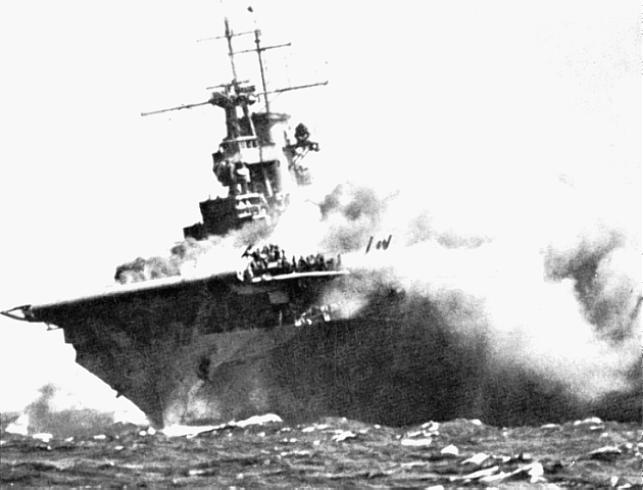
USS Wasp (CV-7): Caption:
USS Wasp (CV-7) burning and listing after she was torpedoed by the Japanese submarine I-19, on 15 September 1942, while operating in the Southwestern Pacific in support of forces on Guadalcanal. Official U.S. Navy Photograph, now in the collections of the National Archives.UPDATE: More here

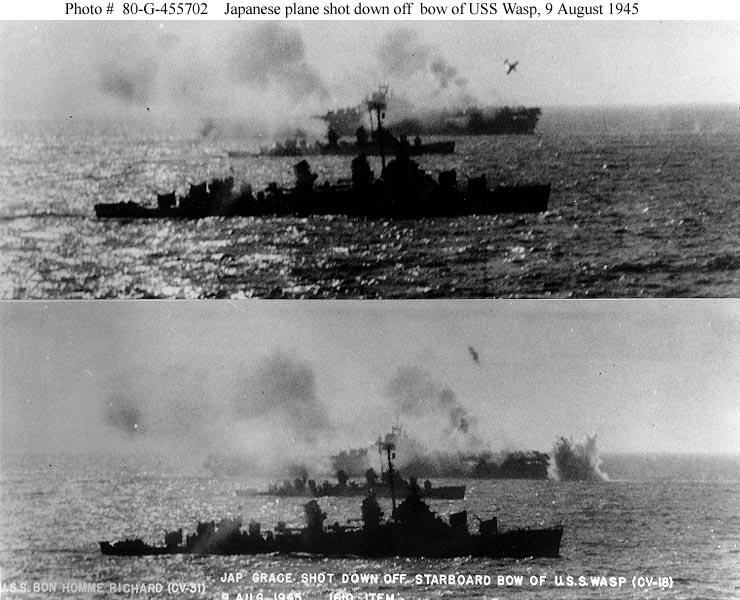
USS Wasp (CV-18): Caption:
Carrier Operations off Japan, August 1945 — A Japanese aircraft is shot down just off the starboard bow of USS Wasp (CV-18), during operations off Honshu, Japan, 9 August 1945. Two Fletcher-class destroyers are in the foreground. Photographed from USS Bon Homme Richard (CV-31), the image includes two frames, showing the scene just before and after the crash. The original caption identifies the aircraft as a Grace (Aichi B7A2).

USS Wasp (LHD-1): And some facts:
The Wasp-class are the largest amphibious ships in the world. WASP class ships are the first to be specifically designed to accomidate the AV-8B Harrier jump jet and the LCAC hovercraft, along with the full range of Navy and Marine helicopters, conventional landing craft and amphibious assault vehicles to support a Marine Expeditionary Unit (MEU) of 2,000 Marines. The ships also carry some of the most sophisticated communications, command and control capabilities afloat, alongwith state of the art electronic systems and defensive weaponry.
USS Wasp (LHD-1) homepage. "First in the Fleet"

You bet!

One ship's name. 230 years. That's some Naval history.

Happy Birthday, Navy!

Thanks to Mudville Gazette's open post!

UPDATE: Some analysis of where the Navy might be headed here from Sea Power. Hat tip to NOSI

Isn't this why it's a "sport?"

Headline reads: Cardinals, Astros Have Mutual Respect".
"On the field, it's a classic," St. Louis manager Tony La Russa said. "We play the game the same way."

St. Louis has six playoff appearances over the past decade, reaching the NLCS four times and the World Series a year ago with a seven-game victory over the Astros — a memorable series that was overshadowed by Boston's comeback win against the Yankees in the ALCS.

The Cardinals stayed alive when Jim Edmonds hit a game-winning homer in the 12th inning of Game 6. St. Louis closed out the series by beating Roger Clemens in Game 7.

Houston is making its sixth playoff appearance in nine years and looking to reach the World Series for the first time in franchise history. The Astros made a breakthrough last year by beating perennial nemesis Atlanta — their first postseason series victory. They knocked off the Braves in the opening round again this year, winning the final game in an 18-inning marathon.

Then again, the Astros still have some catching up to do against the Cardinals, one of baseball's most revered franchises.
When I lived in Bellevue, Nebraska, as a kid, the 1964 Cards were my team because of great players like Bob Gibson (he was from Omaha), Curt Flood, Bill White, and Lou Brock. And because we used to travel to St. Louis to see them play. Bob Gibson
They beat the hated Yankees in the 1964 World Series. But, when I lived in Houston, I was an Astros season ticket holder and was at the long playoff game against the hated Mets (and since the managing partner of the law firm I was working for at the time was not a baseball fan, I probably lost my job as a result of his perception I was ducking work to go to the games (even though I was coming in extra early in the day to get my work done-). I watched Biggio and Bagwell from day one and Roger Clemens attended the same high school as my older daughter (Spring Woods High in the Spring Branch ISD, if you must know). Craig Biggio
My younger son wore a Biggio jersey while we lived in Houston and long after we moved up here. Biggio reminds me of Phil Garner when I first saw him join the Oakland A's when I live out there, when Garner replaced Dick Green at second for the A's. Garner is known has "Scrap Iron" for his style of play and Biggio is a throwback to that style. If he isn't dirty, he hasn't been playing.

Where I live now there is no major league team and there are way too many Boston and New York fans. So where do my loyalties lie? I like the Cards. but...let's go Astros!

Either way, let's have some fun! Isn't that why they call it a "sport?"

Samoan style football

Watching college football the other day I was struck by the number of Samoans on the field, in relative terms. So, I asked what's the deal? So, thanks to the magic of Google I found this.
The vast majority of Samoans playing in the college or professional ranks are first- or second-generation Americans from families that typically settled in Hawaii or on the West Coast. American Samoans are classified as U.S. nationals and easily can become citizens.

Yet an increasing number of college football programs are recruiting the island, plucking players from its six high school teams and placing them directly onto their squads or at junior colleges. This winter, Matt Toeaina, a running back out of Samoana High, signed with Oregon, where he'll join highly recruited, Robert Toeaina, his cousin from California. Defensive end Melila Purcell of Leone inked with Hawaii.
Ah, now I know.

Tuesday, October 11, 2005

Oh, duh: "World Helpless Against Assaults of Nature"


Hat tip to Drudge for pointing this wonderful article out: from the Washington Post:World Helpless Against Assaults of Nature
In a more hopeful time, buoyed by the promise of science, it was thought hurricanes could be tricked into dispersing, earthquakes could be disarmed by nuclear explosions and floodwaters held at bay by great mounds of dirt.

Such conceits are another victim of a year of destruction.
Wait, I though global warming, allegedly caused by man, was... or how about the Russian Weather Machine being operated by the Japanese mafia? Or the US weather machine up in Alaska? or... the Tesla earthquake machine?

Wacky anthropomorphication is also a problem; "Why is nature so angry?" it asks here as if man has somehow ticked off Mother Nature by making margerine taste like butter.

Of course, US hegemony gets trotted out, too, in the death toll blame game:
Research findings of Yale, California and Penn State Universities converge on the probability of a 1600 km. rupture of the crust along the Indo-Australian plate boundary; with the major March 30th. quake not just an aftershock, but ‘a new rupture of an adjacent segment of the fault’. On 23rd.July, Times of India reported that a Columbia University researcher having access to the December event sound tracks, felt as if ‘the earth was ripping apart along the fault’. These sound tracks were recorded at the US Diego Garcia Base, 2500km from Sumatra. The Base was established to monitor nuclear explosions for the Comprehensive Nuclear Test Ban Treaty. This vital information about the earthquake and tsunami’s advance were not immediately relayed to the affected Asian Nations, which could have saved thousands of lives. Such is the stranglehold of US hegemony ! Believe it or not there are no monitoring stations in the vulnerable South Asian region. !
Oh, and don't forget the meteor and asteroid threat. And, uh, the sun going super nova, and snakehead fish.

Doomed! Helpless! Doomed!

Right.

"Improvise. Adapt. Overcome." (source)

UPDATE: Lex has noticed that Ma might be -um- vexed.

Somali pirates seize another ship

Somali pirates have seized a ship enroute to the MV Semlow (recently released by the pirates) ferrying food and suppies to Semlow it says here.
More here:
Somali pirates are feared to have hijacked another ship with its 10-man crew and cargo of mainly foodstuff in the latest of string of hijackings off lawless Somalia, seafarers said Tuesday.

Kenyan Seafarers Assistance Program Coordinator Andrew Mwangura said the vessel, MV Torgelow, was hijacked near El Maan port in Somalia, the same area where eight Kenyans abducted in another ship three months ago were released last week.

Mwangura said MV Torgelow, which belongs Kenya-based Motaku Shipping Agency, the same company that owns the recently released MV Semlow, was carrying general cargo belonging to Somali businessmen.

The captain is Sri Lankan and the other nine seamen all Kenyans.

"The ship was carrying oil, foodstuff and water, which were to be given to the recently released Kenyans, who are still at El Maan port waiting for MV Semlow to be discharged before coming home," he said by telephone.

He said in addition, the Torgelow was carrying a consignment for Somali businessmen, of foodstuffs such as spaghetti, coffee and cooking oil.

The ship's owner said Torgelow vessel was seized off the southern coast on its way from Kenya's Mombasa port to the Somali port of El Maan.

"I have no idea if it was the same pirates or different ones. I'm not even sure it's our vessel, but it looks like it. We lost radio contact on Saturday morning, so were waiting for it to arrive at El Maan, but it didn't," Inayet Kudrati, the boss of theMotaku Shipping Agency, reportedly said.

He said despite being freed, the MV Semlow, chartered by the UNWorld Food Program to carry UN aid, has still not been able to off-load its cargo of 850 tons of rice in El Maan, preventing the return of its exhausted 10-man crew to Mombasa.

Kudrati said his shipping agency runs about two voyages a monthto Somalia mainly taking foreign-donated aid, but would now consider pulling out of the route.

"I think we have to withdraw. There are so many cases of attacks and no one is around patrolling these waters," he said.
BBC report here.

Good grief! Has no one thought of providing escorts?

By the way: STAY AWAY FROM SOMALIA!

NIMBYism in Florida-125 miles offshore drilling "too close" for comfort?

Political fallout from Florida Gov. Bush endorsement of allowing drill rigs 125 miles off the coast reported here.
The Republican governor has endorsed a plan, part of a bill proposed by a California congressman that would allow, among other things, oil rigs 125 miles off the coast. In exchange, Bush said, the state would get other coastal protections.

But environmentalists and Republican and Democratic critics say what Bush advocates would actually allow for oil and gas exploration and production in the Gulf of Mexico closer to Florida.

"The governor is seeking better protection, and lasting protection, for Florida's coasts," Bush spokeswoman Deena Reppen said in defending his stance.

She said the governor wanted a secure 125-mile ban on oil and gas drilling off the state's shoreline from Jacksonville on the Atlantic Ocean to Pensacola on the gulf.

The proposed legislation — and the pressure to support it — comes as fuel prices are at record highs and energy production in the gulf has been crippled by hurricanes Katrina and Rita.

Democratic Rep. Robert Wexler accused Bush, who cannot seek reelection when his second term expires next year, of performing a flip-flop that "abandons Florida's coast."

"For many years, the Florida congressional delegation, Republicans and Democrats, has been unified in opposing drilling off the Florida coastline," Wexler said. He said that meant in the waters up to three miles from the coast that are under Florida's control, and in the adjacent belt, extending 200 miles from shore, where the federal government regulates drilling for oil and gas.

"Gov. Bush unfortunately has effectively undermined that unity," Wexler said. "Now it's all negotiable."
NIMBY. NIMBY. NIMBY.

I guess tourists don't need fuel to get to Florida and that all the power plants producing electricity for the necessary air conditioning systems that allow life in Florida to be bearable run on coal, air or atoms. And the cruise ships operate on coal. And Disney World operates on biofuels.

Well, it's all negotiable.

South Asia Earthquake

Toll tops 42,000. "Oh, the Humanity!"

Disturbing Mind Picture of the Day

From Maritime Advocate Online (email newsletter), the Disturbing MInd Picture of the Day:
In forty years' time, there will be millions of old ladies running around with tattoos.

Monday, October 10, 2005

Worth reading

From here:
October 6, 2005
THE PRESIDENT: Thank you all. (Applause.) Thank you all. Please be seated. (Applause.) Thank you for the warm welcome. I'm honored once again to be with the supporters of the National Endowment for Democracy. Since the day President Ronald Reagan set out the vision for this Endowment, the world has seen the swiftest advance of democratic institutions in history. And Americans are proud to have played our role in this great story.

Our nation stood guard on tense borders; we spoke for the rights of dissidents and the hopes of exile; we aided the rise of new democracies on the ruins of tyranny. And all the cost and sacrifice of that struggle has been worth it, because, from Latin America to Europe to Asia, we've gained the peace that freedom brings.

In this new century, freedom is once again assaulted by enemies determined to roll back generations of democratic progress. Once again, we're responding to a global campaign of fear with a global campaign of freedom. And once again, we will see freedom's victory. (Applause.)

Vin, I want to thank you for inviting me back. And thank you for the short introduction. (Laughter.) I appreciate Carl Gershman. I want to welcome former Congressman Dick Gephardt, who is a board member of the National Endowment for Democracy. It's good to see you, Dick. And I appreciate Chris Cox, who is the Chairman of the U.S. Securities and Exchange Commission, and a board member for the National Endowment of Democracy, for being here, as well. I want to thank all the other board members.

I appreciate the Secretary of State, Condi Rice, who has joined us -- alongside her, Secretary of Defense Don Rumsfeld. Thank you all for being here. I'm proud, as well, that the newly sworn-in Chairman of the Joint Chiefs, the first Marine ever to hold that position, is with us today -- General Peter Pace. (Applause.) I thank the members of the Diplomatic Corps who are here, as well.

Recently our country observed the fourth anniversary of a great evil, and looked back on a great turning point in our history. We still remember a proud city covered in smoke and ashes, a fire across the Potomac, and passengers who spent their final moments on Earth fighting the enemy. We still remember the men who rejoiced in every death, and Americans in uniform rising to duty. And we remember the calling that came to us on that day, and continues to this hour: We will confront this mortal danger to all humanity. We will not tire, or rest, until the war on terror is won. (Applause.)

The images and experience of September the 11th are unique for Americans. Yet the evil of that morning has reappeared on other days, in other places -- in Mombasa, and Casablanca, and Riyadh, and Jakarta, and Istanbul, and Madrid, and Beslan, and Taba, and Netanya, and Baghdad, and elsewhere. In the past few months, we've seen a new terror offensive with attacks on London, and Sharm el-Sheikh, and a deadly bombing in Bali once again. All these separate images of destruction and suffering that we see on the news can seem like random and isolated acts of madness; innocent men and women and children have died simply because they boarded the wrong train, or worked in the wrong building, or checked into the wrong hotel. Yet while the killers choose their victims indiscriminately, their attacks serve a clear and focused ideology, a set of beliefs and goals that are evil, but not insane.

Some call this evil Islamic radicalism; others, militant Jihadism; still others, Islamo-fascism. Whatever it's called, this ideology is very different from the religion of Islam. This form of radicalism exploits Islam to serve a violent, political vision: the establishment, by terrorism and subversion and insurgency, of a totalitarian empire that denies all political and religious freedom. These extremists distort the idea of jihad into a call for terrorist murder against Christians and Jews and Hindus -- and also against Muslims from other traditions, who they regard as heretics.

Many militants are part of global, borderless terrorist organizations like al Qaeda, which spreads propaganda, and provides financing and technical assistance to local extremists, and conducts dramatic and brutal operations like September the 11th. Other militants are found in regional groups, often associated with al Qaeda -- paramilitary insurgencies and separatist movements in places like Somalia, and the Philippines, and Pakistan, and Chechnya, and Kashmir, and Algeria. Still others spring up in local cells, inspired by Islamic radicalism, but not centrally directed. Islamic radicalism is more like a loose network with many branches than an army under a single command. Yet these operatives, fighting on scattered battlefields, share a similar ideology and vision for our world.

We know the vision of the radicals because they've openly stated it -- in videos, and audiotapes, and letters, and declarations, and websites. First, these extremists want to end American and Western influence in the broader Middle East, because we stand for democracy and peace, and stand in the way of their ambitions. Al Qaeda's leader, Osama bin Laden, has called on Muslims to dedicate, quote, their "resources, sons and money to driving the infidels out of their lands." Their tactic to meet this goal has been consistent for a quarter-century: They hit us, and expect us to run. They want us to repeat the sad history of Beirut in 1983, and Mogadishu in 1993 -- only this time on a larger scale, with greater consequences.

Second, the militant network wants to use the vacuum created by an American retreat to gain control of a country, a base from which to launch attacks and conduct their war against non-radical Muslim governments. Over the past few decades, radicals have specifically targeted Egypt, and Saudi Arabia, and Pakistan, and Jordan for potential takeover. They achieved their goal, for a time, in Afghanistan. Now they've set their sights on Iraq. Bin Laden has stated: "The whole world is watching this war and the two adversaries. It's either victory and glory, or misery and humiliation." The terrorists regard Iraq as the central front in their war against humanity. And we must recognize Iraq as the central front in our war on terror.

Third, the militants believe that controlling one country will rally the Muslim masses, enabling them to overthrow all moderate governments in the region, and establish a radical Islamic empire that spans from Spain to Indonesia. With greater economic and military and political power, the terrorists would be able to advance their stated agenda: to develop weapons of mass destruction, to destroy Israel, to intimidate Europe, to assault the American people, and to blackmail our government into isolation.

Some might be tempted to dismiss these goals as fanatical or extreme. Well, they are fanatical and extreme -- and they should not be dismissed. Our enemy is utterly committed. As Zarqawi has vowed, "We will either achieve victory over the human race or we will pass to the eternal life." And the civilized world knows very well that other fanatics in history, from Hitler to Stalin to Pol Pot, consumed whole nations in war and genocide before leaving the stage of history. Evil men, obsessed with ambition and unburdened by conscience, must be taken very seriously -- and we must stop them before their crimes can multiply.

Defeating the militant network is difficult, because it thrives, like a parasite, on the suffering and frustration of others. The radicals exploit local conflicts to build a culture of victimization, in which someone else is always to blame and violence is always the solution. They exploit resentful and disillusioned young men and women, recruiting them through radical mosques as the pawns of terror. And they exploit modern technology to multiply their destructive power. Instead of attending faraway training camps, recruits can now access online training libraries to learn how to build a roadside bomb, or fire a rocket-propelled grenade -- and this further spreads the threat of violence, even within peaceful democratic societies.

The influence of Islamic radicalism is also magnified by helpers and enablers. They have been sheltered by authoritarian regimes, allies of convenience like Syria and Iran, that share the goal of hurting America and moderate Muslim governments, and use terrorist propaganda to blame their own failures on the West and America, and on the Jews. These radicals depend on front operations, such as corrupted charities, which direct money to terrorist activity. They're strengthened by those who aggressively fund the spread of radical, intolerant versions of Islam in unstable parts of the world. The militants are aided, as well, by elements of the Arab news media that incite hatred and anti-Semitism, that feed conspiracy theories and speak of a so-called American "war on Islam" -- with seldom a word about American action to protect Muslims in Afghanistan, and Bosnia, Somalia, Kosovo, Kuwait, and Iraq.

Some have also argued that extremism has been strengthened by the actions of our coalition in Iraq, claiming that our presence in that country has somehow caused or triggered the rage of radicals. I would remind them that we were not in Iraq on September the 11th, 2001 -- and al Qaeda attacked us anyway. The hatred of the radicals existed before Iraq was an issue, and it will exist after Iraq is no longer an excuse. The government of Russia did not support Operation Iraqi Freedom, and yet the militants killed more than 180 Russian schoolchildren in Beslan.

Over the years these extremists have used a litany of excuses for violence -- the Israeli presence on the West Bank, or the U.S. military presence in Saudi Arabia, or the defeat of the Taliban, or the Crusades of a thousand years ago. In fact, we're not facing a set of grievances that can be soothed and addressed. We're facing a radical ideology with inalterable objectives: to enslave whole nations and intimidate the world. No act of ours invited the rage of the killers -- and no concession, bribe, or act of appeasement would change or limit their plans for murder.

On the contrary: They target nations whose behavior they believe they can change through violence. Against such an enemy, there is only one effective response: We will never back down, never give in, and never accept anything less than complete victory. (Applause.)

The murderous ideology of the Islamic radicals is the great challenge of our new century. Yet, in many ways, this fight resembles the struggle against communism in the last century. Like the ideology of communism, Islamic radicalism is elitist, led by a self-appointed vanguard that presumes to speak for the Muslim masses. Bin Laden says his own role is to tell Muslims, quote, "what is good for them and what is not." And what this man who grew up in wealth and privilege considers good for poor Muslims is that they become killers and suicide bombers. He assures them that his -- that this is the road to paradise -- though he never offers to go along for the ride.

Like the ideology of communism, our new enemy teaches that innocent individuals can be sacrificed to serve a political vision. And this explains their cold-blooded contempt for human life. We've seen it in the murders of Daniel Pearl, Nicholas Berg, and Margaret Hassan, and many others. In a courtroom in the Netherlands, the killer of Theo Van Gogh turned to the victim's grieving mother and said, "I do not feel your pain -- because I believe you are an infidel." And in spite of this veneer of religious rhetoric, most of the victims claimed by the militants are fellow Muslims.

When 25 Iraqi children are killed in a bombing, or Iraqi teachers are executed at their school, or hospital workers are killed caring for the wounded, this is murder, pure and simple -- the total rejection of justice and honor and morality and religion. These militants are not just the enemies of America, or the enemies of Iraq, they are the enemies of Islam and the enemies of humanity. (Applause.) We have seen this kind of shameless cruelty before, in the heartless zealotry that led to the gulags, and the Cultural Revolution, and the killing fields.

Like the ideology of communism, our new enemy pursues totalitarian aims. Its leaders pretend to be an aggrieved party, representing the powerless against imperial enemies. In truth they have endless ambitions of imperial domination, and they wish to make everyone powerless except themselves. Under their rule, they have banned books, and desecrated historical monuments, and brutalized women. They seek to end dissent in every form, and to control every aspect of life, and to rule the soul, itself. While promising a future of justice and holiness, the terrorists are preparing for a future of oppression and misery.

Like the ideology of communism, our new enemy is dismissive of free peoples, claiming that men and women who live in liberty are weak and decadent. Zarqawi has said that Americans are, quote, "the most cowardly of God's creatures." But let's be clear: It is cowardice that seeks to kill children and the elderly with car bombs, and cuts the throat of a bound captive, and targets worshipers leaving a mosque. It is courage that liberated more than 50 million people. It is courage that keeps an untiring vigil against the enemies of a rising democracy. And it is courage in the cause of freedom that once again will destroy the enemies of freedom. (Applause.)

And Islamic radicalism, like the ideology of communism, contains inherent contradictions that doom it to failure. By fearing freedom -- by distrusting human creativity, and punishing change, and limiting the contributions of half the population -- this ideology undermines the very qualities that make human progress possible, and human societies successful. The only thing modern about the militants' vision is the weapons they want to use against us. The rest of their grim vision is defined by a warped image of the past -- a declaration of war on the idea of progress, itself. And whatever lies ahead in the war against this ideology, the outcome is not in doubt: Those who despise freedom and progress have condemned themselves to isolation, decline, and collapse. Because free peoples believe in the future, free peoples will own the future. (Applause.)

We didn't ask for this global struggle, but we're answering history's call with confidence, and a comprehensive strategy. Defeating a broad and adaptive network requires patience, constant pressure, and strong partners in Europe, the Middle East, North Africa, Asia and beyond. Working with these partners, we're disrupting militant conspiracies, destroying their ability to make war, and working to give millions in a troubled region of the world a hopeful alternative to resentment and violence.

First, we're determined to prevent the attacks of terrorist networks before they occur. We're reorganizing our government to give this nation a broad and coordinated homeland defense. We're reforming our intelligence agencies for the incredibly difficult task of tracking enemy activity, based on information that often comes in small fragments from widely scattered sources, here and abroad. We're acting, along with the governments from many countries, to destroy the terrorist networks and incapacitate their leaders. Together, we've killed or captured nearly all of those directly responsible for the September the 11th attacks; as well as some of bin Laden's most senior deputies; al Qaeda managers and operatives in more than 24 countries; the mastermind of the USS Cole bombing, who was chief of al Qaeda operations in the Persian Gulf; the mastermind of the Jakarta and the first Bali bombings; a senior Zarqawi terrorist planner, who was planning attacks in Turkey; and many of al Qaeda's senior leaders in Saudi Arabia.

Overall, the United States and our partners have disrupted at least ten serious al Qaeda terrorist plots since September the 11th, including three al Qaeda plots to attack inside the United States. We've stopped at least five more al Qaeda efforts to case targets in the United States, or infiltrate operatives into our country. Because of this steady progress, the enemy is wounded -- but the enemy is still capable of global operations. Our commitment is clear: We will not relent until the organized international terror networks are exposed and broken, and their leaders held to account for their acts of murder.

Second, we're determined to deny weapons of mass destruction to outlaw regimes, and to their terrorist allies who would use them without hesitation. The United States, working with Great Britain, Pakistan, and other nations, has exposed and disrupted a major black-market operation in nuclear technology led by A.Q. Khan. Libya has abandoned its chemical and nuclear weapons programs, as well as long-range ballistic missiles. And in the last year, America and our partners in the Proliferation Security Initiative have stopped more than a dozen shipments of suspected weapons technology, including equipment for Iran's ballistic missile program.

This progress has reduced the danger to free nations, but has not removed it. Evil men who want to use horrendous weapons against us are working in deadly earnest to gain them. And we're working urgently to keep weapons of mass destruction out of their hands.

Third, we're determined to deny radical groups the support and sanctuary of outlaw regimes. State sponsors like Syria and Iran have a long history of collaboration with terrorists, and they deserve no patience from the victims of terror. The United States makes no distinction between those who commit acts of terror and those who support and harbor them, because they're equally as guilty of murder. (Applause.) Any government that chooses to be an ally of terror has also chosen to be an enemy of civilization. And the civilized world must hold those regimes to account.

Fourth, we're determined to deny the militants control of any nation, which they would use as a home base and a launching pad for terror. For this reason, we're fighting beside our Afghan partners against remnants of the Taliban and their al Qaeda allies. For this reason, we're working with President Musharraf to oppose and isolate the militants in Pakistan. And for this reason, we're fighting the regime remnants and terrorists in Iraq. The terrorist goal is to overthrow a rising democracy, claim a strategic country as a haven for terror, destabilize the Middle East, and strike America and other free nations with ever-increasing violence. Our goal is to defeat the terrorists and their allies at the heart of their power -- and so we will defeat the enemy in Iraq.

Our coalition, along with our Iraqi allies, is moving forward with a comprehensive, specific military plan. Area by area, city by city, we're conducting offensive operations to clear out enemy forces, and leaving behind Iraqi units to prevent the enemy from returning. Within these areas, we're working for tangible improvements in the lives of Iraqi citizens. And we're aiding the rise of an elected government that unites the Iraqi people against extremism and violence. This work involves great risk for Iraqis, and for Americans and coalition forces. Wars are not won without sacrifice -- and this war will require more sacrifice, more time, and more resolve.

The terrorists are as brutal an enemy as we've ever faced. They're unconstrained by any notion of our common humanity, or by the rules of warfare. No one should underestimate the difficulties ahead, nor should they overlook the advantages we bring to this fight.

Some observers look at the job ahead and adopt a self-defeating pessimism. It is not justified. With every random bombing and with every funeral of a child, it becomes more clear that the extremists are not patriots, or resistance fighters -- they are murderers at war with the Iraqi people, themselves.

In contrast, the elected leaders of Iraq are proving to be strong and steadfast. By any standard or precedent of history, Iraq has made incredible political progress -- from tyranny, to liberation, to national elections, to the writing of a constitution, in the space of two-and-a-half years. With our help, the Iraqi military is gaining new capabilities and new confidence with every passing month. At the time of our Fallujah operations 11 months ago, there were only a few Iraqi army battalions in combat. Today there are more than 80 Iraqi army battalions fighting the insurgency alongside our forces. Progress isn't easy, but it is steady. And no fair-minded person should ignore, deny, or dismiss the achievements of the Iraqi people.

Some observers question the durability of democracy in Iraq. They underestimate the power and appeal of freedom. We've heard it suggested that Iraq's democracy must be on shaky ground because Iraqis are arguing with each other. But that's the essence of democracy: making your case, debating with those who you disagree -- who disagree, building consensus by persuasion, and answering to the will of the people. We've heard it said that the Shia, Sunnis and Kurds of Iraq are too divided to form a lasting democracy. In fact, democratic federalism is the best hope for unifying a diverse population, because a federal constitutional system respects the rights and religious traditions of all citizens, while giving all minorities, including the Sunnis, a stake and a voice in the future of their country. It is true that the seeds of freedom have only recently been planted in Iraq -- but democracy, when it grows, is not a fragile flower; it is a healthy, sturdy tree. (Applause.)

As Americans, we believe that people everywhere -- everywhere -- prefer freedom to slavery, and that liberty, once chosen, improves the lives of all. And so we're confident, as our coalition and the Iraqi people each do their part, Iraqi democracy will succeed.

Some observers also claim that America would be better off by cutting our losses and leaving Iraq now. This is a dangerous illusion, refuted with a simple question: Would the United States and other free nations be more safe, or less safe, with Zarqawi and bin Laden in control of Iraq, its people, and its resources? Having removed a dictator who hated free peoples, we will not stand by as a new set of killers, dedicated to the destruction of our own country, seizes control of Iraq by violence.

There's always a temptation, in the middle of a long struggle, to seek the quiet life, to escape the duties and problems of the world, and to hope the enemy grows weary of fanaticism and tired of murder. This would be a pleasant world, but it's not the world we live in. The enemy is never tired, never sated, never content with yesterday's brutality. This enemy considers every retreat of the civilized world as an invitation to greater violence. In Iraq, there is no peace without victory. We will keep our nerve and we will win that victory. (Applause.)

The fifth element of our strategy in the war on terror is to deny the militants future recruits by replacing hatred and resentment with democracy and hope across the broader Middle East. This is a difficult and long-term project, yet there's no alternative to it. Our future and the future of that region are linked. If the broader Middle East is left to grow in bitterness, if countries remain in misery, while radicals stir the resentments of millions, then that part of the world will be a source of endless conflict and mounting danger, and for our generation and the next. If the peoples of that region are permitted to choose their own destiny, and advance by their own energy and by their participation as free men and women, then the extremists will be marginalized, and the flow of violent radicalism to the rest of the world will slow, and eventually end. By standing for the hope and freedom of others, we make our own freedom more secure.

America is making this stand in practical ways. We're encouraging our friends in the Middle East, including Egypt and Saudi Arabia, to take the path of reform, to strengthen their own societies in the fight against terror by respecting the rights and choices of their own people. We're standing with dissidents and exiles against oppressive regimes, because we know that the dissidents of today will be the democratic leaders of tomorrow. We're making our case through public diplomacy, stating clearly and confidently our belief in self-determination, and the rule of law, and religious freedom, and equal rights for women, beliefs that are right and true in every land, and in every culture. (Applause.)

As we do our part to confront radicalism, we know that the most vital work will be done within the Islamic world, itself. And this work has begun. Many Muslim scholars have already publicly condemned terrorism, often citing Chapter 5, Verse 32 of the Koran, which states that killing an innocent human being is like killing all humanity, and saving the life of one person is like saving all of humanity. After the attacks in London on July the 7th, an imam in the United Arab Emirates declared, "Whoever does such a thing is not a Muslim, nor a religious person." The time has come for all responsible Islamic leaders to join in denouncing an ideology that exploits Islam for political ends, and defiles a noble faith.

Many people of the Muslim faith are proving their commitment at great personal risk. Everywhere we have engaged the fight against extremism, Muslim allies have stood up and joined the fight, becoming partners in a vital cause. Afghan troops are in combat against Taliban remnants. Iraqi soldiers are sacrificing to defeat al Qaeda in their own country. These brave citizens know the stakes -- the survival of their own liberty, the future of their own region, the justice and humanity of their own tradition -- and that United States of America is proud to stand beside them. (Applause.)

With the rise of a deadly enemy and the unfolding of a global ideological struggle, our time in history will be remembered for new challenges and unprecedented dangers. And yet the fight we have joined is also the current expression of an ancient struggle, between those who put their faith in dictators, and those who put their faith in the people. Throughout history, tyrants and would-be tyrants have always claimed that murder is justified to serve their grand vision -- and they end up alienating decent people across the globe. Tyrants and would-be tyrants have always claimed that regimented societies are strong and pure -- until those societies collapse in corruption and decay. Tyrants and would-be tyrants have always claimed that free men and women are weak and decadent -- until the day that free men and women defeat them.

We don't know the course of our own struggle -- the course our own struggle will take -- or the sacrifices that might lie ahead. We do know, however, that the defense of freedom is worth our sacrifice. We do know the love of freedom is the mightiest force of history. And we do know the cause of freedom will once again prevail.

May God bless you. (Applause.)

If you read nothing else on the Harriet Miers nomination- please read this

Hugh Hewitt interviews Professor Lino Graglia here. Professor Graglia does not mince words about what is happening:
To some extent, we don't really know what anybody's going to do, and we're really in a position where we have to trust George Bush. He says he knows her, and she will be conservative. Let me add...you know, we talk about conservative. I'm very conservative, more conservative judges, not because I want judges who will give conservatives victories, by holding things unconstitutional that conservatives don't like, like minimum wage laws or rent control. No, I think that important thing is to have a judge who believes in democracy, a judge who trusts the people more than he trusts his or his own...his or her own judgment, and is willing to let the political process operate. That has not been the Court of the last fifty years. The Court of the last fifty years doesn't trust the people. The Con law professors that support it have a very low opinion of democracy, and they feel they need the Court. If you left the decisions to the people for goodness sakes, you'd have prayer in the schools, you'd have capital punishment, you wouldn't have busing for racial balance, you'd have enforcement of criminal law, and who can live in a country like that? Not these liberals...HH: Now, what is your opinion of adding a practitioner, as opposed to an Appellate judge to the Court, Professor Graglia?

LG: Well, I think there's maybe a lot to be said for it. As her supporters have been saying, she should have more real world experience, and more real world understanding that should be a valuable contribution. But again, I think that the main thing in a Supreme Court justice is do they trust democracy? Are they reluctant to intervene and say that, for example, Ruth Bader Ginsburg wrote the opinion that Virginia can't have an all-male military school. Well, why can't they have an all-male military school? Does the Constitution forbid that? Nowhere that I've ever seen. But they're perfectly...but she doesn't like it. Any discrimination that involves sex, she's going to hold unconstitutional. So to me, it doesn't matter whether I'm for or against all-male military schools, or whether I'm for or against abortion, control of pornography, prayer in the schools, and so on.

HH: Same sex marriage even.

LG: Or same sex marriage. My position is that these decisions, if you read my article in that book, my position is these decisions should be made by the people.

HH: And is that not the true originalist position?

LG: Of course. That's the genius, the very genius intent of the American Consitutional system, was one representative self-government, that the idea, the original, radical idea at the time that people can be trusted to govern themselves, there's no improving on that. Secondly, federalism. Leave most decisions to the local level, so you can have different positions on any issue in different states. What they're doing in Maine you don't have to do in Arizona. And third, separation of powers. When the Supreme Court makes the policy judgments, it's by a majority vote of nine lawyers, unelected, holding office for life, deciding for the nation from Washington, D.C., and the judges perform the legislative function. It violates every Constitutional provision.
Wow!

It's what I was trying to suggest here.

The Make Indigenous People Irritated & Liberals Feel Guilty Day

As we all know, October 10 used to not be celebrated because no one thought much about it. Oh, sure, in 1792 there was some recognition of the 300th anniversary of "Make Indigenous People Irritated & Liberals Feel Guilty Day (MIPIALFGD)" but not until President Benjamin Harrison in 1892 was MIPIALFGD made an official holiday (all reported here, though the discussion relates to something known as "Columbus Day" (whatever that was). MIPIALFGD is still thriving in some areas and even attracts known liberal irritants like Justice Scalia.

Trying to horn their way into MIPIALFGD are gay activists who seem to be unhappy with Justice Scalia.

Belated Happy Birthday to the US Naval Academy


1845 The Naval School opens in Annapolis and the tradition starts as noted here.

To all my USNA friends, Happy Birthday!

Academy web home here.

Me? I'm a NROTC guy along with Navy pilot son.

Planning for a LA port evacuation

Some people are looking ahead: Port agencies will plan for a streamlined evacuation: "With its complicated and interwoven structure, the Harbor Area poses a challenge to emergency planners." Pick almost any harbor area and you could make the same blanket statement.

Border screening security issues

According to this, you can have security of a sort but ...these are not comforting words:
"Success depends how you measure it," says Randy Hite, the GAO's director for IT architecture and systems issues, who conducts oversight on the US-Visit program. "If you don't commit to what you are going to do and how you will measure it, you can declare success on whatever you choose to measure."

Hastings acknowledges that getting a workable screening system in place on time meant making trade-offs in standard project management practices, in documenting what was done and in measuring the ROI. He says he didn't have time to do the kind of strategic plan that might have enabled the US-Visit team to build the most comprehensive solution possible. He also didn't have time to build a new system using the latest technologies. Instead, to meet its deadline, the US-Visit staff was forced to cobble together a bunch of legacy applications and networks. The system will need repeated code changes as new requirements are added. In short, the US-Visit program is currently the sum total of all the compromises that deadline pressure made necessary.

"This violated every rule in how you do systems development," Hastings acknowledges. "But you've gotta compromise, and you've gotta break rules."

Malaysia's new coast guard to patrol Malacca Strait

Noted here:
A new Malaysian coast guard with 72 vessels will begin patrolling the piracy-plagued Malacca Strait next month, the government said Monday.

More than 4,000 personnel will eventually be trained to work for the Malaysian Maritime Enforcement Agency, which will begin surveillance on Nov. 30 along the busy shipping lane between peninsular Malaysia and Indonesia's Sumatra island, Deputy Prime Minister Najib Razak said.

Malaysia currently has no separate coast guard agency, and the 72 vessels will be transferred from the military and police, the national news agency Bernama quoted Najib as saying.

Sunday, October 09, 2005

Extended NIMBYism and LNG

Sure, we need fuel, and we need fuel where we need fuel and LNG has been safely transported for 60+ years, and the proposal is for a location 2 miles off shore, but.... see this.
To develop the island, the company would first need a two-thirds vote by the Legislature and approval by the state Department of Conservation and Recreation. Local legislators, who anticipated that a bill would be filed by November, said they would follow Hull's selectmen's decision on whether to move forward with the terminal, which would vaporize the super-cooled gas and send it through a 1.2-mile-long undersea pipe, eventually flowing into a Beverly-to-Weymouth pipeline.
Safety is the foremost concern for local officials. A Department of Energy study from December 2004 found that an attack on an LNG tanker could create a thermal blast igniting buildings more than a third of a mile away and causing second-degree burns a mile away. Hull sits about 2 miles from the island, leaving it outside the danger zone outlined in the report, but officials still have questions.
''What's the potential harm?" said Bradley. ''They talk about a mile thermal range, but is that decreased if [the terminal] is sunk into the ground? Is that [distance] the same if it's over water? How many times are they going to have the ship there? What's the process of the unloading?"
Chris Olivieri, chairman of the Board of Selectmen, said the Jacobs Elementary School, where the town is about to invest several million dollars, is one of the closest points to the island.
Aaron Samson, managing director of LNG projects for AES Battery Rock, said there are no homes within a 2.1-mile radius of the terminal, well beyond the thermal impact zone outlined in the government report, and that security specialists have said that risk of a terrorist attack on a tanker is significantly lessened if terminals are located away from people.
Locals also have basic questions about tanker traffic, boating restrictions, and potential impact on local fishermen, who prefer to fish near rocky outcroppings like Outer Brewster and its neighbors. Tankers that enter Boston Harbor to make deliveries to the Distrigas terminal in Everett have been under heavy guard, with air, land, and sea traffic shut down.
Hull officials are also looking for potential benefits. AES Battery Rock has estimated that the project would create hundreds of construction jobs and 40 to 50 permanent jobs. Company officials have said that the firm would probably pay $10 million to the state to lease the island, as well as a projected $5 million in property taxes to the city of Boston.
''Hull is the most impacted community, in terms of the location of homes and view and everything else, so the case can be made that Hull should be on equal footing" with Boston, said state Senator Robert Hedlund, a Weymouth Republican who represents Hull.
The Hull Lifesaving Museum, Save the Harbor/Save the Bay, and the Boston Harbor Island Alliance have opposed the proposal.
''We really feel that it is inappropriate for this land, which has been carefully studied and made into a national recreation area, to be considered for industrial purposes," said Lory Newmyer, executive director of the Hull Lifesaving Museum, which has accumulated hundreds of signatures opposing the project.
Let the NIMBYs freeze in the dark. They've got theirs.

Saturday, October 08, 2005

Pork Busters update: Pitching the light rail pork line


The Raleigh News & Observer, long known as the newspaper of the North Carolina Democratic Party line and the liberal establishment, has recently run a 5 part series on the proposed regional rail system starting with Triangle trains: Off track? explaining how the cost of the proposed system (on which $43 million has already been spent) has escalated from $100 million to $759 million and is in trouble because the Triangle Transit Agency has been unable to cook the estimated rider levels enough and then blames the problem on the federal government, which is supposed pony up 60% of the cost:
The Triangle Transit Authority wants to build the $759 million system. But TTA is struggling to answer rigorous questions from federal officials about predictions of how many people will ride.

And just as construction was planned to start, Washington changed the rules this year, setting a higher standard for cost-effectiveness than the project was ever designed to meet.

KEY PLAYERS

U.S. Rep. David Price has long been a backer of Triangle rail. John D. Claflin, TTA's general manager, wants Price or Sen. Elizabeth Dole to get TTA an exemption from new federal rules -- a break given to some others.

The rail project's fate now rests on the answer to a simple question: Will building rail in the Triangle be worth it?

The project is behind schedule, and more delays appear likely.

TTA missed a key deadline last week to produce the new ridership forecasts. Federal officials gave the agency until Oct. 14 to finish the work and have the project considered for President Bush's next budget.

No dirt has yet been turned, although TTA has spent nearly $43 million acquiring land and access to an existing railroad corridor.

The project's cost has ballooned from a 1994 estimate of about $100 million to a new estimate of $759 million.

Even at that price, the 28-mile route would be seven miles shorter than its backers have long wanted, a reduction that saves money. Four stations were cut, three in North Raleigh and one at Duke University Medical Center.

For now, federal authorities have held up approval of most of the money needed for the project, more than $400 million. The brakes have been on the Triangle's plans since late last year....
...TTA's ridership forecasts were "unexpected and unexplainable," according to a memo written Aug. 1 by Jennifer L. Dorn, administrator of the Federal Transit Administration.

To judge the Triangle plan, Dorn's staff members will apply a formula that weighs the cost of the project against how many people will ride, and how much travel time they will save. The result will determine whether the project is recommended for federal money -- or whether TTA must cut millions from its plans and try again.

Congress makes the final decision, acting on advice from the Federal Transit Administration.

John D. Claflin, TTA's general manager, said the effort to reach an acceptable cost-effectiveness number amounts to a mission to save the project as it's now designed.

"You either have the numbers or you don't," Claflin told TTA trustees in July. "That's all they care about. The only thing they're looking at is, really, what are your costs and what is your ridership?"

For the first time, Claflin is talking about possibly needing more money from Triangle taxpayers to keep the project on track. Previously, he and other TTA leaders have said that new local taxes would only be needed later to expand to North Raleigh and Chapel Hill.

"We have to start thinking about getting more local funds," Claflin said in a recent interview. "You come up with more local money if the federal government can't come up with that money for you."
I guess the idea of simply stopping this ridiculous project never occurs to these clowns.

The series continues with an expose of the overly optimisitic assumption that got this silliness started, such as the belief the companies owning existing rail lines would generously share their rails here:
The Triangle Transit Authority said back then that it would cost as little as $100 million to get trains rolling by 2000 from West Durham to North Raleigh through RTP, Cary and downtown Raleigh. But those plans carried a big assumption: that TTA would get free access to the existing tracks, which it could share with the freight trains.

TTA also expected generous concessions from the freight railroads.

Instead, TTA learned it would have to build its own track within the railroad right of way, then that it would have to build two -- at an extra cost of more than $170 million. Inflation, spikes in construction costs and unexpected engineering challenges added millions more.

The railroads did not surrender their interests for the sake of commuter rail. They extracted concessions that added more than $74 million in unexpected expenses, TTA says.
Surprised? What kind of research did they do in advance? Speaking of research, they haven't done much to ask potential riders about the need for the system, as reported here in the sub-headline, "Commuters have few reasons to ride in sprawling, parking-rich region"
Unlike most of the nation's local rail systems, the $759 million regional line proposed for the Triangle isn't designed to get people in and out of one busy downtown.
Instead, it would stretch for 28 miles, through two downtowns and a spread-out research park. Its path reflects the nature of the Triangle -- a sprawling collection of relatively small cities. Together, they form what would be the least dense region in the country to build a major local rail project.
But it's for the future and the $759 million is just the bare beginning:
But TTA chief John D. Claflin says that TTA's service will be more frequent than other commuter rails at times other than rush hours, which will help it attract more riders.

More than that, he said, the future holds promise for rail. He believes this region will embrace the chance to avoid highway congestion if it's available.

"We have to offer alternatives," Claflin said in an interview. "And we have to be prepared for the inevitable $80 a barrel for [oil], when only the rich can afford to drive, when your gas is $6 or $7 a gallon and you can't afford to commute."

A spread-out population isn't the only challenge to the success of rail in the Triangle. Others:

* Cheap, plentiful parking across the region. Many stops on the rail are near places with spacious parking lots, making it easy for commuters to drive instead of ride. The 60 major business locations in Research Triangle Park, for example, are surrounded by free parking lots.

* Small park-and-ride lots at the proposed TTA stations. Under current plans, the largest TTA parking lot would accommodate 444 vehicles. TTA would build a total of 2,000 park-and-ride spaces. Some cities have single lots that big.

* Few stations, long rides. At 28 miles, the Raleigh-to-Cary-to-Durham rail line is planned as one of the longest start-up commuter rail projects in the country. Covering all that ground while keeping within budget constraints means stations are fewer and farther between.

* Skipping numerous high-traffic locations. The system won't run to Chapel Hill, Duke University Medical Center, South Durham, Raleigh-Durham International Airport, North Raleigh or fast-growing eastern Wake County, at least not at first. TTA hopes riders from those areas will drive to rail stations, or get on a bus and link to the rail.

* Expanding the rail line to serve more riders would require new taxes.

Claflin acknowledges the challenges. He calls the $759 million startup plan a "very meager beginning."
Meager beginning? It's a very large rat hole. And is being laughed at by some who it would allegedly serve:
Some potential riders expressed doubts.

"I don't think anyone is going to want to drive, ride a train, get on a shuttle, and then get to work," said Joshua J. Higgin, 30, a scientist at the National Institute of Environmental Health Sciences in RTP. "The people here, we make fun of it. The park is too spread out with big campuses for the rail."
The next article in the series deals with explanations as to why there are allegedly "no alternatives" to the rail system for getting 14,000 people out of thier cars. You know, except for all the other alternatives, like buses, HOV lanes, staggered work hours, and all those other silly ideas that woon't garner $400 million in federal money and open up the taxpayer wallets for more picking:
Other state and local leaders see no affordable alternatives, and no ready replacement for more than $400 million in federal rail transit funds the growing region could lose. No other approach, they say, offers Triangle residents hope for relief from a future of freeway gridlock and nonstop suburbia.

"It ain't gonna get any cheaper. But we need it," said W. Lewis Hannah Jr. of Holly Springs, a bank executive who represents Wake County on the Triangle Transit Authority board. "We're out of options here."
Yeah, gotta halt that "nonstop suburbia" at any cost...

The final installment is due Oct. 9.

But you can already feel the liberal elite establishment "Borging" ("resistence is futile- we know what is good for you"). North Carolina may have two Repubilican senators and vote for Republican presidents, but the pork roots run deep.

Porkbusters

Friday, October 07, 2005

More UN effectiveness: Arms flows to Somalia soar, despite U.N. embargo

Read this:
Arms flowing into lawless Somalia have increased dramatically over the last eight months through smuggling and shipments from Yemen, Ethiopia and Eritrea in violation of a U.N. weapons embargo, a panel of experts reported on Friday.
The four-member panel, appointed by the U.N. Security Council, proposed that the council slap an embargo on charcoal exports and foreign fishing vessels in Somalia's waters, the main source of revenue for warlords and pirates to buy arms.
Man, those experts are good.

Who will build the expensive ships? Maine does some politcing

Got some mega billion ships that need building? Senator Collins from Maine wants your business as reported here. What fun to be the nominee for Secretary of the Navy.