PIRATES using fleet of nine fast speedboats attempted to board a chemical tanker sailing through the Gulf of Aden in broad daylight last Saturday. According to the latest weekly report from the ICC International Maritime Bureau, six speedboats doing 20 knots surrounded the tanker while it was underway. The master altered course, increased speed, raised the alarm and mustered the crew. Three more speedboats joined the attacking group.The source of the report is the Wekly Piracy Report from ICC Commerical Crime Services (to Feb 20) which is found here.
VertRep

Thursday, February 23, 2006
"Mass attack" on tanker
Reported here:


Here's an explosive Press Release
From India a PIB Press Release:
The Government is conducting an investigation into the loss of the explosive consignment meant for use by the Border Roads Organisation (BRO) for its Project in Afghanistan while it was being shipped from Mumbai to Afghanistan between 22nd and 23rd December 2005. Six containers containing explosive cargo for the BRO were swept over board from the deck of the ship MV EUGENIA.I'm glad they cleared that up. I mean, we could be wondering about 6 missing containers of explosives intead of just two...
From the six containers, four have been extricated and their contents verified and found to be in order. Two containers are yet to be traced and the Navy is of the opinion that they may have merged with the wrecks of 2 ships, lying in the same area or drifted away. The four containers have been shifted to the premises of the manufacturer M/s Premier Explosives for destruction.
Port security- the real issues
Nicely done explanation of the real port security issues here:
And some reality from the Baltimore Sun here:
Ultimately, U.S. ports to a large extent are dependent on security measures in foreign ports, making the issue a global problem, experts say. Mr. Flynn points out that Israel operates one of the most comprehensive security systems in the world, and yet found itself nearly facing catastrophe because it had no control over cargo security procedures at the foreign port where the suicide bombers smuggled themselves into a container.Congress will, I am sure, be able to confuse the issue as the silly political games continue.
And some reality from the Baltimore Sun here:
Just about any given time, it's possible to find a Greek-owned ship flying a Liberian flag, employing a Filipino crew and carrying cargo from China into a U.S. port terminal managed by a British company that hires American longshoremen.By its very nature, sea transportation is an international busniness.
This is how Wal-Mart, Best Buy, Target and others get their socks and stereos for the U.S. consumer.
So, some in the shipping industry have been taken aback in the past week by growing criticism in Washington and in state capitals to a deal that would transfer control over some operations in several major U.S. ports from a British company to one owned by the government of Dubai.
"To be fair, we're on the edge of the world and we haven't done a good job explaining how we work, so people are confused by it," said Art Wong, a spokesman for the port of Long Beach, near Los Angeles.
...In the major U.S. ports where Dubai Ports World would operate terminals - Baltimore, New York, New Jersey, Miami, New Orleans and Philadelphia - many of the shipping lines, the stevedores that load and unload ships and terminal operators have foreign owners.
The top 10 containership fleets are based in Denmark, Switzerland, Taiwan, China, Germany, France, Japan, Hong Kong and Singapore, said Peter S. Shaerf, managing director of AMA Capital Partners LLC, a merchant banking firm that focuses on the maritime and transportation industries. All call on U.S. ports, and some of the shipping lines manage terminals.
..."The real risk is in a poorly run port. A badly run port is more of a terrorist target than perceived bad ownership," Shaerf said. "This is an international business. If you welcome their commerce, you have to welcome them."
Many U.S. ports, including Baltimore's, have offices and agents overseas to drum up business from foreign companies. Some want shipping lines to visit their terminals, and some want them to run and invest in their operations.
Cosco (owned by the Chinese government) was operating at Long Beach when the political questions arose in 2000, Wong said. The company still operates there, bigger than ever because of record imports coming to the West Coast from Asia. Although Cosco was barred from moving to the former Navy location, other companies moved to that site, freeing land around Cosco's operation where it could expand.
Continuing Legal Education
Spending a couple of days fulfilling my Continuing Legal Education requirements.
Which, for the benefit of you non-lawyers, is the opportunity for me to spend a couple of days not doing meaningful legal work in my field of expertise while attending lectures for which I have paid a hefty price.
I know, I'll be a better lawyer for it.
Which, for the benefit of you non-lawyers, is the opportunity for me to spend a couple of days not doing meaningful legal work in my field of expertise while attending lectures for which I have paid a hefty price.
I know, I'll be a better lawyer for it.
Tuesday, February 21, 2006
The Ports Issue -The President is right on this one
President Bush takes on the rascist and ethnic stereotypes behind the port flap here:
UPDATE: The CounterTerrorism Blog offers a differing view from an alleged former DP employee (and UAE resident) and also offers up this:
UPDATE2: A range of views here at the National Review Symposium on Dubai Port Deal on National Review Online. I thought the following was particulary good:
"After careful review by our government, I believe the transaction ought to go forward," Bush told reporters who had traveled with him on Air Force One to Washington. "I want those who are questioning it to step up and explain why all of a sudden a Middle Eastern company is held to a different standard than a Great British company. I am trying to conduct foreign policy now by saying to the people of the world, `We'll treat you fairly.'"As you might gather from reading this blog, I am big on protecting the US, but I find the uproar over the issue of a Dubai company taking over six ports to be completely misplaced. We need to get everyone connected to the global economy, not shut them out. The President is exactly right on this one.
UPDATE: The CounterTerrorism Blog offers a differing view from an alleged former DP employee (and UAE resident) and also offers up this:
My personal opinion: If we're going to engage in "business profiling" to prevent companies from Arab companies from buying national security-related assets, we might as well start "personal profiling" to keep Arab terrorists from penetrating our border and transportation security. It doesn't make sense to me to do one and not the other.Uh, wait, my Lenovo Thinkpad is beeping an alarm. More connectedness is better.
UPDATE2: A range of views here at the National Review Symposium on Dubai Port Deal on National Review Online. I thought the following was particulary good:
James Jay Carafano
Foreign companies already own most of the maritime infrastructure that sustains American trade — the ships, the containers, the material-handling equipment, and the facilities being sold to the Dubai company. It's a little late now to start worrying about outsourcing seaborne trade, but congressional hearings could serve to clear the air.
Sure security is important. That’s why after 9/11, America led the effort to establish the International Ship and Port Security code that every country that trades with and operates in the United States has to comply with. And compliance isn’t optional—it is checked by the U.S. Coast Guard. And the security screening for the ships, people, and cargo that comes into the United States is not done by the owners of the ships and the ports, but by the Coast Guard and Customs and Border Protection, both parts of the Homeland Security department. Likewise overall security for the port is coordinated by the captain of the port, a Coast Guard officer.
What happens when one foreign-owned company sells a U.S. port service to another foreign-owned company. Not much. Virtually all the company employees at the ports are U.S. citizens. The Dubai firm is a holding company that will likely play no role in managing the U.S. facilities. Likewise, the company is owned by the government, a government that is an ally of the United States and recognizes that al Qaeda is as much a threat to them as it is to us. They are spending billions to buy these facilities because they think it’s a crackerjack investment that will keep making money for them long after the oil runs out. The odds that they have any interest in seeing their facilities become a gateway for terrorist into the United States are slim. But in the interest of national security, we will be best served by getting all the facts on the table.
Interesting warning from Maritime Liaison Office Bahrain
Posted here:
BACKGROUND On 24 April 2004, terrorists conducted suicide attacks against the Al Basra Oil Terminal (ABOT) and a Coalition warship near the Khawr Al'Amaya Oil Terminal (KAAOT). The terrorists used ordinary dhows, fishing boats, and speedboats to conduct the attack. Their unlawful actions are intentionally designed to put innocent persons at risk.
RECENT EVENT On 3 February 2006, a cargo dhow sailed into the KAAOT Exclusion Zone after repeated warnings to change course. Coalition Maritime Forces and KAAOT security forces warned the dhow via bridge-to-bridge VHF radio, ship mounted loudspeakers, the firing of flares and other means. The cargo dhow was repeatedly warned to turn and repeatedly failed to do so. Only after shots were fired, did the dhow finally comply. Thankfully, no lives were lost in this incident.
All mariners are reminded to identify themselves and make their intentions known when operating near Coalition warships. If queried, mariners should immediately clearly identify themselves, state their intentions, and if given directions from Coalition warships, they should promptly execute such directions so as to make their intentions known. Mariners are reminded that Coalition warships are prepared to take defensive measures, including if necessary the use of deadly force, against any contact whose identity or intentions are unknown or which poses a threat.
WARNING AND EXCLUSION ZONES Warning zones are established around the Khawr Al'Amaya Oil Terminal and the Al Basra Oil Terminal as follows:
Khawr Al'Amaya Oil Terminal (GEOREF 29-46.8n, 048- 48.5e). The warning zone extends 3,000 meters from the outer edge of the terminal structure, in all directions, creating a racetrack shape 6,990 meters long by 6,107 meters wide, oriented northwest to southeast, centered on the terminal. This warning zone is distinct from, and in addition to, the exclusion zone established later in this advisory.
Al Basra Oil Terminal was formerly known as the Mina Al Bakr Oil Terminal (GEOREF 29-40.8n, 048-48.5e). This warning zone extends 3,000 meters from the outer edge of the terminal structure, in all directions, creating a racetrack shape 7,030 meters long by 6,107 meters wide, oriented northwest to southeast, centered on the terminal. This warning zone is distinct from, and in addition to, the exclusion zone established later in this advisory.
VLCC traffic to the terminals remains at high levels. In addition to berthing and departing VLCCs and assisting tugs, Coalition warships conducting maritime security patrols maneuver unpredictably within the Warning Zone.
Vessels are advised to remain clear of the ABOT and KAAOT Warning Zones. Transit should not require entry into the Warning Zones. If transit requires entry into the Warning Zone, vessels are required to contact Coalition Maritime Security forces via marine VHF Channel 16, identify themselves, and make transit intentions known. If Coalition Maritime Security forces advise a vessel to depart the warning area, the vessel should immediately depart.
Additionally, EXCLUSION ZONES are established and the right of innocent passage is temporarily suspended in accordance with international law around the KAAOT and ABOT oil terminals within Iraqi territorial waters. The exclusion zones extend 2,000 meters from the outer edges of the terminal structures in all directions.
Only tankers and support vessels authorized by terminal operators or Coalition Maritime Security Forces are allowed to enter the exclusion zones. VESSELS ATTEMPTING TO ENTER THE ZONES WITHOUT AUTHORIZATION MAY BE SUBJECT TO DEFENSIVE MEASURES, including when necessary, the use of deadly force. All reasonable efforts will be taken to warn vessels before employing deadly force; however, deadly force will be employed when necessary to protect Coalition maritime security forces, legitimate shipping present in the exclusion zones, and the oil terminals.
Fighting for the soul of Somalia?
Warlords against Islamists. Reported here. It's not Predator v. Alien, but the consequences could be very important.
Nigeria troubles begin to impact oil prices
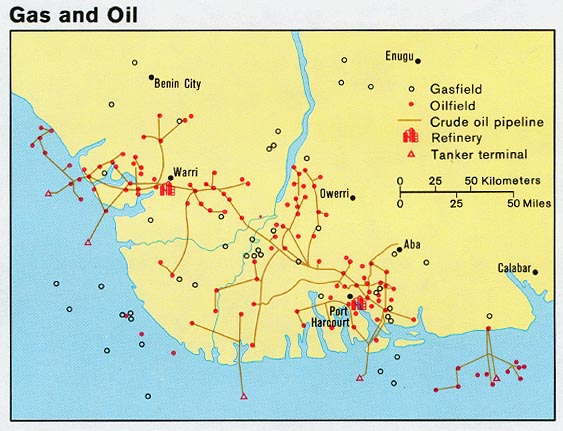
Reported here:
Oil rose the most in a month in New York as Nigerian rebels threatened more attacks after cutting output from Africa's largest producer by about 20 percent.Earlier reports on "total war" of Nigerian rebelshere, here, and hereand at the links therein. And for Nigeria's place in the US import totals here. Map above is of oil and gas areas of Nigeria.
Royal Dutch Shell Plc closed 455,000 barrels a day of production after militants began a series of attacks on oil facilities and kidnapped nine foreign workers three days ago. The rebels blew up a pipeline yesterday. New York futures, which didn't trade on Monday, also rose because talks in Moscow failed to resolve the dispute over Iran's nuclear program.
``The difference between now and previous attacks is that this looks a little bit better organized,'' said David Thurtell, commodity strategist at Commonwealth Bank of Australia Ltd. in Sydney. ``If the Iran issue escalates, I guess we could get to the $70 mark pretty easily.''
UPDATE: Econbrowser takes note in Nigeria back in the news and says "And the news is not good." Amen.
Monday, February 20, 2006
Jail time for some Indonesian pirates
Reported here:
Nine Indonesians, mainly from the tsunami-hit province of Aceh, have been jailed for seven years for a pirate attack on a Malaysian-owned tanker, local media said Monday.Original report on the attack here and a follow-on here.
The Sessions Court on Sunday sentenced the group for carrying out the armed, pre-dawn attack on the Nepline Delima off the northern resort island of Langkawi in the Malacca Strait last June.
The tanker was carrying RM12 million (US$3.23 million) worth of diesel from Malaysia's Port Klang to Myanmar when it was boarded.
The attack was foiled when a quick-thinking crewman from the tanker leapt into the pirates' boat and sped off to alert police.

StrategyPage: Syrian ships for Iranian nukes?
Strategy Page raises the issue of the use of Syrian merchant hulls as possible delivery vehicles for the Iranians here:
Syrian involvement in seaborne smuggling is one of the reasons it got tagged as part of the Axis of Evil. Get Syria out of the terrorism business, and you might get them out of the smuggling business as well. But that's unlikely. The Syrian government needs the money. Iran was generous with its "foreign aid" because Syria provided support for terrorists Iran backed. Now Iran is keen on getting nuclear weapons. The first ones Iran will get will be large and delicate. The only feasible intercontinental delivery system will be a ship. A ship that is accustomed to moving illicit goods.Earlier reports of Iran experimenting with missiles on merchant ships here and here. Strategy Page names names of the suspect shipping companies.
New Philippines-US security agreement?
Reported here, negotiations for a "more modern" agreement between the Philippines and the US.
al Qaeda bomb maker in Turkey discovered by the WaPo
WaPo discovers Louai Sakka, the man who would bomb Israeli cruise ships and more here:
He showed up in Antalya last summer with tens of thousands of dollars in cash and a face altered by plastic surgery. After his arrest, he told investigators he had planned to die steering a yacht laden with explosives into a cruise ship he believed was filled with U.S. soldiers and which was already approaching across the turquoise Mediterranean.The guy was captured back in August 2005 as was noted at the time here
The attack, just 48 hours away when the chemicals ignited, was intended to crown a wide-ranging career in terrorism. Sakka played a role in the so-called millennium plot to attack hotels in Amman, Jordan, on Dec. 31, 1999. Turkish prosecutors also describe him as the planner of the 2003 truck bombings that killed 57 people in Istanbul, financed with $160,000 in al Qaeda funds...
...In Antalya, Sakka spent lavishly preparing for the attack. Using an alias, he put down $60,000 on a villa in the Beldibi neighborhood, insisting on the unit closest to the beach, with a panoramic view of the resort city and its harbor. "His criterion was it had to be directly on the water, no matter what the price was," said Mehmet Yildirim, the watchman.
The two-bedroom Apt. 1703 was closer to town, in a complex overlooking the marina where Sakka moored a 27-foot yacht, the Tufan. On board was diving equipment and a submersible water scooter, capable of running for 45 minutes at a depth of 75 feet.
Karahan said Sakka spent days chatting with Israeli tourists, who flocked to the Turkish coast in summer, and learned the precise arrival time and route of the ship he planned to attack as it approached Antalya. In a rented Hyundai, he ferried the ingredients for a one-ton bomb -- hydrogen peroxide, aluminum powder, acetone -- from the port city of Mersin. Then he scoured Antalya's industrial zone for a shop that worked with chrome.
Sakka needed someone to build a distiller, a glorified pressure cooker to concentrate the hydrogen.
Sunday, February 19, 2006
Northwest Africa, too
Also of note is this article titled "Funding Doubled for "Anti-Terror" Forces in Africa" (scare quotes in title provided by the IPS):
Last year, the Trans-Sahara Counter-Terrorism Initiative (TSCTI) was allocated just 16 million dollars -- pocket change compared to other U.S. military incursions across the globe. But funding for the exercises, described as enhancing regional security and stability, is expected to grow steadily in coming years.
For 2006, the initiative has been allocated 31 million dollars. The big push comes in 2008, when the administration hopes to get 100 million each year for five years.
To those keeping a close eye on the situation, the question arises whether there will be an accompanying U.S. military build-up in the region.
"The answer is no," according to Maj. Holly Silkman, a public affairs officer for the U.S. military's European Command, or EUCOMM, which is based in Stuttgart, Germany. Besides Western and Central Europe, EUCOMM also claims West Africa as part of its defensive responsibility.
"There are no plans for forward deployed forces in the region," which is U.S. military parlance for bases, Silkman told IPS. "There's not an African nation that wants us there."
But Silkman does not downplay what many know: The U.S. military -- albeit in small numbers -- is on the move in Northwest Africa. Joint anti-terror training exercises, along with some humanitarian development projects, with forces from Chad, Nigeria, Mauritania and other countries are ongoing, she says.
US Navy asked to act as Somali "fishery patrol"
In a sort of logical follow-on to anti-piracy efforts off the Somali coast, the "Somali government" has asked for some help from the US Navy in keeping its coastal waters free of illegal fishermen, as reported here: 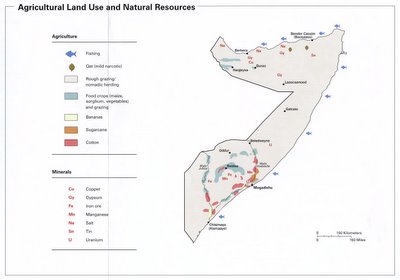
The map to the left shows the natural resources of Somalia, and fishing is one of the "biggies."
Back in November, 2005, I posted on the problem of fish poaching off the Somali coast and referred to this piece:
As to why the US ought to get involved, it seems, after several years of Somalia disintegration, that almost no one else gives a damn or has the capability of doing the job. I remain convinced that it job the UN, EU, NATO or some sort of African group ought to be handling since the sea lanes involved are not high priority to the US. On the other hand, since Somalia is perhaps the prime example of a failed state that needs help to participate in the global economy (a one state example of Barnett's "gap") - it may behoove the US to become the prime mover in organizing (and even paying for) the effort to reconnect Somalia. Some of the same logic that Thomas Barnett is talking about here. Further, it cuts a leg off the argument of the pirates that they are filling in to do what their ineffective "government" cannot do and undercuts the support of the warlords who use the "protection" of the local fishermen as a means of earning and maintaining support.
StrategyPage offers up a piece on the "pirate fishermen " of Somalia here.
UPDATE: (2-20-06) A "breakaway" Somali province has taken matters into its own hands and arrested 84 Yemeni fishermen as reported here.
The powerless Somali transitional government has asked the US Navy, which last month arrested pirates in the country's coastline, to extend its patrols in the Indian Ocean and curb illegal fishing along its vast coastline.
The request came nearly a month after the US Navy's Fifth Fleet arrested 10 pirates who had attempted to hijack a merchant ship in Somali waters.
"Somalia is grateful for recent initiative taken by the United States Navy aimed at curtailing rampant sea piracy that has been taking place in the territorial waters of Somalia," Fisheries and Marine Resources Minister Hassan Abshir Farah said in a statement Sunday.
"But it will also be pleased if similar action could be taken against illegal fisheries in the Somali territorial waters. The illegal international fishing vessels cause serious damage to Somali marine resources and its environment," he said.
Farah said curbing piracy and illegal fishing could be beneficial to the impoverished Horn of African nation of about 10 million people that has been wracked by lawlessness since 1991.
"As Somalia's coastline is one of the busiest shipping lanes in the world, curbing sea piracy and illegal fishing will not only be beneficial to the Somali people but also to the international community," he added.
The Somali government "is making every effort to address these serious problems of sea piracy and illegal fisheries in its coastal waters. Therefore, the government calls upon all the international community to join and support noble efforts being made by the United States," Farah said.

The map to the left shows the natural resources of Somalia, and fishing is one of the "biggies."
Back in November, 2005, I posted on the problem of fish poaching off the Somali coast and referred to this piece:
For many Somalis, especially marine experts and coastal dwellers, it all began when foreign fishing boats started invading the country's fishing grounds after the fall of the Somali government in the early 1990s. When the various rebel groups that had toppled the government failed to fill the vacuum and instead turned on each other, an opportunity arose for foreign vessels to invade the country's territorial waters and marine economic zone to fish for diverse species.In recent months, fishing trawlers from Taiwan, China, Ukraine and other countries have been captured by Somali pirates, and released when ransoms have been paid. Since there is no government, it might be understandable if the Somalis are attempting, in the only way they have, to keep their waters free of foreign fishing craft. The argument is diluted, however, by the capture of non-fishing vessels and attacks on merchant shipping passing through the area (or up to 160 miles offshore).
The unscrupulous foreigners were simply taking advantage of the confusion created by the civil war to catch whatever they wanted. Their vessels were widely reportedly to be using universally prohibited fishing equipment, including nets with very small mesh sizes and sophisticated underwater lighting systems to lure fish to their traps.
Somali coastal dwellers have been crying for help to stop this fishing for nearly a decade, but nothing has been done.
"The trawlers began to come closer to the coast - looking for lucrative fish species - triggering direct confrontation between the foreign vessels and Somali inshore fishermen," Omar Abdulle Hayle, a Mogadishu based fishery expert says.
"Criticism of the illegal fishing came from the South West Indian Ocean Fisheries Commission (SWIOFC), a United Nations body, but its words were not backed by deeds, ending up having no effect," Mr Hayle added.
As to why the US ought to get involved, it seems, after several years of Somalia disintegration, that almost no one else gives a damn or has the capability of doing the job. I remain convinced that it job the UN, EU, NATO or some sort of African group ought to be handling since the sea lanes involved are not high priority to the US. On the other hand, since Somalia is perhaps the prime example of a failed state that needs help to participate in the global economy (a one state example of Barnett's "gap") - it may behoove the US to become the prime mover in organizing (and even paying for) the effort to reconnect Somalia. Some of the same logic that Thomas Barnett is talking about here. Further, it cuts a leg off the argument of the pirates that they are filling in to do what their ineffective "government" cannot do and undercuts the support of the warlords who use the "protection" of the local fishermen as a means of earning and maintaining support.
StrategyPage offers up a piece on the "pirate fishermen " of Somalia here.
UPDATE: (2-20-06) A "breakaway" Somali province has taken matters into its own hands and arrested 84 Yemeni fishermen as reported here.
Saturday, February 18, 2006
CH-53's down
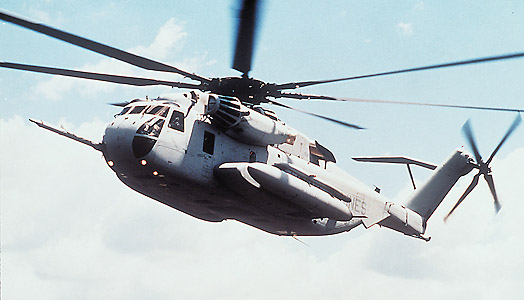
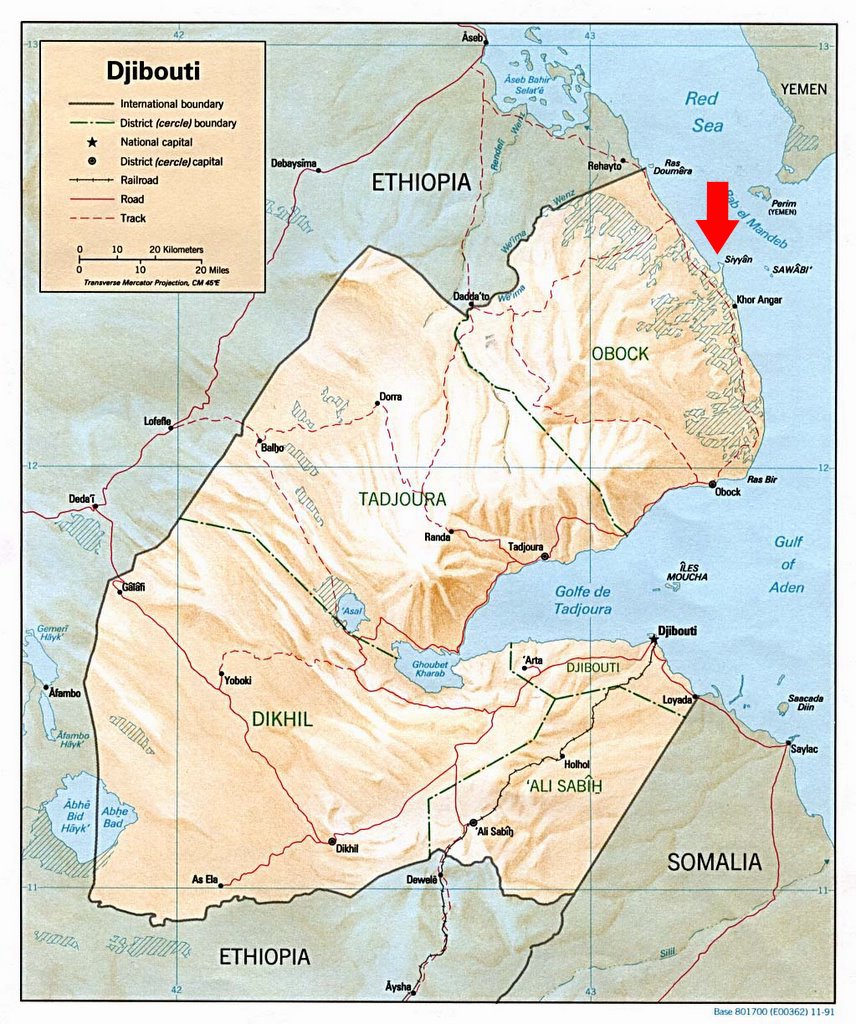
Two US Marine CH-53E helos are down near Djibouti as reported here:
The cause of the crash was unclear and there was no indication of hostile fire, said Maj. Susan Romano of the Combined Joint Task Force Horn of Africa, a U.S.-led military force headquartered at Camp Lemonier, a former base of the French Foreign Legion in Djibouti.Our prayers are with the aircrews, troops and their families.
The CH-53E transport helicopters that went down Friday were carrying a dozen troops. Two were rescued in the initial search not far from the coastal town of Ras Siyyan, in northern Djibouti.
Info on CH-53E here. Info in US CentCom's Horn of Africa mission here. Photo from a training exercise involving Marine CH-53's here. Sample
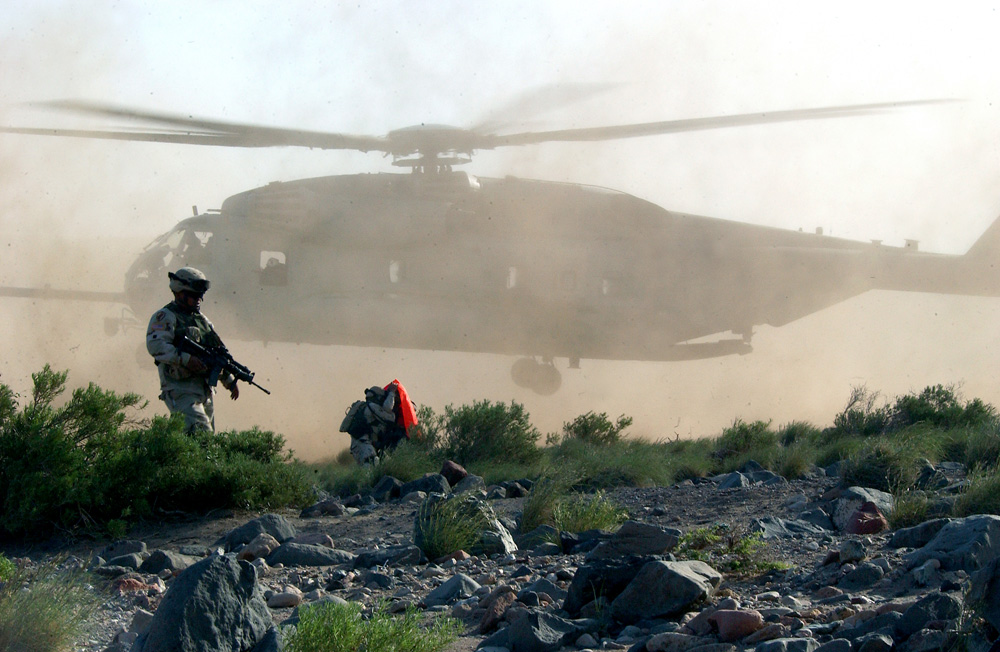 Caption:
 Members of the Force Protection Company, assigned to the Combined Joint Task Force, Horn of Africa, watches for simulated hostiles while a U.S. Marine Corps CH53 Super Stallion, lands to pickup patients during a simulated patient rescue exercise, February 14, 2006, Camp LeMonier, Djibouti, Africa. Photo By: USAF Staff Sgt. Nic RavenUPDATE: (2/19/06) Ten dead, two rescued as reported here. Bless them all.
Attacks on Nigerian oil businesses
After a declaration of "total war", it probably shouldn't be a surprise that attacks on oil companies in Nigeria have begun, as reported here:
Armed militants launched a wave of attacks across Nigeria's troubled Niger delta Saturday, blowing up oil and gas pipelines and seizing nine foreign oil workers in the latest violence to strike the troubled region.
Friday, February 17, 2006
US Navy ships to help in Philippines mudslide disaster
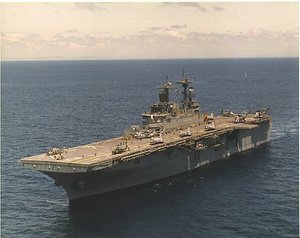

Reported here:
A Pentagon spokesman, Lt. Col. Brian Maka, said that in response to a Philippine government request, the U.S. military was dispatching the USS Essex and the USS Harper's Ferry, and possibly other ships. He said Army and Marine Corps ground forces that happened to be in the Philippines also were available to help.USS Essex on top, Harper's Ferry below. Info on disaster here.
Attention bunker dwelling scum- US technology is on the march
In what can't be good news for bad guys who hide in deep holes: adeep-drilling bomb reported here:
And, yes, the North Koreans and the Iranians better be thinking about this new technology.
Deep Digger is different. It does not depend on the kinetic energy of the warhead at all – in fact, it parachutes down. Then it stars drilling. The weapon is limited only by how deep the drilling process can go, which is a matter of how deep it can ‘muck’ (clear debris from the shaft). And although the details are classified, that is much, much deeper than any kinetic weapon will ever go. In the tests last year, it demonstrated a tunneled down ten meters -- about 50% more than the BLU-113, which is the current record holder.Give the US a reason to come after you, and we'll figure out a way to make it happen...
It has numerous other advantages. One is a thinner casing which means more payload. Another is that it does not undergo a shattering 10,000g impact. Other penetrating bombs need special insensitive explosives; Deep Digger can carry a range of warheads, as well as sensors and communications. It can stay in touch with the launch aircraft and report its progress; multiple Deep Diggers could be co-ordinated to detonate simultaneously producing a combined shockwave.
Part of the secret is the rock-breaking projectile, developed like the cannon at ARDEC, the US Army’s Armament Research Development and Engineering Center at Picatinny. David Burns, the Program Manager, describes it as being a special .75 calibre round, a monolithic design which is more robust and performs better than earlier projectiles. In place of the blasting gel used earlier it now employs a solid high explosive called PAX-11, one of Picatinny’s own special recipes.
And, yes, the North Koreans and the Iranians better be thinking about this new technology.
Subscribe to:
Posts (Atom)