VertRep

VertRep

Friday, June 23, 2006

US Navy shoots down missile warhead


Reported here:
Saying the test had been scheduled for months and had nothing to do with the current crisis with North Korea, the U.S. Missile Defense Agency has announced that a Navy ship has fired an interceptor that shot down a warhead from a medium-range missile over Hawaii, according to an Associated Press dispatch. The test had been postponed from Wednesday.

"The USS Shiloh detected a medium-range target after it was launched from the Pacific Missile Range Facility on Kauai, then fired a Standard Missile-3 interceptor. The interceptor shot down the target warhead after it separated from its rocket booster, more than 100 miles (161 kilometers) above the Pacific Ocean, the Missile Defense Agency said in a statement," AP says


More:
For the seventh time in eight tries, a ship-based missile hit its intended ballistic missile target yesterday off Kauai's coast.

The test, the first to include a Japanese naval vessel equipped with tracking equipment, checked the ability of the Navy's portion of the ballistic missile defense system.

At about noon yesterday, the USS Shiloh, an Aegis-class cruiser from San Diego, tracked the target missile fired from Kauai's Pacific Missile Range Facility and destroyed the target warhead using only the rocket's kinetic energy, ballistic missile defense officials said.

The whole test took about six minutes from launch to collision, while the contact occurred more than 100 miles above the Pacific and 250 miles northwest of Kauai.

It was USS Shiloh's first test since being fitted with the tracking and communication systems, officials said, and the test also involved upgrades in weapon system configuration and a new missile configuration.

It also was the second attempt by a ship to shoot down a separating target. The first came in November when the USS Lake Erie successfully shot down a multistage target in another test.

The achievement is considered significant because medium- and long-range ballistic missiles typically have at least two stages.

40 missing in ferry accident off Sumatra

Reported here:
Nearly 40 passengers were still missing after a ferry sunk in rough waters off the coast of Indonesia's Sumatra island, officials said Friday.

Most of the over 130 passengers and crew on board the Surya Makmur Indah ferry when it sunk off the coast of North Sumatra Thursday were rescued, but dozens of others were still missing.

"Up to now, there are 94 passengers that have been evacuated from the accident," Navy commander Lieutenant Colonel Djaka Santosa told the online news agency Detik.com, adding that 39 passengers listed on the boat's manifest were still missing.

Rescue workers have said the number missing could be even higher, with passengers, including children, often boarding Indonesia's ferries without being on the official list.

Three Americans and two Australians were also reported among the missing, the state-run news agency Antara said.

Protecting Iraq's oil outlets and Iraq's future

A "ring of steel" reported here:
There is a 3km zone around the oil platforms that the fishing dhows and other craft are not allowed to enter. It has been described as "a ring of steel" and there are sailors constantly scanning radar screens and looking from the bridge with binoculars to ensure it is not breached. What the navies want to prevent is a dhow laden with explosives sailing up to the platforms and detonating itself.
***
There can be little doubt that the threat to the oil platforms, Al Basra Oil Terminal, or ABOT as it is usually referred to, and Khawr Al Amaya Oil Terminal or KAAOT is real.

Two years ago, three suspicious dhows sailing near the platforms were intercepted by US forces. The suicide attackers set off their explosives prematurely, killing three sailors.
***
A senior US military commander has said it is essential that coalition forces "stick it out" in Iraq.

Captain Chris Noble predicted the security situation in the insurgency-rattled nation would deteriorate significantly if there was a pull-out.

The 51-year-old - in charge of a major task group of ships operating in the Northern Arabian Gulf - said the coalition forces were "committed for the long haul".

"Just because it's long, that doesn't mean it's wrong. There was hope things would go faster, but people understand why they have not gone faster.

"If we leave, things will get very bad very quickly. There is a fundamental, underlying hope that we will stay and I really believe this is the right thing to do," he said.

Noble said the speed at which day-to-day life improved in Iraq was down to the new administration in Iraq.

"It is dependent upon the investment by the Iraqi government. It will be a measure of their commitment and resources. It really very much is in their hands," he said.

Thursday, June 22, 2006

Homeland Security Thinks Outside the Box


From every MIB's favorite intel source Weekly World News on how to protect the Golden Gate Bridge:
However, working with the San Francisco Police Department, the OHS has devised a plan to keep the bridge safe.

"We've hired 25 young, beautiful women willing to remove all their clothing and station themselves at strategic points on and approaching the bridge," explained San Francisco Police Public Information Officer Bruce Onder.

"Hopefully, that will keep religious radicals from coming near the structure."

According to Dr. Henry Chilvers, Professor Emeritus of Religion and Morality at the University of Sprituality in Sacramento, "Many orthodox faiths demand that a woman cover herself completely, excluding the face and hands, from men except her husband. Most religious zealots who would harm our nation are youths who have not seen one naked woman, let alone many. The shock, shame or simple eye-popping spectacle is going to make them do a U-turn pretty quickly. Or else drive into the bay, which is just as good."
Hmmm. Of course the bridge will be too full of cars full of men for any terrorists to get on it anyway...

University of Spirituality in Sacramento...?

Nice move, Iran, you've even irked the Canadians

Iran, showing its usual deft sense of diplomacy, manages to select as a UN "human rights delegate" a man implicated in the death of a female Canadian photographer as reported here:
Canada expressed "disgust" on Wednesday at Iran's decision to send Tehran's chief prosecutor, Saeed Mortazavi, as a delegate to the new United Nations human rights council, saying he was implicated in the death of a Canadian photographer.

"The presence of Mr. Mortazavi in Iran's delegation demonstrates the government of Iran's complete contempt for internationally recognized principles of human rights," Foreign Minister Peter MacKay said in a statement.

"The government of Canada expresses its disgust at the fact that Iran would choose to include such a person in its delegation to a new U.N. body intended to promote the highest standards of respect for human rights."

Canada's relations with Iran have been frosty since 2003, when photographer Zahra Kazemi -- who held dual Canadian and Iranian citizenship -- died in detention after being arrested outside a Tehran prison.
Canadians are usually hard to get riled, but Iran seems intent on sticking a finger in the Canadian eye.

Dolts and clods seem to be in charge in Tehran now.

Professor Bainbridge Not Impressed with 500 WMD Shells

Read ProfessorBainbridge.com: 500 WMD Shells: Big Deal:
Everybody knows Saddam used chemical weapons on the Kurds and in his war with Iran. It would be astonishing if we hadn't found some munitions. But there's nothing new here to suggest that Iraq had a WMD program sufficiently threatening to justify the war.
As I asked in a comment:
Out of idle curiosity, what number of shells or other indications of WMD would reach your level of justification for the war?

Obviously 500 is too low...would 1000 do it? 2000? 10,000? 100,000? A big huge lab full of anthrax spores?

What is your standard, Professor?
I just don't think saying "Oh, we knew about those" is an adequate dismissal of the issue.

UPDATE: Op-For has a very pertinent post. Not for the humor impaired.

UPDATE2: And Spook86 has some "backstory" here.

Rape, war and nonsense

It's a straight-forward report on a UN agency seeking (no surprise there) extra funding and reporting on rape and sexual violence in wars and conflicts. After all, given the dismal record of some UN peacekeepers, who better than the UN to study such a problem?
A UN report prepared for the meeting found that systematic rape was a prominent feature of the conflicts in Bosnia-Hergovina, DR Congo, East Timor and Haiti, and is ongoing in the Darfur region of Sudan.

No-one knows exactly how many women have been attacked in the chaos of Darfur, the BBC's David Loyn says from the conference.

But rape has been used there as a weapon of war to impose the will of one people on another - as it was in previous conflicts such as those in Bosnia-Hercegovina and Rwanda, he says.

In Rwanda, officials estimate that 60,000 women were raped during the 1994 conflict, two-thirds of whom have been infected with HIV/Aids, the UNFPA believes.

In Bosnia, the figure is put at around 40,000.

The conference has already heard testimony from the DR Congo, where sex with very young children has become commonplace in the mistaken belief it can cure Aids.
Ok, well and good. However, here's a howler from Gaza:
Sexual violence has also been linked to development funding. Cases in Gaza and the West Bank have increased significantly since the EU and the US cut funding after January's election of Hamas, Luay Shabaneh of the Palestinian Central Bureau of Statistics says.


Get it? Internal Palestinian problems are the fault of others- including the US- and not caused by support for a terrorist regime which is the reason funds got cut. All as "established by the "Palestinian Central Bureau of Statistics."

Thank you BBC for sharing that unquestioned info with us.

One man's terrorist may be another's freedom fighter, and one woman's rapist may be another's victim of withdrawn US & EU funding...what garbage...

Indonesia to beef up military

Reported here:
Indonesia's defense minister said the country plans to buy submarines, fighter jets and frigates in a shopping spree stretching from Russia to the Netherlands.

The world's largest archipelago plans to buy two new German submarines next year, doubling its fleet, and four Dutch frigates within three years, Defense Minister Juwono Sudarsono said in a June 20 interview in Jakarta. The government, which owns four Russian-made Sukhoi fighters, will buy a further six over the next four years.
German subs, Dutch frigates and Russian fighters. U.S. toys must be too expensive.

Wednesday, June 21, 2006

Ask a simple question

Simple Simon meets a pieman and asks, "Why Isn't the Whole World Developed?" Which is, in fact, the title of this piece from The American Spectator. For those of you who think that the answer is a complicated economic package of mathematical complexity, let me reveal the much less complicated answer: Property law.

Or, as set out in the article
De Soto argues that in this way an actual majority of the world's population "has been locked out of the global economy." Poor people "are forced to operate outside the rule of law," and have "no legal identity, no credit, no capital and thus no way to prosper." They would like to participate in a free enterprise system, "but they cannot access the existing property law" and so are forced to operate outside the law. He adds:

Property law is what makes the market economy work. It is property law that provides the framework of rules that organizes the market, the titles and records that identify economic agents, the contractual mechanisms that allow people to exchange goods and services in the expanded market. It is property law that provides the means to enforce rules and contracts.... Therefore, those who are excluded from the legal system, mainly the poor, are also excluded from the legal market economy.
Well said. Read it all. Thank goodness the U.S. government was founded by property owners.

No direct talks with North Korea over missiles


The Bush administration has declined the opportunity to be blackmailed into talking with the North Korean government as reported here. And the DPRK gets a little verbal slap from UN Ambassador Bolton, too:
Ambassador to the United Nations John Bolton said a missile threat wasn't the way to seek dialogue.

"You don't normally engage in conversations by threatening to launch intercontinental ballistic missiles, and it's not a way to produce a conversation because if you acquiesce in aberrant behavior, you simply encourage the repetition of it, which we're obviously not going to do," Bolton told reporters at U.N. headquarters in New York.

President Bush said North Korea faces further isolation from the international community if it test-fires the missile believed capable of reaching U.S. soil.

"It should make people nervous when non-transparent regimes who have announced they have nuclear warheads, fire missiles," Bush said at a meeting with European leaders in Vienna, Austria. "This is not the way you conduct business in the world."

The U.S. and Japan have said they could consider sanctions against North Korea if it goes ahead with the launch, and Washington was weighing responses that could include attempting to shoot down the missile.

A spokesman for former South Korean President Kim Dae-jung cited the missile crisis as the reason for canceling a trip next week to the North that could have offered a rare chance for talks to soothe tensions.
I wonder what Kim Jong-il's face-saving fallback position is?

Some photos of the DPRK missile launch site at GlobalSecurity here.

Asian Regional Anti-Piracy Pact to take effect in September 2006


Reported here:
Eleven countries have now ratified the Regional Cooperation Agreement on Combating Piracy and Armed Robbery against Ships in Asia (ReCAAP), a Japanese initiative launched in Tokyo in November 2004.

"The ReCAAP Agreement will enter into force on 4 September 2006," a foreign affairs ministry statement said.

Singapore serves as the depository of the agreement and will host the group's information sharing centre, a permanent body with full-time staff.

Cambodia, Japan, Laos, Singapore, Thailand, the Philippines, Myanmar, South Korea, Vietnam, India and Sri Lanka have all ratified the agreement, Singapore said, noting that 10 ratifications were needed for implementation of the pact.

Brunei has also signed and is in the process of ratification, Singapore said.

"The ReCAAP Agreement is the first regional government-to-government agreement to combat piracy and armed robbery against ships in Asia," it added.

Officials say vessels plying the Malacca Strait, which pass through Singaporean, Indonesian and Malaysian territorial waters, are vulnerable to pirates and seaborne "terrorism". The three countries have launched coordinated military air patrols over the waterway, one of the world's most vital sea lanes.

Horn of Africa: Djibouti's hope


Nice piece found here on the one stable country in the Horn of Africa:
Because of Djibouti's excellent port and strategic location - the eye of the storm between the Middle East across the Red Sea and the troubled Horn of Africa - it has attracted some 1,800 U.S. troops. They are stationed mostly at Camp Lemonier, under the command of U.S. Navy Rear Admiral Richard W. Hunt, with 2,300 French Foreign Legionnaires. There is also a joint international naval task force, including U.S. assets, in the Indian Ocean waters that include Djibouti.

All of that helps. But Djibouti also has plans for the future.

Dubai, in the Persian Gulf, started with little more than an excellent port. It has some oil, but that accounts for only 6 percent of its income. The rest is financial services, trade, and investment. Djibouti could do likewise, with a bit of enterprise, gumption, and foreign help.

Promising areas include fishing, environmental tourism, a role as an east coast depot for trade across Africa, and related financial services. Fish would be caught in the extensive waters off Djibouti and Somalia, brought to Djibouti for processing and storage, then exported across the world.

Eco-tourism - any kind of tourism - may seem hard to imagine at this point. Djibouti has killer heat, only one dubious major hotel, and generally forbidding desert terrain. But that is a misleading impression. The country has countless beautiful, colorful fish to dive for off the coast, a wide variety of interesting and unusual birds in the interior, and for those - unlike me - who like such things, a wide variety of nasty snakes and other reptiles to see and study. There is also a lovely, isolated lake, and cool mountains. A new world-class hotel is scheduled to open in October.

All of Djibouti's development possibilities require secure seas offshore. Somali pirates could wreck the whole show. Thus, naval security becomes essential. International naval assets are a temporary solution, but they are inadequate now, particularly for fishing and heavier cruise ship volume, and who knows how long they will be there. This becomes an issue of long-term concern to Djibouti, and to its president.
Dreams gotta start somewhere, I guess.

Headline: U.S. weighs shootdown of N. Korea missile


Found here:
The Bush administration is weighing responses to a possible North Korean missile test that include attempting to shoot it down in flight over the Pacific, defense officials told The Associated Press on Tuesday.

Because North Korea is secretive about its missile operations, U.S. officials say they must consider the possibility that an anticipated test would turn out to be something else, such as a space launch or even an attack. Thus, the Pentagon is considering the possibility of attempting an interception, two defense officials said, even though it would be unprecedented and is not considered the likeliest scenario.
Spook 86 has some thoughts here:
Judging from Gertz's article, it appears the U.S. has been unable to clearly identify the purpose behind the TD-2 test, forcing us to prepare for both scenarios. If we can ascertain that the TD-2 is being used to launch a satellite, we will probably let the test proceed; if it is determined that the launch is an ICBM test, the probability of an intercept attempt increases dramatically. Determining North Korea's intentions has likely been complicated by Pyongyang's proficiency at denial and deception. It is certainly in Kim Jong-il's interest to keep Washington guessing, delaying any engagement decision to the last possible moment.

How would North Korea react to a U.S. attempt at engaging their missile? That's the $64,000 question. Beyond the usual propaganda barrage and diplomatic bluster, Pyongyang might employ some military options of its own, ranging from the intercept of U.S. reconnaissance aircraft near its borders, to the engagement of ROK naval forces along the Northern Limit Line (NLL), the maritime extension of the DMZ. Potential warning time for these events would be limited, given that much of North Korea's armed forces are positioned along their coastlines, or near the DMZ.
Earlier discussion here.

UPDATE: Wall Street Journal editorial says, "Take shot at it" here. The DPRK now says it wants direct talks with the U.S.:
North Korea said in comments published Wednesday that its self-imposed moratorium on testing long-range missiles from 1999 no longer applies because it's not in direct dialogue with Washington, suggesting it would hold off on any launch if Washington agreed to new talks.

"Some say our missile test launch is a violation of the moratorium, but this is not the case," Han Song Ryol, deputy chief of North Korea's mission to the United Nations, told South Korea's Yonhap news agency in an interview from New York.

"North Korea as a sovereign state has the right to develop, deploy, test fire and export a missile," he said. "We are aware of the U.S. concerns about our missile test-launch. So our position is that we should resolve the issue through negotiations."

Pyongyang has consistently pressed for direct dialogue with the United States, while Washington insists it will only speak to the North at six-nation nuclear talks. The North has refused to return to those nuclear talks since November because of a U.S. crackdown on the country's alleged illicit financial activity.

On Wednesday, the U.S. ambassador to Japan, Thomas Scheiffer, called on Pyongyang to return to the six-party talks but did not address the possibility of bilateral negotiations.

"They have the opportunity to do that through the six-party talks," he said. "They don't have to undertake bad policies in order to talk to the United States."

He also said the United States has means of responding to a North Korean missile test that it didn't have the last time Pyongyang carried out a launch in 1998, and is considering "all options."

Tuesday, June 20, 2006

Say what? UN to assess security in Somalia


Before sending peacekeepers, the UN wants to make sure where things stand, as reported here:
The United Nations is sending a security team to Somalia later this week to meet Islamic leaders who control the capital, Mogadishu.
It will be the first formal contact between UN officials and the Union of Islamic Courts in Somalia since the union captured much of south Somalia.

Earlier, the African Union agreed to send a separate team to assess the possibility of deploying peacekeepers.

Somalia has been without an effective central government since 1991.

The deployment of any peacekeepers would require the UN to lift its arms embargo on Somalia.

The Islamic Courts fiercely oppose the idea and last week held large protests against peacekeepers. (emphasis added)
Let's see--what are some synonyms for "cannon fodder?" Part of the cause of the 15 year period of Somali chaos was the UN "cut and run" in 1995. Some history:
The regime of Mohamed SIAD Barre was ousted in January 1991; turmoil, factional fighting, and anarchy have followed in the years since. In May of 1991, northern clans declared an independent Republic of Somaliland that now includes the administrative regions of Awdal, Woqooyi Galbeed, Togdheer, Sanaag, and Sool. Although not recognized by any government, this entity has maintained a stable existence, aided by the overwhelming dominance of a ruling clan and economic infrastructure left behind by British, Russian, and American military assistance programs. The regions of Bari, Nugaal, and northern Mudug comprise a neighboring self-declared autonomous state of Puntland, which has been self-governing since 1998, but does not aim at independence; it has also made strides toward reconstructing a legitimate, representative government, but has suffered some civil strife. Puntland disputes its border with Somaliland as it also claims portions of eastern Sool and Sanaag. Beginning in 1993, a two-year UN humanitarian effort (primarily in the south) was able to alleviate famine conditions, but when the UN withdrew in 1995, having suffered significant casualties, order still had not been restored.
The Somalis can't get along internally and don't much like anyone else, either.

While the UN studies,
Tension is high in Somalia, after the Islamists said Ethiopian troops had crossed the border - a claim the Ethiopians have denied.

UN envoy Mr Fall said that there were reports of troop movements on both sides of the Ethiopian border.

"There's a risk that if they [Islamist militias] move close to the border, the Ethiopians might react," he said.

Ethiopia has been mentioned as one of the countries that could send peacekeepers to Somalia, but Ethiopia is deeply distrusted by some Somalis.
And, by the way, they hate the U.S.

UPDATE: I just don't think peace will be flowing like a river in Somalia any time soon--see here and here:
Mogadishu was recently taken over by a Somali teacher, Sheikh Shariff Ahmed, now the chairman of the Union of Islamic Courts. While this group may now be in charge in Mogadishu, the war is far from over as there appears to be fears that the fighting could degenerate into internecine warfare, long the bane of Somalia.
And Austin Bay's gloomy outlook here:
Clans dominate Somali life and politics, which means even in the best of times Somalia is a country constantly grappling with divisive factional and regional interests. Somalia's U.N.-backed Transitional Federal Government (TFG) is weak -- wracked by corruption and sapped by political infighting among clan leaders with designs on national leadership. The ICU bills itself as a multi-clan organization, with Islam the common denominator, but like the TFG it has internal factions with divisions that are tough to bridge.

The clerics atop the ICU now deny any affiliation with al-Qaida. They have, however, displayed Taliban tendencies. The clerics banned World Cup soccer "watching parties" and cut off electricity to theaters showing the games. They have ordered Somali women to wear veils.
***
In the long run, regional stabilization will help Somalia -- but in the short run, Somalia will remain a chaotic battlefield. The United States and Islamo-fascist terrorists will continue to square off through proxies. Neighboring nations like Ethiopia, Eritrea and Kenya will pursue their own interests by backing favored Somali clans and leaders with money and arms. Ethiopian troops (already inside Somalia) may masquerade as African Union peacekeepers. In January, the African Union discussed sending troops to Somalia. Its abysmal peacekeeping record in Darfur damns itself.
In short, the wheel is still very much in spin.

UPDATE: 6/21/06 The Somali leaders holding talks? Reported here.

I've been a little distracted lately


Red Neck Hockey. Indeed.

A Bangladesh piracy problem


Reported as 200 trawlers looted in Bay in 2 months:
Pirates killed six fishermen and looted 200 trawlers in the Bay of Bengal during the last two months creating panic among the fishermen.

Besides, 40 fishermen were abducted and 100 others injured in the attacks by the pirates during the same period.

Sources said the fishermen of Patharghata, Raenda, Tushk-hali, Mathbaria, Zianagor, Daulatkhan, Tazumunddin, Monpura, Kolapara and Morelganj areas under Barguna, Pirojpur, Bhola, Patuakhali and Bagerhut districts are the victims of piracy.

Locals said coastal and estuary areas of Meghna, Bishkhali, Balweswar rivers are under control of the different pirate gangs.

Jahangir, Kamal-Suman, Rezaul and BDR Kalam are the most notorious pirate gang leaders of these areas and they have secret dens in the deep forest of Sunderbans, they said.
Bangladesh is also under a "Piracy Alert" for its Chittagong anchorage as set out here (ICC CCS Weekly Piracy report to 19 June):
ALERT
Chittagong anchorage, Bangladesh
Twenty two incidents have been reported since 28.01.2006. Pirates are targeting ships preparing to anchor. Ships are advised to take extra precautions.
More warnings at the ONI Worldwide Shipping Threat site here (to 14 June 06).

President Bush at the Merchant Marine Academy

Transcript of speech here. Highlights:
Life at this Academy is demanding -- and it is meant to be. America is a great maritime power, and our Merchant Marine has a vital role to play. In times of peace, the Merchant Marine helps ensure our economic security by keeping the oceans open to trade. In times of war, the Merchant Marine is the lifeline of our troops overseas, carrying critical supplies, equipment, and personnel. For more than six decades, the mission of this Academy has been to graduate highly skilled mariners to serve America's economic and national security needs. To train you for these responsibilities, this Academy sharpens your mind, it strengthens your body, and builds up your character. The Academy has made you strong and instilled respect for the Kings Point motto -- Acta Non Verba -- "Deeds, Not Words."
***
Deeds, Not Words" defines the Academy's role in the global war on terror. Your cadets are forward deployed in the Middle East, where they're supporting operations in Afghanistan and Iraq. Your Global Maritime and Transportation School is providing advanced training in areas from marine engineering to port security for military units like the Navy Seabees and Surface Warfare Officers. And your graduates are serving our nation in every branch of our Armed Services, as sailors projecting American combat power across the Earth; as Marines and soldiers leading platoons from Khandahar to Tikrit; as Coast Guard officers securing our homeland; and as airmen delivering justice to terrorists hiding in safe houses and caves. In the global war on terror, the men and women of this Academy are making a difference on every front -- and the American people are grateful for your service.
***
The advance of freedom is the calling of our time -- and the men and women of the United States Merchant Marine Academy are answering that call. In a few moments, you'll walk through Vickery Gate and leave the Academy that's been your home. You leave with a bachelor's degree, a license as a Merchant Marine officer, and a commission in one of the branches of our Armed Services. And you leave with something else: The great truth that duty and honor and courage are not just words; they are virtues that sustain a free people, people who are determined to live under self-government. They're the virtues that will be your anchor and compass in a life of purpose and service. These are the virtues that America demands of those entrusted with leading her sons and daughters in uniform. And these are the virtues that America has come to expect from the blue and grey.

We see the devotion to duty and honor and country in the life of one of this Academy's finest graduates, Aaron Seesan. Aaron was an Ohio boy who grew up dreaming of being a soldier. He brought that dream with him to this Academy -- and when he walked through these gates three years ago, he carried on his shoulders the gold bar of a second lieutenant in the United States Army. After entering the Army, Lieutenant Seesan trained as a combat engineer. And he was serving at Fort Lewis, Washington, when a group of soldiers who were based at the fort were struck by a suicide bomb in Iraq. Two of the men were killed. And that's when this young lieutenant volunteered to go to Iraq to take the place of a wounded platoon leader.

When Lieutenant Seesan arrived in Iraq, some of his fellow soldiers wondered what was the Army thinking. His platoon sergeant said, "I didn't know what the hell a Merchant Marine graduate was doing here in the 73rd Engineering Company." The sergeant quickly changed his mind when he saw Lieutenant Seesan in action, taking care of his men as they patrolled the most dangerous roads in and around Mosul. In May 2005, he was leading a routine sweep of a city street when a bomb exploded and hit the fuel tank of his Humvee. Those who were with him recall his last words: "Take charge, Sergeant Arnold, and take care of the others."

He died on May 22 -- on National Maritime Day. For his act of bravery, Lieutenant Seesan was awarded the Bronze Star. And the campus memorial that bears his name will remind all who come here of Kings Point commitment to service above self.
As noted in other places, he also talked about Iran.
UPDATE: More coverage at Fred Fry International's Maritime Monday.

Ship sinks off Somalia -rescuers enroute


Marlo Bahrain sent out an email report of s ship sinking off Somalia:
M/V Kanaya has sunk of the Coast of Somalia at position 0840N - 05327E. It was carring 20,000 tons of coal. There are 18-19 crew members in life rafts. Two vessels (M/V Mearsk Arkansas and M/V Jo Betula) are enroute and they will be there in three hours. There is a Coalition vessel enroute and it will be there in approximately 10 hours.


Email dated at 0830, 20 June 06.

Map shows approximate area of sinking.

Monday, June 19, 2006

North Korea missile guessing


As posted about earlier here, the lovely DPRK and its wacky leader may be stirring a missile launch pot. And now there seems to be some suggestion that maybe there's an Aegis cruiser off the coast of the DPRK waiting.

Some background on the AEGIS Anti-ballistic missile system here. A SM-3 success story here and here.

Photo caption:
A Standard Missile - 3 (SM-3) is launched from the Pearl Harbor-based Aegis cruiser USS Lake Erie (CG 70), during a joint Missile Defense Agency, U.S. Navy ballistic missile flight test today. Minutes later, the SM-3 intercepted a separating ballistic missile threat target, launched from the Pacific Missile Range Facility, Barking Sands, Kauai, Hawaii. The test was the sixth intercept, in seven flight tests, by the Aegis Ballistic Missile Defense, the maritime component of the "Hit-to-Kill" Ballistic Missile Defense System, being developed by the Missile Defense Agency. All previous Aegis Ballistic Missile Defense flight tests were against unitary (non-separating) targets. (U.S. Navy Photo)
Missile Defense Agency site here. Another good site is Missile Threat from Claremont Institute.

How the "Murtha plan" would work


As the blogoworld is now well aware, Rep.and Col (USMCR(ret)) John Murtha has suggested that we don't need boots on the ground in Iraq and could be using a bombing 911 service to dispatch the bad guys. Actually, his exact words are found in Froggy's post at Black Five here, wherein Rep Murtha suggests that using Okinawa as a base of operations just might work.

I assume that Rep. Murtha is suggesting bombing in lieu of ground forces. He might have missed a briefing or two on military capabilities since his retirement from the Marine Corps Reserve in 1989 (entered Marines in 1952, served 37 years= 1989). In fact, he missed out on the lessons of Desert Shield, Desert Storm, Somalia, Rwanda, the Balkans and, last, but not least, Kosovo. Unless, of course, as a Congressman he gets up to the minute reports of an operational nature.

In any event, his suggestion of using precision bombing from, I presume, high and safe altitudes (so as not to place any of our personnel in undue harm's way) reminded me of some things.

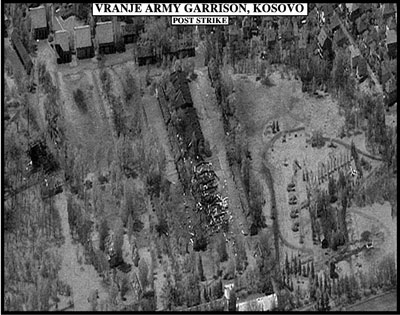
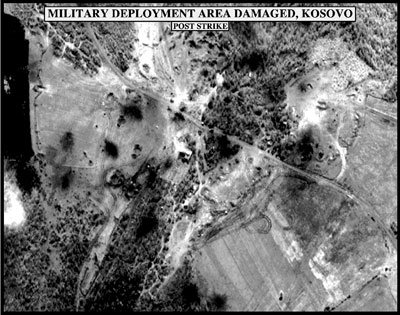
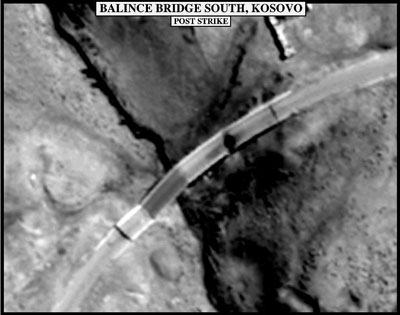
The first of which was some lessons we might have learned from following up on the Kosovo bombing missions, as detailed in a MEAT report somehow gathered and reported on by Newsweek under the title Newsweek Exclusive: Suppressed Air Force Report on Kosovo Bombing Shows Little Damage Done to Milosevic's Forces, Contrary to Early NATO and Pentagon Claims. Some highlights:
A suppressed U.S. Air Force report
obtained by Newsweek shows that the number of targets verifiably destroyed by
high-altitude bombing in the Kosovo War was a tiny fraction of what top
military officers publicly claimed. The report shows there were 14 tanks
destroyed, not 120; 18 armored personnel carriers, not 220; and 20 artillery
pieces, not 450. And instead of the 744 "confirmed" strikes by NATO pilots
during the war, the Air Force investigators, who spent weeks combing Kosovo,
found evidence of just 58 strikes. The damage report has been buried by top
military officers and Pentagon officials, who, in interviews with Newsweek
over the last three weeks, were still glossing over or denying its
significance.
***
Gen. Wesley Clark, the top NATO commander during the war, tried - at least
at first - to gain an accurate picture of the bombing, Newsweek reports in the
current issue. At the end of June, Clark dispatched a team to do an
on-the-ground survey in Kosovo. The 30 experts were known as the Munitions
Effectiveness Assessment Team, or MEAT.
The bombing, they discovered, was highly accurate against fixed targets,
like bunkers and bridges. "But we were spoofed a lot," said one team member.
The Serbs protected one bridge from the high-flying NATO bombers by
constructing, 300 yards upstream, a fake bridge made of polyethylene sheeting
stretched over the river. NATO "destroyed" the phony bridge many times.
In addition, artillery pieces were faked out of long black logs stuck on
old truck wheels. A two-thirds scale SA-9 antiaircraft missile launcher was
fabricated from the metal-lined paper used to make European milk cartons. "It
would have looked perfect from three miles up," said a MEAT analyst. The team
found dozens of burnt-out cars, buses and trucks - but very few tanks, and no
indications that hit tanks had been hauled away.
When Clark heard this news, he ordered the inspectors to walk the terrain,
report National Security Correspondent John Barry and Assistant Managing
Editor Evan Thomas in the May 15 issue (on newsstands Monday, May 8). They
came back with 2,600 photographs and briefed the commanders. "What do you mean
we didn't hit tanks?" said Gen. Walter Begert, the Air Force deputy commander
in Europe. Clark said, "This can't be. I don't believe it.
The Air Force was ordered to prepare a new report and in a month, Brig.
Gen. John Corley was able to turn around a survey that pleased Clark. It
asserted that NATO had successfully struck 93 tanks, close to the 120 claimed
by Gen. Shelton at the end of the war, and 153 armored personnel carriers, not
far off the 220 touted by Shelton. But Corley's team did not do any actual
field research. Rather, it looked for any support for pilots' claims. "The
methodology is rock solid," said Corley, who strongly denied any attempt to
obfuscate. "Smoke and mirrors," is more like it, according to a senior officer
at NATO headquarters who examined the data, Newsweek reports. NATO sources
also say two of Clark's officers cautioned him not to accept Corley's numbers.
The U.S. intelligence community, too, was doubtful. "Nobody is very keen to
talk about this topic," a CIA official told Newsweek. Over-rating the Kosovo
bombing could lead to fundamentally flawed strategies in future similar
conflicts, Newsweek notes.
(emphasis mine)
I'm sure there is more on this topic other places, but it should give anyone thinking that bombing from afar is the solution some pause.

While pondering the implications over "over-rating the Kosovo bombing" you might also consider these words from T.R. Fehrenbach:
You may fly over a land forever; you may bomb it, atomize it, pulverize it and wipe it clean of life--but if you desire to defend it, protect it, and keep it for civilization, you must do this on the ground, the way the Roman legions did, by putting your young men into the mud.
Just saying, commanders and Congressmen need to have the truth about past actions, not reports that support some previously taken position.
UPDATE: Another view of the "misunderstood" modern airpower here (Hat tip: NOSI). Maybe it is misunderstood, but it still seems to require some people on the ground to avoid the sort of deception used by the Serbs and to wrap up all those loose end things - like getting things to work in the area you just bombed.