VertRep

Showing posts with label Drug Submarines. Show all posts
Showing posts with label Drug Submarines. Show all posts
Monday, September 13, 2021


Tuesday, September 22, 2020
Wednesday, September 02, 2020
Monday, January 06, 2020
U.S. Navy Office of Naval Intelligence Worldwide Threat to Shipping (WTS) for 28 November 2019 - 31 December 2019 and HORN OF AFRICA/GULF OF GUINEA/SOUTHEAST ASIA Weekly Piracy Update for 25 to 31 December 2019
Issues involving crimes against merchant shipping, merchant sailors, and other illicit activity at sea continue. Why? It's the same reputed answer Willie Sutton gave to the question as to why he robbed banks, "Because that's where the money is." Given the low capture and punishment rates, it is, except for the hazards of any operation at sea, relatively low risk.
U.S. Navy Office of Naval I... by lawofsea on Scribd
U.S. Navy Office of Naval I... by lawofsea on Scribd
Monday, December 30, 2019
U.S. Navy Office of Naval Intelligence Worldwide Threat to Shipping (WTS) for 21 November 2019 - 24 December 2019 and HORN OF AFRICA/GULF OF GUINEA/SOUTHEAST ASIA Weekly Piracy Update for 19 to 24 December 2019
U.S. Navy Office of Naval I... by lawofsea on Scribd
U.S. Navy Office of Naval I... by lawofsea on Scribd
Monday, December 23, 2019
U.S. Navy Office of Naval Intelligence Worldwide Threat to Shipping (WTS) for 14 November 2019 - 18 December 2019 and HORN OF AFRICA/GULF OF GUINEA/SOUTHEAST ASIA Weekly Piracy Update for 12 to 18 December 2019
U.S. Navy Office of Naval I... by lawofsea on Scribd
U.S. Navy Office of Naval I... by lawofsea on Scribd
Monday, December 09, 2019
U.S. Navy Office of Naval Intelligence Worldwide Threat to Shipping (WTS) for 31 October 2019 - 4 December 2019 and HORN OF AFRICA/GULF OF GUINEA/SOUTHEAST ASIA Weekly Piracy Update for 28 November to 4 December 2019
U.S. Navy Office of Naval I... by lawofsea on Scribd
U.S. Navy Office of Naval I... by lawofsea on Scribd
Wednesday, December 04, 2019
U.S. Navy Office of Naval Intelligence Worldwide Threat to Shipping (WTS) for 24 October 2019 - 27 November 2019 and HORN OF AFRICA/GULF OF GUINEA/SOUTHEAST ASIA Weekly Piracy Update for 21 to 26 November 2019
U.S. Navy Office of Naval I... by lawofsea on Scribd
U.S. Navy Office of Naval I... by lawofsea on Scribd
Monday, September 30, 2019
U.S. Navy Office of Naval Intelligence Worldwide Threat to Shipping (WTS) for 21 August - 25 September 2019 and HORN OF AFRICA/GULF OF GUINEA/SOUTHEAST ASIA Weekly Piracy Update for 19 -25 September 2019
U.S. Navy Office of Naval I... by lawofsea on Scribd
U.S. Navy Office of Naval I... by lawofsea on Scribd
Monday, November 26, 2018
U.S. Navy Office of Naval Intelligence Worldwide Threat to Shipping (WTS) Report 22 October - 21 November 2018 and HORN OF AFRICA/GULF OF GUINEA/ SOUTHEAST ASIA: Piracy Analysis and Warning Weekly (PAWW) Report for 15 - 21 November 2018
Reports from before the Russian- Ukrainian activity the impact of which on shipping remains to be seen.
U.S. Navy Office of Naval Intelligence Worldwide Threat to Shipping (WTS) Report 22 October - 21 November 2... by lawofsea on Scribd
Monday, July 23, 2018
U. S. Navy Office of Naval Intelligence Worldwide Threat to Shipping (WTS) Report 18 June - 18 July 2018 and HORN OF AFRICA/GULF OF GUINEA/ SOUTHEAST ASIA: Piracy Analysis and Warning Weekly (PAWW) Report for 12 - 18 July 2018
Monday, May 21, 2018
U. S. Navy Office of Naval Intelligence Worldwide Threat to Shipping (WTS) Report 16 April - 16 May 2018 and HORN OF AFRICA/GULF OF GUINEA/ SOUTHEAST ASIA: Piracy Analysis and Warning Weekly (PAWW) Report for 10 - 16 May 2018
Monday, March 19, 2018
U. S. Navy Office of Naval Intelligence Worldwide Threat to Shipping (WTS) Report 12 February - 14 March 2018 and HORN OF AFRICA/GULF OF GUINEA/ SOUTHEAST ASIA: Piracy Analysis and Warning Weekly (PAWW) Report for 8 - 14 March 2018
Friday, December 22, 2017
Follow the Money: Terrorism Financing, Drug Smuggling and U. S. Maritime Security
The Josh Meyer Politico article The secret backstory of how Obama let Hezbollah off the hook contains so many interesting trails that it is easy to forget the key point:
For example, let's take a look at the now nearly routine capture of "drug smuggling submarines" - see CBP, Coast Guard Seize Drug Smuggling Submarine from earlier this month:
AMERICA is fighting a new front in its war on drugs — locating, tracking and intercepting fleets of sophisticated homemade submarines loaded with cocaine.:
Notable is the amount of money involved in this trade Coast Guard in Florida offload $23 million worth of cocaine:
Clearly, by the amount of illegal drugs successfully entering the country, the capture rate, even of expensive semi-submersibles, is merely a "cost of doing business" in the lucrative trade.
While much has been made of the potential to use these routes for human smuggling of terrorists, perhaps the amount of money generated through illegal drugs is sufficient to make such efforts unnecessary because it is just as easy to fund locally grownn terrorists or import "refugees" who may be funded to perform acts of terror. At least, that is. so far.
The drug smugglers are innovative and well-financed. As a result, they freely experiment with new tech:
It's a problem and one that we need to find better solutions to handle.
The untold story of Project Cassandra illustrates the immense difficulty in mapping and countering illicit networks in an age where global terrorism, drug trafficking and organized crime have merged, but also the extent to which competing agendas among government agencies — and shifting priorities at the highest levels — can set back years of progress.In addition to funding terrorism, the routes used to smuggle illegal drugs into the U.S. are national security threats.
And while the pursuit may be shadowed in secrecy, from Latin American luxury hotels to car parks in Africa to the banks and battlefields of the Middle East, the impact is not: In this case, multi-ton loads of cocaine entering the United States, and hundreds of millions of dollars going to a U.S.-designated terrorist organization with vast reach.
For example, let's take a look at the now nearly routine capture of "drug smuggling submarines" - see CBP, Coast Guard Seize Drug Smuggling Submarine from earlier this month:
Customs and Border Protection based out of Corpus Christi said they captured a drug submarine attempting to smuggle nearly two tons of cocaine into the country.Or Jaime Seidel's
Crews from the CBP Air and Marine Operations tracked the sub last month while operating in international waters.
Officers tracked the sub for several days before a Coast Guard Cutter stopped it and arrested its crew.
Over 3,800 pounds of cocaine were seized and three suspects on board face multiple charges.
AMERICA is fighting a new front in its war on drugs — locating, tracking and intercepting fleets of sophisticated homemade submarines loaded with cocaine.:
BURIED deep in the jungles of South America are covert shipyards.U.S. Coast Guard video of a capture of a drug smuggling boat in June 2017:
They’re hand-building submarines. And they’re churning out dozens every year.
They have just one job to do.
Covertly carry tons of cocaine, along with crews of armed smugglers.
They skim just beneath the surface of the Carribbean and Pacific, out of sight and under the radar of law enforcement ships and aircraft.
PACIFIC OCEAN
06.08.2017
Coast Guard Cutter Waesche crewmembers intercept a suspected low-profile smuggling vessel seizing an estimated 5,550 pounds of cocaine worth more than $74 million while on patrol off the coast of Central America, June 8, 2017. Waesche is a 418-foot long National Security Cutter homeported at Coast Guard Island in Alameda, Calif., outfitted with the most advanced command, control, and communications equipment for detecting and disrupting transnational organized crime networks. U.S. Coast Guard video courtesy of Coast Guard Cutter Waesche/Released.
Notable is the amount of money involved in this trade Coast Guard in Florida offload $23 million worth of cocaine:
The Coast Guard Cutter Pelican brought ashore almost one ton of cocaine Monday.You will note that arrests are made in the Caribbean, the Gulf of Mexico and the Pacific, an indication of how wide-spread the the operations of these drug cartels are. Spreading the smuggling routes forces the law enforcement agenices to spread themselves thinner to cover larger areas with the same limited number of assets.
The cocaine is valued at $23 million, and along with the seizing of the drug, three smugglers were also arrested.
The cocaine came from a drug bust in the Caribbean Sea on Nov. 11, just south of Jaragua, Dominican Republic, say officials with the Coast Guard.
Clearly, by the amount of illegal drugs successfully entering the country, the capture rate, even of expensive semi-submersibles, is merely a "cost of doing business" in the lucrative trade.
While much has been made of the potential to use these routes for human smuggling of terrorists, perhaps the amount of money generated through illegal drugs is sufficient to make such efforts unnecessary because it is just as easy to fund locally grownn terrorists or import "refugees" who may be funded to perform acts of terror. At least, that is. so far.
The drug smugglers are innovative and well-financed. As a result, they freely experiment with new tech:
It's a problem and one that we need to find better solutions to handle.
Monday, November 27, 2017
U. S. Navy Office of Naval Intelligence Worldwide Threat to Shipping (WTS) Report 23 October - 22 November 2017 and HORN OF AFRICA/GULF OF GUINEA/ SOUTHEAST ASIA: Piracy Analysis and Warning Weekly (PAWW) Report for 16 - 22 November 2017
Saturday, September 15, 2012
Weekend Reading
 |
| Krugman needs one of these |
North American energy independence possible, House panel told:
It’s not unrealistic to expect abundant oil and gas resources to help make North America energy independent within a decade, witnesses told a US House Energy and Commerce Committee subcommittee on Sept. 13.
“The United States has become the world’s second-largest oil producer,” said Harold G. Hamm, chief executive of Continental Resources Inc. in Enid, Okla. “We just passed Russia and are behind only Saudi Arabia. I don’t think a lot of people realize this.”
Hydraulic fracturing and horizontal drilling have helped the US reduce its crude oil imports from 60% of its total consumption a few years ago to 45%, he told the committee’s Energy and Power Subcommittee. US natural gas reserves have grown from a 7-year supply to one that’s more than a century, Hamm added.
“The technology that allows us to drill 2 miles down, turn right, go another 2 miles, and hit a target the size of a lapel pin has unlocked the resources that make energy independence a reality,” he said.

Iran is complaining about "terrorists" in Syria receiving shipments of weapons from stocks in Libya. "Terrorists" being those who oppose the Iranian-supported Assad regime. Irony knows no bounds.
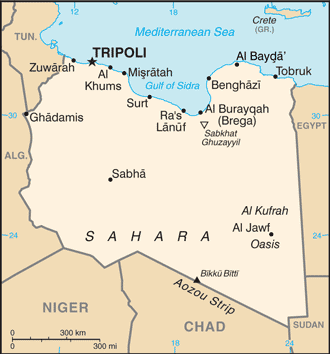
Over the past two months, at least three Iranian-linked container ships, all blacklisted by the U.S. Treasury, have called at the Libyan port of Benghazi.
***
The U.S. government has described Iran as the world’s “leading state sponsor of terrorism.” The U.S. State Department, in its most recent annual report on terrorism, released in July, noted that Iran had “increased its terrorist-related activity, likely in an effort to exploit the uncertain political conditions resulting from the Arab spring.” The same report noted that “Iran continued to provide financial, material and logistical support for terrorist and militant groups throughout the Middle East and Central Asia.” This includes “weapons, training and funding” for Palestinian terrorist groups, and “weapons and training” to help Syria’s Assad regime in a crackdown that has cost many thousands of lives.
***
In remarks Wednesday on the deaths of American personnel in Benghazi, Secretary of State Hillary Clinton reaffirmed that “A free and stable Libya is still in America’s interest and security, and we will not turn our back on that.” Surely, regardless of who was behind the Sept. 11 attack, the aspirations for a free and stable Libya are better served without the presence of blacklisted IRISL vessels dispatched from terror-linked ports in Iran.
Drug submarines continue to make news,
Use of sophisticated drug subs spikes in the Caribbean. There was a time when such drug running subs where operating only in the Pacific. Things change, but the threat is high:
American authorities have recently discovered at least three models of a new and sophisticated drug-trafficking submarine capable of travelling completely underwater from South America to the United States, and the use of these covert vessels has spiked in the Caribbean over the last year.And, as noted here,
Older models pressed into service by drug barons were only semi-submersible, requiring a snorkel for air intake, but three newer captured vessels were fully submersible, capable of hauling 10 tons of cocaine and, by surfacing at night to charge their batteries, could sail beneath the surface from Ecuador to Los Angeles.
***
“These vessels are seaworthy enough that I have no doubt in my mind that if they had enough fuel, they could easily sail into a port in the United States,” according to Cmdr Mark J Fedor of the US Coast Guard, who commands the cutter Mohawk, a 200-foot vessel whose fast boat and helicopter interdicted a submersible in the Caribbean last September.
Last year, interdiction missions coordinated by the joint task force captured 129 tons of cocaine en route to the United States — more than five times the cocaine seized over the same period by operations in the United States, where agents and officers stopped about 24 tons of the drug.
Despite these advances, three-quarters of potential drug shipments identified by the task force are not interdicted, simply because there are not enough ships and aircraft available for the missions. “My staff watches multi-ton loads go by,” Admiral Michel said.
The drug trafficking quandary is bad enough, but officials worry that these subs could also be employed by terrorists. “If you can carry 10 tons of cocaine, you can carry 10 tons of anything,” said Rear Adm. Joseph Nimmich of the Joint Interagency Task Force South, which polices drug-interdiction efforts in the waters south of the United States.Though I think it is safe to assume the drug kings would rather have a healthy U.S. economy to allow their profitable business to grow rather than a even more wounded U.S. . . .
Thursday, April 19, 2012
Drug Submarines: Coast Guard, partner agencies interdict 5th Western Caribbean drug sub
Good news from the Coasties -Coast Guard, partner agencies interdict 5th Western Caribbean drug sub:
The crews of the Coast Guard Cutter Decisive, Coast Guard Cutter Pea Island, Joint Interagency Task Force South (JIATF-S), and the Honduran Navy interdicted a drug smuggling, self-propelled semi-submersible (SPSS) vessel in the Western Caribbean Sea March 30.
A sinking self-propelled semi-submersible vessel was interdicted in the Western Caribbean Sea March 30, 2012 by the crews of the Coast Guard Cutter Decisive, Coast Guard Cutter Pea Island, Joint Interagency Task Force South (JIATF-S), and the Honduran Navy. The cutter Pea Island and Decisive's pursuit boatcrews interdicted the SPSS and detained four suspected smugglers. The SPSS sank during the interdiction in thousands of feet of water. U.S. Coast Guard photo.
SPSS vessels are used regularly to transport illegal narcotics in the Eastern Pacific, and this interdiction is only the fifth Coast Guard interdiction of an SPSS in the Caribbean. The Coast Guard’s first interdiction of a drug smuggling, SPSS vessel in the Western Caribbean Sea happened July 13, 2011: http://tinyurl.com/bouggn2.
Cutter Pea Island
A Coast Guard Air Station Miami aircrew, working in the Caribbean in support of JIATF-S Operation Martillio, spotted a suspicious vessel and notified 7th Coast Guard District watchstanders of the location.
The cutter Pea Island and Decisive diverted to the given position. The cutter Pea Island and Decisive's pursuit boatcrews interdicted the SPSS and detained four suspected smugglers. The SPSS sank during the interdiction in thousands of feet of water.
Cutter Decisive
"Medium endurance cutters like the Decisive are built for multi-week offshore patrols including operations requiring enhanced communications, and helicopter and pursuit boat operations," said Capt. Brendan McPherson, 7thCoast Guard District chief of enforcement. "When combined with patrol boats like the Pea Island, which has superior speed and flexibility, it helps us and our partners to provide the Coast Guard's unique blend of military capability, law enforcement authority, and lifesaving expertise wherever needed to protect American interests."
Built in the jungles and remote areas of South America, the typical SPSS is less than 100 feet in length, with four or five crewmembers, and carries up to 10 metric tons of illicit cargo for distances up to 5,000 miles. Drug traffickers design SPSS vessels to be difficult to spot and to rapidly sink when they detect law enforcement, thereby making contraband recovery difficult.
The U.S. Coast Guard, U.S. Navy, Customs and Border Protection, and partner nation aircraft and vessel crews work together to conduct counter drug patrols in the Caribbean Sea.
The Decisive is a 210-foot medium endurance cutter homeported in Pascagoula, Miss.
The Pea Island is a 110-foot patrol boat homeported in Key West, Fla.


Monday, November 14, 2011
U.S. Coast Guard: Drug Sub Busts
Footage of capture of crew of scuttled drug semi-submerisible from the USCGC Mohawk from Coast Guard Cutter Mohawk interdicts drug sub
Drug subs and semi-subs used to be a Pacific issue but recent months have seen their appearance in the Caribbean. First Caribbean drug sub bust:
Drug subs and semi-subs used to be a Pacific issue but recent months have seen their appearance in the Caribbean. First Caribbean drug sub bust:
Monday, August 01, 2011
Drug Submarines: First Interception Of “Drug Sub” In Caribbean
A US Coast Guard report of a drug semi-submersible being caught in the Caribbean at First interdiction of Western Caribbean drug sub and underwater recovery:
The crew of the Coast Guard Cutter Seneca, a medium-endurance cutter homeported in Boston, interdicted a drug smuggling, self-propelled semi-submersible (SPSS) vessel in the western Caribbean Sea July 13.
Diver recovering drugs
Used regularly to transport illegal narcotics in the Eastern Pacific, this interdiction is the first interdiction of an SPSS in the Caribbean and the first underwater drug removal of an SPSS.
A C-130 fixed-wing aircrew spotted a suspicious vessel and notified U.S. Customs and Border Protection (CBP) maritime patrol airplane to further investigate. The CBP crew spotted the SPSS while on patrol and alerted the Seneca crew of the location.
With the assistance of the CBP airplane, a Seneca-based Coast Guard helicopter crew and pursuit boatcrew interdicted the SPSS and detained its crew. The SPSS sank during the interdiction, but not before a quantity of cocaine was recovered.
The Seneca crewmembers commenced searching for the sunken SPSS on July 13. Several Coast Guard Cutters, the Honduran Navy and FBI dive teams conducted multiple search patterns. The SPSS was located by the crew of the Coast Guard Cutter Oak on July 26 using side-sonar equipment.
Recovered drugs
"The U.S. Coast Guard greatly appreciates the support and cooperation of the Honduran authorities as we worked together to recover the drugs from the sunken SPSS," said Capt. Brendan McPherson, Seventh Coast Guard District chief of enforcement. "In addition, the technical expertise of the FBI dive team was instrumental in the success of this unique operation in international waters, far from U.S. shores, that ultimately prevented tons of cocaine from reaching our streets and neighborhoods."
The FBI Laboratory's Technical Dive Team from Quantico, Va., was able to recover nearly 15,000 pounds of contraband worth an estimated street value of $180 million from the sunken SPSS.
"Working on a buoy deck is dangerous enough; but this unique mission involved blending dive operations, boat operations, and deck operations at the same time," said Lt. Cmdr. Peter Niles, commanding officer of the cutter Oak. "The equipment the FBI brought to the Oak and their dive teams were essential to locate the SPSS and recover its cargo."
Built in the FARC-controlled jungles of Colombia, the typical SPSS is less than 100 feet in length, with 4-5 crewmembers, and carrying up to 10 metric tons of illicit cargo for distances up to 5,000 miles. Drug traffickers design SPSS to rapidly sink when they detect law enforcement thereby making contraband recovery difficult. SPSS are responsible for the movement of nearly one-third of all cocaine in the transit zone.
"I am very proud of the brave efforts of the crew to stop the SPSS, apprehend the smugglers and obtain evidence prior to the vessel sinking," said Cmdr. Charles Fosse, commanding officer of the cutter Seneca. "The teamwork of the Coast Guard, Customs and Border Protection and Joint Interagency Taskforce South personnel during this case was excellent and it is gratifying to see this crew's exceptional skills, persistence and hard work yield such tangible results with direct impact on our communities back home."
The U.S. Coast Guard, U.S. Navy, CBP, Joint Interagency Task Force South, and partner nation aircraft and vessels work together to conduct counter drug patrols in the Caribbean.
"Medium-endurance cutters like the Seneca are built for sustained offshore patrols including those that require enhanced communications, and helicopter and pursuit boat operations such as this, they provide a key capability for the nation's homeland security operations at sea and allow us to fight the threats to our homeland security before they arrive at our doorstep," said Rear Adm. William Baumgartner, commander of the Seventh Coast Guard District headquartered in Miami. "Our goal is to interdict cocaine at sea when it is still concentrated in large loads before those drugs can be broken into small loads and smuggled across our border with Mexico."
The case is under investigation. The contraband will be turned over later to other U.S. law enforcement agencies for disposition.


 |
| Red arrow point to general area of sub sinking |
Sunday, March 06, 2011
Drug Wars: Another Drug Submarine Found in Columbia
Reported at The Telegraph (U.K.)Video: Drug submarine seized in Colombia:
According to the Colombian Navy, 63 submersibles have been discovered since 1993, the most recent of which was found in the remote jungle region of Cauca.
Subscribe to:
Posts (Atom)