VertRep

VertRep
Showing posts with label Econ. Show all posts

Monday, July 06, 2015

There Ain't No Such Thing As A Free Lunch: Greek Edition

TANSTAAFL strikes Greece.

As Prime Minister Thatcher once said:
. . . Socialist governments traditionally do make a financial mess. They always run out of other people's money. It's quite a characteristic of them.

Or, as well stated here:
The Greeks held their breath and jumped off the precipice. The Greek debt crisis, and the outcome of a No vote in the referendum, is a perfect example of politics trumping economics.
***
Greece, Portugal, Spain, Italy and Ireland masked their debts to keep the illusion of solvency until the 2008 economic crisis eventually exposed their economic juggling. Greece was the first to collapse in 2009, and the first failure of the euro zone experiment. Five years of remorseless austerity has done little for the Greek economy. The only growth has been the debt.
Greece has the GNP of the U.S. state of Connecticut with 3.5x the population. See here, here and here.

Some nice analysis at Forbes The Future Of The Greek Economy:
The view that “monetary sovereignty” independence could be used wisely does not take into account that the type of government that has driven Greece to the edge of the cliff is not the type of government that would enact the reforms Greece needs to grow, including better tax collection, better infrastructure and a better business climate.
and
As the economic health of Greece deteriorates, the need for new loans and harsher austerity measures increases. Greece cannot count on other nations to pay its debt through debt forgiveness. In 2012, other countries provided loans on attractive terms with below-market interest rates, extended maturities, deferral of interest payments, and rebates on interest. This is why the present value of Greece’s debt is actually a fraction of its face value.
So, does Putin of Russia think he sees a crack in the NATO alliance caused by the Greek need for money? See this Barron's article More Than Economics at Stake in Greek Crisis Unlike Argentina or Thailand, Greece is a key NATO member. Opening for Putin?:
One alternative is for Russia’s Vladimir Putin to toss Greece a lifeline. That could potentially extend his sphere of influence and push back against Europe as effectively as his incursion into Crimea. This, of course, is all speculation.

But Tsipras flew to Russia as recently in mid-June to confer with Putin. The Greek prime minister also has been an outspoken critic of the EU’s sanctions against Russia over the de facto annexation of eastern Ukraine. Meanwhile, the Russian economy and the ruble have rebounded despite the sanctions since the price of crude oil, the nation’s crucial export, has stabilized around $60 a barrel. As a reflection, the Market Vectors Russia exchange-traded fund (ticker: RSX ) is up 44% from its lows earlier this year. Putin would seem far from debilitated on the economic front.

Even though a Russian gambit is a long-shot outcome of the Greek crisis, the inherent problems of the euro remain.
Nice warm-water ports you have there, Athens.

Wait, you mean a Russian bailout would come with a price? TANSTAAFL, what's that?

Saturday, September 15, 2012

Weekend Reading

Krugman needs one of these
When your model is proving to be wrong, insult the people who have a found a plan that works for them: Paul Krugman's Baltic Problem - By Anders Aslund | Foreign Policy

North American energy independence possible, House panel told:
It’s not unrealistic to expect abundant oil and gas resources to help make North America energy independent within a decade, witnesses told a US House Energy and Commerce Committee subcommittee on Sept. 13.

“The United States has become the world’s second-largest oil producer,” said Harold G. Hamm, chief executive of Continental Resources Inc. in Enid, Okla. “We just passed Russia and are behind only Saudi Arabia. I don’t think a lot of people realize this.”

Hydraulic fracturing and horizontal drilling have helped the US reduce its crude oil imports from 60% of its total consumption a few years ago to 45%, he told the committee’s Energy and Power Subcommittee. US natural gas reserves have grown from a 7-year supply to one that’s more than a century, Hamm added.

“The technology that allows us to drill 2 miles down, turn right, go another 2 miles, and hit a target the size of a lapel pin has unlocked the resources that make energy independence a reality,” he said.

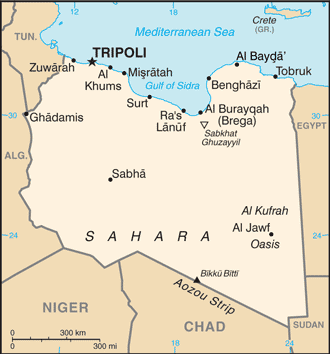
Iran is complaining about "terrorists" in Syria receiving shipments of weapons from stocks in Libya. "Terrorists" being those who oppose the Iranian-supported Assad regime. Irony knows no bounds.

Especially since About Those Blacklisted Iranian Ships Calling at Libyan Ports...:
Over the past two months, at least three Iranian-linked container ships, all blacklisted by the U.S. Treasury, have called at the Libyan port of Benghazi.
***
The U.S. government has described Iran as the world’s “leading state sponsor of terrorism.” The U.S. State Department, in its most recent annual report on terrorism, released in July, noted that Iran had “increased its terrorist-related activity, likely in an effort to exploit the uncertain political conditions resulting from the Arab spring.” The same report noted that “Iran continued to provide financial, material and logistical support for terrorist and militant groups throughout the Middle East and Central Asia.” This includes “weapons, training and funding” for Palestinian terrorist groups, and “weapons and training” to help Syria’s Assad regime in a crackdown that has cost many thousands of lives.
***
In remarks Wednesday on the deaths of American personnel in Benghazi, Secretary of State Hillary Clinton reaffirmed that “A free and stable Libya is still in America’s interest and security, and we will not turn our back on that.” Surely, regardless of who was behind the Sept. 11 attack, the aspirations for a free and stable Libya are better served without the presence of blacklisted IRISL vessels dispatched from terror-linked ports in Iran.

Drug submarines continue to make news,
Use of sophisticated drug subs spikes in the Caribbean
. There was a time when such drug running subs where operating only in the Pacific. Things change, but the threat is high:
American authorities have recently discovered at least three models of a new and sophisticated drug-trafficking submarine capable of travelling completely underwater from South America to the United States, and the use of these covert vessels has spiked in the Caribbean over the last year.

Older models pressed into service by drug barons were only semi-submersible, requiring a snorkel for air intake, but three newer captured vessels were fully submersible, capable of hauling 10 tons of cocaine and, by surfacing at night to charge their batteries, could sail beneath the surface from Ecuador to Los Angeles.
***
“These vessels are seaworthy enough that I have no doubt in my mind that if they had enough fuel, they could easily sail into a port in the United States,” according to Cmdr Mark J Fedor of the US Coast Guard, who commands the cutter Mohawk, a 200-foot vessel whose fast boat and helicopter interdicted a submersible in the Caribbean last September.

Last year, interdiction missions coordinated by the joint task force captured 129 tons of cocaine en route to the United States — more than five times the cocaine seized over the same period by operations in the United States, where agents and officers stopped about 24 tons of the drug.

Despite these advances, three-quarters of potential drug shipments identified by the task force are not interdicted, simply because there are not enough ships and aircraft available for the missions. “My staff watches multi-ton loads go by,” Admiral Michel said.
And, as noted here,
The drug trafficking quandary is bad enough, but officials worry that these subs could also be employed by terrorists. “If you can carry 10 tons of cocaine, you can carry 10 tons of anything,” said Rear Adm. Joseph Nimmich of the Joint Interagency Task Force South, which polices drug-interdiction efforts in the waters south of the United States.
Though I think it is safe to assume the drug kings would rather have a healthy U.S. economy to allow their profitable business to grow rather than a even more wounded U.S. . . .

Friday, August 05, 2011

Slipping Shipping Portends Bad Economic News

Wondering about the short term future of the economy? Read this by Eric Kulisch and, well, things may not get brighter for you - Freight economics 101 :: www.americanshipper.com:
Most economists have minimized the likelihood that the U.S. or global economies will fall into decline again, but economic data and shipment volumes at freight carriers in recent weeks have raised worries the economy is stalling.
Some of the initial warning signs are coming from a slow-down in business at companies that transport goods. Trucking and other transport modes are leading indicators of economic activity, usually showing upturns or downturns several months ahead of the broader economy.
Some experts suggest weak growth is normal and that the economy and shipments will rebound in the second half of the year. But for the first time since the 2008 financial crisis, the dreaded term “double dip” is being whispered — and it doesn’t refer to the number of scoops at the local ice cream parlor.
Here's a slightly different view 2011 Annual State of Logistics Review: Lack of Recovery Leads to Tightening Trucking Capacity, in which this tight capacity is explained:
Transportation capacity is close to being fully engaged, especially in trucking and air. Though volumes have only recovered around half of what was lost during the recession, total industry capacity is currently much lower than it was in 2007. "The recovery is not being felt evenly throughout the economy and 2010 did little to shore up precarious carriers who have been hanging on hoping to be rescued by a resurgence in the economy," Wilson wrote.
But wait, there's more. Our friend the Baltic Dry Index isn't showing a spurt in shipping rates - a sign that too few goods are chasing too much capacity:


Is that an "uptick" there at the end? It will need to be the "Mother of All Upticks" to counter the 5 year trend:


That's a 66.24% decrease over the past 5 years.

More here:

Spot market rates on the Europe-Far East trades have been below breakeven levels for all carriers since March. “Still, freight rates have continued to fall and the numerous attempts to raise rates over the past 12 months all failed,” the analysis firm said in a market report.
***
If implementation is successful, the increases on August 1 would only bring rates back up to where they were in March. “Thus, some carriers would presumably still operate at a loss, even at those somewhat higher rate levels,” Alphaliner said.
The withdrawal of two Asia-Europe service strings in June and July only removes 3.5 percent of the total trade capacity, insufficient to drive vessel utilization rates above 95 percent.

Further, it is ironic that as shipping as slowed, the costs to the operators have increased:
As the largest part of the transportation sector (78%), trucking remains the hardest hit mode as it struggles to cover costs, particularly rising fuel costs. Though much of the increase has come from fuel surcharges, most truckers have not been able to recover all of their actual added fuel costs.
This shows that even as the number of trucking companies has decreased and the volumes carried by the remaining companies may have increased, the profits of more goods chasing fewer trucks are being eaten by increased costs, especially fuel.

Recovery? Keep an eye on shipping trends. Right now, things are not looking up.

Tuesday, January 18, 2011

A Study on the "Costs of Piracy"

From the One Earth Future organization, "Oceans Beyond Piracy" web site - "The Cost of Piracy" in three pdf units. Their bottom line (which I will examine soon) is that piracy costs the global community somewhere between $7 to $12 billion annually.

From the Executive Summary at the beginning of the full report:
At the end of 2010, around 500 seafarers from more than 18 countries are being held hostage by pirates.1 Piracy clearly affects the world‘s largest trade transport industry, but how much is it costing the world? One Earth Future (OEF) Foundation has conducted a large-scale study to quantify the cost of piracy as part of its Oceans Beyond Piracy project. Based on our calculations, maritime piracy is costing the international economy between $7 to $12 billion,2 per year.
This report details the major calculations and conclusions made in the study. The project focuses on direct (first) order costs, but also includes some estimates of secondary (macroeconomic costs), where data is available. It concentrates on the supply-side costs to both industry and governments. The study set out to analyze the cost of piracy to the Horn of Africa, Nigeria and the Gulf of Guinea, and the Malacca Straits. The focus is inevitably on the costs of Somali piracy because this is the region where contemporary piracy is most highly concentrated and is the greatest source of current data and information.3
From Oceans Beyond Piracy Presentation
 UPDATE2: Is it just me that finds it ironic that pirate ransoms for 2010, estimated at $238 million (page 10 of the full report) are one of the lower costs identified in the report? My math (which may be wrong) says that ransom costs were under 4% of the total costs identified above). Insurance, however, against piracy losses was around 7 to 25%.

UPDATE: Just to put this number in perspective, cargo theft in the U.S. alone has been estimated to be about $30 billion a year -see here.

Further, consider the costs involved in actually taking those actions that might reduce the level of piracy. Hmmm - what would it cost to mount an amphibious operation and stage a punitive raid or more?

Footnotes:
1 Countries include: Bangladesh, China, Ghana, Greece, India, Indonesia, Kenya, Korea, Myanmar, Pakistan, the Philippines, Sri Lanka, Sudan, Ukraine, United Kingdom, Turkey, Yemen, and Vietnam.
2 Unless otherwise indicated, all dollar costs throughout this paper are in United States (US) dollars.
3 In 2010, 44 successful ship hijackings out of a global total of 48, were conducted by Somali pirates.