VertRep

VertRep

Sunday, January 14, 2007

Sunday Ship History: Net Tenders


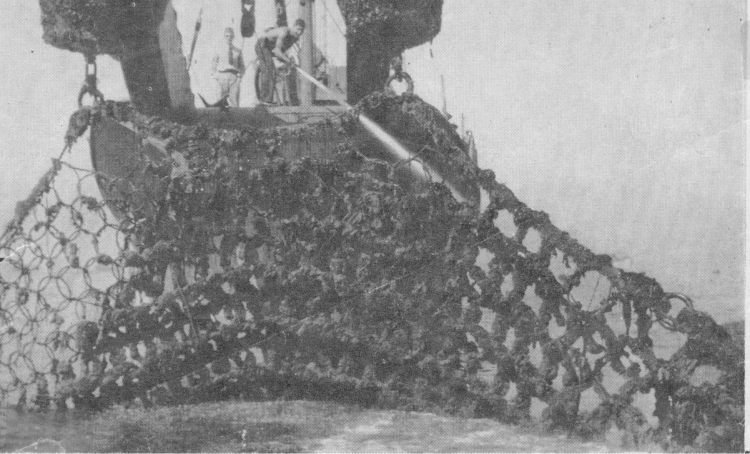
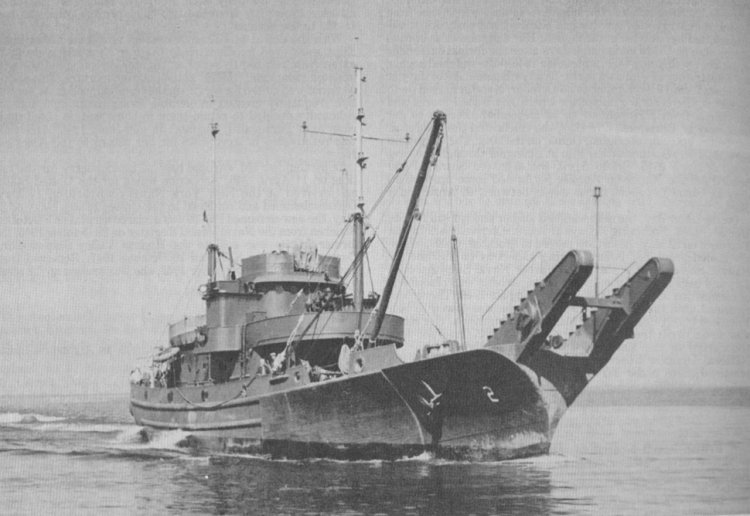
Why does that ship have horns on its bow?

How do you defend ports, harbors and the ships that are contained therein from submarines and torpedoes? Once answer was the development of anti-torpedo nets:
The idea of anti-torpedo nets rapidly followed the introduction of the locomotive torpedo. Experimenting against a hulk, numerous devices were tried out for catching torpedoes and rendering them harmless before they ever reached the ship. The most successful of these was galvanised wire net with an 8 inch mesh weighted at the foot and hung out around the ship from 40 ft booms; the depth of the nets when thrown out in to the water was to corresponded with the ship's keel, with the nets hung vertically whilst at rest and extended about 4ft above the water. In 1874 tests these nets arrested all torpedoes fired.
Eventually, higher speeds and power of torpedoes rendered individual ship net systems obsolete. However, the concept of using nets and booms to block access to harbor entrances continued:
Efforts to block the entrances to harbors against surface vessels date back to the earliest times. The appearance of the high-powered, steel-hulled surface vessel, the submarine, and the torpedo have made the present-day problem of protecting ships at anchor increasingly difficult. The problem has evolved into one of defense against torpedoes. This defense is accomplished in two ways: by preventing the vessel carrying the torpedo from approaching within firing range, or by stopping the torpedo itself.
***
To protect ships at anchor in a harbor either (1) the harbor must be blocked off or (2) each ship must be protected individually. During World War II merely blocking off the harbor did not, in itself, give sufficient protection, because of the torpedo-carrying aircraft. Therefore, valuable ships and floating dry docks may be surrounded by a variation of the Type T net called an ISP (Individual Ship Protection) net.


The above quote is from an interesting site Gene Slovers' US Navy Pages at which Mr. Slovers seems to have copied old Naval Academy texts. The illustrations to the left are from one of these texts, NAVAL ORDNANCE AND GUNNERY VOLUME 1, NAVAL ORDNANCE, CHAPTER 14
ANTISUBMARINE WEAPONS.

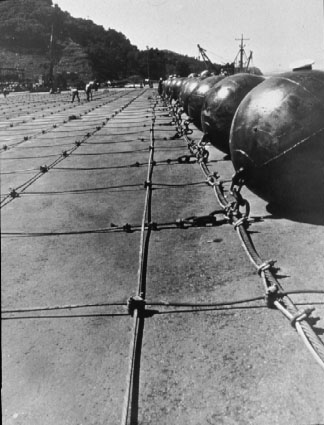
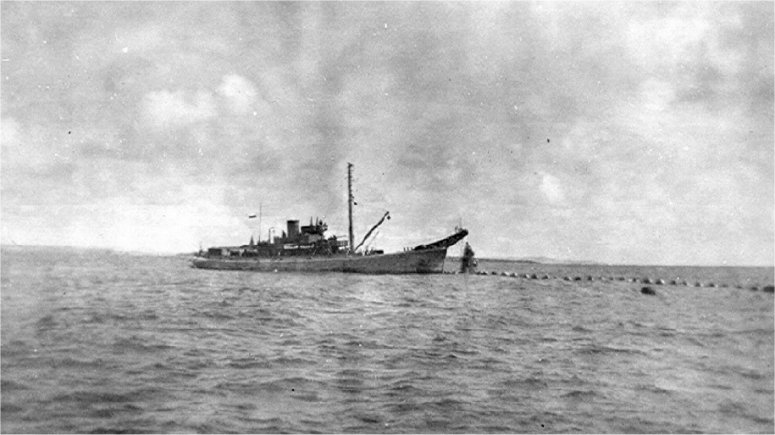
Well, all well and good, but how do you get the nets out there to do their job to begin with? The answer lies in a group of ships devoted to net laying, transportation and maintaining- net tenders (there were also Net Cargo Ships, but today we focus on the net tenders). A little background:
Six ship builders were given contracts to build the first 32 steel Net Tenders in the ALOE class. Most of the keels were laid in October 1940. They were all launched before the attack on Pearl Harbor.
***
Two Net Tenders were at Pearl Harbor on Dec. 7, 1941. They were USS ASH AN-7 (Ex YN-2) and USS CINCHONA AN-12 (Ex-YN-7), also Net Gate Vessel (YNg-17)...
***
After Pearl Harbor more Net Tenders were built. The next 30 ships, in the AILANTHUS class, were wooden and somewhat larger. The first keel was laid down in Oct. 1942, the keels of the last 15 steel ships, in the CAHOES class, were laid down in 1944 and 1945.
How did they lay nets?
Net Laying was usually done by:
1. Net Tender Ships only.
2. Net Tenders assisted by other ships such as Net Cargo Ships, Tugs, Landing Craft (LCM's) or barges.

NET LAYING BY NET TENDERS ONLY:
This was usually done when the following 3 circumstances were combined.
(a) Appreciable distance from Net Depot to point of Installation.
(b) Cold, foul weather where it was especially undesirable to work in small boats with Net Tender.
(c) A situation calling for the installation of a short piece of net in an out of the way place.


Where were nets used? Among other places, San Francisco Bay, where the nets came from the Naval
Net Station, Tiburon, California:
Local people still often call it "The Net Depot" much to the discomfort of the current owners. San Francisco Bay was one big Navy base as World War II loomed closer. It would have been wide open to Japanese submarines except for an anti-submarine net constructed at the Tiburon base and stretched across the Golden Gate. This seven mile long net was in place on December 7, 1941. The personnel of the Net Depot not only constructed over 100,000 tons of anti-submarine netting during the war but trained the sailors in the installation and handling of these nets which protected the harbors up and down the Pacific Coast of the U.S. and across the Pacific as well. The huge gantries left over from the coaling station were perfect for handling the giant nets.

After the war the nets were recovered and returned to Tiburon for storage in case of future need. Eventually, they were salvaged, the nets went to scrap dealers, the massive concrete anchors became bulkheads for shoreline protection at the depot and what is now Paradise Park, and many of the huge floats became beehives around California. The gantries were removed, leaving only the tracks on which they ran and a concrete trestle down the center of the base.
Where else? USS Butternut had an interesting career:
The ship departed Seattle on 17 May for a brief visit to San Francisco until 1 June when she got underway for the southwestern Pacific. After escorting SS Eldridge Gerry across the ocean, Butternut arrived in Noumea, New Caledonia, on 27 June. For 18 months, she tended nets in the southwestern Pacific, first at New Caledonia, later in the New Hebrides, and then in the Solomons. Her active service was interrupted only by two repair periods--August and September of 1943 at Port Chalmers, New Zealand, and November 1943 to February 1944 at Pearl Harbor. During her overhaul at Pearl Harbor, Butternut was reclassified a net laying ship and was redesignated AN-9. In January 1945, the ship steamed from the Solomons via Humboldt Bay, New Guinea, to Leyte in the Philippines. She spent the ensuing two years engaged in net and other district craft operations in the waters adjacent to the islands of Leyte and Samar.


Butternut departed Leyte Gulf in convoy on 24 February 1947 and shaped a course for the Marianas. She arrived at Guam on 9 March and began three years of service in the Trust Territories of the Pacific Islands. Based at Apra Harbor on Guam, she carried passengers and cargo among the islands as well as laying and tending nets at various islands. The ship also performed several assignments off Iwo Jima laying mooring buoys and assisting in the recovery, repair and replacement of submarine lines. Butternut departed Guam on 19 June 1950 for repairs at the Pearl Harbor Naval Shipyard. The net laying ship completed repairs and put to sea on 15 September. Steaming via Guam and Iwo Jima, she arrived in Sasebo, Japan, on 28 October. The ship conducted operations at Sasebo and Yokosuka until 7 July 1951 when she set sail for Guam to resume her former duties in the Trust Territories.
Name a spot, and these little ships were there - including Kodiak, Alaska, where the net depot was known as Woody Island:
"On Woody Island, Northeast of St. Paul's Harbor, are located Magnetic Loop and Harbor detection equipment, net depot, and nets for anti-submarine detection and the C.A.A. (Civil Aeronautic Authority) Range Station for air traffic.

In October, 1942, a heavy indicator net for surface and under surface vessels consisting of 200' panels, was stretched from Woody Island to Shahafka Cove. If a 200' section of this net was carried away, the net vessel, equipped with depth charges, went into action. This net was approximately 1500 yards long with a 600' gate in the ship channel. It was opened and shut by two YP boats, one of which was on duty at all times. Equipped with anti-aircraft guns and radio these YP boats signaled the approach of all aircraft to Woody Island signalman, who relayed this information to the aircraft clearance tower on the base.

In November, 1943, anti-torpedo nets, 30' deep, for protection against the torpedo rather than the submarine, were substituted for the heavier nets installed in October, 1942.

In December, 1942, magnetic loop stations were installed at the entrance of the channel leading to Kodiak and at St. Paul's harbor...
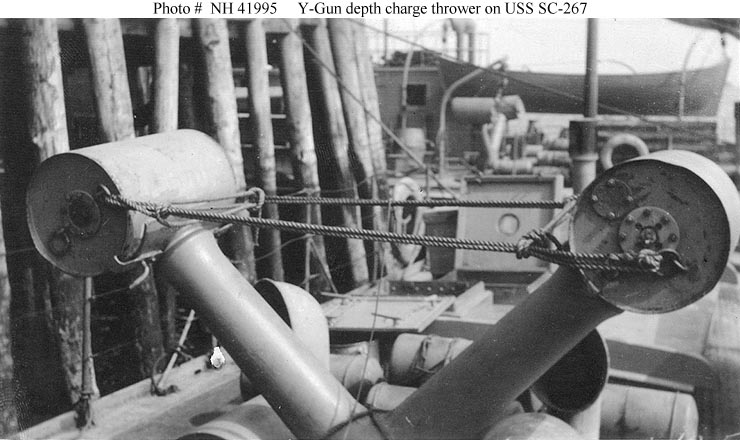
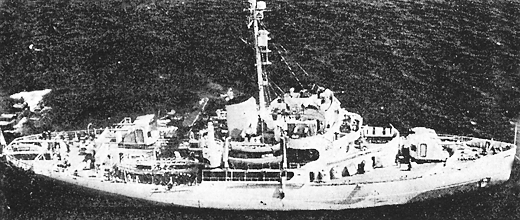
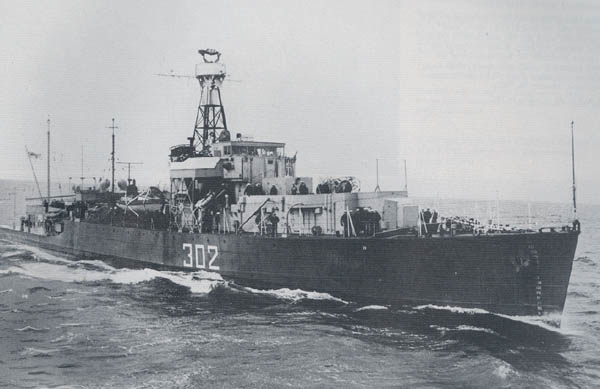
Oh, yes, the net tenders were armed- a 3" gun, 3- 20mm guns and depth charge firing Y guns. And those horns? Look at the picture nearby to see how they were used in net work.

In addition to their net tending duties, these hearty little ships were used for salvage, cargo and other useful activities.

In addition to WWII service, many of these ships also served during the Korean War and a few served nearly 40 years.

One ship was lost when it hit a mine and others were damaged in storms. But all served faithfully and well, as did their crews.

And a special note of thanks to all the old net tander sailors who have shared their memories online and to
Robert (Bob) Cooper,Sr.. who maintains the site for USS Mulberry (AN- 27).

Some old nets have become diving attractions.

UPDATE: A modern approach.

Saturday, January 13, 2007

Iran: What happens when you devote your energy to making nuclear weapons and ignore the other things: " Iran smog 'kills 3,600 in month"


Reported here':
Air pollution is estimated to have killed nearly 10,000 people in Tehran over a one-year period, including 3,600 in a month, Iranian officials say.

Most of the deaths were caused by heart attacks and respiratory illnesses brought on by smog, they said.

The scale of the problem led one senior official to say living in the Iranian capital was like "collective suicide".

Cheap fuel encourages car use in Iran, correspondents say, and many vehicles do not meet global emissions standards.

"It is a very serious and lethal crisis, a collective suicide," the director of Tehran's clean air committee, Mohammad Hadi Heydarzadeh, told an Iranian newspaper.

"A real revolution is needed to resolve this problem."
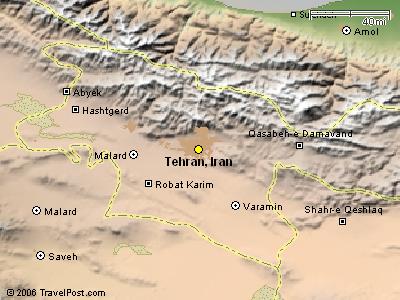
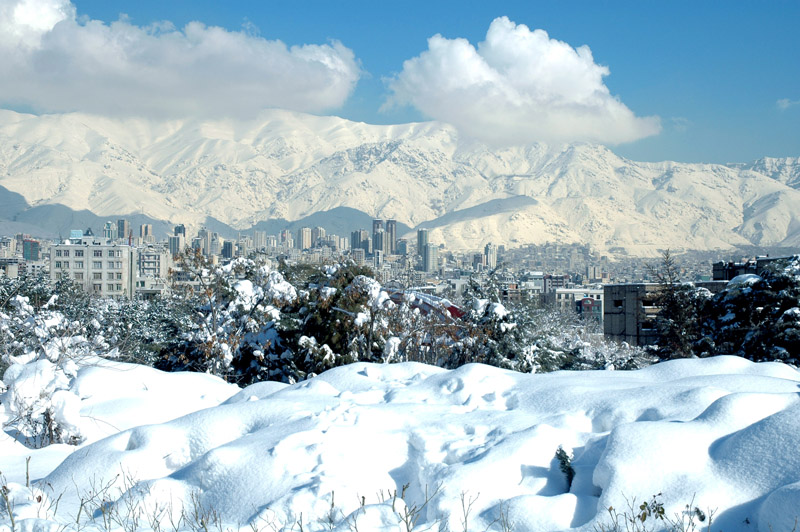
About 12,000,000 people live in the Tehran metro area according to this. Snow photo is, as you might gather, on a clear day, Wikipedia adds:
Tehran, like many big cities, suffers from severe air pollution and the city is often covered by smog making breathing difficult and causing widespread pulmonary illnesses. It is estimated that about 27 people die each day from pollution-related diseases.[2] According to Iranian officials, 3,600 people died in a single month due to the poor air quality. [3]

The air pollution is due to several different reasons: 1) Economical: most Iranian industries are located on the outskirts of Tehran. The city is also overrun with old and aging cars which do not meet today's emission regulations. Furthermore, Iran's busiest airport, Mehrabad International Airport, is located in the west of the city; 2) Infrastructure: Tehran has a poor public transportation network. Buses and metros do not cover every area of the city. Most people are then obliged to either use private cars or hire taxis. This has created severe traffic and congestion; 3) Geographical: Tehran is bound in the north by the massive Alborz mountain range that is stopping the flow of the humid Caspian wind. As a result, thermal inversion that traps Tehran's polluted air is frequently observed. The lack of humidity and clouds makes Tehran a very sunny city. The UV radiations then combined with the existing pollutants significantly raise the level of the ozone.

The government, however, is engaged in a battle to reduce the air pollution. It has for instance encouraged taxis and buses to convert from petrol engines to engines that run on compressed natural gas. Furthermore, since 1979 the government of the Islamic Republic of Iran has setup a "Traffic Zone" (طرح ترافیک) covering the city center during peak traffic hours. Entering and driving inside this zone is only allowed with a special permit. The government is also trying to raise people's awareness about the hazards of the pollution. One method that is currently been employed is the installation of Pollution Indicator Boards all around the city to monitor the current level of particulate matter (PM10), nitrogen dioxide (NO2), ozone (O3), sulfur dioxide (SO2), and carbon monoxide (CO). The board also displays the Pollutant Standard Index (PSI), which is a general indication of air quality based on the measurements of the above-mentioned five pollutants. The Pollution Indicator Boards classify the level of each pollutants as either safe, hazardous or dangerous.

Lockheed Littoral Combat Ships: Stop Order issued


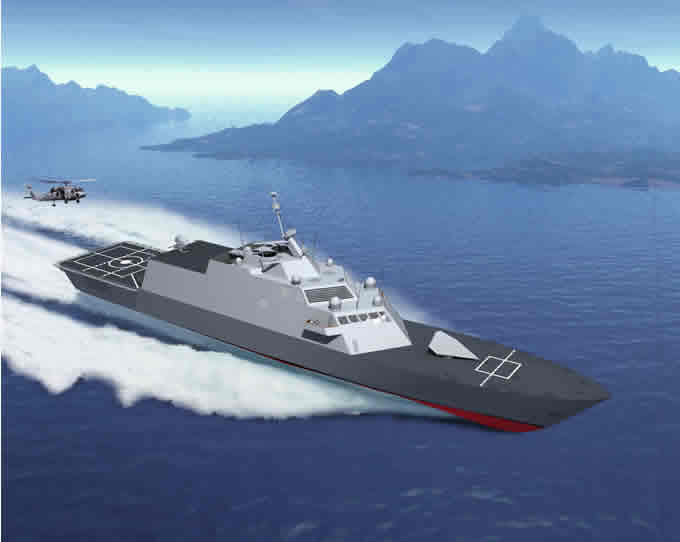
LCS program cost overuns? Surprise, surprise. Press rrelease from DoD: Navy Issues Stop Work Order for Littoral Combat Ship 3 Announced:
The Navy has issued a stop work order today to Lockheed Martin Corp. Maritime Systems & Sensors unit, Moorestown, N.J., for the construction of the third Littoral Combat Ship (LCS). This stop work order will take effect immediately and is for a period of 90 days.

The stop work order was issued because of significant cost increases currently being experienced with the construction of LCS-1 and LCS-3, under construction by Lockheed Martin.

“I determined that at this point in time it was critical to stop work on LCS-3 to assess the LCS program and ensure we understand the program’s cost and management processes before we move forward. It is essential that we complete LCS 1 and get it to sea so we can evaluate this new ship design” said Secretary of the Navy Donald Winter.

The Navy is working closely with the contractor to identify the root cause of the costs growth. The Navy is reviewing the overall acquisition strategy for the LCS program and is working closely with the contractors to keep this program on track.
Root cause? Anyone? Anyone? Bueller? Bueller?

One answer found here:
"We believe these increased costs are due to an underestimation of labor hours," said Lt. John Gay, a spokesman for the Navy, in a telephone interview, noting the Navy had not changed requirements on the initially awarded contract granted in June 2004.
***
According to Lockheed, several issues raised costs including incorrect reduction gears supplied by vendors, a six-month delay in receiving high-grade steal (sic) and the Navy's decision to apply standard vessel production rules when constructing the ships.
Yeah, you gotta pay extra for that "high grade steal."

More here:
A recent cost review of the USS Freedom showed that the estimated price had jumped from a planned $220 million to between $331 million and $410 million, according to a Navy official. That ship is under construction by Lockheed Martin and scheduled to be delivered to the Navy this summer.
***
Another factor in gauging Congressional response to the program’s cost growth, the Congressional naval analyst pointed out, is that the ships are being built at three small shipyards that have not done a lot of Navy work.

“People from the big yards” — the six major shipyards owned by Northrop Grumman and General Dynamics — “have always regarded LCS as a threat,” the analyst said. “This doesn’t help that.”

The pace of acquisition is key to the Navy’s desire to rapidly get the ships in service to perform close-to-shore combat missions.
So, the long knives are out.

Anchors turn out to be weakest links


Two ships, rough seas, two lost anchors. Reported here:
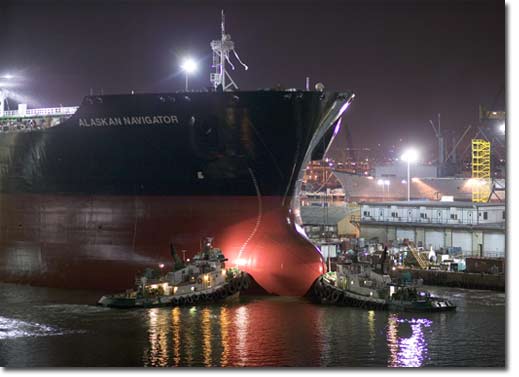
Two of BP's new double-hulled oil tankers are sitting idle off Washington state after each lost an anchor while sailing through rough North Pacific waters, company and Coast Guard officials said Thursday. An investigation into how the anchors got away revealed "material defects" in the enormous steel claws, said Anil Mathur, president of Alaska Tanker Co., a Beaverton, Ore., company that hauls North Slope crude oil for BP. Each anchor weighs 16 tons, stands more than 13 feet tall, and hangs at the bow of one of the identical 941-foot ships. One ship, the Alaskan Navigator, discovered an anchor missing on Dec. 26 and the Alaskan Frontier lost one Dec. 23, Mathur said.
I guess the loss of two anchors proves it was no fluke. I wonder if BP stocks spare anchors or goes stockless.


Delivery press release on ship here.

Friday, January 12, 2007

China begins using Mekong River as oil route


As I noted in April 2006, China is looking for alternate pathways to get oil from source to user. One route is the Mekong River:
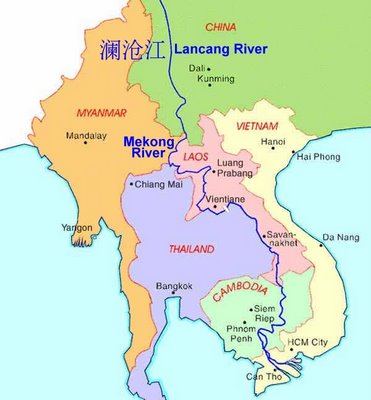
China wants to import Mideast oil through the Mekong River to avoid the unsafe Malacca Strait. As an oil shipping route it is already operational but there are strong environmental concerns that accidental spills could adversely affect the livelihoods of nearly 60 million people living along its banks.

Two Chinese ships made their maiden journey on December 29 carrying a total of 300 tons of refined oil up the Mekong. The two vessels arrived at a port in China's south-western province of Yunnan with a cargo that was shipped from a port in Thailand's northern province of Chiang Rai, China's state news agency Xinhua reported.

China’s estimated total annual oil imports have now reached 140 million tonnes per year, and about 75 per cent currently flows through the narrow, pirate-infested Strait of Malacca.

Piracy is not the only perceived vulnerability though. Beijing has also concerns that in a potential conflict with US fuel shipments through the waterway could be choked off, hence the importance of the Mekong. (emphasis added)
Planning ahead in case the U.S. decides to help defend Taiwan by cutting off the Strait of Malacca to them?

Betting that the U.S. would find it hard to put 60 million people at risk by stopping up the river?

Freeing up their hands to take action?

UPDATE: Previous post on Sea lanes. Here is a link to an article titled, "The Oil Weapon: Myth of China's Vulnerability." Another analysis here. More here:
According to the Washington Times, China understands that the principle national security threat facing it is disruption of sea lanes bringing oil and commerce to its shores.
The Bill Gertz piece noted says:
China believes the U.S. military will disrupt China's energy imports in any conflict over Taiwan ... Beijing's leaders see access to oil and gas resources as vital to economic growth and fear that stalled economic growth could cause instability and ultimately the collapse of their nation of 1.3 billion people. Energy demand, particularly for oil, will increase sharply in the next 20 years — from 75 million barrels per day last year to 120 million barrels in 2025 -- with Asia consuming 80 percent of the added 45 million barrels, the report said. Eighty percent of China's oil currently passes through the Strait of Malacca, and the report states that China believes the sea area is "controlled by the U.S. Navy." Chinese President Hu Jintao recently stated that China faces a "Malacca Dilemma" -- the vulnerability of its oil supply lines from the Middle East and Africa to disruption. Oil-tanker traffic through the Strait, which is closest to Indonesia, is projected to grow from 10 million barrels a day in 2002 to 20 million barrels a day in 2020, the report said. Chinese specialists interviewed for the report said the United States has the military capability to cut off Chinese oil imports and could "severely cripple" China by blocking its energy supplies.
See also here.

UPDATE2: Looking at this map, I wonder about the Mekong as an alternate to the Strait of Malacca (since I'm a little fuzzy on how oil tankers get to the Mekong without transiting a couple of major chokepoints). However, it is an excellent alternative to the Taiwan Strait and the South China Sea, if need be.


UPDATE3: Tankers do not actually have to get to the Mekong from the Middle East if there is some sort of transport from Thailand or Burma such as a pipeline, as was proposed at one time. See here.

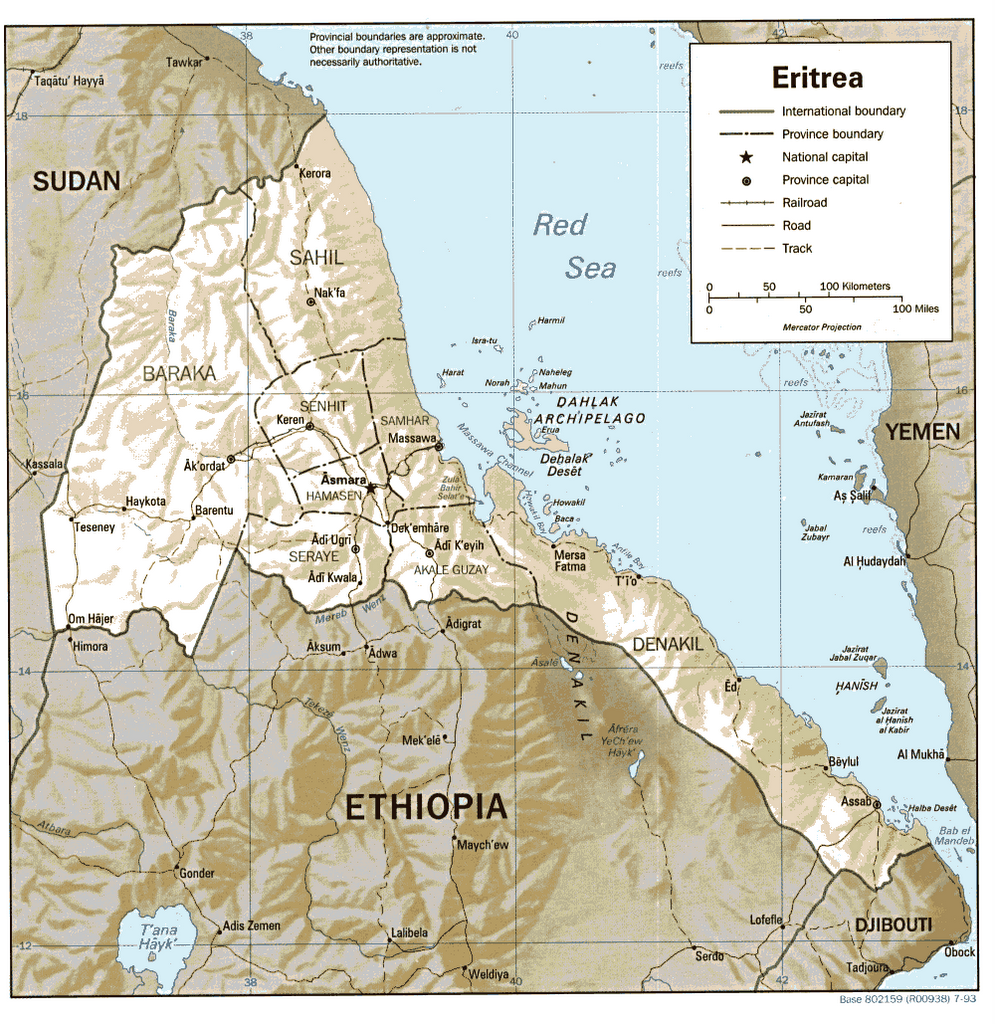
Odd Friday headline: "Eritrea warns US over Somalia"


I am quaking in my boots since Eritrea warns US over Somalia.

Not.

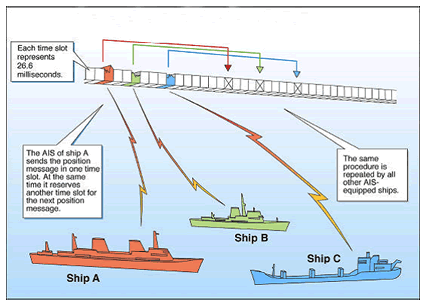
U.S. maritme identification system to go forward


Reported here:
"The nationwide automatic identification system will greatly aid the essential process of identifying, tracking, and communicating with vessels approaching our maritime borders and is a centerpiece in establishing effective maritime domain awareness," said Rear Adm. John P. Currier, the Coast Guard's assistant commandant for acquisitions. "This is an important milestone for the project as it marks the approval to begin contracting for the initial deployment of this powerful capability," said Capt. Kurtis Guth, automatic identification system project manager. "The nationwide automatic identification system will provide numerous key operational benefits to the Coast Guard, including improved maritime security, navigational safety, and vessel traffic planning. The speed, course and location data collected by this system from vessels carrying international automatic identification system equipment will be used to form an overarching view of maritime traffic within or near the U.S. and its territorial waters."

The nationwide automatic identification system [NAIS] is being developed in three acquisition increments primarily to accelerate deployment of mission critical capabilities. The Coast Guard partnered with the Naval Sea Logistics Center under the first increment to establish receive-only automatic identification system coverage in approximately 60 critical U.S. ports and coastal areas during the current fiscal year.
More info on NAIS request for bids here, more on the system here

Rebuilding Iraq

A plan from Giuliani and Gingrich here.

And getting there via counterinsurrgency here.

A review of the Tamil Tiger mess


An end of year look at the Sri Lankan Tamil Tigers (LTTE) here by a retired Indian Intel officer:
To those who do not subscribe to LTTE methodology, LTTE’s overall goal appears murky. LTTE appears to be trying hard to push the clock back to 2001, after shedding the blood of at least 3,000 of its own kind in the years of peace, and complaining to the international community when the fortunes of war went awry. The bottom line is that LTTE strategies of 1996 and 2000-2001 are not working in 2006 as international ambience has changed. In a nutshell the only achievement of ceasefire period appears to be that LTTE had sacrificed the international sympathy the Tamil cause had enjoyed all these years, to crown itself as the sole spokesman for Tamils in Sri Lanka.
***
Armed Sea Tigers seized a Jordanian ship MV Farah III, carrying 14000 tons of rice, which was stranded 8 nautical miles off Mullaitivu due to engine trouble on December 23, 2006. They arrested the 14- member Arab crew and whisked them away to Kilinochi. According the ship’s captain, Sea Tigers also confiscated the ship’s communication equipment and computers. In international terms, this action is called piracy. If LTTE wanted to reassert its claim to legitimacy in 2006, it could not have chosen a worse way of articulating it.
***
The LTTE is perhaps the strongest non-state actor with military capability in Asia. Its falling fortunes in 2006 can be attributed to certain characteristics of Prabhakaran’s leadership conduct of LTTE. These have eroded the organization’s credibility...

Somalia: Back to the basics of statehood


What next for Somalia? As this piece notes, when you are at the bottom, anything looks like an improvement:
Nearly two decades of war have reduced this country of 9 million to chaotic destitution, making it less a failed state than no state at all. (The U.S. State Department lists the country's government type as "none.")
***
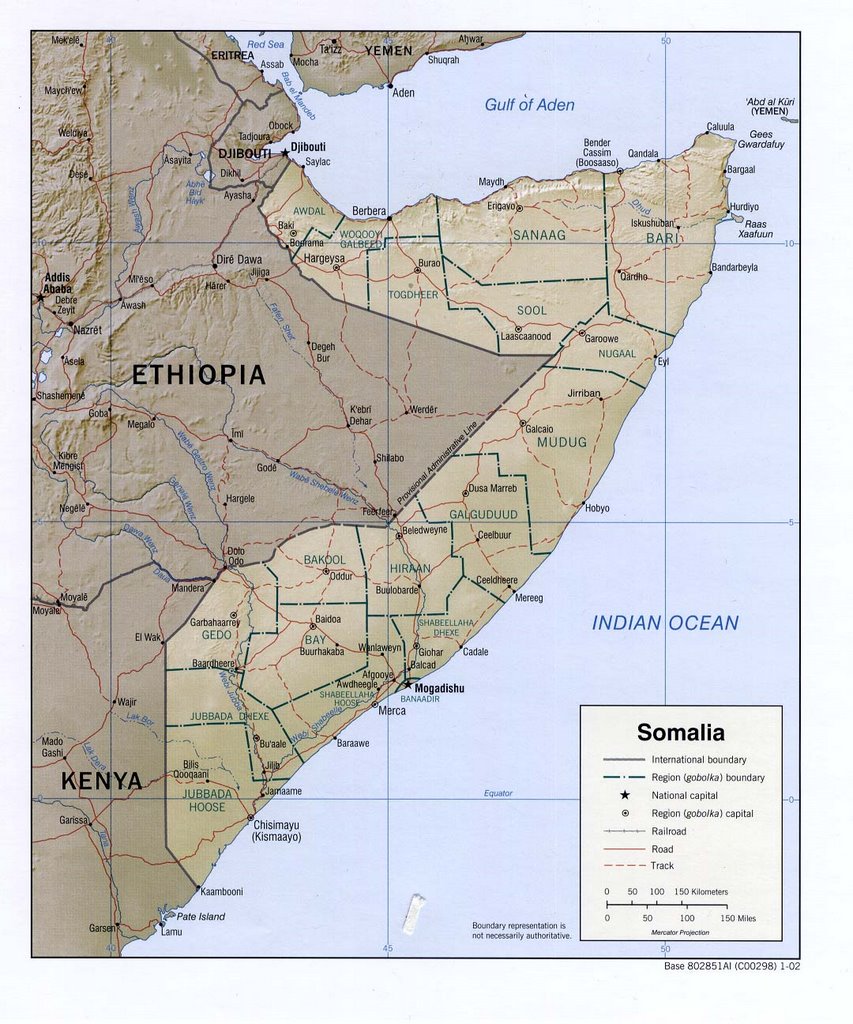
But nailing terrorists is one thing; building a nation where none exists is another. "We are starting from scratch," the head of Somalia's new government, Prime Minister Ali Mohammed Gedi, told me in an interview in Mogadishu. Given Somalia's penchant for clan warfare and inhospitableness toward foreign armies--just go out and rent a copy of Black Hawk Down--it's tempting for Western policymakers to wash their hands and wish Gedi luck. But Somalia's strife has repercussions beyond its borders. The country is victim to the worst ravages of man and nature. Instability there has the potential to engulf the entire Horn of Africa in war, with neighboring countries Ethiopia and Eritrea jockeying for influence and pirates using the lawless coast as a base to launch attacks on the freighter traffic headed for the Suez Canal. Some of the Islamists have vowed a guerrilla war against the new government, which they deride as a puppet of Ethiopia and the U.S. On top of all that, a double disaster of summer drought followed by December floods has left more than 500,000 Somalis dependent on foreign aid for their livelihoods.
If the peace can be kept long enogh, the Barnett's SysAdmin forces need to move in. If...

Why try to fix Somalia? It might be argued that Somalia is a "broken window" on the world scene and that fixing it will help the whole neighborhood get better. Others will argue that there is no compelling U.S. interest in the area to justify the expenditure of any time, treasure or personnel to help the broken state...The underlying question is "who benefits" from the status quo and its future. And who will benefit if Prime Minister Gedi can make his effort work...

Time to choose between clans and chaos or nationhood and realtive peace.

UPDATE: UN Security Council is concerned.

Thursday, January 11, 2007

Oh, Dwat!


Al-Qaida suspects still alive in Somalia
A top U.S. official in the region said Thursday that none of the al-Qaida suspects believed to be hiding in Somalia died in a U.S. airstrike this week, but Somalis with close ties to the terrorist group were killed.

A day earlier, a Somali official said a U.S. intelligence report had referred to the death of Fazul Abdullah Mohammed, one of the three senior al-Qaida members blamed for the 1998 bombings of the U.S. embassies in Kenya and Tanzania.

But the U.S. official in Kenya, who spoke on condition of anonymity because he was not authorized to speak to the media, said that Ethiopian troops and U.S. special forces were still pursuing the three suspects in southern Somalia.
Is it a riddle? Can an official who is not offically allowed to talk to the media, but talks anyway still be an official?

Wednesday, January 10, 2007

Now let the fun begin

The new Congress gets underway with the House passing a bill mandating "six impossible things by breakfast" as reported here:
Lawmakers voted 299-128 to require screening of all cargo on passenger planes within three years, to check cargo ships for nuclear bombs before they leave ports bound for the U.S. and to boost homeland security funding for urban areas most likely to be terrorist targets.
***
The anti-terrorism measure is the first in a series of bills the House is expected to pass this week and next. The list--all part of Democrats' campaign platform--includes an increase in the minimum wage, expansion of federally funded embryonic stem cell research and permission for the federal government to negotiate with pharmaceutical companies for lower drug prices for senior citizens.
Wonder what the Senate will do?

Somalia: Airstrikes take out a bad one


Reported in Embassy bomb planner killed in airstrike:
The suspected al-Qaida militant who planned the 1998 U.S. embassy bombings in east Africa was killed in an American airstrike, a Somalian official said Wednesday.

"I have received a report from the American side chronicling the targets and list of damage," said Abdirizak Hassan, the Somali president's chief of staff. "One of the items they were claiming was that Fazul Abdullah Mohammed is dead."

Mohammed, 32, allegedly planned the attacks on the U.S. embassies in Kenya and Tanzania that killed 225 people.

He is also suspected of planning the car bombing of a beach resort in Kenya and the near-simultaneous attempt to shoot down an Israeli airliner in 2002. Ten Kenyans and three Israelis were killed in the blast at the hotel, 12 miles north of Mombasa. The missiles missed the airliner.

Mohammed, one of the FBIís most wanted terrorists, who has evaded capture for eight years, is thought to have been the main target of an American helicopter attack Monday afternoon on Badmadow island off southern Somalia.
Some, who deny an al Qaeda connection to Somalia, will be surprised. Others of us will be singing "Another One Bites the Dust" -quietly.

Another one bites the dust
And another one gone, and another one gone
Another one bites the dust
Hey, I'm gonna get you too
Another one bites the dust


New target.

UPDATE: 1/11/07 Not so fast!

Tuesday, January 09, 2007

From Counterterrorism Blog: Weird incidents in US airports are raising questions

Counterterroism Blog notes a Saudi news report of some odd happenings at U.S. airports here:
...there have been a number of thefts of airport vehicles in US airports in the past few days including an United Air car on Chicago O'hare's airport.
also attempts were made in the Buffalo airport to stael (sic) authorized vehicles and supposedly airport authorities around the country have noticed strange people watching restricted areas in airports.
More probing?

My quick searches have revealed nothing along the lines of stolen airport vehicles...

A grim assessment for Somalia


Found here:
....[T}he people badly need help. Almost one in four Somalis require outside assistance to survive and the Islamic militants who imposed security, while demanding piety, are gone. The warlords are ascendant and aid workers are afraid to go back in.

Second, the United States can do little by itself. A botched intervention in the early 1990s left 18 U.S. servicemen dead and the legacy of the "Black Hawk Down" battle still weighs heavily on both countries. American boots on the ground is not an option.

"An African peacekeeping force is a good start to bring about stability," said Frazer, the U.S. assistant secretary of state for Africa. She took that message to the presidents of Somalia, Uganda, Djibouti, Yemen as well as Ethiopia's prime minister and the African Union's deputy chairman.

A meeting of U.S., European Union, African and Arab diplomats ended in Kenya on Friday with a call for a peacekeeping force envisioned at 8,000 soldiers.
I note that while "American boots on the ground" seems to have been ruled out in some circles, the U.S. is apparently offering some support from the sky:
A U.S. Air Force AC-130 gunship attacked suspected al-Qaeda members in southern Somalia on Sunday, and U.S. sources said the operation may have hit a senior terrorist figure.

The strike took place near the Kenyan border, according to a senior officer at the Pentagon. Other sources said it was launched at night from the U.S. military facility in neighboring Djibouti. It was based on joint military-CIA intelligence and on information provided by Ethiopian and Kenyan military forces operating in the border area.
And the U.S. is also involved offshore:
U.S. warplanes from the USS Dwight D. Eisenhower have already flown intelligence-gathering missions over Somalia while their aircraft carrier deploys off the wartorn African nation's coast, the U.S. military said Tuesday.

The U.S. military sent the USS Eisenhower to join three other U.S. warships conducting anti-terror operations off the coast of Somalia, and planes from the carrier have begun flying over the country, said U.S. Navy spokesman Lt. Cmdr. Charlie Brown in Bahrain, where the U.S. Navy's Fifth Fleet is based.
***
Brown said the Eisenhower will join the guided missile cruisers USS Bunker Hill and USS Anzio and the amphibious landing ship USS Ashland, which are patrolling the Somali coast in search of Al Qaeda members thought to be fleeing Somalia in the wake of Ethiopia's December invasion.

Navy crews aboard the Bunker Hill, Anzio and Ashland have been halting, boarding and searching commercial ships off the Somali coast, Brown said. No terror suspects have been found aboard any of the ships, he said.

"That's a sign that what we're doing is working," Brown said. "We're trying to deter the terrorists from using the sea. If we haven't detained anyone, that shows us that it's working."
See also here.

Of course, al Qaeda is calling for jihad:
A new audio message from al-Qaida's number two leader, Ayman al-Zawahiri, urges all Muslims to go to Somalia to help Islamic extremists there.

"I call upon my brothers the Muslims everywhere to participate in jihad in Somalia," said Zawahiri in the message, which was posted on the Internet ...."I call upon the lions ... in every land of Islam: set out and support your brothers in Somalia by souls, money, advice, and experience," said Zawahiri, according to a translation provided by the SITE Institute...Zawahiri, echoing recent calls by some Islamic Courts leaders, sought to cast the situation in religious terms, calling the Ethiopian military "Crusader forces," and urging attacks on them. "Hurt the slaves of America," he said.
Ethiopia has its own problems. And some "experts" downplay the al Qaeda message:
Stirring as it might sound, an Internet appeal from Al-Qaeda for Muslims to go to Somalia and wage holy war is unlikely to amount to much, experts on Islamic extremism say.

Penetrating the lawless and strife-torn Horn of Africa country is difficult, if not impossible, they say, and even if jihadis got in, they would find its Islamist insurgents surrounded and near defeat.
***
Egyptian military expert Mohammed Nabil Fuad said that, having lost their last stronghold at Kismayo, the Islamist militias have found themselves "surrounded, and it will be hard for them to receive volunteers and weapons".

"What's more, given the desert-like nature of the terrain, any movement would be easy to detect -- and any infiltration would be almost impossible by the sea, which is controlled by US forces" and those of other nations.

Saudi political analyst Zuhair al-Harithi said that "Zawahiri's appeal risks being a pious hope".

But he observed: "Having been pursued in Afghanistan and Pakistan, Al-Qaeda seems to be looking to gain a foothold in Somalia, which is fertile land for extremist ideologues due to its deplorable economic situation."

"Success for Al-Qaeda hangs on the way the situation in Somalia develops," he added.

"If the government can ensure security for Somalis, it will close the door on Al-Qaeda. But if instability and civil war persists, Somalia will be fertile ground" for the terrorist network spearheaded by
Osama bin Laden.

Fellow Saudi analyst Hani Nakchabandi agreed.

"Security hinges on bread and prayer. Zawahiri's call will only be a sermon in the desert if the government ensures security for Somalis," he said.

"The Muslims to whom Zawahiri is directing his remarks have noticed how previous calls to jihad in Afghanistan and Iraq have led to Guantanamo, death or prison," Nakchabandi said.

"I doubt very much that such Muslims, dismayed by the hanging of Saddam Hussein, will be interested in what's going on in Somalia."
There is another view:
amal Ismail, director of the Al-Quds information centre... begged to differ, saying that Zawahiri's remarks will find favour amongst Al-Qaeda's supporters and sympathisers.

"Of course, getting into Somalia involves many obstacles and dangers, due mainly to the geographic environment," said Ismail...

"But neither land and sea patrols, nor patrols along the Kenya border, will stop the infiltration (of jihadis). It certainly would be difficult, but it would not be impossible."

On the Internet in recent days, many Islamists have expressed the hope that "the war has only just started" and that "Somalia will be a place to wage guerrilla combat, following the example of Afghanistan and Israel".
UPDATE: More on U.S. airstrikes here from the BBC. Interesting quote:
Somalia's interim President Abdullahi Yusuf backed the US action.

"The US has a right to bombard terrorist suspects who attacked its embassies in Kenya and Tanzania," he said in Mogadishu, a day after entering the city for the first time since the Islamists withdrew.
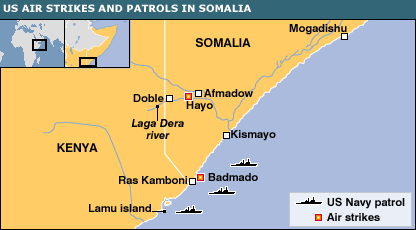
BBC map of naval forces and airstrikes.

UPDATE2: U.S. boots on the ground? Says so here.

UPDATE3: In for an penny... more on airstrikes here:
A U.S. air strike hit targets in southern Somalia where Islamic militants were believed to be sheltering suspects in the 1998 bombings of two U.S. embassies, Somali officials and witnesses said Tuesday. Many people were reported killed.
***
Helicopter gunships launched new attacks Tuesday near the scene of a U.S. air strike in the village of Hayi, although it was not clear if they were American or Ethiopian aircraft, and it was not known if there were any casualties.

Two helicopters "fired several rockets toward the road that leads to the Kenyan border," said Ali Seed Yusuf, a resident of the town of Afmadow in southern Somalia.

Back to the basics- why we are at war

Trouble sorting Shia from Sunni?

Wonder why Iran is a problem?

Asking why we are at war?

Some answers here in a nice explanation of the radical world view of some Muslim extremists. Portion:
According to Mary Habeck of the School of Advanced International Studies at Johns Hopkins University:

"Jihadis thus neither recognize national boundaries within the Islamic lands nor do they believe that the coming Islamic state, when it is created, should have permanent borders with the unbelievers. The recognition of such boundaries would end the expansion of Islam and stop offensive jihad, both of which are transgressions against the laws of God that command jihad to last until Judgment Day or until the entire earth is under the rule of Islamic law."

Al Qaeda and its terrorist allies are waging their war on several continents. They have killed innocent people in Europe, Africa, the Middle East, Central Asia, the Far East, and the United States. They will try to overthrow governments and seize power where they can--and where they cannot, they will attempt to inflict fear and destruction by disrupting settled ways of life. They will employ every weapon they can: assassinations, car bombs, airplanes, and, if they can secure them, biological, chemical, and nuclear weapons.

The theocratic and totalitarian ideology that characterizes al Qaeda makes typical negotiations impossible. "Anyone who stands in the way of our struggle is our enemy and target of the swords," said Abu Musab al Zarqawi, the late leader of al Qaeda in Iraq. Osama bin Laden put it this way: "Death is better than living on this Earth with the unbelievers among us."

This struggle has an enormous ideological dimension. For example, both Osama bin Laden and Ayman al-Zawahiri, the number two leader of al Qaeda and its ideological leader, were deeply influenced by Sayyid Qutb, whose writings (especially his manifesto "Milestones") gave rise and profoundly shaped the radical Islamist movement. Qutb, an Egyptian who was killed by Egyptian President Gamal Nasser in 1966, had a fierce hatred for America, the West, modernity, and Muslims who did not share his extremist views.

According to the author Lawrence Wright:

"Qutb divides the world into two camps, Islam and jahiliyya, the period of ignorance and barbarity that existed before the divine message of the Prophet Mohammed. Qutb uses the term to encompass all of modern life: manners, morals, art, literature, law, even much of what passed as Islamic culture. He was opposed not to modern technology but to the worship of science, which he believed had alienated humanity from natural harmony with creation. Only a complete rejection of rationalism and Western values offered the slim hope of the redemption of Islam. This was the choice: pure, primitive Islam or the doom of mankind."

Sunni jihadists, then, are committed to establishing a radical Islamic empire that spans from Spain to Indonesia. Ayman al-Zawahiri, for example, has spoken about a "jihad for the liberation of Palestine, all Palestine, as well as every land that was a home for Islam, from Andalusia to Iraq. The whole world is an open field for us."

Their version of political utopia is Afghanistan under the Taliban, a land of almost unfathomable cruelty. The Taliban sought to control every sphere of human life and crush individuality and human creativity. And Afghanistan became a safe haven and launching pad for terrorists.

The Islamic radicals we are fighting know they are far less wealthy and far less advanced in technology and weaponry than the United States. But they believe they will prevail in this war, as they did against the Soviet Union in Afghanistan, by wearing us down and breaking our will. They believe America and the West are "the weak horse"--soft, irresolute, and decadent. "[Americans are] the most cowardly of God's creatures," al-Zarqawi once said.

Monday, January 08, 2007

Miami "suspicious" package destroyed

Miami stays on alert as set out here:
One day after a case of miscommunication turned into a security scare at the Port of Miami, now there’s been a possible explosive scare at the busy Port, which may also have been a false alarm.

According to the U.S. Coast Guard, a package that was to be loaded on Royal Caribbean’s Majesty of the Seas, tested positive for C-4 plastic explosives by the private security firm, McRoberts Maritime Security, hired by the cruise line.

According to CBS local affiliate WFOR's Brian Andrews, officials from Customs and Border patrol used Miami-Dade bomb sniffing canines which did not detect any explosives. However, the Coast Guard says the package did test positive for trace amounts of the explosive.

The “Majesty of the Seas” was moved slightly to a different berth as the Miami-Dade bomb squad exploded the package without incident around 3:30 p.m.
Better safe than sorry...

Maritime Monday 41 at Fred Fry International

41! Fred Fry International: Maritime Monday 41

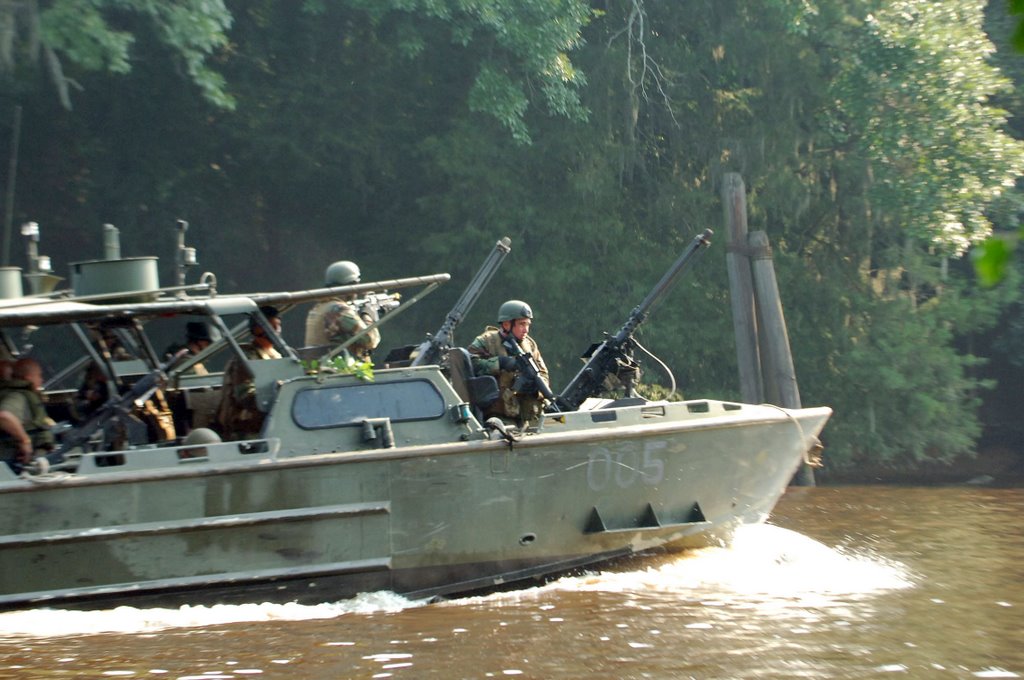
Everything old is ...the "'New' Brown Water Navy


Found in All Hands! here:
The battle on the waterways has moved from the dense jungles and harsh humidity of Vietnam’s Mekong Delta of yesteryear into the open deserts and dry brush near the banks of Iraq’s southern rivers. Protecting infrastructure, cutting off enemy escape routes, severing supply lines, searching out and destroying enemy troops and bases and providing a safe route for coalition troops to accomplish the mission is now the job of the newly resurrected Riverine Squadron (RIVRON) 1, part of the new Navy Expeditionary Combat Command (NECC).

“We’re always going to need the ability to control the waterways in whatever country we go to,” said Hull Maintenance Technician 2nd Class Cameron J. Hohimer. “The ability to do that in countries we’re friendly with training them and building relationships the way we have been trained is definitely a good asset to the war on terror.”

Moving out of the water and onto the sands of Iraq is a harsh reality check for many Sailors in today’s environment. Strapping on a 50-pound pack, wearing 30 pounds of protective combat gear and carrying a weapon is what is being asked of them more and more often.

"We cannot sit out in the deep blue, waiting for the enemy to come to us. He will not. We must go to him,” said ADM Mike Mullen, Chief of Naval Operations in a recent speech given at the Naval War College, Newport, R.I. “We need a green-water capability and a brown-water capability. I want the ability to go close in and stay there."

With NECC standing up RIVRON-1, the Navy is creating an armada of small but swift watercraft. Small Unit Riverine Craft (SURC) provides Sailors with a combat-capable boat that allows them
to navigate waters much too shallow for conventional ships. Insertion teams now can be rapidly deployed, saving lives in
the process by driving right up on the river banks.
A couple of years late, but ...

Photo caption:
Cape Fear River, N.C. (Sept. 9, 2006) - Riverine Squadron One (RIVRON-1) conducts an operational training mission along the banks of the Cape Fear River at Camp Lejeune. U.S. Navy photo by Mass Communication Specialist Seaman Kenneth R. Hendrix


UPDATE: Fixed some gremlin work.

Rescue 21 comes to the Northwest

Reported as USCG Activates New Communication System in Pacific Northwest:
The United States Coast Guard announces the switch to new command, control and communications technology monitoring distress calls throughout Puget Sound, the Strait of Juan de Fuca, and the West Coast of Washington, north of the Quinault Indian Reservation. Rescue 21 allows the Coast Guard to monitors Digital Selective Calling (DSC) emergency transmissions. When properly registered with a Maritime Mobile Service Identity (MMSI) number and interfaced with a GPS receiver, a DSC distress call provides the Coast Guard a vessel's identity and exact location, greatly improving emergency response. Rescue 21 also includes advanced direction-finding capability, allowing Coast Guard watchstanders to more accurately locate the source of a VHF distress call. That capability also helps the Coast Guard locate the source of hoax calls, saving valuable time when lives are at stake and conserving taxpayer dollars.

Sunday, January 07, 2007

Fish tale 2

Back in August 2006, I posted about three Mexican fishermen who claimed that they had been saved after spending 9 months lost at sea, living on rainwater and fish. I had my doubts, so I started the headline with a meant to be cautionary "Fish Tale?" Now, here, a report casting some doubt on the tale:
[T]hey claim to have survived for 289 days at sea, but, four months on, the awe-inspiring tale of the Mexican fishermen looks less like a miracle and more like an elaborate hoax.
Worth a read for the questions it raises.

Port of Miami truck incident


Breaking news about some odd goings on at the Port of Miami here:
The container truck was stopped near the cargo-area entrance to the port around 8 a.m. and the driver of the vehicle, who had valid port identification, was questioned by authorities.

"The driver of the 18-wheeler was apparently asked several questions — we're told routine questions — and at one point, he said he was alone," FOX News' Nancy Harmeyer said.

Police became suspicious and discovered two men hiding in the sleeper cab of the 18-wheeler. All three men are of Middle Eastern descent. The men are believed to be in the country legally and were being questioned by the FBI.

"At this time we don't know why they were here, what they were planning to do, or quite honestly even if the driver knew that the two men were back there," Harmeyer said.

The driver reportedly is of Iraqi descent and one of the other two is a Lebanese national; the third is also believed to be Middle Eastern and early reports stated authorities have a warrant out for one of the three but none of the detained is on a terror watch list, sources said.
More here and here.

Sounds serious.

UPDATE: Well, potentially serious. Little hard to trust all the initial hyperventing news reports, but apparently a "nuke screen" revealed nothing and normal protocols are being followed, including having the bomb squad and Haz-Mat teams on site. As these things go, probably good practice for all hands. Normal port operations seem to be on-going including routine departures of cruise ships.

UPDATE2: More initial reporting:
The Miami Herald reported that ‘suspicious’ 55 gallon drums were found in the back of the truck, and that while the driver's paperwork claimed he was carrying auto parts, no such cargo was found on the truck, according to authorities. The drums and the discrepancy raised suspicions, and prompted the search.
Miami Herald report here:
Police said when the driver was stopped at the security gate, he appeared nervous and would not make eye contact during questioning, authorities said. The driver said he was alone but police later found two other Middle Eastern nationals hiding in the truck's cab.

Also, the driver's manifest indicated he was carrying auto parts, but nothing like that was found in the truck, authorities said.

None of the men has been arrested. They were being detained for questioning.

''Port operations have not been impacted,'' said Miami-Dade police spokesman Robert Williams. ``The cargo area and the cruise ship area were not impacted.''

FBI spokeswoman Judy Orihuela said the driver and the others were placed in custody. The hidden passengers were a second Iraqi man and a Lebanese national. Both were found inside the small cab of the blue and white semi.
Even if nothing dangerous is found on the truck, the circumstances are very suspicious. If nothing else, it might be a probe of the port's defenses. Al Qaeda is well known for its thorough preparation...

Or maybe there is a logical explanation, which I will not be holding my breath to hear...

UPDATE3:
Port of Miami website here.
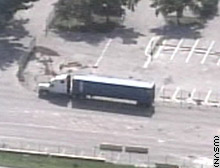
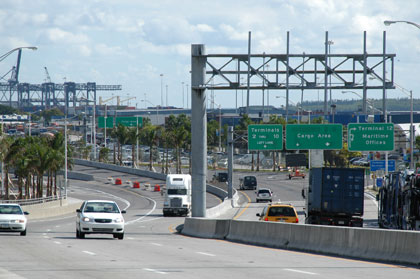
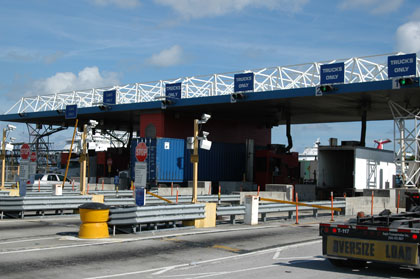
Nearby photos are from that site, showing the cargo truck security access point.

UPDATE4:

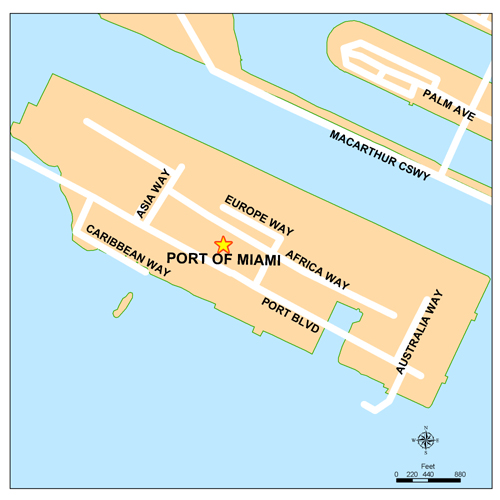
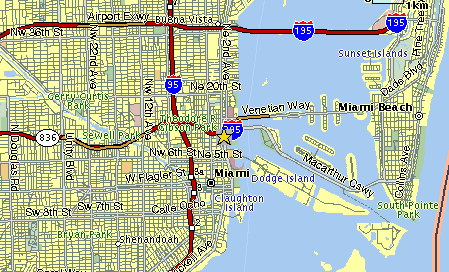
Maps of the Port of Miami.

UPDATE5:
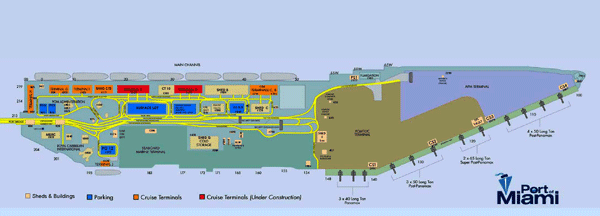
Port map.

UPDATE6: Live blogging the press conference. Let's see how much of the initial reporting was totally wrong.

"Port of Miami is safe."
Driver lacked proper i.d. needed one day pass- diverted to inspection station. Two addition pax noticed - communications problem between gate security and driver. One pax lacked any i.d. alert announced due to suspicious conditions...

Update7: Contents matched manifest. Security system worked as it was supposed to.
Gamma ray device used. No radiation. Now being checked by removing pallets. No 55 gallon drums on truck. Wire, etc for automotive wiring harnesses.

What "miscommunication?" Lack of ID, admin stuff and driver said he was by himself. Other guys were just along for the ride? Brother and friend. Legal residents of U.S.

Still trying to figure out what got into these guys heads...

UPDATE8: Let's count the errors: 1. No 55 gallon drums 2. The manifest did match the cargo and vice versa. On the other hand there is the issue of the two extra guys in the truck...

Once again, a reminder to not trust initial reports. And an impressive show of how the port security system can work. Well done to the security guard who was paying attention!

UPDATE9; 1/8/07 Miscommunication explained:
A port security officer became suspicious when the truck driver could not produce proper paperwork in a routine inspection to enter the port about 8 a.m., Goldberg said.

The driver also indicated he was alone in the truck, though security officers found two other men in the cab, she said. The passengers, ages 28 and 29, were a friend and a relative of the 20-year-old Iraqi driver, she said.

"Due to a miscommunication between the gate security personnel and the truck driver, we believe there was a discrepancy in the number of people in the vehicle," Goldberg said. "This, and the fact that one of the individuals did not have any form of ID, raised our level of concern."
I feel "miscommunicated" with all over on this matter.

Saturday, January 06, 2007

Sunday Ship History: Ocean Weather Ships


Before we plan a trip, most of us look at the newspaper, television or a webpage to get the latest weather to see what effect that might have on our trip. Pilots plan their routes around major storms, Navy ships use Optimum Track Ship Routing (OTSR) as a way to get the help of Fleet Weather Guessers in routing around "weather events."

Today much of the information needed for such forecasting comes from satellites and ocean buoys. There was a time, though, when Ocean Weather Ships were out at sea, gathering and reporting on the weather.

The importance of such information came to light during World War II:
The growing importance of airpower in World War II, combined with its sensitivity to weather, led to an ever greater military reliance on accurate forecasts. Knowing if and when your airfields, your enemy's airfields, or the target area would be "socked in" by bad weather was of vital concern to the combat commanders of that war.

As much an art as it is a science, predicting the weather is dependent on the accurate tracking of weather phenomena, particularly storm fronts, from the areas where they originate. In the North Atlantic and Transalpine Europe, that means gathering weather data in Greenland, the Norwegian Sea, and the arctic regions of Norway itself. Though meteorologists of the 1940s had none of the weather tracking satellites which make that job so much simpler today, they were still able to generate usably accurate forecasts for northern Europe as much as 72 hours in advance - as long as they could get the data they needed from those regions.

The need for that data gave birth to one of the most interesting and unique campaigns of the Second World War, the so-called "Weather War." Although it was not a war of major commands and large numbers of troops, ships, or aircraft, it had an important impact on the fighting in the Atlantic and European Theaters. It was the weather data secured by this campaign which enabled the planning and execution of such critical operations as the Germans' "Channel Dash," the Battle of the Bulge, the Allied landings at Dieppe and Normandy, and the entire strategic bombing campaign against the Third Reich.

The Weather War was fought with great stealth, audacity and innovation. Losses were proportionately heavy, and in the end, the Germans had to turn to technology to try to obtain that which they could not gain on the battlefield. Interestingly, a German weather unit, Group Haudegen, was the last Axis force to surrender to the Western Allies in Europe, on 9 September 1945.
While much of the key weather information was provided by shore sites (and the tales of the struggles by both sides to keep these sites operating is fascinating - as set out here), in addition to the shore sites, the Allies and Axis navies also posted ships at various locations at sea to provide timely weather information to aircraft, ships and submarines. In February 1941, the Germans had a weather ship, Miinchen, north of Iceland, broadcasting weather information to the U-Boats and other German forces.

Miinchen was to provide more important information to the Allies, who were having a great deal of difficulty with U-Boats and the German codes being used to transmit orders to them. Cracking "Enigma" was aided by events that followed Iceland's declaring independence from Denmark:
The U.S. then replaced Great Britain as the occupying power on Iceland... The British were thus freed to patrol the open ocean of the Greenland Sea, and they scored a major coup almost immediately, finally capturing the Miinchen -complete with its enigma encoding machine with surface ship broadcast settings intact. That capture, along with that of U-110 only two days later, gave the Allies their first real successes in breaking the German naval codes. Then a second weather ship, the Laurenberg, along with its codes was also taken two weeks later. The Allies were thus able to read Germany's U-boat and surface ship codes well into February 1942.
The source of this information "Weather War" by Cdr. Carl O. Schuster, USN is worth reading in its entirety starting here.

The Germans, as noted earlier, were not the only ones working the weather front. The U.S. and the Canadians were active as well. As Captain R. P. Dinsmore, USCG (Ret.) writes here:
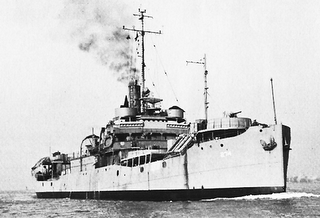
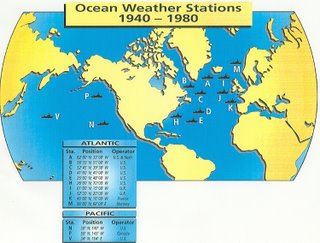
The advent of World War II brought about a dramatic increase in trans-Atlantic air navigation. Wartime radio blackouts ended what little weather information was available from ships at sea. The transoceanic airlines, chiefly Pan American, supported by the Weather Bureau strongly advocated weather reporting ships. In January of 1940 President Roosevelt directed the establishment of the "Atlantic Weather Observation Service" using Coast Guard cutters of the 327-ft "Secretary" class and U.S. Weather Bureau observers. Announcement of this service and descriptions of the ships were given to the belligerent nations. Most flights at this time were using southern routes and the stations selected were on the tracks from the U.S. to the Azores.

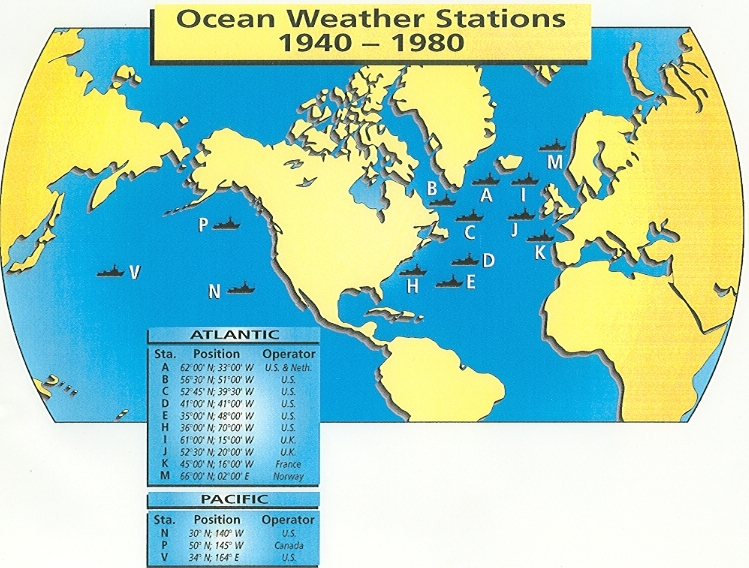
On February 10th 1940, the cutters Duane and Bibb occupied Ocean Stations 1 and 2 - the forerunners of Stations E and D (see chartlet). Additional Coast Guard cutters which rotated on 21-day patrols steaming within a 100 mile radius of the assigned station included the 327ís Hamilton and Spencer. The ships were under the operational control of the First Coast Guard District but orders actually came from Washington. In mid-1940 a third station was established northeast of Newfoundland (near later Station C) in order to support military aircraft flying to England. Cutters of the 250-ft Champlain class and 240's Mojave and Modoc were added for this duty.

The Coast Guard was placed under the Navy on November 1st 1941 and the weather ships became part of the Atlantic Fleet but operational control remained with the Boston Coast Guard (it was then termed "District Coast Guard Officer, First Naval District").

In 1942 Lend Lease supplies to Britain resulted in short range aircraft flying the northern route over Greenland and Iceland to the U.K. In support of these routes, the program was expanded to include northern stations shown as A and B on the chartlet. The Champlain class (10 ships as part of the "destroyers for bases" trade) had been transferred to the U.K. and ships to occupy the stations were drawn from the wartime Greenland Patrol under Commander Task Force 24 (now Rear Admiral Smith), and included the 165-ft cutters Comanche, Mohawk, Algonquin, and Tahoma, and the old icebreaker Northland.

With the U.S. entering the war, in 1942 the 327-ft Coast Guard cutters were withdrawn from weather patrol and diverted to anti-submarine duties. Replacements were five old World War I cargo ships, 247-ft, obsolete and scarcely able to make 9-10 knots speed. These ships lasted barely a year, and one, the Muskeget, was torpedoed while on Station I, about 400 miles south of the Grand Banks. Their replacements were an assortment of available vessels: buoy tenders (Evergreen, Conifer, and Sorrel), converted luxury yachts including the Sea Cloud and Nourmahal, and two ex-Navy "Q-boats": an old tanker, the USS Big Horn and an ancient freighter, the USS Asterion. Q-Boats were heavily armed vessels disguised as merchant ships to lure enemy submarines into combat. Reports by crew members of the Big Horn assert that the ship continued as a Q-boat even as a Coast Guard-manned weather ship. No information is available for the Asterion except that the heavy armament did remain on the vessel during the relatively short weather ship operation.

During 1943 and early 1944 North Atlantic stations were moved around to fit air routes in use. Some reached as high as 64 N.; first as "plane guard", then weather stations when trained weather observers were available . On April 1st 1944, the North Atlantic stations were reorganized into a coherent network of eight stations numbered 1-8 and under the control of Commander, Task Force 24 at U.S. Naval Station, Argentia, Newfoundland. British ships would man two additional stations in the Eastern Atlantic. Weather observers which up to now were Weather Bureau civilians were taken into the Coast Guard as Temporary Reserves mostly with Chief Aerographers Mate ratings. There were about 55 of these meteorologists; four had gone down with the Muskeget along with 117 Coast Guardsmen and a Public Health Service doctor. Stations now were designated as a square ten miles on a side. Assigned to man them was a new class, frigates.

Frigates, 303-ft ships designated PF by the Navy and built by the Maritime Commission to merchant ship specifications and design based on the British "River" class, were intended to be cheaply and quickly built escort vessels. However, they had temperamental reciprocating steam engines, and were slower and less maneuverable than their Destroyer Escort (DE) cousins. Seventy five of the 96 built in 1943-44 were manned by the Coast Guard, the remainder going to the Royal Navy. Although inferior to DE's as convoy escorts, they were among the most seakindly and comfortable ships in this size range, and the decision to assign them to weather patrol was a correct one. Nineteen frigates were assigned to the Atlantic weather patrol, and the first of these took up station in November 1944.

Early in 1945 the demand for more stations grew as they demonstrated their usefulness to the burgeoning trans-Atlantic air traffic. By May there were a total of 16 stations in the North Atlantic, 11 of which manned by USCG frigates, and nine in the tropical and South Atlantic manned by British and Brazilian ships (although one later defaulted to U.S. operation). A total of 26 frigates were now assigned. This was the peak number of stations and ships either before or since.

In the Pacific Ocean the role of weather during the Battle of Coral Sea and the increasing volume of trans-Pacific flights resulted in stations being set up in that ocean also. However, it was not until 1943 that the Navy established two stations, one north of Hawaii and another in the Gulf of Alaska (near Station P on the chartlet). The latter was manned by the 240-ft. Coast Guard Cutter Haida which continued to rotate on this station during the remainder of the war. This was followed shortly afterward by three plane guard stations on a line between Hawaii and San Francisco. As the Pacific war moved westward additional stations were set up under air routes and in areas of special meteorological interest. Throughout the war, stations were established and directed by Navy commands. Initially these were occupied by Navy patrol vessels and auxiliary craft but as Coast Guard manned frigates arrived in 1944 most were assigned to weather station duty. One, in the Gulf of Alaska, was manned by Canadian frigates. By the end of 1945 there were a total of 24 weather and plane guard stations in the Pacific stretching as far as Leyte where the CG frigate USS El Paso (PF-41) took station. Altogether, a total of 22 CG manned frigates were assigned to Pacific weather patrols.
A list of U.S. weather patrol ships can be found here.
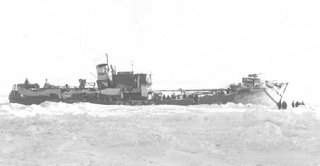
Among them are 5 "Wind" class Weather Patrol Ships, two of which, in their ice breaker mode, pulled off the amazing feat of being the only U.S. surface ships to capture an enemy surface vessel during the war. The tale of the capture of the Externsteine is very well set out here, with some very good photos.

When the war ended, the weather patrols did not:
Peacetime patrols included the six remaining 327-ft cutters (CGC Hamilton was lost in the war) and thirteen new 255-ft cutters built in 1945-46 to replace the ten 250-ft cutters transferred to the U.K. in 1941. (Of the latter, six were returned and two placed in service for a short time.) The new 255'­s were poorly regarded by the crews which sailed them, especially during early years. They were considered to be very uncomfortable sea boats with unreliable machinery. Modifications made over the years made them more tolerable. To replace the frigates which had been returned to the Navy in 1946, eighteen 311-ft. ex-seaplane tenders (AVP) were transferred from the Navy to the Coast Guard. These ships were spacious, comfortable and favorably regarded. They entered service from 1946-49. The U.K., France, Canada and Netherlands continued the use of frigates. In fact, the French and Dutch ships were ex-USCG frigates. Headquarters of the U.S. patrols were New York and San Francisco respectively; and in 1947 the system settled into peacetime routine. By 1948 all U.S. stations were manned continuously except Station H. That station was operated only from 1952-54 and again from 1971-76.

A typical weather patrol was 21 days on-station plus enroute time and about 10-days in port. Four or five U.S. Weather Bureau observers joined the Coast Guard crews during each voyage. A "station" was a 210-mile grid of 10-mile squares each with alphabet designations. The center square, which the ship usually occupied, was "OSî" (for "on-station"). A radio beacon transmitted the call sign of the station and the square in which the ship was located. Overflying aircraft would check in with the ship and receive its position, course and speed by radar tracking, and weather data. Surface weather observations were made and transmitted every three hours; and upper winds every six hours by radar tracked balloons with a known ascension rate. Using radiosonde transmitters and radar tracking, air temperature, humidity, pressure, wind direction and speed were obtained every twelve hours to elevations up to 50,000 ft.
During the Korean War, the effort was stepped up yet again with four additional "stations" being added:
Two were northeast of Hawaii and two were m the western Pacific. To meet this requirement twelve destroyer escorts (DE) were taken out of reserve fleets in 1951 and assigned to the Coast Guard. (Most had been Coast Guard manned during the war.) Although excellent wartime escorts, they were rough riding and not generally favored as ocean station vessels. Converted with balloon inflation shelters and weather offices, eleven were assigned to the pacific duty. All were returned to the Navy in 1954.


The Canadian effort is described here. Like the U.S. the Canadians carried on with the weather ships well into the 1980s, using a variety of platforms.

While the idea of "boring holes in the ocean" while on a 21-day patrol of a weather box doesn't seem all that exciting, the work was important. No more evidence of how important is needed than this tale of heroic sea rescue by U.S. Coast Guard cutter George M. Bibb
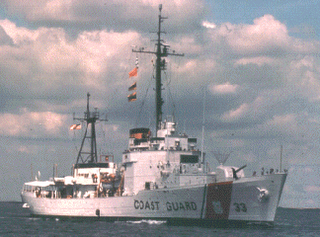
It was a combination ocean station patrol and search and rescue operation that brought Bibb and her crew international recognition when, while operating on Ocean Station Charlie on 14 October 1947, the transoceanic airliner Bermuda Sky Queen was forced to make a landing during a gale with high winds and in rough seas when the flying boat ran low on fuel.

The Bibb, under the command of CAPT Paul D. Cronk, had picked up an aircraft on radar heading west at 0232 (GCT) on 14 October 1947. It was the Boeing 314 flying boat Bermuda Sky Queen (NC-18612), on a trans-Atlantic flight from Foynes, Ireland to Gander, Newfoundland with 62 passengers and 7 crew on board. After flying beyond Bibb, the pilot of the flying boat, Captain Charles M. Martin, decided to return to the cutter to attempt an emergency landing because unexpectedly strong head winds had caused the aircraft to consume too much fuel for them to make landfall safely. After establishing communications with Bibb, Martin made a successful landing in the 30-foot seas at 1004 (GCT) near the cutter. After maneuvering close to the Bibb to secure a mooring line, the flying boat lost control and collided with the cutter's hull, damaging the nose of the aircraft as well as both wings and their attached floats.

With the waves cresting at 30 feet and the cutter rolling 30 to 35 degrees, getting the passengers and crew of the Bermuda Sky Queen aboard Bibb proved to be a tremendous challenge. Attempting various methods, including using a pulling boat and various rubber rafts from both the cutter and the flying boat, three passengers of the latter volunteered, only two hours before sunset, to attempt to make it to the cutter using one of the flying boat's small rafts. The Bibb laid down an oil slick downwind of the Bermuda Sky Queen prior to crossing her bow to create a lee for the three men. They then began paddling towards the cutter, but the seas were too great. As they cleared the flying boat, Bibb drifted as close a practicable and threw lines to the men, bringing them safely aboard. This method would prove impossible for the women and children on board, so the cutter launched her motor surfboat that towed a 15-man raft to the Queen.

Using that raft as a bridge between the flying boat and the motor surf boat, the Coast Guardsmen managed to save 28 persons in three trips and get them back to Bibb. On the fourth trip, the surfboat, taking on water after being battered against the hull of Bibb, began to sink. Fortunately Bibb was able to pull all 21 survivors and Coast Guardsmen on board the surfboat and in the raft to safety, leaving 22 on board the Queen. One more attempt was made with a pulling boat that night, but again the rough seas and darkness prevented their success and captains Cronk and Martin agreed to wait until the next morning to save the remaining passengers and crew.

The following morning the seas had abated somewhat and Cronk ordered a rescue attempt with his personal gig. After one successful trip, the gig's engine broke down and the Coast Guardsmen once again launched a pulling boat. The pulling boat successfully rescued the remaining passengers and crew and the captain's gig finally got its engine going again and both boats were then brought back aboard Bibb. Cronk and Martin agreed that it was impossible to tow the Queen to safety and Cronk then ordered her sunk as a hazard to navigation. Obtaining permission to leave the ocean station and return to Boston with all of the souls who had been on board the Queen, the cutter arrived to a hero's welcome. The rescue demonstrated the utility and importance of the ocean station program and historian Robert E. Johnson noted that "The Bermuda Sky Queen incident must rank with the Coast Guard's outstanding rescue feats."
More here, including a letter from a survivor of the Bermuda Queen.

Of course, there is no way of knowing how many lives were saved by the weather information passed on by the Ocean Weather Ships. What we do know is that many brave men went to sea to provide that information and deserve a salute for their efforts.

Pirates off Guyana


Reported here:
Eighteen fishermen from the Corentyne and East Coast Demerara were terrorized and robbed in four separate boats by pirates near the Corentyne River on Thursday.

The first robbery took place just off the shore at Number 43 Village and owner/captain of the boat, William Busgith, 51, recounted the horror to this newspaper. He was robbed of his 40-ft boat valued $600,000, one 40 HP Yamaha engine worth $750,000, a 250-pound nylon seine valued $250,000, a quantity of gasoline, foodstuff, a stove and three wristwatches.

Fishermen from three other boats were also robbed of the same items and the bandits also carted off clothing and cell phones from the East Coast fishers.

Busgith said he and two workers were heading out to sea around 8:30 am when four masked gunmen abandoned their boat and jumped into his boat and fired several shots in the air.

He said he and the two workers ran into the cabin in an attempt to hide but the bandits followed them and beat them with a hammer they found in his boat. They then tied their hands and feet and also wrapped their heads in three canvas bags. They continued their attack on other fishermen using Busgith's boat.

He said the bandits robbed two other boats in the vicinity of Bush Lot and Albion and ordered the occupants into his craft. They then proceeded to the mouth of the Berbice River where the last boat, belonging to fishermen from the East Coast, was robbed around 7 pm.

The pirates dumped all of the fishermen into the East Coast boat, untied them and escaped in Busgith's boat. He could not say in which direction they headed since the place was already dark.
The exchange rate of US $ to Guyana dollar is about 1 to 190. Thus, the Yamaha engine is worth about $3950 US dollars.

Friday, January 05, 2007

Don't confuse the Jihadis in Iraq with the real al Qaeda threat


Or so says George H. Wittman in The American Spectator here:
For example, the argument has been put forward that the conflict in Iraq involves terrorists who otherwise would be concentrating on targets in the United States and Western Europe. There is no operational basis for this theory. To proceed effectively on a covert mission aimed at destruction of high value targets in advanced societies requires a totally different degree of sophistication and talent from the paramilitary capability of the various insurgent elements in Iraq.
The primarily Sunni Al Qaeda has the operational interest and assets that directly threaten Western society. Among these committed terrorists, those fighting in Iraq do not generally qualify for Al Qaeda's international operations in the U.S. or Europe. The "street fighters" of that organization are in Iraq, not their sophisticated covert operators.

To put it simply, the agents of Al Qaeda capable of attacking European or American targets must be able to "pass" in those communities. They must have both the vocational and language skills that allow them a certain legitimacy within these foreign societies. While this is not necessarily a small pool of candidates, it is not large, and it does tend to restrict potential recruits to a particular socio-economic sector of the Islamic world.
In a war, there are many level at which at an enemy can, and will, operate. They have to be countered at each level. A failure on the ground in Iraq or Somalia by loosely linked al Qaeda forces does not impact al Qaeda's threat to the West by its covert agents, but even "street fighting" failures can divert attention if we are not reminded to keep our focus.

UPDATE: Excellent quote from an article "Somalia on the verge of War"
By Atle Mesoy, Senior Analyst, at Protocol:
When the expression global jihadist movement is used here, it refers to the remains of al Qaeda and international “al Qaeda-style” groups, which are part of an international network and movement. These groups and individuals base their world view on an understanding where there is an on-going war against Islam by the all the non-Muslim countries, specially the West. Their goal is to attack the enemy using all means, creating Islamic states, and finally re-establishing the Caliphate.
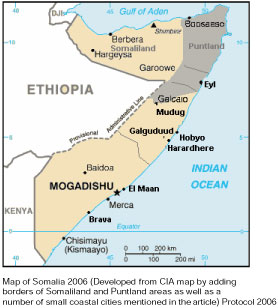
The article was written before the recent action against the UIC but anticipates the fight, if not the outcome. It's a free pdf available here. Protocol has been kind enough to allow me access to some of their previous work (see here), including the map of Somalia used in this post.

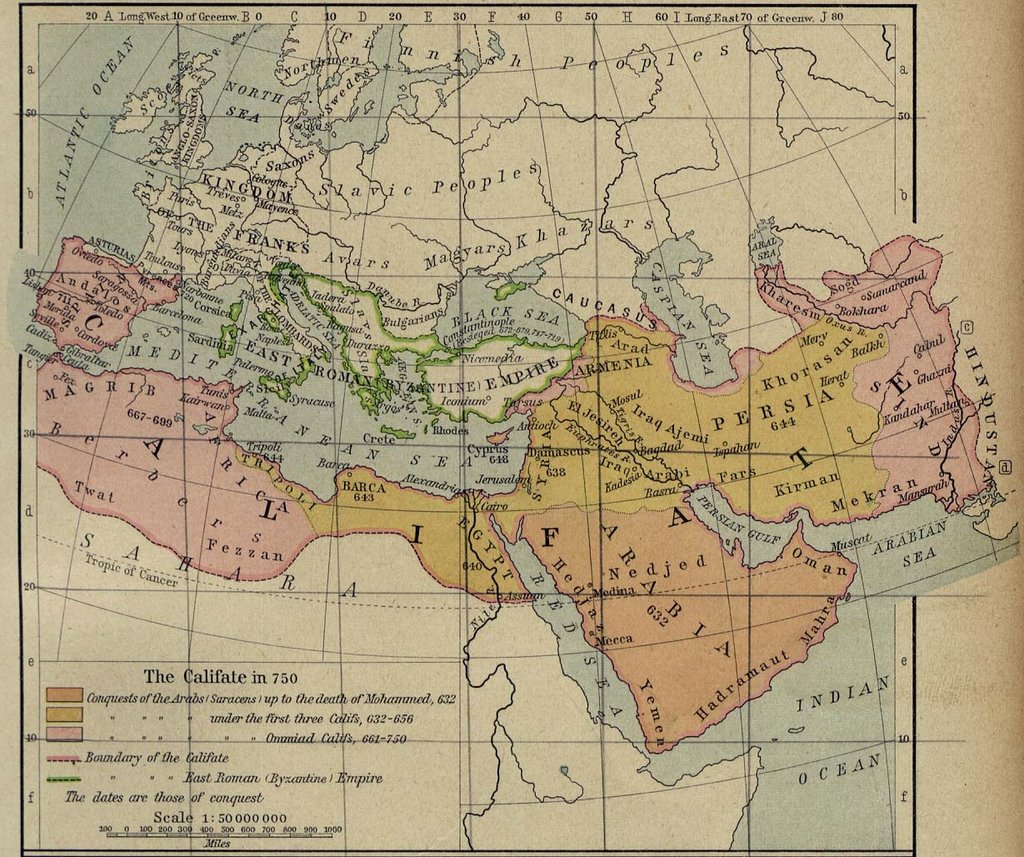
Caliphate? In case you forget, the jihadis want what they claim was once theirs, as seen in the map below showing the Caliphate as it was in 750AD:


Of course, if we are going to claim lands on the basis of what was once held, the Italians might want to stake out a claim to the Roman Empire at its peak:


The Italians seem unwilling to use suicide bombings and terrorism to assert their "ownership."

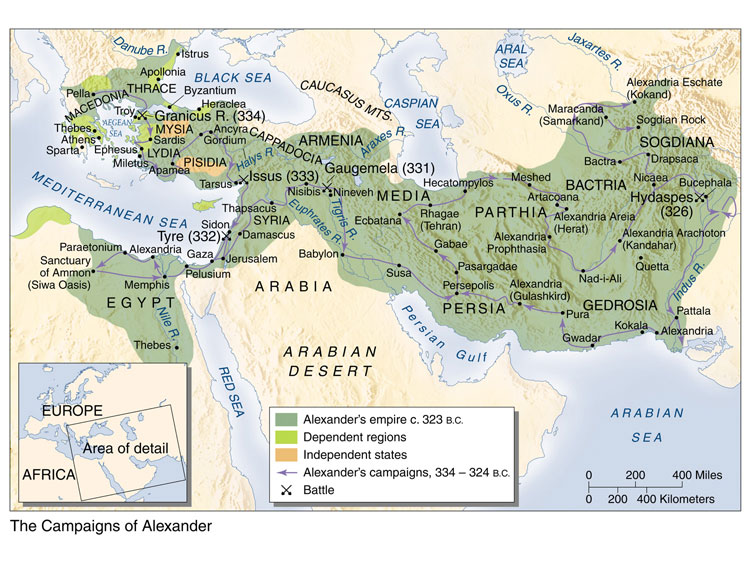
Maybe the Greeks will make an effort based on Alexander's Empire:


Clicking on the images makes them bigger.

CTF 150 0ff Somalia


More on the task force offshore Somalia here:
Spokeswoman Lt. Denise Garcia said that ships of Combined Task Force 150 are "continuing to monitor evolving events in Somalia," adding Thursday, "Recent events in Somalia are a cause of concern because of the potential for an increased risk of piracy and illegal activities that historically [have] followed the instability in that country."

Task force ships include the Norfolk, Va.-based destroyer Ramage, the San Diego-based cruiser Bunker Hill and other coalition ships, Garcia said. She said the ships remain outside the internationally recognized territorial standard of 12 nautical miles from shore, or 13.8 statute miles, and are operating throughout the Horn of Africa region.
Ramage is named after Medal of Honor awardee VADM Ramage as set out here.

Thursday, January 04, 2007

Navy tries to block fleeing jihadists from Somalia


Reported here:
U.S. Navy and coalition ships are deployed off the coast of Somalia to make sure al-Qaida and allied jihadists are not able to escape the country by sea now that the once-dominant Islamist forces in Somalia are in retreat from Ethiopian forces, the State Department said Wednesday.

Of particular concern, the Associated Press reported, is the fate of three al-Qaida militants who were believed by U.S. officials to be under the protection of the Islamic Courts Union in Khartoum until Ethiopian forces drove the Courts from power in recent days.

The militants are believed to have had a role in the 1998 bombings of U.S. embassies in Kenya and Tanzania, and in the 2002 bombing of a hotel in Kenya. Kenya sent extra troops to its border with Somalia on Wednesday to keep Islamic militants from entering the country.
Lex says Get some.

I concur.

Wednesday, January 03, 2007

Best New Year's Gift: 50 Greatest Cartoons

With salute to Chap who linked to 50 Greatest Cartoons which, in turn has links to the videos.

Whoo hoo!

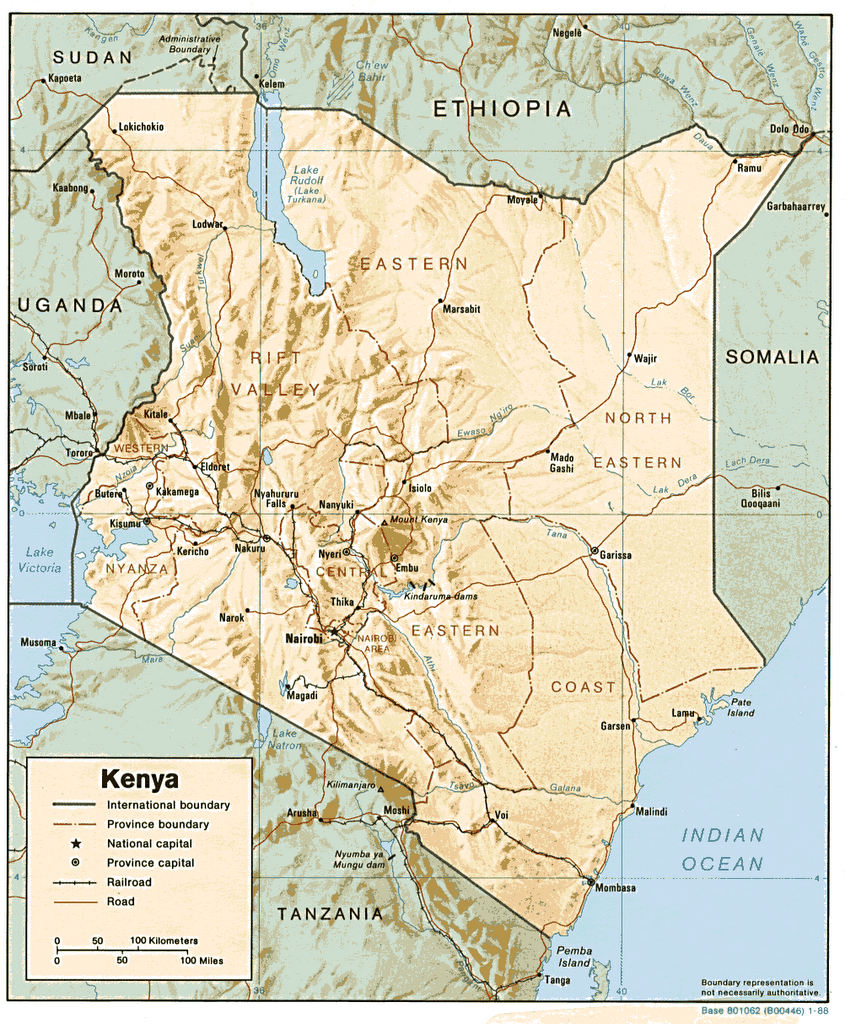
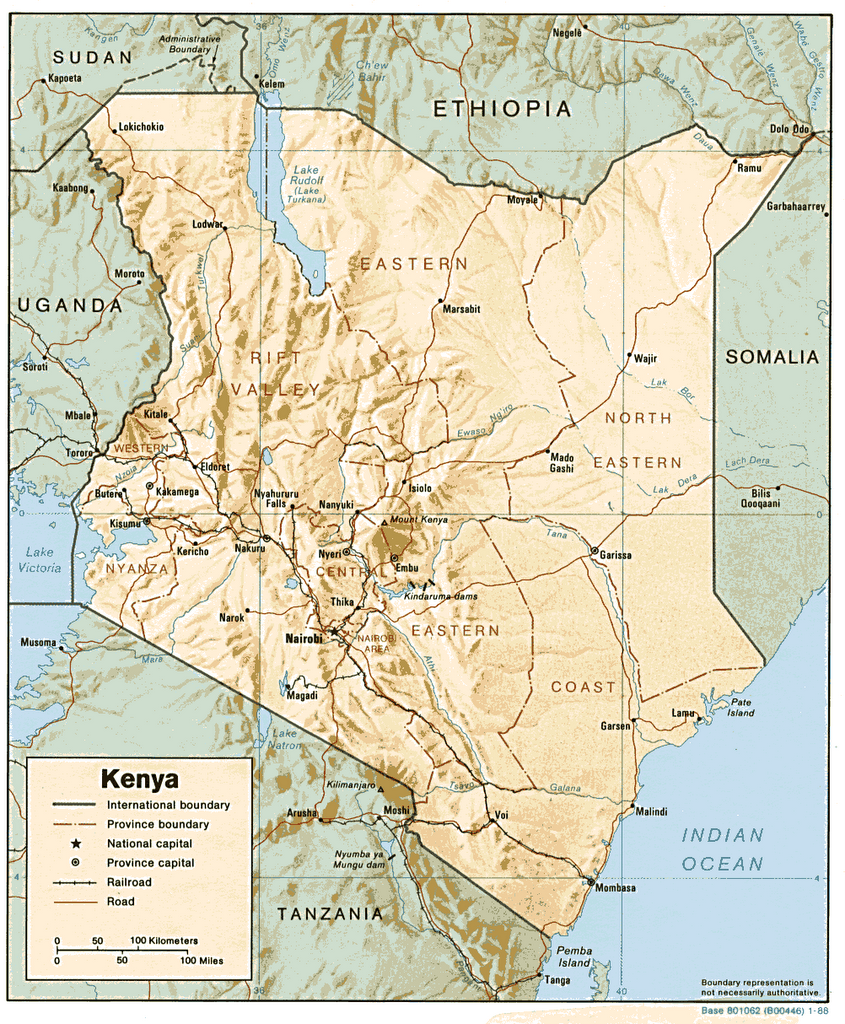
Kenyan troops guarding border with Somalia


Kenya is boosting its border forces on the Somalia border as reported here:
Kenya sent extra troops to its border with Somalia on Wednesday to keep Islamic militants from entering the country after Ethiopian helicopters attacked a Kenyan border post by mistake while pursuing suspected fighters.
***
Kenya has deployed troops, armored vehicles and trucks with light weapons along the 400-mile border with Somalia. A U.S. counterterrorism task force has trained new coast guards and recently gave Kenya three patrol boats.

The U.N.'s humanitarian agency said about 4,000 Somali refugees were reported to be in the Dhobley area, unable to cross into Kenya. The agency gave no further details, but noted fears of newly laid land mines in southern Somalia following the latest fighting.

In nearby Liboi, UNHCR said it was trying to check reports Kenya had held 350-400 Somalis at the border since Dec. 27. "We can't confirm it because we have been denied access to the reception center by Kenyan security personnel," spokeswoman Millicent Mutuli told The Associated Press.

Kenyan government spokesman Alfred Mutua denied that security personnel had blocked U.N. refugee agency staff from getting to Liboi, but said border officials had instituted "rigorous security vetting" to ensure no fighters slipped in among the refugees. Only those that cleared the security check would be handed over to U.N. refugee officials, he said.

Somalia's government and its Ethiopian allies have long accused Islamic militias of harboring al-Qaida, and foreign Islamic radicals - including Pakistanis, Arabs and Chechens - are believed to have come to Somalia to fight on behalf of the Islamic movement in recent months.

Three suspects wanted by the United States in the 1998 bombings of U.S. embassies in East Africa are believed to be leaders of the Somali Islamic movement. (emphasis added)

Islamic movement leaders deny having any links to al-Qaida.
Well, of course they would.

Tuesday, January 02, 2007

NYT observes Coast Guard Maritime Domain Awareness growing pains

Despite its "glass is half full" headline, Security Effort by Coast Guard Is Falling Short, the NY Times is actually simply observing the growing pains of a new system:
A Coast Guard plan to combat terrorism by creating the maritime equivalent of an air traffic control system in the coastal waters here, a test for a nationwide effort, has fallen far short of expectations.
Apparently maritime security is one of those off-the-rack type things that works immediately once the wheels are set in motion - sort of like a large metropolitan newspaper, I guess. You know- plug it in and it runs by itself.

The Times, of course, fails to provide the metric of what what there "before" the current effort. That is to say, they don't like to report that there wasn't really anything there before the new and struggling system.

Comparisons to the federal aviation "unified command over the nation's skies" ignore the fact that that "unified" effort took about 100 years to get installed and still is far from a solid shield of defence.

Turf wars have hampered some efforts, and the ways Congress doles out money for "favored" ports and pork projects hurts, too.

And at least the Coasties have the right idea:
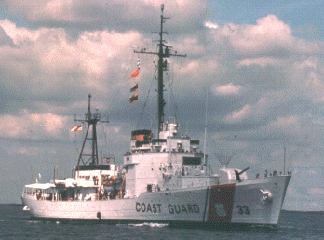
Lt. Justin W. Noggle, chief of the Miami sector command center, said he recognized that many of the antiterror tools the Coast Guard had installed were falling far short of their goals. But it still is progress, Lieutenant Noggle said.

“We are just in the infancy of this effort here,” he said. “But if you don’t start somewhere, you don’t get anywhere.”

Kenya blocking UIC from Somalia


Reported here:
Kenyan security forces arrested eight suspected members of the routed Somalia’s militant Islamic Courts Union.

The fleeing fighters crossed the border at Liboi in Garissa District on Sunday. The eight were seized as reports indicated that heavily armed bands of militia were in full flight headed for Kenya.

Kenyan forces at the same time threw tight security cordons along the border in North Eastern and Coast provinces to bar the fleeing militia from entering the country.
Meanwhile the UIC is being forced fromtheir "final" refuge...as set out here:
The Islamist forces in Somalia abandoned their final stronghold Monday morning, fleeing the port city of Kismayo much like they had fled Mogadishu, the capital, last week.

In the face of an intense artillery barrage by Ethiopian-backed forces and thousands of well-equipped troops heading their way, the Islamists scattered, with some of their militia shedding their uniforms and melting back into the population while others headed south towards a thickly forested area along the Kenya border.

"I can't tell you how happy people were that they disappeared," Adam Ragay, a businessman in Kismayo, said today.

As soon as the Islamists left, looters rushed into the streets and smashed up stores and ran away with TVs and mobile phones. But by mid-afternoon, the brief burst of anarchy was over and transitional government troops had arrived on the outskirts of town.

"I can confirm to you that our forces have captured Kismayo," Somalia's transitional prime minister, Ali Mohamed Gedi, told The Associated Press today.
I suspect that the new features of Somalia will include a very active guerrilla war.

Mozambique gets U.S. boats for maritime patrols


Three vessels being sent to Mozambique, as reported here:
The United States of America have donated three ships to Mozambique in order to boost the country’s capacity for inspection of its waters, following an increase in illegal fishing, an officer of the Mozambican navy said Friday in Maputo.

Commander of the Mozambican Navy, Patrício Jotamo, said that the three ships would operate from the naval sub-bases of Tete (center), Metangula (north) and Nampula (north).

“This important donation will contribute to fighting the pillage of our resources, which is occurring in Mozambique’s waters,” Jotamo said.

Jotamo noted that the Bazaruto archipelago was one of the points of the country in which the actions of “pirate fleets” was most intense.