VertRep

VertRep

Friday, February 17, 2006

Navy future?

Interesting piece on how to get more bang for the buck here by Jane Dalton. At least part of the changes will see more employment of civilian mariners:
The U.S. Navy currently maintains a force of approximately 550,000 full-time employees, about 35 percent of whom are civilians. At any given time, 130-plus of the Navy’s 283 ships are under way, about 45 percent of the total ship inventory. In 2004 the Chief of Naval Operations (CNO), then Admiral Vern Clark, directed the Navy to maximize capabilities, minimize payroll, improve productivity, and eliminate unnecessary billets. One way to meet those goals is to remove sailors from billets that have little to do with war fighting and replace them with civilians. At sea, for instance, sailors cut hair, serve meals, maintain the engineering plant, chip paint—all tasks that civilians are equally capable of performing, and in fact do perform at commands ashore. Placing civilians on warships to perform those functions is a logical extension of the CNO’s guidance and would free sailors for combat-related activities.

Accordingly, one of the Navy’s answers to the CNO’s challenge is an experimental program to place federal civil-service mariners on board warships. These mariners perform tasks naval personnel have traditionally performed on board warships but that civilians have performed on board naval auxiliary vessels for decades and on board merchant vessels for centuries—navigation, engineering, and deck seamanship. For example, in early 2005 USS Mount Whitney (LCC/JCC 20) deployed to the European theater as the new U.S. Sixth Fleet and North Atlantic Treaty Organization (NATO) command ship. One of the most sophisticated command, control, communications, computer, and intelligence (C4I) ships ever commissioned, Mount Whitney today is manned by a composite crew of 157 U.S. Navy sailors and 143 civilian mariners employed by the Military Sealift Command. These three hundred personnel represent a reduction of 276 from the previous all-active-duty Navy crew. “By supplementing the crew with civilian mariners,” the Sixth Fleet Public Affairs Office reports, “the Navy is operating the command ship at a reduced cost and employing captured uniformed personnel billets on forward combatant vessels.”

...Of particular interest for this discussion is the role of the MPF-F cargo ship. The MPF-F is designed as the replacement for today’s logistics-force cargo ships and would act as a floating logistics center. One report notes that it would be “nearly as large as an aircraft carrier” and would “accommodate heavy-lift helicopters and perhaps cargo planes as large as the Air Force’s C-130. It would be able to move supplies and equipment to those aircraft and other ships while at sea.”8 Another report, however, depicts a role directly involved in combat operations. It refers to the MPF-F as a replacement for the big-deck Tarawa-class amphibious assault ships, describing it as a “fighting logistics ship with a flight deck big enough to send hundreds of Marines ashore in rotorcraft and launch Joint Strike Fighters.”9

Civilians who assist in operating and maintaining a warship engaged in international armed conflict might be viewed as having lost their protected status.

If the MPF-F is manned as prepositioning ships are today, its crew will consist entirely of civilian mariners. There is no legal prohibition against manning naval auxiliaries, such as oilers, ammunition ships, supply ships, and prepositioning ships, with civilians. In fact, these seamen have a recognized status under the Geneva Conventions as “civilians accompanying the force” and are entitled to prisoner-of-war status if captured.10 Issues arise, however, if the MPF-F is indeed to become part of the “assault echelon”—if Marines or soldiers actually launch from the ship into combat operations ashore. Similar issues will arise if USS Mount Whitney, with its hybrid crew, is employed as a C4I platform in an armed conflict.(footnotes omitted)
There's a lot more, go read.

(Hat tip: NOSI)

US Navy officer testifies in Kenya against captured Somali pirates

Reported here:
A Navy officer testified in a Kenyan court Friday against 10 Somali men accused of piracy, saying U.S. sailors detained the suspects after firing warning shots that forced their vessel to stop.
Lt. Lucas Michael Grant told the court that the sailors, who are part of an anti-terrorism task force based in Djibouti, detained the 10 Somalis on Jan. 22 in an operation involving U.S. military helicopters and a warship that fired several warning shots.

Grant said the U.S. troops, who were responding to a hijacking report from the International Maritime Bureau in Kuala Lumpur, tracked down an Indian-based vessel that the suspected pirates had taken over and were using to attack other ships.

Rebel leader: "Total War" against oil interests in Nigeria


Reported here:
Nigerian militant commander in the oil-rich southern Niger Delta has told the BBC his group is declaring "total war" on all foreign oil interests.
The Movement for the Emancipation of the Niger Delta has given oil companies and their employees until midnight on Friday night to leave the region.

It recently blew up two oil pipelines, held four foreign oil workers hostage and sabotaged two major oilfields.

The group wants greater control of the oil wealth produced on their land.

Nigeria is Africa's leading oil exporter and the fifth-biggest source of US oil imports, but despite its oil wealth, many Nigerians live in abject poverty.

It is the first time the military leader of the Mend movement, Major-General Godswill Tamuno, has spoken publicly of his group's aims.

He refused to be interviewed on tape or for his location to be disclosed.

He told the BBC's Abdullahi Kaura Abubakar that they had launched their campaign, called "dark February", to ensure that all foreign oil interests left.
As has been noted here before, the US is highly dependent on Nigerian oil...

See this for import figures from all countries to the US.

Thursday, February 16, 2006

Greenpeace ship is locked down


As Nelson from the Simpsons would say -"Ha Ha!" because the law seems to be catching up with Greenpeace's anti-whaling pirates as reported here:
The chained Farley Mowat floats under police guard in Cape Town harbor, out of reach of the whaling ships its captain seeks to destroy.

For seven weeks, the crew of the tiny activist ship harassed Japanese whalers in Antarctic waters, chasing the hunters through thousands of kilometers of icy seas.

Now, the Canadian-registered ship has been forced to rest.

Last month, it was detained on arrival in South Africa by marine officials who say it does not meet safety requirements.
Let's see... people who admit they break the law for a "higher calling" complain of a "conspiracy" against them when the law is (partially) enforced against them. Must be some word that covers that situation...

Latest ICC Commercial Crime Services Weekly Piracy Report (to 13 Feb 06)

Latest ICC Commercial Crime Services Weekly Piracy Report here. Highlights:
08.02.2006 at 0450 UTC in position 15:21.7N - 052:34.1E, Gulf of Aden. Several high speedboats approached a RO RO ferry underway at forward and stern. Boats came within 400m at stern. Several persons in each boat had what appeared to be weapons. Master increased speed and after 10 mins boats sped off in a southerly direction.

07.02.2006 at 0120 LT in position 01:15N - 104:07E, Singapore straits.
An unlit speedboat approached a chemical tanker underway at port bow. Master altered course and took evasive manoeuvres. However another speedboat with three persons came close to stern and tried to board. Crew took anti piracy measures and boarding was averted. It seems the boat at port bow was meant to create a diversion.

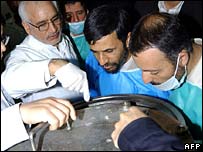
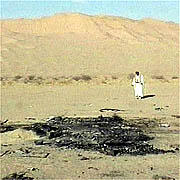
I can see the future - Iran's leadership before and after photos

Even the French have developed a prickly attitude toward the lying leadership of the Iranian government as evidenced here:
France has for the first time explicitly accused Iran of using its nuclear programme as a cover for clandestine military nuclear activity.
Foreign Minister Philippe Douste-Blazy told French TV no civilian programme could explain Iran's activity.
The present Whack Jobs in Charge (WJIC) of the Iranian dictatorship pose in photos like this:


However, if they continue on the present path, I see the future holding more WJIC posing for pictures like this:

Tuesday, February 14, 2006

Pirates of Strait of Malacca leading to sea lane control race?

Might be, it says here:
Nevertheless, the race to secure the straits has highlighted a potentially more destructive threat on Asia's sea- lanes as a result of growing competition for naval supremacy in the region.

This inter-state naval posturing has been fueled by the importance of the waters for international trade, as well as the presence of a series of long- standing maritime territorial disputes and reports of oil and gas deposits in the disputed waters of the region.

Furthermore, while these territorial disputes are over tangible resources, many of them are rooted in intangible issues of national identity.
Can't we all just get along?

Speaking of terrorism from the sea...

Interesting Denver Post article with this spicy lead:
A federal agent working with port authorities in South Asia sounded the warning: A cargo container had tripped sensors that detect possible chemical, biological and nuclear weapons. The container was gliding west through the Mediterranean Sea on a ship bound for New York.

Here, at the military's homeland defense headquarters in Colorado Springs, surveillance crews melded that tip with radar and satellite data. Surrounded by wall-sized screens, the high-tech trackers located the ship and followed it across the Atlantic Ocean.

About 200 miles off the East Coast, Coast Guard forces intercepted and boarded the freighter and searched the cargo containers until they knew all of them were safe.

Military officials wouldn't say more about this classified incident that occurred in November, but the way it was handled begins to reveal how secretive military forces in Colorado - the center for airspace surveillance through the Cold War - increasingly target the high seas to reduce what commanders see as a major vulnerability.
I would hope so.

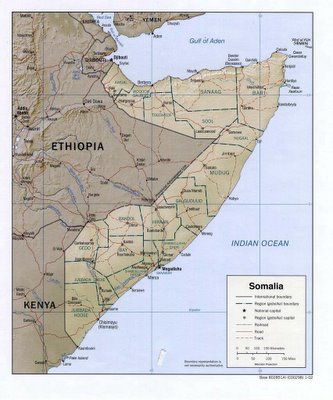
Somali pirates are mean and they lie, too.

Probably not a news flash, but Somali pirates beat Indian crew of ship.

And more on pirates here:
Security forces in central Somalia have apprehended a suspect in the hijacking of a humanitarian aid vessel at the town of Merka town four months ago.
The man is alleged to be one of three people who hijacked a vessel chartered by the World Food Programme.
I wonder if it's "torture" to allow this guy to starve to death, as his actions did to numerous Somalis who failed to receive their food aid because of him.

And:
Meanwhile, the trial of 10 alleged pirates arrested by the US navy has begun in the Kenyan port of Mombasa.

The trial in Mombasa follows last week's ruling that the court can hear the case, even though the alleged offences took place on the high seas.

The men have denied the charges and said they did not know why they had been "abducted" from their fishing boat.

But Indian sailors taken hostage by pirates have identified the men.
They just don't sound honest to me...

More on the rescue of another pirate attacked ship here:
he U.S. Navy rescued a 3,000-tonne cargo ship attacked by pirates off the coast of lawless Somalia, the vessel's captain said late on Monday.

In a spate of attacks along the unpatrolled waters off Somalia, gunmen stormed the United Arab Emirates-owned Al Manara last month, captain Deaa Naseh said.

U.S. sailors arrested and left two suspected pirates locked up aboard the ship, Naseh said, adding that it was unclear what action would be taken against them.

After the rescue mission, the ship suffered engine failure and drifted for 15 days before being towed at Naseh's request by the Seychelles coastguard into the port of Victoria on Saturday.

"The attackers kept boarding and leaving the vessel at will going and coming back by smaller boats, but when the U.S. Navy personnel were about to board, the gunmen threw away their weapons into the sea," Naseh told Reuters.

Looking tired and weak, he said he used makeshift sails to reach the Indian Ocean island.

Anti-RPG weapon and more cool weapon news

Someone let let the genius loose: Mr. Completely: Raytheon's Quick Kill System for RPG's. Way cool!

Hat tip: Castle Argghhh!

UPDATE: While you are at it, here's something the bubbleheads will like:
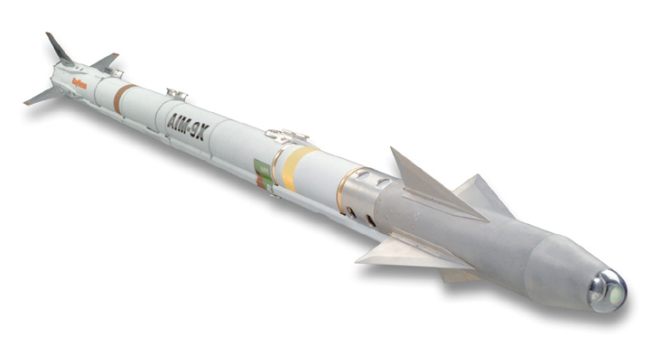
Mark Russell, vice president of Raytheon IDS engineering, said that the recent test launch also represents a significant step toward enabling the submarine force to strike targets with surprise from shallower coastal waters. Now, in addition to MK-48 torpedo and the Tomahawk cruise missile, submarine forces will have the option of another weapon system making them a more versatile player in the integrated battlespace. "Successfully demonstrating the AIM-9X lock-on-after-launch mode from a vertical orientation launch is a major step toward providing our submariners
with an unprecedented offensive and defensive capability," said Brock McCaman, vice president of Raytheon Missile Systems Air-to-Air Product Line. "It's another example of the tactical flexibility of this proven weapon system."
"This test is the first step toward an AIM-9X missile being launched vertically from a submarine," said John Cochran, the Raytheon IDS program manager. "Ultimately, the missile will be encased in a launch capsule. When the capsule broaches the surface, the missile will launch and then acquire and engage its target."
More on the AIM-9X here and here. A new wrinkle in anti-air warfare for subs.

Vertrep fun


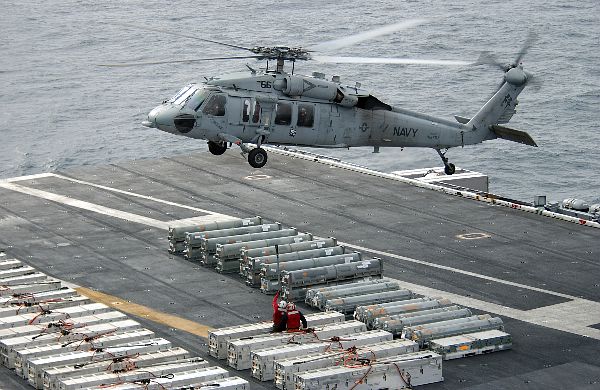
A MH-60S Seahawk assigned to the “Black Jacks” of Helicopter Combat Support Squadron Two One (HSC-21), transports ammunition from the nuclear-powered aircraft carrier USS Nimitz (CVN 68) to the Military Sealift Command (MSC) fast combat support ship USNS Bridge (T-AOE 10). Nimitz is currently preparing for a major propulsion plant examination off the coast of Southern California. U.S. Navy photo by Photographer's Mate Airman Melissa Vanderwyst
Moving munitions at sea. Whoohah!

Taking OBL seriously


Refreshing reminder that some people in the right places are capable of assuming that when Osama bin Laden says he wants to reestablish the "caliphate" he ought to be taken a face value here:
The recently released Quadrennial Defense Review, which reveals long-term military planning, shows a top brass worried about the ideology of hate preached by imams across the Islamic world. This ideology, though twisted, is somewhat coherent and calls for using terrorism to create a "caliphate," a unified Islamic state, stretching from Afghanistan and Iran all the way to Spain and including most of North Africa. For a lack of a better term, some American military planners call this ideology "bin Ladenism."

Gen. Douglas Lute, director of operations for U.S. Central Command (which oversees U.S. forces in the Middle East), dropped by the offices of The Wall Street Journal recently. He noted that bin Ladenism has deep roots in many Islamic countries and that bin Laden isn't the only terrorist leader trying to appeal to populations oppressed by dictators. There are some 18 terrorist organizations that are part of what the military calls al Qaeda and Affiliated Movement. The military, he said, even has an acronym for it: AQAM.

To counter bin Ladenism, the military is planning a two-stage war. The first is being fought in open battles in Afghanistan, Iraq and elsewhere and looks a lot like the kind of war most Americans assumed we'd wage on al Qaeda and terror-sponsoring states after the Sept. 11 attacks. The second stage is what senior military planners--including Mr. Rumsfeld--call "the Long War." It involves countering one set of ideas with another.
It occcurs to me, as I am re-re-reading Eric Hoffer's The True Believer, that OBL has the vision thing working for him- the "caliphate" will not build up the individual downtrodden Islamisist, but will create the world of "equality" among the masses that Hoffer writes of as being an aspiration of those masses (their motto might be:"If I can't be great, let me be part of a movement to bring others down to my level"- though, of course couched in much more inspiring terms ("Death to the Great Satan" "Death to America" - or "Restore the Capliphate and be part of something great you otherwise pitiful loser"). As Hoffer put it:
Passionate hatred can give meaning and purpose to an empty life. Thus people haunted by the purposelessness of their lives try to find a new content not only by dedicating themselves to a holy cause but also by nursing a fanatical grievance. A mass movement offers them unlimited opportunities for both.
Section 75, The True Believer


If the Pentagon plans are to improve the lot of the masses and help them become part of the Thomas Barnett "functioning core", then full speed ahead, I say. It may be the only way to cut OBL's legs out from under him.

UPDATE: Of course. this is not helping. It simply feeds the notion of the fanatics that they are being held down. Thanks, Crazy Uncle Al.

UPDATE2: CDR Salamander is tracking down the same path, I think, here.

Monday, February 13, 2006

Iraqi's protect their oil terminals


Reported here:
The Iraqi navy consists of two squadrons — a patrol boat squadron and an assault boat squadron. It also includes one marine battalion, which serves both squadrons.

The patrol boat squadron uses Predator class patrol boats to conduct 24-hour security operations and sector patrols around the oil terminals and in Iraqi territorial waters.

The assault boat squadron has 24 fast assault boats that routinely patrol the inland waters and approaches of the Kwar Abd Allah up to the port of Umm Qasr which is Iraq’s largest and only deep water port.

According to Price, both have seen tactical successes in combating smuggling and piracy as well as conducting a couple of successful rescues at sea for injured mariners.

“Incidents of piracy have continuously declined since the Iraqi Navy began 24/7 presence operations in the [Kwar Abd Allah] and their territorial waters,” Price said.

“Last July, merchant ships were afraid to come into our port due to pirating, but that is no longer the case because our squadrons have been successfully patrolling the port,” Iraqi Navy Commodore Adel said.
Info on the "Predator" patrol boats here.

Saturday, February 11, 2006

A nice bit of praise for the US anti-Somali piracy action


Noted here:
It is now official. Pirates, like terrorists, can run but they cannot hide. Not only along the coast of Somalia, which is currently the world's most dangerous waters for pirate activities, but also along areas in Southeast Asia such as the Straits of Malacca that are traditional havens for pirates.

The United States does not anymore see the difference between pirates and terrorists, and with good reason. A study carried out by the Piracy Reporting Centre says that freighters carrying payloads of fuel could be hijacked and used in terror operations similar to the 11 September attacks on America. There is real fear that terrorists could, for example, use a ship transporting liquefied natural gas as a weapon.

In any case, action by the US Navy will benefit Kenya because of the dangers posed by pirates to the country's tourism and maritime trade. The shores off the East African coast are important sea-lanes for cargo ships and luxury cruise liners. And many of the cargo ships are oil supertankers and attacks on them could trigger environmental disasters through crude oil spillage.

The modus operandi of the pirates makes such possibilities real. Pirates in Somali waters attack with heavy firearms everything that floats, from fishing vessels and yachts to bulk carriers, general cargo ships and tankers. Their aim is to steal valuables from the ship, or hold the crew for ransom. IMB says it has received reports of Somali pirates armed with automatic weapons and rocket propelled grenades, firing indiscriminately in attempts to force such vessels to stop.

"The lack of any stable or coherent government in Somalia is contributing to this lawlessness in its waters. Local warlords are interested in making money above all else, and hijacking commercial vessels has proven to be an expedient method of doing so," notes Captain Pottengal Mukundan, director of IMB.

The good news is that all pirates are international outlaws triable by any and every state. Any state may seize a pirate ship or aircraft, arrest the persons, seize the property on board and try the persons or hand them over to another state.
Not only Kenya benefits, but so do those other African states dependent on the port of Mombassa (see here).

Friday, February 10, 2006

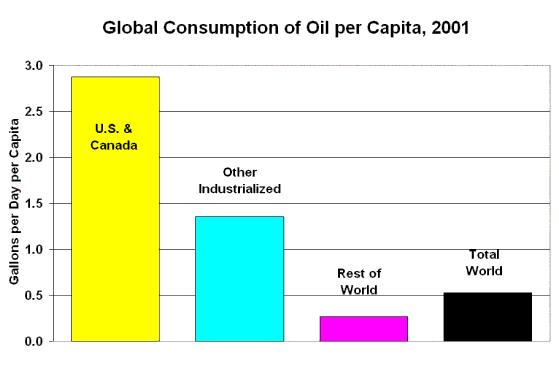
Oil consumption

Examine this chart provided by the fine folks at Chart of the Day (chartoftheday.com).

Certainly, the US uses lots of oil. Throwing in Germany (population 82,431,390) without including the rest of Europe is a little odd. For comparison, Japan has 120.000.000 people, the US over 300,000,000 and China has 1.3 billion. Europe has a population of around 710,000,000 (EU alone is 456,953,258).

Now, let's have a chart that shows oil consumptiono on a per capita basis. The US may still lead, but I bet that there are lots of others in the running...

UPDATE: Found a chart of oil consumption per capita here. US is 17th (behind 16 small, mostly island places) with .677 barrels per day. Canada is 19th at .668. Germany is 53rd at .325.

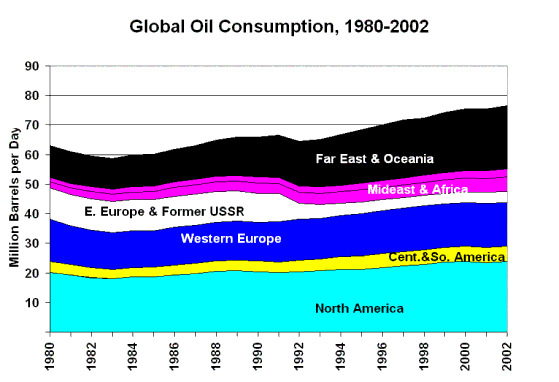
On the other hand, the US is the world's 3rd largest oil producer, according to this. Germany is 47th, in case you were wondering. But then there are the following charts from here and here:

An explanation here:
The industrialized countries are the largest consumers of oil but until 1998 had not been the most important growth markets for some years. The countries of the Organization for Economic Cooperation and Development (OECD), for instance, account for almost 2/3 of worldwide daily oil consumption. In contrast, however, oil demand in the OECD grew by some 11 percent over the 1991-97 period, while demand outside the OECD (excluding the Former Soviet Union) grew by 35 percent. The Former Soviet Union presents a special case. The collapse of the Russian economy that accompanied the collapse of Communism led to a decline in oil consumption of more than 50 percent over the 1991-98 period.

The developed economies use oil much more intensively than the developing economies, and Canada and the United States stand almost alone in their consumption of oil per capita (see graph). For instance, oil consumption in the United States and Canada equals almost 3 gallons per day per capita. (The difference is these countries' transportation sectors, with their dependence on private vehicles to travel relatively long distances.) Oil consumption in the rest of the OECD equals 1.4 gallons per day per capita. Outside of the OECD, oil consumption equals 0.2 gallons per day per capita.

Regionally, the largest consuming area remains North America (dominated by the United States), followed by Asia (with Japan the largest consumer), Europe (where consumption is more evenly spread among the nations), and then the other regions. As the regional graphs illustrate, Asia was the region with the fastest demand growth until the 1998 economic crisis in East Asia. The region's economic upheaval is a central reason for the oil price collapse of 1998.

The United States and Canada use oil more for transportation than for heat and power, but the opposite pattern holds for most of the rest of the world: most regions use more oil for heat and power than for transportation. As a result, global demand for oil is highest in the Northern Hemisphere's cold months. There is a swing of 3-4 million barrels per day (some 5 percent) between the 4th quarter of the year, when demand is highest, to the 3rd quarter, when it is lowest. (The precise amount varies from year-to-year, depending on weather, economic activity and other factors.) While the 4th quarter is not the coldest in any region, estimated demand calculations are swollen by the traditional stock building that occurs during the period.

Demand for crude oil is derived from the demand for the finished and intermediate products that can be made from it. In the short-term, however, demand for crude oil may be mismatched with the underlying demand for petroleum products. This misalignment occurs routinely as a result of stock changes: the need to build stocks to meet seasonal demand, for instance, or the desire to reduce stocks of crude oil for economic reasons. In the longer term, blending non-petroleum additives into petroleum products (such as ethanol or other oxygenating agents into gasoline) can also reduce crude oil demand relative to demand for finished products.

US Navy to help out in Africa

Noted here:
Through the planned use of interconnected radar sites, west African nations in the Gulf of Guinea - and possibly U.S. military forces- are hoping to be able to track "ships engaged in suspicious activities," according to a U.S. European Command.

Naval Forces Europe Commander Adm. Harry Ulrich has been in Africa over the past week, talking with leaders about the U.S. Navyís presence in the region. Ulrich met with Ghanaian President John Agyekum Kufuour, along with other military and civilian officials, to discuss cooperative naval efforts, and maritime safety and security issues.

Ulrich touted the radar plan as a way to "economically benefit" the region by allowing legitimate shipping easy and safe access to nations' ports while keeping tabs on those "suspicious" ships.
For historical reasons, the eastern part of Africa is under the eye of the US European command.

Game theory and terrorist targets?

Reported here:
A University of Wisconsin-Madison professor is working on a computer model that she says can identify the targets that terrorists are most likely to hit, which would help authorities figure out how to best allocate their limited security resources.
Vicki Bier, a professor of industrial engineering and engineering physics, uses a combination of game theory and risk analysis to predict where terrorists might strike next. Her efforts are part of a collaborative three-year, $12 million project funded by the U.S. Department of Homeland Security.

"The potential number of terrorist threats is enormous," she said. "But we can't defend everything. We must pick and choose where our resources are needed most."
I think it help to think big. No need to protect the bridge over Fat Dog Creek, I would guess. Maybe that will help narrow the target field...

Tuesday, February 07, 2006

Iran: Silkworm on the Hormuz


Reported here:
Iran's Mehr news agency reported that Shura Council national committee for security and foreign policy member Sulaiman Jaafar Zadeh said, 'If a ban is imposed on our oil exports, we will not allow oil tankers to sail in the Gulf waters.'

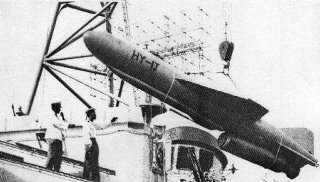
...At its narrowest point the Strait of Hormuz is only 21 miles wide, two 1-mile-wide channels for inbound and outbound tanker traffic, as well as a 2-mile-wide buffer zone. Iran has deployed Chinese HY-2 'Silkworm' anti-ship missiles along its Persian Gulf coast and its Abu Musa, Qeshm and Sirri islands. Over 14 million barrels of oil pass through the Strait of Hormuz each day.
There is an ominous precedent for the Iranian threat. During the 1980-1988 'tanker war,' between Iran and Iraq, there were 543 attacks on ships, with approximately 200 merchant sailors killed. More than 80 vessels were sunk or written off, causing more than $2 billion in losses and a 200 percent increase in global hull insurance rates. The U.S. State Department urged the government to re-flag 11 Kuwaiti oil tankers, which it did as well as providing naval escort through the Strait of Hormuz.
Any Iranian action to carry out its threat would undoubtedly involve the U.S. Navy's Fifth Fleet, home-ported in Bahrain.
Silkworm range in the Hormuz map from here. Explained in comment #151 here:
The pink zone reflects the range of a silkworm missile. The pink bars left and right are the rough East & West limits, between which large tankers would be forced to travel 'under their guns'.

Saturday, February 04, 2006

Fire may have doomed ferry

Reported here:
Survivors visibly suffering from the effects of cold have been coming ashore at the Egyptian port of Hurghada early on Saturday, describing how the fire burned on board before the ship finally sank.

One shouted: "It was like the Titanic on fire," according to the AP news agency.

The fire started less than two hours after the ferry sailed from Duba in Saudi Arabia on Thursday night, survivors said.

"There was thick smoke. We asked why and they told us they were putting out the fire but it got worse," Rifat Said, from from Giza near Cairo, was quoted by Reuters agency as saying.

"The ferry sailed on for two hours listing to the side. Then it just went onto its side and within five minutes it had sunk."

On the road

I'll be on the road for a few days. Back to the Gulf Coast. Family stuff.

Blogging may be spotty.

But thanks for tuning in.