VertRep

VertRep

Wednesday, March 01, 2006

Back to the future: Navy to have "Flying Warrant Officers"

The US Navy announces New Opportunities for Sailors to Sit in the Cockpit:
According to Vice Adm. John C. Harvey's naval message in January, the new program is called the Flying Chief Warrant Officer (CWO) Pilot program and is “designed to harness the strengths of our Sailors today and shape the Navy of tomorrow.”

The Flying CWO Pilot program will select 30 highly-qualified E-5 through E-7 Sailors over the next two years, commission them as CWO2 prior to Limited Duty Officer/CWO indoctrination, and subsequently place them in flight training as student pilots or naval flight officers (NFO). As newly winged aviators, they will receive fleet replacement squadron training and then report to the fleet.

***
The Flying CWO Pilot program targets the VP (Patrol Squadron), VQ (Fleet Air Reconnaissance Squadron), HSC (Helicopter Sea Combat Squadron) and HSL (Helicopter Anti-Submarine Squadron Light) communities, and will select 10 pilots and four naval flight officers in July 2006 and then 10 pilots and six NFOs in 2007.

The Navy had enlisted/non-commissioned (CWO2s are commissioned officers)pilots at the start of WWII, but that program was abandoned. Someone is in a creative thinking mode in the CNO side of the house...

Flag of convenience


The Republic of Georgia may have some concerns over being a "flag of convenience":
According to basic estimates, 35 percent of the world's merchant shipping vessels are registered under flags which are different from their country of origin. In these cases there is no genuine link between the vessel's owner and the flag that the vessel flies.

For a variety of reasons - including tax breaks, cheap registration fees and the freedom to employ cheap labor - ship owners often find it lucrative to fly a flag other than that of their own country.

This practice is known as flying a "Flag of Convenience" and, although legal, it is generally associated with unethical practices and murky financial practices. For example, fishing boat owners who use a flag of convenience can ignore their home countries' conservation agreements.

Certain countries have taken advantage of this situation by marketing themselves as tax havens for ship owners. The perennially war-torn West African nation of Liberia, for example, has operated a flag registration since 1948 and now boasts a merchant fleet that is more than three times the size than that of the United States.

Georgia is one of thirty-two nations which appear on the International Transport Workers' Federation list of "flag-of-convenience" states. Perhaps proving the dubious nature of this practice, two landlocked countries - Bolivia and Mongolia - are also on this list...

...Because of this more-or-less officially sanctioned process of selling Georgian flags to certain maritime vessels it has recently become clear that a number of these ships, or their owners, are of suspicious reputation. Consequently, there are currently ships that are sailing under the Georgian flag that operate beneath commonly accepted safety standards, and which may engage in smuggling or other illegal activities.

All of this negatively influences Georgia's international reputation. According to a United Nations Office on Drugs and Crime report the "availability of a flag-of-convenience shipping registry" is one of the characteristics necessary for creating an ideal environment for money laundering.

According to Deputy Chairman of Georgian State Border Guard Department David Gulua, 730 ships that were sailing under Georgian flag were stopped for spot inspections by the Georgian Coast Guard last year.

"Plenty of ships sailing under Georgian flags have been detained. If Georgia's flag-bestowing process is not reformed and made more stringent then it's quite possible that, sometime in the near future, a ship flying under the Georgian flag could be used to transport an atomic bomb," Gulua warned in an interview with the newspaper Rezonansi.
At least, unlike some other countries, Georgia seems to have people concerned with the issue.

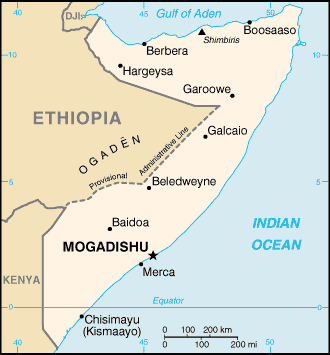
Al Qaeda's legacy to Somalia -"Piracy slows food aid for hungry Somalians"

More here on the impact that the pirates of Somalia are having on their fellow Somalis (see prior post here):
Piracy is a growing problem along Somalia's long coastline, slowing efforts to feed as many as 2 million Somalis left hungry by severe drought, U.N. Secretary-General Kofi Annan said on Tuesday.
Due to the threat of pirate raids on food shipped by boat, the World Food Program has had to move some aid overland to southern Somalia through Kenya for the first time in five years, Annan said in a report to the U.N. Security Council.
U.N. officials estimate that 1.5 million to 2 million people are in need of food in the northeast African nation, one of 11 countries in the region hit hard by prolonged drought.
The situation is so dire there that some Somali children are drinking their own urine, international aid group Oxfam reported this month.
Warlords. pirates and desparation. Not a good combination. Some of this mess lies at the feet of Osama bin Laden and al Qaeda, who managed to make the idea ofa humanitarian intervention in the area by the major powers unlikely, thereby possibly condemning hundreds of thousands to death, disease and despair. See here for some background, and this advice which argues against "nation-building:"
Keep the focus on fighting al-Qaeda and avoid mission creep. Washington must remain tightly focused on battling al-Qaeda, whose far-flung network already has required U.S. intervention in Afghanistan, the Philippines, and Georgia. U.S. military forces, already spread thin, must prepare for the contingency that al-Qaeda forces seek sanctuary in Iraq or are not expelled from Iran in a timely manner. The United States cannot afford to commit substantial military forces to action in Somalia unless there is solid evidence that al-Qaeda has moved its leadership or major portions of its operations there.

Faced with the prospect of a looming confrontation with Iraq over weapons of mass destruction--the ultimate terrorist weapon--the Defense Department cannot risk getting bogged down in operations against AIAI absent a growing al-Qaeda threat in Somalia. The United States should try to contain and defeat AIAI by giving diplomatic, economic, and intelligence support to Somali factions that oppose it and to Ethiopia and Kenya, which it also threatens. But the United States should reserve the use of military force for cases in which vital national interests are at stake. Those interests are not at stake in Somalia unless al-Qaeda greatly increases its lethal activities there.

Washington cannot repeat the mistake of getting involved in nation-building in Somalia, this time under the guise of fighting terrorism. America's experience in Lebanon, Somalia, and the Balkans demonstrates that nation-building efforts often draw U.S. forces into internal power struggles that actually create incentives and targets for terrorism. 30 U.S. soldiers should be employed to capture or kill terrorists, not to function as social workers.

Tuesday, February 28, 2006

Latest ICC CCS Piracy Report (to 27 Feb 06)

For the latest ICC Commercial Crime Services Piracy Report go here. Highlight:
26.02.2006 at 0530 UTC in position 02:13N - 045:55E, off Mogadishu, Somalia.
Pirates armed with guns in two speedboats boarded a wooden dhow underway. They hijacked the dhow and are holding the 25 crew hostage.
More on this here.

People smugglers kill at least 33 off Yemen


Reported here:
In the latest grim episode of asylum seekers and migrants dying while trying to cross the Gulf of Aden from Somalia to Yemen, the United Nations refugee agency reported today that smugglers forced 137 men, women and children into deep waters off the Yemeni coast, killing at least 33, with another 30 missing.

"The latest tragic incident once again highlights the urgent need for joint international and local efforts to address this problem and minimize the flow of desperate people who fall victim to ruthless smugglers," UN High Commissioner for Refugees (UNHCR) spokesperson Jennifer Pagonis told a news briefing in Geneva.

Thousands of Somalis, many fleeing violence in their homeland, arrive in Yemen every year, averaging an estimated 100 people a day during the annual September to March period of good sailing conditions, after making the perilous crossing in the hands of smugglers who often beat them or force them overboard while still far from shore, sometimes with their hands tied behind their backs, leaving them to the mercy of the seas.
This sort of thing has been going on a long time in a variety of areas (including the US Southwest deserts) as people in one God-forsaken place make every effort to get out --even with improbably high odds against success. The smugglers, if caught, should "enjoy" the same treatment as their victims.

How bad are things in Somalia? Well, in addition to a food shortage that cannot be mitigated because of the pirates seizing World Food Program shipping, overland routes that also difficult and also dangerous, there is major drought so bad that animals are competing with humans for water as reported here:
Reports of baboons and hyenas attacking communities in drought-stricken Somalia are becoming common. The wild creatures are said to be locked in competition with human beings in search of water as the merciless drought currently affecting the entire Horn of Africa region exhausts both food and water supplies.

In Tayeglow district in Bakol region, southern Somalia, a vicious attack by baboons led to the deaths of several animals and injury to some pastoralists when a war for water broke out.

Ravenous hyenas, capable of breaking a camel's neck with one snap of their strong jaws, often attack in broad daylight. It is a fight for survival as drought takes its toll on communities in various regions, especially in southern and central Somalia.

Desperation is even reported from riverine areas. Lorry drivers and conductors have begun complaining of herds of monkeys positioning themselves at strategic road intersections or on bridges to raid lorries with loads of fruits destined for markets in Mogadishu.

The sight of animals making off with bunches of bananas or 10kg watermelons is common, to the annoyance of horticultural traders whose profits are dwindling due to scarcity of commodities. "The road section between Shalambood and Afgoye towns in Lower Shabelle region, south of Mogadishu, is the worst," complained Ali Hashi Damal, a young conductor.

In rural areas, carcasses of dead animals are a common sight, while villagers complain of putrefying dead animals causing a health hazard to those who still keep some grains for survival.

The scorching sun, a dusty environment and heightened population mobility are already worsening the magnitude of the starvation.

The more physically fit are fleeing famine-hit areas for urban centres, adversely affecting those who remain behind - the sick, the elderly, children and mothers being the prime victims...

...rious good samaritans have also been trying their best to reach the needy. Their efforts are however hampered by internal hostilities between Somalis. Moreover, food supplies arriving at the harbours have to be transported inland by lorries over potholed and badly damaged roads; the vast country does not even have a railway system.

Trucks carrying relief items generally take days, if not weeks, to reach their destinations. The situation is worsened by armed groups along the route who often hold the trucks to ransom.

Until recently, the logistical problems were limited to inland areas, but recently sea pirates around Somalia's waters have begun attacking vessels. They don't care if the ships contain commercial goods or relief items. Once they get hold of the crew, they demand a ransom.
Latest ReliefWeb info on the drought here:
- The forecast for the ‘gu’ rains is not promising (March – May). The number of food aid beneficiaries could increase significantly if the rains are poor.
- Water shortage reaching critical levels with 640,000 people requiring emergency water in Somali Region and 100,000 in Borena.
...The Disaster Preparedness and Prevention Agency (DPPA) continues to dispatch emergency food aid for 1.5 million people in Somali Region and for 155,000 beneficiaries in Borena zone of Oromiya Region. WFP is providing a full food basket and supplementary food for 35 percent of beneficiaries regarded as the most vulnerable groups. The DPPA has sent a multi-sectoral assessment team (MoWR, MoH, MoARD) to Jijiga, Liben, Afer and Gode in Somali Region to jointly monitor the situation. However, the humanitarian crisis in Borena zone has not yet adequately captured the attention of humanitarian partners at all levels. This is mainly due to poor capacity of the zone to manage the crisis, including prioritising the needs and sharing information timely. There is a strong fear that massive death of animals could occur in the coming few weeks. Sectoral taskforces have quantified their respective emergency needs; however, to date, there is no consolidated emergency need.

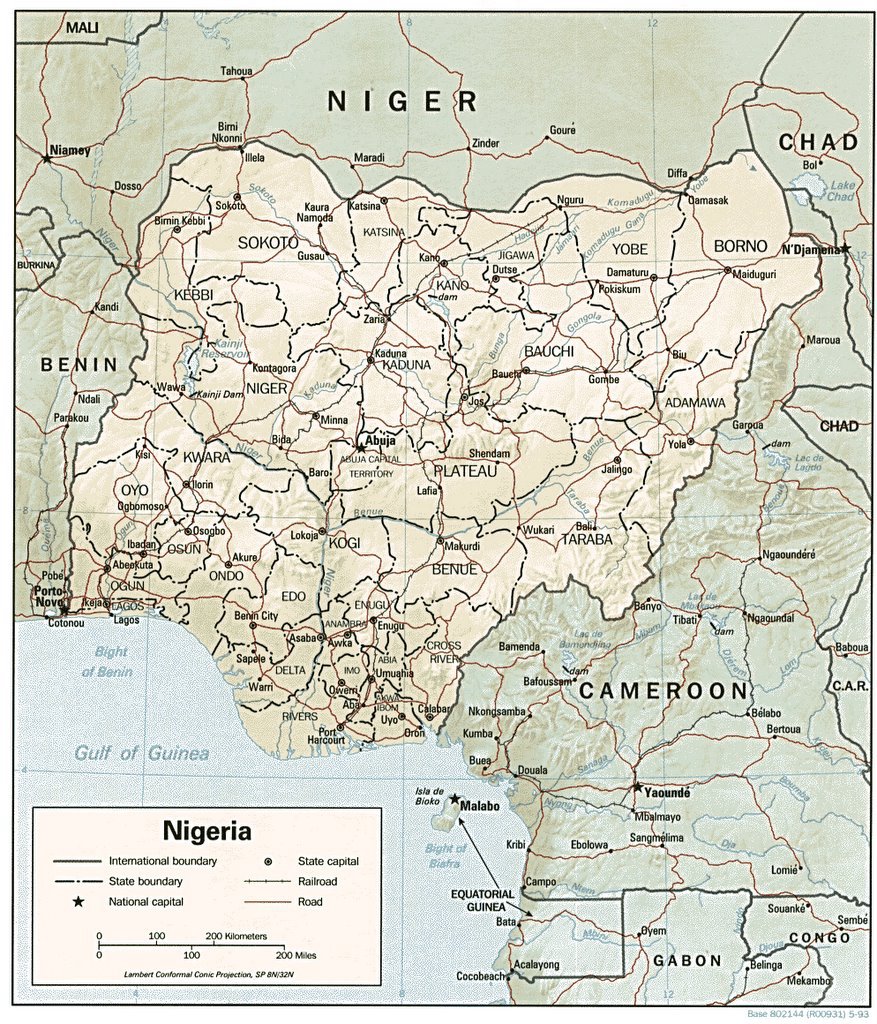
Update on Nigerian hostages

BBC updates hostage status here:
The head of the Nigerian military unit seeking the release of nine kidnapped foreign oil workers says there is no military solution to the crisis.
Brigadier Gen Elias Zamani told the BBC that the government hoped mediation efforts would see their release soon.

They were seized in the Niger Delta in one of a series of attacks by militants on the oil industry last week.

The militants have been demanding a greater share of the region's oil wealth for local Ijaw people.

Monday, February 27, 2006

A chilling opening

From Simon World here:
China executes about 8,000 people a year, or 22 a day...
. Simon says the Chinese judiciary is trying to get control of the process.

8,000 a year? Stunning.

Latest ONI World Wide Threat to Shipping (to 22 Feb 2006)

For the latest ONI World Wide Threat to Shipping, o here and click on the date. Highlights:
1. Ro Ro ship underway reported being followed 18 Feb, Somalia.
2. Chemical tanker surrounded by speedboats, 18 Feb, Gulf of
Aden.
3. Container ship surrounded by speedboats, 18 Feb, Gulf of
Aden.
4. Container ship (LICORNE) reported being followed, 20 Feb,
Somalia.

*******
1. NIGERIA: An offshore barge was boarded and hostages
taken 18 Feb in a predawn raid along the Escravos coast. Militants
in speedboats stormed the barge and abducted nine people. Militants
also blew up two nearby oil and gas pipelines, and set fire to a
tanker loading platform. Eight hostages were working as
contractors for Houston based Willbros Group Inc., which was
subcontracted by Shell. Willbros has confirmed that three
Americans, two Egyptians, two Thais and one Filipino were taken
hostage. Additionally, one British national working as a security
export for a private firm under contract with Willbros was also
taken hostage. The Movement for the Emancipation of the Niger
Delta (MEND) reported that the attacks were a response to military
air raids in the delta state that took place earlier this week and
indicated another wave of violence “on a grander scale” will
follow. Shell was warned not to repair the offshore loading
platform, threatening a more brutal attack (LM).

NY Times abets terrorists -again

Ranting Profs hammers the NYT here:
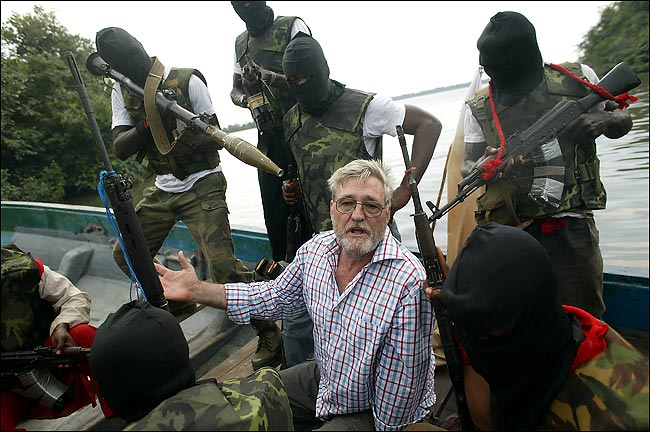
In other words, not only is the New York Times, by publishing this photograph -- publishing it in quite large size in the paper edition, by the way -- giving the terrorists the opportunity to give emotional punch and credibility to their threats that they would not otherwise have, the Times' representative is apparently the one who staged the text they are using to begin with. This is not a photograph of a historic event or a text that teaches us about the group because they provided it. This is a staged photograph of a group of people, but the terrorists are staged in such a way as to showcase the fact that they pose a threat to their hostage. Thus the Times creates for them the chance to publicize their threat, a chance they would not otherwise have, and a critical chance. I was originally going to criticize the Times for making the decision to publish the photograph, which gives their threat legitimacy, but in fact the Times complicity here goes far deeper.
The subject of her perfectly correct outrage: Caption:
Macon Hawkins of Kosciusko, Tex., an employee of a pipe-laying company, is a hostage of the Movement for the Emancipation of the Niger Delta.
Large portions of the Nigerian population may, in fact, have legitimate complaints over the manner in which the oil and gas wealth their country is being exploited, stolen, sold and much more. But this sort of coverage of a staged event* provides proof to would-be terrorists that outrageous acts can provide a forum for their complaints. Next time, when a NY Times reporter is grabbed and weapons pointed, I wonder if the Times will be so thoughtless.

Meanwhile, I suggest some prayers for Mr. Hawkins, who is apparently to the NY Times just grist for their mill.

*How do we know it's staged? Among other reasons, only an idiot (the masked man on the left) would point an RPG at a hostage in real life- especially at such close range.

Somali pirates take another dhow


Reported here, pirates off Somalia appear to have captured an Indian dhow:
Gunmen on Sunday hijacked an Indian dhow with 25 crew in the high seas off Somalia's pirate-infested coastline, a maritime official said.

"We do not know the exact location, but we suspect it was in northeastern Somalia," said Andrew Mwangura of the seafarers' assistance programme in the Kenyan port town of Mombasa.

Mwangura said the dhow, MV Bhakti Sagaar, was seized as it was sailing from the southern Somali port of Kismayo to the port of Elmaan, north of the capital Mogadishu.

"It was empty when it was seized but we have managed to contact the US navy in the Horn of Africa," Mwangura said, adding that he was also in touch with Indian maritime officials to get more information.
Hmmm. "...we have managed to contact the US Navy..." We may need to set up a 911 emergency line.

India-US defense cooperation - a growth business

With President Bush about to visit India, India and the US are cooperating militarily more than ever as reported here.

US ready to help in Strait of Malacca security

Probably not a surprise, but, as reported here:
The United States on Monday pledged to help combat the threat of piracy and terrorism in the Straits of Malacca, one of the world's busiest shipping lanes.

Details of the cooperation will be planned after Malaysia, Indonesia and Singapore sign a pact in April outlining standard operating procedures for maritime security, said Adm. William Fallon, commander of the U.S. Pacific Command, which includesU.S. forces in the Indian Ocean and the Pacific.

"We are standing by to help. We are hopeful that when this agreement is formalized then we will have a better understanding of what we might do," Fallon, who is based in Hawaii, told a news conference.

Fallon, who is visiting the region, did not give details of the assistance that the U.S. wants to give to protect the waterway that is used annually by about 50,000 ships, carrying half the world's oil and a third of its commerce.

But regional officials have said that help would be sought from the United States, China, Japan and other powers to contribute equipment and expertise aimed at strengthening air patrols launched in September by Malaysia, Indonesia and Singapore, the three countries that border the sea route. Theyalso conduct coordinated sea patrols.

The help is likely to be limited to capacity building and technical cooperation, without any foreign military presence in the strait. Malaysia and Indonesia have ruled out any direct foreign intervention, saying other countries must respect their territorial sovereignty.

Saturday, February 25, 2006

And the winner of the "Empty Threats" category is...the DPRK

The excellent Korea Liberator blog points to more nonsense from our North Korean Windbags of Death.

Vessel Tracking System for Nigerian waters?


An idea that might work:
Speaking against the backdrop of the porous nature of the nation's waters, an expert, Mr. Abel Edijala called for the setting up of a Vessel Traffic Management Authority (VETMA).

He said vessel traffic management is an act of providing active monitoring and navigational advice for vessels either in particularly confined and busy waterways or the oceans at large.

According to him, the two main types of Vessel Traffic Schemes (VTS) are the surveilled and non-surveilled systems.

The surveilled system consists of one or more land-based sensors which output their signals to a central location where operators monitor and manage vessel traffic movement.

For non-surveilled systems, they consist of one or more reporting points at which ships are required to report their identity, course, speed and other data to the monitoring authority.

They encompass a wide range of techniques and capabilities aimed at preventing unauthorized and unnoticed entry of vessels into a country's territorial waters.

Mr. Edijala explained that they are also aimed to prevent vessel collision, ramming and groundings in the harbour, harbour approach and inland waterway phase of navigation.

He said they are also designed to expedite ship movements, increase transportation system efficiency and improve all weather operating capabilities.

The expert stated that in view of the fact that Nigeria's waterways accounts for over 95 per cent of the mainstay of the Nigerian economy in terms of both export and import activities, it is only pertinent that a monitoring and surveillance agency be set up.

He highlighted the need for VETMA to include the fact that the surveillance system overlooking Nigeria's oceans/seas will check leakage arising from illegal oil bunkering vessels operating in the nation's waters.

Mr. Edijala explained that vessels involved in moonlighting, a term that refers to vessels that ship into Nigeria's export terminals under the cover of night with security agencies looking away will be eradicated as the Automatic Identification System (AIS) is not hindered by visibility.

Arms trading for oil which is the major source of gun running in the Niger Delta region, he said shall be cut off through vessel monitoring.

"Hostage taking and piracy will be highly reduced as locating vessel position will be easier to track down these unprits", he added.
As previously noted losses to the Nigerian economy by fuel thieves run about 30,000 barrels of oil per day.

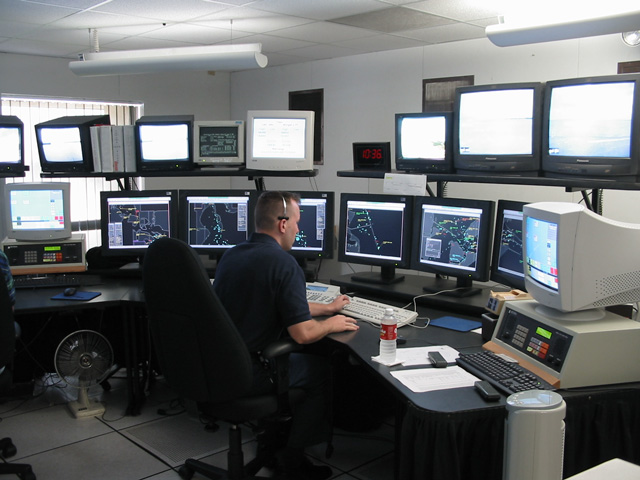
Stopping that leak might pay for an excellent VTS system. Perhaps this outfit could help. And a sample from the US Coast Guard Port of Houston VTS here. Photo is of a part of the Houston system and the "chart" is a radar image from that system looking at a portion of the ship channel passing through Galveston Bay.

Anti-piracy hub in Kenya?

Reported here:
A regional maritime coordination centre in Mombasa will be revived to help fight piracy in the Horn of Africa.

The centre would initiate and maintain a worldwide navigation warning system for ships off the coast of Somalia, Transport minister Chirau Ali Mwakwere told a meeting of agencies and states affected by piracy.

"The system is vital in guiding ships sailing in the high risk areas, to eliminate the likelihood of their falling into the hands of pirates," he said.

And the Search and Rescue Centre, which is under construction, would be in operation by May, to help boost the fight against piracy, said the minister.

The meeting being held at the Nyali Beach Hotel is expected to form a task force to look into ways of fighting piracy in the region.

At the meeting are delegates from the USA, Britain, Kenya, Tanzania, Somalia, Bangladesh, India, the International Maritime Organisation, and the World Food Programme.

"These attacks are a threat to the economies of eastern and southern Africa and the landlocked countries in the region," said Mr Mwakwere.

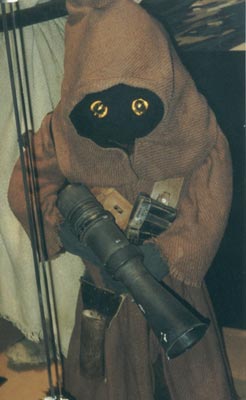
Shades of "Star Wars"- the attack on the Jawas


A couple of laid up tugs proved too tempting for some scavengers off the coast of Pakistan as reported here:
Ali informed the police that the four men approached his company's boats in two separate vessels. They took the guards stationed at the tugboats hostage and loaded the stuff into their boats. The names of the tugboats are Jawa and Jawa Bosar.
The 'pirates' took away motors, some tools and copper and scrap. The police said that the tugboats were being repaired and had been out of order for the last six months.


Of course, in the Star Wars movies, the scavengers were the Jawas.

Friday, February 24, 2006

Shell ordered to pay Nigeria

Reported here:
A Nigerian court has ordered oil giant Shell's local operation to pay $1.5bn to the Ijaw people of the Delta region.
The Ijaw have been fighting since 2000 for compensation for environmental degradation in the oil-rich region.

They took the case to court after Shell refused to make the payment ordered by Nigeria's parliament.

Ijaw militants have staged a spate of attacks against Shell facilities recently and are holding seven foreign oil workers hostage.

Following the violence, Shell - the biggest oil producer in Nigeria - has halved its output from the country.

Shell says it believes there is no evidence to support the claim, and will appeal against the ruling.

A statement said: "We remain committed to dialogue with the Ijaw people."

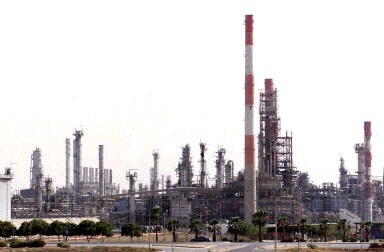
Foiled attack on Saudi oil facility

A Saudi refinery
Reported here:
Saudi security forces have foiled an apparent suicide car bomb attack on a major oil production facility in the eastern town of Abqaiq, reports say.
At least two cars carrying explosives were fired on at the plant, Saudi officials have said.

BBC security correspondent Frank Gardner says the attack is the first direct assault on Saudi oil production.

The al-Qaeda network on the Arabian Peninsula has long called for attacks on Saudi oil installations.

About two-thirds of Saudi Arabia's oil is processed at the Abqaiq plant, one of the largest in the world.

Oil security analysts have estimated that a serious attack on the Abqaiq facility could halve Saudi exports for up to a year.

Saudi Oil Minister Ali al-Nuaimi said the kingdom's oil output - the largest in the world - was unaffected by the attack, AFP news agency reported.
More here:
Suicide bombers in explosives-laden cars attempted to attack an oil processing facility that handles about two-thirds of Saudi Arabia's petroleum output on Friday, but were stopped when guards opened fire on them, causing the cars to explode, officials said.

The Saudi oil minister said the blast "did not affect operations" at the Abqayq facility, denying an earlier report on Al-Arabiya television that the flow of oil was halted briefly.

The facility "continued to operate normally. Export operations continued in full," the minister, Ali Naimi, said in a statement.
How big is the refinery? Well, very bighttp://www.eia.doe.gov/emeu/cabs/saudi.html:
Most of Saudi Arabia's crude oil is exported from the Persian Gulf via the huge Abqaiq processing facility, which handles around two-thirds or so of the country's oil output. Saudi Arabia's primary oil export terminals are located at Ras Tanura (6 million bbl/d capacity; the world's largest offshore oil loading facility) and Ras al-Ju'aymah (3 million bbl/d) on the Persian Gulf, plus Yanbu (as high as 5 million bbl/d) on the Red Sea. Combined, these terminals appear capable of handling around 14 million bbl/d, around 3.0-3.5 million bbl/d higher than Saudi crude oil production capacity (10.5-11.0 million bbl/d), and about 4 million bbl/d in excess of Saudi crude oil production during the first half of 2005. Despite this excess capacity, there have been reports that the Saudis are planning to conduct a feasibility study on construction of an oil pipeline from the Empty Quarter of southeastern Saudi Arabia through the Hadramaut in Yemen to the Arabian Sea.
I suspect security will be tightened at these export terminals and along pipelines in a hurry.

UPDATE: The Counterterrorism Blog coverage here.

UPDATE2: More here, with this unnecessary quote:
A USA Today report says that Matthew Simmons, a Houston-based investment banker who specializes in oil and gas ventures, said that he was alarmed by the light security at Saudi Arabia's massive Abqaiq oil processing plant.

To cripple the Saudi oil network, "All you'd need to do would be to get a big fire raging at Abqaiq," Simmons says. "It's got a chain-link fence around it. Chain-link fences aren't exactly the Maginot Line."
Well, they didn't have to be, did they? The "best" protection is a watchful eye...

UPDATE3 (2/25/06): The al Qaeda gang sends a few more of its "true believers" to their reward as it claims responsibility for the attack. Maybe it was a moral victory...

It's manifest -Sen Schumer doesn't know what he's talking about

See Chuck Schumer: Terrorists Could Alter Ship 'Manifolds' .
Despite his apparent ignorance on the subject of shipping documentation, Schumer took credit for exposing the Dubai ports controversy, insisting: "I was the first one who mentioned it, as you know, a week ago Monday."
Big deal.