Satellites and mobile phones, built on international standards, help the world get
connected. But the communications technology we use on land does not work well underwater. As water covers over 70 per cent of the earth's surface, NATO has sponsored research into establishing the first ever digital underwater communications standard.
****
CMRE is working to support effective underwater communication networks to allow undersea robots to work together and report back home (see the infographic on Digital Underwater Networked Communications).
"Robots can behave intelligently and act as a team," says João Alves, Principal Scientist and Project Leader at CMRE. “For example, one of the robots could find some interesting feature and call the rest of the team.”
With effective undersea communication, this can all happen in an autonomous way, without requiring direct human intervention. If needed, the operation can be managed by land-based engineers who monitor all the communications from a command and control room ashore. The connection to land is made through gateway buoys on the surface of the water equipped with radio links to local support platforms or satellites.
“This is particularly important for search-and-rescue operations,” says John Potter, a scientist at the CMRE Strategic Development Office. “Autonomous vehicles are relatively inexpensive and of course unmanned, so they can be sent to do dirty, dangerous jobs.”
****
To be able to communicate with each other, underwater assets need common standards. “In the air we can simply connect our gadgets to any WiFi hotspot without having to worry about the compatibility,” says João Alves. “Until now, there wasn’t anything even remotely similar for the underwater domain.”
As with the industry standard for WiFi communication, an undersea communication standard has to be defined in order to guarantee the interoperability between equipment from different manufacturers.
For the past ten years, CMRE has been working on the development of the first international digital underwater communication protocol, known as JANUS, which is now an approved NATO standard.
“JANUS was a Roman god of openings and gateways,” says John Potter. “That’s why it is called JANUS, because this language opens the portal between two domains, two different operating paradigms, through which they can talk.”
“It is a digital underwater signalling system that can be used to contact underwater devices using a common format; announce the presence of a device to reduce conflicts; and enable a group of underwater devices (that can be underwater robots, submarines, divers or any other equipment operating under the surface) to organise themselves into a network,” adds John Potter.
Adopted globally, JANUS can make military and civilian, NATO and non-NATO devices interoperable, providing them all with a common language with which to communicate and arrange to cooperate.
JANUS has been extensively tested at sea in exercises involving a number of partners (universities, industries and research institutions) covering a range of application scenarios. Close collaboration with NATO Allies has been particularly fruitful in developing JANUS for use in cases that may improve the safety of maritime operations.
VertRep

Showing posts with label NATO. Show all posts
Showing posts with label NATO. Show all posts
Thursday, June 01, 2017
"A new era of digital underwater communications" Says NATO
NATO announces "A new era of digital underwater communications"


Tuesday, April 11, 2017
A Reset of the "Cold War?"
Watching CNN this morning (and was there ever a more confusing mess of news than that at CNN?) and Professor Stephen Cohen was on, warning of the dangers of the new world order left in the wake of the out-going administration and the bow wake of the arrival of the current administration. As I understood the Prof, we're on the brink of a crisis on par with the Cuban missile crisis of 1962 and things are serious indeed.
This is not a drum that Dr. Cohen just started beating, either, as can be seen in this CNN interview from back in December 2016:
It should be noted that Dr. Cohen is a contributor to The Nation and has a book out on Russian-U.S. relations, Why Cold War Again?: How America Lost Post-Soviet Russia :
Sec State Tillerson is visiting Russia. I hope plain speaking and an understanding of Putin's remarkably weak position helps defuse this mess.
Finger pointing on the Syria debacle seems to be a thing on right and left. See Syria Will Stain Obama’s Legacy Forever from Foreign Policy and Obama’s Disastrous Syria Policy from National Review.
Can the genie be put back in the bottle? I don't know, Russia seems to have only a couple of friends in the world, and Assad of Syria appears to be one of them. AND there is that warm water port.
Iran has hopped on the anti-U.S. band wagon (with "red line warnings"), which was a short hop indeed, given their view of the Great Satan. If I were they, I'd be more worried about the regime to their north, but that might just be me.
In any event, I am less concerned about a "cold" war than a "hot" one stumbled into like WWI, the results of which, by the way, still haunt the Middle East. See A century on: Why Arabs resent Sykes-Picot:
Of course, there is also Ukraine, Crimea and the threat to the Baltic NATO countries.
May we live in interesting times.
This is not a drum that Dr. Cohen just started beating, either, as can be seen in this CNN interview from back in December 2016:
It should be noted that Dr. Cohen is a contributor to The Nation and has a book out on Russian-U.S. relations, Why Cold War Again?: How America Lost Post-Soviet Russia :
The new East-West conflict, which broke out over the Ukrainian crisisWhich is pretty much what he said this morning.
in 2014, but which long predated it and soon spread through Europe and to the Middle East, is potentially the worst US-Russian confrontation in more than fifty years― and the most fateful. A negotiated resolution is possible, but time may be running out. In this book, renowned Russia scholar and media commentator Stephen F. Cohen traces the history of this East-West relationship in the 'Inter Cold War' period― the years from the purported end of the preceding Cold War, in 1990-1991, to what he has long argued would be a new and even more dangerous Cold War.

Sec State Tillerson is visiting Russia. I hope plain speaking and an understanding of Putin's remarkably weak position helps defuse this mess.
Finger pointing on the Syria debacle seems to be a thing on right and left. See Syria Will Stain Obama’s Legacy Forever from Foreign Policy and Obama’s Disastrous Syria Policy from National Review.
Can the genie be put back in the bottle? I don't know, Russia seems to have only a couple of friends in the world, and Assad of Syria appears to be one of them. AND there is that warm water port.
Iran has hopped on the anti-U.S. band wagon (with "red line warnings"), which was a short hop indeed, given their view of the Great Satan. If I were they, I'd be more worried about the regime to their north, but that might just be me.
In any event, I am less concerned about a "cold" war than a "hot" one stumbled into like WWI, the results of which, by the way, still haunt the Middle East. See A century on: Why Arabs resent Sykes-Picot:
The borders of the Middle East were drawn during World War I by aAlso here.
Briton, Mark Sykes, and a Frenchman, Francois Picot.
The two diplomats' pencils divided the map of one of the most volatile regions in the world into states that cut through ethnic and religious communities.
Later dubbed the Sykes-Picot treaty, the secret agreement was signed by Paris and London on May 16, 1916, to become the basis on which the Levant region was shaped for years to come.
A century on, the Middle East continues to bear the consequences of the treaty, and many Arabs across the region continue to blame the subsequent violence in the Middle East, from the occupation of Palestine to the rise of the Islamic State of Iraq and the Levant (ISIL), on the Sykes-Picot treaty.

Of course, there is also Ukraine, Crimea and the threat to the Baltic NATO countries.
May we live in interesting times.
Thursday, February 16, 2017
Mr. Mattis Goes to NATO
The Secretary of Defense does not mince works in Speaking Truth to Eurocrats
By social welfare, I include the idea that a primary function of a state is to protect its citizenry.
Next, how about a discussion of those sea lines of communication the U.S. is protecting? How about some load sharing?
That being said, we, of course, properly should thank France for using its carrier and carrier air as an ally.
*Emphasis added
Defense Secretary Jim Mattis, echoing his boss in Washington, warned on WednesdayI think I hear Euro heads exploding - their social welfare spending does not include sufficient defense of their nations - because they long have counted on the U.S. to have the laboring oar. However, the U.S. has carried some of them for over 70 years and that is not how partnerships are supposed to work. I know previous SecDefs have made the same point - but Secretary Mattis, well, he seems to have a way with words.
that the amount of American support for NATO could depend on whether other countries meet their own spending commitments.
“Americans cannot care more for your children’s future security than you do,” Mr. Mattis said in his first speech to NATO allies since becoming defense secretary.* “I owe it to you to give you clarity on the political reality in the United States and to state the fair demand from my country’s people in concrete terms.”
“America will meet its responsibilities,” he said, but he made clear that American support had its limits.
In his speech to NATO defense ministers, Mr. Mattis repeated a call made by previous American secretaries of defense, for European allies to spend more on their militaries. His comments on Wednesday give teeth to President Trump’s expressed skepticism about the alliance.
What’s more, Mr. Mattis went further than his predecessors in apparently linking American contributions to the alliance to what other countries spend.
“If your nations do not want to see America moderate its commitment to this alliance, each of your capitals needs to show support for our common defense,” he said.

By social welfare, I include the idea that a primary function of a state is to protect its citizenry.
Next, how about a discussion of those sea lines of communication the U.S. is protecting? How about some load sharing?
That being said, we, of course, properly should thank France for using its carrier and carrier air as an ally.
*Emphasis added
Monday, November 28, 2016
U.S. Navy Office of Naval Intelligence Worldwide Threat to Shipping (WTS) Report 25 October - 23 November 2016 and NATO Ending Indian Ocean Counter-Piracy Operations
In addition to the information in the following ONI report, it is of interest that Voice of America reports NATO has announced that it is ending its counter-piracy operations in the Indian Ocean:
NATO has ended Operation Ocean Shield after a sharp drop-off in attacks by Somali pirates.According to NATO, operations will cease on 15 December 2016.
The Royal Danish Air Force carried out the last Indian Ocean surveillance missions for NATO.
The NATO operation had been one part of a highly successful coordinated international response to the threat of piracy that also included the European Union, the United States and other independent nations.
During its peak, piracy off the Horn of Africa had an economic impact of $7 billion, with more than 1,000 hostages taken. There hasn’t been a successful piracy attack since 2012, down from more than 30 ships at the peak in 2010-11. The NATO planes flew from the Seychelles.
***
NATO is now shifting resources to deterring Russia in the Black Sea and people smugglers in the Mediterranean.
NATO's spokesman Dylan White said in a statement that the global security environment had changed dramatically in the last few years and that NATO navies had adapted with it.
After more than a decade of NATO-led operations far beyond its borders, the military alliance is shifting its focus to deter Russia in the east, following Moscow's 2014 annexation of Ukraine's Crimea peninsula.
U.S. Navy Office of Naval Intelligence Worldwide Threat to Shipping (WTS) Report 25 October - 23 November 2... by lawofsea on Scribd
Sunday, August 28, 2016
On Midrats 28 August 2016 - Epsiode 347: Baltic Security with Bruce Acker and Dan Lynch
Please join us at 5pm (EDT) for Midrats Episode 347: Baltic Security with Bruce Acker and Dan Lynch
Due to the location of our guests, the show was recorded earlier today. Listen to the show to at 5pm or pick it up later by clicking here. You can also get the show later from our iTunes page or from our Stitcher page.With a resurgent Russia, the security environment from former Soviet Republics to the traditionally neutral nations of Finland and Sweden has changed dramatically.
What are those changes and how are they changing how these nations see their place in the larger Western security infrastructure? We’re going to look at how thing are changing in how they work and see each other, NATO, and what they need to do to provide for both their and collective defense.
Our guests for the full hour will be Colonel Bruce Acker, USAF (ret) and Captain Dan Lynch, USN (Ret).
Bruce is currently a Defense Strategy Consultant in Stockholm Sweden. He spent 30 years on active duty starting as a Air Defense Weapons flight test engineer upon graduation from the Air Force Academy, and subsequently served in Space, Missile Warning, and Missile Launch operations culminating as a Minuteman ICBM squadron Commander. Following staff tours managing future Air Force and Defense Space systems programs, he broadened to political military assignments as the US Air Attaché to Malaysia and as the US Defense Attaché and Senior Defense Official in Stockholm. Col Acker has published articles on regional security issues in the Swedish Royal Academy of War Sciences journal as well as leading National daily newspapers.
Dan is currently beginning his fifth year on the maritime faculty of the Swedish Defense University in Stockholm. He spent over 35 years on active duty starting as an enlisted Marine and upon graduation from the Naval Academy selected Naval Aviation where he commanded a VP squadron and a patrol and reconnaissance wing. Following major command, he served on the staff of the US ambassador to NATO in Brussels and retired after his last tour as the Naval Attache to Stockholm.

Saturday, July 23, 2016
On Midrats 24 July 2016 - Episode 342: Turkey, Erdoğan & its Miltary - with Ryan Evans
Please join us at 5pm EDT (US) for Midrats Episode 342: Turkey, Erdoğan & its Miltary - with Ryan Evans:
Join us live if you can or listen later by clicking here. Or pick the show up later from either our iTunes page here or our Stitcher page here.The events of the last week in Turkey brought that critically important nation in to focus, and we are going to do the same thing for this week's episode of Midrats.
Turkey has a history of military coups as a byproduct of an ongoing drive to be a modern secular nation against the current of a deeply Islamic people. This week we are going to look at how Turkey found itself at another coup attempt, the response, and the possible impact for Turkey and its relationship with NATO, Russia, Europe, and its neighbors.
Our guest to discuss this and more for the full hour will be Ryan Evans.
Mustafa Kemal Atatürk- Father of Modern Turkey
Ryan Evans is a widely published commentator and recovering academic. He deployed to Helmand Province, Afghanistan from 2010 – 2011 as a Social Scientist on a U.S. Army Human Terrain Team that was OPCON/TACON to the British-led Task Force Helmand. He has worked as assistant director at the Center for the National Interest, a research fellow at the Center for National Policy, and for the International Centre for the Study of Radicalisation and Political Violence in London. He is a Fellow of the Inter-University Seminar on Armed Forces and Society and received his MA from the King's College London War Studies Department.


Monday, March 14, 2016
U.S. Navy's Office of Naval Intelligence Worldwide Threat to Shipping (WTS) Report 9 February - 9 March 2016
From ONI:
For those of you interested in the smuggling of migrants, an interesting blog from a law professor at the University of Southern California, Migrants at Sea, one post of which links to this NATO news release about an expansion of it counter-migrant program in the Mediterranean/Aegean from international waters into territorial waters of NATO members Greece and Turkey:
As the good professor at Migrants at Sea notes:
NATO video on their efforts in the Aegean:
For those of you interested in the smuggling of migrants, an interesting blog from a law professor at the University of Southern California, Migrants at Sea, one post of which links to this NATO news release about an expansion of it counter-migrant program in the Mediterranean/Aegean from international waters into territorial waters of NATO members Greece and Turkey:
Yes, criminals committing crimes at sea.
NATO took swift decisions to deploy ships to the Aegean Sea to support our Allies Greece and Turkey, as well as the EU's border agency FRONTEX, in their efforts to tackle the migrant and refugee crisis. NATO ships are already collecting information and conducting monitoring in the Aegean Sea. Their activity will now be expanded to take place also in territorial waters.
***
the purpose of NATO's deployment is not to stop or push back migrant boats, but to help our Allies Greece and Turkey, as well as the European Union, in their efforts to tackle human trafficking and the criminal networks that are fueling this crisis.
As the good professor at Migrants at Sea notes:
NATO’s characterisation of its operation seems to be an attempt to draw a distinction between a push-back practice where any migrant boat, regardless of whether it is in need of rescue, would be intercepted and pushed back and a search and rescue operation providing assistance to migrant boats in need of rescue. This is meaningless distinction given the current situation in the Aegean where every migrant boat is in need of assistance or rescue.
NATO video on their efforts in the Aegean:
Tuesday, November 24, 2015
Turkey v. Russia: Turks Defend Their Airspace
Reuters report "Turkey downs Russian warplane near Syria border, Moscow denies airspace violation". Hurryiet report:
Hmmm.
Two Turkish F-16's shot down a Russian-made SU-24 jet on Nov. 24 near the Syrian border after it violated Turkish airspace, presidential sources said.
Turkish F-16
Turkey shot down the jet after it failed to heed the warnings within the rules of engagement.
Initial reports said the jet belonged to Russia, but presidential sources later clarified that the jet's nationality was unknown.
The Turkish Armed Force also stated that the jet of “unknown nationality” had been warned 10 times in five minutes about its violation of the airspace.
SU-24


Hmmm.
Tuesday, September 01, 2015
Fun with Russia - Putin Pushes, Gets Pushed Back by Baltic States

In light of this, this article from IEEE Spectrum is exactly on point, Fear of Russia Drives High-Voltage Power Projects in the Baltics:
Former Soviet Union satellites such as Ukraine, Georgia, and the three Baltic states—Lithuania, Latvia, and Estonia—rely heavily on Russian energy, a dependence that colors the ongoing geopolitical tussle among the Russian Federation, the European Union, and NATO. But new energy infrastructure is beginning to free the Baltics from this drama, including two high-voltage direct current links to Lithuania nearing completion: the 500-megawatt LitPol Link with Poland and the 700-MW NordBalt cable to Sweden, which is among the world’s longest subsea power links.Putin has done a remarkable job of causing the rest of Europe to work hard to free themselves of ties that Russia could use to "punish" them for standing up for freedom from Putin's bullying.
The links will give the Baltics the ability to get 100 percent of their imported power from non-Russian sources. Laying the 453-kilometer NordBalt cable was hindered by a series of nerve-wracking interventions by Russian naval ships, prompting Lithuania to lodge an official complaint with Moscow. Despite this hurdle, both NordBalt and LitPol Link are expected to begin testing by December and should be in operation from January 2016, says Daivis Virbickas, CEO of the Lithuanian power grid operator Litgrid.
Read the whole thing.
Saturday, August 29, 2015
On Midrats 30 Aug 2015 - Episode 295: "NATO Goes Back to Fundamentals" With Jorge Benitez

From the Balitic to the Black Sea, the last year has seen the North Atlantic Treaty Organization (NATO) return to its roots - the defense of Europe from Russian aggression.Join us live if you can, or pick the show up later by clicking here. Or you can also find the show later at our iTune page here.
The names and players have changes significantly since a quarter century ago - but in many ways things look very familar.
To discuss NATO's challenge in the East in the second decade of the 21st Century for the full hour will be Dr. Jorge Benitez.
Jorge is the Director of NATOSource and a Senior Fellow in the Atlantic Council’s Brent Scowcroft Center on International Security.
He specializes in NATO, European politics, and US national security. and previously served as Assistant for Alliance Issues to the Director of NATO Affairs in the Office of the Secretary of Defense. He has also served as a specialist in international security for the Department of State and the Institute for Foreign Policy Analysis.
Dr. Benitez received his BA from the University of Florida, his MPP from the Kennedy School of Government at Harvard University, and his PhD from the Fletcher School of Law and Diplomacy at Tufts University.
Monday, July 06, 2015
There Ain't No Such Thing As A Free Lunch: Greek Edition
TANSTAAFL strikes Greece.
As Prime Minister Thatcher once said:
Or, as well stated here:
Some nice analysis at Forbes The Future Of The Greek Economy:
Wait, you mean a Russian bailout would come with a price? TANSTAAFL, what's that?
As Prime Minister Thatcher once said:
. . . Socialist governments traditionally do make a financial mess. They always run out of other people's money. It's quite a characteristic of them.
Or, as well stated here:
The Greeks held their breath and jumped off the precipice. The Greek debt crisis, and the outcome of a No vote in the referendum, is a perfect example of politics trumping economics.Greece has the GNP of the U.S. state of Connecticut with 3.5x the population. See here, here and here.
***
Greece, Portugal, Spain, Italy and Ireland masked their debts to keep the illusion of solvency until the 2008 economic crisis eventually exposed their economic juggling. Greece was the first to collapse in 2009, and the first failure of the euro zone experiment. Five years of remorseless austerity has done little for the Greek economy. The only growth has been the debt.
Some nice analysis at Forbes The Future Of The Greek Economy:
The view that “monetary sovereignty” independence could be used wisely does not take into account that the type of government that has driven Greece to the edge of the cliff is not the type of government that would enact the reforms Greece needs to grow, including better tax collection, better infrastructure and a better business climate.and
As the economic health of Greece deteriorates, the need for new loans and harsher austerity measures increases. Greece cannot count on other nations to pay its debt through debt forgiveness. In 2012, other countries provided loans on attractive terms with below-market interest rates, extended maturities, deferral of interest payments, and rebates on interest. This is why the present value of Greece’s debt is actually a fraction of its face value.So, does Putin of Russia think he sees a crack in the NATO alliance caused by the Greek need for money? See this Barron's article More Than Economics at Stake in Greek Crisis Unlike Argentina or Thailand, Greece is a key NATO member. Opening for Putin?:
One alternative is for Russia’s Vladimir Putin to toss Greece a lifeline. That could potentially extend his sphere of influence and push back against Europe as effectively as his incursion into Crimea. This, of course, is all speculation.Nice warm-water ports you have there, Athens.
But Tsipras flew to Russia as recently in mid-June to confer with Putin. The Greek prime minister also has been an outspoken critic of the EU’s sanctions against Russia over the de facto annexation of eastern Ukraine. Meanwhile, the Russian economy and the ruble have rebounded despite the sanctions since the price of crude oil, the nation’s crucial export, has stabilized around $60 a barrel. As a reflection, the Market Vectors Russia exchange-traded fund (ticker: RSX ) is up 44% from its lows earlier this year. Putin would seem far from debilitated on the economic front.
Even though a Russian gambit is a long-shot outcome of the Greek crisis, the inherent problems of the euro remain.
Wait, you mean a Russian bailout would come with a price? TANSTAAFL, what's that?
Thursday, May 22, 2014
Roundup of Piracy, Sea Robbers, Kidnappers and Hostage Takers- 22 May 14
 |
| Be careful out there |
1. (U) DOMINICA: On 3 May, two men boarded a 43 foot sailing yacht moored south of Roseau and assaulted the owner and passenger onboard. One of the robbers attacked the boat owner while the other attempted to assault the passenger, who used mace on her attacker. At that point, the robbers fled the boat. The crew of the yacht untied from the mooring point in the harbor and departed the area after attempting to contact local authorities, who did not respond. (www.noonsite.com)
****
2. (U) PHILIPPINES: Two German citizens living in the Philippines were reportedly kidnapped in late April from their sailing yacht CATHERINE near Palawan Island while on an island-hopping trip, according to police and press reports. They are reportedly being held by members of the Abu Sayyaf Group, along with two other Europeans taken by the group in 2012. (www.noonsite.com, and www.abs-cbnnews.com)
More trouble in and off Nigeria:
1. (U) NIGERIA: On 13 May, two robbers boarded an anchored tanker near position 04:45N – 006:59E, Port Harcourt Anchorage. The robbers took two crewmembers hostage and threatened them with knives. The robbers released the crewmembers after stealing mooring ropes. Upon release, the crew raised the alarm and mustered on the bridge. While mustered on the bridge the crew smelled cargo gas and noticed a small craft alongside the vessel near the bow stealing cargo. Nigerian Navy contacted and ships in the vicinity warned on VHF Channel 16. The Navy responded by sending a small speed boat, which circled the vessel and then left. Robbers escaped and all crew safe. (IMB)On the good news front, the NATO Shipping Center's Daily Piracy Update has this map of activity in the area where Somali pirates were once very active:
2. (U) SIERRA LEONE: On 5 May, two robbers armed with knives boarded
a berthed bulk carrier at position 08:29N - 013:13W, Berth No.2, Freetown Port. The robbers took hostage the duty cadet on rounds. They then stole the aft mooring ropes before releasing the cadet and escaping. On being released the cadet informed the duty officer who raised the alarm. (IMB)
3. (U) NIGERIA: On 4 May, three Dutch citizens and two Nigerian citizens were kidnapped near the settlement of Letugbene, a river community in Bayelsa State. The group was reportedly touring the area to promote work on a local hospital. They reportedly had local guides, but not an armed escort. Up to ten heavily armed bandits were involved in the kidnapping, utilizing several speedboats. The Nigerian citizens were later released, but the Dutch citizens are still being held. (Premium Times of Nigeria)


“In the last three years, around 3,000 cargo ships and oil tankers have been escorted by the Navy’s commandos and vessels,” Commander of the Iranian Navy’s Missile Program Admiral Ali Vafadar told FNA.Those remarks were made in December 2013. It is interesting to take a look at Somali pirate activity in recent years. Here is a table from the ONI Piracy Analysis and Warning Weekly for 22 May 2013:
He also said that pirates' attempts to hijack 147 cargo ships and oil tankers in international waters have been aborted due to the timely action of the Iranian warships deployed in the region.
Vafadar said that the Iranian naval forces have also managed to seize control of a number of pirate boats and vessels, arrest their crews and transferred them to Iran to stand trial for their crimes.
The Iranian Navy has been conducting anti-piracy patrols in the Gulf of Aden since November 2008, when Somali raiders hijacked the Iranian-chartered cargo ship, MV Delight, off the coast of Yemen.
The Iranian navy has been developing its presence in international waters since 2010, regularly launching vessels in the Indian Ocean and the Gulf of Aden to protect Iranian ships from Somali pirates operating in the area.

The Iranians seem to be finding a lot more trouble out there than the rest of the world's naval vessels and commercial shipping.
Friday, October 26, 2012
Somali Pirates: Fire on NATO Ship, Lose Dhow in Return
NATO reports, Pirates Fire on NATO Ship:
On 24 October, while conducting routine surveillance off the Somali coast, HNLMS ROTTERDAM the flagship for the NATO ‘OCEAN SHIELD’ counter piracy mission, came under sustained fire from groups of suspected pirates.
A boarding team from Rotterdam was making an approach on a suspect dhow near the coast when they came under fire from ashore and from the dhow itself. Rotterdam returned fire in accordance with Rules of Engagement, during which the dhow was seen to ignite and crew members were observed leaping into the water. One crew member of the dhow was killed in this action and 25 people were subsequently rescued from the water by Rotterdam. Commodore Ben Bekkering, the commander of the NATO Task Force, said that the Rotterdam and her boats remained under sustained fire from the shore throughout, even while attempting to rescue the crew of the stricken dhow and one of Rotterdam’s rigid inflatable boats was damaged.
Small boat from the HNLMS Rotterdam returning fire on a suspect Dhow after coming under fire during an approach off coast Somalia on the 24th of October 2012. (Photo courtesy: HNLMS Rotterdam)
Those rescued were subsequently transferred to the NATO flagship where those who required it, were given prompt medical attention. None of the crew from the ROTTERDAM were injured during this action.
"We know that pirates are increasingly using larger dhows as mother ships. Therefore, we routinely inspect them" says Commodore Ben Bekkering, Commander of the NATO Task Force. "In this instance the pirates openly choose confrontation. This does not happen often and it indicates that we are indeed impeding their operations and in doing so, pushing them to take more extreme options.”
Commodore Bekkering praised the calm professionalism of the ROTTERDAM crew and stated that this incident together with ROTTERDAM’s successful interdiction of seven pirates on 11 October made two things very clear. "Firstly, it is obvious that the scourge of piracy has not gone away and we need to maintain our vigilance. Secondly, the risks to the pirates themselves are becoming much greater and while we regret any loss of life, we will deal with any threat we encounter in a firm, robust but always proportionate manner.”


 |
| HNLMS Rotterdam |
 |
| Chases pirates, too |
Friday, October 12, 2012
Somali Pirates; Dutch Navy, doing NATO work, nabs some suspected pirates
|
| HMS Rotterdam |
Dutch sailors taking part in NATO's piracy-busting operation Ocean Shield on Thursday detained seven suspected pirates off the coast of Somalia after an attack on a Spanish vessel.Here's the Netherlands Defence Ministry statement, as translated, more or less, by Google:
The alleged pirates were intercepted by Dutch amphibian transport HMS Rotterdam after the Izurdia was ambushed by a skiff off the Horn of Africa, the Dutch defence ministry said in a statement.
Hr. Ms. Rotterdam has this morning put an end to the activities of a group of suspected pirates from Somalia. The suspected pirates men and their boat on board the Rotterdam taken pending further besluitvorming.De quest for the pirate group began yesterday afternoon when the Spanish fishing vessel Izurdia reporting an attack by a skiff called. "The timely and complete reporting of the Izurdia enabled us focused action. Following coordination between the staffs of NATO and EU task forces was eventually Rotterdam who suspected pirates managed to intercept," said Commander Bekkering, commander of NATO Task Force 508.
Netherlands MOD photo
Schoten
"During our search is suspicious skiff by the crew on the bridge seen after the Cougar helicopter and boarding team are deployed," says the commander of Rotterdam, captain, sea Huub Hulsker know. "From the helicopter, the suspect skiff with warning shots to stop forced. The boarding team has seven suspects taken to Hr. Ms.. Rotterdam where they are retained."
508
Hr. Ms. Rotterdam has its patrol for Operation Ocean Shield, NATO's contribution to the international anti-piracy mission in the waters around the Horn of Africa, meanwhile prosecuted. Aboard the flagship of NATO Task Force 508 are located about 350 soldiers from all armed forces and from 8 different NATO countries.

Thursday, October 04, 2012
Syria: Turkey Get Fired On, Shoots Back and NATO Gets a Call
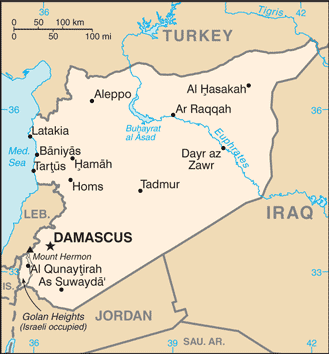
Turkish artillery fired on Syrian targets after deadly shelling from Syria hit a Turkish border town on Wednesday, sharply raising tensions on a volatile border that has been crossed by tens of thousands of Syrian refugees fleeing violence in their country.More from Hurriyet:
Targets in Syria has been bombed in return to a deadly attack which killed 5 people in southeeastern Turkey, Turkish Prime Ministry has said.NATO. Hmmmm. This could get nasty.
"These provacations against the safety of Turkey will not remain unanswered," the Prime Ministry said. "We have responded to the attack, and bombed targets in Syria."
***
An emergency NATO meeting had been summoned, and will take place in the upcoming hours.
The Prime Minister said Turkey's response abided with the international law, and came as self-defense.
UPDATE: The Turkish parliament has authorized cross border operations for its military, as set out here:
The Turkish Parliament has passed a motion allowing the military to conduct cross-border raids into Syria.UPDATE2: A WSJ report with a discussion of the NATO duty to come to the aid of an attacked NATO member, which Turkey is:
Some 320 deputies cast votes in favor of the motion, while 129 voted against it.
***
“All military targets have been hit by the shells. After this point, the process is down to the reaction of the opposite side [Syria]. They have now taken the lessons that they should have taken,” AKP Ankara Deputy Yalçın Akdoğan said.
Regarding opposition criticism of the mandate text, Akdoğan said: “There is nothing saying we have to go to a war in the text. The criticism of the opposition is political. Everything is clear in the text."
AKP Deputy Group Chairman Nurettin Canikli said there was an armed attack toward Turkey undetaken by the Syrian goverment. “Everybody needs to define their side. Are you on Turkey’s side or on the side of cruel al-Assad? Are you on the side of al-Assad, who has been shelling his own people including children? You need to make a decision on this.
Nobody in the Turkish Grand Assembly can defend the policy of a country who attacked this country [Turkey]. Our duty is to defend our country,” Canikli said.
Oh,yes, and the Syrian chemical weapons threat.
Tuesday, August 14, 2012
Somali Pirates: EU NAVFOR and NATO Spring a Pirate Trap
 |
| HNLMS Rotterdam |
After a three day hunt by NATO and EU counter piracy forces, HNLMS Rotterdam in close cooperation with EU unit FGS Sachsen, has successfully disrupted a pirated dhow.More info at
This end game took place in the coastal waters of Somalia. The crew has been freed and is in good condition. The suspected pirates will be transported to Rotterdam and will be detained awaiting further decisions on the follow-on process.
Two Pirated Dhows Freed in the Last Three Days:
And yet more from Marine Log:On 10 August, a suspicious dhow, reportedly pirated in Bosaso – Somalia, was located off the coast of Oman by the Spanish EU NAVFOR Maritime Patrol and Reconnaissance Aircraft (MPRA). The French EU Naval Force frigate La Fayette was dispatched to intercept and investigate the dhow. Early on Saturday morning an unopposed boarding found the pirates had left the dhow, leaving the vessel and the crew in good condition. According to the crew, the suspected pirates fled the scene on a second pirated dhow.
FGS Sachsen
The German MPRA located the fleeing dhow. With this information, EU Naval Force frigate FGS Sachsen was able to intercept the second pirated dhow on Sunday evening, heading south towards the Somali coast. The Sachsen kept pressure on the suspected pirates and was joined by EU NAVFOR flagship ITS San Giusto and the NATO flagship HNLMS Rotterdam.
ITS San Giusto
The presence and the deterrence of naval units, their helicopters and the sea craft deployed by Rotterdam, kept constant pressure on the suspected pirates preventing them to receive any aid from land or to escape to the shoreline.
After careful considerations by the Commanders of EU NAVFOR and NATO, HNLMS Rotterdam’s amphibious craft blocked the dhow’s path to the shorelines forcing it to stop. With EU NAVFOR ships and helicopter providing surveillance and close protection, a Dutch team was able to board the dhow, freeing its crew and apprehending 6 suspected pirates. They are now detained onboard HNLMS Rotterdam, awaiting further decisions on the follow-up process.
.jpg)

NATO Press Release (pdf)"To us it seemed highly unlikely that the pirates would want to return to Bossaaso," said Commodore Ben Bekkering, Commander of NATO's counter piracy mission, Operation Ocean Shield. "The authorities there make no secret of their intentions to eradicate piracy. However, to the east of Bossaaso two hijacked ships are still held by the pirates, who seem to be present in the nearby villages as well. We expected the pirates to go there, possibly asking help from their colleagues. We therefore decided to station Rotterdam off the coast, deploying her landing craft in a number of locations, effectively blocking any retreat from or support of the dhow. As expected, the dhow entered the trap. It was then up to Rotterdam."
"For the pirates it must have been a strange site," said Captain Huub Hulsker, Commanding Officer of HNLMS Rotterdam. "Not just Rotterdam and FGS Sachsen from the EU Naval Force Somalia (EUNAVFOR) following closely, but also a helicopter and few landing craft ahead making the coast almost impossible to approach.
Rotterdam Boarding Teams Approach Pirated Dhow (NATO Photo)
"There was not really anywhere for them to go. Obviously, the main thought is always for the safety of my crew and that of the crew of the dhow. But the situation was clear and some strict orders and two warning shots later, the suspected pirates surrendered. The boarding team was on board and in control of the vessel within the next 20 minutes. A grateful dhow crew, an impressive first action of my whole team early in my deployment and six suspected pirates detained on board, awaiting further decisions - this is a result that counts."

Nicely done!
Tuesday, May 08, 2012
Somali Pirates: NATO - Taking on the pirates
Challenges and stuff in dealing with pirates that no one seems willing to punish.
An older video from the NATO Channel: "NATO - Taking on the pirates"
An older video from the NATO Channel: "NATO - Taking on the pirates"
Thursday, April 05, 2012
Somali Pirates: 15-Month High in Pirating?
Reported as Somali Pirate Hijackings Increase to 15-Month High, AKE Says at Bloomberg:
Here's what to take from all this - the pirates are still out there and they continue to find ways to expand their search patterns for unprotected ships to hijack.
In looking at the maps, be aware that the NATO red markers are "pirated" vessels and the IMB red markers are "actual attacks."
On the other hand, Reuters reports:Somali pirates hijacked 10 ships in March, the most since December 2010, and may attack larger merchant vessels this month, AKE Intelligence said.
NATO's Map of pirate attacks last 30 days
**
Somali pirate attacks rose to a record 237 in 2011, with ransoms worth $160 million paid to release 31 hijacked vessels, a One Earth Future Foundation report released Feb. 8 showed. Pirates based in Somalia cost governments and the shipping industry as much as $6.9 billion last year, One Earth estimates.

They both could be right, though the NATO map of hijackings over the last 3 months only shows 3 hijacked ships, so there is some issue about what counts as a "hijacked ship" and whether NATO is only counting, as indicated in the section I highlighted above, those "pirated for ransom.""PIRACY counter-measures have returned the rate of successful hijackings to pre-2007 levels, a NATO naval officer has told reporters.
IMB 2012 to date
Just six ships have been pirated for ransom in the past eight months, from “36 in the preceding eight", Lieutenant Commander Mehmet Elyurek said yesterday aboard the missile frigate Giresun, the Turkish flagship of the force NATO operates off the Horn of Africa, Reuters reported.
The rate of successful hijackings had "almost returned to pre-crisis (2007) levels", added Elyurek, who noted that more merchant ships have turned to armed security guards, razor wire and pirate-pummelling water pumps.
***

Here's what to take from all this - the pirates are still out there and they continue to find ways to expand their search patterns for unprotected ships to hijack.
In looking at the maps, be aware that the NATO red markers are "pirated" vessels and the IMB red markers are "actual attacks."
Wednesday, February 29, 2012
Somali Pirates: "Pirates kill 2 hostages on hijacked vessel" - 16 Freed by Danish Navy

Two hostages were killed and 16 others freed when a Danish warship intercepted a cargo vessel that had been hijacked by pirates off Somalia's coast.Good on the Danes. Sorry for the hostage life loss, but the Somali pirates are to blame for hijacking the ship in the first place. From the Danish Navy (Google translate version):
Navy spokesman Kenneth Nielsen said Tuesday that 17 pirates were detained in Monday's anti-piracy operation. He declined to give the nationalities of the hostages.
Danish ship HDMS Absalon had been following the hijacked vessel for several days, Nielsen said. The cargo ship had been used as a mothership from which pirates sailed out in smaller boats to attack other vessels.
HDMS Absalon
He said HDMS Absalon intervened when the vessel tried to move away from the coast on Monday. "(It) stopped the mothership before it could become a threat against the shipping on the open sea."

ABSALON has stopped another pirate mothership The ship was stopped by ABSALON yesterday. The Danish warship Absalon has on 27 February 2012 halted a pirate mother ship. During the incident two hostages on pirate mother ship killed. ABSALON has for several days been watching a pirate mother ship off the Somali coast. Sunday night attempted pirate mother ship to sneak away from the coast. ABSALON was inserted and stopped the mother ship before it could pose a threat to shipping on the high seas. As neither the call, or cry unto warning shot to bring the pirate mother ship to a stop, was ABSALON strength of the NATO head allowed to firing equipment aboard the mother ship piracy, with a view to bringing the vessel to a stop. This fire was on board suspected pirates to surrender. ABSALON crew could then take control of the pirate mother ship. On board the pirate mother ship took ABSALON crew 17 suspected pirates and 18 hostages from the mother ship's original crew. Two hostages were found badly injured, and even with a rapid assistance from ABSALON doctor stood their life to save. The circumstances that led to the two hostages were killed is not yet known. Military Auditor Corps investigates the facts surrounding the incident. Danish authorities will, in line with the actual course of events relating to the hijacking of the mother ship clarified assess the possibilities to prosecute suspected pirates. Anyone from ABSALON's crew is in good shape.
Dnaish Navy photo of pirated vessel

Sunday, January 08, 2012
Somali Pirates: Royal Danish Navy Frees Hostages, Nabs Pirates

A Danish warship freed 14 Iranian and Pakistani hostages following a seaborne action against alleged pirates off Somalia's coast, the Danish Navy said late Saturday.
"The operation took place as planned and without harm to the ship's crew, the hostages or the pirates," said Carsten Fjord Larsen, Captain of the warship Absalon, which conducted the action, in a press statement.
The Danish Navy is now considering what further action to take with the 25 alleged pirates who were found on board, and how to send home the hostages.
On Saturday morning, the Absalon, which is part of a NATO-led anti-piracy operation, pursued a fishing boat it had suspected of being a pirate mother ship for some time, off Somalia's coast in the Indian Ocean.
HMDS Absalon
"After three hours, the 25 pirates gave themselves up. Some began to throw their weapons overboard, and others followed," Larsen told DR News, Denmark's public broadcaster.
The Absalon fired warning shots and gave verbal instructions to the pirates to surrender, he added.
On inspection, the fishing vessel, which was previously hijacked by pirates, was found to contain small motor boats and fuel, allegedly used by the pirates.
Both alleged pirates and hostages are now being registered and questioned, while the fishing vessel is held alongside the Absalon with a view to returning it to its rightful owner.

Subscribe to:
Posts (Atom)