
 On October 25, 1944, at the seminal battle of Surigao Strait, the battleships USS Mississippi, USS Maryland, USS West Virginia, USS Tennessee, USS California and USS Pennsylvania "crossed the T" of a Japanese fleet in the last great surface ship engagement.
Of the six battleships of the U.S. Navy involved in the action, five had been either sunk or damaged during the Japanese attack on Pearl Harbor. This is a brief look at how those five were returned to the fleet.
While mine warfare gets little respect in the United States Navy, there is probably no area of the American Navy that is ignored as much as salvage operations. This is surprising, as a ship restored to duty is just as valuable a ship built from scratch and probably carries substantially lower costs depending on the systems that can be restored.
As history now tells us, the attack on Pearl Harbor was not a death blow to the United States Navy. If the purpose of the raid was to invoke a mass sailing of the surviving fleet to a mid-ocean sea battle, that mission failed, too.

Indeed, as laid out in Pearl Harbor: Why, How, Fleet Salvage and Final Appraisal by Vice Admiral Homer N. Wallin USN (Retired), of all the damage the Japanese could have done to the Pacific Fleet, what they did was far less than what they could have, and probably should have done. See also here.
While some older battleships were damaged, only three -one being the Arizona - and the other two (the target hulk Utah and the capsized Oklahoma) were not re-floated and refurbished to serve again, along with newer, faster and more powerful battleships, submarines and aircraft carriers that eventually swept the sea of the Japanese fleet.
But this post is meant to be a brief homage to the men who salvaged the old battle wagons and made them seaworthy enough to be sent to shipyards where they were gutted, refitted, improved and sent back to the Pacific - back to fight the Japanese. Here's list of the damaged battleships and what happened to them (as set out here) as set out by Vice Admiral Wallin, the officer (as a Captain) for the recovery of the ships:

- The lightly damaged Pennsylvania gave promise of being one of the first ships to be ready for action. The Navy Yard expedited the lining up of her shafts and propellers. One of the 5-inch anti-aircraft guns was put out of commission temporarily and one 5-inch 51 caliber gun was seriously damaged by the same 250 kilogram bomb which exploded two decks below. The latter was replaced by a gun from West Virginia. The fragmentation and explosion damage was quickly overcome. The splinter protection, wooden deck, electrical gear, water mains, and structural steel were soon repaired and the ship was ready to leave the drydock by 12 December and the Navy Yard by 20 December.
- Maryland was berthed inboard of Oklahoma. She was struck by two 15-inch armor-piercing bombs. Fortunately both
 bombs had a low level of detonation. The first struck the forecastle awning and tore a hole about 12 feet by 20 feet and caused some damage in the compartments below. The second entered the hull at the 22 foot water level at frame 10. It exploded within the ship and caused considerable flooding. The bow was down about five feet. Since a dry dock was not available, the Navy Yard, assisted by the forces afloat, made repairs without docking. A small caisson was fitted over the hole on the port side. When sufficient pumping facilities were available to control the flooding, temporary repairs were easy to complete. Maryland was fully repaired and ready for action by 20 December.
 - Tennessee was moored inboard of West Virginia and became wedged hard against the forward quay as the latter ship settled and finally sank to the bottom. Arizona's oil fire engulfed the stern of the vessel and caused serious fires aft, especially in the officers' quarters on the second deck.

The explosion of the magazines aboard Arizona showered Tennessee with burning powder and debris. The forward magazines were purposely flooded as a precaution against the many fires on the ship. These fires were ominous for a long period and were so intense as to warp the stern plates and cause some pulling out of hull rivets.
In order to minimize fires the vessel played several water hoses over the stern to keep the burning oil on the water at a distance. Also the engines were turned over to make five knots and the wake was effective in keeping the oil clear of the ship. There was no movement of the ship even when the engines were run at ten knots. This shows how securely the ship was wedged between West Virginia and the quay.
The vessel was struck by two bombs of the 15 or 16-inch armor-piercing type from high-level bombers. Both bombs had a low order of detonation, or perhaps did not explode at all.
The first bomb hit the centerline gun of turret II, causing the barrel to crack. All three guns were rendered inoperable. The second bomb passed through the roof plate of turret III and damaged the structure and the rammer of the left gun.
Several attempts were made to free the ship. About 650,000 gallons of oil were removed by pumping while work progressed on the quay and its buffer. The work proved more onerous than expected and was finished by dynamite blasting about 16 December. In the meantime, repair ship Medusa and the Navy Yard patched the warped plates by welding, and blanked off a number of air ports. When Tennessee was finally freed she was moved to the Navy Yard where all inside damage was repaired. The ship was ready for service by 20 December. - Nevada was beached to prevent sinking on 7 December. She was located near the entrance channel with stern up against the shore and bow in deep water. Her draft when flooding of compartments had been completed on the following day was about 48 feet forward and 391/2 feet aft at high tide, which was about two feet above zero. This position was maintained by several anchors laid out astern, and she remained in such position until refloated in February. Her list at the time was about two degrees to starboard. This was to prevent any possibility of the ship's sinking in the channel which connected Pearl Harbor to the sea.
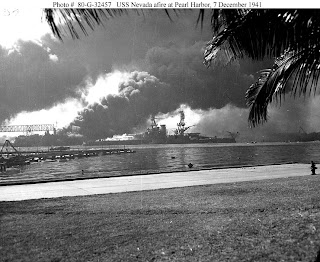
The Salvage Officer, Captain Homer N. Wallin, was optimistic with respect to Nevada as she had reciprocating engines as compared to the electric-drive battleships California and West Virginia which were in much worse shape. But, he was taken aback somewhat by the words of the new Commander-in-Chief of the Pacific Fleet, who, when viewing Nevada for the first time, remarked that satisfactory salvage seemed impossible and that we should not be over-optimistic. It should be stated here that when Admiral Nimitz arrived on 31 December 1941 he wanted very much to be shown the various "wrecks" in the harbor. Captain Wallin, who was then the Senior Material Officer of the Battle Force, was assigned to him for this purpose. What Admiral Nimitz saw was a ship entirely filled with water, with her bridge and forward controls entirely burned out, and with the forecastle wrecked by the bombs which exploded beneath. No wonder he was pessimistic!
Nevada was struck by a torpedo at frame 41 about 0810 about fourteen feet above the keel. The innermost torpedo bulkhead held but the joints permitted considerable flooding below the first platform. The original list was four to five degrees but this was soon corrected by counterflooding. The ship had started warming up the machinery and was able to get underway at 0840. While underway near the Air Station the signal was received that the ship should not leave the harbor but should continue to the west side of Ford Island.
About 0950 five bombs hit the ship almost simultaneously. Two struck the forecastle near frame 15. One passed out through the side of the second deck and caused near-miss damage. The other exploded within the ship after penetrating the structure near the gasoline tank. This caused gasoline leakage and vapors in that part of the vessel. This added to the many fires and the difficulty of extinguishing them. Another hit was near number I turret inboard from the port waterway. It blew large holes in the upper and main decks. A fourth bomb struck the port director platform in the foremast and exploded at the base of the stack on the upper deck The fifth bomb exploded directly over the crew's galley, at about frame 80.
New fires broke out immediately. They were intense around the foremast, the officers' quarters forward, and the crew's galley. The forward magazines were flooded, and by mistake the after group was flooded too. When the fires burned themselves out, the foremast structure containing the bridge was entirely destroyed. Air from the intakes was smoky and caused the boiler rooms to be abandoned.
Flooding was progressive and emanated primarily from the "bull ring" where the main ventilation air intakes were located. By Monday nearly the whole ship was flooded including the machinery spaces. This flooding continued for a month; only a few compartments were found partly dry when the ship was eventually drydocked.
The new Commander-in-Chief of the Pacific Fleet was concerned about the flooding of the after part of the vessel where practically no damage had occurred. He therefore requested a report for the benefit of future operations. Nevada's officers pointed out that the progressive flooding was due to the following causes:
a. Ventilation trunks permitted water to spread from the "bull ring" to various parts of the ship. There were inadequate closures in the ventilation system.
Salvage work commenced promptly. The bomb holes forward were covered by wooden patches externally as shown in the illustration on page 217. These are known as "window frames" and are held close to the hull plating by hook bolts manipulated by divers. Of course the water pressure assists.
b. The second deck was not watertight. As water spread on the second deck it reached spaces below through hatches and other openings. The second deck should have a large number of transverse bulkheads to prevent water from traveling forward or aft.
c. There was leakage around piping and electric leads passing through armored decks and bulkheads.
d. Although it was found that practically all "X", "Y", or "Z" closures were properly closed during the action, the flooding of the ship converted Nevada into a salvage job instead of a repair job.
As the water level is lowered the inflow of water was partially stopped by stuffing rubber mats and kapok material in the bomb holes and using shores to tighten them. In one instance a steel patch was welded by divers in way of a serious leak.
Where the torpedo hit, there was one void and two liquid layers of fuel oil. This was minimal protection against torpedoes and exists in major ships only forward and aft of vital spaces. The damage from the torpedo was roughly 48 feet long by 25 feet in depth. Over this it was proposed to fit a large patch, but it was found that internal bulkheads in this area were reliable and would prevent the spread of flooding. Although the seams and butts of the inner bulkhead were opened somewhat as a result of the explosion, the flooding from this torpedo hit was not enough to scuttle the ship or cause serious flooding.
The large patch was made up at the Navy Yard and made to fit the upturned bottom of Oklahoma, the sister ship of Nevada. It was delivered in early January but it was unwieldy for handling. Immediately dredging was resorted to and part of the docking keel was removed by dynamite charges. Divers were busy for a month to fit the patch but it was finally given up and the intact bulkheads properly shored and backed up with water pressure. The patch would have projected at least two feet below the keel, and therefore presented a docking problem. It was ascertained after docking that the blister had blown outboard about two feet, and, unknown to the divers, prevented the patch from seating properly. The large hole was therefore left open to the sea and the internal bulkheads were depended upon for restricting the flooding.
Gradual reduction of the water level in the flooded ship was accomplished by suction pumps ranging in size from 10 inches to 3 inches. As spaces were unwatered prompt steps were taken to plug holes used for drains or sanitary discharges. The ship's crew also cleaned compartments of oil and refuse as the level receded. Personal property was guarded, classified information was turned over to a central point, and steps were taken to assure proper care and preservation of electrical and other equipment.
Ammunition and stores were removed from the vessel, as was oil and fresh meat which was very smelly by this time. The ammunition was sent to the ammunition depot for reconditioning.
Credit should be given to the Acting Commanding Officer for the efficient work performed by the twenty men of the ship's force who remained to handle the salvage work. His name was Commander H. L. Thompson. The working force, which was recruited from the Receiving Ship and from the Salvage Division, performed valiantly in removing stores and ammunition. Oil was pumped into oil barges by the fuel oil pumps in the machinery spaces. These were operated by compressed air furnished by the compressors on barges alongside. The suction pumps on the oil barges were of considerable help. The valves for fuel oil lines were traced out by sense of feel by the divers.
The Engineering Officer should not be overlooked, as he was a true optimist. He predicted that Nevada would sail to the West Coast under her own power. It sounded fantastic at the time, but his prediction was correct, not only for his own ship but for all the sunken ships except Cassin and Downes. His name was Lieutenant Commander George E. Fee.
Naturally the living spaces and other compartments were a real mess. These areas had been under water for two months, and the contents of the compartments were strewn about. The first requirement was general washing down with sea water; thereafter a hot caustic solution was used to cut the oil which had permeated all materials and all spaces which were open.
It was determined early that the proper uniform for men of the salvage crew and ship's crew were rubber boots and a one-piece overall. These permitted the men to wade in oily water and to contact oily objects. Again, care was taken to guard all personal belongings and official papers.
Unwatering was a step by step process, in order to give the salvage crew time to plug leaks and to give the working crew time to clean up the spaces which were unwatered. Care was taken later when the ship was afloat to reduce to a minimum the free water surface. The use of small suction pumps in lower spaces facilitated this purpose.
The electrical gear held up remarkably well. At least ninety-five percent of it was salvaged, at least for temporary or limited duty. As the machinery spaces became free of water the motors were removed and sent to the Navy Yard for drying out and reconditioning. On account of the number involved, a Honolulu firm was requisitioned to assist with the work. Even the delicate electrical instruments like ammeters and wattmeters were found to be satisfactory and capable of salvage if prompt steps were taken for their proper preservation following unwatering. About this time "tectyl" was "discovered" by the salvage crew although the Bureau of Ships had become familiar with it before. Generous quantities of "tectyl" were used by all ships beginning with Nevada.
"Tectyl" is the trade name of a liquid substance which does wonders for machinery submerged in salt water. It not only absorbs what water remains, but furnishes a thin protective film over all parts. The treatment should be given before the air is allowed to cause corrosion after the removal of salt water.
The electrical wires or leads were found in relatively good shape. They could be dried out and used satisfactorily. The vital leads were finally replaced by the Navy Yard when the ship was sent to the Yard.
At about this time two fatalities occurred on Nevada due to poisonous gas. On 7 February Lieutenant James S. Clarkson removed a cap from the air test fitting of the steering engine room. He was in a trunk which had limited space and air volume. Several men went to his rescue, but too late as escaping gas killed him. Machinist Mate DeVries who reached him first, later died at the hospital. In all, six men were overcome by the gas. At once a Board of Investigation was called, and the Navy Yard chemist ascertained that the gas was hydrogen sulfide. It is odorless in high concentrations and acts without warning; it originates in stagnant water which has a quantity of paper products in the pressured space. Thereafter frequent samples of air were taken for analysis, and temporary ventilation was greatly increased on all ships under salvage. Confined spaces were not entered without wearing rescue breathing apparatus.
Besides the temporary ventilation which was provided as spaces were unwatered, temporary lighting lines were run. Both were essential for the efficient performance of the work.
As weights were removed and water was pumped out, Nevada gradually came afloat. She floated on 12 February and was drydocked in Drydock Number Two on 18 February. It had been the original intention to drydock the vessel in Drydock Number One which is a smaller dock and has less clearance over the sill. This was given up gradually as trouble was encountered with fitting the large patch over the torpedo hole forward. As recounted, the patch was finally discarded and the magazine bulkheads were depended on for relative watertightness. The holding bulkheads were backed up by water introduced in the magazines. This water was pumped out as the vessel took up on the blocks of the drydock.
The operating forces, especially Admiral Nimitz were concerned lest Nevada sink in the channel when jostled by the tugs which conveyed her to drydock. To forestall this, gasoline pumps were kept running and there was no re-sinking. Accordingly, on 18 February Admiral Nimitz and Admiral Furlong stood at the head of the drydock to show their support of salvage work. A commendation was received from Admiral Nimitz for all hands whose hard work and persistence made possible the satisfactory outcome of the operations.
The work of the divers is worthy of mention. Much of the diving forward could be done with shallow water diving outfits, which were widely used until it was discovered that the water was polluted. Nevada divers were helpful in finding the valves in machinery spaces and operating the right ones to permit the transfer of fuel oil from the ship's tanks to the oil barges. All of this work was done underwater and without lights. The ship had only two divers but they made 80 dives. Widgeon and Ortolan had over a dozen divers each and together they made over 150 dives. Even the Destroyer Repair Unit had a few divers who participated in the salvage work. Of major importance were the four civilian divers of the Pacific Bridge Company who made 160 dives for over 950 diving hours. In all over 400 dives were made on Nevada totaling over 1500 diving hours. The divers performed all manner of work from underwater cutting with oxy-hydrogen and electric torches to hydraulic and syphon excavating, to using dynamite to remove sections of the docking keel, to the use of hand and pneumatic tools for drilling and setting patches. They also did much interior work for pumping operations, adjusting watertight closures, etc. The successful accomplishment of all assigned diving tasks without casualty or injury was the result of excellent supervision on the part of Lieutenant Commander H. E. Haynes, who was in general charge of all diving, plus Gunner Duckworth of Widgeon, Gunner Arnold Larson of Ortolan, and Carpenter Mahan of the Salvage Division.
The Pearl Harbor Navy Yard took Nevada in hand once she was in drydock. The torpedo hole was temporarily made watertight. The bomb damage was also repaired, although it was necessary to build a new structure and new decks in various locations. The galley was made suitable for limited service. The damaged starboard shaft and propellers, and the rudder, were put in temporary good condition. These were damaged as the ship backed into the shore at Waipio Point. The six boilers were all rebricked, reinsulated, and properly tested.
The Navy Yard worked assiduously on Nevada and the vessel was undocked on 15 March 1942. The main and auxiliary machinery was thoroughly overhauled and tested. All Navy Yard work was completed on 22 April 1942. On that date Nevada joined a convoy for the West Coast and set sail for Bremerton, Washington. She traveled on her own power with both screws in use, arriving at the Puget Sound Navy Yard on 1 May 1942.
There the ship was thoroughly overhauled and modernized. She left Bremerton before the end of the year with a bristling array of modern antiaircraft guns. She participated in the Aleutian Campaign in December 1942, and later took an important part in the landings in France. Thereafter she joined forces in the Pacific and took part in the campaigns which brought victory at Iwo Jima, Okinawa, and Japan itself. Here was a ship which at one time looked like a total wreck but now was a formidable foe of the Axis Powers.
Nevada won seven stars in World War II as follows: one star for Pearl Harbor-Midway, one star for the Aleutian operations, one for the Invasion of Normandy (including bombardment of Cherbourg), one star for the Invasion of Southern France, one star for the Iwo Jima Operation, one star for the Okinawa Gunto Operation, and one star for the Third Fleet Operations against Japan. She also received the Navy Occupation Service Medal ( Asia clasp).
... Nevada was noted for the accuracy of her main battery of 14-inch guns. - (California) The Salvage Organization studied all jobs which lay ahead and came to some conclusions regarding the salvage of each particular ship. As a result there was little difference of opinion as the work progressed. The officers and men of the Salvage Division, the Navy Yard, and the Pacific Bridge Company were all included.
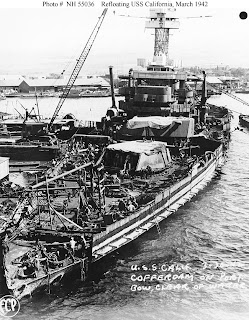
While work was proceeding on Nevada, the wooden cofferdams for California were well underway, and the patches for West Virginia were being put in place. Moreover, personnel were transferred from a ship which had been completed to the next ship scheduled for drydocking. Thus Lieutenant Ankers and Chief Carpenter Mahan were transferred, among others, from Nevada to California. The Salvage Officer, Captain H. N. Wallin, divided his time among all ships and concentrated on the one that seemed most in need of his services. ***
The crew of California affectionately referred to her as "The Prune Barge," because that state produced a large quantity of prunes for export. It did not seem possible that the old "Prune Barge" was helpless on the bottom of Pearl Harbor. The salvage of California was studied by many interested persons.
The salvage of California was somewhat similar to the work on Nevada, but the first ship was damaged much more severely and recovery of human bodies was involved. It was the recommendation of experts from Washington that a sheet steel bulkhead be driven entirely around the ship. But because of the nature of the bottom of the harbor, it was decided that the first work should be to close the torpedo holes with concrete patches. Before that could be done, it was necessary to wall off the water by driving steel sheet piling around the torpedo holes. But, as work progressed it was decided to reduce leaks through these holes from the inside and to eliminate entirely the patches on the outside.
While Nevada lost some men, none of the bodies were in the ship. All men had been blown overboard or killed near the impacts of the bomb hits. In the case of California, however, it was assumed that about fifty bodies remained in the ship.
Another important difference was that the whole quarterdeck and a part of the forecastle of California were underwater. While Nevada was driven by reciprocating engines, California was electric-driven. The experts at hand figured that the salvage of electric-drive battleships would require at least four years. All in all, then, the salvage of California was a much more difficult job than the salvage of Nevada.
California was struck by two torpedoes and one bomb. Serious damage was done by a bomb near-miss and minor damage resulted from bombs which exploded at a distance. A bad fire resulted from the bomb which struck the ship before it was stopped by the armored second deck. The vessel sank over a period of three days. This fact indicated that the torpedo bulkheads were reasonably intact.
Flooding of the ship was progressive due to open manholes, ventilation systems, and ruptured pipelines. Water and oil permeated the ship and caused abandonment of fire rooms and engine rooms. Unfortunately a serious oil fire from Arizona swept down upon California at 1000 on the day of the attack. This caused temporary abandonment of the ship and interfered with the steps being taken to keep the ship afloat. Except for this, California would no doubt have been saved from sinking.
The list of the vessel was to port, and at one time was nearly sixteen degrees. There was considerable concern lest the ship turn turtle as Oklahoma had done, or that she slide into deeper water on the port side. In order to reduce the list, counterflooding was resorted to, and two boiler rooms on the starboard side were purposely flooded. The Commanding Officer, Captain Joel W. Bunkley, asked the Material Officer of the Battle Force, Captain Wallin, if flooding by hose of the outboard starboard blisters would not be helpful, and this step was taken. The result was that the list to port was greatly reduced. It was about five and a half degrees eventually.
Unlike Nevada, California was not in battle condition at the time of maximum damage. Although attempts were made to assume condition Zed after the surprise attack was begun it must be realized that passing from X-ray to Zed at breakfast time on a Sunday morning was no easy task. The fact that unwatering showed many Zed closures open substantiates the fact that the ship never attained the proper closure.
A number of the manholes of the port blisters were off or were loose, which contributed to the loss of the ship. This permitted fuel oil to flow up from the fuel tanks near the torpedo hits and eventually to find its way to the lower parts of the vessel. This together with non-closure of 8-inch fuel lines and ventilation ducts, permitted gradual seeping of fuel oil and water to vital parts of the ship.
California was well designed. The holding bulkhead near the torpedo holes was adequate to its task. Except for a few discrepancies in the location of fuel oil lines and water lines the ship was entirely able to withstand the punishment received on 7 December. Staying afloat for three days and drydocking without a single patch attests to the toughness and ability of the ship. Adequate pumping, if it could have been supplied at the time, would have kept the vessel afloat.
The two torpedo hits at frames 46-60 and frames 95-100 respectively were the most serious damage sustained. The torpedo protection at these areas is approximately 11V2 feet deep consisting of five bulkheads. In each case the inboard bulkhead was practically intact. The torpedo hits were below the armor belts.
The near-miss forward was a serious threat because of the 3000 gallons of gasoline carried in this area for the seaplanes and for the motorboats. The gasoline lines were not ruptured although some leaks occurred. Most of this gasoline was drained out during salvage operations. Flooding was general in this part of the ship, and that put the bow down several feet. A "window frame" patch was installed over the hole blown by the near-miss on the level of the first platform deck. This was effective but was blown off a few days before docking by the explosion of gasoline vapor in the area. The explosion was severe and did additional damage to the structure. Fortunately all hatches and doors were tightly closed and dogged at the time of the explosion. It is likely that a naked light, possibly with defective wiring insulation, caused the explosion. Later, additional ventilation was provided to prevent such explosions. Some additional areas were opened to the sea, but it was possible to isolate the damage and to proceed without attempting further patching. By this time it was ascertained that the pumps in use were more than enough to keep up with the water which found its way into the ship.
A 250 kilogram bomb did considerable damage at about 0845 on the day of attack. Although it killed a large number of people, it did not directly affect the ship's stability or floatability. It entered at the starboard upper deck level at frame 60, passed through the main deck, and exploded on the armored second deck. It caused a great deal of structural damage and a fire which was difficult to extinguish on account of the failure of water pressure at that time. The smoke from this fire, which was fought with carbon dioxide extinguishers by men using old type rescue breathing apparatus, infiltrated the second and third decks. The smoke found its way into the forward engine room through the ventilation system. By causing the abandonment of the engine room it had a bad effect on the fortunes of the ship. The fire was finally put out by three minesweepers which came alongside.
A few high-level bombs were dropped on the starboard side, but these had little effect on the ship aside from slight damage from near-misses and some fragmentation damage to smoke stacks and starboard anti-aircraft guns.
After three days the ship came to rest with a list to port of about 5 1/2 degrees with a draft of about 43 feet forward and 57 feet aft. This put sea water over the port side forward and over turret IV on the quarterdeck. The ship was settled deeper in the mud than anticipated.
The first requirement was to unload the ship. This was partly accomplished by the removal of all guns from the turrets except turret IV which was below the water level. Eventually the ship and flag conning towers were taken off, the broadside guns removed, and the mainmast, which had previously been recommended for removal, was cut off at the base and taken off the ship. Plans were made to remove all safes aboard, the catapults, the boats, the cranes, and the anchors and many shots of anchor chain.
While this was being done a wooden fence-like cofferdam was erected around the quarterdeck, and in the forecastle area, which was flooded. The thickness of the timbers depended upon the pressures which were encountered; they varied from four inches to eight inches. The cofferdam was usually installed from barges in thirty foot sections. Each section was made watertight at the deck coaming, was braced by divers against fixed objects, and was fitted with bins for sand bags to overcome the positive buoyancy of the lumber. The weight of the sections was taken by a fore and aft timber which rested in the waterway. The heights were sufficient to prevent seawater from entering in case a greater list was experienced or if the vessel should take a starboard list when afloat.
About this time, material from the mainland began to arrive. The most important were the electric deep-well centrifugal pumps up to twelve inches in diameter. Although the ship received power from Ford Island it was self-sufficient with generators, air compressors, and drying out machines. These were set on the upper deck or some other dry spot on the ship.
The Navy Yard received some mechanics from the mainland who were extremely useful in the heavy workload ahead. Among these were carpenters to fabricate the cofferdams and make them tight against water pressure.
Most of the work was done by divers at this and later stages. A large part of it was done by the Pacific Bridge Company, which fabricated and installed the wooden cofferdams. Their six divers were kept busy bracing and making watertight the cofferdam around the quarterdeck. When the water level inside was below that outside, the flow of water was checked by stopping small leaks. At the deck coaming and between sections a soft material, or pudding, was used to attain watertightness. This was usually oakum enclosed in canvas.
Other divers were busy below decks plugging sanitary drains, ruptured piping, sea scuppers, and ventilation lines. The closing of all ports was one of the most important tasks. They also closed off the leakage resulting from open or loose manhole covers. This was done by driving shores or wooden wedges in ruptures admitting seawater or oil.
One big job efficiently performed by divers was the closure of gun ports on the port side. The Navy Yard made strongbacks which permitted the closures to be drawn up tight. After removal of guns it was hard to make the closures watertight except by strongbacks and wedges.
When the electric and the gasoline-driven centrifugal pumps were placed in the various trunks and compartments the water was circulated to overcome stagnation. This was kept up everyday. It was then discovered that the out-flow of the pumps was greater than the inflow of water, and it was decided that with additional plugging it would be possible to float the vessel without patches over the torpedo damage.
The lowering of the water level was kept in step with the removal of stores and oil, the care and preservation of the equipment which was uncovered, the removal of human bodies, and the cleaning of the compartments which were unwatered. A definite schedule controlled this work. As soon as turret IV was above water, inspection was made of turret rollers. It was found that aside from slight corrosion and discoloration the rollers and their paths were perfectly all right.
The Salvage Division never did get enough men to do a satisfactory cleaning job although men from the Receiving Station were added from time to time to augment the ship's force available. The amount of cleaning which is necessary in a sunken battleship is well-nigh incalculable. The maximum number required was about 500 men; at first only 6 officers and 48 men were available.
As the ship was pumped down in accordance with the schedule, divers plugged leaks in the structure and steps were taken to preserve machinery. A hot caustic solution was applied to machinery equipment as well as to all surfaces immediately after original wash-down with seawater. This was followed by fresh water, and machinery items were treated to a bath of "tectyl" to prevent corrosion. Many items were put on a barge and sent to the Navy Yard. They were tagged for identification under the able direction of Lieutenant Commander J. A. McNalley who was in charge of preservation and identification. Eventually these items were sent to the Navy Yards at Puget Sound and Mare Island, but those needed for the homeward voyage were retained at Pearl Harbor. Because of the large number of electric motors on California all those not needed for the voyage to the mainland were preserved in place aboard ship. Lieutenant J. W. Darroch was in charge under Commander McNalley, and did a good job of preserving and drying out these electric motors.
On the second and third decks of California a number of human bodies were encountered. It was the practice to stop the pumping in time to leave about two feet of water above the deck. The bodies were then floated into large canvas bags. These were securely tied and transported to the Naval Hospital at Aiea for correct identification and burial.
The removal of oil, ammunition, and stores went on continually. About 200,000 gallons of free oil were collected from various compartments. The free oil had a good effect in protecting machinery items from the seawater although, of course, it was also responsible for causing loss of life and the abandonment of certain battle stations. Stores were easy to remove when the water level permitted. The refrigerator spaces containing fresh meat were a notable exception. Ammunition was a valuable factor in reducing weight, especially the 14-inch shells and powder.
Mention should be made of the oil-skimming operation, which was followed in all ships. This was a part of the free oil recovered, and was used at all times particularly before final pumping at any deck level. All classified information and personal effects were turned over to the Commanding Officer for proper handling and disposal.
The experience aboard Nevada warned of the danger of toxic gases. Great care was taken to avoid subjecting the men to this danger. Before any compartment was entered the air was analyzed by the Yard expert, Lieutenant Commander C. M. Parker (Medical Corps) of the Industrial Department. He was available at all times and was a frequent visitor to the ships under salvage. Lieutenant Ankers and Carpenter Mahan were charged with watching for gas hazards. One of these officers was aboard at all times. Temporary ventilation was furnished for all spaces and temporary electric lights were installed in all compartments. All men were outfitted with boots and coveralls.
As the machinery spaces were emptied, great care was taken to preserve the electric-drive alternators and motors. It was hoped they would be usable for the voyage to the mainland. The mechanical parts were washed out with fresh water and "tectyl." The electrical parts were cleaned and dried. The instruments in the control room were sent to the Navy Yard as quickly as possible following removal from the instrument board.
Shortly after docking Commander Hyman G. Rickover arrived from the Bureau of Ships. He had a plan for reconditioning the electric-drive machinery and had consulted with General Electric and Westinghouse Companies as well as with the Puget Sound Navy Yard. He held a conference on 11 April. He had with him a representative of the Puget Sound Navy Yard, Mr. McConnell, and Mr. C. E. Wilson of the General Electric Company. It was decided that electric motors which were subjected to high voltages could not safely be dried out and re-impregnated. This method was only suitable for low voltages especially in a ship which was twenty years of age at that time.
It was not long before General Electric had fifty-three men working on one alternator and two motors. It was their estimate that the electric machinery necessary for a trip to Puget Sound could be completed in about four months. It was decided that one set, consisting of one alternator and two motors, would be cleaned in place and dried out for the voyage, and finished while other work was being performed at Puget Sound. All vital wiring and instruments were replaced at Pearl Harbor. The machinists, electricians, and riggers from the Puget Sound Navy Yard were partly responsible for the fine record made.
The turbine end of the electric-drive machinery gave no important trouble although it required the usual attention due to corrosion in some degree and the presence of fuel oil.
As for the boilers which had been submerged for four months, they were found to be in good condition although, as done on Nevada, it seemed best to rebrick and test them.
California came afloat on practically an even keel or a slight list to port on 24 March 1942 and was placed in Drydock Number Two on 9 April 1942. At that time her mean draft was about forty feet. Before docking, the wooden cofferdam around the quarterdeck and on the forecastle were removed from the vessel. As customary, the Commander-in-Chief of the Pacific Fleet and the Commandant of the Navy Yard were at the head of the dock to welcome California. In the spring of 1942 the office of Fleet Maintenance was established under Rear Admiral C. A. Dunn; after arriving at Pearl Harbor he was never absent from significant events in the salvage operations.
California remained in dock, subject to seventy-two hours notice, until 7 June 1942. During this time the Yard made permanent structural repairs to almost all the ship's damage. After a few trial trips she left Pearl Harbor under her own power on 10 October 1942 and arrived at the Puget Sound Navy Yard on 20 October 1942. There she was modernized and fitted out with forty 40-millimeter Bofors in quadruple mounts and forty-eight 20-millimeter Oerlikons in single mounts. The ship was entirely new with greater beam, greater stability, greater protection, and 154 miles of new electric cable.
Credit for the successful salvage of California has to go to the Navy Yard personnel as well as to the Salvage Division. Of the former we must not overlook the Planning Officer, Captain Fred M. Earle, and his able assistants. In the Salvage Division, by far the hardest worker and the one who set the pace for all others was Lieutenant Wilfred L. Painter. His assistants were Generaux, Bjork, Greely, Walker, Ankers, and Mahan. The Manager of the Navy Yard, Captain Claude S. Gillette, was helpful at all times, especially in reconditioning the electric-drive machinery, with which he was intimately familiar since he had served as Engineering Officer in one of these ships. We must not forget Lieutenant Commander J. A. McNalley who did so much in preserving and reconditioning all machinery parts and electric motors. He was a real optimist! The Pearl Harbor Repair and Salvage Unit under Commander Horne was on the job during most of California's salvage and did much good work in cleaning and preserving electric equipment as well as stringing temporary lighting cables.
California remained at the Puget Sound Navy Yard somewhat less than one year. After that she joined the Fleet and participated in the Marianas Campaign, bombarded Saipan under Rear Admiral J. B. Oldendorf, and bombarded Guam under Rear Admiral Richard L. Conolly. She was a part of the American forces at the famous Battle of Surigao Strait in which she, on 25 October 1944, pumped over sixty 1500-pound projectiles into a Japanese battleship of the Fuso class.
Thus, U.S.S. California came out of a watery grave and won seven battle stars against the forces of Japan before World War II ended. They were for Pearl Harbor-Midway, the Marianas Operation (Saipan, Tinian, Guam), the Leyte Operation, the Luzon Operation, the Okinawa Gunto Operation, and for Third Fleet's Operation against Japan. - (West Virginia) Here was a ship much more severely damaged than California or Nevada. Salvage was getting harder as the work progressed. Few there were in the early days after the Japanese attack who believed that West Virginia would ever float again, much less be a formidable ship against Japanese sea power. Yet, so it turned out to be!

The pet name for this formidable ship was the "Weevie." Most of the crew and officers were transferred to other ships and only a skeleton crew remained on board. The high command was hard pressed for experienced men to man the ships of the fleet, and after all, it did not seem reasonable to assume that "Weevie" would ever fight again.
The vessel was hit by as many as seven torpedoes; the exact number is questionable because of the extent of damage on her port side. At least three torpedoes struck below the armor belt and one or more hit the armor belt knocking it askew. Seven armor plates and their keys were ordered by the Puget Sound Navy Yard. One or possibly two torpedoes entered the ship through the holes made by the first torpedoes when the vessel was listed about 20 to 30 degrees. These exploded on the armored second deck; and one hit the steering gear and wrecked the area aft, besides knocking off the rudder. Two bombs struck the ship but fortunately they were both duds.
The torpedoes virtually opened up the whole port side. It was the composite opinion that a patch was required over the two major holes extending from the waterline to the turn of the bilge. One such concrete patch was needed at frames 43 to 52, and another of ample proportions from frames 61 1/2 to 97 1/2. The steering area could be isolated, and the rudder picked up from the bottom of the harbor in due course.
The torpedo bulkheads were severely damaged. The holding bulkhead was ruptured far more than in the case of California, and the intervening transverse members were badly accordianized.
The bombs which struck 16-inch turret III and the foretop respectively did little damage. Both were the armor-piercing type of 15-inch projectiles.
The first passed through turret III's top but failed to explode within the turret. The other passed through the foretop and was found later unexploded in the debris on the second deck.
Serious damage occurred due to an oil fire which was not extinguished for thirty hours. Part of the oil was washed in from Arizona and part of it came from the ship itself which was about 70 percent loaded with fuel oil. This fire caused warping of a large area of deck and bulkhead plating amidships. A peculiar aspect of the fire was that when it was put out in one area it broke out in another.
West Virginia suffered some damage from being pinched by Tennessee when that ship wedged against the forward quay. Some damage to the bilge amidships was caused. But this may have prevented West Virginia from capsizing in the early stages of the attack before counterflooding was effective. In any event it reduced the amount of heel.
Salvage work began while similar work was underway on Nevada and California. The experience which the salvage crew gained on those two ships was useful for the West Virginia job.
One significant aspect of the work was the use of underwater concrete. By this time, too, the electric driven deep well pumps of up to a ten-inch discharge, were available. Also, the gas hazard was recognized and steps were taken to consult Commander Parker of the Medical Corps frequently. In fact, regular tests were run in various parts of the ship, especially those recently unwatered, to assure that the air was safe before men entered without gas masks. By this time, too, the men had regular "tank" suits, as coveralls were now called, which were laundered continuously by a contractor in Honolulu. Men engaged in particularly dirty work were furnished knee-length rubber boots which were readily cleanable. ***
The underwater concrete was a great success. It extended from above the waterline to below the turn of the bilge. This material was used to seal the ends of the large patches as well as the bottoms of each individual patch. Its efficacy was proved by the fact that in drydock it stuck so well to the hull of the ship that small dynamite charges were required to break the concrete loose. We were extremely fortunate that the Pacific Bridge Company was present and available to handle the design and installation of these patches, and to make the large number of dives which was necessary to make the patches watertight.
It is not practicable to give a complete description of the concrete-sealed patches, but some information should be included. In the first place, the patches were usually in thirteen and a half foot sections. Each section was about fifty feet long or deep. The bottom portion followed the contour of the ship, and the patch was pulled up snugly by means of hook bolts spaced horizontally every twelve feet or so. The hook bolts were spaced by divers and hooked into the side plating through holes burned by an underwater gas or electric torch. These bolts passed through the patches and were fitted with butterfly nuts. The mud which covered the bilge was washed away by waterjets. The bilge keel was cut away where it fouled the patch, but in most instances the patch fitted over it.
The joints between patches were made watertight by using old rubber hose for gaskets, and drawing one patch to another by lug bolts.
The patches were made of four-inch planking. The 4-inch steel "I" beams and the 10-inch steel "H". beams were set vertically. *** Fore and aft wales of 12" x 14" timbers were spaced about four and a half feet apart. These members were shored directly to the armor belt. Negative buoyancy at the time of placement was obtained by a lead weight placed on an angle iron shelf on the outside of each patch. The clearance between the armor and the inside of each patch was about eighteen inches. This gave sufficient room for a person to work between the armor and the patch. The forward patch had one door and the after patch three doors for divers to pass from the outside to the inside of each patch. After concrete was poured these doors were secured.
The final operation was the pouring of the underwater concrete to seal the bottoms of all sections and the sides of end sections. All were poured in succession from a steel barge on which had been placed a mixing machine. The concrete was a rich mixture consisting of one part cement to three and one-half parts of aggregate. The contractor utilized the Tremie process which he used in drydock construction. Ten-inch Tremie pipes were about ten feet apart. Care was taken, as is usually the case, that the concrete mixture did not disintegrate in the water. The concrete was installed about four feet deep along the bottom of each patch and at each end. In all 325 cubic yards, or about 650 tons of concrete were used.
As soon as the concrete patches were finished the deep-well pumps were started to reveal large leaks in the patches, or elsewhere. It was easy to exceed the inflow when the leaks were rectified by the divers. Soon the salvage crew was in command, and it only remained to reduce draft by removing weights still in the ship.
These weights consisted of free oil which was skimmed from the surface of each level by use of a skimmer operated by an electric motor. Fuel oil, which totaled about 800,000 gallons, was also removed. About 40,000 gallons of free oil was picked up by the skimmers. This was only half of the free oil in California. However, West Virginia had only 70 percent of its fuel oil aboard whereas California had 100 percent. The fuel oil was taken out by ship's pumps operated by air, as in California. All of the 16-inch shells and powder were sent ashore. This was a sizable weight. Many of the regular stores and canteen stores were landed also. Experience proved that the removal of fresh meat and dairy products was an unwholesome job, but a new method was devised. This consisted of pumping sea water into the compartments for several days, after which the meat was in shredded form and could be removed in its original bags without a noticeable stench.
The hazard of capsizing was always present because of possible failure of the concrete patch due to an enemy air attack or structural failure. Steps were taken to prevent this, especially when the ship was enroute to the drydock. Temporary patches, similar to a collision mat, were made to draw over any damage which might be sustained.
We asked to drydock in Number One instead of Number Two Drydock, if possible, because of the long time that West Virginia would require to make even temporary repairs. It should be understood that Number Two was a much larger dock with a greater depth over the sill and blocks. Therefore it had to be available for damaged ships returning from a fray with the Japanese. The use of Number One Drydock established our goal for a draft of approximately thirty-three feet, which was hard to attain for this severely damaged ship. But it was reached by removing the fresh water from the double bottoms and all unattached weights on board.
Air pressure was used extensively in West Virginia. It was tried out successfully in the area near the steering mechanism, and elsewhere wherever isolation of damage was possible.
Human bodies were handled as in California and were taken out almost unknown to the working parties. Sixty-six bodies were found throughout the ship. Several bodies were found lying on top of steam pipes which were in the air bubble existing in the flooded areas.
Three bodies were on a lower shelf of a storeroom near a fresh water supply. These men were clad in blues and jerseys. They presumably died from lack of oxygen. A calendar indicated that they had lived from 7 December to 23 December. They had consumed the emergency rations which were available at the battle station, which apparently was the fresh water pump. This area had not been flooded.
Great care was taken with the main propulsion plant. Little oil was allowed to percolate into the main units, and as they were unwatered prompt steps were taken toward preservation. The General Electric Company and Puget Sound working parties on California became available and went to work promptly on West Virginia. They reconditioned the steam end without much trouble, and were able to start at once on the alternators and motors. As a result West Virginia had all her electric-drive machinery restacked and rewound before the voyage to the mainland. This was the biggest job ever undertaken on a ship afloat.
West Virginia came afloat on 17 May and was received in Drydock Number One with blocks cut down to thirty-three inches on 9 June 1942. At that time she was practically on an even keel although she had been heeled to a maximum of twenty-eight degrees. When the salvage crew started working on her the draft was 50 1/2 feet forward and nearly 41 feet aft, with a list to port of about three degrees.
It might be observed that the smaller pumps were used to reduce the water level in storerooms and smaller compartments. Even the Barnes three-inch suction pumps were put to work, as were the four-inch and the six-inch suction pumps. The 440 volt Pomona and the Peerless ten-inch deep-well pumps were extremely effective in reducing the ship's water level.
Adequate ventilation was a must in West Virginia in order to reduce the gas hazard. Temporary lines were run by the Pearl Harbor Repair and Salvage Unit and hooked up to the ship's ventilation system. Temporary lights were rigged by the same crew, as lower compartments were unwatered.
Nearly all electric motors and auxiliary machinery were saved. This was due to the care exercised by Commander McNalley's crew. Preservation was the watchword. All vital items were reconditioned at the yard; all others were retained on the ship for delivery at a West Coast Navy Yard.
As usual, personal effects and classified material were turned over to the ship superintendent by order of the Commanding Officer. Great care was exercised, especially when personal lockers were emptied of their contents.
The enthusiasm and spirit of the crew deserves high praise. The commanding Officer, Lieutenant Commander W. White, and his first assistant, Lieutenant Commander Levi Knight, were fine leaders and performed through the months most admirably. They, with less than 500 men at any time, tackled almost a hopeless job. Yet they were able to clean up the ship, remove the dead, take off every weight that could be moved, set up and man an anti-aircraft battery of nine machine guns, and reduce the draft to permit docking in Drydock Number One. At the same time they established temporary living quarters on Ford Island, built a walkway to the ship, recommissioned the officers' and crews' galleys aboard ship, and from 27 April served three meals a day to all hands.
The Navy Yard's design and planning specialties were important to the success of salvaging West Virginia. Various shops also applied their talents to the work. Without them the operation of air compressors and ventilation blowers would have been greatly handicapped.
The Navy was fortunate indeed to once again have the personnel and the experience of the Pacific Bridge Company. Their abilities in diving work and in design and installation of the patches was an achievement which excited the admiration of all. Without them the work could not have been done. Gratitude was expressed to Messrs. Graham, Ginella, Freeman, and Rice who handled the outside work and to Messrs. Crocker and Foster who did so magnificently in design.
The Salvage Division itself was on the job constantly. No harder worker or more devoted man could be found than Lieutenant Painter who had been in charge of the California work, and who relieved Lieutenant Generaux so he could take the Plunger job. Lieutenant Painter was everywhere and spread enthusiasm and initiative. He was a Civil Engineer rather than a ship man. He was killed in Greece after the war by an explosion aboard a private yacht. His loss was a real one to his profession.
Other Salvage Division officers who stood out were Lieutenant commander Charles W. Rhodes, a machinery and electrical expert; Darroch, Liedstrand, Bjork, and Beauchamp-Nobbs, acting as Lieutenant Painter desired, especially in the installation of patches, the setting of pumps, opening of drain lines, and ventilation. During this time Commander McNalley spent only a small portion of his time aboard ship, but he was always active in reconditioning mechanical and electrical machinery.
Some reference has been made to the work of divers. Without them it would have been impossible to salvage West Virginia. They performed hazardous work, both inside and outside, without a casualty. These men came from the Salvage Division, West Virginia, Widgeon, the Submarine Base, the contractor, and the Navy Yard. In all from January to June, 527 dives were made totaling nearly 1400 hours. Nearly half of the hours underwater were done by the contractor. Credit for the fine record achieved goes to the meticulous officer in charge of all diving, Lieutenant Commander Haynes and his assistants who were Calhoun, Ephland, and Suggs.
In drydock West Virginia received the attention of the Navy Yard. It was agreed that the ship could be undocked to make way for any battle casualty, but none appeared. The electric-drive machinery was the governing job, so final repairs in lieu of temporary repairs were possible in most cases.
The Navy Yard did a great deal of work on West Virginia before her departure for the Puget Sound Navy Yard.
She sailed under her own power, as was the habit of Pearl Harbor's sunken ships. She was modernized by the Puget Sound Navy Yard with greater torpedo protection, increased stability and floatability, and a vastly improved anti-aircraft battery. ***
West Virginia left the Puget Sound Navy Yard on 4 July 1944 and took up the fight with the Japanese at the famous Battle of Surigao Strait where she poured ninety-three 16-inch projectiles into the Japanese Fleet. Before this she helped the landings at Leyte by bombardment. Later she took part as flagship in the Mindoro Operation, and still later she participated at Luzon, Iwo Jima, and Okinawa. She was present on 2 September 1945 when the Japanese surrendered formally on board Missouri. West Virginia was the first of the "old" battleships to steam into Tokyo Bay and to anchor off the Japanese capital. Such is the history of the ship which was "lost" on 7 December at Pearl Harbor. She had won five battle stars. - (Oklahoma) The Japanese planes which passed over the officers' boat landing at Merry Point seemed to concentrate their torpedoes on the battleships which were moored outboard near the northern end of the line. West Virginia was hit by as many as seven torpedoes, Arizona was sunk at her berth, and Oklahoma received from five to seven hits. Early in the onslaught she was put out of action and capsized at her berth.
It was realized that the salvage of this ship would require a combination of the steps taken on West Virginia and Oglala. The size of Oklahoma and her general condition made salvage questionable, although it was deemed important to rid the harbor of a derelict and to make the berth available for other ships. Accordingly, plans were made by the Salvage Division toright her and to refloat her for further disposition.
As early as May 1942 the Navy Department indicated a desire that Oklahoma be salvaged. Contractual arrangements were therefore made with the Pacific Bridge Company so that the company could get suitable priorities on required material, and at the same time could hire the right men for the job. A scheme of salvage was therefore drawn up which divided the responsibilities between the Navy and the company. In short, the scheme provided that the ship should first be righted and then floated to a drydock for repairs.
***
The righting of a ship weighing about 35,000 tons was no easy task. It was accomplished by various means. The important element was, of course, the installation of shore winches on Ford Island. These twenty-one electric winches were anchored in concrete foundations and operated in unison. Each electric winch was capable of about a twenty ton pull through a flexible one-inch wire cable operated through a block system which gave an advantage of seventeen. The three-inch cable, in order to increase the leverage, passed over a wooden strut arrangement which stood on the bottom of the ship about 40 feet high. Then the cable divided into four "cat tails" which were secured to lugs welded to the shell of the ship at frame stations. Calculations indicated that the hull strength was adequate. To assist the twenty-one winches it was at first proposed that submarine salvage pontoons be used on the port side. This was given up because of the difficulty of proper attachment, and the presence of mud. The air pressure proposed inside the hull seemed ample.

The air bubble method accounted for almost 20,000 tons of weight initially and was highly effective. It was used on the starboard side after the oil had been removed through the bottom. This totaled about 350,000 gallons of the 1,000,000 gallons originally in the ship. It was placed in oil barges as it was pumped Out by three-inch steam reciprocating pumps and air-driven pumps. A steam blanket was used to prevent explosions from oil vapors. This was provided for by having ex-Navajo moor alongside and furnish steam and electric power.
The air bubble was divided into five parts to prevent loss of air pressure or the whole ship at a crucial time. The air pressure was about 11-12 pounds, so that the water level was blown down to about twenty-five feet below the surface. This lightened the ship's weight considerably.
There was a large amount of weight in the ship which could have been removed prior to righting or refloating, but difficulty of access made this impracticable. About one-third of the ammunition was taken off but none of the 14-inch projectiles. Some of the machinery was removed from the dry evaporator pump room. The blades of the two propellers were taken off, more to avoid damage to them than to reduce weight.
The above methods assumed that Oklahoma would roll instead of slide. Tests, including soil tests, were made to check whether restraining forces should be used to prevent sliding toward Ford Island. It was indicated that the soil of the after two-thirds of the ship facilitated rolling; but the bow section rested in soupy mud which surely permitted sliding. To prevent this about 2200 tons of coral soil were deposited near the bow section, and anchorages along the port side were given up as not necessary.
Consideration was given to some dredging and removal of mud on the starboard side prior to righting, but this was deferred to assure that the vessel would rotate rather than slide. When Oklahoma was righted with a list of about fifteen degrees to port the excess soil under the starboard side was washed away by high pressure water jets operated by divers.
During and prior to the righting operation, care was taken that all purchases were equalized. This was accomplished by the use of strain gauges on the hauling wires at each bent or strut. The one-inch flexible cable was speeded up or slowed down to equalize these strain gauges. Observation posts were established on barges to note the effect of righting movements, and especially to note whether the ship was rotating or sliding.
The wooden bents became less effective as their leverage decreased when the ship gradually assumed a position approaching ninety degrees. When the list was about sixty-eight degrees to port the bents or head frames were cast off and floated clear. From then until the ship reached thirty degrees to port the pull was directly on the lugs welded to the port shell. Then the hauling cables were secured to the ship's topsides, especially to strong portions such as barbettes and the starboard crane foundation.
The ship rolled as desired. The stern section traveled a greater distance than the bow section toward the quays. This was because of the greater area of the stern. In any event, the vessel came to rest with a mean draft of 49 1/2 feet at high tide (high tide is something less than 2 1/2 feet above mean low water). The list to port was only 2 degrees and 10 minutes. The behavior of the ship was in strict accord with the models which were constructed and tested before salvage operations were begun. Oklahoma was right side up by 16 June 1943, the work having started 8 March 1943.
When Oklahoma was nearly upright, divers investigated the damage on her port side. They found that the port side was pretty well opened up from torpedo explosions which occurred before and during capsizing. They cut away structural wreckage and took necessary measurements for temporary patches. The topside damage was apparent; contact with the bottom had broken off the masts and most other superstructure. The divers found that a large patch was required from frames 43 to 75. This patch was 130 feet long and 571/2 feet high as it extended well under the turn of the bilge. In addition, several patches were installed, usually of wood and sealed with Tremie underwater concrete. For instance, one went between frames 31 and 43, another between frames 74 and 96.
The large patch was in five parts and was primarily steel and wood as shown on page 257. It was sealed by underwater concrete at the ends as well as at the bottom. The sections were made watertight by puddings between the sections. Again, underwater concrete was essential. In all over 1000 tons of concrete were poured. Hook bolts were used by the divers in drawing up the patches to the hull of the ship.
The main deck aft was underwater, but not enough to prevent refloating. However, in order to increase the waterplane area and in order to improve the stability during refloating a wooden cofferdam like Oglala and California cofferdams was installed from frames 85 to 115.
In the meantime the divers were busy jetting out mud, closing drains and sanitary outlets, cutting sluicing holes, closing watertight doors and hatches, etc. In due time they followed the reduction of the water level and closed off the main leaks in the hull and the patches.
During the last period of righting the weight of the ship was reduced by about 3500 tons through using the buoyancy forward of frame 30 and aft of frame 115. This was done primarily by deep-well pumps which quickly removed the water in those areas.
Then 10 ten-inch deep-well pumps augmented by lesser pumps were more than enough to lower the water level in the ship, but by this time the Navy Yard was in possession of twelve-inch pumps, both electric and diesel. In the main patch eighteen and twenty-inch electric pumps were used at a later date. As in other ships, the water level was reduced according to schedule which permitted adequate testing for toxic gases, plenty of ventilation and lighting, and removal of the 400 or more human bodies which were in Oklahoma.
In order to insure positive stability, some ballasting by sea water was scheduled in the machinery spaces. Great care was exercised by the Salvage Superintendent to insure that the ship would come afloat with a minimum of list. Actually she came afloat on 3 November 1943 with a mean draft of about forty-six feet and a starboard list of twenty-six minutes. The list was increased to about one degree to starboard and so maintained by pumping water from the port engine room to the starboard engine room. The hauling tackles were removed after the ship came afloat and the various leaks were well in hand.
Thought was given to the damage caused by teredo worms on patches after long submergence. This was found to be negligible, as was the teredo damage to the teak decking of the ship.
For the purpose of refloating very little weight was removed. However, prior to drydocking, attention was given to this important consideration. It was not practicable to remove stores, but anchors, chain, remaining oil, and so on were taken ashore. Mud in the ship was jetted to electric pumps by water jets in the hands of divers.
The ship was placed in Drydock Number Two on 28 December 1943 with a mean draft of thirty-six and a half feet and a list to starboard of nearly three degrees. The list was purposely put on the vessel in order to favor the port side and its patches. In order not to lose buoyancy the introduction of water to attain the desired list was not permitted; instead four submarine salvage pontoons, each having a lift capacity of eighty tons, were used on the outside of the main patch.
The total draft of Oklahoma was nearly thirty-nine feet because the main patch extended several feet below the keel. During the trip to the drydock the electric-driven pumps were replaced by diesel-driven. The list was taken off in drydock and the ship settled on the blocks provided without undue ncident. The pontoons were removed, and the patches were likewise taken off to expose the damage which the ship had sustained. *** A strict fire watch was maintained on board.
The Navy Yard employees were quick to start with temporary repairs. They worked from inboard to obtain watertightness of the hull inasmuch as the drydock was available for emergency dockings of damaged major ships of the fleet. Thus the drydock had to be vacated on seventy-two hours notice. However, no emergency developed, and Oklahoma remained there for several months. During her time at the Navy Yard she was stripped of guns and some of the auxiliary machinery. The ship was unloaded of ammunition and stores. She was decommissioned on 1 September 1944 and sold for scrap for $46,000 on 5 December 1946 to the Moore Drydock Company. On 10 May 1947 she left Pearl Harbor under tow of two tugs but was lost in a storm at sea about 500 miles northeast of Hawaii on 17 May 1947.
Much of the early salvage work was performed by divers under Lieutenant Haynes. This work was difficult and hazardous, but no serious casualty occurred to the naval divers or to the civilian Navy Yard divers. Only one casualty marred a perfect record of the contractor's divers.
Exterior steel work by divers was done with oxy-hydrogen torches; interior work with the oxygen-carbon arc. Precautions were taken to avoid explosions from fuel oil and gases. No serious explosions occurred although several small ones were experienced without serious injury. In all about 1850 dives were made with a total of 10,300 man-hours underwater.
Credit for a great job must go to the Salvage Superintendent, Captain F. H. Whitaker and his corps of assistants. The Navy Yard should be included as should the Pacific Bridge Company which had shown their proficiency in previous salvage jobs. The work of this company in setting up the winches, in making the soil tests, and in designing and installing the various patches is beyond calculation. The feats performed could not have been done without the cooperation of such men as Messrs. Graham, Ginella, Crocker, Davenport, Freeman, and Bisordi. Also, we should include the old Salvage Organization. It was they who made detailed plans of Oklahoma's righting and refloating.
In addition to Captain Whitaker, we should give credit to naval officers who spent time and energy in the long and arduous project. Among these who should be mentioned are the following: Greely, Liedstrand, Lindstrom, Tell, Baker, Leech, Morris, Calhoun, Chase, Keenum, Minor, Nordquist, Smith, Urbaniak, Hendon, Snow, Arbogast, Hall, McDonald, and Smith. To these must be added the enlisted personnel who assisted with the work, and also the Commandant and the Manager OF the Navy Yard, Admiral Furlong, and Captain Paine, who were an inspiration to those entrusted with the project.
Captain Whitaker's complete story of the salvage of U.S.S. Oklahoma may be found in the Transactions of The Society of Naval Architects and Marine Engineers, Volume 52 (1944). The original estimate dated 18 July 1942 may be found as Appendix F of this book. This is the estimate prepared by the Salvage Division while West Virginia and Oglala were being salvaged. - (Utah) This ship presented about the same problems of salvage as Oklahoma. However, she was a much older ship and was used only for aircraft target practice. She did not occupy a berth essential to the fleet. Some thought was given to using an air bubble to float the hull to the drydock for scrapping, but this idea was abandoned when it was revealed that Utah would not hold enough compressed air to make a safe trip to the drydock across the channel.
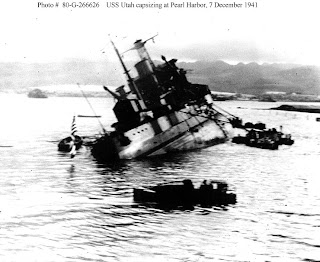
It was originally intended that the ship should be salvaged immediately after Oklahoma, but there was considerable doubt whether the time, energy, material, and cost warranted the operation. The ordnance gang under Lieutenant Commander Stelter and Gunner Manthei had already removed from this ship, and other disabled ships, considerable ordnance material. This consisted of anti-aircraft guns, ammunition, small arms, etc. Most of the fuel oil had already been pumped out through the bottom.
The decision was made by the Navy Department to forego salvage work on Utah as the space was not needed and economy did not warrant further work. The matter was taken up anew in 1956 when the Commandant of the Fourteenth Naval District pointed out that carriers of the Essex class had insufficient space in which to transfer ammunition, special weapons, and guided missile components. The removal of Utah would facilitate such essential transfers. The cost of salvage would be about $4,000,000 whereas the 7,000 tons of recovered steel would bring only about $30-$40 per ton. The Commandant showed, however, that the salvage of Utah would remove an obstruction from the channel and would obviate the necessity of building a new berth for the aircraft carriers.
This view was concurred in by the Service Force, the Fleet Maintenance Officer, and by the Pacific Fleet. The plan was to use the refloating of Utah as a training project for harbor clearance. The ship had already been partially righted. The list to port had been reduced to about thirty-eight degrees, but she sat in water which nearly covered her hull.The Bureau of Ships stated that since the decision of 1944, by the Chief of Naval Operations, the material required for righting the ship had been disposed of by sale, that the divers were no longer available, and that the project would consume one and a half to two years. Further, funds were not available and if the work was to proceed it should be under funds appropriated for the purpose.
The Chief of Naval Operations did not favor further work on Utah but had no objection to using the ship for training of divers and harbor clearance. He saw no emergency requirement which would warrant the project. He was probably influenced by the argument advanced a few years earlier that the final resting place of some fifty-eight men should not be disturbed. It was proposed that a survey be made to determine whether a new pier tangent to Utah could not be built for mooring and servicing aircraft carriers.
In any event Utah still remains at Pearl Harbor. She rests on the bottom although in a slightly different position than the bottom-up position she originally assumed. The Chief of Naval Operations has been consistent in his decision of April 1942 that because of the minor military value of Utah any salvage work should be directed toward her ultimate use as scrap. - There was no thought of raising Arizona because of her military value, but the divers and other salvors spent a lot of time investigating the wreckage. At one time it was believed that the after part of the ship was reasonably intact and that it could be raised if the underwater cutters could satisfactorily disconnect this portion from the rest of the ship.

The Ordnance Section was successful in removing from Arizona in the early days a great deal of the anti-aircraft battery with its ammunition. Much other ordnance material was recovered from the ship even as late as November 1942. The oil which fouled the harbor was gradually removed as it was released from the ship's opened tanks.Practically all of the survey conducted in the summer of 1942 had to be performed by divers, mostly from the inside of the ship. It was found that the bow portion was buoyant, the after portion relatively intact, but the central portion of the ship was badly wrecked. Lieutenant Ankers, assisted by Ensign Beauchamp-Nobbs and Carpenter Urbaniak make a thorough survey. Gunner Manthei recovered considerable ammunition from turrets III and IV. The 14-inch guns, except from turret II, were removed and offered to the Army.
It was decided that nothing further should be done toward salvaging Arizona, but that the ship should remain as a memorial to the men who lost their lives at Pearl Harbor. The hull of the ship is the final resting place of about 1100 men, including Rear Admiral Isaac C. Kidd.
In due time the topsides of Arizona were removed, and all projections from the hull were cut off by divers. A memorial structure was built transversely over the hull of the ship. It is supported by two concrete girders which weigh 250 tons each. This rests on concrete piling. The structure is 185 feet long with a width of 27 and 36 feet respectively at the ends to 14 feet at the center. The assembly area accommodates 200 people.
The memorial is reached by a boat landing, and access is gained by formal stairs at the harbor end. Included is a carillon and a shrine. The shrine has a marble wall on which are inscribed the names of the men who were lost on Arizona on 7 December 1941.
This structure is a fitting memorial to the 2335 service men who were lo st and the 1143 who were wounded on 7 December. It is painted white and is surmounted by the American Flag which flies day and night. The memorial is visited by many Americans and foreigners visiting Pearl Harbor.


Both ships received what was probably the most extensive reconstruction given to any of the Navy'sGive a salute to the salvors who saved the ships, honored the dead, risked their lives and did the impossible. Remember, too, the battleships were not the only ships damaged and restored to duty. Thanks to the salvors of WWII.
wartime major combatants, emerging with much heavier deck armor, a huge improvement in their anti-aircraft battery and modern gun directors. Standard displacement went up some 2500 tons, speed dropped slightly below 21 knots and beam increased to 114 feet, making them too wide to transit the Panama Canal. Their appearance was drastically changed, and now superficially resembled that of the brand-new South Dakota class. Tennessee completed her modernization in May 1943, in time to take part in the Aleutians Campaign. California, which needed extensive repair of her Pearl Harbor damage, was finished in early 1944. Both ships were heavily engaged in providing bombardment support for amphibious operations through the rest of the war. They were present for the World's final battleship-against-battleship engagement, the Battle of Surigao Strait on 24-25 October 1944, and stayed in action despite receiving "Kamikaze" damage in 1945.


Most photos from here and links therein.
UPDATE: Lots of the links from 2009 were no longer good, so I have gone back and updated them - after the original re-posting.


