VertRep

VertRep

Thursday, August 17, 2006

Fish tale? Fishermen rescued after 9 months lost at sea

Reported here:
Three Mexican fishermen who disappeared in the Pacific Ocean nine months ago have been rescued nearly 8,000 kilometres from their home, saying they survived by eating seagulls, drinking rainwater and reading the Bible.

A Taiwanese tuna boat scooped the men out of the water about halfway between Hawaii and Australia on Aug. 9. They had drifted all the way from San Blas, a fishing village about 160 kilometres north of Puerto Vallarta, Mexico, where they were last seen in late October or early November, 2005.
In a 26-foot long boat.

Of course, there is also some confusion:
Some reports said five fishermen were originally aboard the Mexican boat, but only three survived. Others said the men had only been at sea for three months. Friends and relatives of the men gave the National Post varying reports of when they had set out, saying it was in late October or early November, 2005. They agreed only three men were on board.

Wednesday, August 16, 2006

This can't be good news: "DoD Finds Cruise Missile Defense 'Gaps'"


Uh oh. DoD Finds Cruise Missile Defense 'Gaps':
Pentagon and Missile Defense Agency officials increasingly are concerned with the threat of terrorists using a cargo ship to fire cruise and ballistic missiles just off U.S. shores but outside its territorial waters.

“I am concerned about that,” MDA Director Lt. Gen. Trey Obering said at a breakfast with reporters in July 2005. Lockheed Martin is proposing an architecture of Patriot missile batteries and Aegis systems to protect the United States against Scuds fired offshore, he explained.

“We have also taken steps to upgrade certain [continental U.S.]-based radars to provide a coverage against an asymmetric threat,” Obering added. “We are looking at other alternatives that will provide coverage and would provide some protection.”

In August 2004, MDA provided a target to the Israeli Arrow program during an intercept test off the coast of California where a Scud target missile was launched from an ocean-going platform.

“It was not hard,” Obering said last year. “It was very easy to do. It was not technically challenging to do.”

When asked how that compares to a cruise missile, Obering said: “The thing about cruise missiles is we have a capability to shoot them down today. As long as we can detect them. We don't have the capability over wide areas to do that with ballistic missiles.” ***
The final capability gap involves not having enough weapons-delivery platforms available to cover the North American continent, according to the RFI, and even then, many of the available platforms are unable to “negate advanced cruise missiles and other irregular platforms.”
***
Developing a robust capability to intercept a cruise missile launched from a ship offshore is “very controversial around town,” with some believing a more likely scenario would be terrorists smuggling a weapon of mass destruction in a container cargo ship into a U.S. port, according to Ben Stubenberg, chief of analysis and scenarios at MDA.

However, the threat of a missile attack from commercial vessels off the coast “is something we need to worry about very much,” he said April 28 at a conference sponsored by Defense News.

Offshore bombardment “is not something new historically,” Stubenberg said. “Ever since the cannon was invented and they put those cannons and rockets and so forth on ships, this has been a problem.”

The challenge for the United States is that its long coast and dependence on shipping are among the factors that render it vulnerable to seaborne attack, he said.
See my earlier post on missile attacks from offshore "cargo" ships here.

Latest ICC CCS Piracy Report (to 15 August 2006)

Latest ICC Commercial Crime Services Weekly Piracy Report (to 15 August 2006) found here. Highlights:
-12.08.2006 at 0830 LT in posn 24:59.4N - 059:16.1E, Gulf of Oman, Iran. 12 pirates in a boat approached a container ship underway. Pirates asked the ship to stop but master (took) evasive manoeuvres. Boat approached the ship and suddenly increased speed. Master raised alarm and crew mustered and activated fire hoses. After 15 mins pirates aborted attempt.

-11.08.2006 at 2255 LT at Manila south harbour anchorage, Philippines. Eight robbers armed with guns boarded a container ship. Alert cadet on forecastle sighted a boat near bulbous bow. Master raised alarm, blew ship's whistle and crew mustered. Robbers ransacked forward locker and escaped with ship's stores. VTIS Manila and coast guard informed.

-11.08.2006 at 1910 LT at Callao anchorage no. 12, Peru. Four robbers boarded a bulk carrier via hawse pipe and forced open bosun store. C/O raised alarm and alerted crew. Robbers escaped in their boat empty handed. Port authorities were informed.

-08.08.2006 at midnight off Niger Delta region, Nigeria. Pirates boarded a supply tug and kidnapped four crew members and took them ashore. Pirates are demanding a ransom for their release. Owners are negotiating.

-04.08.2006 at 2030 UTC at Teluk Semangka anchorage, Indonesia. Eight robbers armed with knives boarded a tanker. They entered engine room and tied up and assaulted two duty crewmembers. Robbers stole generator spares and escaped.

Carnival Cruise Lines has another "oopsie"


Reported here:
A U.S. cruise ship's engine propeller struck the sea floor while docking Wednesday in the Bahamas, spilling oil and damaging the vessel, the cruise company said.

The Celebration was forced to abandon its planned stop in Nassau and return to its homeport in Jacksonville, Florida, a Carnival Cruise Lines spokeswoman said.
Didn't know the water depth or got off track?

Wait until the Federalist Society hears about this!

Nightmare in the Supreme Court, according to the Men in Black favorite source
Weekly World News:
A gypsy curse has transformed conservative Supreme Court justices into liberals, leaving GOP leaders howling like werewolves.

"This is obviously a huge blow to the party, not to mention the United States of America," said North Carolina Republican Senator Kurt Krewcut, 56.


Hope the Federalist Society is on the case.


Kurt Krewcut?

A critique of the US Navy's new Maritime Strategy

An analysis of the new US Maritime Stratgy from Sam Bateman of the Singapore-based Institute of Defence and Strategic Studies here:
...Admiral Michael Mullen, has recently announced a plan to develop a “maritime strategy for the 21st century.” He has foreshadowed that this will widen the Navy’s concept of sea power beyond its war-fighting role to include securing international shipping against piracy and maritime terrorism and using warships to deliver humanitarian aid. While previous maritime strategies have been based on unilateral sea control, the new strategy will have a strong cooperative flavor, recognizing the impact of globalization and common interests in safety and security upon the world’s oceans.
The author sees resistance from the US Army and Air Force as part of a competition for a limited pool of money and from other nations that may view the "cooperative" part as American Imperialism.

Tuesday, August 15, 2006

More NIMBY LNG Nonsense


At least the guy who wrote this is relatively honest. He wishes a proposed offshore LNG terminal will become someone else's problem:
For me, one of the 10 top risks "that disaster and homeland security planners worry about most" doesn't sound like a really wonderful sort of thing to have coming into our neighborhood. This is no time for Gloucester to play Mr. Rogers - please, please, don't be my neighbor.
His concerns, however, are based on the idea that the worst case scenario- a terrorist or otherwise induced gasline explosion - is not just a remote possibility, but the most likely of all scenarios.

This strikes me as a very awkward way to live out one's life. In this world view, applied broadly to everything in life, the odds are stacked way against you.

For example, you might end up living in fear of your automobile. After all, as set out here:
Consider that just two ounces of gasoline, or about as much gin as you'd put in your martini, has the explosive power of several sticks of dynamite.
And there is substantially more gasoline in your car's gas tank than I hope you might find in your martini glass. However, not to put too fine an edge on it, our anti-LNG author has perhaps not come to grips with the odds of dying. He might be interested in this piece which points out that heart disease and cancer are way more likely to get you than a terrorist blowing up a LNG plant or pipeline or even an asteroid falling on you from outer space.

If he gets worried about the asteroid, I wonder what neighborhood he will urge to volunteer to take the hit for him?

Pre-Paid Cell Phone Control


Last year, Malayasia announced a program requiring the registration of "pre-paid" cell phones as noted here:
All pre-paid handphone users will be required to register their personal particulars with their service providers under a new cabinet directive.

"The decision was made not just because of recent SMS abuses, but also for national security as we saw the London bombs were triggered off by mobile phones," Energy, Water and Communications Minister Datuk Seri Dr Lim Keng Yaik said Sunday.
Neal Boortz also reportedfrom July of last year that cell phone service had been "disabled" in certain key areas following the Londan attack:
Cell phone service was disabled in the four tunnels leading into Manhattan following the Islamic terrorist bombings in London. Now just why would they do that? Because cell phones make excellent remote detonation devices for bombs. As our troops in Iraq have found out too many times, any cell phone can apparently be rigged to blow a bomb as soon as the number is called. Quite convenient.
In my view, the registration of pre-paid cell phones is a logical security step.

UPDATE: Lttle Green Footballs coverage of pre-pay phone purchases here.

Monday, August 14, 2006

European drug sub


Reported here:
A submarine which police say may have been used for cocaine smuggling has been found floating off Spain's north-western coast.

It was spotted by a member of the public in an inlet along the rugged coastline on Sunday.

No drugs were found on board the vessel, but it is now being dismantled at a shipyard in Moana, near Vigo.

It is reported to be about 10m (33ft) long, made by amateurs from basic materials, not by professionals.


Photo: Faro de Vigo

Maritime Monday 22 posted at Fred Fry International

Always entertaining and educational, it's Fred Fry International: Maritime Monday 22!

Trinidad pirates found in Venezuela

Reported here:
The engines stolen and taken away on a boat after a bloody attack on Guayaguayare fishermen on Tuesday have been found by Venezuelan military officers in the coastal town of Perdanales in that country.

With the help of Interpol, officers from Trinidad went by sea to Venezuela on Friday with several victims to identify their property kept at a Guardia Nacionale base.

Police also have the identity of three of the thieves who raided the fishing depot near the Guayaguayare seawall in the pre-dawn incident.

Seven fishermen were tied up and beaten by the men, who forced the depot owner to open a steel door leading to the six engines worth $150,000.
***
The thieves are said to be part of an organised gang operating around Trinidad, stealing high-powered engines to sell on the black market, the Express was told.

Sunday, August 13, 2006

Somali pirate base captured by Islamist forces


Reported here:
Somalia's dominant Islamic militia seized control of a central township near the coastline that has been a base of piracy and dozens of hijackings of ships in the Indian Ocean, officials and residents said.

"The Islamic courts are in full control of Haradere and we were welcomed by its inhabitants, who were forcefully ruled by pirates," Sheikh Said Ali, an Islamic courts official, told AFP of the township that lies about 300 kilometres (185 miles) north of Mogadishu.

"The era of banditry and piracy is over. People can now live peacefully and get money by fishing and doing other businesses, but not piracy. The pirates have mistreated people in the territorial waters of Somalia and damaged our credibility," he added.
Of course, remember that some of the pirates allege they have been acting a a fisheries patrol to keep outside fishermen from Somali waters...

Littoral Combat Ships on parade


Reported here:
"There's a lot of appeal about what it can do," said Navy Cmdr. Joe Chiaravallotti, the Navy's littoral combat ship section head.

"Its concept is new and foreign to anything we've ever done before, and ... that, by its very nature, causes controversy. Until we put these ships out in numbers, that controversy is going to be there."

Independent analysts tend to give the program high marks, even with the increasing concern over cost. "The littoral ship is the star of the Navy's shipbuilding program," said Loren Thompson with the Lexington Institute in Arlington, Va.

John Pike, director of GlobalSecurities.org in Alexandria, Va., says the ship will be "fiendishly fast" and "certainly seems like a good idea right now."

But yet to be tested, he said, is how its unusual design will handle in rough waters.

"The crews aren't going to do you much good if they're all barfing," he said.

With the emergence of new threats after 9-11, Clark and other Navy leaders pushed for a light, high-speed ship that could ply shallow waters off-limits to larger, more conventional ships. Clark also wanted a ship that could be produced much faster than the normal cycle, which typically spans years.

"I didn't think we had the right kind of force structure to deal with the threats and challenges we were going to face in the 21st century," Clark said in a recent telephone interview.

Potential adversaries in the coastal environment, he said, could include "pirates, terrorists, who knows. You don't know if you're not there, and that's the whole point."

One of the most striking features of the emerging line of ships is what the Navy describes as "plug and play." The ships can be easily refitted for new missions with modules that enable it to switch between three main tasks -- mine warfare, anti-submarine warfare and surface combat.

They will be equipped with unmanned air and sea drones, an attack helicopter and smaller watercraft. Littorals are also designed to reduce -- though not completely eliminate -- detection by radar.
Like a lot of innoative sea concepts, the proof will be at sea.

UPDATE: A plan to have the LCS sailors qualified to do their jobs before they report aboard here. What a concept:
Commander, Naval Surface Forces, is overseeing the development of a revolutionary training process for the Littoral Combat Ship (LCS) called Train to Qualify (T2Q) that will enable LCSís hybrid Sailors to be fully trained before reporting to the ship.

The new system of preparation and evaluation for LCS is necessary because of its unique crew size and billets aboard. Each LCS will have a core crew of about 40 Sailors for a ship about the size of a frigate. The core crew will be joined by a mission package crew and an aviation detachment, bringing the total crew size to approximately 75. To perform any one of several missions, an LCS seaframe can be configured with mine warfare, anti-surface or anti-submarine mission modules.

"With Train to Qualify, everyone has to report aboard the LCS ready to fulfill all the duties of their watches and their jobs, both individually and as an integral part of the crew," said Dr. Carl Czech, head of the Human Performance Center Detachment at Commander, Naval Surface Forces.
I guess the opportunity for leave for the crew might be limited, too, given that even have 4 sailors ashore means a 10% reduction in crew available...

Or maybe there'll be "ready LCS" crews to provide spare sailors...

Transportation system interrption and terrorists

Some interesting points raised here:
"'Five years ago, during Sept. 11, I and other analysts wondered how we were ever going to bounce back from this,' Klaskin said. 'But the fact is that aviation is having one of its best years ever. More people are flying. More commercial cargo is being shipped. If a terrorist wants to have a damaging effect on aviation, they'd be better off going after oil fields than airplanes. It's jet fuel costs that threaten the industry most.'

There have been major attacks involving non-transportation sites, such as the bombing of the federal building in Oklahoma, the first World Trade Center bombing, the school siege in Russia by Chechen guerrillas, and the endless bombings of restaurants and cafes in Israel.

But these often involve indigenous networks trained to study routines, procure explosives or seize territory. By comparison, foreign-based jihadists can more easily board U.S.-bound planes and destroy them using relatively fewer resources, terrorist experts say.

For those who see the United States as the primary target of Islamic holy war, the choice is irresistible.

'These are symbols of the United States that are outside of the United States, which makes them easier to get to,' said Randolph Hall, founder of the University of Southern California's Center for Risk and Economic Analysis of Terrorism Events. 'You look at the carriers -- United, American, Continental -- that were targeted, and you have two names that automatically communicate America.

The best way to protect against terrorism, Hall said, is how it was done in London. 'Taking these precautions against liquids or electronic devices is all well and good, but the best protection is good intelligence,' said Hall. 'You have to stop these people well before they get to the airport, because by then, you have them in a crowd of people which is part of the goal.'(emphasis added)

The nagging worry of piracy

As set out here, piracy at sea is a continuing worry:
Chris Horrocks, secretary-general of the International Shipping Federation, says the current position worldwide is better than in some recent years, particularly 2000, when attacks peaked at more than 450 a year.
But piracy can emerge suddenly in any area.
"When attacks hit a peak in 2000, at that time Somalia was just a blip on the radar screen," Mr Horrocks says. "Then it becomes a big problem. Piracy tends to be a feature of areas where there is either lawlessness or real economic deprivation and it's very difficult to eradicate."
Attacks in some areas have also become more sophisticated. Mr Horrocks compares the shift with a progression from mugging to organised crime. Attackers in the Malacca Strait now often kidnap crew or hijack vessels because they know owners will pay a ransom.
The pirates that attacked the Seabourn Spirit, meanwhile, appear to have launched their fast boats from a larger mother ship. The cruise ship's master had thought that, at 100 miles off the coast, he was out of their small boats' range.
Yet the shipping industry, Mr Horrocks admits, can do little about the risks except ensure that ships keep a good lookout and press governments to act. Improved intergovernmental co-operation has reduced the Malacca Strait problems, while better international naval patrols have helped to control the Somali problem.
"Piracy is a constant concern of the shipping industry," Mr Horrocks says. "If things are somewhat better now, we should be thankful for that. But we should not be in any sense encouraging governments to drop their guard."

Sunday Ship History: AOGs- gas pipeline at sea


Napoleon said, "An army travels on its stomach," referring to the need to keep an army in the field fed so it can keep moving. By World War Two the saying had expanded to include the "beans, bullets and black oil" needed to keep a fleet at sea. The logistics work behind keeping thousands of ships, hundreds of thousands of men and tens of thousands of aircraft fueled and supplied is, perhaps, not as exciting a tale as the landings at Iwo Jima, but it is an important story. A tiny portion of that tale should be carved out for the men who sailed and worked on the ships known as "AOGs"- or gasoline tankers.

Unlike the big fleet oilers designed to replenish carrier task forces at sea, the AOG was designed to transfer fuel to shore stations, though some could conduct replenishment at sea.

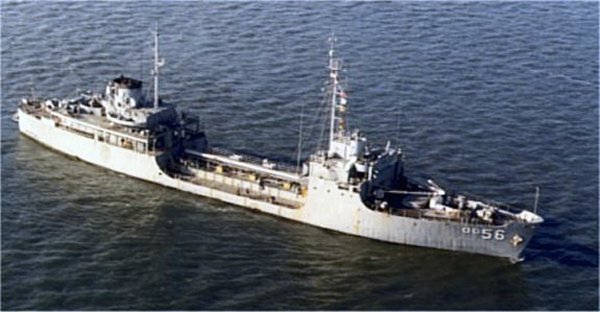
Not generally considered "front line" duty, the role of AOGs during wartime has been underreported. For example, off Iwo Jima, some AOGs carried potable water for use by the Marines ashore, a job which required the AOG to close the beach in close proximity of the fighting. One such ship was USS Tombigbee (AOG-11):
Her tanks filled with fresh water instead of the oil for which she was designed, Tombigbee began replenishing the tanks of the ships of the Fleet and worked out of Guam and Ulithi as she continued this duty for the remainder of the year. The ship's first taste of combat came while she lay anchored at Ulithi on 20 November 1944. A Japanese midget submarine slipped into the anchorage area and torpedoed the oiler Mississinewa (AO-69) which was anchored less than 1,600 yards from Tombigbee.

The tanker remained on the Guam-Ulithi "express" water supply run through January 1945. On 7 February, while she was steaming toward Guam, orders rerouted Tombigbee to Saipan. Subsequently removed to Tinian, with a full load of water, she supplied water until 19 February, when she joined Task Group (TG) 60.9 and got underway for the Volcano Islands. At 0924 six days later, Tombigbee was detached from the task group and entered the harbor at Iwo Jima. There, the water carrier lay-to and kept out of the line of fire of the supporting battleships, cruisers, and destroyers. Rough seas hampered her water-discharging operations, but the need for fresh water overrode considerations such as the desire to avoid minor hull damages caused by the ships bumping and scraping each other in the tossing waves.

After remaining in the Iwo Jima area until 9 March, the ship proceeded to Guam where she reloaded her holds with more of her precious liquid cargo. Later in the month, Tombigbee joined the invasion force heading for the Ryukyus. (source)
She took part in the invasion of Okinawa.

During the Vietnam War, AOGs played a very important role, as set out in "How AOGs Fueled the Vietnam War" by Paul Gryniewicz in the Feb 2005 edition of Sea Classics and found here:
To their crews, the gasoline tankers were "Always On the Go," but to the GIs, airmen and sailors fighting the Viet Cong, the AOGs were the most popular - and important - ships in the entire Navy.

In his Report on the War in Vietnam, Gen. William Westmoreland observed that, "We were utterly dependent upon the sea logistical line."

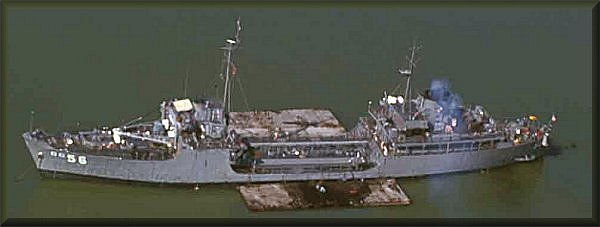
A critical link in Westmorland's supply chain was made up of six, small slow, 22-year-old US Navy gasoline tankers: USS Patapsco (AOG-1), USS Elkhorn (AOG-7), USS Genesee (AOG-8). USS Kishwaukee (AOG-9), USS Tombigbee (AOG-11) and USS Noxubee (AOG-56). Their mission was to deliver fuel to US forces in the I Corps Tactical Zone, the five most northern provinces of South Vietnam that ran from the Ben Hai River in the center of the DMZ south to Sa Hyuhn. Thirty to 70-miles wide, I Corps was bordered on the west by Laos and on the east by the South China Sea. With the exception of a low, narrow coastal plain, jungle and mountains covered the region. Land-based transportation was practically non-existent. Route One was a narrow winding road running the length of the zone. A single narrow-gauge railroad ran parallel to it. Both were frequently out of commission due to enemy action and monsoon storms. The only established port in the zone was Da Nang.

I Corps' physical condition meant that the only way to practically and consistently move large quantities of supplies around was by water. Without fuel, planes and helicopters could not fly, tanks and trucks could not move, and PBRs and swift boats could not patrol the waterways. In December 1968 alone, shore-based forces consumed 1.7 million gallons of fuel daily. On average, the six AOGs pumped over 15 million gallons of fuel per nine-month deployment. Noxubee set the record by pumping 20 million gallons in 1968, earning a Meritorious Unit Commendation in the process.
***
For seven hard years, beginning in March 1965 and ending early 1972, at least one AOG was constantly deployed in Vietnamese waters. Tombigbee arrived in Vietnam on 8 March 1965, supporting the Ninth Marine Expeditionary Force as they waded ashore at Red Beach near Da Nang. Tombigbee became the first AOG to pump fuel ashore during the Vietnam War.
***

Using both bow and stern anchors to keep from swinging with the current, AOGs anchored 1500 to 2000 yards offshore alongside a buoy marking the seaward terminus of an assault pipeline. One of the ship's boats or a boat from shore would float a fourinch hose from the tank deck to the buoy. A swiveling gooseneck connection on top of the buoy gave the AOGs a secure point to attach the refueling hoses. First, a crewman would hop onto the buoy and connect the hose. Once the connection was secure, the AOG would begin pumping fuel ashore. Due to their limited pumping capacity and small-diameter pipelines, it could take as long as 72 hours to unload all 680,000 gallons of fuel.
The job was not without danger, and the AOGs came under attack at various times:
Tan My was in the cross hairs of the Communists' 1968 TET offensive. The fuel farm was destroyed along with several landing craft and barges. River cargo operations were interrupted for ten days, and 18 men belonging to NSAD Tan My were killed. During one 72-hr period of nonstop operations, Kishwaukee pumped 1.7 million gallons ashore at Cua Viet and Hue. While anchored in the lagoon at Tan My on 28 February, unloading into bladder boats and barges, she came under small-arms fire, quickly got underway without any casualties, re-anchored out of range and resumed pumping. The need for fuel was so critical during the TET Offensive that Kishwaukee spent 144 out of 168 days on the line.
***
On 28 October 1968, Noxubee (Lt. J.R. McCall) was pumping cargo through the underwater pipeline and to a bladder boat alongside when North Vietnamese artillery opened fire on the ship. Ensign Richard Bland was at the pumping station on the port side of the tank deck when the first rounds came in, sending up plumes of water along the starboard side. Bland called away the sea detail, and ordered the engine room to stand by for an emergency underway. BMC Franklin and the two fantail sentries quickly yanked the stern anchor up, while at the same time, Ens. Andy Bavarik, hauled in the bow anchor.

Meanwhile, Bland and the tank deck crew cast off the bladder boat and grabbed fire axes to cut away the fueling hoses. All the while, the enemy's artillery was bracketing the ship. By the time the fuel hoses were cut free and the bow anchor hoisted off the bottom, Noxubee was underway at 14-kts and safely got out of range. After a few hours, Noxubee returned to the anchorage and resumed pumping.
***
(Attack on Genesee) The first round was short, the next long, and the next four or five walked down the length of the ship as near misses. The XO, Lt(Jg) Michael Haines, from his GQ station on the signal bridge, directed the crew of Mt. 33 to cut the stern mooring line. He also ordered all exposed topside personnel below and darkened ship. Cutting the stern line enabled the ship to swing about ten feet, just enough to keep from taking a direct hit on the tank deck loaded with JP-4 jet fuel that could have incinerated the ship and all those aboard.

Rounds were exploding all around. It was only a matter of time before the enemy gunners found their mark. The first hit was on the 01 level port side aft. A second round struck the outboard engine on the ammi barge. Both hits sent lethal shrapnel flying up and down the port side of the Genesee and started fires on the ship and the barge. Internal communications throughout the ship were knocked out. Chunks of flying steel perforated Genesee's stack and exploded an acetylene tank stored along the passageway outside the wardroom. Shrapnel sliced through the high frequency antennas, limiting Genesee's ability communications to the outside world. One chunk hit a 55-gal gasoline drum stored on the 02 level aft. Fire flowed down the scuppers and down the side of the ship near the JP-4 cargo tanks. hot metal tore through the tops of empty cargo tanks B-2 and B-4 without causing any additional fires or explosions. The most serious damage occurred forward. As SF3 Art Ball was securing the watertight door from the tank deck, shrapnel blasted through the door, striking Ball in the left chest and abdomen. SA Theodore Perkins, who was standing near Ball, was also wounded.
***
(Noxubee limpet mine attack) Noxubee (Lt. Dudley Cass) anchored off the Cua Viet fuel farm at 0855 on 8 September 1969. At 1640, YOG-76 moored astern and began filling her cargo tanks. About four hours later, pumping secured and YOG-76 got underway. An hour later, at 2137, fantail sentries SN Paul Gryniewicz and SN Sam Profit and OOD Lt.(jg) Clare Brooks, sighted two swimmers in the water only ten to 15 yards astern of Noxubee. They immediately took the swimmers under rifle fire and tossed concussion grenades at them. Noxubee hoisted her anchors and got underway.

At 2215, Noxubee re-anchored about 1200 yards off the beach so divers could inspect the hull. By 2350, the divers reported that, because of the dark conditions, strong current and rough sea, they could only inspect the stern area and did not find anything. A more complete inspection would have to wait until first light. The divers did speculate that if there was a mine it would probably be a Soviet-made BPM-2 with a 64-1b TNT charge, equipped with a six-hour timer, and magnetically clamped to the hull. With that less-than-encouraging report, Lt. Cass decided to move further out from the beach and anchor for the night.

At 0201 the mine exploded. The swimmers had placed the mine not at the stern by the engine room or the tank deck where it would have done lethal damage, but forward on the port side by the dry cargo hold in a relatively "safe" spot. The blast opened a three-ft by five-ft hole in the hull, flooding spaces underneath the cargo hold and the hold itself with two- to three-ft of water. It also ruptured a fire main causing the Number 2 magazine to flood with over six feet of water. Before the dust from the blast settled, damage control parties under the experienced direction of SFC Eskel Wolf went into action, working in knee-deep water to stem the incoming flood by plugging the hole with mattresses and lifejackets. They also secured the fire main and pumped out the Number 2 magazine.
Even without enemy fire, handling the nototiously dangerous AVGAS made for dangereous work:
On 1 May 1968, Genesee arrived at Tan My and anchored alongside the pipeline buoy. US Army LARC-801 came out to assist Genesee connecting to the pipeline. Genesee crewmen SA Donald Shafer and DC2 Harley Cowans climbed aboard the LARC and hooked the ship's hoses to the connection on the buoy. Those on board Genesee witnessed the LARC explode and burst into flames. The stunned observers saw one of the men blown through the air and into the water.

The LARC was completely engulfed by a lake of fire as the motor whaleboat from Genesee got underway to rescue the crew. SF3 Tony Neil, aboard the whaleboat, dove into the flame-covered water to attempt a rescue. Swimming under water and pushing the flames away with his hands when he surfaced for a breath, Neil located the LARC's driver, SP4 Tommy Miller, who was without a life jacket and badly burned. Neil managed to get the burned driver back to the ship. The others on the whaleboat fished Cowans and another LARC crewman out of the water but could not locate Schafer. By this time LCM-92 and 18 other LARCs were on site searching for the missing seaman but without any luck. Army units recovered Shafer's body a week later. An investigation determined that a spark from the LARC's exhaust caused avgas from the leaking hose line to ignite, destroying the LARC, killing Shafer and injuring three others.
As you may have gathered, these ships during the Vietnam War were Lieutenant commands. And very hard working ships they were, indeed.

Modern war planning still includes getting petroleum products from the sea to the beach (see here, for example). But the AOGs are no longer with us. Many of their brave crews are, however, and they deserve a big salute!

Thought you might like to know.


(Top photo: USS Tombigbee, lower photos USS Noxubee)

Saturday, August 12, 2006

Navy Tug Fights Freighter Fire in Liberia


USNS Apache (T-ATF-172) helps out a commerical freighter which was on fire in Monrovia as reported here:
The engine room of Tahoma Reefer, an Estonian commercial freighter also paying a call on Monroviaís port, burst into flames in the early hours of the day. Later that morning, just as smoke from the burning vessel was spotted from Apacheís bridge, the U.S. Embassy in Liberia phoned the ship and asked the crew to respond.

Using the shipís rigid hull inflatable (RHIB) boat, Apache Chief Mate Troy Bruemmer and Chief Warrant Officer 3 Pete Sharpe, officer-in-charge of the 12-member embarked Mobile Diving and Salvage Unit 2 and three other crew members, rushed to the scene.
All photos fronm US Navy.
Crew members aboard the Military Sealift Command (MSC) fleet ocean tug USNS Apache (T-ATF 172) evacuate personnel from the commercial freighter Tahoma Reefer, while rendering assistance at sea. The fire broke out in Tahoma's engine room in the early morning hours of Aug 10, 2006. Apache rescued the freighter's crew and was able to bring the fire under control. Apache is in Liberia to conduct a harbor survey and do repair work on the port of Monrovia's pier as an ongoing effort to strenghten the United States emerging partnership with this nation. U.S. Navy photo
BZ Apache!

Going to the mothball fleet


Off to mothballs. Companion story here.

Former USS Robin (MHC 54) is towed from the Naval Station Ingleside, Texas, wharf enroute to Beaumont, Texas. It is the first of the four decommissioned Osprey Class coastal mine hunters to be towed to where it will be stored for logistical support.

Thanks to Glenn Geramine of Seaward Services (that's his tug moving the Robin)!

Friday, August 11, 2006

Want to take a chance on Venezuela?


Got your offshore natural gas blocks right here - who'll make a bid? 65% ownership... Come on which rich Western big energy companies will take a chance?

Nigeria: Oil field turmoil

A couple of foreign workers kidnapped as reported here:
Gunmen in military fatigues seized two foreign oil workers here yesterday in the latest violence targeting the petroleum industry of Africa's largest producer, authorities said.
***
Southern Nigeria, where most of the country's crude oil is pumped, has seen an increase in violence against the petroleum industry in recent days. The attacks have forced a nearly 20 percent reduction of Nigeria's usual 2.5 million-barrel daily production, helping send crude prices soaring in international markets.
The abductions came a day after gunmen stormed a supply boat in the Gulf of Guinea heading to offshore oil rigs, kidnapping four Norwegian and Ukrainian workers in a raid on the vessel owned by a Norwegian shipping firm.
Reportage of earlier seizure here:
Gunmen kidnapped four Norwegian and Ukrainian workers from a boat heading to oil rigs in the latest violence targeting the petroleum industry in Nigeria, the continent's largest exporter of crude oil, officials said Wednesday.
***
ndy Oputa, a security official for Nigeria's Bayelsa State, confirmed the kidnappings and said negotiators had been sent to the Niger Delta region, where most of the crude is pumped. Another state official said the capture took place nearly 30 miles from shore, with gunmen boarding the ship as it headed to oil rigs off the West African coast.
***
The kidnappings came less than a week after militants wearing camouflage uniforms took a German oil industry worker hostage, spiriting him away on a boat into Nigeria's troubled oil-rich delta region. A group calling itself the Movement for the Niger Delta People has claimed responsibility for that kidnapping, but police said the group was unknown.