VertRep

VertRep

Saturday, July 29, 2006

Outstanding video of threat to Israel from the sea


Excellent report by Wolf Blitzer on CNN. Video here.

Cross posted at Milblogs.

See also earlier post on Israel and terrorist swimmers.

UPDATE:
One form of Israeli response - the anti-terror unmanned surface vehicle Death Shark.
But the true mission of the "death shark" is to defend Israel waters, her civilian coastline and her allies from a terrorist attack.

The IDF said that it plans to deploy it for dangerous tasks, such as monitoring the coast for suspected infiltrators. Palestinian terrorists have detonated themselves a number of times next to Navy patrol boats, and the Navy has long sought a safer way to approach suspicious sea craft at sea.

Friday, July 28, 2006

Israel and terrorist swimmers

There have been several attempts by swimming terrorists to enter Israel and sow havoc. In recent years, these efforts have not been successful as noted
herefrom a 2004 event:
Israeli soldiers killed two armed Palestinians dressed in diving uniforms who attempted to infiltrate a Gaza Strip settlement from the coast, the army said yesterday, the latest in a series of failed attempts to avenge Israel's assassination of the Hamas spiritual leader.
Initially, the army said three Palestinians had been killed. After searching the area in daylight, a spokesman downgraded the death toll, saying only two bodies were found near the Tel Katif settlement.

The two militants -- who opened fire on an army outpost guarding the settlement shortly before midnight Thursday -- were wearing diving uniforms, and flippers were found thrown on the coast, the army said. The men were armed with assault rifles and rocket-propelled grenades, the army said.

In August 2002, militants also attempted to infiltrate from the sea the Dugit settlement in the coastal strip. The militants were killed before they reached shore.
I suspect Israel is well aware of the threat and closely watches its shores.

Israel's oil supply


In conjunction with an earlier post on the effect of the Israeli sea blockade on Lebanon -especially on oil supplies for Lebanon's power plants, and as the result of an e-mail from Glenn Germaine (his companies are Seaward Services and Cetacean Marine), suggesting the topic - let's look at Israels' oil supply...

We know that Israel has asked the U.S. for jet fuel as reported here:
The Pentagon notified Congress July 14 of an Israeli request to purchase up to $210 million in JP-8 aviation jet fuel for its military aircraft.
”The jet fuel will be consumed while the aircraft is in use to keep peace and security in the region,” the Pentagon’s Defense Security and Cooperation Agency said.
This would seem to indicate some oil issues. Israel's oil supply situation is well-described here:
From Russia and former Soviet republics. Israel produces only a couple thousand barrels of oil a day, which means it relies on the global market for more than 99 percent of its consumption. It's difficult to name all of the country's suppliers—in 2004, Israel's minister of national infrastructures admitted that "Israel's situation is complicated. We don't have diplomatic relations with most of the countries from which we import oil." But over the past 25 years, significant fuel imports have come from Angola, Colombia, Mexico, Egypt, and Norway. In more recent times, the Israelis have turned to Russia, Kazakhstan, and some of the other -stans for the bulk of their oil.
***
The Israelis have also tried to ramp up their own fuel production. A few weeks ago, they got some press for developing a new way to extract energy from the country's large reserves of "oil shale."
The Slate piece also refers to a Memorandum of Agreement under which the US agrees to provide oil if needed to Israel, but I note that the dates therein indicate the MOA should have expired.

Israel has two refineries, one at Haifa that has temporarily reduced capacity (see here) because it is a target of Hezbollah rockets:
Hezbollah earlier claimed it was targeting the refinery.
"The resistance fires rockets on the oil refinery in Haifa, north of
occupied Palestine," Lebanese Hezbollah satellite station Al-Manar reported on
Sunday.
The other Israeli refinery is in Ashdod. The Ashdod refinery also figures into the oil shale extraction process, as set out here.

In sum, Israel buys the bulk of its oil on the open market. In the current situation, except for the persistent rocket attacks on Haifa, there is no known restriction on importing oil into Israel by ship. As to the sources of the oil- well, oil is very fungible and in the real world, the source is really not that significant compared to a steady supply. As for the JP-8 request, that may be due to the refinery cut back or to other issues.

Impact of Israeli Naval Blockade


Israel's naval blockade of Lebanon is having an impact as reported here:
As the Israeli military blockade of Lebanese ports enters its third week, officials here say they are running critically short of fuel for power plants.

"All our power generation depends on fuel oil," Public Works and Transportation Minister Mohammed Safadi said Thursday. "We are five days away from running out."
***
Attacks on the key Jieh power plant 20 miles south of Beirut caused a massive oil spill that has coated 50 miles of Lebanese coastline. The popular Ramlat al Baida public beach in west Beirut is covered with a 10-foot band of black tar.

"This is a catastrophe I wouldn't wish on any country in the world," Environment Minister Yacoub Sarraf said. Attempts to gauge the extent of the spill, Sarraf said, have been complicated by the air and sea embargo that prevents him from viewing it by plane or boat.

"I am not even allowed to go out in a patrol boat," he said. "I've had to resort to calling captains on ships at sea to find out what they have observed."

Sarraf said he sent a frantic appeal this week to the U.N. Mediterranean Action Plan environmental program in Athens for help with the cleanup. But the program's coordinator, Paul Mifsud, said nothing could be done until the fighting had ended.

"The extent of the pollution and the type of pollutant would call for a complex and long shoreline cleanup operation," Mifsud said. "However, international assistance could be considered only once the hostilities in the area have ceased."

The most pressing problem facing the country is the looming electric power shortage that threatens hospitals, government buildings and residential neighborhoods.
Israel has opened the blockade to allow evacuations of foreigners from Lebanon and to allow the inflow of some humanitarian supplies, see here.

Other Maritme Mishaps and Adventures

The world will get a chance to find out the effect on a coral reef of tons of sugar being pumped on it, as reported here. The Zhi Qiang carrying a load of sugar, smacked into a reef off Papua New Guinea and, in order to free the ship, the suger had to be dumped. If we see coral with lots of cavities, we know what to blame.

And in the US, a 670 foot ship had steering troubles and ran aground off Mayport, Florida, as set out here:
The Horizon Discovery, a container ship, ran into rocks at the Little Jetties Park off Ocean Street Tuesday night. Early reports indicate mechnical failure caused the problem.


At the port of East London, South Africa, a cargo ship ran aground several weeks ago as it was leaving port. Cargo, fuel and other oils have been removed to try to lighten the ship for removal from the rocks (and it's well up on the rocks- see photo). Most recent indications, here, are that the ship will be removed, but no one seems quite certain as to how that will be accomplished.

Dismantling old ships is much in the news, as evidenced by "ghost ships" stories from England and a "toxic ship" story from Turkey.

In England, 13 former U.S. Navy ships are awaiting scrapping amid some controversy, as reported here and here. Why ae the U.S. ships in England? The latter link reports:
An American subsidiary of Able UK won the contract to recycle 13 of the obsolete ships, and chose to carry out the work at Able's Hartlepool shipyard.

Environmental campaigners say the US has the technology to do the work.

But the UK's Environment Agency initially agreed to the transfer on the basis that all approvals were in place.

It subsequently transpired they were not - so new consents must be sought.
Concerns are, of course environmental and include issues of lead, asbestos, mercury, etc.

Turkey has something of similar problem, as the Netherlands is sending a "toxic" ship its way, as reported here and Turkey has agreed to accept it over the howls of environmentalists. And Turkey has its eye on a bigger ship dismantling prize:
France is searching for a country to disassemble its 270 retired war ships. “They came and we showed the facilities. If we could only reach an agreement;,so the Turkish economy could earn income from the deal.”

Cougar Ace Update: Ship leaking fuel?


Reported here:
A Mitsui O.S.K. cargo ship, listing in rough seas near Alaska's Aleutian Islands, might be leaking fuel from its tanks, the U.S. Coast Guard said.
"Observers have reported a light and broken sheen extending two miles around the vessel" carrying 430 metric tons of fuel oil and 112 metric tons of diesel, the Alaskan office of the Coast Guard said in a statement on its Web site.
The Coast Guard, which did not clarify who the observers were, said its own personnel found "no signs of the vessel's fuel tanks losing containment at this time."
***
A team from salvage company Crowley Marine is due to reach the location of the Cougar Ace, about 230 miles (370 kilometers) south of the Aleutian Islands, on Wednesday, with the aim of towing the ship to a nearby port, the Coast Guard said.
You are invited to find an appropriate salvage tug and race the Crowley team to the Cougar Ace to vie for salvage rights...

UPDATE: Cougar Ace history posts: #1,
#2, #3. You are reading #4.

Container shipping rates fall: Law of Supply and Demand at work


Classic result of the Law of Supply and Demand at work as set out here:
As bigger container vessels enter into service, the container shipping industry is beginning to feel the pinch as demand has not picked up as much of late, says Winston W.F. Loo, managing director of Barwil Unitor Ships Service Malaysia.
***
On the local front, he said rates had dropped like about 19 percent at the end of first half of the year compared with the last quarter of 2005.

When compared with first quarter of 2005, the drop has been in excess of 30 percent, he disclosed.

Base Ocean Rates to Europe in the local market currently have been hovering between US$700-750 per TEU (twenty-foot equivalent), way below rates of US$1,200 - 1,300 per TEU during the heydays of 2004/05 period.
***
On the other hand, he felt that there was still a problem affecting the container industry, especially with the mis-match in timing of these large vessels entering into service as they were ordered during the good times of 2004 and 2005.

But he conceded that "you can't order for ships today and get them tomorrow", adding that there has to be a considerable time lag before the ships could come into service after they had been ordered.

Loo believed that competition is expected to intensify as bigger vessels like those with a capacity of 9,600 TEUs by China Shipping and the 12,000 TEUs ships of Maersk Line, amongst others, coming into service.

"The (start of the) second half of the year is not looking good given that the summer season is usually a period whereby volume would actually start to taper off, with the rebound coming in late August or September before tapering off again for the year end festivities in November," he said.

Between now and 2008, more large container vessels are expected to come into service.

"The scary part is whether there is enough demand to take-up the ample space (in the vessels)," he told Bernama in a recent interview.

Loo said it was forecast that the available container capacity worldwide would expand by about 50 percent between 2006 and 2008.

As a booming economy, he felt that if China could take up much of the capacity being injected to the industry, shipping rates could be maintained at current levels.

If not, he believe they could come down further.
Except, of course, that some firms, unable to make money in a excess capacity market, will lay up their less efficient ships and capacity will decrease as a result.

Thursday, July 27, 2006

Somalia: One reporter's take

An interview with Craig Timberg, WaPo reporter, found here:
FP: How has life in Mogadishu changed since the Islamic Courts came to power?

CT: There are fewer guns on the street. Every once in a while, you see armed gunmen. But that’s quite rare. And that’s a big change from the past when guns were everywhere. Shops and restaurants are now able to stay open after dark because people aren’t afraid to go out. Ordinary street crime has declined markedly.

On the other hand, some men have been forced to cut their hair, women feel pressured to veil themselves, and cinemas have been closed. Broadcasts of the World Cup were banned. It’s safer, but it much less freewheeling.

FP: Is there any support for an American or international force to step in and prevent the Islamic militia from taking full control of the country?

CT: I can’t imagine a scenario where the United States sends troops back to Somalia. When I was in Mogadishu recently, I clearly sensed a popular frustration with the United States for having backed lawless warlords. They used to shoot people and rape girls with impunity. They drove around the capital in fancy trucks and flaunted their wealth. For the Americans to have associated with and supported these guys . . . it made Somalis angry and frustrated with the U.S. government. But in the rallies at the mosques in Mogadishu, they’re not burning American flags; they’re burning Ethiopian flags. That’s where the real, powerful public anger is directed.

Chittagong: "We're Number One!"


And the leader at the half way point in the 2006 competition for the "World's Most Dangerous Port" is Chittagong. Bangladesh, don't ya' know.

UPDATE: Chittagong doesn't like being Number One and plans to file a protest:
He said the IMB report was wrong as there were no incidents of piracy in Chittagong port this year. The IMB report, however, mentioned 22 piracy incidents in the first six months of this year and termed Chittagong port most dangerous port in the world.

Actually, IMB often terms petty theft or stealing of ropes from ships as piracy even though piracy actually means armed robbery at sea, Hossain said when asked why IMB mentioned the 22 piracy incidents.

According to him, armed robbery at sea hardly ever happens in Bangladesh territory.
. Well, "hardly ever.*"

*
CAPT. I am the Captain of the Pinafore;
ALL. And a right good captain, too!
CAPT. You're very, very good,
And be it understood,
I command a right good crew,
ALL. We're very, very good,
And be it understood,
He commands a right good crew.
CAPT. Though related to a peer,
I can hand, reef, and steer,
And ship a selvagee;
I am never known to quail
At the furry of a gale,
And I'm never, never sick at sea!
ALL. What, never?
CAPT. No, never!
ALL. What, never?
CAPT. Hardly ever!
ALL. He's hardly ever sick at sea!
HMS Pinafore libretto.

Wham! Bam! Thank you, Ma'am!

Claudia Rosett absolutely hammers the idiots at the UN who think we are all too dumb to keep our eye on the ball when they wave their hands to distract us here. And she doesn't mince any words in delivering the blows.

Right now it is the job of the world’s more responsible political leaders not simply to deplore the horrors of war, or construct another false U.N. peace leading to even worse nightmare ahead, but to seek real answers to the miseries and menaces of the Middle East. That is a task perilous, contentious, and rough enough, without a parade of unelected and largely unaccountable U.N. civil servants using public platforms to insinuate into the process their private prejudices.
Amen.

Hitler's Aircraft Carrier?

Murdoc has the story of a remarkable find here.

I didn't know about a WWII German aircraft carrier until I read his post.

UPDATE: CDR Salamander way ahead on this one. See here.

Somali Pirates: A look inside

An enterprising South Korean TV crew got and inside look at how Somali pirates treat their captives and, as reported here, the treatment stunned the Korean public:
The program showed the crew, eight Koreans and 17 from other Asian countries, who were very skinny, in constant fear as they were guarded by armed kidnappers.

The program said the cause of their despair lay on the government's indifference. The government has not sent a single official to Somalia, and occasional negotiations have been conducted by Dongwon Fisheries, not the government, the report said.

The ministry had said the kidnappers could check Korean journalism reports on the Internet and take advantage of it for negotiation, but there was no computer in the village there, only three telephones, and only one person could speak English.

The government has blamed the kidnappers, saying they do not come up with reasonable conditions for the release of the fishermen due to internal disputes, and also claims that Dongwon Fisheries should directly talk with them and pay a ransom.

The program said the crew felt betrayed, and claimed the government has failed to even grasp the situation.
Naturally, some of the viewers blame their government rather than the pirates...

Why am I not comforted by this exercise?

San Diego. Waterfront. Exercise Bay Shield, a simulated terrorist attack on a cruise ship. All the agencies spring into action:
The participants sat around rows of tables inside a steamy, dimly lit hangar at the Coast Guard station, playing out their respective roles in coping with the aftermath of the “attack.”

“Everybody sits in and discusses what happens next after the initial response,” said Coast Guard Lt. Rick Hipes. “This is a test of our security plan and to look at our shortfalls

“We will see everything we did wrong, so that if there's an actually event, we can come out perfectly.”
All as reported here. I hope there's an on the water portion, too, because the best "talked" about plans often go differently when real rubber meets real road...

UPDATE: Cruise Ship Report worries about the "message."

A pirate's (hic!) life is not all beer and skittles


Dim-bulb wannabes fail the nautical portion of their "Pirate Test" as reported here:
Three 18-year-old Manchester youths, dressed in pirate outfits and wearing make-up, were being blown further out to sea when they were picked up by Moelfre inshore lifeboat.

Two of them were in the water trying to push the dinghy back to shore. Their "pirate ship" was loaded with a crate of beer.
What, no chips? How long before we had a Regina v. Dudley & Stephens?

UPDATE: More here.

Wednesday, July 26, 2006

A Russian aircraft delivering weapons and questions on a "proxy war" in Somalia


All found here:
A mysterious Russian-built cargo plane believed to be loaded with weapons landed in this capital Wednesday, setting off a fresh round of allegations that Somalia has become a proxy battleground for its neighbors Eritrea and Ethiopia.

The United States and other Western powers have cautioned outsiders against meddling in Somalia, which has no single ruling authority and can be manipulated by anyone with money and guns. But there's little sign the warning has been heeded.

The Seattle Times finds a minor problem with Port Security

Got to love investigative reporting like this. My suggestion is that big trouble fall on any driver who allows passengers to enter ports. And a few random security checks will tighten up gate security.

Indonesia anti-piracy police to go to mobile bases

Reported here:
The National Police will start building mobile posts in five areas across the country next year to support the Marine Police in fighting crimes such as illegal logging, illegal fishing and piracy.

Marine Police chief Brig. Gen. Nengah Sutisna said Tuesday the mobile posts would be based along coastal areas in Tugu Batu, Riau; Nunukan, East Kalimantan; Bitung, North Sulawesi; Sorong, Papua; and Kupang, East Nusa Tenggara.

"Each base will consist of docks, offices and shelters for the officers. The cost may be as much as Rp 15 billion for each base," said Sutisna.

The mobile posts will enable marine police to reach crime scenes faster since they will not have to wait for city police officers to deal with marine crimes, said Sutisna.

He added that they will save the police money on fuel for ships, which costs about Rp 130 million a day.

Cougar Ace stable, listing 60 degrees


Car carrier Cougar Ace still afloat and holding at 60 degrees list, it says here. And, probably, except for an intervening storm, the ship will probably stay afloat until salvage crews arrive to tow her. I note from prior photos that her screw was out of water, so self propulsion not likely in her current position.

Some rescue photos here.

UPDATE: Faulty ballast tank shift at fault? Owner says so here:
The owner of a cargo ship that was crippled when it listed almost completely on its side said Wednesday that the problem occurred when its ballast tank was adjusted in the open seas of the North Pacific.
***
The mishap appeared to have been caused by insufficient stability within the vessel, not by a collision or outside flooding, said Greg Beuerman, a spokesman for Tokyo-based Mitsui O.S.K. Lines, which owns the 654-foot car carrier.

"There clearly was imbalance in the intake of ballast water. The company investigation ultimately will tell us what caused that imbalance," he said.
4700 Mazda cars hang in the balance. Zoom.

UPDATE2: And a primer on the Free Surface Effect. You know, just until the owner's investigation comes up with something.

Maritime Security: A "Real Missile Threat?"


From a Washington Post commentary by James Jay Carafano of Heritage Institue, in which he deeply discounts the threat posed by North Korean ICBMs and the container packaged "nuke in a box" concern, he writes: Missing the Real Missile Threat:
If a country was serious about wanting to attack the United States with nuclear fire in a manner that would ensure surprise, leave no fingerprints and guarantee success, there's a much easier, better and cheaper way. It's one that could avoid the challenge of smuggling weapons into U.S. ports under the eyes of law enforcement, intelligence, customs officials and the Coast Guard: Put the missile on a ship disguised as a commercial freighter or private craft, sail near American waters and fire.

The North Koreans could adapt a short-range missile, such as a Scud. They already have them, and they know they work. The Scud has a large "throw-weight" (meaning it can carry a very heavy warhead) and could deliver a weapon at close range with ease. Building an improvised vertical launch platform for the missile is no significant technical challenge, nor is figuring how to make firing accurate enough to shoot a nuke at New York or Washington.

What's better (from an enemy's standpoint) is that the missile firing might well go undetected. Even tracing the perpetrator after the fact might be tough, particularly if the ship were scuttled after the firing. We wouldn't know who to retaliate against.

Now that's a real threat -- one we should take seriously.
This concept has been covered before- at The CounterTerrorismBlog here:
Reader Timothy Thompson, who is always able to provide keen insight into weapons systems, comments on the missile purchase:

[The BM-25 missiles that Iran purchased] can easily be launched from [a] freighter modified with launch tubes and blast channels. They give Iran a projection of force capability far beyond the 2000-3000 km range of the missiles. It is possible -- though not confirmed -- that Iran may not use the BM-25's but only bought them to get the R-27 rocket motors for a missile of their own design.
Other relevant links here ("Iran's New Missiles"), here ("Iran's Cruise Missile Threat and Merchant Ships") and all the links therein. And remember that SecDef has mentioned this scenario before:
Mr. Rumsfeld also was asked about the danger of terrorists or rogue states attacking the United States by putting a short-range Scud-type missile on a freighter and firing it close to U.S. shores.

He said one Middle East nation already has “launched a ballistic missile from a cargo vessel.”

“They had taken a short-range, probably Scud missile, put it on a transporter-erector launcher, lowered it in, taken the vessel out into the water, peeled back the top, erected it, fired it, lowered it, covered it up. And the ship that they used was using a radar and electronic equipment that was no different than 50, 60, 100 other ships operating in the immediate area.”

Other U.S. officials have said the nation was Iran, which tested a freighter-launched missile in the Caspian Sea in the late 1990s.

“It is true that the big distinction we make between intercontinental, medium-range and shorter-range ballistic missiles doesn’t make a lot of sense if you’re going to move the missile closer to the target,” he said. (source)
As long as I'm repeating things, go visit MissileThreat.com at the Claremont Institute and enjoy their movies of a merchant ship launch here (big) or here (smaller) to see how it would work.
In short, Dr. Carafano is not raising a brand new issue with his comentary, but he does a service by keeping the issue alive.

UPDATE: Forgot to add about the EMP danger of a nuke exploding above our land mass. See "EMP Heard Again" which even has a quote from The Hertiage Foundation
An EMP attack damages all unprotected electronic equipment within the blast's "line of sight" (the EMP's "footprint" on the earth's surface). The size of the footprint is determined by the altitude of the explosion. The higher the altitude, the greater the land area affected. A Scud-type ballistic missile launched from a vessel in U.S. coastal waters and detonated at an altitude of 95 miles could degrade electronic systems across one-quarter of the United States.


Artwork of merchant ship missile launch liberated from MissileThreat.com.

UPDATE2: My version of a DPRK merchant hull with a SCUD TEL. The ship is the one intercepted by the Spanish Navy carrying SCUDs to Yemen as reported here.

UPDATE3: Everybody scooped by China Confidential? See here for a report that the DPRK "May Have Helped Iran Test a Sea-Going Scud."

Tsunami Aid Pirates Arrested

Reported here:
The Indonesian navy has arrested three former separatist rebels for pirating ships carrying aid for tsunami survivors in the country's far-west Aceh province, a senior commanding officer said on Wednesday.

The three men, from two different groups, were caught in the north Aceh city of Lhokseumawe on July 18, two days after their latest operation, Rear Admiral Moekhlas Sidik, chief of the Indonesian Navy's Western Fleet, told reporters.

"We are still on alert for more action from their groups because they use weapons like rifles and grenade launchers in their operations," Sidik said.

Bubblehead gets weird mail

I like conspiracy theories. But somehow Bubblehead at The Stupid Shall Be Punished gets the good ones.

Though I am surprised he hasn't heard of the degaussing properties of merchant ships before...

Back to Weekly World News for me, after all, a T-Rex is terrorizing a trailer park...

First half 2006 Piracy totals


Reported here as Pirates are back on the map:
The Piracy Reporting Centre at the International Maritime Bureau listed 127 pirate attacks worldwide in the first six months of this year, the same as in the previous six months.
***
The report said that 6 seafarers were killed, 156 crew members were taken hostage and 13 were kidnapped. A total of 74 ships were boarded by pirates and 11 were hijacked. Indonesia recorded 33 of the incidents, Bangladesh had 22 and Somalia had 8.
The Strait of Malacca's rate of piracy slowed, but Somalia, Indonesia and Bangladesh are trouble spots.

Nice maps from here

Cruise ship "tilt" due to human error

Remember the sudden change in course of the cruise ship that caused it to heel over so much that passengers were injured? It's now reported here as due to "human error":
Human error caused a cruise ship to abruptly tilt at sea last week, sending furniture and debris flying about the vessel and injuring 240 passengers, a cruise-line official said.

Though federal investigations continue, Princess Cruises president Alan Buckelow wrote in a letter to passengers that "the incident was due to human error and the appropriate personnel changes have been made."


UPDATE: After thinking it over, if I were the cruise ship company, I probably would prefer the "human error" causation to any sort of random computer glitch or mechanical malfunction. In some cases, the human factor is easier to fix.

Tuesday, July 25, 2006

Somalia- No talks unless Ethiopia walks


The Islamic Courts announce their peace talk terms:
Islamic courts controlling the Somali capital will not take part in talks with the government unless Ethiopian troops leave Somalia, an official says.
Earlier, Somalia's interim government agreed unconditionally to hold peace talks with the Islamists.

Talks to try and avert conflict between the two sides broke down last week.

The Union of Islamic Courts has vowed to expel Ethiopian troops who are deployed in Baidoa to assist the weak transitional Somali government.

"There is a condition for talks: as long as the enemy is in our country it will be impossible to sit down together and hold talks (with the transitional government)," Sheik Hassan Dahir Aweys, Chairman of the Islamic courts' consultative council told the BBC Somali service.

"We want the Ethiopian government, which has invaded Somalia and threatened Somalia, to leave our country, so that we can hold talks."

Latest ICC CCS Piracy Report (to 24 July 06)

Latest ICC Commerical Crime Services Piracy Report (to 24 July 06) is here. Very quiet week with only four reports of robberies, all while vessels were at anchor. Congo, Bnagladesh, Angola & Indonesia earn the honors.

Cougar Ace Follow-up

cougar
As reported here, the crew of the stricken Cougar Ace has been rescued and the ship abandoned. Earleir report here.


Photo by PETTY OFFICER JOSEPH ZEMCHAK / U.S. Coast Guard

UPDATE: Much credit to the Coast Guard and Air Force for taking care of the crew. Report:
The Cougar Ace had been carrying cars from Japan to Canada when it began tilting to its port side late Sunday night. The crew sent out an SOS, but the nearest Coast Guard ship was a day's journey away.

By the time a Coast Guard aircraft arrived and was able to drop three life rafts for the crew Monday morning, the ship was at an 80 degree angle, nearly on its side, officials said. The roiling waters shoved the rafts underneath the dipping port side of the ship before the crew could secure them.

Rescuers tossed another raft toward the higher starboard side, but it was a 150-foot drop to the water.

A merchant marine ship crew that was nearby was unable to rig a line to the cargo ship, and the Cougar Ace's crew was losing power in its hand-held radio.

The helicopters appeared to the crew's best chance for survival.

"We made the decision to cram in everybody," said Master Sgt. Sal Provenzano with the Alaska Rescue Coordination Center.

In a daring rescue, the crew members, who had donned survival suits aboard their troubled ship, were hoisted Monday night into two National Guard Pave Hawk helicopters and a Coast Guard helicopter, then flown 230 miles north to Adak Island. One crew member with a broken ankle was to be flown by plane to Anchorage, Provenzano said.


H-60 Pavehawk info here

Monday, July 24, 2006

A piece of military history -sorta

It's 1972. Off the coast of Vietnam, thousands of American sailors are working in the heat of tropical sun and humid nights to support gunnery and air missions. On off nights, movies are shown to the crews of the ships.

The movies came from the Navy Motion Picture Service which was essentially a library of movies that could be checked out by a ship. Movies could also be transferred from ship to ship. The "movie officer" had a tough job - trying to meet the entertainment needs of young sailors for weeks at sea. And the pool from which to select was not deep. It seems to me that most movies were a few years old and were generally of "B" quality. Spaghetti westerns, John Wayne movies and comedies were welcome. Not too often were deep psychological films well-taken. Some movies transcended all the others and were exceptionally valuable trading material due to their high demand.

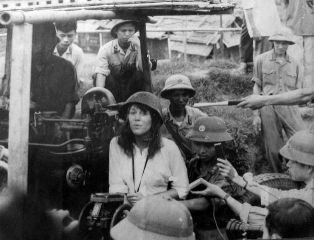
Now, remember, it's 1972. It's the year Jane Fonda visits North Vietnam. It's also the year of the April Offensive, when the NVA came rolling across the DMZ with beaucoup tanks. The Navy got busy with gunfire and air support for the South Vietnamese Army. The Navy mines the harbors of North Vietnam. Many Navy ships end up off the coast of Vietnam.
.

You also have to remember that in 1972 there were no VCRs, no DVDs. Movies were just film, run on projectors.

Got the picture? Well, here's another bit of Navy history probably rarely, if ever, recorded until now. The most highly sought after film on the ships off Vietnam in 1972 was a Jane Fonda film.

That's right, the same Jane Fonda.

And the movie was Barbarella.

And, as can be seen at Barbarella Headquarters, the reasons were not the acting performances of Ms. Fonda or John Phillip Law. Nope. The popularity was due to the costumes more or less (mostly less) worn by the actresses. So, in an ironic twist, Ms. Fonda was helping morale at the same time she was, well, trying to hurt morale.



Of course, the movie was released in 1968, so it was old enough to be in the Navy system (we never got first run movies). Now, I understand that a remake is in the works, this time starring Drew Barrymore.

I hope our current warriors enjoy the new version.

(Blog sweeps? Over to you, Lex)

UPDATE: Oh, yeah, it was also the last Jane Fonda movie I have ever seen.

UPDATE2: Time-Life proof.

An Army guy goes messing about in boats

John of Castle Argghhh!!! goes in for a sea adventure as he sets out here in fine James Michener style here. Essential theme: "Or how a retired artilleryman found himself traveling to Mexico to help repatriate a US WWII Fletcher-class destroyer back to the United States."

Go, read, enjoy and wonder whether Josephus Daniels' rules pertaining to libation will apply.

Maritime Monday 19 at Fred Fry International!

Excellent roundup of things nautical at Fred Fry International: Maritime Monday.

Car smuggling by sea from Singapore


Reported here:
"Every car smuggler taking cars coming into Batam from Singapore must wait for the high tide because it allows the boats to dock at the beach, something that people don't expect," Sumandi said. Each large vessel carried seven to 12 cars, he said.

It is an open secret that the local police, the Navy, the Army and the customs office are behind the smuggling of the used cars from Singapore into Batam.

These smuggling operations have grown in size since the beginning of the reform era, with importers now competing to bring in cars illegally.
The Riau Islands are part of Indonesia. Batam is across the Singapore Strait from Singapore.

Ship in trouble off Alaska


Reported here:
A crewmember from the Singapore based container ship Cougar Ace, a car carrier with 23 people on board, contacted the North Pacific Search and Rescue Coordination Center at 11:09 p.m. Sunday. He reported that they were taking on water and listing 80 degrees.

The Cougar Ace is currently located about 230 miles south of the Aleutian Island Chain, in the middle of the North Pacific Ocean.
U.S. Coast Guard ship enroute, C-130 overhead:
A Coast Guard C-130 plane was circling over the Cougar Ace, which sent out an SOS late Sunday night, Petty Officer Stephen Harrison said. A Coast Guard cutter was on its way to the site, 230 miles of the Adak in the western Aleutians.

A merchant ship in the area also was heading to the site and expected to arrive shortly, Harrison said.
UPDATE: New report here says liferaft has been dropped by C-130 and the other merchant ship has a line over to the Cougar Ace to try and halt the listing:
The 654-foot ship, which had been carrying cars from Singapore to Canada, but was at an 80 degree angle to the water Monday morning and appeared to be leaking oil.

"It's sitting on its side, basically," Petty Officer Stephen Harrison said.

A merchant marine ship that had been in the area was trying to rig a line to the Cougar Ace to keep it from tilting futher, while the Coast Guard worked on a way to get the life raft, which landed some distance way, to the crew, said Petty Officer Thomas McKenzie. All 22 crew members were wearing survival suits, officials said.
Massive load shift? Great big wave strike?

UPDATE: Latest report here says helos enroute with refueling plane and another C-130. Crew ready to abandon ship.

Gone in 60 Seconds? Grand theft ship

One way of evading the enforcement of legal consequences is to run off. This is apparently the case here:
Namibian security forces have abandoned the search for a SA-registered container vessel, MV Umfolozi, which was reported stolen a week ago.

It is believed that the 133-metre-long ship is headed northwards, possibly to Russia.

The Umfolozi had been docked at Walvis Bay since September last year, after a collision with another SA-registered vessel, the dredger MV Ingwenya, belonging to the SA National Ports Authority.
***
The ship was refloated on July 15 and went missing after its captain, Alexander Saleh, radioed a false report of engine trouble while ostensibly conducting engine trials.
The old "testing the engines" trick works again.

UPDATE: Cruel Kev had the story early. Hat tip: Fred Fry International.

UPDATE2: South Africa denies the ship was South African:
A container ship stolen from the Walvis Bay harbour in Namibia is not a South African vessel, the South African Maritime Safety Authority (Samsa) revealed today.

"The ship is not registered on any of our (South African) rolls at all," said Saleem Modak, Samsa's captain. It reportedly docked in Walvis Bay in September after a collision with the South African-registered dredger, the MV Ingwenya, while on its way to Cape Town with 335 tons of fuel on board. Originally called the MV Umfolozi, it was renamed the Michael S and sold to the Greek ship-owner, Alexander Saleh, after it was repaired.
UPDATE3: A report on the "mystery deepening"here:
The Umfolozi made headlines in September last year when it sank in the Walvis Bay harbour after colliding with a South African dredger.

After it was repaired and refloated, the Umfolozi was rechristened the Michael S and was sold to a Greek ship owner, Alexander Saleh, who, it is being alleged, is responsible for spiriting away the ship.

Crew members are alleged to have boarded the ship under false pretences, held two security guards captive and later dumped them and their belongings overboard.

It is alleged that Saleh boarded a plane at Windhoek's Hosea Kutako International Airport on the same day.

Approached for comment, Gusev confirmed to The Namibian that he had been notified of his suspension yesterday morning, and that it was related to the theft of the Umfolozi.
Doesn't sound all that mysterious.

Carriers attacked

Probably a good idea to occasionally question the way you are doing business as is the case reported in this article: Navy's use of big carriers again being questioned

I predict the end result will be "no change."

Ship insurance rates to rise in Middle East


Reportedhere:
With the worsening conflagration in Lebanon-Israel and the resulting consequences for maritime traffic, ship operators are bracing themselves for a hike in war risk insurance premiums for vessels that transit the Eastern Mediterranean.

The 12-member Europe Mediterranean Trade Agreement that includes A.P. Moller-Maersk, Mediterranean Shipping Company and CMA CGM issued a statement: "In the event that extra costs do arise for war risk insurance, the lines wish to inform their customers that they will have no option but to pass these on to customers by way of a war risk surcharge with immediate effect".
***
The US National Geospatial-Intelligence Agency has also issued a warning that due to 'armed conflict' Israeli naval ships have established a closure area in the Eastern Mediterranean Sea off the coast of Lebanon (between 34-05N and 33-06N and between 034-00E and the coastline). Ships will not be allowed to enter or exit the area and all commercial vessels are being advised to keep well clear of the specified zone.

Interesting thoughts: The Wedgie in the Middle East

Nice commentary by a retired US Navy officer on The Wedge as Tactical Tool: What is Hezbollah Doing and What is the US Strategy?.
Iran's strategy for international relations can be summed up in these three simple words: wedge, isolate and destroy. Iran chose this strategy to deal with the most heinous place and people it can imagine on earth: Israel and the Jews. Iran uses this strategy in its dealing with the UN. And we see this strategy applied to relations with "the Great Satan," the United States.

Often nations use the wedge as a tactic to divide allies arrayed against them in hopes that this divided counter-force will make the principal enemy subject to isolation and destruction. How Iran and Hezbollah plan to isolate and destroy Israel, especially given the strong and historic support from the United States, remains to be seen. But we are seeing evidence of the use of wedge tactics in Hezbollah and Iranian actions as well as the US response.
The author is identified as John E. Carey whose blog Peace & Freedom is also recommended.

UPDATE: Is this the same John E. Carey? If so, well...it doesn't mean his assessment in all things is flawed.

Sunday, July 23, 2006

Kosovo: Revisiting the mess


Nice summary of the mess left behind by the Kosovo intervention in The American Spectator here. Hatred, poverty and stupidity are not good foundations for a country.
Kosovo is an unpleasant bit of unfinished business that the West would prefer to forget. A fair and sensible resolution is well nigh impossible, especially since the behavior of Washington and NATO has been truly disgraceful. Far from creating a tolerant democracy, the allies have presided over one of the largest episodes of ethnic cleansing in the Balkans. And if the U.S. continues on its present course, virtually everyone expects the ethnic majority to complete the job in just a few more years, if that long.

Like most of the Balkans, the problem of Kosovo goes back centuries. Serbian identity is rooted in both Kosovo's military history, particularly the 1389 defeat by the Turks in the Battle of the Blackbirds, and spiritual significance, represented by ancient churches and monasteries.
***
In any case, Western officials, starting with American Secretary of State Madeleine Albright, developed policy in a dream world. They thought that a couple days of bombing would bring Belgrade to heel, completely missing the nationalism that animated most Serbs, even democrats and human rights advocates. Worst, the allies believed that they would be able to concoct a multi-ethnic Kosovo in which Albanians and Serbs would join hands singing Kumbaya around communal campfires. In fact, having used their American-supplied air force to eject the Serb military units, the victorious ethnic Albanians saw no need to compromise.

After the war -- under the occupation of the West -- the Albanian community kicked out a quarter million Serbs, Roma, Jews, and non-Albanian Muslims. Over the next five years isolated Serbs were killed, beaten, and kidnapped. Even Serbian enclaves were vulnerable to drive-by shootings.
The U.S. maintains about 1700 troops in Kosovo as part of the 18,000 member KFOR. This somewhat after the "They'll be home by Christmas" deadline set by President Clinton.

The opinion piece does not mention that lives were saved by the intervention, or that the Kosovar Albanian agenda was not "peaceful" coexistence with the Serbs, but rather (1) revenge (and the memories are long in Kosovo) and (2) independence from Serbia (why would you want to be part of a country that had a history of ethnic cleansing against you). The author gets the Plain of Blackbirds (Kosovo Polje) thing right from the Serbian point of view. In 1989, Milosevic held a huge rally there at the big monument to fire up Serbian nationalism.

UPDATE: Oh, yes, the Kosovo economy stinks, too. According to this (pdf) unemployment is over 51%. Whoo hoo.

Sunday Ship History: Behold the LMSR


Modern military logistics includes the need for large quantities of material and equipment to be delivered in a hurry and in operating condition. One solution to the problem of filling that need has been the use of the RoRo, or "Roll On- Roll Off" ships.

Anyone who has ever driven a car onto a ferry has seen the concept of RORO in action.

You drive on and you drive off. But modern military ROROs hold a little more than the average ferry. For example, a US Large, Medium Speed Roll on/Roll Off (LMSR) ships hold the following:
*Each LMSR can carry an entire U.S. Army Task Force, including 58 tanks, 48 other tracked vehicles, as well as more than 900 trucks and other wheeled vehicles.
* The LMSRs are each crewed by approximately 30 civilian mariners who work for private companies under contract to the Military Sealift Command.
* The ships support both combat and humanitarian missions.
* Bob Hope-class, Watson-class and Shughart-class ships each have a cargo-carrying capacity of more than 300,000 square feet, equivalent to more than five football fields.
* Each LMSR has a slewing stern ramp and a removable ramp that services two side ports, making it easy to drive vehicles on and off the ship.
* Interior ramps allow easy traffic flow between decks.
* Two single pedestal twin cranes which can jointly lift 110-tons make loading and off-loading possible where shoreside infrastructure is limited or nonexistent.
* A helicopter deck allows for emergency landings.
What's that give you when you need to apply force somewhere?
The eight LMSRs dedicated to prepositioning can carry enough ammunition, food, water, fuel, equipment and other supplies to sustain up to 20,000 troops of an Army 2x2 heavy armored brigade for up to 15 days. These ships preposition U.S. Army equipment and supplies principally in the Indian Ocean.
Of course, the LMSR is just part of the US Afloat Prepositioning Force that also includes the Maritime Prepositioning Ships (MPS) that provide the US Marines support as follows:
One squadron of MPF ships can provide all the equipment and supplies to support a U.S. Marine Expeditionary Brigade of about 15,000 personnel for 30 days. The ships are capable of off-loading at piers or offshore with special lighterage equipment. Each ship has roll-on/roll-off capability and a flight deck for helicopter operations.
In other words. given the airlift to get the troops in place, the US could put 35,000 Marines and soldiers in place and mission-equipped for extended operations in a hurry. The importance of this prepositioned capacity set out here.

Thought you might like to know.

Saturday, July 22, 2006

Ethiopia on the move in Somalia?


Judging by this report, Ethiopia is on the move in Somalia, taking a town with an airstrip:
Ethiopian troops have reportedly moved into another town in south-western Somalia, two days after entering the country to protect the weak government.
Eyewitnesses say about 200 Ethiopian soldiers took control of the airstrip outside Waajid early on Saturday.

There is no confirmation from either the Ethiopian or the Somali government.
Of course, the situation is fluid.

Friday, July 21, 2006

Latest ONI Worldwide Threats to Shipping Report (to 19 July 06)


Latest Office of Naval Intelligence Worldwide Threats to Shipping Report (to 19 July 06) found here: Highlights include details on Israeli blockade area (sea map), reports of sea robberies from Guyana, Indonesia, Vietnam, China, Venezuela, Cameroon, Nigeria, Angola and lots of other places, including this report from Romania:
5. ROMANIA: Bulgarian ferry boarded and robbed 09 Jul, Danube River, Galatz port. During a passport review, when the crew and passengers had to leave the vessel, thieves came aboard and broke the windows of two cars and stole money, cloths, and a dog. The ferry routinely sails from the Bulgarian Ruse to the Ukrainian port of Reni. According to passengers who usually travel that route, such attacks are not rare. The crew speculates the thieves could be listening to their radio channels when they report what the ferry is carrying and stated this was 21st century piracy (LM).
I can understand money and maybe the "cloths" - but stealing a dog? Especially one that is obviously not much of a watchdog...


The most interesting item in the list is one I noted earlier here, but ONI sets the right note of concern raised by the unusual nature of the event:
2. INDIAN OCEAN: Bulk carrier reported attempted boarding 13 Jul at 1020 UTC in position 10:12S 112:15E, 105nm south of Java Island, Indonesia. Six boats (two with white hulls and four with black hulls) approached the vessel from the stern. Each boat had five masked persons dressed in black cloths. Boats came close to the stern so alert crew mustered and master altered the vessel'’s course. Small boats then moved away. ONI Comment: The location, distance from shore, time of day, and large number of vessels and persons involved is not typical of piracy and maritime armed crime reporting for this area and warrants further attention (IMB, ONI).
"Warrants further attention" -indeed. Map shows approximate location at red blob.

UPDATE: More on Romanian river pirates here. Turns out the dog was worth a good deal of money.

I guess I should also note that the 'fishermen" who had a submarine full of cocaine have pleaded guilty as reported here. They were arrested last year:
Authorities announced Tuesday that eight Colombian fishermen have pleaded guilty to federal charges of cocaine possession with intent to distribute. The men were arrested in August onboard the fishing vessel Rio Mar I, 90 nautical miles southwest of the Galapagos Islands.

Days before the interdiction, members of the U.S. Coast Guard onboard the naval ship saw the fishing boat trailing a cable from the stern, appearing to be pulling something. The boat was plying waters known for drug trafficking.

The fishing vessel was interdicted Aug. 19. The wire-towing harness guardsmen had seen and photographed was nowhere to be found, according to court filings.

The day after stopping the boat, guardsmen found a 31-foot-long, submersible vessel about 15 miles away from where the Rio Mar had been boarded. The steel sub was about 4 feet in diameter, contained 5,500 pounds of cocaine and was attached to a 350-foot cable, according to court papers. It had an electronic transmitter in its nose cone.
Just to keep you up to date...

Sir Lanka's government view of the Tamil Sea Tigers


Found here:
LTTE terrorist leadership having understood the importance of a separate fleet much emphasis and attention was given to forming of a sizable sea Tiger fleet. Much of the LTTE’s attention at the mid 90’s was to equip the sea Tigers with various types of craft along with weapon out fit to challenge the Sri Lanka Navy. LTTE terrorists being the only organization with an international maritime network were thinking that they are too in equal state with the Sri Lanka Navy.
Has a little history, from a certain view.

UDATE: Added map. Previous posts on Tamil Tiger maritime operations here and here (and at links therein).

More on Israeli ship attacked by missiles

Found here:
An investigation into the Hizbullah terrorist attack on an Israeli Navy boat last Friday shows that missile systems were not prepared to intercept the Iranian-made rocket. Four sailors were killed in the incident.

The Israeli warship had only 20 seconds to respond and was lacking intelligence information that would have prepared Naval officers to respond. The missile exploded above the ship but caused a shock wave which resulted in a fire and a hole in the boat.
I'd say, except for the four dead crew, the Israeli ship was pretty lucky it wasn't worse.

Malaysian fishermen fear pirates, won't go to sea


Nervous Malaysian fishermen are staying home, it's reported here, due to fear of pirates:
Some 150 fishermen in Parit Jawa, Muar stopped going to sea, fearing for their safety following rumour of the presence of pirates and criminals in several areas near Malaysian waters.

Parit Jawa Fishermen's Association advisor Chong Chee Seong said that according to the rumour, any fisherman going to sea would face great risk and trouble from the pirates while at sea.

"Widespread rumour of the trouble waiting for the fishermen at sea worries them as it could be real and they are reluctant to take the risk," he told Bernama, here today.
***
He said the Parit Jawa fishermen were often exposed to criminal incidents at sea like their fishing nets being stolen or sabotaged and some even had their boats shot by unidentified parties.

He said marine police did carry out patrols in national waters where the fishermen caught their fish but the pirates usually looked for their prey when the authorities were not around.

Chong said almost all the criminal acts faced by the fishermen at sea were committed by foreigners.

The worst incident took place last year when several of the association members while fishing in national waters, were shot at by foreign fishermen using automatic firearms. One of the fishermen was wounded in the incident.

In a separate incident that took place last year, six Parit Jawa fishermen were captured and made hostage by the foreigners. They were released after paying a RM6,000 ransom.
UPDATE: Added maps. Note that Pirat Jawa is on the Malacca Strait.

Thursday, July 20, 2006

Historical perspective: Another evacuation


Recalled as The Hungnam Evacuation, 10-24 December 1950:
Generally described as an "amphibious operation in reverse", the evacuation of Hungnam encompassed the safe withdrawal of the bulk of UN forces in eastern North Korea. It was the largest sealift since the 1945 Okinawa operation. In barely two weeks, over a hundred-thousand military personnel, 17,500 vehicles and 350,000 measurement tons of cargo were pulled out. In comparison with the retreat in central and western Korea, little was left behind. Even broken-down vehicles were loaded and lifted out. Also departing North Korea through Hungnam were some 91,000 refugees, a large number, but not nearly as many as had gathered to leave.
As you might observe from the photos, the conditions for the evacuees were substantially different than those of the current Lebanon effort.

UPDATE: Remember Eastern Exit?

More evacuation vessels

DoD press release here:
Ships and aircraft transported 1,200 citizens out of Lebanon to Cyprus yesterday. Of these, 161 "special needs" Americans left via choppers, and 1,066 sailed on the Orient Queen. DoD chartered the Greek-owned vessel for the operation.

In addition to the USS Nashville, the Saudi-owned, Panamanian-flagged Rahmah, with a capacity of 1,400 passengers, arrived in the region and will begin ferrying U.S. citizens to Cyprus tomorrow. The Italian ship Vittoria, with a capacity of around 330 passengers, also will begin operations in the next few days.

DoD officials said five more U.S. Navy ships will arrive at the scene in the next few days. The USS Iwo Jima will join the operation July 22. Officials expect to move around 4,000 evacuees tomorrow.


UPDATE: The Italian vessel is the "Vittoria M" a 300+ passenger high speed catamaran ferry.
UPDATE2: And the M/S Rahmah in an earlier iteration:

Moving Americans out of Lebanon


U.S. builds capacity to move people out as noted here. Recurrent press theme: "Why did it take so long?"

Part of the answer:
Responding to criticism that the Pentagon has been slow to organize the evacuation of up to 25,000 Americans compared with the evacuation of Europeans by their governments, Whitman said the emphasis has been on security. American citizens are tempting terrorist targets, and the operation -- which got underway Sunday when the State Department requested the insertion of an 18-man planning team -- takes into account safety "first and foremost," he said.

"The goal here is a safe, orderly organized disciplined evacuation of American citizens," he said.
Another part is that logistics, especially involving ships, takes time. I'll bet that not all of the Americans being evacuated in arrived in Lebanon on the same day. And the U.S. doesn't keep empty ships bobbing about waiting for refugees...

DoD photo of USS Nashville (LPD-13) by Chief Petty Officer Dave Fitz, U.S. Navy.

(cross posted)

UPDATE: Australia has had some trouble getting its people out:
All Australians will share their relief and hope that the thousands trapped in Lebanon can soon be rescued. Until now, the rescue mission by the Australian Government had been chaotic. A ship that was supposed to be chartered by Australia had been "double-booked". This sequence of events, however, cannot be blamed entirely on the Government. It was after all, as Foreign Minister Alexander Downer said, a war zone. But surely, given that acknowledgement, more could have been done earlier.
It's my understanding that the Canadians outbid the Aussies for the "double-booked" ship. A relatively clear statement of the situation is set out here:
The Foreign Minister Alexander Downer says the failure so far to get a chartered ship in shows just how hard it is.

ALEXANDER DOWNER: And it's complicated by a number of factors. First of all, the whole issue of chartering ships is reasonably chaotic, secondly even when you charter a ship it's very hard the ship into the port. And that's partly because the security situation sometimes is bad and the Israelis recommend against using the port at certain times. And secondly the port's facilities have their limitations.

LOUISE YAXLEY: But he's not giving assurances that any of the ships Australia is trying to charter will steam into port.

ALEXANDER DOWNER: We have chartered, we have contracts to charter ships to arrive in Beirut on Friday, Saturday and Sunday, and if all of those ships are able to get into Beirut, and that a very big qualification - if they are - we will have enough capacity to take out around 6,000 people. And that will probably be more than we need, but we're not sure that we will get these ships into Beirut.

LOUISE YAXLEY: Mr Downer says he understands the frustrations, but says all nations are facing the same problems.

ALEXANDER DOWNER: Some nationals have got out, but the same controversy, I'm afraid, has erupted in every country. It's just very, very difficult to get people out. I mean, some people have got out, some haven't.

Java: latest tsunami


UNOSAT maps showing impact of most recent tsunami off Java here or here.

Latest info here. Over 500 dead so far.

Indonesia says it wants warning system in place by 2008.

Somali Islamists call for "holy war" on Ethiopian troops


Reported here:
- Somalia's Islamists threatened on Thursday to wage holy war on Ethiopian troops they said had crossed into the Horn of Africa nation.
"God willing, we will remove the Ethiopians in our country and wage a jihadi war against them," Sheikh Mukhtar Robow, a senior Islamist in charge of defence, told reporters.


Earlier report on Ethiopia troops moving into Somalia here.

Not just a war, but a "holy war" - swell.

Illegal immigration: Malta

Reported here:
Malta and Spain have resolved a stand-off over 51 African migrants who have been stranded at sea since Friday.
Valletta agreed to let the migrants disembark after Madrid sent a plane to take most of them to Spain.

From Spain, the migrants - most of them from Eritrea - will be taken to various European and African nations. Malta will accept three migrants.

Malta had refused to allow the ship to dock, saying they were rescued outside its territorial waters.

It had said the men, women and children on board were the responsibility of Spain or Libya's as since the boat was Spanish and the migrants were picked up in Libya's search-and-rescue zone.
***
On Tuesday, Mr Frattini said the EU was about to launch a mission to patrol the Mediterranean near Malta, as he announced plans to set up a system for sending rapid reaction border guard teams to countries facing a migration crisis.

Since January almost 1,000 immigrants have landed on Malta, which has a total population of 400,000.

Malta says it has no more capacity to deal with illegal immigrants and has been pressing the EU to help.

Spain, meanwhile, is dealing with its own immigration crisis in the Canary Islands, with some 11,000 African migrants arriving on the island chain so far this year.
It ain't just the U.S. dealing with illegals, folks...