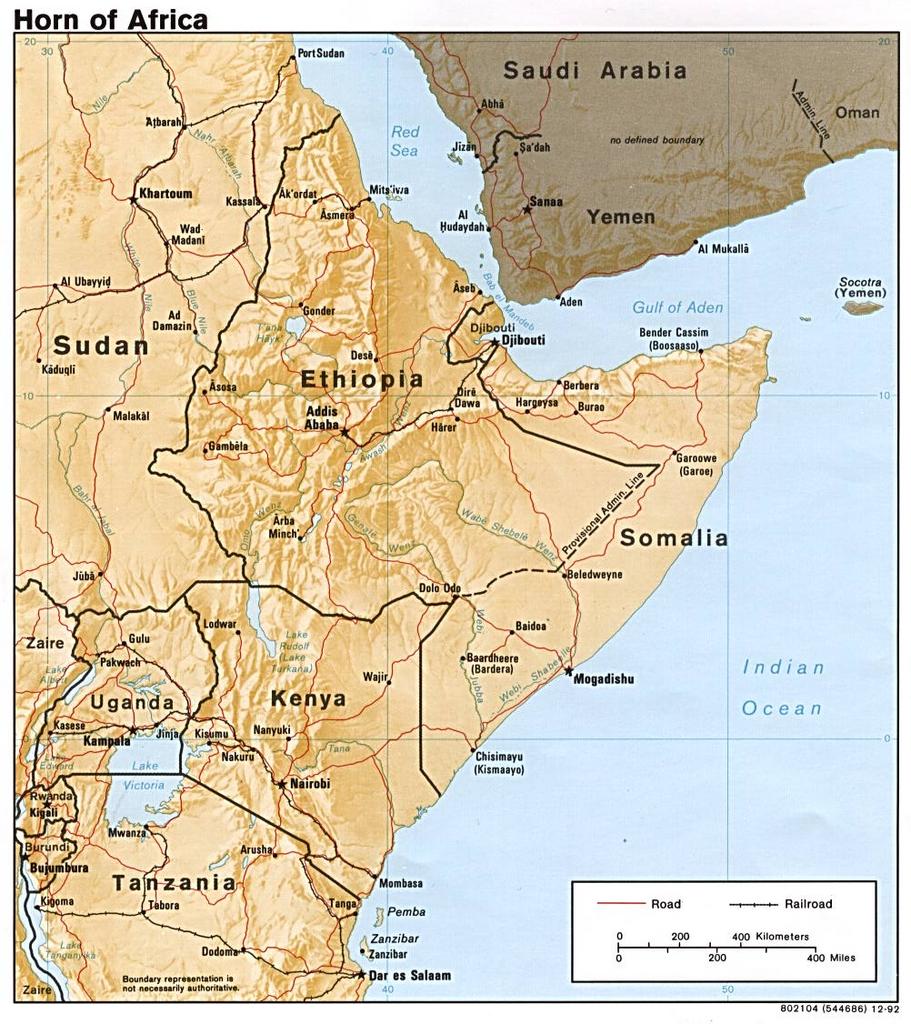
"In 2005, Al-Qaida is very much in the Horn of Africa," a U.S. intelligence officer said during a background brief. "But we're there, too. CJTF-HOA supports a spectrum of counter-terror operations."Good work by Col. Bay and by the HOA team. Read all about it.
The intelligence officer emphasized the role Djibouti's seaport and airbase play in supporting coalition naval operations in the Red Sea and Indian Ocean. That force includes ships from German, Spanish and other allied navies. The ships and aircraft conduct "counter-terror surveillance operations" -- which means stopping and inspecting everything from rowboats to oil tankers.
Four years ago, terrorists tried to sink a French tanker as it passed through the Bab Al Mandab Strait between Yemen and Djibouti. The navies have also tackled the pirates that plague the area. Terrorists and criminals cooperate on land -- terrorist organizations with cash can also buy a pirate.
The spectrum of counter-terror operations in the Horn also includes developmental aid, medical support, and training for border troops and police forces -- what Huddleston meant when he said U.S. forces were "waging peace."
Poverty may not create international terrorists, but poverty, social turmoil, starvation, lack of infrastructure and weak political systems attract them. East Africa and the Horn suffer from all of these afflictions.
VertRep

Wednesday, August 24, 2005
Austin Bay: Counter-terror ops in the Horn of Africa (HOA)
Austin Bay at StrategyPage on the under-appreciated, under-reported HOA opshere.


India says no China defence posts on Myanmar island, but will verify
Just an interesting change of mind reported here:
The chief of India's navy said on Wednesday he believed a Myanmar official statement that there were no Chinese military or intelligence facilities on Myanmar's Coco islands near India.What did Reagan say? "Trust but verify." Good advice.
For years, New Delhi has accused China of having naval listening posts with personnel in the Coco islands in the Bay of Bengal, just 45 km north of Indian's Andaman and Nicobar islands.
The Indian navy has kept a robust presence in the region, which is near the Straits of Malacca, a vital sea trade route.
"According to the Myanmarese, there is no Chinese involvement in Coco Island(s) and we believe them," Indian navy chief Admiral Arun Prakash told reporters in Port Blair, the capital of the Andaman and Nicobar island chain.
In February, Myanmar chief of naval staff Soe Thane visited India and met Prakash, a sign of closer ties between New Delhi and Yangon.
"During his last visit to New Delhi, I had enquired about Coco Island and ... in reply he invited us to visit the islands and check as, according to him, there is no such (Chinese) threat," Admiral Prakash said, adding that he would visit the Coco islands soon but did not give a date.
Good summary of the piracy/terorist threat in the Malacca Strait
Nice summary of the terrorism and piracy situation in the Malacca Strait presented here.
I do, however, disagree with the distinction attempted to be drawn in the following paragraph between terrorism and the use of piracy to fund terrorism.
I do agree whole-heartedly with the article's conclusion:
I do, however, disagree with the distinction attempted to be drawn in the following paragraph between terrorism and the use of piracy to fund terrorism.
GAM has been fighting a separatist war against the Indonesian government since the 1970s with the aim of creating an independent Islamic kingdom in the province of Aceh. The group is said to finance its terrorist activities partly through sea piracy and smuggling. These are not, strictly speaking, acts of maritime terrorism. It has been well documented that terrorist groups have resorted to criminal activities in order to generate funds for their political campaigns. However, these criminal acts are not in themselves acts of terrorism. Therefore, the threat of maritime piracy must not be labeled as a terrorism risk.(E1 note: GAM is, if it is not clear to you, the separatist movement based in Aceh on which Indonesia has atttempted to pin much of the blame for piracy at the north end of the Strait. A recent treaty may ease that situation.)As the US has stated in the War on Terrorism, those who fund terrorists are as culpable for the damage terror inflicts as are the actual terrorists performing their the acts of terrorism. It seems to me me to be too fine a distinction to try and differentiate between the act of a person who, say robs banks, and then uses those ill-gotten gains to buy explosives to blow up a ferry boat. His motive for the bank robbery was to fund his terrorism. Why call him a bank robber and then a terrorist - he's simply a terrorist. And so are the terrorist groups who use kidnapping to collect ransom to pay for their operations. In addition, such a distinction provides cover for those who fund terrorists - no matter how they got their money. Such cover is unjustified and unsupportable in light of legal precedent regarding aiding and abetting criminal activity.
I do agree whole-heartedly with the article's conclusion:
While it is important to distinguish between the pirate attacks taking place in the straits and acts of terrorism, what these pirate attacks demonstrate is that the vessels transiting the straits are highly vulnerable to a breach in their security. Pirates regularly hijack tankers in order to steal the cargo or kidnap crew members. If terrorists were able to take over a tanker carrying highly hazardous chemical cargo, the implications could be disastrous. The unpredictability of terrorism makes it hard to carry out accurate risk assessments. However, as can be seen from the evidence that the threat from maritime terrorism is a clear possibility in the Straits of Malacca.
Shanghai Organization of Cooperation Plays War
 Chinese amphibious tanks -Reuters photo
The Shangahi Organization of Cooperation(SOC) is, i guess, China and Russia and, as reported here, they've been having a dandy time playing war in the South China Sea and the
The "legend" of the maneuvers describes 10,000 strong Chinese and Russian troops would engage against some terrorists, separatists andSeparatists? Extremists? Under Chinese control? Can't they say "Taiwan" -- or as "Nation of Orange" like we do in the US?
extremists of an "imaginary" state. Under the scenario, the UN gave approval to Russia and China to destroy the terrorists and gave these two countries a special mandate for a peace keeping operation.
In any event, an interesting read from the Russian viewpoint, especially as to which arms are for sale (and which are not):
Even before the maneuvers "Peace Mission 2005" Sergey Ivanov announced that Russia in these war games will put the most emphasis on demonstrating the capability of its weapon systems. The goal is evident - to galvanize the arm sales to Beijing. The source in the Russian Joints Chiefs of Staff said that Moscow is not offering to sell China Tu-95MS or Tu-22M3, but it would like China to buy modernized frontline bombers Su-24 and fighters Su-27SKM, A-50, military-transports Il-76, flying fuel tankers Il-78, helicopters Ka and Mi, as well as naval vessels. Moscow needs stable orders for its defense industry. As of now Beijing is pretty selective with its purchases. For instance, when the designers of the corporation Tactical Missile Arms" redesigned the "air-to-air" missile R-77 for "surface-to-air" anti-aircraft complex of short range, the Chinese military had the immediate interest to the new system. China already buys R-77 for its aircraft and the dual use of the missile presents definite interest. Also, Beijing liked the new mobile complex "Ball" with the range of 120 km, which was designed for defense of the sea shore zones. The complex uses the missiles X-35 that was employed earlier only in the warships. Beijing also buys on a regular basis X-35.SU-24
A-50
SU-27
X-35 (SS-N-25)
Finally, the Chinese showed a lot of interests to Russian systems that allow dropping armored vehicles with parachutes. The Chinese army does not have this type of systems. During the maneuvers Russian paratroopers impressed Chinese counterparts by dropping in the same time several airborne troop's armored vehicles BMD-2 from the Il-76 MD.
 SU-24
SU-24 A-50
A-50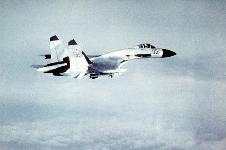 SU-27
SU-27 X-35 (SS-N-25)
UPDATE: Prior post here.
Tuesday, August 23, 2005
Malaysian police intercept hijacked cargo ship - hijacked 3 years ago
Initial report here:
More detail here:
UPDATE: Some more details of the recapture here.
Malaysian police commandos have successfully intercepted a hijacked cargo ship and detained its crew.
After a 17 hour chase through the busy Malacca Strait, maritime police officers boarded the moving MV Paulijing and detained 20 Chinese nationals on board.
The Malaysian-owned cargo ship, which was originally named MV Natris, was hijacked in November 2002 in Indonesian waters off Batam island near Singapore.
The ship was heading from India to Vietnam with a cargo of soya bean when it was intercepted.
More detail here:
The Malaysian marine police Tuesday detained a Belize-registered merchant ship and arrested 20 Chinese crew including the captain on suspicion that the vessel was that of MV Natris reportedly hijacked and went missing three years ago.
Marine Police Commander SAC I Abdul Rahman Ahmad from the Bukit Aman police headquarters told reporters that the 567-tonne vessel "MV Paulijing" was stopped at 3.20 am in an operation involving the special operations force about 9 nautical miles off Kukup, Pontian.
Police believed that MV Paulijing, laden with soy beans and vinegar, was Panama-registered MV Natris that had been repainted as their shape, weight and other characteristics were the same, he said at the Southern Region Marine Police Headquarters in Tampoi.
MV Natris was reportedly hijacked and went missing in Batam waters, Indonesia on Nov 17, 2002.
Abdul Rahman said the marine police went into action to track down the vessel after being informed of its presence in Malaysian waters at about 9 am last Monday.
It was on its journey from Khandra, India to Ho Chi Minh port, Vietnam, and was spotted cruising at 10.8 knots in Port Klang waters at 10.30 am when the marine police ordered the captain to stop.
UPDATE: Some more details of the recapture here.
Somali Warlord: Crew of hijacked UN World Food Program ship will be tried
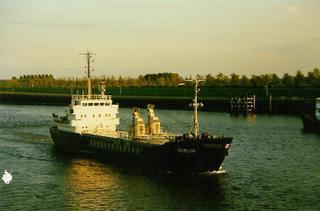 photo source
Another twist in the long-running saga of the M/V Semlow, captured by Somali pirates several weeks ago (around June 30). The latest crazy turn is reported here:
A regional Somali warlord said on Tuesday that the crew of a United Nations-chartered relief ship hijacked two months ago off the lawless country's eastern coast will be prosecuted for illegally entering Somali waters.Un-freaking-believable.
Mohamed Sheikh Ali, who the controls district off of which the vessel has been held by armed pirates since late June, said the 10-man crew of the MV Semlow will be tried under laws intended to protect the coast from illegal fishing and dumping.
"The laws were already in place before the arrest of the ship," said Ali, who claims the title of district commissioner for area in central Somalia around Haradere, the home region of the gunmen.
"The district introduced them to protect Somalia's fishing zones and prevent the dumping of chemical waste there," he said.
'The laws were already in place before the arrest of the ship'
Ali gave no details of the law nor any explanation of why the crew - who were transporting 850 tons of German - and Japanese-donated rice for the World Food Programme (WFP) to distribute to Somali tsunami victims - would be tried under it.
Latest Piracy Report from ICC Commercial Crime Services (to 22 August 2005)
For latest ICC CSS piracy report go here. Highlights:
Iraq:
Indonesia:
Oh, yes, STAY AWAY FROM SOMALIA: ICC-CSS reports 17 incidents since March 15 and some well offshore.
Iraq:
21.08.2005 at 1945 UTC in position 29:43.6N - 048:39.3E, Um Qasr-Khawr Abd Allah Channel, Iraq.
Six robbers in two boats armed with machine guns and knives approached a general cargo ship at anchor awaiting berthing. Four robbers boarded; overpowered duty A/B and went to the bridge, where they took hostage D/O and two crewmembers. Robbers held further seven crewmembers at gunpoint and took them to master’s cabin. By this time master escaped and hid inside engine room. Robbers assaulted the hostages and threatened them with guns and knives and ordered them to open the safe. As none of hostages knew the safe combination they lowered the safe in their boat. Robbers escaped in a two metre dark green speedboat at 2020 UTC.
Indonesia:
19.08.2005 at 2030 LT in position 02:37.1N - 108:57.0E, off Natuna islands, Indonesia.
Pirates armed with guns in a fishing boat fired upon a tug towing a barge causing damage to navigation equipment and accommodation. Master cast off the barge, took evasive manoeuvres and proceeded to Singapore. No injuries to crew.
16.08.2005 at 0200 LT in approx posn 01N – 104E, Indonesia.
Pirates hijacked a tug towing a barge. They threw a crewmember overboard who was rescued by a nearby craft. He reached shore and reported the incident to naval authorities in Tg. Pinang. The tug and barge are still missing. (Earlier post on this here
Oh, yes, STAY AWAY FROM SOMALIA: ICC-CSS reports 17 incidents since March 15 and some well offshore.
China's Refinery Wars
Hat tip to Instapundit: Read The Peking Duck: Oil Wars for some interesting information on distortions in the Chinese economy caused by its - uh- "unique" way of doing business:
Some general information of oil prices here and at links therein. It's a complicated business and as can be seen from China, one that governments have trouble keeping under control.
UPDATE: Simon was on this issue earlier and notes this:
It's interesting to sit on the sideline and watch which system will deal with increasing gasoline prices better- those that have subsidized cheap gas or those which let the market work its magic..
That’s the ‘how’ of it, as to the ‘why’, we need only to glance at the balance sheets of the mainland’s oil refiners. Together they lost 4.19 billion yuan in the first half of this year. Compare that to a profit of 16.38 billion yuan for the same period last year (figures from the China Petroleum and Chemical Industry Association). No wonder there are few happy bunnies among the executives at Sinopec and PetroChina. Their crude oil refining companies have been sacrificed for the greater good of society, i.e. to bear the losses incurred in providing cheap subsidized oil...Earlier post on China refining here.
Some general information of oil prices here and at links therein. It's a complicated business and as can be seen from China, one that governments have trouble keeping under control.
UPDATE: Simon was on this issue earlier and notes this:
One other interesting part of the article that is mentioned in passing but has greater significance:Well, I suspect most dedicated Communists and anarchists have thought so for some time...
..as Sinopec and PetroChina have listed many of their business operations in overseas securities markets, they are increasingly able to cite "shareholder interests'' as an excuse to defy government orders.
Maybe market economics can triumph over Communism after all? The writer is implying that Sinopec and PetroChina are using shareholder interests as a fig leaf to ignore orders. What if, perhaps, they actually believe in creating shareholder value and subverting Government orders is a means to that end?
Stockbrokers as subversives. Who would have thought?
It's interesting to sit on the sideline and watch which system will deal with increasing gasoline prices better- those that have subsidized cheap gas or those which let the market work its magic..
Ship captain appealing ban on carrying weapon onboard
Following up on a previous post, a ship captain from New Jersey is appealing from a court decision barring him from carrying a concealed weapon as reported here:
State Superior Court Judge John Pursel ruled last year that Salvatore Atanasio Jr. could carry a gun when operating a ship or at port and dock facilities. In his ruling, Pursel cited the post- Sept. 11 world of terrorist threats and increased threat levels in the national terrorist alert system as part of the reason for his decision.His attorney has argued that his is a special case:
The state Attorney General's office filed an appeal, and last month the state's appeals court overturned Pursel's decision. The court said that if a ship captain could carry a hidden handgun, then every flight attendant, bus driver and truck driver carrying hazardous materials would be able to, as well.
"This is a gentleman who, just like an airline pilot, transports hundreds and sometimes thousands of people aboard his vessels," said Lee March Grayson, an attorney in Randolph. "These are big vessels and, just like airline pilots, he ought to be permitted that right to carry a handgun. Not only for the protection of the crew and the passengers, but for the vessel itself..."We're talking about a ship that can literally carry more than half the people who were killed in the Sept. 11 incident in the city," Grayson said. "These are huge ships. We're not talking a little 28-foot cabin cruiser; these are huge ships, massive tonnage that could do a lot of damage if they were commandeered.""
Probably time to re-read his books
In an earlier post, one of the comments prompted me to remember Eric Hoffer author of The True Believer : Thoughts on the Nature of Mass Movements, and a great American thinker, and a self-educated one at that. Here's the exchange:
UPDATE: Another great quote:
(Comment by "Corsair"):San Francisco still has Fleet Week thanks to Feinstein. No this isen't the same city that Feinstein knew or I grew up in. This group of supervisors, thanks to district only elections, is about single-interest elections. This town is still supportive of the Navy, especially when the fleet comes in for the above, only this generation of govt. types thinks their ideological opinions can stretch across the city and into its laws, measures and fatwas...err positions. The example of the Midway and its benefits to San Diego should have been obvious.Wow. Time to dig the Hoffer books out and read them again..
(My response)
Corsair-
"Fatwah?" LOL
You wouldn't be suggesting a "True Believer" problem with the majority of the Board, would you?
Of course, Eric Hoffer did do his writing in The City... and one of his quotes was "Absolute faith corrupts as absolutely as absolute power."
Or, maybe the explanation lies in what Thomas Sowell wrote of Mr. HofferContrary to the prevailing assumptions of his time, Eric Hoffer did not believe that revolutionary movements were based on the sufferings of the downtrodden. "Where people toil from sunrise to sunset for a bare living, they nurse no grievances and dream no dreams," he said. He had spent years living among such people and being one of them.
Hoffer's insights may help explain something that many of us have found very puzzling -- the offspring of wealthy families spending their lives and their inherited money backing radical movements. He said: "Unlimited opportunities can be as potent a cause of frustration as a paucity or lack of opportunities."
What can people with inherited fortunes do that is at all commensurate with their unlimited opportunities, much less what their parents or grandparents did to create the fortune in the first place, starting from far fewer opportunities?
Like the frustrated artists and failed intellectuals who turn to mass movements for fulfillment, rich heirs cannot win the game of comparison of individual achievements. So they must change the game. As zealots for radical movements, they often attack the very things that made their own good fortune possible, as well as undermining the freedom and well-being of other people.
UPDATE: Another great quote:
"The monstrous evils of the twentieth century have shown us that the greediest money grubbers are gentle doves compared with money-hating wolves like Lenin, Stalin, and Hitler, who in less than three decades killed or maimed nearly a hundred million men, women, and children and brought untold suffering to a large portion of mankind." (quote source)
Monday, August 22, 2005
Piracy and Terrorism Stuff
Let's see if I can tie this all together.
First, Malaysian ship owners are none to happy about their insurance rates possibly going up, so they assert a "misperception" here
Then there's Nigeria and its admitted pirate problem as reported here. Nigeria seems to be developing a plan - of some sorts:
And, finally, the Indian Navy is getting into the anti-terrorism business as reported
here:
All tied in by terrorism and pirates who are, marginally terrorist (Nigeria's ethnic minority problem). Now, is it because that's where the money is right now? Or because the intelligence services are seeing a real threat out there?
First, Malaysian ship owners are none to happy about their insurance rates possibly going up, so they assert a "misperception" here
Malaysian Ship Owners Association (MASA) said there is a misperception among underwriters of a direct link between piracy and terrorism in the Straits of Malacca.Reader Steve pointed out in a email that the "consultant" referred to by FASA is Aegis Defense Services and a principal of that entity is a somewhat controversial man named Tim Spicer (Lt Col, RA (ret). I don't know anything about the man, but there seem to be certain groups that don't like him much. You can judge a man by his enemies, they say, so take it for what it is worth... He has been hired by Lloyd's before. Mr. Spicer has addressed maritime security.
Its chairman, Nordin Mat Yusoff, said in a statement here Monday that so far there has been no terrorist attacks in the Malacca Straits, and no evidence of a continuing threat of an Al-Qaeda inspired attack.
The explanation came at a time when the busy and important straits, under the littoral states of Malaysia, Indonesia and Singapore, was rated as a high-risk zone for piracy and terrorism.
In July, Lloyd's Joint War Committee, a London based advisory body for insurers designated the Malacca Straits as a high-risk area for war and terrorism on a par with Iraq for insurance purposes.
Meanwhile, in the same statement, the Federation of Asean Shipowners' Associations (FASA) welcomed the start of dialogue with the Joint War Committee marine hull underwriters at the offices of the International Chamber of Shipping on Aug 16, 2005, and hoped talks would continue.
Its president S.S. Teo said that while the war risk rating was unchanged, FASA remained optimistic that the Malacca Straits would be removed from the listing soon.
He said that the committee should not rely on a single report from one consultant and should review its decision to place Malacca Straits on the listed areas of Perceived Enhanced Risk (listed areas) in relation to war risks.
Then there's Nigeria and its admitted pirate problem as reported here. Nigeria seems to be developing a plan - of some sorts:
OVER the years, the menace of piracy and robbery of vessels on anchorage has been of concern to the federal government and had continued to evoke high level concern within the government quarters...
It is consequent upon this that the Federal Government is now contemplating complementing efforts of the Nigerian Navy with that of the Army in wagging[sic] war against sea pirates....
He noted that in addition to efforts of local security committees and those of the Presidential Implementation Committee on Security and Services (PICOMSS), NPA management has supported the federal government with $10 million to buy patrol boats to cover the waterways.
Sarumi said that the use of surveillance helicopter to monitor activities in the port areas has also been introduced into the entire security arrangement...
And, finally, the Indian Navy is getting into the anti-terrorism business as reported
here:
In a clear break from conventional manoeuvres over the last five years, the Navy will focus on anti-terror exercises this time.
Three top-level exercises scheduled over the next three months - with the US, Russia and France - will have the Navy testing indigenously developed methods to destroy terrorist bases, rescue hostages, intercept transport of weapons of mass destruction (WMDs) and even liberate a country from terrorists.
“The nature of these exercises is gradually undergoing a transformation from conventional to unconventional, from known to unknown. Countries now recognise India as an imperative partner against terror on the high seas,” an officer said.
Next month, the nuclear-powered aircraft carrier USS Nimitz, a destroyer, missile cruiser and Los Angeles-class attack submarine will arrive off the coast of Goa for exercises. The two navies will simulate engagements with “rogue vessels”, and work on procedures to deal with biological or chemical threats.
In October, the Russian Navy will arrive with a BDK-11 rapid landing vessel, a Marshal Shaposhnikov-class anti-submarine vessel, a submarine and a Burny-class destroyer for IndRo 2005, a series of exercises in the Bay of Bengal. The two navies will jointly liberate an imaginary third country from a terrorist takeover.
According to Anatoly Mazurkevich, chief, Main Department, International Military Cooperation, Russia, “The main goal is to practice organisation and interaction in preparing and conducting joint operations between anti-terrorist units of India and the Russian Federation. International terrorism can only be defeated by joint efforts.”
In November, a pair of the Navy's Delhi-class guided missile destroyers and support vessels will sail to the Gulf of Aden for exercises with the French Navy. Again, both navies will engage in missions aimed at debilitating renegade vessels and escorting a seized ship, apart from working on protocol issues to deal with such situations.
All tied in by terrorism and pirates who are, marginally terrorist (Nigeria's ethnic minority problem). Now, is it because that's where the money is right now? Or because the intelligence services are seeing a real threat out there?
Sea Fighter is the 'key to the future,' vice admiral says
 Navy photo of Fast Sea Frame-1 (FSF-1) meeting USS Rentz(FFG-46) as it enters San Diego
Commander Naval Surface Forces likes it. The price right. It goes fast and can be loaded with a lot of firepower. What's not to like? It defies "tradition" and the "blue water" Navy.
Reported here:
SAN DIEGO — Like a slender runner in a roomful of weightlifters, the Sea Fighter stands out among ever-bigger warships the Navy is building.Dear Mr. Pike: Have you got any maps of the major straits (Malacca, Hormuz) or of any littoral areas (like those where the Iraqi oil terminals are- you know where we have some billion dollar cruisers floating around)? Let me know if you don't, 'cause I'll order you up a set.
The aluminum catamaran — the fastest ship in the arsenal — could play a critical role in the war on terrorism, skimming shallow water in the fight against a smaller enemy attacking in swarms of motorboats.
Critics aren't convinced, believing that sea power is the domain of big ships in the middle of the ocean.
"There's a philosophical discussion going on whether the Navy needs more smaller ships or fewer bigger ships," said Paul Francis of the Government Accountability Office.
After the deadly terrorist attack on the destroyer USS Cole five years ago, the Navy accelerated efforts to strengthen its fighting ability in shallow water. The experimental Sea Fighter arrived this month in San Diego, where it will spend the next two years as a convertible test vessel for the new breed of fast, agile and relatively affordable ships.
The Sea Fighter, formerly known as the X-Craft, carries a Navy and Coast Guard crew of 26 and went from paper design to christening in less than two years. It carries a price tag of $79 million, compared with $4.5 billion spent on the new USS Reagan nuclear-powered aircraft carrier.
Resembling a commercial car ferry, the Sea Fighter stretches the length of a football field and can hold two helicopters on its deck. Its stern can launch and retrieve manned or unmanned mini-submarines and small boats, and it can be armed with hundreds of low-cost, "cruise-like" missiles capable of supporting U.S. troops hundreds of miles away.
In calm seas, it can exceed 50 knots, or 57 mph, and is capable of entering water as shallow as 12 feet.
Much of the design is new for the Navy. While a conventional warship bristles with sensors and weapons, the Sea Fighter is mostly empty space and weighs about 1,000 tons — one-tenth as much as the newest destroyer. The empty space allows it to be rapidly reconfigured after cranes hoist aboard 20-foot containers holding gear needed for each job — anti-submarine, mine detection, humanitarian missions.
"Sea Fighter is the key to the future," said Vice Adm. Terrance T. Etnyre, commander of Naval Surface Forces.
Whether Sea Fighter itself eventually joins the fleet will depend on how well it fares during testing, said Rear Adm. Jay M. Cohen, head of the Office of Naval Research, which oversaw the ship's development.
"The challenge is to demonstrate the effectiveness of a concept like this," he said.
House Armed Services Committee Chairman Duncan Hunter, R-Calif., has championed the ship since the late 1990s and his wife christened it in February at a Washington state shipyard. Both the Sea Fighter and the missiles, called Affordable Weapons, are made by Titan Corp., a San Diego-based defense contractor. But Hunter is frustrated that many in the Navy don't like the idea of building more small ships like the Sea Fighter.
"They'll say 'OK, you got it built. It's not going to the fleet. It's going to be a nice experimental craft. Keep it out of the way. We'll keep building big ships,' " Hunter said.
Plans are that by 2035, the Navy will have as many as 82 smaller, agile ships — a quarter of the future fleet — at a potential cost of $32.7 billion, according to a Congressional Research Service report issued in May.
However, several U.S. government studies have criticized the effort. With many shipbuilding projects competing for the same pool of money, the studies question whether the smaller vessels are as urgently needed as the Navy claims, and just how vulnerable those ships would be to missiles or medium-caliber weapons.
Others have problems envisioning exactly where on the globe the smaller combat ships would be used.
"It's a Jim Dandy concept," said John Pike, who directs the defense and space Web site Globalsecurity.org. "I have just had some difficulty sitting down and pointing to it on the map."
He said a fleet of small ships is a marked change from the Navy's core belief.
"It goes against everything they have believed for more than a century," Pike said.
Let's see the FSF costs $79 million or approximately 12 for $1 billion, The DDX may cost $3 billion. How many FSF's could I buy with that? Oh, yeah, about 36 give or take a volume discount.
Hmmm.
UPDATE: Related? Well, sorta- Thomas Barnett ( The Pentagon's New Map)- has some fun with the Washington Puzzle Palace's changing guard and the insider "media" that covers them..."The neocons are leaving, but so are the subs?!?" Probably won't win over the "big sub" boys, though...
Don't get me wrong. Not all submariners are dinosaurs. Scratch a younger officer and most times you'll find someone not totally wedded to the notion that subs comes in only one size: huge and absurdly expensive. But there is an entire senior generation of leaders, not to mention the crabby old grey beard retired admirals, that need history's hook..
UPDATE2: I guess, given the current environment, that it's a good thing that they didn't call it the "Sea Warrior"...
Thanks to Mudville Gazette's Open Post
Jordan Nabs Prime Suspect in Navy Ship Attack
Reported here:
A Syrian linked to an Iraqi-based terrorist group has been arrested as the prime suspect in the rocket attack that barely missed U.S. warships docked in the port of Aqaba (search), the Jordanian government said Monday.
The government statement, read on state television, said the suspect, Mohammed Hassan Abdullah al-Sihly (search), plotted and carried out the attack along with two of his sons and an Iraqi.
The statement said the plotters were part of an Iraq-based terrorist group, which was not named.
Al-Sihly, who lives in Amman, had been surveying sites for the Katyusha rocket attack in Aqaba since Aug. 6, the statement said. He was joined by his two sons — Abdullah and Abdul-Rahman — and Mohammed Hamid Hussein, the Iraqi, in "carrying out the heinous crime."
Hussein, also known as Abu Mukhtar, was the leader of the Iraq-based group, the announcement said.
What's Going on with San Francisco? Maybe this is the answer
Security of Our Ports (and a Little More)
An interview with the Director of Security for the Virginia Port Authority and formerly "the No. 2 Coast Guard official in New York in 2002," found here says much about the post-9/11 spirit in New York and the challenges being addressed thereafter:
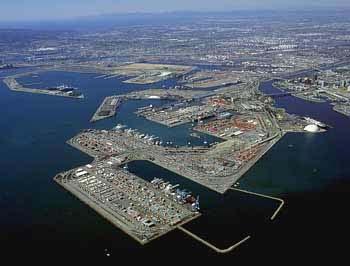 photo - Port of Long Beach
Long Beach is the second largest US container port. Norfolk, Va, is the sixth and Newport News is 23rd. (source)
An earlier post on LNG ship risk. And one on container security.
UPDATE: Added visual effects. Port of Long Beach website and POLB LNG info:
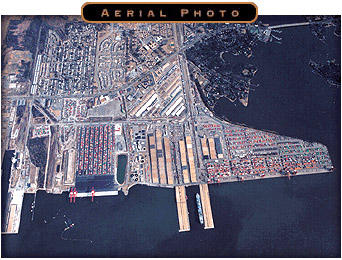 photo- Port of Norfolk (Which, in case you hadn't figured it out, is an "aerial photo")
UPDATE: Excellent article from the LNG Observer:
Q: Were there any terrorist scares that you dealt with in your time in New York?Unlike, say, the seemingly easily frightened City Council of Long Beach, California, which is considering rejecting an LNG site. According to this, there is a "battle" brewing because of of "potential terrorist and safety threats" -
A: We had the first detection of radiation aboard a container ship, the Palermo Senator, that turned out to be ceramics. We were using new equipment, and we were alerted to levels that we hadn't seen before. We had to track back through the cargo and determine who loaded the containers.photo - Container ship
Q: What did you learn from that?
A: Cases like that help you learn, and that rolls into your understanding next time. It also opened my eyes to just-in-time delivery and the concept of a ship as a moving warehouse. We had the ship detained for 96 hours. And the impact of detaining one 2,700-container ship was permeating throughout the nation. It seriously impacted assembly lines and parts and supplies of Ford Motor and other companies that depended on the containers. So we have to balance the economics against security.
 photo - Container ship
 But the sides are gearing up for a battle that may only be inflamed by a city report released late Friday detailing the project's potential terrorist and safety threats.Quick, before reading any further, think of all the bad things that could happen to any ship entering port. It could be ship full of furniture or cars or gasoline or passengers or whatever. The Long Beach report lists them all (except, perhaps, bering hit by a meteor) as a parade of horrors that could befall an LNG ship:
The report that City Hall sent to the California Energy Commission described the potential for "massive damage' downtown and in neighborhoods if an incident occurs at the proposed LNG site. It also detailed an alarming range of potential terrorist threats including hijacked LNG vessels, a small boat attack, a small aircraft attack and underwater diver or mine attacks.
Those concerns have caused opponents in recent months to urge council opposition to the project proposed by Sound Energy Solutions, a subsidiary of Mitsubishi Corp. and ConocoPhillips. SES officials maintain the complex would be safe and have urged the completion of an upcoming environmental review before any decision is made...At issue is a $450 million LNG receiving terminal on the port's Pier T. At the proposed terminal, ships would offload the supercooled methane gas, which would be reheated into natural gas for commercial and residential use.
SES officials have said the terminal would provide needed resources of the alternative fuel for the state and could provide Long Beach natural gas customers with cheaper rates. Opponents have challenged the company, claiming the risk of an incident outweighs any benefits the terminal could provide... But in a section on security response, city officials said the project poses numerous terrorist risks, including a hijacking of an LNG vessel.
The probability of any of these occcurences actually happening is not provided, nor is the economic impact of playing NIMBY in an area that is energy starved. Instead, port security in Long Beach presumably does not involve balancing the various benefits and risks. It's either "on" or "off."photo - LNG ship
"If the ship were to be hijacked, it could be navigated into a highly populated zone in the city such as the Queen Mary complex and crashed into either the Carnival Cruise ship or the Queen Mary itself, causing an explosion or release of gas,' the report stated.
City officials also cautioned that a small boat with explosives could be docked next to the terminal and that rocket-propelled grenades could be launched from a nearby ship.
The report also described the risk of a small aircraft attack as "very high' given the proximity to the takeoff route from Long Beach Airport. Prior to any ship arriving, Long Beach police would also insist on sending divers to search the piers and the hulls of the ships themselves.
Lastly, the report noted that any fire at the site could have devastating effects on the city.
"A major LNG incident at this proposed Port location could result in massive damage to both people and property over an area that could include downtown Long Beach as well as residential neighborhoods north of the Port,' the city wrote.
Adler said the list of risks is already known and can be mitigated. He downplayed the report, saying the port and airport face those same risks even without an LNG terminal.
"The city's trying to throw the kitchen sink at the state on this issue,' he said.
 photo - LNG ship
 photo - Port of Long Beach
Long Beach is the second largest US container port. Norfolk, Va, is the sixth and Newport News is 23rd. (source)
An earlier post on LNG ship risk. And one on container security.
UPDATE: Added visual effects. Port of Long Beach website and POLB LNG info:
Sited to occupy 25 acres at the southeast end of Terminal Island, the terminal would provide about 10 percent of California’s needs for the cleaner-burning fuel. When cooled to minus 260 degrees, natural gas becomes a liquid. LNG would be shipped primarily from Pacific Rim countries to Long Beach, where the liquid would be gradually warmed until it is again a gas. The proposed terminal also would have a facility for distributing LNG in its liquid form.Virginia Ports webste. Just for comparison:
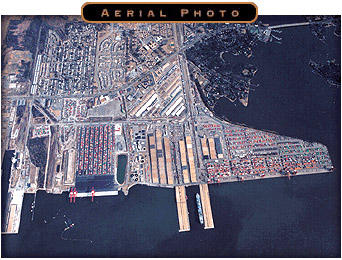 photo- Port of Norfolk (Which, in case you hadn't figured it out, is an "aerial photo")
UPDATE: Excellent article from the LNG Observer:
The only economic method of transporting natural gas over long distances is to liquefy it near the source, transport it by ship in a liquefied state, and regasify it upon arrival.Yes, they do and it doesn't help that excellent safety record gets short shrift. Lots of other good stuff - read it.
While experience and evidence seem to show that LNG is no more dangerous than many other cargoes routinely carried by ships and that LNG carriers are some of the most robust commercial ships ever constructed, the perception is otherwise.
Thus, in our increasingly threat-conscious world, the security demands placed on the LNG industry generally exceed those placed on similar commercial activities...
Sunday, August 21, 2005
Oil Prices : It's the crude, too
Nice piece from Econbrowser on the effect of sweet and sour crude and oil prices.
Light sweet crude is easier and less expensive to refine and, not surprisingly, not every refinery is equipped to handle the heavier, sour crudes. Why not? Well, rather than repeat Professor Hamilton here, I suggest you read his post.
P.S. (the government is involved)
UPDATE: Other factors: tanker shortage, refining capacity and more lack of refining capacity/
Oil shale and other exploration here.
Light sweet crude is easier and less expensive to refine and, not surprisingly, not every refinery is equipped to handle the heavier, sour crudes. Why not? Well, rather than repeat Professor Hamilton here, I suggest you read his post.
P.S. (the government is involved)
UPDATE: Other factors: tanker shortage, refining capacity and more lack of refining capacity/
Oil shale and other exploration here.
Saturday, August 20, 2005
Navy, Marine Helicopter Fleets- "A Growth Industry"
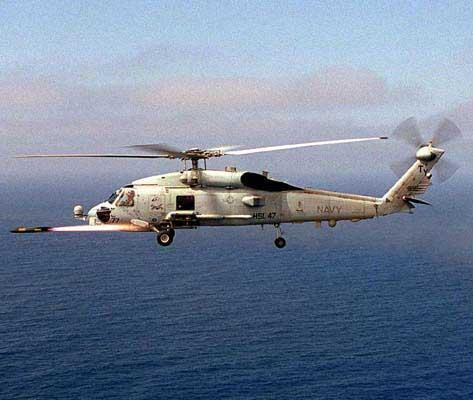 Seahawk and Hellfire
National Defense reports here:
Rotary aviation in the Navy and Marine Corps will be a growth industry for some time, says Rear Adm. Thomas J. Kilcline Jr., director of the Navy Air Warfare Division.Why , yes - yes, they would.
Emerging “concepts of operations” for helicopter missions focus on antiterrorism mission, he tells National Defense. In maritime interdiction operations, for example, helicopters are teamed with inflatable RHIB boats. “In the future, we may find ourselves doing more with helicopters,” says Kilcline. Armed helicopters “will be useful against smaller threats, such as swarming boats.”
UPDATE: In the interest of full disclosure, I note (again) that my oldest son is a Navy helicopter pilot. His wings look like this:

Naval aviator helicopter pilots are also qualified in fixed wing aircraft.
USS Iowa Banned from San Francisco, Moves to Stockton
In a silly and immature protest of some sort, the governing body of San Francisco rejects a plan to put the decommissioned battleship USS Iowa on display near Fishermans Wharf as reported here. The ship will go to Stockton, instead, which, not surprisingly, is happy to get it. The action of the Board appalled even Senator Diane Feinstein, as you will see in the following quote:
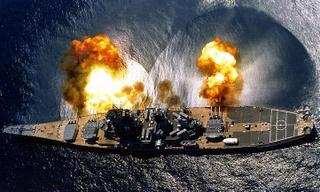 Iowa in action
(Thanks to Mudville Gazette's Open Post)
UPDATE: John at Arrgggh! seems a little sarcastic or something...
UPDATE2: USS Iowa vets looking for help to put the Iowa in San Francisco instead of Stockton here. Not that there's anything wrong with Stockton...
 Iowa in action
The USS Iowa joined in battles from World War II to Korea to the Persian Gulf. It carried President Franklin Roosevelt home from the Teheran conference of allied leaders, and four decades later, suffered one of the nation's most deadly military accidents.No, ma'am, it isn't. A lot of us have fond memories of the City by the Bay that used to be.
Veterans groups and history buffs had hoped that tourists in San Francisco could walk the same teak decks where sailors dodged Japanese machine-gun fire and fired 16-inch guns that helped win battles across the South Pacific.
Instead, it appears that the retired battleship is headed about 80 miles inland, to Stockton, a gritty agricultural port town on the San Joaquin River and home of California's annual asparagus festival.
Sen. Dianne Feinstein, D-Calif., a former San Francisco mayor, helped secure $3 million to tow the Iowa from Rhode Island to the Bay Area in 2001 in hopes of making touristy Fisherman's Wharf its new home.
But city supervisors voted 8-3 last month to oppose taking in the ship, citing local opposition to the Iraq war and the military's stance on gays, among other things.
"If I was going to commit any kind of money in recognition of war, then it should be toward peace, given what our war is in Iraq right now," Supervisor Ross Mirkarimi said.
Feinstein called it a "very petty decision."
"This isn't the San Francisco that I've known and loved and grew up in and was born in," Feinstein said.
(Thanks to Mudville Gazette's Open Post)
UPDATE: John at Arrgggh! seems a little sarcastic or something...
UPDATE2: USS Iowa vets looking for help to put the Iowa in San Francisco instead of Stockton here. Not that there's anything wrong with Stockton...
Coast Guard Port Security Unit
After the Aqaba flap, naturally, attention might turn to Port Security here at home, as in this report from San Francisco here on a Port Security Unit. However, they don't seem to have communications problems well in hand, with as far as talking with other emergency responders or in discussing communications with the press...
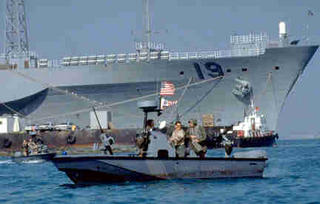 photo source
I worked with Port Security Units during Desert Storm (we in the MIUWU were the "eyes" and they were the "teeth") and those guys were great. I suspect this new crop is pretty darn good, too, and probably deserve a little more credit than this report gives them.
UPDATE (8/21/05): A little better article (subscription) regarding the new PSU and its mission: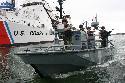
Welcome to the Fleet, PSU 312!
(You should note that the unit is based at Coast Guard Island in San Francisco Bay on the Oakland side...and thereby may avoid the Iowa problem.)
High quality official Coast Guard photos here.
Thanks to Mudville Gazette's Open Post!
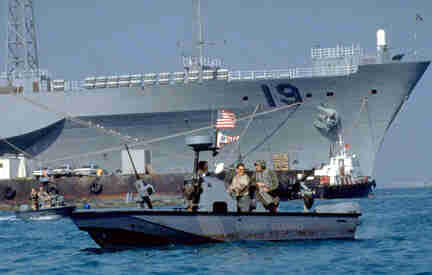 photo source
I worked with Port Security Units during Desert Storm (we in the MIUWU were the "eyes" and they were the "teeth") and those guys were great. I suspect this new crop is pretty darn good, too, and probably deserve a little more credit than this report gives them.
UPDATE (8/21/05): A little better article (subscription) regarding the new PSU and its mission:
The Coast Guard showcased a new tool for protecting ports Friday, complete with ear-splitting demonstrations of firepower.
Equipped with six high-speed, 25-foot boats armed with machine guns, Port Security Unit 312 is prepared to defend ships and harbors from a wide range of threats.
The unit is the first of its kind based in the Bay Area and the third on the West Coast. Its main mission is to defend overseas ports in support of U.S. military operations, such as in the Middle East.
"They're looking to do port security on the front lines," said Petty Officer Brian Leshak, a Coast Guard spokesman.
The unit's leader, Cmdr. Don Huenefeld, is one of about 140 reservists who constitute most of the unit, with six active-duty members making up the rest. The central Washington apple and hay farmer said the unit is prepared to ship out on short notice -- no more than four days -- and stay overseas with little help.
Tents, sleeping bags, cots, medical supplies, communications equipment, guns, cooking gear and almost everything else the unit needs are packed into metal shipping containers. Those and the boats are transported aboard military or chartered civilian aircraft.
"We're self-contained for 30 days," Huenefeld said. "All we need is fuel and water."
The unit can begin limited operations within a day of landing. However, currently it isn't scheduled to deploy. It also could be called on to secure a U.S. port, as others did in New York, Boston and Los Angeles after the Sept. 11, 2001, attacks.
"Port security units operate in everything from cold environments ... to the deserts of Iraq," said the unit's operations officer, Lt. Cmdr. Brett Linden.
It also isn't limited to operating on water. Members can patrol on land, too, to guard the unit or other potential targets.
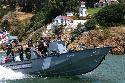
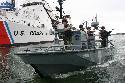
Welcome to the Fleet, PSU 312!
(You should note that the unit is based at Coast Guard Island in San Francisco Bay on the Oakland side...and thereby may avoid the Iowa problem.)
High quality official Coast Guard photos here.
Thanks to Mudville Gazette's Open Post!
Subscribe to:
Posts (Atom)