VertRep

VertRep

Tuesday, July 11, 2006

Have we won the War on Poverty yet?

42 years of the War on Poverty.
Poverty among Americans between ages 18-64 has fallen only marginally since 1966, from 10.5% then to 10.1% today. Poverty has significantly fallen among Americans under 18 years old from 23% in 1964 to 16.3% today. The most dramatic decrease in poverty was among Americans over 65, which fell from 28.5% in 1966 to 10.1% today.

In 2004, more than 35.9 million, or 12% of Americans including 12.1 million children, were considered to be living in poverty with an average growth of almost 1 million per year.
I don't know how many billions have been spent, but it doesn't look like we've moved much except in the 65+ age group.

UPDATE: John Rosenthal discusses the premature announcement of "the end of poverty" in Europe here with special attention to France:
Nonetheless, if it has not quite succeeded in "abolishing" poverty yet, the EU has indeed managed to make a remarkably large share of poverty in Europe disappear -- that is, as far as the official statistics are concerned. Thus, the EU statistical office, Eurostat, defines the poverty line -- or rather what it more gingerly describes as "the risk-of-poverty threshold" -- not in absolute terms, as in the US statistics, but rather as 60 percent of the median national income in each country. Thus, for example, the Portuguese "risk-of-poverty" threshold for a family of four gets set at around €10,000.

Given the massive disparities in income among European countries, this convention makes for some interesting results. Whereas, for instance, according to Eurostat, a German family of four is "at risk" of falling into poverty with an annual income of €20,000, a Romanian family of four only "risks" poverty with an income roughly ten times less. (See here for a comparative chart from Eurostat including Germany [DE] and Romania [RO].) In this way, the EU has already eliminated a great deal of poverty in Romania even before the country's formal adhesion to the EU scheduled for 2007. Reason enough for the New York Times to be impressed!
Hmmm. I wonder how well How to Lie with Statistics sold to Eurostat employees?

LNG offshore New England moving ahead

Reported here:
The offshore terminals would be invisible on the sea surface unless a tanker is moored. Underwater, there would be buoys, anchors, and the pipe carrying gas to shore. A ship carrying supercooled gas would dock, regasify the liquid on board and inject it into the underwater pipeline. Excelerate has proposed building a 16.4-mile pipeline to connect to New England's distribution network.

Environmentalists and government officials have liked the idea of offshore terminals because ships don't steam near populated areas. Public officials and residents near the Everett facility and proposed LNG terminals in populated areas, such as in Fall River, fear that a terrorist attack or catastrophic accident on one of the mammoth ships could cause widespread death and injury.

Construction of an offshore terminal would not force closure of the Everett terminal, New England's only operating LNG facility, but it may provide enough to meet New England's growing energy demand so that other projects wouldn't need to be built on land.
Will and way meet...

Somali Islamists win another round


BBC report here:
Some 500 Somali fighters loyal to the last member of an alliance of warlords fighting Islamists in Mogadishu have surrendered, along with their weapons.
Abdi Qeybdid's forces had battled the Islamist militia for two days, leaving almost 100 dead and 200 wounded.

A BBC correspondent says the Union of Islamic Courts now controls 99% of the Somali capital and other key towns.

The Islamists deny claims made by the US and the weak, UN-backed government that they are linked to al-Qaeda.
And they'll deny it until bin Laden walks in their victory parade...

BBC map.

Bombay bomb attack

Hundreds feared dead as 7 bombs go off on trains. Reported here:
Scores of people have been killed in at least seven near-simultaneous bombs on trains in the Indian financial capital, Mumbai (Bombay), police say.
The city's police Chief AN Roy said on Indian TV as many as 100 people were feared killed and more than 250 hurt.

The first explosion went off at about 1830 local time (1300 GMT), during the peak of the evening rush hour in the suburbs on the busy Western Railway.

There have been a number of bomb attacks in Mumbai in recent years.

The city and the capital Delhi have been put on high alert, and Mumbai's entire rail network has been shut down.

Indian Prime Minister Manmohan Singh appealed for calm and described the incidents as a "shocking and cowardly attempt to spread a feeling of hatred".

Pakistani leaders also condemned the blasts as a "despicable act of terrorism".


More coverage at CounterTerrorism Blog here.

Latest ICC CCS Piracy Report (to 10 July 06)


Latest ICC Commercial Crime Services Piracy Report here. Highlight:
09.07.2006 at 0750 UTC in position: 12:28N - 045:10E, Gulf of Aden.
Two speedboats, turquoise hull, length 10 metres and each manned by three persons followed a container ship underway. Ship increased speed, raised alarm; crew mustered and informed ships in vicinity via vhf. After 10 minutes boats moved away.
Plus some minor ship robberies...


Map shows approximate area of Gulf of Aden incident. Yemen is country to the north, where Aden is located.

Port Security: Container threat thoughts


Found here:
Some politicians want to require inspectors to look inside each container before it's shipped to U.S. ports. Supposedly, this would prevent terrorists from smuggling in a weapon of mass destruction or a "dirty" bomb (a large, conventional explosive laced with radiological material). But in reality, we'd be wasting our time and money.

While it's true that a terrorist could put a bomb in a box, it's neither likely nor logical. In the case of all but a nuclear device, it would be easier and more certain to just build the weapon here.

That's especially true for conventional explosives. Biological weapons can be produced with materials and equipment bought off the Internet or shipped here via any number of cargo delivery services. Potential chemical weapons surround us: chlorine tankers, gasoline trucks, pipelines and storage facilities. All a terrorist group needs for a dirty bomb is some low-grade radioactive material stolen from a hospital or a watch factory.
UPDATE: The Democrats question Port Security here.Hey, it's their press release and their choice of "facts." I guess they need one security issue to run on and port security seems to be it. However, I question whether throwing money at it is the right approach, especially in light of a threat that seems to me to be overstated. More on this in a later post.

Military & political wheels spin in Asia

Editorial lays out some background and covers the moves in Far East goes ballistic.

Monday, July 10, 2006

Cement ship capsizes off Yemen, 7 sailors die

Reported here:
The ship, ‘Meryam 4’, sank on Wednesday night while it was on its way to Zanzibar in Tanzania from the Omani port of Salalah, with its nineteen crew members. The ship was owned by al-Hufuf Maritime Co, which is based in the United Arab Emirates, but it sailed under the flag of Panama, according to media reports.

Khaleej Times reported from reliable sources that the crew members were from India, Sri Lanka, Burma and Somalia. Whereas the Associated Press website reported that the seven dead sailors included individuals from Tanzania, Borneo, Somalia and four from India.
***
Khaleej Times said that after getting a distress call from the vessel, Yemeni coast guard boats were dispatched to the scene. The body of a sailor was recovered early the next morning, and naval ships patrolling the area as part of a US-led anti-terrorism mission, pulled five other bodies from the water that afternoon. The rescued crew members were admitted to a hospital in Aden.

More Summer Fun in Somalia


A couple of updates from the world's least organized "state":

Somali gangs-er- "factions" kill each other over who gets to escort an aid convoy, as reported here:
Five people were killed at the weekend and several others seriously injured after rival militia clashed along the Kenya/Somalia border.

Fighting erupted at the Somalia border town of Dobley after the two groups differed over a contract to protect convoys of relief supply shipments to the southern part of the troubled nation.

Fighting ensued and spilled over to the common border, where a defeated faction had retreated to regroup before staging a surprise dawn raid on Sunday, leaving at least 14 people with bullet wounds.
***
Witnesses said forces allied to the Somalia Patriotic Movement (SPM) waylaid a column of trucks ferrying humanitarian supplies after World Food Programme (WFP) reportedly awarded a rival faction a security contract to escort the shipments.


The Arican Union votes to send a belated "peace" mission to Somalia, but the Union of Islamic Courts, which claims to be in charge, rejects the idea, as reported here:
The African Union (AU) upon the conclusion of its leaders' summit last Sunday, unanimously adopted a resolution to deploy a peace mission in Somalia.

The militant Islamist group in Mogadishu however has dismissed the idea protesting that no foreign troops would be allowed into the country.
***
The Union of Islamic Courts (UIC) which took control of Mogadishu and some other parts of Somalia however, had priorly warned the Transitional Federal Government (TFG), that they will terminate any negotiation if foreign peace keeping troops were allowed into Somalia.

Sheikh Sharif Ahmed, the Mogadishu Islamic Courts chairman, said: "The government should stop the request of foreign troops in order for internal discussion with us to continue," Ahmed told reporters, "Negotiations with the government are not possible at this time because parliament could approve foreign troops."
No much in the way of a surprise in any of that.

North Korean missile launch: Some concerned, others say "No worries"

At least I think my post title sums up this Aviation Week & SpaceTechnology report except for this part:
U.S. defense officials were tight-lipped about the types of missiles launched last week and how the vehicles were detected and tracked. U.S. Army Lt. Col. Brian Maka, a Defense Dept. official, said the Pentagon does not discuss military forces' "alert status," the types of detection assets used or missile trajectories, citing classification of "collection systems."

HOWEVER, ALLIES IN THE PACIFIC region say a number of missiles were being prepared for launch from the northern part of the Democratic Peoples Republic of Korea (North Korea) in May, and that those activities were discovered by a U.S. Keyhole-series reconnaissance satellite. Japan positioned two Aegis cruisers nearby, and the U.S. undoubtedly had Defense Support Program satellites, surveillance aircraft such as the RC-135S Cobra Ball and the RC-135V/W Rivet Joint, the Cobra Judy ship and myriad radars detecting and tracking the tests.
Not that AW&ST would ever reveal any "sources and technique" info...

An explosion, an Iraqi ship, and an Indian crew "trapped" in Basra

Reported here:
Thirteen Indian crew members of a cargo vessel are stranded in the Iraqi port of Basra since a month after an explosion hit their vessel leaving one compatriot dead.

The vessel Al Aber, which left Sharjah Creek on June 4 for Basra port, was hit by an explosion at Abu Fulus port on June 16, one of the injured crew members Deepak said.

"We didn't know whether it was a terrorist attack or what happened. But our compatriot, Imam Hussien, was killed and six of us injured," he was quoted as saying by the Khaleej Times.

Six of the other crew members injured in the blast are undergoing treatment in a hospital in Basra.
***
"We are in trouble. We contacted the Indian missions here but have yet to get a reply," Deepak said.

"The owner of the vessel, an Iraqi national, was not responding when we asked whether we can leave Basra. We are struggling for food and other facilities. Now we don't know what to do with the body of our compatriot," he added.
Seems very odd to me.

"Marines Want Spaceplane"- Unh huh.


Out of the pages of Starship Troopers comes Marines Want Spaceplane:
Unlike the Air Force, Navy and Army, all three of which sponsor expensive satellite programs, the cash-strapped Marines are pushing just one space concept. It's called Small Unit Space Transport and Insertion, or SUSTAIN, and it's a reusable spaceplane meant to get a squad of Marines to any hotspot on Earth in two hours -- then get them out. The idea is to reinforce embattled embassies, take out terrorist leaders or defuse hostage situations before it's too late. "The Marine Corps needs [this] capability," Brig. Gen. Richard C. Zilmer told Congress in 2004.
I'm holding out for the transporter, myself. I just don't want to be the crewman in red.

More here with the great end line: "What’s next, a formal requirement for a time machine?"

The War with Iran: Mark Steyn's thoughts on the need to get serious

Found here:
Once again, we face a choice between bad and worse options. There can be no “surgical” strike in any meaningful sense: Iran’s clients on the ground will retaliate in Iraq, Lebanon, Israel, and Europe. Nor should we put much stock in the country’s allegedly “pro-American” youth. This shouldn’t be a touchy-feely nation-building exercise: rehabilitation may be a bonus, but the primary objective should be punishment—and incarceration. It’s up to the Iranian people how nutty a government they want to live with, but extraterritorial nuttiness has to be shown not to pay. That means swift, massive, devastating force that decapitates the regime—but no occupation.

The cost of de-nuking Iran will be high now but significantly higher with every year it’s postponed. The lesson of the Danish cartoons is the clearest reminder that what is at stake here is the credibility of our civilization. Whether or not we end the nuclearization of the Islamic Republic will be an act that defines our time.
Read it all.

Missile Defense?

Nice piece here on why U.S. missile defense is not quite a layered system.

Hint: It's all about the money!

Sunday, July 09, 2006

A book report on No Higher Honor


Curt at Chaotic Synaptic Activity has a review of No Higher Honor at his site. The book deals with the saving of USS Samuel B. Roberts after she struck a mine in the Persian Gulf in 1988.

In the book, Curt finds lessons in heroism, leadership and the vital importance of good training. Curt has an excellent background to judge such matters, including a tour as the Executive Officer of FFG-52 while it was deployed to the Persian Gulf .

As an aside, I know the marine surveyor who oversaw the loading of Roberts on the Dutch heavy lift vessel to bring her back for repair. A portion of the book involves that operation as can be seen at this No Higher Honor website and the photo shows the frigate loaded on the Mighty Servant.

Go see what Curt has to say.

UPDATE: The mine struck Roberts reminds me of the saga of USS Warrington (DD-843 which struck a mine off Vietnam in 1972 as reported here with more here, here. Unlike the Roberts, Warrington was too damaged to salvage and was towed back to Subic Bay, where she tied up alongside USS Pyro and her ammo was off loaded while her crew got some hot food and showers from Pyro. After the ammo offload, she was put in drydock for a damage assessment and later sold for scrap.

Katrina psych: Survivors moving off Gulf Coast

The full impact of Katrina is just beginning to be felt along the Gulf Coast. The psychological toll is beginning to show among those who can afford to get out. Let me explain what I've seen.

A couple of months ago I was down in Pensacola, attending a family funeral. and got to talking with a long-time friend of the family about the impact of Katrina. I was describing the damage we had seen over in Biloxi and asked whether people will be rebuilding on the coast. His response took me by surprise. "I think we're just starting to see what will be the second wave of damage down here," he said. "A lot of people will not rebuild and many who didn't suffer all that much will be getting out of the area as soon as they can. They simply don't have the heart to go through another hurricane."

Recently my sister, a long-time resident of the Mississippi coast, announced her plans to pull up stakes and move -- away from the hurricane zone. Mountains, piedmont or someplace where the threat of storm surge and high winds are either absent or too remote to spend much time worrying about. She just wants to not have to worry about losing everything. Again.

And here's an article from New Orleans of other survivors who are moving away. And it's the people you'd like to keep who are leaving:
Ivan Echegarrua, vice president of sales for Security Van Lines in Kenner, said the overwhelming majority of his customers are headed for the exits. Because people who can afford to hire moving companies tend to be educated and affluent, Echegarrua said, the trend portends trouble not only for the future market for his business but for the economic health of the New Orleans region.

Doctors and other professionals find their patient and client bases have shriveled, he said. Senior citizens say they cannot endure another harrowing hurricane season, or that relatives are pressing them to resettle outside the strike zone.

"We're seeing a lot of outflow, not much inflow," Echegarrua said.

Paul McCord, president of Crescent City Moving and Storage in Metairie, an agent of the national moving firm Bekins, said he finds it especially alarming to see lifelong New Orleanians giving up on the city.

"That scares you," McCord said. "They would not desert New Orleans if they have any other opportunity."
As I say, I don't think we know the full impact of Katrina yet. But it's beginning to show...

Sunday ship history: Merchant aircraft carriers


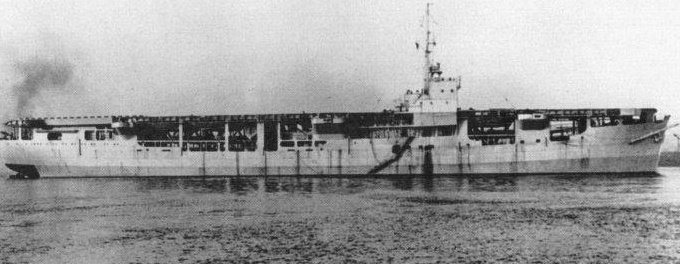
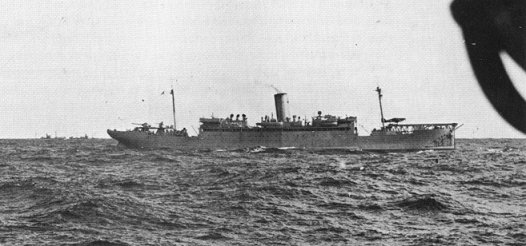
Tough times call for some innovative measures, and converting merchant hulls to use as aircraft carriers in WWII was one such extraordinary effort. As set out here :
Merchant aircraft carriers (MAC) were minimal aircraft carriers used during World War II by Britain and the Netherlands as an emergency measure ...
They were bulk grain carriers or tankers built with flight decks and small islands, but no catapult or other aircraft support facilities. The nature of the cargoes removed the need for the type of deck mounted cargo-handling gear needed by general freighters. They operated with civilian crews, under merchant colors, and carried their regular cargo while serving as aircraft carriers. Their fighter planes were primarily intended to attack long-range reconnaissance aircraft such as the Fw 200 Condor and the Junkers Ju 290 to prevent tracking of convoys.

The tanker conversions had no hangar, the grain ships did but it was small (four Fairey Swordfish was the limit). Flight decks were around 460 feet long on the tankers and between 413 and 424 for the grain ships, width was 62 feet in all cases. Aircrew accomodation was minimalistic and ammunition and fuel stores were neither armoured nor partitioned.
***
The 'Air Party' consisted of an Air Staff Officer (Lt-Commander), the aircrew, a doctor, a batsman (landing control officer), ten ship's gunners, four signalmen, and three or four Able Seamen. The Merchant Navy part of the crew might have an extra mate and/or wireless operator but was otherwise unchanged.
***
In practice, the MAC ships were successful. The antiquated, but robust, Swordfish aircraft were suited to the conditions and their patrols were very effective. Flying more than 4000 sorties in all, wartime records show that no convoy with an accompanying MAC ship ever lost a vessel to U-boats.


In addition to the merchant aircraft carriers, there were merchant ships equipped with catapults, "CAM" ships (Catapult Aircraft Merchantman":
...CAM ship was equipped with a rocket-propelled catapult launching a single Hawker Sea Hurricane, dubbed a "Hurricat" or "Catafighter". The ship was not fitted for landings so the pilot would bail out or ditch in the sea at the end of the flight and the plane would be lost. In 1940-41 35 ships were converted, starting with SS Michael E, and continued to carry their normal cargoes after conversion.
Note that all of the ships converted still carried out duties as cargo carriers or tankers.

Photos: MAC "Empire MacCabe", a Swordfish aircraft, CAM ship (see the catapult on the bow?) and a Hawker Sea Hurricane.

UPDATE: About 20 years ago, the US Navy was testing a similar program called ARAPAHO:
In the Arapaho program, the Naval Air Systems Command developed a portable, modularized aviation facility intended for installation aboard container ships. It can be installed in less than twenty-four hours and included all components necessary for V/STOL aircraft operations: flight deck, hangar, fuel, and crew accommodations. It was estimated to cost less than $20 million per set.

ARAPAHO was a research and development project to demonstrate the feasibility of equipping merchant ships with emergency aviation support in wartime and of operating ASW helicopters and other combatant aircraft from these vessels. ARAPAHO at-sea testing was completed 07 October 1982 at the Norfolk International Terminal, Norfolk, Va., when the 18,000-ton container ship Export Leader - configured with a portable modular aviation facility — returned to port after having logged 178 day and 45 night helicopter landings.

Photo is of HMS Reliant, a container ship converted for duty as an experimental helicopter support ship for the Royal (UK) Navy:
A container ship initially chartered as an emergency helicopter support ship for Falklands duties. Later converted with US/UK "Arapaho" project modular helicopter support equipment to test the capabilities of the Arapaho project. This was intended as a pre-manufactured, standardized, modular helicopter support suite to enable merchant ships to serve as helicopter ships in wartime. The project was not found to be a particular success.

Saturday, July 08, 2006

The battle for Somalia continues


Reported here:
The main road links Mogadishu to southern region in Somalia has been close for the second day on Saturday as rival militias loyal to Islamic courts and warlord Col. Abdi Qeybdid who was member of the failed anti terror alliance preparing for battle, reports confirmed Somalinet.

And here:
Another war tension has resumed in southwest suburb of the Somalia capital Mogadishu on Friday where Islamic militiamen and militia loyal former member of anti terror alliance Abdi Hassan Qeybdid are feared to clash.

The Islamic militiamen who have already captured a key checkpoint in the main road linking Mogadishu to other southern regions from Qeybdid’s militia began to block the road ordering all cars heading to the capital to use other road for preparation of all out war. Local resident said.

There are symptoms of war between rival sides, reinforcements of militias and battle wagons from both sides could be seen in the area outside of the capital, an eyewitness told Somalinet.

Colonel Abdi Hassan Awale Qeybdid, former police chief, is said to have been preparing for final battle if he is attacked and now he seeks for clan support to defend what he called ‘the clan interest’.

Col. Qeybdid, who is from Sa’ad sub-clan of Habar-gidir clan, earlier called the assault on him by the Islamists as an occupation of all Sa’ad sub-clan; therefore they should stand for defiance.

The people in the capital are too much worried about possible flare up of fighting between Islamic militiamen and militia loyal to Abdi Qeybdid who has been member of the collapsed alliance for restoration of peace and counter terrorism (ARPCT) in which united by more feared warlords who lost the control of the capital and other key towns in more than three months heavy bloody battles with Islamic courts early June.

And rumors of splits in the Islamist Court ranks here:
An ideological battle is being fought far from the public eye and the stage is now set for a clash between two contending visions of Islam.

Recent developments in Mogadishu indicate the new calm in Mogadishu could, indeed, be the calm before the storm.

The ideological divisions within the Islamist groups, were masked by the fact they had a common enemy - the warlords. Now that the warlords have been ousted, and the clans have switched their allegiance to the Islamists, these divisions are becoming noticeable.


And, of course, the threat of death for not being properly religious as noted here:
A leading sheik said Friday that Muslims who do not pray five times a day should be put to death.

The sheik's statement, which he confirmed to Reuters after it was broadcast on local media, caused consternation among residents and is expected to fuel Western fear that the Islamist militias that recently seized the capital are planning a hard-line Taliban-style rule.

"He who does not perform prayer will be considered as infidel and our Sharia law orders that person to be killed," said Sheik Abdallah Ali, who runs a Sharia, or Islamic law, court here in the capital, where the militias took control last month.
Better and better...

A theory on reasons behind North Korean missile firing


The excellent site The Korea Liberator has a theory about "Why North Korea willfully pissed off the whole world by launching a rocket, that is" that sounds reasonable here:
The regime is in desperate shape and is about to make some kind of face-losing concession, such as asking for food aid or agreeing to give up some weapon or activity. Kim Jong Il needed a garish display of belligerence to save face — to tell his people that any aid is really an extortion payment, or that any deal was being forced on his enemies.

Read it all, and also I suggest looking through the whole site, as there are some excellent posts by written by people with a clue.

Latest ONI Worldwide Threat to Shipping Report (to July 6, 2006)

Latest Office of Naval Intelligence Worldwide Threat to Shipping Report (to July 6, 2006) found here. Highlights:
Anti-piracy and crime current developments:
.
1. INDONESIA: Sixteen suspected members of an Indonesian based piracy syndicate that hijack small vessels are under detention after four vessels were recovered in the Philippines, per 29 Jun reporting. The syndicate targeted tugs and barges off the coast of Sumatra, hijacking them, changing their identities and then reselling them in other countries. Rather than hijacking the vessels on the open sea, the syndicate worked by recruiting crew members working on the targeted ship, who would then steal the vessel. One of the suspects reportedly admitted having been
involved in the hijacking of the (MARCOPOLO) and the (GEMINI) and selling the vessels in the Philippines. The syndicate is also believed to be responsible for the hijacking of the tug (MARTHA DINI) and barge (SENTANA V), which were recently recovered in the Philippines. According to testimony from the 16 suspects, comprised of 14 Indonesians and two Malaysians, the syndicate had stolen at least six ships belonging to Indonesian businessmen and sold them overseas (LL).
***
7. INDONESIA: Per 15 Jun reporting, Indonesia and Japan signed and exchanged diplomatic notes on Tokyo’s provision for three patrol boats to fight piracy and deter terrorism in the Malacca Strait. The donation is in response to an Indonesian request made in 2003 by the country’s then president, Megawati Sukarnoptri, for
help in procuring vessels to beef up its maritime patrol capabilities.
(LM, BBC).
***
H. INDIAN OCEAN-EAST AFRICA:
1. Chemical tanker reported gun assault and attempted boarding 4 Jun, Gulf of Oman.
***
3. Pirates reportedly have killed six fishermen and looted 200 fishing trawlers over the last two months per 19 Jun media reports, Bay of Bengal.
4. Bulk carrier reported attempted boarding 7 Jun, Chittagong anchorage A, Bangladesh.
5. Bulk carrier boarded 6 Jun, Chittagong anchorage A, Bangladesh.
***
1. NIGERIA: Unidentified bulk carrier boarded and robbed 20 Jun at 0310 UTC at Lagos Roads anchorage. Three robbers armed with guns and knives boarded the vessel from forecastle. They took hostage a duty A/B and held him at gunpoint. They lowered ship's
stores into a waiting motor boat and escaped (IMB).
***
2. SRI LANKA: Tamil Tiger rebel frogmen and a boat with mines and explosives detected north of Colombo port, per 19 Jun reporting. Two rebel frogmen, who came ashore because of rough seas, were caught by fishermen 20 km north of Colombo last week and handed over to police. Local newspapers have reported that the rebel mission was to penetrate Colombo port and attach mines to merchant ships. The government maintains that the rebels were targeting navy patrols and that the ports are well secured. Sri Lanka port security stated that all vehicles, ships, and persons who arrive at any port via sea and land are thoroughly checked and that
all entrances are being monitored around the clock. Additionally, port security indicated that all operational activities at Colombo and other ports are taking place as usual and approximately 30 vessels use Colombo Port for their daily operations. ONI Note: LTTE maritime operations have often been launched at points far from fighting in northern Sri Lanka, whenever combat operations have intensified there. Colombo and Trincomalee ports have typically been affected (FP, ONI).
***
2. JAPAN: Taiwan fishing vessel feared hijacked by the crew 10 Jun while operating off Iwo Jima. The Taiwanese fishing boat (HSING LONG), sailing near the Japanese Volcano Islands, has lost contact with the Taiwanese authorities and is believed to be hijacked by members of the crew. According to Foreign Affairs spokesperson Michel Lu, the crew members included two Taiwanese men, the captain and the chief engineer, and eight mainland Chinese fishermen. Media reports indicated the Japanese authorities intercepted a distress call on 10 June, alerted the Taiwanese
authorities, and sent a team of investigators to look for the boat. Lu stated that the captain was reportedly murdered on the afternoonof 10 Jun and the Japanese authorities are monitoring the boats movements. Lu explained Japanese authorities have no legal jurisdiction over the case and will hand the case over to the Taiwanese Coast Guard at an appropriate time. According to Lu, the Coast Guard Administration Officials have sent two vessels into “Taiwan’s economic sea zone” [seas on the border between Taiwan and Japan]. Also, a large warship (HEHSING) has been sent
to intercept the (HSING LONG), which has special agents and criminal police armed with the necessary weapons and equipment to handle the matter. It is anticipated that the warship will make contact with the HSING LONG in two to three days, per 12 Jun reporting. According to the fishing association, the (HSING LONG) had been taken over once before by another group of Chinese crew
embers three years ago (LM).

New Chinese WZ-10 Attack Helicopter - where have we seen this design before?


SinoDefence.com says:
Changhe Aircraft Industries Group (CAIG) and China Helicopter Research and Development Institute (CHRDI), both based at Jingdezhen, Jiangxi Province, are currently developing an attack helicopter for the PLA. The helicopter, which is often referred to as Wuzhuang Zhisheng-10 (WZ-10), is said to be a third-generation two-seat design comparable in size and performance to the European Tiger and South African Rooivalk.

The WZ-10 helicopter is believed to have been under development since the late 1990s under tight security. Very little information about the project is available. Chenghe’s parent company, AVIC II, is currently working with European partners on the common helicopter dynamic system, which can be used on both the proposed medium helicopter and the attack helicopter. However, China has not sought outside help with the attack helicopter’s mission system, mainly due to security reasons.

Limited information revealed on Internet has confirmed that the helicopter features a stepped tandem two-seat cockpit and narrow fuselage similar to Western designs. The helicopter has a five-blade main rotor and a four-blade tail rotor. The helicopter has a chin-mounted 30mm cannon and a pair of stub wings carrying ATGMs and/or other weapons. China is also said to have been developing the new HJ-10 ATGM comparable to the U.S. AGM-114 Hellfire for the WZ-10, but this cannot be confirmed.
Doesn't seem too mysterious to me where they got the design... blue bird is the WZ-10. The other is the US Army Apache AH-64.

Friday, July 07, 2006

Settlement in Navy sonar vs. whale dispute

Reported as Navy, environmental groups settle on sonar:
The settlement prevents the Navy from using the sonar within 25 miles of the newly established Northwestern Hawaiian Islands Marine National Monument during its Rim of the Pacific 2006 exercises, and also imposes a variety of methods to watch for and report the presence of marine mammals.

Vice President speaks to Expeditionary Strike Group 8

Full text here:
The war on terror creates an entirely different kind of security environment. And a military that was designed for the mid-to-late 20th century must now become a force that is lighter, more adaptable, more agile, and more lethal in action.

At the same time, we're keeping our eye on the fundamentals, and one of those is sea power. Naval operations are every bit as important, if not more so, than they were in the last century. Nothing takes the place of a convoy, able to enter any ocean, project great force from over the horizon, keep terrorists from disrupting the sea lanes or using them to transport operatives or weapons. Sea power allows the Commander-in-Chief to commit forces while retaining flexibility. With ships in place, we can fire precision strikes, launch sea-based rockets and missiles, deploy SEALS and Marine air-ground task forces by night or day, from close range or afar. Expeditionary Strike Groups are essential in the new security environment because they are so mobile and so adaptable. With ESGs, we have great offensive capability, wider operational reach, a maritime interdiction force without equal, and an even better intelligence-gathering network.

After we were attacked on 9/11, sea power provided the capability to go in and take down the Taliban in Afghanistan. It was vital as well in removing the dictator in Iraq, and we depend on sea power every day as we pursue the global war on terror.

This war is unlike any we've ever known. In the case of the terror network, we are not dealing with large armies we can track, or uniforms we can see, or men having territory of their own to defend. Instead, these enemies are hidden, diffuse, secretive in their movements, and asymmetrical in their tactics. They regard the entire world as a battlefield, and their goal is to plot, and plan, and strike wherever they can gain a foothold. They came into our country and murdered thousands of innocent, unsuspecting men, women, and children. They continue attempting to evade our strengths and to search for our weakness, in order to find ways to strike us again. And the greatest danger to civilization is the prospect of a terror network, on its own or with the help of an outlaw regime, acquiring chemical, nuclear or biological weapons -- and thereby gaining the power to kill hundreds of thousands, and to blackmail entire nations.

As long as these enemies threaten us, we'll have to wage the fight on many fronts. For us, this conflict began nearly five years ago. But for the terrorists, it's been going on for more than 20 years. For much of that time, they had the initiative, they were on the offensive. They carried out one attack after another -- on U.S. Marines in Beirut in 1983; on the World Trade Center in New York in 1993; and the same year on American special forces in Somalia. They attacked American embassies in Africa in 1998; the Khobar Towers in Saudi Arabia in 1996; killed sailors on the USS Cole in 2000. Over time, the terrorists kept hitting America but America did not hit back hard enough. And then, finally, came the attacks of September 11th, 2001. Those attacks changed everything for our country. And America and the civilized world made a decision: Wherever terrorists operate, we will find them and bring them to justice. As long as it takes, we will stay on the offensive, and stay in the fight until the fight is won.

By taking the offensive, we've been able to avoid another gathering -- having another attack in -- such as 9/11. No one can guarantee that we won't be hit again, and the enemy is trying desperately to strike us. But the relative safety of the recent past is no accident. We've been safe because of the hard work every day, around the clock -- and men and women involved in law enforcement, in homeland security, and the especially in the United States military have done a superb job for all of us.

The central front of the war on terror is now Iraq. Having removed a dictator, our coalition is working with Iraqi leaders toward the same goal: a democratic country that can defend itself, that will not be a safe haven for terrorists, and that will be a model for freedom in a troubled part of the world. Our strategy in Iraq is clear and our tactics remain flexible. Iraq today has the most progressive constitution and the strongest democratic mandate in the entire Arab world. Despite threats from assassins and car-bombers, the Iraqis came forward by the millions to cast their votes and proclaim their rights as citizens of a free country. And Iraq now has a unity government committed to the future of freedom for all Iraqis. None of this progress has come easily, but there is no denying the hopeful signs, and we can look to the future with confidence. All of us live in a better world because Zarqawi is dead, Saddam Hussein is on trial, and Iraq is free. (Applause.)

Our coalition has also put great effort into standing up Iraqi Security Forces. And that work also is going well. At present more than a quarter of a million trained and equipped Iraqi forces are in the fight on behalf of the Iraqi people. As those forces gain strength and experience, and as the political process advances, we'll be able to bring down our troop levels. But the President will make that call. And he will do so based on the judgment of military commanders and conditions on the ground -- not according to artificial timelines set by politicians in Washington, D.C.

We are going to keep at this mission until it is completed -- because we have given our word, and because freedom's victory in Iraq is vital to our own security. If the terrorists were to succeed, they would return Iraq to the rule of tyrants and make it a source once again of instability in the Middle East. And if that region remains a place of tyranny and resentment, we can expect more violence directed against the United States and other free countries. Yet if people are given a say in their own affairs, and the Middle East is allowed to grow in liberty and freedom, then tyrants and terrorists will lose their appeal. And if freedom and democracy take hold in that part of the world, we'll have a better chance for a future of security and peace.
Well said, sir!

Indian Navy acquiring more ships


Reported here:
The Cabinet Committee on Security (CCS) on Thursday approved the purchase of three more Russian-made stealth warships and 28 submarine-launched KLUB cruise missiles. This is expected to strengthen the Indian Navy’s operational capabilities. The three Russian Krivak-class frigates would be acquired at a cost of Rs 5,114 crores, while the submarines [E1 note: surely means missiles vice submarines] would be acquired in a Rs 844-crore deal.
***
These missiles would be fitted in six upgraded submarines already bought by India. Two of the submarines would be fitted with the missiles in Russia, while the other four would be equipped with the cruise missiles in India. The great maritime arc stretching from the Persian Gulf to the Strait of Malacca is being viewed globally as an extremely strategic area, and the acquisition of more warships will enable the Indian Navy to play a major role in the region. Last month, India had also offered to help the Southeast Asian countries to protect the Strait of Malacca from the threat of piracy and terrorism. The acquisition of warships and missiles for its submarines will facilitate the translation of these plans to reality.
Info on Indian Krivaks (Talwar) here.

Lockheed Martin wins 3rd Littoral Ship Contract


The third US Navy Littoral SHIP (LCS) will be built by Lockheed Martin as reported here:
he Lockheed Martin team design for LCS is a survivable, semi-planing steel monohull that provides outstanding maneuverability with proven sea-keeping characteristics to support launch and recovery operations, mission execution and optimum crew comfort. The LCS will be the first surface combatant to be classed under the new Naval Vessel Rules by the American Bureau of Shipping.
Navy LCS info here.

Inflation adjusted oil prices


Chart of the Day here provides the graphic and this description:
The price for a barrel of crude oil has just surged above the $75 level. While oil is currently at 24-year highs, it is still significantly below the inflation-adjusted highs of 1980. It is also interesting to note that most oil price spikes were a result of Middle East crises and often preceded or coincided with a US recession.
Let's see 1980, wasn't Jimmy Carter president then?

UPDATE: And, yes, Mr. Clinton was president during some of the lower price periods.

Thursday, July 06, 2006

DPRK Missile Range -worst case scenario


From a report by North Korea Advisory Group submitted to the Speaker of the House in 1999.

Click on the graphic to make it bigger.

UPDATE: You know, there's a lot of Europe inside the outer ring...

UPDATE2: Oh, in case you've heard nonsense about this being GWB's fault, the 1999 report (you know, before Mr. Bush was elected) said:
Among the issues that need to be addressed are the following:

* Current U.S. policy is not effectively addressing the threat posed by North Korean weapons of mass destruction, missiles and their proliferation.

* U.S. assistance sustains a repressive and authoritarian regime, and is not effectively monitored.

* Current U.S. policy does not effectively address the issues posed by international criminal activity of the North Korean government, such as narcotics trafficking, support for international terrorism and counterfeiting.

* Current U.S. policy does not effectively advance internationally-recognized standards of human rights in North Korea, including liberating political prisoners and abolishing prisons for hungry children.

* Current U.S. policy does not effectively encourage the political and economic liberalization of North Korea.


UPDATE3: (7/7/06) Belmont Club notes some European interest in missile defense here.

National Geographic does modern pirates

National Geographic says here:
Piracy may seem like a romanticized scourge of the past.

In reality, piracy is flourishing from Sumatra to Somalia, and today's pirates are far from the lovable rogues who populate swashbuckling movies like the new Pirates of the Caribbean: Dead Man's Chest.
Oh, arrrgh!

And the Times of London:
PIRACY on the high seas, given a romantic gloss by films such as Pirates of the Caribbean, is a growing risk to seafarers, with 340 deaths since 1992.

The number of attacks has grown fivefold since the late 1980s, from 50 a year to more than 250 in each of the past seven years, according to a report by MPs. Last year there were 264 reported attacks, including an attempt to hijack the Seabourn Spirit, a cruise ship carrying British passengers, off Somalia.

More than 650 passengers and crew were taken hostage from ships last year; 152 were injured and 11 remain missing. Victims are often thrown overboard and left to drown. In 2003 British officers on board an Isle of Man-registered supply ship were held hostage until a ransom was paid.
More Arrgggh!

Earlier Brit take on pirates here.

The US and the Indian Navy


Interesting work on how the U.S. is working with the Indian Navy and why here:
Washington... is working overtime to bring the Indian Navy on board its two-year-old initiative [E1 Note: reference is to the Proliferation Security Initiative], with even the now regular Malabar series of exercises between the two navies being PSI- directed. This, in essence, is aimed at containing the transportation of weapons of mass destruction and related items over the seas, giving the participating countries the authority to board and search ships on the high seas without warning.

The US has authored a telling phrase: the Indian Navy leaves no footprints in the country as all dealings with it are offshore, away from the public eye.

The growing cooperation between Washington and the Indian Navy has followed this initiative to the letter, with the US clear that the Indian Navy had to be brought on board to give vibrancy and credibility to the PSI.

As a defence expert put it, the Indian Navy is now fast evolving as the nation's "wild card" and by 2015 will be a hi-tech force with around 140 vessels.

It is at present the only carrier-capable navy in the region, with even China falling short on this front.

The US is keen on the Indian Navy playing an extended role in the Indian Ocean region to curb growing piracy and to neutralize what it has projected as "terrorist threats."
The Indian Navy created some apprehension in the region by agreeing to jointly patrol the Malacca Straits with the US fleet.
And, while we may not agree with India in many areas, it is, as they say, the "world's largest democracy" and, as such, a vital ally in defense of freedom. This potential alliance has long been recognized:
President John F. Kennedy saw the competition between India and China as a struggle between the world's largest democracy and communism for the future of all of Asia; he continued the shift toward India that had begun in the last years of the Eisenhower administration.
The shift, with a few interruptions, continues...

And a bit of an eye-opener:
An indication of the American interest in expanding the reach of the Indian Navy is evident from the fact that the US has been willing to train Indian pilots for Russian fighter planes.

Thirty-two Indian Navy pilots have been trained at the US Navy's training command at Pensacola, Florida, to operate the Russian MiG-29K fighters aboard the Russian-built aircraft carrier INS Vikramaditya (formerly the Admiral Gorshkov).
UPDATE: India and China are do some relation building, too, as reported here. UPDATE2: Someone is suspicious of US-India cooperation.

Brits underestimate sea-going piracy, terror


That's what a report of the House of Commons Transportation Committee says, according to this:
The threat of seaborne militant attacks on the U.K. and areas of southern Iraq protected by coalition troops has been seriously underestimated by the U.K. government, a committee of lawmakers said Thursday.
Members of the House of Commons Transport Committee warned that too little attention had been paid to rising levels of maritime piracy and the potential for militants to seize control of vessels.
"Bold and extensive practical measures in the U.K. and overseas, in the Middle East and elsewhere, are required to lessen the risk. There is no room for complacency," said the group's report, published Thursday.
It said pirates had offered a "tempting and successful demonstration" to militants of the ease with which ships, including oil tankers, could be commandeered.
"Well organized and determined terrorists could take control of a ship and use it to achieve terrible ends," the report said.
The report said that in 2005 there had been 10 piracy attacks on merchant ships off the coasts of the southern Iraqi port of Umm Qasr and the Basra oil terminal.
Lawmakers said U.K. government officials had been largely unaware of the attacks. The "level of ignorance on the government's part is a matter of gravest concern," the report said.
Internationally, 650 ship crew members were taken hostage or kidnapped and 150 injured as the result of piracy last year, it said.
"Over the past decade, piracy has increased by 168%," said Gwyneth Dunwoody, a lawmaker for the governing Labour party.
On the other hand, the International Maritime Bureau reports piracy has declined in 2006 compared to a comparable period in 2005:
International Maritime Bureau (IMB), a group that monitors international shipping activities has said piracy on the high seas decreased worldwide for the first three months of 2006, compared with the year before.

There were 79 attacks reported from January to March, compared to 103 attacks last year, which IMB said is the lowest first quarter record in three years.

The London-based IMB said that sea pirate in Asia is also decreasing, but that it is too soon to say whether Asia’s shipping lines are safer. However, the bureau warned against drawing positive conclusions about the report too soon.
So, keep those conclusions in neutral until more evidence comes in...

A BBC piece on pirates, letting us know that it is not all Johnny Depp out there, here:
But who are these modern-day pirates? Are they anything like the movies?
"Colourful pirates don't exist. They're either well-organised gangs, making a lot of money out of it, or opportunistic thieves," says Ian Taylor, editor of Cargo Security International.

Their target might be those on board as much as the cargo, as the current trend is for pirates to seize crews and demand a ransom from their employers. Abducting a crew can yield a $200,000 ransom for a pirate gang in Somalia, says Paul Singer, of Securewest International.
StrategyPage notes:
The emergence of the Islamic Courts has not interfered with the pirates operating along the coast. Several ships, and their crews, are still being held for ransom, and pirate boats can still be seen moving along the coast.

An Across the Atlantic Rowing Race


Somewhere at sea, between New York City and Falmouth, England crews of 29-foot boats are rowing across the Atlantic in the Shepherd Ocean 4's Rowing Race. Ken Adams of Smadanek was kind enough to let me know of the event, which can be tracked via the Shepherd Ocean4's website.

If you think rowing in a race of over 3100 miles is odd, then you need to take a step back and look at some of our other sports. Of course, as a former marathon runner, I find it perfectly logical and admire the effort.

By the way on July 4, the halfway point was reached by the American crew as reported here:
only 24 days of the Shepherd Ocean Fours Rowing Race 2006, Boat #2 - James Robert Hanssen crewed by Americans, Jordan Hanssen, Dylan Le Valley, Brad Vickers and Greg Spooner is the first boat to cross the half way mark in this epic test of strength and endurance.

On 10 June 2006, four courageous teams of four set out from New York Harbour, USA on a once in a lifetime adventure, to row 2,863 nautical miles across the North Atlantic Ocean to Falmouth, UK.

Competing in identical 29ft long purposely designed and built ocean rowing boats, known as the Woodvale Fours class and with a set of Event Rules governing a list of mandatory equipment, the crews are competing on level terms to win the first ever North Atlantic Ocean Rowing Race and to be the first ocean rowing crew ever to row unaided from America in to mainland UK.

The Shepherd Ocean Fours Rowing Race is one of the toughest endurance races to have ever taken place and after only 24 hours, the first crew were forced to withdraw due to boat damage caused by the pounding North Atlantic sea and the extreme weather conditions. Three days later, the remaining crews were hit by the full force of Tropical Storm Alberto, which brought winds of 50 knots, huge swells and torrential rain. This was a humbling time for these 12 brave men and the experience can only be likened to being whirled around in A washing machine whilst being powerless to do anything to aid the situation.

Wednesday, July 05, 2006

On Malacca piracy

Interesting report here:
What challenges do the authorities face in tackling piracy?

There are two key factors. One is the jurisdiction. Many states in the region are concerned about having armed personnel onboard vessels. If you put armed guards on ships, something terrible is going to happen, there will be mistakes made or something else, and then what happens? What is the jurisdiction? What are the rights that the individual would have and what about the legal protection? That’s one area. The second is of a more practical nature. The shipping that is targeted is mostly local and regional. Most of these shippers would not have the ability to put guards on their vessels, and there are so many vessels transiting this Straits and in reality, with the amount of traffic to the amount of piracy incidents, it is very rare, so the cost of trying to protect even a substantial portion of the shipping would be astronomical and impractical.

Latest piracy reports from ICC CCS (to 3 July 06)

Latest ICC Commercial Crime Services piracy report here. Highlights indicate increased activity in Strait of Malacca:
03.07.2006 at 2105 UTC in position: 05:17.0N - 098:01.5E, off Acheh, Malacca straits.
Armed pirates in an unlit speedboat, blue hull, length about 10 meters Approached a bulk carrier underway. They tried to board from stern. D/O Raised alarm, crew mustered and activated fire hoses and directed search lights. Noticing crew alertness, pirates aborted boarding.

02.07.2006 at 2145 LT enroute from Belawan to Lhokseumawe, Acheh, Indonesia.
Pirates boarded a landing craft underway carrying tsunami relief cargo. They stole ship's equipment and escaped.

02.07.2006 at Langsa, north Sumatra, Indonesia.
Pirates boarded a landing craft underway carrying tsunami relief cargo. They stole cash and personal belongings from crew and escaped.
These incidents previously covered here.

Shipping security: Australia, China and the Philippines


Interesting report on why Australia is lending a hand to the Philippines in improving security of trade routes here:
Australia has set a high priority on expanding trade and investment ties with China, potentially the world's biggest market for Australian natural resources and farm products. Australia's drive to sell more to China took a big step forward this week when Prime Minister John Howard flew from talks in Batam on Monday (26 June) with Indonesia's President Susilo Bambang Yudhoyono for a meeting in Shenzhen with Chinese Premier Wen Jiabao.

They attended a ceremony to mark the opening of a liquefied natural gas terminal in the industrial hub of southern China that will receive LNG from Australia worth about A$25 billion over the next 25 years.

Given the value of this new energy supply route to China and its vulnerability to possible terrorist attack, Australia has been quietly helping the Philippines improve its sea surveillance and its ability to respond to threats against ships and seaborne trade.
***
A number of recent developments have evidently prompted Canberra to pay much closer attention to the possibility of an attack launched by al-Qaeda-linked terrorists in the southern Philippines against ships carrying billions of dollars of Australian exports to Asia and the U.S. -- particularly giant tankers laden with LNG going to Japan, South Korea, Taiwan and soon to the west coast of North America as well as China.
***
Because it is an island-continent separated by the sea from its main markets, Australia is, by some counts, the fifth biggest user of shipping in the world. Almost all Australia's overseas trade by bulk and some 72 percent by value are carried in ships. A large majority of exports of Australian goods to six of its top 10 markets -- Japan, China, the U.S., South Korea, Taiwan and Hong Kong -- are carried north in tankers, bulk carriers and other vessels through two deepwater passages in Indonesia: The Lombok Strait between the islands of Bali and Lombok, and the Makassar Strait between the islands of Borneo and Sulawesi.

Then, depending on their destination, size and weight, the ships either branch right through the Celebes Sea south of Mindanao, the main island in the southern Philippines, out into the Philippine Sea and the Pacific Ocean; or they branch left, skirting the Sulu archipelago and Palawan Island in the Philippines to reach the South China Sea.
Earlier post on Australia sea lanes here

(Second map from Straits, Passages and Chokepoints: A Maritime Petroleum Distribution by Jean-Paul Rodrigue)

Tuesday, July 04, 2006

Let Freedom Ring!


IN CONGRESS, July 4, 1776.

The unanimous Declaration of the thirteen united States of America,

When in the Course of human events, it becomes necessary for one people to dissolve the political bands which have connected them with another, and to assume among the powers of the earth, the separate and equal station to which the Laws of Nature and of Nature's God entitle them, a decent respect to the opinions of mankind requires that they should declare the causes which impel them to the separation.

We hold these truths to be self-evident, that all men are created equal, that they are endowed by their Creator with certain unalienable Rights, that among these are Life, Liberty and the pursuit of Happiness.--That to secure these rights, Governments are instituted among Men, deriving their just powers from the consent of the governed, --That whenever any Form of Government becomes destructive of these ends, it is the Right of the People to alter or to abolish it, and to institute new Government, laying its foundation on such principles and organizing its powers in such form, as to them shall seem most likely to effect their Safety and Happiness. Prudence, indeed, will dictate that Governments long established should not be changed for light and transient causes; and accordingly all experience hath shewn, that mankind are more disposed to suffer, while evils are sufferable, than to right themselves by abolishing the forms to which they are accustomed. But when a long train of abuses and usurpations, pursuing invariably the same Object evinces a design to reduce them under absolute Despotism, it is their right, it is their duty, to throw off such Government, and to provide new Guards for their future security.--Such has been the patient sufferance of these Colonies; and such is now the necessity which constrains them to alter their former Systems of Government. The history of the present King of Great Britain is a history of repeated injuries and usurpations, all having in direct object the establishment of an absolute Tyranny over these States. To prove this, let Facts be submitted to a candid world.

He has refused his Assent to Laws, the most wholesome and necessary for the public good.
He has forbidden his Governors to pass Laws of immediate and pressing importance, unless suspended in their operation till his Assent should be obtained; and when so suspended, he has utterly neglected to attend to them.
He has refused to pass other Laws for the accommodation of large districts of people, unless those people would relinquish the right of Representation in the Legislature, a right inestimable to them and formidable to tyrants only.
He has called together legislative bodies at places unusual, uncomfortable, and distant from the depository of their public Records, for the sole purpose of fatiguing them into compliance with his measures.
He has dissolved Representative Houses repeatedly, for opposing with manly firmness his invasions on the rights of the people.
He has refused for a long time, after such dissolutions, to cause others to be elected; whereby the Legislative powers, incapable of Annihilation, have returned to the People at large for their exercise; the State remaining in the mean time exposed to all the dangers of invasion from without, and convulsions within.
He has endeavoured to prevent the population of these States; for that purpose obstructing the Laws for Naturalization of Foreigners; refusing to pass others to encourage their migrations hither, and raising the conditions of new Appropriations of Lands.
He has obstructed the Administration of Justice, by refusing his Assent to Laws for establishing Judiciary powers.
He has made Judges dependent on his Will alone, for the tenure of their offices, and the amount and payment of their salaries.
He has erected a multitude of New Offices, and sent hither swarms of Officers to harrass our people, and eat out their substance.
He has kept among us, in times of peace, Standing Armies without the Consent of our legislatures.
He has affected to render the Military independent of and superior to the Civil power.
He has combined with others to subject us to a jurisdiction foreign to our constitution, and unacknowledged by our laws; giving his Assent to their Acts of pretended Legislation:
For Quartering large bodies of armed troops among us:
For protecting them, by a mock Trial, from punishment for any Murders which they should commit on the Inhabitants of these States:
For cutting off our Trade with all parts of the world:
For imposing Taxes on us without our Consent:
For depriving us in many cases, of the benefits of Trial by Jury:
For transporting us beyond Seas to be tried for pretended offences
For abolishing the free System of English Laws in a neighbouring Province, establishing therein an Arbitrary government, and enlarging its Boundaries so as to render it at once an example and fit instrument for introducing the same absolute rule into these Colonies:
For taking away our Charters, abolishing our most valuable Laws, and altering fundamentally the Forms of our Governments:
For suspending our own Legislatures, and declaring themselves invested with power to legislate for us in all cases whatsoever.
He has abdicated Government here, by declaring us out of his Protection and waging War against us.
He has plundered our seas, ravaged our Coasts, burnt our towns, and destroyed the lives of our people.
He is at this time transporting large Armies of foreign Mercenaries to compleat the works of death, desolation and tyranny, already begun with circumstances of Cruelty & perfidy scarcely paralleled in the most barbarous ages, and totally unworthy the Head of a civilized nation.
He has constrained our fellow Citizens taken Captive on the high Seas to bear Arms against their Country, to become the executioners of their friends and Brethren, or to fall themselves by their Hands.
He has excited domestic insurrections amongst us, and has endeavoured to bring on the inhabitants of our frontiers, the merciless Indian Savages, whose known rule of warfare, is an undistinguished destruction of all ages, sexes and conditions.

In every stage of these Oppressions We have Petitioned for Redress in the most humble terms: Our repeated Petitions have been answered only by repeated injury. A Prince whose character is thus marked by every act which may define a Tyrant, is unfit to be the ruler of a free people.

Nor have We been wanting in attentions to our Brittish brethren. We have warned them from time to time of attempts by their legislature to extend an unwarrantable jurisdiction over us. We have reminded them of the circumstances of our emigration and settlement here. We have appealed to their native justice and magnanimity, and we have conjured them by the ties of our common kindred to disavow these usurpations, which, would inevitably interrupt our connections and correspondence. They too have been deaf to the voice of justice and of consanguinity. We must, therefore, acquiesce in the necessity, which denounces our Separation, and hold them, as we hold the rest of mankind, Enemies in War, in Peace Friends.

We, therefore, the Representatives of the united States of America, in General Congress, Assembled, appealing to the Supreme Judge of the world for the rectitude of our intentions, do, in the Name, and by Authority of the good People of these Colonies, solemnly publish and declare, That these United Colonies are, and of Right ought to be Free and Independent States; that they are Absolved from all Allegiance to the British Crown, and that all political connection between them and the State of Great Britain, is and ought to be totally dissolved; and that as Free and Independent States, they have full Power to levy War, conclude Peace, contract Alliances, establish Commerce, and to do all other Acts and Things which Independent States may of right do. And for the support of this Declaration, with a firm reliance on the protection of divine Providence, we mutually pledge to each other our Lives, our Fortunes and our sacred Honor.
Happy Fourth!

N. Korea launches missile

Expect hand-wringing as the North Koreans pop off a couple of missiles.

UPDATE: And so it starts. even including Sandy Berger, who wants to reward the DPRK with direct talks.

My guess is the North Koreans were (a) showing off (b) testing US and Japan defenses and (c) looking for buyers.

Malaysian Naval officer says Malacca piracy assertions overblown insurance scam

Reported here:
A top ranking Malaysian naval officer has dismissed continuous assertions that the Malacca Strait, one of the busiest waterways in the world, is a high risk zone for terrorist attacks. Rear Admiral Danyal Balagopal Abdullah told Adnkronos International (AKI) that contrary to reports by insurers and even the United States government, the number of attacks in the Straits fell significantly from 2000-2005 due to joint operations and tighter scrutiny by Malaysia, Indonesia, Singapore and Thailand.

"The Malacca Strait is one of the most peaceful routes in the world and any talks of terrorist threats here reflect the vested interests of selected parties," he said in an interview.

Abdullah added that in the post 9/11 years, insurers have capitalised on the global war on terror to raise the risk for commercial vessels using the Strait. The fear was exacerbated by al-Qaeda video footage in 2002 that showed a Malaysian police patrol in the Strait, indicating the group's interest in the waterway.
Yeah, that video and the second higest piracy rate on the planet, though it has slowed.

2005 Piracy in the area:

Why I use iMacs: Reason #257

Windows Anti-piracy tool confuses users

Ho hum: Pyongyang Threatens Nuclear War

Not quite up to its usual threat of a "nuclear sea of fire" : Pyongyang Threatens Nuclear Retaliation.

Ho hum.

Malaccan pirates go after UN ships & Japanese cargo ship


Reported here"
Pirates in the Malacca Strait have attacked two UN-chartered ships and threatened a Japanese cargo carrier, a maritime watchdog has said.

The UN ships were set for Indonesia's Aceh province when they were attacked on Sunday, said Noel Choong of the International Maritime Bureau.

The pirates stole some cash and construction materials belonging to the UN's World Food Programme.

The Japanese ship's crew repulsed an attack on Tuesday.

A crew member noticed an unlit speedboat approaching.

"They used high-pressure fire hoses and floodlights on the pirate's boat to scare them off, but the pirates, believed to be armed with guns, still chased them for about five minutes before vanishing," Mr Choong told Kyodo news agency.

No injuries were reported in the incidents, but they raised fears of a resurgence of piracy in the area.
Except for minor incidents, the Strait of Malacca has been without pirate attacks for several months.

Monday, July 03, 2006

Gettysburg July 3, 1863


The "High Water Mark of the Confederacy" reached via "Pickett's charge" as remembered here:
At 1 o'clock, two guns stationed in the Peach Orchard fired the signal to begin the bombardment. Over 150 Confederate guns on Seminary Ridge simultaneously exploded, sending shot and shell toward Cemetery Ridge. Startled Union artillerymen sprang to their guns and soon both ridges were covered with thick, acrid smoke. The pounding of the guns in the great duel shook the earth for nearly an hour, when the Union fire finally slackened. Longstreet reluctantly gave the order for the infantry to advance and nearly 12,000 Confederate soldiers began the long march toward the Union line. Suddenly the Union artillery came back to life, blasting the formations and cutting large swaths through them. As they reached the Emmitsburg Road, they were startled by the blast from hundreds of Union muskets. Officers were replaced by captains and sergeants, urging the men on until they reached "the Angle". Brig. General Lewis Armistead, the lone unscathed general of Pickett's Division, pierced the Union center with about 300 men. This was the "High Water Mark" and the last great Confederate gamble for victory.
Only when you walk the ground between the lines do you understand the courage of that charge. And the great defense against it.

Photo from here of a reenactment.

Pirate booty found?


Reported in the Stabroek News:
Fishermen from the Number 66 Fish Port Complex recovered six of the seven engines that were stolen by bandits during an attack in the Corentyne River early last month.

In the terror which lasted for two days, bandits stripped the fishermen of their Yamaha engines with leads, gasoline, a quantity of fish and groceries, a total value of $4.5M.

The men were left to drift at sea for a few days until rescue boats went in search of them.
That's Guyana, by the way.

Initial report of piracy here.

Anti-piracy move: Reflagging to Japanese flag?


That's what it says. See Japan plans flag rule change to protect energy ships from pirates:
The government is planning to allow foreign-registered oil tankers and other energy transporter ships operated by Japanese firms to hoist the Japanese national flag as a way to protect them from pirates, a transport ministry official said Sunday.

NYT: Somali coast has pirates

Reported here. I'm shocked. Shocked, I tell you.

Bad news from the Bay of Bengal

Found here:
At least 33 fishing trawlers with 426 crewmembers and fishermen are missing on the Bay of Bengal after they were caught in a sudden storm on Saturday.
Most of the missing trawlers sailed from Patharghata and Kalapara coasts of Barguna and Patuakhali on Thursday.
***
Meanwhile, pirates allegedly kept 180 fishermen and crewmembers of 15 trawlers hostage after the boats took shelter in the narrow canals of Sundarbans during the Saturday's storm.
Frying pan and fire...

Sea attack by "unconventional" means?

Washington Times op-ed piece on the topic of Attacks on the US -from the sea:
Ports oversee the annual movement of some 6 million containers, of which the U.S. Customs and Border Protection (CBP) Agency inspects perhaps 3-5 percent. Indeed, CBP has little counterterrorism intelligence to support its efforts.
In all, an estimated 7,500 foreign-flag vessels make some 51,000 U.S. port calls each year.
Yet, an attack from the sea may not necessarily come from a container offloaded from a ship.
Instead, merchant ships under terrorist control could be fashioned into floating nuclear bombs. It wouldn't take many such vessels and terrorists with state-sponsor support are assessed to have such a capability.
These terrorist ships, however, would not have to enter into a U.S. port. They only would need to come near one, thereby bypassing the much-ballyhooed "National Maritime Security Strategy" of container security.
It also would make useless Customs' Container Security Initiative program at selected foreign ports. That said, authorities still would need to expend the resources to insure against the use of containers to smuggle contraband or weapons of mass destruction.

Port Security

This article tipped me to a very nice study of port security done in California. It's 300 page document and I'm about half way through, so a report will be posted later. It has a couple of nice opposite views of economic damage that might be done by an attack on a large port:
Terrorists believe they can hurt America most by damaging our economy. They may be wrong, contend two contributors to the report. The attack on the World Trade Center failed to provoke a recession. Nor did the natural disaster of Katrina send the U.S. economy into recession. The economy is more resilient than we might suppose.

Other contributors rate the cost of an attack as far higher - especially if a radiological bomb were sneaked into the country and detonated.

“The only reason terrorists would attack a port is the impact on the economy,” said Jon Haveman, a contributing editor and a researcher at the institute. “But if you can reduce the economic damage, the less likely they are to attack.”

Damage would ripple through the country, affecting suppliers, and their employees, who depend on international shipping.

Reducing the economic impact of an attack includes designing responses that quickly would put a port back in business.

Such a strategy may sound callous, as if an attack is accepted as unavoidable, but it is merely realistic. After all, the report is about “balancing” safety and cost.
More later.

Sunday, July 02, 2006

Ethiopia in Somalia?


Reported here:
About 100 Ethiopian troops crossed the border into Somalia on Saturday, witnesses said, the latest sign that Ethiopia might try to bolster this country's weak interim government as an Islamic militia gains increasing power.

The troops entered the border town of Beled-Hawo in eight military vehicles, Husein Ali Burale, a well-known traditional elder, said in a telephone interview.
100 troops? Whatever could be their intentions? Bill Roggio has a report that says it was 200-300 troops and reminds us:
Ethiopia has intervened in Somalia in the mid 1990's and destroyed the al-Qaeda backed Union of Islam (al-Ittihad al-Islamiya), as it was sponsoring separatist Islamist groups in Ethiopian border province of Ogaden. The rise to power of the Islamic Courts Union, the successor group to al-Ittihad al-Islamiya, must be of concern to the Ethiopian government. In Osama bin Laden’s latest speech (which has just been verified by the CIA) he backs the Islamic Courts and call for the continuation of Jihad in Somalia must also concern the secular government of Ethiopia. Osama essentially elevates the importance of Islamic Courts Union to the status of the Taliban.
Bill's post is a must read. More on bin Laden's speech here.

Saturday, July 01, 2006

Osama bin Laden draws another line in Somalia


OBL is back and wants everyone to join the fun in Somalia, except, of course, "foreign troops" who might spoil the party. As reported here:
Osama Bin Laden, the fugitive leader of al-Qaeda Islamist militants, has apparently issued a warning against foreign intervention in Somalia.
An internet audio message warns the world community against sending troops to the country where Islamists have been making major military gains.

Posted on a website, it is addressed to militants in Somalia and Iraq.

It would be the second message in two days attributed to the man the US blames for the 9/11 attacks.

The 19-minute recording calls on all Somalis to back the Council of Islamic Courts militia in its bid to build an Islamic state in Somalia.
***
"We will fight [US] soldiers on the land of Somalia... and we reserve the right to punish it on its land and anywhere possible," the speaker says.

"We warn all of the countries in the world not to respond to America by sending international troops to Somalia."

The speaker condemns Abdullahi Yusuf Ahmed, president of Somalia's secular interim government, as a "traitor" and "renegade".
Exactly how the Saudi-born, cave-dwelling bin Laden has any standing to refer to a Somali as a "traitor" or "renegade" to Somalia is a little fuzzy to me. Perhaps he could come out of the mountains of Pakistan (or whereever) and explain it to us all?

UPDATE: I'm sure OBL has never studied American history from the 1860s, but as we near the Fourth of July, it would be wrong not to point out the strength of the American people to him as evidenced at a little knoll in Pennsylvania called Little Round Top:
It was a desperate moment. The troops of the 20th Maine had been ordered to defend the left flank of the Federal line at Gettysburg "at all costs." Led by Colonel Joshua L. Chamberlain, a 35 year-old college professor and Christian theologian, the men from Maine had successfully repulsed repeated attacks by courageous Confederates from Alabama. Finally, exhausted and low on ammunition the valiant soldiers from Maine appeared near the breaking point. As the determined Southerners renewed the attack on Little Round Top with another assault against the Federal left flank. Chamberlain knew what was at stake. If his troops could not hold the line and the flank was turned, the Federal army might be destroyed, the battle lost -- and the war with it.

Facing what appeared to be impending destruction, Chamberlain did the unexpected: he ordered a bayonet charge. The battle-weary men in blue obediently fixed bayonets, charged down the hill Into the face of the enemy -- and shattered the final Confederate assault The day was won.


As another American once said, "I have not yet begun to fight!" So should say all of us.

Navy Riverines have to explain themselves to Congress: It's all about the money


Reported here, the Navy Expeditionary Combat Command has to dog & pony for more moola:
The new Navy Expeditionary Combat Command (NECC), after hitting some rough waters in Congress this year, is working to raise lawmakers’ awareness about its mission in an effort to gain more support in future defense bills.

The NECC unifies existing Navy functions, such as naval construction (better known as the Seabees), logistics, ordnance disposal, diving and salvage, as well as maritime protection.

But the program’s creation of a riverine force, capable of fighting on river waters, is stirring up controversy on the Hill.

Traditionally, the Marine Corps, the Navy’s land component, has provided the riverine forces, and several lawmakers are concerned that the Navy is trying to duplicate something the Marines specialize in.
Marine Corps Protection Society at work? I don't remember much controversy over this during the Vietnam War (from whence the photo of the "Zippo" comes).

UPDATE: History of US Navy Riverine operations here. And a proud history it is!

India's Navy watchdogging China


As reported here, India's Navy is keeping an eye on China's fleet:
Keeping as it does a watchful eye on the rapidly-modernising Chinese Navy, the Indian Navy has detected, tracked and photographed three spanking new Chinese submarines in the Mediterranean region.

This is the second such instance of remarkable long-range maritime snooping by the Navy this year. Its TU-142M and IL-38 maritime surveillance aircraft had "spooked" a new Chinese destroyer off Yemen's Socotra Island, almost 2,300-km away from the Indian mainland, as was reported by TOI in February.

This time, four of its warships — destroyer INS Mysore, guided missile frigates INS Brahmaputra and INS Betwa and tanker INS Aditya — came across the three submarines being transported on board two carrier "mother" ships transversing through the Suez Canal and Red Sea earlier this month.

"These three Kilo-class submarines, armed with the latest Klub-S cruise missiles, are the last batch of the eight contracted by China from Russia in a $2-billion deal in 2002," said a top source. "The helicopters aboard our warships clicked their photographs with remarkable clarity. The first five submarines were delivered by the end of 2005.

China, incidentally, had also procured four Kilo-class submarines from Russia in the mid-1990s," he added.
Good on India!

More on China's Kilos here. And here. India has ten Kilo class submarines of its own- Sindhughosh class. Klub cruise missile info here.