Off the Deck

Off the Deck

Tuesday, December 07, 2021

The Other Part of Dec 7, 1941 "Disaster in the Philippines"


Due to the International Dateline, the attack on the Philippines took place on Dec 8 - Philippines time, but on Dec 7 in the U.S. and Hawaii. From Air Force magazine Disaster in the Philippines:


Almost all of the American airplanes at Clark—45 miles north of Manila and the main operational base of the Far East Air Force in the Philippines—were lined up neatly on the ground when the strike came at 12:40 p.m. Japanese A6M Zero fighters followed the bombers, dropping down to strafe the ramp. The fighter base at Iba on the western coast of Luzon, 42 miles from Clark, was struck almost simultaneously.

By end of the first day, the strength of Far East Air Force was reduced by half, and it was eliminated as an effective fighting force. The FEAF response was scattered and ineffective. Of approximately 200 aircraft in the Japanese strike force, all but eight returned to their bases on Formosa.

Air superiority established, the land invasion began. The fighting continued for several months, but the Japanese victory was inevitable, leading to a surrender of US forces on May 6, 1942.

It was not as if US commanders in the Philippines had no warning. Ten hours had elapsed since the devastating Japanese attack on Pearl Harbor, where in addition to the naval losses, the US air forces were caught on the ground. Now, it had happened again.

When Pearl Harbor was struck at 7:55 a.m. on Dec. 7, 1941, in Hawaii, it was 2:25 a.m. on Dec. 8. Reports reached the Philippines soon afterward. In addition to warning messages received, the movement of Japanese aircraft was detected by radar and ground observers and there were several preliminary attacks.

Maj. Gen. Henry H. “Hap” Arnold, chief of the Army Air Forces, called FEAF commander Maj. Gen. Lewis H. Brereton to ask, “How in hell could an experienced airman like you get caught with your planes on the ground? That’s what we sent you out there for, to avoid just what happened. What in the hell is going on there”

The question has never been answered satisfactorily. Pearl Harbor generated 10 official investigations. The senior officers in Hawaii, Adm. Husband E. Kimmel and Gen. Walter C. Short, were relieved of command and forced into retirement. By contrast, there was no official investigation of events in the Philippines, and no one was held accountable.

(emphasis added)

More at Pacific Eagles:

At 0300 local time on the 8th of December, the famous ‘Air Raid Pearl Harbor’ message was received in the Philippines. The FEAF was instantly put on alert, with pilots ordered to stand by their aircraft. Within 30 minutes, unidentified aircraft were detected by Iba’s SCR-270 radar set and P-40s were sent to intercept, but they failed to find the incoming aircraft (probably reconnaissance patrols) in the darkness. At 0500, official word came from the US that the war was underway. When notification of the Pearl Harbor raid was received, the FEAF’s commander Lt.Gen. Lewis H. Brereton immediately requested permission to send his B-17s to attack Japanese airfields in Formosa. He was unable to talk to MacArthur to gain authorisation, so as a precaution had his B-17s take off to prevent them being caught on the ground. Shortly afterwards a large formation was aircraft was discovered coming in from the north.

This formation was a strike that had been launched in the early hours. Japanese Army bombers arrived over northern Luzon around 0800, as the 8th Sentai attacked Tuguegarao airfield and the 14th Sentai’s Ki-21s bombed Baguio barracks. As with the earlier contacts Iba’s radar set had detected the intruders but Brereton’s P-40s were deployed to protect what were deemed the most important facilities in the Philippines – Manila and Clark Field – not Baguio, and so the bombers were able to complete their attack unmolested. Davao on the southern island of Mindanao was also bombed by aircraft from the small carrier Ryujo, with two of PatWing10’s PBYs destroyed on the water. Thick fog covering Japanese Navy airfields on southern Formosa delayed the launch of the 11th Air Fleet’s own bombing raid by several hours, the planes not departing until 0930 – less one bomber which crashed and exploded during the takeoff.

Eventually, MacArthur contacted Brereton and authorised the strike on Formosa. The B-17s were recalled to Clark to refuel and bomb-up for the mission. Most of the fighter aircraft that had been launched before the 5th Air Group’s raids were also running low on fuel and had to land, and the 3rd Pursuit Squadron which had been sent on a fruitless hunt over the South China Sea was ordered to return. Therefore the vast majority of the FEAF was on the ground when the 11th Air Fleet’s bombers arrived just after 1pm. Flying in perfect V formations the Japanese bombers were completely unopposed.

And more from here:

According to the Japanese plan for the capture of the Philippine Islands, naval air units would assume the initial responsibility for destruction of defending air and naval forces and for cover of the landings. When beachheads had been established and Philippine airfields had been captured, army air units would move in for the purpose of supporting the ground forces. The first air assault was scheduled for early morning on the same day of the attacks in Hawaii.18

Preparations had been well under way by the opening of November. During the first two weeks of the month, land-based naval air units of the 11th Air Fleet were transferred to Formosa, where with approximately 300 planes they entered into intensive training in day and night bombing, long-range reconnaissance, air coverage, and strafing attack. As December came in, the Third Fleet was engaged in assembling its main forces at Formosa for the amphibious invasion of the Philippine; and to the naval air strength deployed at Formosan bases were added 150 to 175 planes of the Fifth Army air force. The main weight of army aviation was deployed in the south for support, initially from Indo-Chinese bases, of the conquest of Malaya.19

For defense of the Philippines, the Far East Air Force had in commission thirty-three B-17's, of which sixteen were at Del Monte and the rest at Clark Field, and approximately ninety pursuit aircraft.20

The 3e Pursuit Squadron at Iba and the 17th at Nichols each had eighteen P-40E's; the 20th at Clark was equipped with the same number of P-40B's. The 21st and 34th Squadrons, respectively based on the Nichols and Del Carmen fields, had arrived in the Philippines only in late November and did not receive their planes until 7 December, when the former was assigned approximately eighteen hastily assembled P-40E's and the latter took up its duties with P-35's, each of which had an average flying time close to 500 hours.l Also available were a miscellaneous assortment of noncombat aircraft and twelve P-26's flown from Batangas by pilots of the Philippine Air Force.21

Had the Japanese been able to keep to their schedule, the attack on the Philippines would have coincided much more closely than it did with that at Pearl Harbor. But inclement weather above Luzon delayed execution of the plan for an early morning attack, and gave the Americans advance notice of several hours.22 In fact, the major attack on Clark Field, where virtually half of our total bombing force was destroyed on the ground, did not develop until after noon, some nine hours following the initial bombing of Oahu.

In the Philippines, which lie on the other side of the international date line, it was Monday, 8 December, when shortly after 0300 (0830 in Hawaii) a commercial radio station picked up a report of the Pearl Harbor attack.23 Though no official confirmation was immediately available, base commanders received prompt notification and all units were placed on combat alert. Within thirty minutes of this first warning, the radar set at Iba plotted a formation of aircraft about seventy-five miles offshore headed toward Corregidor. The 3d Pursuit Squadron immediately sent out planes for interception. As the radar followed the course of the outgoing P-40's, it showed them making contact with the approaching aircraft, after which the latter swung off to the west and their plots disappeared. It was later learned that our pursuits actually had made no interception. Apparently, the P-40's in the darkness had passed underneath the enemy planes.24 There were not other alarms prior to receipt of official confirmation of the outbreak of hostilities with Japan by 0500.

A plan of action which had been considered for this eventuality by the Far East Air Force was an American air attack against Formosa, the natural point of concentration for a Japanese invasion of the Philippines.25 Objective folders, although without calibrated bomb target maps or aerial photographs, had been prepared,26 and Col. Francis M. Brady, chief of staff to General Brereton, promptly took the initial step toward mounting the operation by ordering the B-17's at Clark Field prepared for the mission.27 Brereton himself reported at about 0500 to General MacArthur's headquarters at Fort Santiago, where he requested permission of Brig. Gen. Richard K. Sutherland, chief of staff, to carry out offensive action as soon as possible after daylight.28

That request, unhappily, has become a subject of controversy. Conflicting statements have been made and the historian is left to find his way without the aid of a complete record. Indeed, only a few fragments of the official records of the Far East AiR force survived the initial engagements and movements of the war, with the result that chief reliance must be placed on the recollections of its personnel. It would appear that the files of General Headquarters, Southwest Pacific Area, are also incomplete.29

Since the question turns so largely on evidence drawn from the memory that men carry of the first hectic hours of war, it seems pertinent to observe here that there can be little doubt that to the airmen of General MacArthur's command the logical defensive use of the long-range heavy bomber in the circumstances existing was to strike at the enemy's concentration of air and naval power on Formosa, and to strike before the enemy could attack.30 Not only would this have been in accord with standard AAF doctrine and with the mission in defense of our own shores for which the B-17 originally had been designed, but Formosa lay well within the range of the plane, which incidentally had been built for missions extending beyond the distance for which fighter escort could be provided by current models of pursuit aircraft. It is true that the number of planes available was nowhere near that required for a decisive striking force, but the defensive value of the B-17 lay almost entirely in its offensive power and the alternative to its use in that manner was to save it for possible destruction on the ground. Moreover, the mission presumably would serve useful purposes of reconnaissance, and it would have been accordance with the recent revision of RAINBOW No. 5. [See above, pp. 184-85.] If General Brereton did not propose an early undertaking of offensive action against the enemy on Formosa, as both officially and publicly he has stated he did, it would be surprising indeed.

Following the publication in 1946 of The Brereton Diaries, in whichfor the first time General Brereton publicly stated the facts as he recalled them, General MacArthur announced that he had received no such recommendation and that prior to that publication he knew "nothing of such a recommendation having been made."* This statement lent special weight to the testimony of General Sutherland, who during the preceding year had stated in an interview that the responsibility for holding the bombers on the ground that morning was entirely Brereton's.

It was Sutherland's recollection that the air commander agreed that there would be no point in attempting a bomber mission without advance reconnaissance. The interview did not indicate whether the question of an immediate reconnaissance mission was considered, but General Brereton, in reply to a request for information on that point, has indicated that no authorization for reconnaissance was received until later. "At the first conference," he wrote, "General Sutherland approved my plans for an attack immediately after daylight, instructed me to go ahead with preparations and that in the meantime, he would obtain General MacArthur's authority for the daylight attack."31

The record of an interview by Walter D. Edmons with Lt. Gen. Richard K. Sutherland in Manila on 4 June 1945 (copy supplied the author through the courtesy of Mr. Edmonds) reads on the question of "Why was Formosa not bombed?" as follows:

Gen. Sutherland began by saying that all the B-17s had been ordered to Del Monte some days before. On a check it was found that only half had been sent. GHQ wanted the planes in Del Monte because they would there have been safe from initial Jap attacks--they could not have been reached at all--and they could themselves have staged out of Clark Field to bomb Formosa. This direct order had not been obeyed. And it must be remembered that GHQ gave out general orders and that the AFHq were supposed to execute them. As Sutherland recalls, there was some plan to bomb Formosa, but Brereton said that he had to have Photos first. That there was no sense in going up there to bomb without knowing what they were going after. There were some 25 fields on Formosa. On December 9th and 10th, photo missions were dispatched--Carpenter going on the first and returning with generator trouble; Connally going on the second but being turned back by fighters. Holding the bombers at Clark Field that first day was entirely due to Brereton. (Italics mine, WDE.)

General Sutherland's statement that all B-17's had been ordered to Del Monte (subsequently confirmed in MacArthur's statement of September 1946) and General Brereton's account of the move have been discussed above in Chap. 5, pp. 188-89. On the immediate question of the employment of the planes at Clark Field on 8 December, the question of a prior order for their transfer is a side issue.

[The official US Army history, published in 1952, gives greater weight to Brereton's version that the Sutherland/MacArthur version! Note particularly, the discrepancy in MacArthur's supposedly holding back the bombing attack in favor of a reconnaissance mission, then later the same day authorizing the bombing mission in spite of the lack of reconnaissance. Considering other events, and MacArthur's non-appearance throughout the morning of that critical day, this student believes that a plausible explanation is the MacArthur suffered at least a mild nervous breakdown upon receiving the news of Pearl Harbor--and realizing his inevitable defeat in the Philippines--and that Sutherland's primary task that morning was to get the "boss" to pull himself together and assume effective command. After the efforts that MacArthur had initiated to repudiate the long-standing strategy of 'delay-and-defend until the fleet could arrive to reinforce', in favor of an aggressive forward defense relying largely on the striking power of the B-17s he demanded, it boggles the mind to discover another believable explanation for his failure to even meet face-to-face with his air force chief that morning. Further evidence of his tenuous response to events is the continued commitment to a forward defense of the beaches, until precipitously abandoning those plans in favor of the retreat to Bataan immediately after the Japanese landing at Lingayen Gulf--too late to move the mountains of material needed to feed and support his army. HyperWar] (emphasis added)

Sunday, December 05, 2021

On Midrats 5 December 2021- Episode 610: Presence & Command of the Sea, with Robert “Barney” Rubel

Please join us on 5 December 2021 for a special 4pm (EST) edition of Midrats for Episode 610: Presence & Command of the Sea, with Robert “Barney” Rubel

Both history and common practice show that the most fundamental role of a major power’s naval forces is to “show the flag.” The world’s premier naval power has additional responsibilities if it wishes to remain the premier power; command of the seas.

From material condition of our ships to failures of basic seamanship, the last few years have signaled that whatever we are doing, it isn’t being done in the best service of the nation or its Navy.

As we face an accelerating challenge from the People’s Republic of China at sea, do we need a fundamental re-look at how we run our Navy?

Our guest for the full hour to discuss this and related topics he raises in the article, “Think Differently about Naval Presence” in the December 2021 Naval Institute Proceedings, will be Robert C. “Barney” Rubel, CAPT, USN, Ret.).

Captain Rubel served 30 years on active duty from 1971-1991 as light attack/strike fighter aviator. He commanded VFA-131 1990-91 and ashore served three tours at Naval War College teaching planning and decision making. After retirements, he was brought on as a civilian analyst in wargaming 2001 and was Director of Wargaming 2003-2006, Dean of the Center for Naval Warfare Studies 2006-2014, and Advisor to CNO 2015-2021.

He directed the 2006/7 NWC research effort that supported development of CS21 and is the author of over 30 journal articles, book chapters, and more.

If you miss the show live, you can pick up this episode and others and add Midrats to your podcast list simply by going to you use Apple Podcasts here. Or on Spreaker. Or on Spotify.

Sunday Ship History: Operation Game Warden South Vietnam 1965- 1973


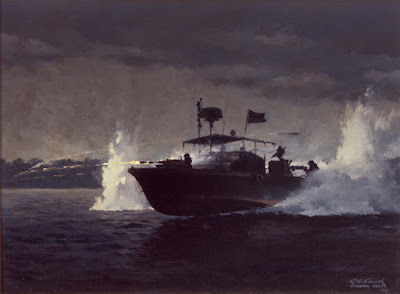
"Firefight" by R. G. Smith; 1968


In an earlier post, we took a look at Operation Market Time which was meant to halt the influx of weapons and other supplies by sea into South Vietnam. Operation Game Warden was initiated to cover the inland waters of parts of South Vietnam, as set out at the Navy History and Heritage Command Operation Game Warden: Keeping Shipping Channels Open

In 1965, the Military Assistance Command, Vietnam (MACV) recognized that the enemy was supplying Viet Cong units via the Ho Chi Minh Trail and Cambodia. In December of that year, the Navy established the River Patrol Force (Task Force 116) to keep shipping channels open, search river craft, disrupt enemy troop movements, and support special operations and ground forces. Operation Game Warden limited the enemy’s use of South Vietnam’s larger rivers.

Below is a study of Game Warden prepared at the Navy's request by the Center for Naval Analysis in 1976. Before reading that report, it is worth reviewing some comments on the nature of the U.S. Navy's involvement with riverine warfare as set out here:

To our small initial Navy section of the Military Assistance and Advisory Group, Vietnam, we gradually added stronger coastal forces, rapidly increased the number of river patrol and minesweeping craft, and introduced a river assault force to give three major U.S. Navy combatant task forces in Vietnam. Also during the period of build up of U.S. Navy strength in Vietnam, the Vietnamese Navy itself was growing in coastal and river patrol, river assault, and logistics capabilities with the help of U.S. Navy advisors. In late 1968 operations were begun that combined the capabilities of all three major U.S. Navy task forces, the Vietnamese Navy, and other Free World ground and air forces to strike at enemy strongholds and interdict enemy supply routes. In addition to the combat operations on the many waterways of Vietnam, hundreds of large and small U.S. and Vietnamese Navy logistics craft form a vital link in the flow of supplies to allied forces at remote bases.

Riverine warfare is an extension of sea power. By controlling the high seas the Navy can project its strength along the inland waterways into the heart of enemy territory.

Operation Game Warden by lawofsea


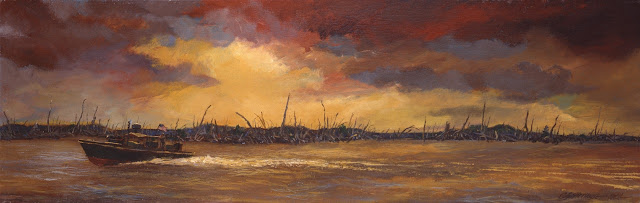
PBR on Patrol by Charles Waterhouse


More on Game Warden here

.

Sunday, November 28, 2021

Sunday Ship History: Operation Market Time Vietnam 1965 - 1973


Operation Market Time, Gene Klebe; 1965


One of the interesting aspects of the Vietnam War was the substantial naval effort to stop the sea transport of arms and other material to enemy forces in South Vietnam. This effort include aircrat, naval and Coast Guard vessels. As set out in Operation Market Time it was largely successful in cutting off the supply from the sea.
The Navy established Operation Market Time (March 1965-1972) to prevent North Vietnamese ships from supplying enemy forces in South Vietnam by sea. The Coastal Surveillance Force (Task Force 115) used a system of three barriers to patrol the South Vietnamese coast. Patrol aircraft covered the outermost barrier to identify, photograph, and report suspicious vessels and U.S. Coast Guard cutters stopped and searched cargo vessels in the middle barrier forty miles off the coast. The South Vietnamese Navy, the Junk Force, and U.S. Navy Patrol Craft Fast (PCF( Swift boats cruised the coastal waters of the inner barriers. By 1968, these forces stopped virtually all seaborne infiltration from North Vietnam to South Vietnam. The blockade forced the North Vietnamese to rely on the Ho Chi Minh Trail and the Cambodian port of Sihanoukville to transport supplies to the Viet Cong.

A longer history and analysis of Market Time can be found at the U.S. Navy History and Heritage Command here in a paper prepared by Judith C. Erdheim of the Center for Naval Analysis in 1975. That report follows below.

Operation Market Time by lawofsea

And a look at the U.S. Coast Guard involvement:

Update: Navy War College Review article "The U.S. Coast Guard in Vietnam: Achieving Success in a Difficult War" (1998)

Update2: A 1970 fight between Market Time wooden hulled U.S. Navy minesweeper USS Endurance (MSO-435) and a metal hulled NV trawler in the "Sea Battle off the Cua Co Chien River" as depicted by Richard DeRosset as used in part as the cover illustration for David Bruhn's Wooden Ships and Iron Men: The U.S. Navy's Ocean Minesweepers, 1953–1994:


Thursday, November 25, 2021

Thanksgiving


Have a Happy Thanksgiving!

While our kids are spread from coast to coast and in between, we have one of ours and his family on their way down to share dinner with us. My daughter-in-law's brother and his wife will join us, too.


No one deployed.


All adults and grandchildren healthy.


We have so very much for which to be thankful.


Sunday, November 21, 2021

On Midrats 21 November 2021: Episode 609 - The Fat Leonard Podcast with Tom Wright

If you thought you missed a live Midrats podcast on 21 November 2021 - you are absolutely correct. Due to our guest being in Singapore, we had to record the episode and post it later. So, if you go here you will find Episode 609, which is about the man on the right, Leonard Glenn Frances and, well, corruption.

If you are even remotely connected to the US Navy you have directly or indirectly been impacted by the "Fat Leonard" scandal.

A husbanding agent who used every tool in a very old book - greed, sex, power, influence, and envy - managed to have have naval officers and high ranking law enforcement officers become party to his drive for wealth and influence.

One of the best places to find the details of the scandal and to hear from Leonard Glenn Frances himself, is in "The Fat Leonard Podcast."

Our guest today will be the podcast's creator, Tom Wright, the coauthor of Billion Dollar Whale and the cofounder of Project Brazen, a journalism-focused production studio.

Tom worked for the Wall Street Journal for over twenty years. He’s a Pulitzer finalist and has won numerous journalism awards, including the Gerald Loeb award for international reporting. In 2020, Stanford University honored Tom with its Shorenstein award in recognition of his services to journalism in Asia.

Sunday Ship History - The American Frigate "Alliance" Mutiny of 1779

Interesting bit of U.S. Naval past from James Fenimore Cooper's History of the Navy of the United States of America (1853):


The year 1779 opens with the departure of the Alliance, 32, for France. It has already been stated that the command of this ship had been given to a Captain Landais, who was said to be a French officer of gallantry and merit. Unfortunately the prejudices of the seamen did not answer to the complaisance of the Marine Committee in this respect, and it was found difficult to obtain a crew willing to enlist under a French captain. When General Lafayette reached Boston near the close of 1778, in order to embark in the Alliance, it was found that the frigate was not yet manned. Desirous of rendering themselves useful to their illustrious guest, the government of Massachusetts offered to complete the ship's complement by impressment, an expedient that had been adopted on more than one occasion during the war ; but the just-minded and benevolent Lafayette would not consent to the measure. Anxious to sail, however, for he was entrusted with important interests, recourse was had to a plan to man the ship, which, if less objectionable on the score of principle, was scarcely less so in every other point of view.

The Somerset 64, had been wrecked on the coast of New England, and part of her crew had found their way to Boston. By accepting the proffered services of these men, those of some volunteers from among the prisoners, and those of a few French seamen that were also found in Boston after the departure of their fleet, a motley number was raised in sufficient time to enable the ship to sail on the 11th of January. With this incomplete and mixed crew, Lafayette trusted himself on the ocean, and the result was near justifying the worst forebodings that so ill-advised a measure could have suggested.

After a tempestuous passage, the Alliance got within two days' run of the English coast, when her officers and passengers, of the latter of whom there were many besides General Lafayette and his suite, received the startling information that a conspiracy existed among the English portion of the crew, some seventy or eighty men in all, to kill the officers, seize the vessel, and carry the frigate into England. With a view to encourage such acts of mutiny, the British Parliament had passed a law to reward all those crews that should run away with American ships ; and this temptation was too strong for men whose service, however voluntary it might be in appearances, was probably reluctant, and which had been compelled by circumstances, if not by direct coercion.

The plot, however, was betrayed, and by the spirited conduct of the officers and passengers, the ringleaders were arrested.

On reaching Brest, the mutineers were placed in a French gaol, and after some delay, were exchanged as prisoners of war, without any other punishment; the noble-minded Lafayette, in particular, feeling averse to treating foreigners as it would have been a duty to treat natives under similar circumstances.

More of interest on Alliance here

Saturday (and Sometimes Sunday) Is Old Radio Day - Fibber McGee & Molly "Thanksgiving" (1935)

Wednesday, November 17, 2021

The Distinction Between Theory and Practice Writ Large

CDR Salamander pointed this video out, so full credit to him, but it's too important not to put up here, too:

LTG McMasters expresses a large amount of hard-won knowledge. Falling in love with theory instead of dealing with reality is a path to ruination.

For a further look at this, you might want to listen to our Midrats show about the NATO Training Mission in Afghanistan: Listen to "Episode 607: The NATO Training Mission in Afghanistan - Hopes & Lessons" on Spreaker.

Saturday, November 13, 2021

Saturday Is Old Radio Day; Richard Diamond, Private Detective "8 O'Clock Killer" (1950)

5th Circuit Blasts Biden Admin "Malarkey" in Vaccine Mandate Effort

I don't practice law anymore, but every now and then I read a court ruling for some reason or another.  It's not often that such a ruling is as interesting and readable as the one you can find here, portions of which are pasted below, without footnote numbers and with emphasis added.

Nov. 12 Fifth Circuit Rulin... by Daily Caller News Foundation

Not many punches pulled in this one:

Many of the petitioners are covered private employers within the geographical boundaries of this circuit. Their standing to sue is obvious— the Mandate imposes a financial burden upon them by deputizing their participation in OSHA’s regulatory scheme, exposes them to severe financial risk if they refuse or fail to comply, and threatens to decimate their workforces (and business prospects) by forcing unwilling employees to take their shots, take their tests, or hit the road.

    ***

We begin by stating the obvious. The Occupational Safety and Health Act, which created OSHA, was enacted by Congress to assure Americans “safe and healthful working conditions and to preserve our human resources.” See 29 U.S.C. § 651 (statement of findings and declaration of purpose and policy). It was not—and likely could not be, under the Commerce Clause and nondelegation doctrine—intended to authorize a workplace safety administration in the deep recesses of the federal bureaucracy to make sweeping pronouncements on matters of public health affecting every member of society in the profoundest of ways. ....

On the dubious assumption that the Mandate does pass constitutional muster—which we need not decide today—it is nonetheless fatally flawed on its own terms. Indeed, the Mandate’s strained prescriptions combine to make it the rare government pronouncement that is both overinclusive (applying to employers and employees in virtually all industries and workplaces in America, with little attempt to account for the obvious differences between the risks facing, say, a security guard on a lonely night shift, and a meatpacker working shoulder to shoulder in a cramped warehouse) and underinclusive (purporting to save employees with 99 or more coworkers from a “grave danger” in the workplace, while making no attempt to shield employees with 98 or fewer coworkers from the very same threat). The Mandate’s stated impetus—a purported “emergency” that the entire globe has now endured for nearly two years, and which OSHA itself spent nearly two months responding to11—is unavailing as well. And its promulgation grossly exceeds OSHA’s statutory authority.</p>

            ***

After the President voiced his displeasure with the country’s vaccination rate in September, the Administration pored over the U.S. Code in search of authority, or a “work-around,” for imposing a national vaccine mandate. The vehicle it landed on was an OSHA ETS. The statute empowering OSHA allows OSHA to bypass typical notice-and-comment proceedings for six months by providing “for an emergency temporary standard to take immediate effect upon publication in the Federal Register” if it “determines (A) that employees are exposed to grave danger from exposure to substances or agents determined to be toxic or physically harmful or from new hazards, and (B) that such emergency standard is necessary to protect employees from such danger.” 29 U.S.C. § 655(c)(1).

As the name suggests, emergency temporary standards “are an ‘unusual response’ to ‘exceptional circumstances.’” Int’l Chem. Workers, 830 F.2d at 371 (quoting Pub. Citizen Health Rsch. Grp. v. Auchter, 702 F.2d 1150, 1155 (D.C. Cir. 1983)). Thus, courts have uniformly observed that OSHA’s authority to establish emergency temporary standards under § 655(c) “is an ‘extraordinary power’ that is to be ‘delicately exercised’ in only certain ‘limited situations.’” Id. at 370 (quoting Pub. Citizen, 702 F.2d at 1155).

But the Mandate at issue here is anything but a “delicate[] exercise[]” of this “extraordinary power.” Cf. Pub. Citizen, 702 F.2d at 1155. Quite the opposite, rather than a delicately handled scalpel, the Mandate is a one-size fits-all sledgehammer that makes hardly any attempt to account for differences in workplaces (and workers) that have more than a little bearing on workers’ varying degrees of susceptibility to the supposedly “grave danger” the Mandate purports to address.

***

We next consider the necessity of the Mandate. The Mandate is staggeringly overbroad. Applying to 2 out of 3 private-sector employees in America, in workplaces as diverse as the country itself, the Mandate fails to consider what is perhaps the most salient fact of all: the ongoing threat of COVID-19 is more dangerous to some employees than to other employees. All else equal, a 28 year-old trucker spending the bulk of his workday in the solitude of his cab is simply less vulnerable to COVID-19 than a 62 year-old prison janitor. Likewise, a naturally immune unvaccinated worker is presumably at less risk than an unvaccinated worker who has never had the virus. The list goes on, but one constant remains—the Mandate fails almost completely to address, or even respond to, much of this reality and common sense.

On Midrats 14 November 2021 - Episode 608: Time for a Maritime Department?


Please join us at 5pm EST on 14 November 2021 for Midrats Episode 608: Time for a Maritime Department?

All you need to do is look at a map to tell that we are a maritime nation. A strong Navy is only part of being a maritime power. As everyone is starting to appreciate as they look at empty shelves, rising prices, and fleets of merchant ships waiting for their turn off overburdened ports - the other side of a maritime power can impact everyone's quality of life overnight.

If most Americans knew the relative weakness - and in areas complete absence - of America in the maritime trade that keeps up employed, fed, and secure, they would probably have a mild panic attack.

Is part of the problem simply that we lack a national focus? Could a solution be to establish a cabinet-level Maritime Department with a mission of integrating applications of national power to ensure maritime security and prosperity?

Making a return to visit, our guest for the full hour will be Lieutenant Commander Jimmy Drennan, U.S. Navy, and we'll use his recent article, Beyond Defense: America's Past and Future Interests at Sea" as a starting point for a broad ranging discussion.

Jimmy is a surface warfare officer and the soon to be outgoing president of the Center for International Maritime Security - a topic we may discuss as well.

If you miss the show live, you can pick up this episode and others and add Midrats to your podcast list simply by going to you use Apple Podcasts here. Or on Spreaker. Or on Spotify.

Thursday, November 11, 2021

Veterans Day


 U.S. Navy photo by Mass Communication Specialist 2nd Class Joshua J. Wahl

Sunday, November 07, 2021

Sunday Ship History: "Indians in the War" (WWII) (1945)

IndiansInTheWar_997 by lawofsea

Oddly enough, no mention of CDR Ernest E. Evans, Medal of Honor awardee, so here's a link to the story of Commander Ernest E. Evans of Johnston (DD-557).

On Midrats 7 November 2021 - Episode 607: The NATO Training Mission in Afghanistan - Hopes & Lessons


Please join us at 5pm EST for Midrats Episode 607: The NATO Training Mission in Afghanistan - Hopes & Lessons

In what history will show was a failed effort, for almost two decades, the most advanced military and police forces in the West tried to build a security force for the people of Afghanistan, an effort that took off with great urgency towards the end of the first decade of the conflict. A cornerstone of that effort was NATO Training Mission–Afghanistan (NTM-A).

Our guests to discuss this effort and what lessons it holds for the future will be Dr. Martin Loicano and Dr. Craig C. “C. C.” Felker. Using extensive research and two combined years in Afghanistan, they've documented the 2009-2010 effort in their book, No Moment of Victory: the NATO Training Mission in Afghanistan from 2009-2011.

Dr. Loicano served as chief historian, North Atlantic Treaty Organization (NATO), Supreme Headquarters Allied Powers Europe (SHAPE). In that capacity, he advised the SHAPE commander and also was part of the SHAPE Strategic Planning Group. Previously, he was an associate professor in the Department of Strategy at the Air War College (AWC). Prior to joining the AWC faculty, Dr. Loicano served with the NATO Training Mission–Afghanistan from 2010 to 2012. He holds a PhD in history from Cornell University, specializing in Cold War conflicts, Southeast Asia, and China.

Dr. Felker is a retired Navy captain and author of Testing American Sea Power: U.S. Navy Strategic Exercises, 1923–1940. He received his PhD from Duke University in 2004 and afterward served as a permanent military professor in the History Department of the United States Naval Academy, chairing the department from 2014 to 2016. He is currently the executive director of the Society for Military History.

If you miss the show live, you can pick up this episode and others and add Midrats to your podcast list simply by going to you use Apple Podcasts here. Or on Spreaker. Or on Spotify.

Friday, November 05, 2021

Friday Film: "Firefighting Aboard Aircraft Carriers" (1969)

Firefighting techniques have improved greatly since 1969. However, the lessons are the same, everyone on a ship on fire needs to know how to respond.

Sunday, October 31, 2021

Sunday Ship History: Radar Pickets and Methods of Combating Suicide Attacks Off Okinawa March-May 1945

Radar Pickets and Methods of Combating Suicide Attacks Off Okinawa March-May 1945 by lawofsea on Scribd

See also Sunday Ship History: Radar Picket Ships and Submarines.

The preceding document was declassified pursuant to DOD DIR 5200.9 and can be found at the Naval History and Heritage Command here and at UNC's Ibiblio Hyperwar site here. Ibiblio notes that

All software, documentation, research data, and other materials (Materials) submitted for installation on the ibiblio.org Internet Server will be deemed in the public domain, except for any express restrictions included in such Materials by the submitting party.

Tuesday, October 26, 2021

U.S. Navy Office of Naval Intelligence Worldwide Threat to Shipping (WTS) Report, 22 September - 20 October 2021

U.S. Navy Office of Naval I... by lawofsea

Another interesting site regarding the Gulf of Guinea is a joint effort of the Royal Navy and the French Navy MDAT-GoG, with a live map here. Sample screenshot below:


Maritime Domain Awareness for Trade – Gulf of Guinea (MDAT-GoG) is a cooperation centre between the Royal Navy (UKMTO) and the French Navy (MICA-Center) in support of the Yaounde Process. This centre has been in operation since the 20th June 2016.

The primary output from the MDAT-GoG is to contribute by maintaining coherent maritime situational awareness in the central and western African Maritime areas, with the ability to inform and support industry. It contributes to the safety and security of the Mariner in the regional maritime domain. The information supplied by vessels will be treated as commercially confidential.

Of course, the longer running mappping program concerning maritime piracy and armed robbery is that of the ICC CCS IMB Piracy Reporting Center here


Friday, October 22, 2021

Friday Film: "Wings Over Leyte" (1945)

On Midrats 24 October 2021 - Episode 606: China's Dangerous Decade with Andrew Erickson


Please join us at 5pm (EDT) on 24 October 2021 for Midrats Episode 606: China's Dangerous Decade with Andrew Erickson

What are the of economic, demographic, and political forces driving China through this decade?

What direction is her growth heading and where will she find herself at the end of the decade?

Are the forces in play likely to move her towards a more peaceful or a more militaristic stance?

Using the recent article he co-authored with Gabriel Collins in Foreign Policy, A Dangerous Decade of Chinese Power is Here, as a starting point, returning to Midrats for the full hour this Sunday from 5-6pm Eastern will be Andrew S. Erickson.

Andrew is a professor of strategy in the U.S. Naval War College's China Maritime Studies Institute and a visiting scholar in full-time residence at Harvard University's John King Fairbank Center for Chinese Studies. His research website is www.andrewerickson.com.

If you use Apple Podcasts, and miss the show live, you can pick up this episode and others and add Midrats to your podcast list simply by going to here. Or on Spreaker. Or on Spotify.

Wednesday, October 20, 2021

Quote of the Day: Economics Isn't Rocket Science

From Joe Biden, Milton Friedman, and the Tyranny of Tiny Minds

Friedman used to say, “Everything we know in economics we teach in Econ 1, and everything else is made up.”

As we see inflation taking off, and some odd economic theory that taking money from people to pay for government - um - projects doesn't "cost" anything, it's good to back to Econ 101:

... Friedman’s observation that “Inflation is always and everywhere a monetary phenomenon.”

What Friedman meant was, prices rise and fall according to all kinds of market forces, but inflation is what happens when government prints money faster than the economy generates new wealth.

We’ve been printing money by the trillions, and Biden wants to increase that by endless trillions more — all while using the federal bureaucracy to impede the creation of new wealth.

It’s a recipe for inflation, and anyone sensible — including Democratic economist Lawrence Summers — has been warning Biden of just that.

Friday, October 15, 2021

On Midrats 17 October 2021 - Episode 605: The Navy in Afghanistan at Flood Tide - PRT Khost


Please join us at 5pm on 17 October 2021 for Midrats Episode 605: The Navy in Afghanistan at Flood Tide - PRT Khost

Afghanistan is a landlocked nation, but in the USA’s two-decade presence in that country, her Navy was there from the beginning to end serving along with her sister services.

Many are familiar with the untold number of Individual Augmentation (IA) assignments Navy active duty and reserve component personnel filled, Navy Corpsmen serving with USMC units, and even SeaBee deployments to Afghanistan, but there were other units with a large US Navy presence, a few of the Provincial Reconstruction Teams (PRT).

This Sunday we’re going to take a snapshot of this part of the Afghanistan conflict from its high-water mark - 2010 and 2011 - with our guests Captain Steve Deal, USN (Ret.) and Command Sergeant Major Alexander Barnett, USA (Ret.). They served together as the Commanding Officer and Sergeant Major of Provincial Reconstruction Team Khost in 2010 through 2011.

Captain Deal had extensive experience in command. In addition to his tour as Commanding Officer, PRT Khost, he commanded Patrol Squadron 47 in Ali AB, Iraq (2007-2008) and Patrol and Reconnaissance Wing TEN in Whidbey Island, WA (2012-2013).

Command Sergeant Major "Beau" Barnett impressive experience as senior enlisted leader in addition to his tour in Khost included Operations Sergeant Major and Command Sergeant Major at Battalion level and as a USASMA Instructor, Command Sergeant Major for the 1st Brigade Combat Team, 82nd Airborne Division and concurrently the Regimental Sergeant Major of the 504th Parachute Infantry Regiment. His final assignment prior to retirement the 189th CATB CSM at JBLM Tacoma Washington.

If you use Apple Podcasts, and miss the show live, you can pick up this episode and others and add Midrats to your podcast list simply by going to here. Or on Spreaker. Or on Spotify.

Friday Film: "Amphibious Warfare: The Salvage Boat" (1944)

Wednesday, October 13, 2021

Establishment of the Navy, 13 October 1775

This resolution of the Continental Congress marked the establishment of what is now the United States Navy.

"Resolved, That a swift sailing vessel, to carry ten carriage guns, and a proportionable number of swivels, with eighty men, be fitted, with all possible despatch, for a cruise of three months, and that the commander be instructed to cruize eastward, for intercepting such transports as may be laden with warlike stores and other supplies for our enemies, and for such other purposes as the Congress shall direct.

That a Committee of three be appointed to prepare an estimate of the expence, and lay the same before the Congress, and to contract with proper persons to fit out the vessel.

Resolved, that another vessel be fitted out for the same purposes, and that the said committee report their opinion of a proper vessel, and also an estimate of the expence."

Tuesday, October 12, 2021

Repeat It: "Freedom = I Won't"

When confronted by an overbearing version of group think and increasingly instrusive political demands of power seekers, it is always an option to refuse to participate in the way demanded. Refusal to play along with the zillion gender game, the ignorance-based economic guilt trips, and the pressure to conform to rules that seem to change with the wind direction - is resistance at the highest level.

Some people talk about going "John Galt", others suggest forceful confrontation. What really infuriates the bullies is passive resistance to their demands. Simply refusing to conform to someone else's idea of how you should live and think. Passive resistance requires courage but can be extremely effective. Unlike John Galt, who disappears to make his point, passive resistance requires confrontation.


For some fun thinking on how passive resistance works, see Eric Frank Russell's "And Then There Were None"

“What does this F. — I.W. mean?”
“Initial-slang,” informed Baines. “Made correct by common usage. It has become a worldwide motto. You’ll see it all over the place if you haven’t noticed it already.”
“I have seen it here and there but attached no importance to it and thought nothing more about it. I remember now that it was inscribed in several places including Seth’s and the fire depot.”
“It was on the sides of that bus we couldn’t empty,” put in Gleed. “It didn’t mean anything to me.”
“It means plenty,” said Jeff. “Freedom = I Won’t!”
“That kills me,” Gleed responded. “I’m stone dead already. I’ve dropped in my tracks.” He watched Harrison thoughtfully pocketing the plaque.
“A piece of abracadabra. What a weapon!”
“Ignorance is bliss,” asserted Baines, strangely sure of himself. “Especially when you don’t know that what you’re playing with is the safety catch of something that goes bang.”
“All right,” challenged Gleed, taking him up on that. “Tell us how it works.”
“I won’t.” Baines’ grin reappeared. He seemed to be highly satisfied about something.
“That’s a fat lot of help.” Gleed felt let down, especially over that momentary hoped-for reward. “You brag and boast about a one-way weapon, toss across a slip of stuff with three letters on it and then go dumb. Any folly will do for braggarts and any braggart can talk through the seat of his pants. How about backing up your talk?”
“I won’t,” repeated Baines, his grin broader than ever. He gave the onlooking Harrison a fat, significant wink.
It made something spark vividly within Harrison’s mind. His jaw dropped, he dragged the plaque from his pocket and stared at it as if seeing it for the first time.
“Give it back to me,” requested Baines, watching him.
Replacing it in his pocket, Harrison said very firmly, “I won’t.”
Baines chuckled. “Some people catch on quicker than others.”
Resenting that, Gleed held his hand out to Harrison. ‘Let me have another look at that thing.’
‘I won’t,’ said Harrison, meeting him eye to eye.
‘Hey, don’t start being awkard with me. That’s not the way—’ Gleed’s protesting voice petered out. He stood there a moment, his optics slightly glassy, while his brain performed several loops. Then in hushed tones he said, ‘Good grief!’
‘Precisely,’ approved Baines. ‘Grief and plenty of it. You were a bit slow on the uptake.’

So, when someone says, "Comply or else!" There is response that defeats their goal of your submission.

Sunday, October 10, 2021

On Midrats 10 October 2021 - Episode 604: October Natsec Free-For-All


Please join us at 5pm EDT on 10 October 2021 for Midrats Episode 604: October Natsec Free-For-All

From the fleet parked off Long Beach, to the already forgotten Afghanistan, to the particular aspirational desires of the latest 30-year Shipbuilding Plan - and whatever else comes across then quarterdeck - Eagle One and Sal are back LIVE for an October maritime and national security discussion.

As with all free for alls, the chat room will be open as will the studio phone lines … come join us this Sunday starting at 5pm Eastern.

If you use Apple Podcasts, and miss the show live, you can pick up this episode and others and add Midrats to your podcast list simply by going to here. Or on Spreaker. Or on Spotify.

Sunday Ship History: Nixon's Trident - Naval Power in Southeast Asia 1968-1972

A publication from the Naval History and Heritage Command by John Darrell Sherwood published in 2009.

Nixon's Trident: Naval Power in Southeast Asia, 1968–1972 by lawofsea on Scribd

Sunday, October 03, 2021

Sunday Ship History: A Short Look at the Korean War and Navy Surface Forces

Most Americans don't have knowledge of the 1950's Korean War or its background.

Few know that Japan annexed Korea starting in 1910 after a 1905 treaty which made Korea a protectorate of Japan.

At the end of WWII, Soviet Russia gained control of what is North Korea and American forces took over South


Korea, with the 38th parallel being the dividing line.

On June 25, 1950, North Korean forces invaded South Korea and drove very deep into South Korea, by early August only leaving what became known as the "Pusan Perimeter" in U.S. and South Korean hands.

In order to relieve the pressure on the Pusan Perimeter in early September 1950, General MacArthur, acting as UN Command, organized an successful amphibious assault on Inchon ("Operation Chromite"), "110 miles behind enemy lines" (see here) in one of the most amazing feat of arms ever accomplished.

The success of MacArthur's plan was reliant on a strong and coordinated sea, air, and land force. The Inchon invasion demonstrated how naval forces can be a decisive factor in littoral operations. The 230 ships of Vice Admiral Arthur D. Struble's Joint Task Force (JTF) 7, with the aid of Royal Navy and other Allied warships, established superiority in the Yellow Sea as well as the air over it. The continued presence of U.S. and Allied naval forces acted as a deterrent to Soviet and/or Chinese intervention. The element of surprise was essential to Operation Chromite.

On 13 September 1950, the naval forces in JTF 7 led by Admirals Struble and James H. Doyle, began their attack against Inchon. Carrier-based aircraft squadrons, destroyers, and cruisers battered North Korea's fortifications, coastal artillery batteries, and supply points for two days. On 15 September, 1st Marine Division assaulted three beaches and quickly seized Inchon. General MacArthur signaled that "the Navy and Marines... never shone more brightly" than at Inchon.

By 19 September, the Marines had captured Kimpo air base, into which flowed Marine close support aircraft and U.S. Air Force supply transports. U.S. Army troops advanced from the beachhead and linked up with their comrades advancing north from the Pusan perimeter. Marine, Army, and South Korean troops captured Seoul on 28 September 1950.

Another phase of the war began in October 1950, with a planned amphibious assault at Wonsan on North Korea's east coast which left the U.S. Navy and its allies with a valuable lesson as set out below:

The great success of the Inchon Invasion led General MacArthur to order a second amphibious assault, targeting Wonsan on North Korea's east coast. After landing there, Tenth Corps could advance inland, link up with the Eighth Army moving north from Seoul and hasten the destruction of the North Korean army. Wonsan would also provide UN forces with another logistics support seaport, one closer to the battlefronts than Pusan and with greater handling capacity than tide-encumbered Inchon.

Since the enemy army's coherence collapsed much more rapidly than expected, by the Wonsan operation's planned execution date of 20 October 1950, its immediate strategic goals had been overtaken by events. However, the forces landed there proved valuable in the push up North Korea's east side, and the captured port did fulfill its intended mission.

Wonsan's greatest value, though, was unintended: it gave the U.S. Navy a painfully valuable reminder of the fruits of neglecting mine countermeasures, that unglamorous side of maritime power that, when it is needed, is needed very badly. As Admiral Forrest Sherman, the Chief of Naval Operations at the time, remarked "when you can't go where you want to, when you want to, you haven't got command of the sea". This experience provoked one of the greatest minesweeper building programs in the Navy's history, one that produced hundreds of ships to serve not only under the U.S. flag, but under those of many allied nations. (emphasis added)

At the time, the lesson was painfully learned by the damage to or loss of ships. Not all damage was caused by mines - the risk of inshore operation from gun batteries has been well known for hundreds of years, but it came back in 1950.


From the Naval Heritage and History Command this partial list of Ships Sunk and Damaged in Action during the Korean Conflict, the U.S. Navy lost 5 ships to mines, four minesweeping units and one fleet tug
(see here).

USS Magpie (AMS-25) blew up after striking a mine off the coast of Korea on Sept. 29 1950,
claiming the lives of 21 members of the crew. Ships hitting mines during the Korean Conflict would also cost the U.S. Navy the USS Pirate (AM-275), USS Pledge (AM-277), USS Sarsi (ATF-111) and USS Partridge (AMS-31). Mines continue to be the biggest threat to the world’s navies and account for most ship losses other than accidents.

Another 87 ships were damaged, either by mines or by engagement with shore batteries with last damage occurring in 1953.

Now, about that lesson regarding mine warfare . . .

Another aspect of the Navy's involvement in the Korean War was the sea-borne evacuation of both military units and civilians from North Korea after the Chinese Army entered the war in massive numbers. As set out in Edward J. Marolda's The Hungnam and Chinnampo Evacuations:

The Hungnam Evacuation by the U.S. Navy from North Korea of troops under the U.S. X Corps, including the U.S. 1st Marine Division, 7th Infantry Division, and 3d Infantry Division, and the Republic of Korea I Corps, including the 3d and Capital Infantry Divisions, took place from December 9 to 24, 1950. When the People's Republic of China intervened in the Korean War in late November 1950, its 250,000 ground forces threatened to cut off and destroy UN units operating in the mountains of North Korea. To prevent that catastrophe and to concentrate UN units in more easily defended terrain further south, on December 9 General Douglas MacArthur, Commander in Chief, United Nations Command, ordered evacuation by sea of the U.S. X Corps.

Vice Admiral C. Turner Joy, Commander Naval Forces, Far East, had already alerted Rear Admiral James H. Doyle, his amphibious commander, to prepare for such a contingency and begun deploying naval forces to waters off Hungnam on the east coast of North Korea. He dispatched other units, under Rear Admiral Lyman A. Thackrey, to Korea's west coast to handle evacuation from Chinnampo and Inchon, in company with British, Australian, and Canadian ships, of U.S. Eighth Army and allied forces. The mission at Chinnampo was accomplished between the 4th and 6th of December, although most of the allied forces made their way south in vehicles or on foot. In addition, during December and early January 1951, Thackrey's ships pulled 69,000 military personnel, 64,000 refugees, 1,000 vehicles, and more than 55,000 tons of cargo out of Inchon.

As the marines and soldiers, in biting cold and wind, fought their way out of encirclement at Chosin Reservoir and elsewhere in northeast Korea during December, several hundred Navy and Marine aircraft operating from airfields ashore and from the ships of Task Force 77 (aircraft carriers Philippine Sea, Leyte, Princeton, and Valley Forge, light carrier Bataan, and escort carriers Sicily and Baedong Strait) pummelled enemy ground troops. Other U.S. planes airdropped supplies. Conducting round-the-clock air operations from snow and wind-swept carrier decks and from unimproved airstrips ashore demanded the most of the sailors and marines working feverishly to help bring their comrades out of the frozen hills of North Korea.


***

In an orderly fashion, on December 10th the ships under Rear Admiral Doyle, Commander Amphibious Force, Far East (Task Force 90), began embarking the withdrawing ground troops and their equipment from Hungnam (and some ROK 3d Division troops from Wonsan further to the south). The marines, who had endured the hardest fighting, were the first men to board the evacuation ships. They were followed by the ROK units on the 17th and the U.S. Army divisions during the third week of December. By Christmas Eve 1950, Task Force 90 had embarked 105,000 military personnel, 17,500 tanks and other vehicles, 350,000 measurement tons of cargo, and 91,000 Korean civilians. Marine and Air Force transports airlifted out another 3,600 troops, 196 vehicles, and 1,300 tons of cargo.

More here

Generally described as an "amphibious operation in reverse", the evacuation of Hungnam encompassed the safe withdrawal of the bulk of UN forces in eastern North Korea. It was the largest sealift since the 1945 Okinawa operation. In barely two weeks, over a hundred-thousand military personnel, 17,500 vehicles and 350,000 measurement tons of cargo were pulled out. In comparison with the retreat in central and western Korea, little was left behind. Even broken-down vehicles were loaded and lifted out. Also departing North Korea through Hungnam were some 91,000 refugees, a large number, but not nearly as many as had gathered to leave.

These evacuations were not only carried out by U.S. forces, but by chartered merchant ships, and by allied ships, including but not limited to Japanese manned LSTs.

Another reference to the LST force here

There were a total of 40 LSTs and 75 marine transports used during the evacuation of Hungnam. All ships making multiple trips from Hungnam and Wonsan to various ports in southern Korea and parts of Japan.

Early in my research I managed to find a list of US LSTs involved in the Korean War – some 40 LSTs. As part of this process I also found that a lot of Japanese and a few Korean LSTs were used. There were a total 40 LSTs used at Hungnam, 11 US, a large number of Japanese LSTs and a few Korean.

The importance of the evacuation is well stated in the following video:

Friday, October 01, 2021

Don't Trust China: China's Harvesting American Genetic Information is a Threat According to the National Counterintelligence and Security Center (NCSC)

In all the post-election excitement, perhaps you missed this Feb 2021 report from the National Counterintelligence and Security Center (NCSC).

What use can China make of such information? Let your imagination work out the possibilities, but I don't think they are up to any great good things.

National Counterintelligenc... by lawofsea

UPDATE: Some in Congress are on the issue: See here for a press release from Senator Cotton and Rep Gallagher:

BGI also attempted to take advantage of the pandemic to acquire U.S. data, reaching out to the governors of six states with offers to build advanced COVID-19 testing labs before top U.S. intelligence officials convinced states to reject BGI’s offers. Most recently, reports revealed that BGI was selling prenatal tests to pregnant women around the world and using the tests to collect vast swathes of genetic data on different populations.

The Party’s focus on biotech also extends to biotech’s potential military applications. The former head of the People’s Liberation Army (PLA) National Defense University identified biology as one of seven “new domains of warfare,” including the possibility of “specific ethnic genetic attacks,” in a 2017 publication.

BGI has a history of collaboration with the PLA and serving the PLA’s interests. A review of 40 publicly-available research papers demonstrates BGI’s work on PLA priorities, such as improved high-altitude soldier performance, neuroscience, and pathogens. BGI’s worldwide prenatal test was itself developed in collaboration with the PLA. BGI has also partnered with the PLA’s National University of Defense Technology (NUDT) to advance bioinformatics research and leverage supercomputers for biological research. Joint BGI-PLA research could have an application in future bioweapons—which is especially concerning because BGI’s national gene bank is presumably made available for military research.

Given BGI’s and other Chinese biotechnology companies’ support for and collaboration with the PLA, I urge you to include BGI and other Chinese biotech companies on the NS-CMIC List, the Entity List, and the Section 1260H Chinese military companies list. The United States must not turn a blind eye to the threat posed by Chinese biotechnology companies operating at the CCP’s behest. Blacklisting BGI and its fellow biotech companies will help the United States counter the Chinese Communist Party’s efforts to capture Americans’ most private information—their DNA. (emphasis added)

Friday Film: Fog (1943)