VertRep

VertRep

Thursday, February 07, 2013

Fish Stories Part 2: World Aquaculture Background

The UN's Food and Agricultural Organization reports at Fisheries and Aquaculture:
Fish harvest in China -Courtesy of FAO Aquaculture Photo Library
Aquaculture, probably the fastest growing food-producing sector, now accounts for nearly 50 percent of the world's food fish.
The two leading aquaculture nations are China and India.

Naturally, there are concerns that aquaculture (both inland (freshwater) and "mariculture"(ocean/littoral) be conducted in an environmentally sustainable/responsible/friendly manner - as the World Wildlife Foundation argues in the following video:


As set out in FAO's THE STATE OF WORLD FISHERIES AND AQUACULTURE 2012 (pdf),at number page 3, Asia accounts for 2/3 of fish consumption with Africa last on that list. From that same reference:
Bangladesh Carp Harvest -Courtesy of FAO Aquaculture Photo Library
"Capture" refers to non-farmed fish. Inland refers, essentially, to freshwater fish, marine to saltwater fish.

A couple of other important tables from the FAO 2012 report:

India Fish Harvest- Courtesy of FAO Aquaculture Photo Library
China, India, Vietnam,Indonesia, Bangladesh, and Thailand lead the world, with China far out in front. Norway is the sole Western nation in the top ten.

The leading fish produced in China, India and Bangladesh are varieties of carp, often considered a "trash" fish in Western cultures:
Production of freshwater fishes has always been dominated by carps (71.9 percent,24.2 million tonnes, in 2010). Among carps, 27.7 percent are non-fed filter-feeders and the rest are fed with low-protein feeds. Production of tilapias has a wide distribution, and 72 percent are raised in Asia (particularly in China and Southeast Asia), 19 percent in Africa, and 9 percent in America. Viet Nam dominates production of omnivorous Pangasius catfishes although there are other producers, such as Indonesia and Bangladesh. World production of Pangasius catfish may be understated
because booming production in India has yet to be reflected in statistics. In 2010, Asia accounted for 73.7 percent of the production of other catfish species, America took its share to 13.5 percent (with channel catfish production), leaving 12.3 percent of production in Africa (dominated by North African catfish). Carnivorous species such as perches, basses and snakeheads accounted for only 2.6 percent of all freshwater fish produced in 2010.

Tuesday, February 05, 2013

Fish Stories: A New EagleSpeak Series on Aquaculture

Back in August 2012, I decided I would work on a new series concerning aquaculture. Events, however, intervened (as events are wont to do). 

Now it is time to really kick off this series.

What follows is a re-posting of that earlier post:

There are billions of people on this planet and they need to be fed.

We farm the land and we provide grains and animals for harvest. But those grains and animals are land, feed and water intensive.

Animals produce waste and methane, one of those "greenhouse" gases.

Yikes, Malthus seems to be rising from the grave. Except, of course, that there may be some more efficient ways to feed the masses before we turn to Soylent Green. This is the first post in a new series of posts about aquaculture, which may be one of those ways.

If it seems strange to find this topic on a maritime security blog, well, food security is one aspect of national security and protecting the delivery of food from the sea - that's a maritime security issue.

Let's begin then, with a video that the National Aquaculture Association has kindly given me permission to embed - a primer on aquaculture, if you will:

The Voter ID Debate

In a couple of days the local Federalist Society is hosting a lunch time panel on "The Impact of Voter ID in North Carolina."

Speakers:

Hans von Spakovsky, Senior Legal Fellow/Manager, Civil Justice Reform Initiative, The Heritage Foundation
Bob Hall, Executive Director, Democracy North Carolina
Allison Riggs, Staff Attorney, Voting Rights, Southern Coalition for Social Justice
John Fund, National Affairs Columnist, National Review

Democracy North Carolina is one of those "impartial" entities that doesn't seem to have a good handle on what either "nonpartisan" or "impartial" means. By way of example, here's a "Voter ID Fact Sheet" that they have on their website:


Now, lets just do a little fact check - read the part under the section title "Hidden Costs." Yes, the very first sentence reads:
Even if voters who currently lack ID were given free ID, they still have to pay for the legal documents needed to get ID, such as a birth certificate or social security card. (emphasis added)
Say, just how much did you pay for your Social Security card?

Last time I checked, those things were free.

Gratis.

A gift from the the American people to me and to you.

So, now, here's a question we lawyers always hope to ask of the other side, "Well, now, Mr. DNC, if you got this major fact wrong on your little "fact sheet" why should we trust the rest of your stuff?"

Southern Coalition for Social Justice also opposes Voter ID's,
We strive to link claims for minority representation with claims for fuller participation by all citizens. For example, voter ID requirements hinder effective participation by numerous groups, including the elderly and persons with disabilities.
How exactly do voter ID requirements do that?

I really want to know.

I will be attending this event.

I'll let you know if my questions get answered.

Oh, and that goofy "driver's license" at the top? One of the accepted forms of identification needed to use the UNC - Chapel Hill Health Services Library.

One more thing. Wait until these folks face the direct deposit mandate and need a photo id to start a bank account.

Monday, February 04, 2013

West Africa Pirates: French tanker, 17 crew grabbed off Ivory Coast

Reported as Pirates seize French tanker, 17 crew off Ivory Coast
Suspected Nigerian pirates have hijacked a French-owned Luxembourg-flagged tanker along with its 17-member crew off Ivory Coast, Ivorian officials and the International Maritime Bureau said on Monday.

The Gulf of Guinea area is second only to the waters off Somalia for piracy and there has been a spate of violent attacks in vessels in recent days, prompting the bureau to issue a security alert for the region.
Gascogne

The Gascogne was the second vessel to be seized off Ivory Coast in less than three weeks and the first to have been taken so far from shore.

ShipSpotting.com
© Victor Cadelina, Jr.


From the ICC IMB Live Piracy Map, a couple of images of the location of this most recent attack (Map1) and the Gulf of Guinea attack this far in 2013 (Map 2):

Map 1

Map 2

An interesting comparison of West African pirates to those operating off East Africa (read Somalia) at West African piracy: different but the same…. which links to :
Reports from East African (Somali) piracy hijackings typically describe hostage situations lasting for long periods of time to negotiate ransom. One rarely hears about attempts to monetize the ship’s cargo. West African pirates, however, often target oil tankers—both to seek ransom and to discharge the liquid cargo for black-market sale. While successful capture may take days instead of months, pirates reportedly engage in more gratuitous violence while forcing crews to cooperate in vessel movement and product discharge against their will.

While government structures are stronger in West Africa compared to East Africa, alleged government and commercial corruption provide intelligence to pirates while inadequate counter-piracy laws complicate prosecution. Insufficient regional cooperation among Nigeria, Togo and Benin thwart interdiction of pirates in multi-jurisdictional waters. Since hijackings take place both within national territorial waters and beyond, the legal distinction between armed robbery and piracy complicates prosecution, too. West African piracy more resembles transnational organized crime with more sophisticated vessels and weapons compared to that of East Africa.

Saturday, February 02, 2013

Unable to attend the 2013 USNI West Conference and Exposition in San Diego last week?

Well, you might have missed some really good information - except that you can still view some of the key presentations and panels by watching them on USNI's YouTube page and get a summary of each day's summary here.

Almost like being there except you miss the giveaways at the vendor's booth.

Also, given that Midrats has Super Bowl "Best of" going this Sunday, it's a way to get your "talking 'bout National Security" fix.

Friday, February 01, 2013

Time to Change This Problem: "Sandy Created a Black Hole of Communication"

Interesting article from Jim McKay at Emergency Management "Sandy Created a Black Hole of Communication", especially on the absence of certain "self-help" organizations that might have been useful in the pre-disaster hours:
Adam DuBrowa/ FEMA
The lessons from Sandy have been repeated over and over: Communities should be prepared to be self-sufficient for close to 10 days. That means having food, water, batteries and flashlights, among other things. Batteries were especially important during Sandy or perhaps more importantly, ways to charge them.

The challenges of Sandy emphasized the need for community leaders to become informed about how their communities can help themselves during disasters. Questions about to what degree local, state and federal agencies are responsible immediately following a disaster and which agencies or levels of government were responsible for certain services was a source of confusion for some communities.
****
She said that although the community understands what a nor’easter is, many residents were still at home waiting for a knock on the door. “You’re looking at a community that, from what I could see, didn’t have a strong CERT [Community Emergency Response Team],” Thompson said. “There was no FEMA, no Red Cross, no [Voluntary Organizations Active in Disaster], no CERT. I don’t know who they thought was coming.”
****
.... “The public has a general misconception of what FEMA does,” she said. “They believe FEMA is going to come in and help in a physical way. And they don’t recognize the responsibility of the local and state [agencies] as far as who provides things.”
Under $10 radio
There's a lot of stuff in the article, but one of the keys is that people need to have radios (talking AM and FM type) that can be powered by cranking and/or solar cells. I have suggested before that a priority ought to be placed on getting small radios out to the afflicted area as soon as possible after a disaster - see "Radios for Peace" and Great minds and Communications.

The local government or the state or, as a last resort, the federal government needs to set up a broadcast channel to get useful information out to the areas affected, with translators for those communities that lack English skills (the acquisition of which really ought to be encouraged amongst our population).

Under $20 radio
For information about CERT, see here. People who are used to being catered to by their government are always in trouble with the fan gets hit.
“The preparedness materials say you should have batteries and radios, but when we arrived seven days after the storm struck, those batteries are dead,” Thompson said. Preparing for three to five days is old, and “educated” people say be prepared to be self-sufficient for 10 days," Thompson said.
Under $2 radio
Self-powered radios can be inexpensive - here's one from Radio Shack for $19.97American Red Cross Microlink FR170 Emergency Radio and a place where you can buy a radio-flashlight combo for under $10 in bulk.

Further, if you really want to go cheap - there are these ear-bud, 2 AAA battery FM radios (with light, too!) for under $2 in bulk. I got one of those once as a gift from an organization for which I do some work on occasion. It worked fine. In fact, several year later, it still works when I remember to put in batteries. And those are "retail" prices, too, so I suspect there are even cheaper paths to follow.

Federal Budgeting: "The fiscal grand canyon"

Andrew Samwick is a professor of economics at Dartmouth. While I don't  agree with everything he has to say, I do greatly respect his opinions. One of latest of these is from the Jan 6, 2013 op-ed pages of the NY Daily News: "The fiscal grand canyon", which I suggest you read in its entirety. However, there is this section I wish to highlight (emphasis added):
There are only three ways across the fiscal canyon.

First, we could address the growth in the mandatory outlays directly.

Doubtful. We have had more than 15 years of advisory councils and special commissions studying Social Security reform. All of their recommendations have fallen on deaf ears. With health care, the Congress and Presidents have intervened more often than not to increase spending — on Medicare prescription drug benefits, on Obamacare’s expansions of coverage and in delaying the implementation of the “doc fix.”

With the transition of Baby Boomers from workers supporting these programs to beneficiaries collecting from them, future prospects for reform are even more unlikely.

Second, we could cut discretionary spending to make room for the growth of mandatory outlays. Also doubtful. If Congress and the President lost their nerve to implement the 10% cuts to discretionary outlays that were part of the fiscal cliff, how would they summon the will to do the much larger cuts required to offset the growth of Social Security and Medicare?

And even if they could, the relative sizes of mandatory and discretionary outlays mean that we could cut discretionary outlays to the bone and still not make enough room for the growth of mandatory outlays.

Third, we could — drum roll — actually have the courage and fiscal sense to raise revenues to pay for the growth of mandatory outlays. Sadly, the fiscal cliff drama showed how little political will there is in Washington to allow revenues to increase relative to their current levels. All our elected officials could manage was an increase for some of the households with incomes above $400,000 back to levels that prevailed before the Bush tax cuts. Just a drop in the bucket.
My quibbles with the piece include disputing the assumption Professor Samwick makes when he writes about the deficit issue being a " . . . fiscal canyon between the government we all asked for and the government revenue we’re generating to pay for it."

"We all asked for?" I don't remember asking for a lot of the "entitlement programs" - in fact, I specifically argued against "Obamacare," believe Social Security discourages savings and punishes higher income earners (yes, I would get rid of it as currently funded) and believe that the federal income tax should be replaced by the "Fair Tax" so that wage earners get to keep their wages and our economy could boom by getting the IRS/tax law stuff out of the way.

It seems to me that the entitlements issue is not being driven by what "all" of us want or need, but rather what will generate votes for many of those we send off to Congress and the "don't raise taxes" issue covers a chunk of the other elected official - which is why reform is so darn hard and there is this "fiscal grand canyon." However, when nearly 50% of the population is not paying income taxes it does seem that the income tax paying crowd properly might object to losing more of their hard won income to pay for programs that are perpetually demanding more and more (how long, exactly, are we going to wage a "war on poverty?").

So, let's go back to the first point that he dismisses - that " we could address the growth in the mandatory outlays directly." Is he really saying, "It's all the whining that makes this impossible?" Good gosh - time to throw out the wimps in office and get some people in there with more than getting re-elected on their minds.

The good professor's current blog can be found here.

Sunday, January 27, 2013

Bad Idea Number 47: Bringing Back the Draft

Prime Time U.S. Rep. Charles Rangel, who served in the Korean War in the 1950's, has once again raised the idea of bringing back the draft - this time arguing for "equality" ( in terms of who will face the risk of death in combat, I guess)in a CNN piece, "A more equal military? Bring back draft". He writes:
Since January 2003, at the height of the debate on the possible unilateral strike against Iraq, I have advocated for a reinstatement of the military draft to ensure a more equitable representation of people making sacrifices in wars in which the United States is engaged.
***
Currently the burden of defending our nation is carried by less than 1% of the American population. The 2.2 million members of the armed forces in active duty, the National Guard and the Reserve have become a virtual military class that makes the ultimate sacrifice of laying down life and limb for our country. As a result of high combat exposure, combined with multiple deployments, we have seen unprecedented incidences of veterans with post-traumatic stress disorder, traumatic brain injury and veterans committing suicide.
While our founding fathers had some serious concerns about the existence of a "standing army" the de-professionalizing of the military is, as I have said every time this idea is brought up by Rep. Rangel, a really bad idea.

An excellent take down of the idea is set out here, which hits the key points.

Before you move on, though, contemplate for a second this part of the Rangel piece:
As a result of high combat exposure, combined with multiple deployments, we have seen unprecedented incidences of veterans with post-traumatic stress disorder, traumatic brain injury and veterans committing suicide.
Explain to me how a draft of unwilling warriors will stop that problem?

People exposed to combat may get wounded and suffer other damage regardless of how they joined the service.

Rangel seems to believe that having a conscripted military can serve as a brake on military adventurism by the executive branch. You know, it seems to me that under our Constitution, Congress has other ways to reign in the executive, if Congress would do its job.

More than that, however, is the part of the Rangel piece is his "Universal National Service Act" that mandates service:
SEC. 102. NATIONAL SERVICE OBLIGATION.

(a) Obligation for Service- It is the obligation of every citizen of the United States, and every other person residing in the United States, who is between the ages of 18 and 25 to perform a period of national service as prescribed in this title unless exempted under the provisions of this title.

(b) Forms of National Service- The national service obligation under this title shall be performed either--

(1) as a member of an active or reserve component of the uniformed services; or

(2) in a civilian capacity that, as determined by the President, promotes the national defense, including national or community service and service related to homeland security.

(c) Age Limits- A person may be inducted under this title only if the person has attained the age of 18 and has not attained the age of 25.
All men and women in a certain age group?
Depression era CCC camp in Oregon

Only about 25%
can currently meet the requirements to for military service.

What are we going to do with the other 75%? Can you say "make work?" Who the heck is going to watch them? Will it be like a prison camp? Or Club Fed? Bring back the CCC (which was voluntary, by the way)?

Bad idea.

Say "no" to involuntary servitude.


Friday, January 25, 2013

Midrats Episode 160: CHINFO and Peter J. Munson, Jan 27 at 5pm (Eastern U.S.)

Please join us for Episode 160: CHINFO and Peter J. Munson 01-27, 5pm on Midrats at Blog Talk Radio:
In an information driven society wrapped in a 24-hr news cycle, what is the mission, responsibility, and the primary responsibilities of the Navy's Chief of Information?

Well, you couldn't ask for a better guest to help flesh out the answer to that question. Our guest for the first half-hour will CHINFO-actual, Rear Admiral John Kirby, USN.

For the second half of the hour we will have returning guest, Major Peter J. Munson, USMC - author of War, Welfare and Democracy: Rethinking America's Quest for the End of History - a sobering view of how we got where we are, and the underlying trends that will impact the global system, and America's place in it, for the next half century.
If you can't make it live, listen or download here or from our iTunes page.

Finishing Things, Starting Things

"So," you might ask,"Why has your blogging pace slowed in the past few weeks?"

Eight members of the CPDM cohort (7 bunched to viewer's left and 1 on the far right)
Well, part of it has to do with the process leading to completion of a Certificate in Community Preparedness and Disaster Management (CPDM) through the University of North Carolina School of Public Health. You can read about the program here.

The latest iteration of the CPDM program has reduced the number of "courses" to 3 (9 credit hours - my cohort was the among the last to take the four-course/12 credit hour version).

Interesting stuff, at least to me.

There's the Red Cross and other volunteer work . . .

In addition to the the CPDM course, I recently completed a "practical welding" course at my friendly neighborhood community college. Practical enough to work on that 1968 MGB sitting in my garage that needs some welding.

Of course, "Santa" was kind enough to bring me a nice little MIG welder to play with, too. When we get the current project fixed, Santa may be called upon to place another MG in my hands so my welding skills won't atrophy . . .

Of course, the holidays, a ton of reading to catch up on and other stuff life throws at you . . .

Now I have book to read that CDR Salamander shipped up here for Sunday's show and it's a world of ice outside, a fact not making the otherwise intrepid dog very happy, so . . .
the life of a blogger. And I just re-enrolled in that welding class because the instructor is a good guy who will let us "returnees" work on some new techniques.

And, a word of warning, there are a couple of book outlines I'm working on to present to publishers as I work through the research.

Why? Tennyson's "Ulysses" speaks:
I am a part of all that I have met;
Yet all experience is an arch wherethrough
Gleams that untravelled world, whose margin fades
For ever and for ever when I move.
How dull it is to pause, to make an end,
To rust unburnished, not to shine in use!
As though to breathe were life.

Will the blogging pace pick back up?

Yes, I am sure it will. Much of my reading is for that purpose.


Comments and Spam

Lately I have been hit with a wave of spam comments, most of which are auto-blocked.

However, it is an irritant that one or two occasionally sneak through - so I am stepping up the barricade level.

I will be moderating all comments and requiring some sort of "test" - I am sure weeding out friends as well as useless spam bots.

Sorry for any inconvenience.

Read about that ASROC depth charge burst here.


Tuesday, January 22, 2013

One more hit for the Littoral Combat Ship - Assigned helicopters can't tow the minesweeping gear for LCS MIW ops

Mine sweeping helicopters used by the U.S. Navy have been big honking MH-53E's with three engines and huge rotors.

                               An MH-53E Sea Dragon conducts a mine sweeping exercise.                                                                      U.S. Navy photo by Chief Mass Communication Specialist Martens
The plan was to replace them with a "kit" for the small MH-60S birds, which could then be flown off the Littoral Combat Ships as part of the "mine warfare package."

Well, it won't be happening.

As reported by Janes at MH-60S underpowered for MCM towing operations, report finds:
MH-60S AMCM version (Sikorsky photo)
The US Navy's (USN's) future airborne mine countermeasure (AMCM) MH-60S helicopter is unable to tow the minehunting sonar or minesweeping system forming part of the Littoral Combat Ship (LCS) mine countermeasures module (MCM) mission module, the Pentagon's Director of Operational Test and Evaluation (DOT and E) revealed in his annual report, released 15 January.

"The navy determined the MH-60S helicopter cannot safely tow the AN/AQS-20A Sonar Mine Detecting Set (AQS-20A) or the Organic Airborne Sweep and Influence System (OASIS) because the helicopter is underpowered for these operations," read the Office of the Secretary of Defense's Fiscal Year 2012 report from DOT and E, Dr J Michael Gilmore.

"The MH-60S helicopter will no longer be assigned these missions operating from any ship, including LCS," it added.
One form of LCS
Among other things, there are many MH-60 pilots breathing a sign of relief that this mission may pass them by.

The actual money quote from the 2012 DOT and E report (pdf, numbered page 177):
The MH-60S helicopter and AQS-20A sonar are not operationally effective or suitable because the helicopter is underpowered and cannot safely tow the sonar under the variety of conditions necessary. The Chief of Naval Operations recently concluded that the MH-60S helicopter is significantly underpowered for the safe performance of the AMCM tow mission and provides limited tactical utility relative to the risk to aircrew, and cancelled that MH-60S mission. The decision to cancel the AMCM tow mission affects employment of both the AQS-20A sonar and Organic Airborne and Surface Influence Sweep.
• As observed during the OA and developmental testing, the AQS-20A does not meet all Navy requirements in all operating modes. Contact depth (vertical localization) errors exceeded Navy limits in all AQS-20A operating modes. FCD also exceeded Navy limits in two of three search modes.
• The analysis of test data collected during Phase A of the OA of the MH-60S and ALMDS is still in progress. Preliminary evaluation of data collected during the OA suggests that the ALMDS does not meet Navy requirements for FCD or reliability. DOT and E expects to issue a formal test report in 2QFY13. Phase B testing was originally intended to provide early operational testing insight into the operational effectiveness and suitability of AMCM systems when operating from an LCS, and to identify risk to the successful completion of IOT and E. However, the Navy’s cancellation of Phase B testing will eliminate these intended benefits.
Plan B seems to involve surface robots.

Wow.

If you are going to run robots around, here's a lower cost alternative to the LCS for MIW ops:
Long linger time with nice deck chairs.

Just saying.

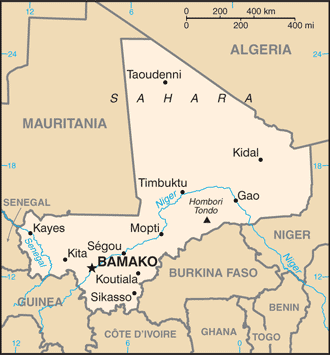
Mali, AQIM and the Long War

BBC News reports "Islamists in Africa emerge as threat to West"
UK Prime Minister David Cameron has said that Islamist extremists in North Africa pose a "large and existential threat" - a comment he made following the siege of a gas facility in Algeria, where dozens of people, nearly all of them foreigners, were killed.

"It will require a response that is about years, even decades, rather than months," Mr Cameron said.

"What we face is an extremist, Islamist, al-Qaeda-linked terrorist group. Just as we had to deal with that in Pakistan and in Afghanistan so the world needs to come together to deal with this threat in north Africa."

The group responsible for the incident in In Amenas in Algeria appears to have been led by Mokhtar Belmokhtar, a local jihadist-criminal who had been a commander of al-Qaeda in the Islamic Maghreb (AQIM).
Making Sense of Mali from Foreign Affairs:
Recent reports have oversimplified the conflict in Mali, hinting that the country hosts a coherent Tuareg separatist bloc and a popular radical Islamist movement. In fact, mainstream Malians love neither. Most of them just want a return to democracy with broader participation and more freedoms -- the precise opposite of what they fear the separatists and Islamists would bring. As long as French assistance helps hold those groups off, it will be welcome.
Long wars require patience and then some more patience.

Friday, January 18, 2013

Reading List

Reading on my Kindle:
Commerce Raider CSS Alabama
W.T. Sherman
G.W. Carver
From Merchantmen at Arms

Books I got for Christmas (hardcovers):
Merchantmen at Arms (2nd ed) (link is to an e book version)

Outlaws of the Ocean

The Barbary Pirates (notable because it was written by C.S. Forester)

Then I got a collection of paperback books of the sort we used to pass around at sea before modern electronics (and no, not the sort of books you have in mind) but westerns, akin to Louis L'Amour: The Trail Ends at Hell, Brand of the Bullet, Hell in His Holsters, and the classic Ensign Pulver (unnecessary rip off of Mr. Roberts,in my view).

Monday, January 14, 2013

A Review of "Zero Dark Thirty" Worth Reading

Paul Miller's review found at Shadow Government from FOREIGN POLICY:
Similarly, Zero Dark Thirty tells the stories of the countless soldiers, sailors, airmen, Marines, CIA officers, intelligence professionals, and special forces who have spent a decade hunting not just bin Laden, but all of al Qaeda and its murderous allies around the world. It is the most accurate depiction of intelligence work I've ever seen in a movie -- the painstaking detective work, the frustration, the dead-ends, the bureaucracy, the uncertainty, and the sudden life-or-death stakes. There isn't the slightest hint of James Bond or Jason Bourne here: even the SEAL Team Six raid is done slowly, methodically, with more professionalism than flare. If this were pure fiction, no one would see it because it would be too dull. Bigelow resists the urge to sensationalize, and in so doing she elevates the material and demands that we pay attention to, and think carefully about, what we are watching.
OBL was just one guy in the on-going war. But the stories of the people who have fought that war - who are fighting that war - and who will fight that war - need to be told.

And remembered.

And, yes, war is most often very boring and tedious work.

That's why professionals matter.

Saturday, January 12, 2013

Midrats Sunday Jan 13, 5pm: Episode 158: 3rd Anniversary Show

Episode 158: 3rd Anniversary Show 01/13 by Midrats on Blog Talk Radio at 5pm Eastern U.S.:
Join us this Sunday to celebrate Midrat's 3rd Anniversary with a free-ranging panel discussion with some of your favorite guests from the past three seasons.


Join your hosts Sal from "CDR Salamander" and EagleOne from "EagleSpeak" with regular guests on the panel; Captain Henry J. Hendrix, Jr. USN; Captain Will Dossel, USN (Ret); LCDR Claude Berube, USNR; and YN2 H. Lucien Gauthier, III (SW) USN.

We will be asking each other questions on the above-the-fold subjects of the last year and what we see in the next.

Join in the chat room for to suggest your own questions as well.
Listen in live here or download it later from here or from our iTunes pages here.

Friday, January 11, 2013

The Mess in Mali

Oh, when the death of Osama Bin Laden was announced did you drop your guard just a little?


Did you forget all those Bush-era warnings that Bin Laden's death wouldn't slow al Qaeda all that much?

Well, then, if you did the above, it must be a shock to learn that Mali, that country out in the middle of nowhere North Africa is a hotbed of AQ activity and that matters are really dire for the counter-AQ forces. See, for example, this NY Times report:

Mali Government Is Left Reeling After Islamists Take Village Long Held by Army:
Islamists advanced into territory held by the Mali government on Thursday, overrunning a long-held defensive position in the center of the country and dealing a significant blow to the Malian Army in its effort to contain the militants who have seized the nation’s north, according to a Malian Army officer.
How grim? The French are intervening, as reported by Al Jazeera in France begins Mali military intervention :
President Francois Hollande has said France is intervening to stop al-Qaeda-linked fighters in Mali who have been moving toward the capital, Bamako.

The announcement by the leader of France, the former colonial overseer in West Africa, came on Friday after Mali's interim president Dioncounda Traore had appealed for French help in stopping the rebels' advance.

"I have agreed to Mali's demand, which means French forces have provided support to Mali this afternoon," Hollande said on Friday. "The operation will last as long as is necessary."

Earlier on Friday, a Mali government official told the AFP news agency that the Malian army was being backed by Western military personnel in a fresh counter-offensive against the fighters.
The UN has now called for "swift deployment of troops" to Mali, whioh, of course, always begs the question of who can deploy troops in a hurry . . .

Why should you care? Take a good look at the neighborhood and think of a nest of al Qaeda vipers in the middle of it.

UPDATE: A handy BBC guide to Who is who in the Mali mess.

Saturday, January 05, 2013

Midrats Sunday 6 January: Episode 157 "Force Structure and Tipping Points"

Join us at 5pm (Eastern U.S.),6 Jan 2013, for the first live episode of the new year,  Episode 157: "Force Structure and Tipping Points":
What happens when a global maritime power finds itself in a position where it can no longer sustain the global presence it once considered an essential requirement?

The US Navy has been in a period of decline in both numbers and capability for awhile, and as budgetary reality sets in and burn out starts to hollow remaining capabilities - the decline is set to continue for at least another decade.

How far the decline goes until stability sets in is unknown, but what is the best reaction to this reality? Are the lessons one can derive from history that can help policy makers shape direction and priority going forward?

Our guest for the full hour to discuss will be Daniel J. Whiteneck, Ph.D.


Dr. Whiteneck is a Senior Research Scientist at the Center for Naval Analyses. He has directed projects ranging from Tipping Point and the future of US maritime dominance, to the use of naval forces in deterrence and influence operations. He also led studies on naval coalition operations and maritime security operations focusing on counter-piracy and counter-proliferation.


Dr. Whiteneck deployed twice with Carrier Strike Groups for OEF and OIF. His CNA field assignments included two tours on numbered fleet staffs, as well as field representative to the Commander of NATO Joint Command Lisbon in 2004-05. He also did three tours in the Pentagon as CNA Scientific Analyst to N51, N31, and OPNAV DEEP BLUE.

He held academic positions at the Seattle University, the University of Colorado, and the Air Force Academy, before joining CNA. In addition to authoring a number of CNA studies over the past 14 years, he has published articles and book chapters on US and British global leadership and naval operations, NATO’s expansion and operations, and the role of conventional and strategic deterrence against terrorist networks and rogue states after 9/11.
Join us live here or download the show later from Midrats on BlogTalkRadio or from our iTunes page.

Wednesday, January 02, 2013

Fighting Fascism: The Oath I Took and the Wrongness of an Obscure Law Professor

 Some time ago I swore an oath:
“I, Mark Tempest, do solemnly swear that I will support and defend the Constitution of the United States against all enemies, foreign and domestic; that I will bear true faith and allegiance to the same; that I take this obligation freely, without any mental reservation or purpose of evasion; and that I will well and faithfully discharge the duties of the office on which I am about to enter. So help me God.”
It was the same oath my father swore before he went off to fight the Germans. The same oath my older son took before he flew his first Navy aircraft, the same oath my younger son will take (God willing and the creek don't rise) in May before he, too, continues the steps to earning his "wings of gold."

At every promotion we take this oath again, to remind us that we serve the Constitution, not a person, not a political party, and not even "the people" except as their will is set out in the Constitution.

Over the years, I have had the privilege to take the Texas Lawyer's Oath:
"I Mark Tempest do solemnly swear that I will support the constitution of the United States, and of this State; that I will honestly demean myself in the practice of the law, and will discharge my duties to my clients to the best of my ability. So help me God."
The Georgia Attorney's Oath:
"I do solemnly swear that I will conduct myself, as an attorney or counselor of this court, truly and honestly, justly and uprightly, and according to law; and that I will support the Constitution of the State of Georgia and the Constitution of the United States. So help me God."
The North Carolina Oath of Office as Attorney at Law:
I, Mark Tempest, do solemnly swear that I will support the Constitution of the United States; so help me God.
I, Mark Tempest, do solemnly and sincerely swear that I will be faithful and bear true allegiance to the State of North Carolina and to the Constitutional powers and authorities which are or may be established for the government thereof; and that I will endeavor to support, maintain and defend the Constitution of said state, not inconsistent with the Constitution of the
United States, to the best of my knowledge and ability; so help me God.
I, Mark Tempest, do swear that I will truly and honestly demean myself

So it really frosts me when a law professor, a molder of young legal minds, suggests something that is just so wrong as, "Let’s Give Up on the Constitution" in the name of some form of political expediency:
As the nation teeters at the edge of fiscal chaos, observers are reaching the conclusion that the American system of government is broken. But almost no one blames the culprit: our insistence on obedience to the Constitution, with all its archaic, idiosyncratic and downright evil provisions.
Well, Professor Seidman, I may be a little ole practicing attorney far removed from the halls of academia, but I know this - far better men than you will ever be have died defending that Constitution you find archaic and, in part, "downright evil." When you write:
As someone who has taught constitutional law for almost 40 years, I am ashamed it took me so long to see how bizarre all this is. Imagine that after careful study a government official — say, the president or one of the party leaders in Congress — reaches a considered judgment that a particular course of action is best for the country. Suddenly, someone bursts into the room with new information: a group of white propertied men who have been dead for two centuries, knew nothing of our present situation, acted illegally under existing law and thought it was fine to own slaves might have disagreed with this course of action. Is it even remotely rational that the official should change his or her mind because of this divination?
I am agog with the pure simple idiocy - dangerous idiocy at that- of a man who claims to have taught "constitutional law for almost 40 years."

While the path we take by having a Constitution means we follow an often winding trail to reach the right result, that path has put an end to slavery, has put an end to most forms of racial discrimination (even when, after careful consideration the Supreme Court found that "separate but equal" was just fine), has put an end to the seemingly "considered judgment" that provided for anti-miscegenation laws, has put an end to forced sterilization of "undesirables," has provided indigents with legal representation, has opened the vote to women and has led to a million other things that make us what we are - the beacon of hope in a world filled with dictators, absolute monarchs and others, who often have made "a considered judgment that a particular course of action" was best for their country and that led to horrible crimes against humanity.

It was a "government official" (or perhaps a gaggle of them) that decided on a "considered" solution to the Jewish problem in Germany. It was a "government official" who decided that internment camps for Japanese citizens and legal residents in this country was a necessary course of action. As you note, "John Adams supported the Alien and Sedition Acts, which violated the First Amendment’s guarantee of freedom of speech." Was he acting on a "considered judgment?"

Yes, it is a slow and often ponderous process to get things right.

Tough.

What you offer up instead is - what? The belief in some sort of "good neighbor" policy that, untied from the Constitution, will allow us to "respect" the institutions of our government based on "tradition?" When you write:
This is not to say that we should disobey all constitutional commands. Freedom of speech and religion, equal protection of the laws and protections against governmental deprivation of life, liberty or property are important, whether or not they are in the Constitution. We should continue to follow those requirements out of respect, not obligation.

Nor should we have a debate about, for instance, how long the president’s term should last or whether Congress should consist of two houses. Some matters are better left settled, even if not in exactly the way we favor. Nor, finally, should we have an all-powerful president free to do whatever he wants. Even without constitutional fealty, the president would still be checked by Congress and by the states. There is even something to be said for an elite body like the Supreme Court with the power to impose its views of political morality on the country.

What would change is not the existence of these institutions, but the basis on which they claim legitimacy . . .
Good luck with that.

What you are proposing seems a fantasy of a law professor too long stuck in academics and frustrated with the rough and tumble world of real people.

Is the Georgetown faculty lounge such a civil place to serve as a model for the rest of society?

No, Professor, take your pipe dream elsewhere. Those of us who take our oaths to support and defend the Constitution seriously may argue for improvements to our Constitution and for a more prudent Congress to argue and pass laws that will sustain Constitutional challenge, but we stand by the Constitution and its amendments and the genius of the idea it represents.

What we fear, sir, is someone like you - well-meaning but totally wrong - trying to govern by "a considered judgment that a particular course of action is best for the country."

Is it today's "considered judgment" that no one should have printing presses except for those approved by a "government official" or a "party leader?" That certain types of books deemed by "considered judgment" immoral be banned, perhaps? That ordinary citizens should not be allowed guns and ammunition in our homes? That all that we "own" really belongs to the state and the state gets to decide it highest and best use? Perhaps our religious beliefs are getting in the way of progress - can they be "condemned" by "considered judgment?" Perhaps the right of the "Tea Party" and its members to assemble and protest should be constrained after a "considered judgment?" Oh, and, of course, why bother with warrants and probable cause - especially when some "government official" has made a "considered judgment" that, say, some outspoken Tea Party member may have things like weapons or anti-government literature at home?

No, Professor, no thanks to your vision of the United States unfettered by the Constitution.

You know, if I hadn't taken all those oaths, I might be tempted to laugh at your thoughts - sort of like laughing at the Emperor who bought that new "special" suit, I suppose.

Let me leave you with a couple of things:
  1. Do away with the Constitution and I am certain that the United States of America, as it currently exists will dissolve. Whether the split will be "Red States" and "Blue States" or some other combination or permutation, it will come. One of the groups will hold on to the old U.S. Constitution as its guiding document, flaws and all. The other - well, they are welcome to your vision of how things should run. I know where my allegiance will lie.
  2.  From the Amendments to the Constitution:
Amendment IX

The enumeration in the Constitution, of certain rights, shall not be construed to deny or disparage others retained by the people.

Amendment X

The powers not delegated to the United States by the Constitution, nor prohibited by it to the States, are reserved to the States respectively, or to the people.

Perfect? Not yet. But far, far better than your idea.

Tuesday, January 01, 2013