Off the Deck

Off the Deck
Showing posts with label US Navy. Show all posts

Monday, December 04, 2023

Enhanced U.S. Navy Office of Naval Intelligence Worldwide Threat to Shipping (WTS) Report, 1 - 29 November 2023

U.S. Navy Office of Naval I... by lawofsea

Issued before the events of this past weekend, set out in Houthi missiles strike commercial ships in Red Sea, while U.S. warship downs drones and detailed in CENTCOM tweet 3 Dec 2023:

Today, there were four attacks against three separate commercial vessels operating in international waters in the southern Red Sea. These three vessels are connected to 14 separate nations. The Arleigh-Burke Class destroyer USS CARNEY responded to the distress calls from the ships and provided assistance.

At approximately 9:15 a.m. Sanaa time, the CARNEY detected an anti-ship ballistic missile attack fired from Houthi controlled areas of Yemen toward the M/V UNITY EXPLORER, impacting in the vicinity of the vessel. UNITY EXPLORER is a Bahamas flagged, U.K. owned and operated, bulk cargo ship crewed by sailors from two nations. The CARNEY was conducting a patrol in the Red Sea and detected the attack on the UNITY EXPLORER.

At approximately 12 p.m., and while in international waters, CARNEY engaged and shot down a UAV launched from Houthi controlled areas in Yemen. The drone was headed toward CARNEY although its specific target is not clear. We cannot assess at this time whether the Carney was a target of the UAVs. There was no damage to the U.S. vessel or injuries to personnel.

In a separate attack at approximately 12:35 p.m., UNITY EXPLORER reported they were struck by a missile fired from Houthi controlled areas in Yemen. CARNEY responded to the distress call. While assisting with the damage assessment, CARNEY detected another inbound UAV, destroying the drone with no damage or injuries on the CARNEY or UNITY EXPLORER. UNITY EXPLORER reports minor damage from the missile strike.

At approximately 3:30 p.m. the M/V NUMBER 9 was struck by a missile fired from Houthi controlled areas in Yemen while operating international shipping lanes in the Red Sea. The Panamanian flagged, Bermuda and U.K. owned and operated, bulk carrier reported damage and no casualties.

At approximately 4:30 p.m., the M/V SOPHIE II, sent a distress call stating they were struck by a missile. CARNEY again responded to the distress call and reported no significant damage. While en route to render support, CARNEY shot down a UAV headed in its direction. SOPHIE II is a Panamanian flagged bulk carrier, crewed by sailors from eight countries.

These attacks represent a direct threat to international commerce and maritime security. They have jeopardized the lives of international crews representing multiple countries around the world. We also have every reason to believe that these attacks, while launched by the Houthis in Yemen, are fully enabled by Iran. The United States will consider all appropriate responses in full coordination with its international allies and partners.

Referenced in ONI report MARAD Warning:

2023-011-Persian Gulf, Strait of Hormuz, Gulf of Oman, Arabian Sea, Gulf of Aden, Bab al Mandeb Strait, Red Sea, and Somali Basin-Threats to Commercial Vessels

Description This advisory replaces U.S. Maritime Advisory 2023-003

1. References: U.S. Maritime Advisory 2023-005, U.S. Maritime Alerts, 2023-001A and 2023-002A.

2. Issue: Regional conflict, military activity, and political tensions pose threats to commercial vessels operating in the above listed geographic areas. The U.S. government is continually assessing the maritime security situation in the region to safeguard freedom of navigation; ensure the free flow of commerce; and protect U.S. vessels, personnel, and interests. Additionally, the international community, including the U.S., continues maritime security operations within this region. While some past incidents may have targeted specific commercial vessels due to their association with certain countries, individuals, or companies, not all did, and the potential remains for miscalculation or misidentification that could lead to aggressive actions against non-associated commercial vessels. Heightened regional tensions in the listed areas, caused by an array of geopolitical issues, could result in an increased threat level to commercial vessels, as noted in Maritime Alert 2023-001A. The following are currently deemed to be the most pressing threats to U.S. flagged commercial vessels in these areas, in no particular order:

a) Illegal Boarding/Detention/Seizure: Commercial vessels transiting through the Persian Gulf, Strait of Hormuz, and Gulf of Oman continue to be illegally boarded and detained or seized by Iranian forces. Recent incidents include the April 2023 Iranian seizure of a Marshall Islands-flagged vessel in the Gulf of Oman, and the May 2023 Iranian seizure of a Panama-flagged vessel in the Strait of Hormuz. Iranian forces attempted to seize one Marshall Islands-flagged vessel and one Bahamas-flagged vessel in the Gulf of Oman during July 2023, but were prevented by the U.S. Navy. Iranian forces have utilized small boats and/or helicopters during boarding operations and have attempted to force commercial vessels into Iranian territorial waters.

- If hailed by Iranian forces, U.S. flagged commercial vessels should provide vessel name, flag state, and affirm that they are proceeding in accordance with international law as reflected in the Law of the Sea Convention. The master should immediately inform the U.S. Fifth Fleet Battle Watch of such queries.

- If Iranian forces seek to board a U.S. flagged commercial vessel navigating these waters, the ship’s Master should, if the safety of the ship and crew would not be compromised, decline permission to board, noting that the vessel is proceeding in accordance with international law, as reflected in the Law of the Sea Convention, and immediately inform the U.S. Fifth Fleet Battle Watch.

- If Iranian forces board a U.S. flagged commercial vessel, the vessel should immediately notify the U.S. Fifth Fleet Battle Watch. The crew should not forcibly resist the boarding party. Refraining from forcible resistance does not imply consent or agreement to that boarding.

- The International Maritime Security Construct (IMSC) is currently recommending that vessels in the Persian Gulf remain as distant as possible from Iran’s territorial sea without impacting navigational safety. When transiting eastbound in the Strait of Hormuz, it is recommended that vessels transit close to Oman’s territorial sea.

b) UAVs: Explosive unmanned aerial vehicle (UAV) attacks on commercial vessels in the listed areas, other than the Somali Basin, remain a threat. The most recent UAV attack in this region was a probable Iranian one-way UAV attack on the Liberian flagged M/V CAMPO SQUARE on February 11th, 2023.

- If U.S. flagged commercial vessels observe or hear a suspected UAV, they should immediately inform the U.S. Fifth Fleet Battle Watch. Crewmembers not needed for the safe navigation and operation of the vessel should be relocated to a safe space on the vessel until the threat has passed.

c) Limpet Mines: Limpet mines have been used to damage commercial vessels on multiple occasions in recent years and are primarily a threat to commercial vessels in the Persian Gulf, Strait of Hormuz, and the Gulf of Oman. Limpet mines, or similar improvised explosive devices, can be attached to vessel hulls, above or below the waterline, via swimmers or small boats, while a vessel is berthed, at anchor, or underway.

- When operating in these waters, U.S. flagged commercial vessels should maintain a close lookout and remain vigilant for suspicious activity to include the approach of swimmers or small boats. Close attention should be given to the vessel’s waterline, especially at slow speeds, at anchor, and when moored.

- If crewmembers believe a mine has been, or was attempted to have been, attached to their vessel, they should immediately inform the U.S. Fifth Fleet Battle Watch and the IMSC. Crewmembers not needed for the safe navigation and operation of the vessel should be relocated to a safe space on the vessel until the threat has passed.

d) Explosive Boats: Explosive boat attacks are a known threat to commercial vessels operating in the Red Sea, Bab al Mandeb Strait, and the Gulf of Aden. Vessels in these areas have reported explosions believed to have been caused by explosive boats, both in port and underway.

- When operating in these waters, U.S. flagged commercial vessels should maintain a vigilant lookout at all times for small boats operating in a suspicious manner and additional precautions should be taken to ensure small boats are kept at a safe distance whenever possible.

- If crewmembers believe an attempted explosive boat attack is underway, or was attempted, they should immediately inform the U.S. Fifth Fleet Battle Watch. Crewmembers not needed for the safe navigation and operation of the vessel should be restricted to a safe location on the vessel until the threat has passed.

e) Piracy and Armed Robbery at Sea: Piracy and armed robbery continue to pose a threat to commercial vessels operating in the Gulf of Aden, Western Arabian Sea, and Somali Basin. Specific case details are available via the Office of Naval Intelligence's weekly "Worldwide Threat to Shipping" product at https://www.oni.navy.mil/ONI-Reports/Shipping-Threat-Reports/Worldwide-Threat-to-Shipping/.

- The Best Management Practices to Deter Piracy and Enhance Maritime Security in the Red Sea, Gulf of Aden, Indian Ocean and Arabian Sea (BMP5), and Maritime Global Security website at: https://www.maritimeglobalsecurity.org should be consulted prior to operating in the above listed geographic waters.

- Transit by yachts and privately owned sailing vessels through the region is hazardous and may result in capture. The U.S. Government advises against all operation of yachts and pleasure craft in these areas. American citizens abroad should inform the nearest U.S. embassy or consulate of their plans to transit the area and/or update their information via the Smart Traveler Enrollment Program (STEP) at: https://step.state.gov/step/. Yachting guidance can be found at: https://on-shore.mschoa.org/reference-documents/advice-for-sailing-vessels.

f) Navigation or Communication Disruptions: Vessels operating in these areas may encounter GPS interference (see Advisory 2023-005), AIS spoofing, bridge-to-bridge communications spoofing, and/or other communications jamming. Vessels have also reported bridge-to-bridge communications from unknown entities falsely claiming to be U.S. or coalition warships, or the Yemeni Government.

- In addition to risks to navigation, confusion from such disruptions could be leveraged by bad actors to facilitate physical attacks. Additional precautions should be taken if your vessel experiences, or vessels in your vicinity report experiencing, such disruptions.

- If a U.S. flagged commercial vessel suspects it is being hailed from a source falsely claiming to be a U.S. or coalition naval vessel or is being asked for positions or info on coalition military vessels or aircraft operating in the area, the U.S. Fifth Fleet Battle Watch should be immediately informed.

- Maritime GPS disruptions or anomalies should be reported immediately to the USCG Navigation Center (NAVCEN), available 24 hours a day.

g) Yemen Conflict: The conflict in Yemen continues to pose a risk to U.S. flagged commercial vessels in the Red Sea, Bab al Mandeb Strait, and Gulf of Aden. The UN-brokered truce in Yemen formally expired on October 2nd, 2022, although the parties continue to uphold most truce conditions. In addition to threats otherwise referenced in this advisory, additional threats include, but are not limited to, missiles, rockets, projectiles, mines, and small arms. These threats pose a direct or collateral risk to U.S. flagged commercial vessels transiting in international shipping lanes, or otherwise operating in these areas.

- U.S. flagged commercial vessels operating in these areas are advised to avoid entering or loitering near Yemen's ports, and exercise increased caution if operating in Yemen’s territorial waters or Saudi territorial waters on the Red Sea. Crewmembers should be especially vigilant if at anchor, operating in restricted maneuvering conditions, or proceeding at slow speeds.

3. Guidance: U.S. flagged commercial vessels operating in these waters are advised to exercise caution, review security measures, ensure AIS is always transmitting (except in extraordinary circumstances) in accordance with provisions of the International Convention for Safety of Life at Sea (SOLAS), and monitor VHF Channel 16. To afford best protection in the region, U.S. flagged commercial vessels are also advised to:

- Coordinate vessel voyage planning for transits in the region with the IMSC and follow their recommendations and guidance whenever possible. IMSC stands a 24-hour watch and has the latest information on the current maritime security threats and the operational environment in this region. IMSC organizational information is available at https://www.imscsentinel.com/.

- The Fifth Fleet Naval Cooperation and Guidance for Shipping (NCAGS) detachment is in the process of reactivation. Guidance on impacts for U.S. flagged commercial vessels will be forthcoming at a later date.

- Simultaneously register with both the United Kingdom Maritime Trade Office (UKMTO) and the IMSC watch 24 hours prior to entering the Indian Ocean Voluntary Reporting Area by sending UKMTO and IMSC, via a single e-mail, the Initial Report from Annex D of (BMP5). Include the estimated times of arrival at the Suez Canal, Bab el Mandeb Strait (BAM), and Strait of Hormuz (SoH) in line 10 of the report and add a line 14 for comments as needed (e.g., speed restrictions or other constraints, anticipated time of entering/exiting the SoH Traffic Separation Scheme; an outline of the navigation plan for operating in the SoH and Persian Gulf, etc.). Utilize other reports included in Annex D of BMP5 as necessary.

- Answer all VHF calls from coalition navies. Vessels should be aware that U.S. and other coalition naval forces may conduct maritime awareness calls, queries, and approaches to ensure the safety of vessels transiting these listed waters.

- In the event of any incident or suspicious activity, immediately contact the U.S. Fifth Fleet Battle Watch, IMSC, and activate the Ship Security Alert System.

- Vessels operating in this area are advised to establish contact with both UKMTO and the IMSC watch, and to include both on all updates or incident report emails, as detailed above. By including both as addressees on each email, awareness will be enhanced without creating an additional reporting burden.

- Due to the risk of piracy, kidnapping, hijacking, and robbery while operating within U.S. Coast Guard designated High Risk Waters (HRW), U.S. flagged commercial vessels are required to comply with the Guidelines for U.S. Vessels Operating in High-Risk Waters contained in U.S. Coast Guard Maritime Security Directive 104-6 (Rev 8) and comply with their Coast Guard approved Vessel Security Plan annex on counter piracy. The U.S. Coast Guard Office of Commercial Vessel Compliance (CG-CVC) announced in the Federal Register in August 2021 the availability of Revision 8 to Maritime Security (MARSEC) Directive 104–6. U.S. vessel owners and operators who need to act under previous versions of MARSEC Directive 104–6 should immediately contact their local Coast Guard Captain of the Port or District Commander for a copy of Revision 8.

- Conduct a pre-voyage risk assessment and incorporate appropriate protective measures into their vessel security plans.

- The Maritime Global Security website at https://www.maritimeglobalsecurity.org/ offers industry issued best practices and guidance to mariners by geographic region and provides contact and subscription information for regional maritime security reporting centers, particularly in high risk-areas. The Global Counter Piracy Guidance for Companies, Masters, and Seafarers, should be reviewed.

- Per 33 CFR 101.305, report all suspicious activities, breaches of security, and transportation security incident events involving U.S. vessels or persons to the U.S. Coast Guard National Response Center. Additional U.S. Coast Guard port specific requirements may be found in Port Security Advisory 2-20 at https://www.dco.uscg.mil/Portals/9/DCO%20Documents/InternationalPortSecurity/Port%20Security%20Advisory/PortSecurityAdvisoryLIBERIARemoveCOE2-20.pdf?ver=2020-06-10-151708-817.

- U.S. Department of State Travel Advisories discuss safety and security information that should be reviewed by U.S. mariners prior to disembarkation or embarkation in foreign ports. These travel advisories are available at: https://travel.state.gov/content/travel/en/traveladvisories/traveladvisories.html/....

Monday, April 03, 2023

Protecting Sealift Ships in Transit

Back in 2018, there appeared this article in Defense News: ‘You’re on your own’: US sealift can’t count on Navy escorts in the next big war

In the event of a major war with China or Russia, the U.S. Navy, almost half the size it was during the height of the Cold War, is going to be busy with combat operations. It may be too busy, in fact, to always escort the massive sealift effort it would take to transport what the Navy estimates will be roughly 90 percent of the Marine Corps and Army gear the force would need to sustain a major conflict.

That’s the message Mark Buzby, the retired rear admiral who now leads the Department of Transportation’s Maritime Administration, has gotten from the Navy, and it’s one that has instilled a sense of urgency around a major cultural shift inside the force of civilian mariners that would be needed to support a large war effort.

“The Navy has been candid enough with Military Sealift Command and me that they will probably not have enough ships to escort us. It’s: ‘You’re on your own; go fast, stay quiet,’” Buzby told Defense News in an interview earlier this year.

A great deal of gnashing of teeth and wailing followed this report.

Stinger missile launch

More recently, there has been a proposal of how to provide some sort of escort for such ships, Stinger Missile-Toting Drone Boats Could Protect Navy Logistics Ships:

The U.S. Navy wants to explore the idea of using small uncrewed surface vessels, or USVs, armed with Stinger missiles as a relatively low-cost additional layer of defense against various threats in the air and on the surface of the water. The service says it is particularly interested in the possibility of using the drone boats to help protect critical, but ever-more-vulnerable logistics vessels, as well as Marine contingents during future expeditionary and distributed operations.

This latter article goes on to note that the budget item is for experimenting with this concept, which is fine, as a "walk before run" development is a good idea. It also notes that the Stinger missile is an anti-air weapon and might require some modification before taking on the role of anti-surface weapon (although it appears the French already have dual-use weapon, the Mistral, which makes one wonder why we have to re-invent the wheel if we could just acquire an existing system).

All of which is fine and dandy, depending on what the potential threats are and where they might appear.

Most this begs the question of why we aren't simply arming the sealift ships with proven weapon systems that are already in our inventory. Weapons like Phalanx CIWS, SeaRAM, and armed helicopters exist. They can be installed on ships with a minimum of work and a small military detachment can maintain and operate them as required. The Military Sealfit replenishment ships (T-AOs, T-AKEs, T-AOEs) either have hanger or flight decks - the latter two classes usually carry a helicopter detachment already. The MH-60R/S helicopters are exceptionally versatile and can carry out protection against both surface and subsurface threats (MH-60R only) and perform vertical replenishment.

Further, updating the old ARAPAHO Sustainment Maintenance Facility concept would allow for spread helo assets to other types of sustainment shipping:

In the Arapaho program, the Naval Air Systems Command developed a portable, modularized aviation facility intended for installation aboard container ships. It can be installed in less than twenty-four hours and included all components necessary for V/STOL aircraft operations: flight deck, hangar, fuel, and crew accommodations. It was estimated to cost less than $20 million per set.

***

To provide nondivisional Aviation Intermediate Maintenance (AVIM) and limited depot support in an operational area, the Army established its Pre-positioned Sustainment Maintenance Facility (ARAPAHO) program. Operating as either a sea-based or land-based facility, ARAPAHO consisted of a designated nondivisional AVIM unit's personnel with equipment installed in shelters. Logisticians designed the unit for loading on board a C-5 Seawitch class or larger container ship within twenty-four to thirty-six hours of receiving movement orders, and they envisioned deployment at sea within six days. The unit can use on-board Operational Ready Float (ORF) and Forward Repair Activities (FRA) and will use extended prescribed load list/authorized stockage list (PLL/ASL). ARAPAHO's ability to deploy rapidly would hopefully save forces from waiting sixty days for a ground-based AVIM unit. As a self-transportable unit, ARAPAHO can also quickly redeploy after completing its initial mission.

Pictured nearby is HMS Reliant which tested the Arapaho concept for the UK after the Falklands War, though "The project was not found to be a particular success." However, my feeling is that it remains a good idea with the proper execution.


In addition to placing assets on the sealift ships, there is nothing barring the use of maritime patrol aircraft (MPA) to cover long transits across the Pacific or Atlantic as air escorts for them. Unlike in WWII, today's MPA have the ability to range ahead of the transit lanes and detect threats. In addition, long endurance maritime drones should also be used.

As set out above, these assets already exist, they just need a doctrine to be applied effectively in the face of any known threat.

Monday, August 15, 2022

How to Get Ready for Confronting China With Naval Air, Surface, Unmanned Gear, Marines, and - Stratospheric Balloons

If you missed Midrats Episode 632, you missed an interesting discussion of how to gear up by the 2030's using current tech while awaiting those long term projects that may arrive in the 2040's.

Our guest was Bryan Clark, who with his co-author, Tim Walton wrote Regaining the High Ground Against China: A Plan to Achieve US Naval Aviation Superiority This Decade, which I encourage everyone to read. These gentlemen propose an approach to getting ready for confrontations in the waters, countries, and islands of the area involving the Philippine Sea, South China Sea, Taiwan Strait and the various chokepoints in that region. It's a pretty extensive document that we just barely scratched the surface of in the hour we had to discuss it.

However, if you are wondering how to keep the Chinese from assuming that the U.S. Navy will "do what it has always done" then the piece's suggestion of building forces for "flexible" operations that allow commanders to play "mix and match" instead of being forced to do what the Chinese are preparing for - well, there are lots of good thoughts in the argument presented by Clark and Walton.

I suggest reading the piece first, then listening to the discussion. Otherwise you might miss excellent images like this:


Listen to "Episode 632: The High Ground in the Western Pacific, with Bryan Clark" on Spreaker.

Tuesday, September 07, 2021

Future Fleet: Unmanned But Not Unarmed

Baby step - but an important one - as discussed in our recent interview with Captain Pete Small.

Listen to "Episode 602: The US Navy's Unmanned Programs, with CAPT Captain Pete Small, USN" on Spreaker.

All according to the Navy/and Marine Unmanned Campaign Plan:

The Medium and Large USVs of tomorrow offer promising solutions to expand the sensor and weapons capacity of the current Fleet. They will be Program of Record, purpose-built vessels that support distributed maritime operations through the Navy Tactical Grid. The MUSV platform is designed as an unmanned sensor-ship, built to carry modular payloads, and standardized to integrate with current and future Navy systems. The LUSV platform will be a high endurance, adjunct magazine, based on commercial designs and built around a common missile launcher with an integrated combat system. The LUSV will add meaningful offensive weapons capability and capacity in Strike and Anti-Surface Warfare.

Wednesday, August 11, 2021

Project Overmatch

From National Defense magazine comes "Navy Dedicates More Resources To Secretive Project Overmatch" with this buzzword filled quote:
Project Overmatch “is a seamless network that will leverage demonstrated progress in command-and-control in all domains and facilitate the manned-unmanned teaming of the future that would be required for future warfare,” said Frederick Stefany, acting assistant secretary of the Navy for research, development and acquisition.

Hmmm. I am always concerned when a project isn't explainable in simple terms - I would have said, "We want to be able to make all our toys war-fighting things play well together when needed."

Perhaps this discussion with RADM Doug Small presented by CSIS and the US Naval Institute helps clarify matters with this project:

Tuesday, March 30, 2021

Once Again, Chokepoints, SLOCs, the Importance of Navies

First off, what is a "chokepoint?" There is very nice definition by John Daly here:

Ever since men first put to sea, conflicts have swirled around narrow maritime passages known as choke points. A subset of the broader category of Sea Lines of Communication (SLOCs), maritime choke points act as funnels drawing in shipping from surrounding seas. As critical pressure points in naval struggles for "command of the sea," every navy seeks to secure them while denying their use to the enemy.

Oh, those "Sea Lines of Communication?" Back in 2011, I tried to clarify:

Back in the beginning days of this blog, I had a couple of posts about "sea lanes" and their importance. For example, from 2005, there was a post cleverly titled "Sea Lanes". I wrote then:

I keep posting about sea lanes. What are these things? Sea lanes are trade routes - almost like highways in the sea, where due to geography, ocean going vessels follow certain paths to avoid islands, shallows and other impediments to their travel. They are also generally the most efficient routes to get from Point A to Point B - as close to straight line travel as a ship can accomplish given the number of obstacles in its path.
Since then, there have been hundreds of posts here in which I refer to either "sea lanes" or "sea lines of communication" (see, e.g. Sea Lines of Communication (SLOCs)). There can be a difference between the two terms, since SLOC can have a military meaning that I have generally ignored here.

However, what is important to know about sea lanes or SLOCs is that they exist and that they are a major reason that nations interested in international commerce have navies - to keep the sea lanes open. In discussing maritime security, keeping sea lanes open is a major topic.

We hear a lot about how many things travel by sea. From crude oil to grain to large screen TVs to cars and much more, cheaper shipping has allowed the entire world to benefit from global product distribution (see here and here). Where do these products travel? Sea lanes. An excellent example of these sea lanes is shown on this Naval War College slide (which I have borrowed without shame):

There it is, a picture of world commerce. Those are not war ships wending their way across oceans, those are merchant ships moving the goods that make the world go. You might note that there are places where the traffic converges to pass through narrow areas. These are referred to as "chokepoints", "Chokepoints are narrow channels along widely used global sea routes . . ."

Large ships sail on rigid schedules, carrying parts from Japan to the U.S. or to Europe in such a reliable manner that warehouse costs are reduced by planning for "just in time" deliveries of products.

So, when there is a disruption in the smooth flow of goods, say from the recent earthquake in Japan, there are ripple effects that impact more than the Japanese part manufacturers.

A similar effect is caused by things that interfere with sea lanes. These might be something like a catastrophe that strikes a chokepoint like a closure of the Suez Canal.

Over 16 years ago,  I first discussed the importance of "chokepoints" on this blog.  During that period, we have seen the effects of pirates and nations interdicting ships headed to and from key chokepoints leading to and from the Indian Ocean, in the Straits of Malacca and Hormuz. 

After the recent ship grounding in the Suez Canal which is, after all,  both a very long "chokepoint" and a SLOC, some people seem to have finally taken note that there is a world-wide system of movement of trade goods and vital energy cargo that takes place on the oceans and seas of the world. 

If they had been paying attention, they could have referred to the U.S. Energy Information Agency and its World Oil Transit Chokepoints Analysis Brief from whence comes the below illustration:


All estimates in million barrels per day. Includes crude oil and petroleum liquids. Based on 2016 data.
Source: U.S. Energy Information Administration

In 1996, the U.S. National Defense University published Chokepoints: Maritime Economic Concerns in Southeast Asia which I have added below. While the data contained therein is no longer valid, and probably hugely understated given the growth of the economies of the countries of Asia, the concerns expressed are not outdated, and, like the data, probably understated.

Strategic Chokepoints of So... by lawofsea

How do we keep these vital SLOCs and chokepoints open? We have navies and coast guards that patrol the seas to thwart pirates and sea robbers. We worry about the effects of local rebel or national forces who occupy territory adjacent to chokepoints who might do damage to ships as they transit them, as we see with the Houti rebels in Yemen or the forces of countries like Iran. Remember the attempted attack on a U.S. Navy destroyer in 2016?

U.S. Navy photo by Photographer's Mate 2nd Class Peter J. Carney 

A U.S. Navy guided missile destroyer was targeted on Sunday in a failed missile attack from territory in Yemen controlled by Iran-aligned Houthi rebels, a U.S. military spokesman told Reuters, saying neither of the two missiles hit the ship.

***

The attempted strike on the USS Mason, which was first reported by Reuters, came just a week after a United Arab Emirates vessel came under attack from Houthis and suggests growing risks to the U.S. military from Yemen’s conflict.

***

Last week’s attack on the UAE vessel also took place around the Bab al-Mandab strait, in what the UAE branded an “act of terrorism.”

In 2013, more than 3.4 million barrels of oil passed through the 20 km (12 mile)-wide Bab al-Mandab each day, the U.S. Energy Information Administration says.

It was unclear what actions the U.S. military might take, but Davis stressed a commitment to defend freedom of navigation and protect U.S. forces.

"Defend fredom of navigation." Exactly. And which is why we need a large and strong Navy.

Saturday, September 12, 2020

On Midrats 13 September 2020 - Episode 558: Shipyards & the Maritime Industrial Base, with Maiya Clark


Concerned with the ability of our maritime industrial base to not just build the navy the nation needs, but to help maintain it? Well, do we have the episode for you! Join us this Sunday at 5pm with out guest for the full hour, Maiya Clark, as we discuss the issues she raises in her recent work, U.S. Navy Shipyards Desperately Need Revitalization and a Rethink. Maiya 
Clark is a research assistant in The Heritage Foundation’s Center for National Defense, focusing on defense industrial base issues. Before joining the Center for National Defense team, she worked at Heritage as assistant to Dr. James Jay Carafano, Vice President of the Kathryn and Shelby Cullom Davis Institute for National Security and Foreign Policy. She originally joined The Heritage Foundation in 2018 as a research and administrative assistant in the Margaret Thatcher Center for Freedom. Maiya holds a Bachelor of Arts degree in international relations with a minor in economics from the University of Southern California.
If you use Apple Podcasts, and miss the show live, you can pick up this episode and others and add Midrats to your podcast list simply by going here. Or on Spreaker. The show also is reportedly on Spotify.

Friday, May 01, 2020

Friday Film: "Ships of the U.S. Navy" (1942)

The Navy has global responsibilities because our country is, in reality, virtually an island nation, tied to the rest of the world by free and open sea lines of trade. We must never forget that.


Tuesday, May 29, 2018

Fun with China in the Caribbean

From Council on Hemispheric Affairs, Ben Tannenbaum - Filling the Void: China’s Expanding Caribbean Presence
Over the past decade, China has steadily increased spending on major infrastructure
projects in the Caribbean. This provides an opportunity for Chinese firms to expand to markets in the Western Hemisphere it had previously ignored.[4] However, Chinese investment levies significant obligations on its Caribbean partners.
****
However, these Chinese investments come with major obligations and have serious repercussions for their Caribbean recipients. In exchange for building its Jamaican highway, the China Harbor Engineering Company received a 50-year toll concession in addition to land grants alongside the route.[16] Prominent members of the Jamaican opposition have lamented both the high toll prices and the fact that China will receive this fare revenue.[17] In addition, rather than use local laborers, the company brought in nearly 1,000 workers and engineers from China to build the highway. Adding to the complications, Chinese contractors receive significant advantages over local Jamaican firms.[18] Considering Jamaica’s already substantial debt obligation, this investment windfall appears unlikely to ease the island’s foreign dependence.

Along similar lines, the Bahamas may not reap many of the intended benefits from the grand Baha Mar resort. Baha Mar’s construction took a circuitous path, with lawsuits forcing prominent Bahamian investors into bankruptcy.[19] Like with the Jamaican highway, Chinese workers rather than locals received most of the construction jobs.[20] In addition, the Baha Mar investment agreement came with advantageous terms heavily weighted towards Beijing-backed companies.[21] Chinese investment took an even more perverse turn in Guyana. An SOE hired to build a wood processing plant violated Guyana’s labor laws by underpaying local workers.[22] China’s Caribbean involvement does not represent an altruistic Sino Marshall Plan. Beijing talks about “win-win,” but actually emphasizes “China winning, and if Latin America will go along with what China wants, that’s good too.”[23] China expects tangible return on investment and arranges favorable deals to maximize profit. This coldly pragmatic outreach imposes serious constraints to China’s Caribbean trade partners.
****
China’s Caribbean outreach also has a military dimension. For example, Trinidad & Tobago recently purchased naval patrol vessels from the People’s Liberation Army.[27] Likewise, China has provided equipment such as tents, uniforms, and binoculars to the Jamaican military.[28] The Bahamas, Barbados, Dominica, and Guyana and have also discussed military collaboration with the PLA.[29] Such military agreements indicate a strong growth in Chinese security engagement with the Caribbean. Admittedly, these deals remain much smaller than the economic investments, and according to Ward China recognizes that “military [aid] isn’t its best option to gain allies” compared with infrastructure spending.[30] Nevertheless, such agreements represent a significant increase in foreign military engagement with the Caribbean. Any Chinese military deals in the Western Hemisphere carry a substantial symbolic punch and counter America’s regional hegemony.

China’s Caribbean diplomacy has a few key goals. First, as noted, the economic deals represent an opportunity for financial gain. The impositions placed on Caribbean recipients provide favorable conditions for the Chinese investors. Secondly, China hopes to potentially flip some of the five Caribbean countries that currently recognize Taiwan.[31] Third, and most important, China can use its Caribbean outreach to advance its broader vision of development and international relations.[32]

Influence ops.

I note that the Chinese "plan" to build an alternative to the Panama canal in Nicaragua is not mentioned, perhaps because it may be permanently stalled but probably ought to be thought about, if it's not a environmental disaster, it seems mostly a huge power and wealth grab by the national government "leadership" in their revolutionary zeal.

Well worth the full read.

The key takeaway is that China is working right next door.  Also worth noting that the U.S. reestablished the 4th Fleet in 2008, as set out here.

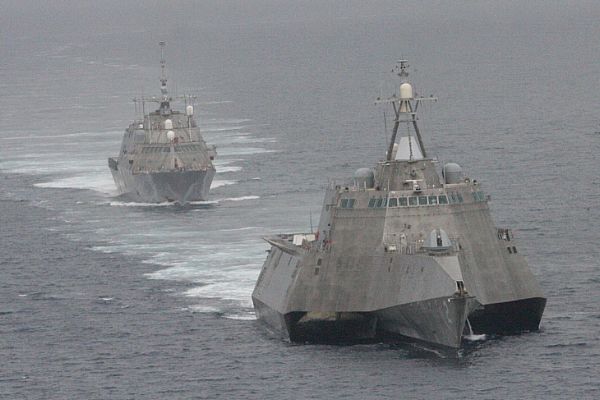
 Freedom-class Littoral Combat Ships are being assigned to NavSta Mayport, FL, which puts them closer to the Caribbean.

They would seem to be good ships for the Caribbean - not very threatening and good for "friendship" visits.

Thursday, May 10, 2018

"A Fleet Must Be Able to Fight"

A Fleet Must Be Able to Fight by Admiral Scott Swift is a need to read look into the the thinking of the Commander of the U. S. Pacific Fleet on preparing to fight a fleet.
A fleet is the Navy’s essential fighting element, our central contribution to the joint fight and to the nation’s defense. Forming a fleet into a coherent fighting organization brings an inherently integrated multi-domain warfighting structure. The natural synergies enjoyed by the surface, subsurface, and air domains are obvious and speak to our current day-to-day warfighting organization. Deliberate inclusion of the organic Fleet Marine Force and Naval Expeditionary Combat Command expeditionary capabilities enhance the fleet organization into one that can fight a highly mobile, maneuver-focused naval campaign sustained in austere locations over time. As we contemplate peer-level maritime adversaries, we need to recall the Navy’s foundational strength and resiliency. In response, we have focused the Pacific Fleet into full-spectrum and multi-domain numbered fleets within theater-level warfighting organizations capable of overmatching any adversary. Careful focus at the operational level of war is necessary to craft and wield this force
The cautionary part of the piece points to a lack of preparation of flag officers to carry out the mission of "fighting the fleet" -
But after what will be five years in command of two fleets, I find myself making similar observations as Admiral Willard: There is no classroom instruction and little doctrine or guidance for fighting a fleet.
The article then lays out Admiral Swift's observations on "...the fleet as a combat formation."

It has been about 73 years since the U. S. Navy fought as fleets. Admiral Swift's thoughts are timely indeed.

Very much worth the time to read and contemplate.

Friday, November 21, 2014

Friday Fun Film: Navy Day (1946)

How many modern weapons have been developed from what you see in this short clip honoring Navy Day!
Officers of tomorrow's navy trained, new radar-controlled glider bomb shown for first time, air-dropped sonar buoy with sub animation, transmitted to destroyer for depth charges (partial newsreel).


As bonus, a 1952 recruiting ad:


Tuesday, September 23, 2014

War Against Terrorists: Al Qaeda is back in the news and gets attacked to forestall "imminent attack"

U.S. Navy photo by Mass Communication Specialist 2nd Class Carlos M. Vazquez II
Al Qaeda makes the news again, and gets attacked in Syria, as set out here
Pentagon spokesman Rear Adm. John Kirby confirmed Tuesday that the plotting was far along.

“This is a very dangerous group,” Kirby told Fox News. “We had information, good information that they were very actively plotting and very close to the end of that plotting -- and planning an attack on targets either in Europe or the U.S. homeland.”

As for the result of the airstrikes, he said: “We think we hit what we were aiming at.”
More from the Long War Journal:
The US-led bombing campaign in Syria is targeting the Al Nusrah Front, an official branch of al Qaeda, as well as the Islamic State, an al Qaeda offshoot that is one of Al Nusrah's fiercest rivals.

Before they were launched, the air strikes were framed as being necessary to damage the Islamic State, a jihadist group that has seized large swaths of territory across Syria and Iraq. But in recent days US officials signaled that they were also concerned about al Qaeda's presence in Syria, including the possibility that al Qaeda operatives would seek to use the country as a launching pad for attacks in the West.

Several well-connected online jihadists have posted pictures of the Al Nusrah Front positions struck in the bombings. They also claim that al Qaeda veterans dispatched from Afghanistan to Syria, all of whom were part of Al Nusrah, have been killed.
***
Among the Al Nusrah Front positions targeted in the bombings are locations where members of the so-called "Khorasan group" are thought to be located. Ayman al Zawahiri, the emir of al Qaeda, sent the group to Syria specifically to plan attacks against the US and its interests. The group, which takes its name from al Qaeda's Khorasan shura (or advisory) council, is reportedly led by Muhsin al Fadhli, an experienced al Qaeda operative who has been involved in planning international terrorist attacks for years.

Al Fadhli's presence in Syria was first reported by the Arab Times in March. Shortly thereafter, The Long War Journal confirmed and expanded on this reporting. [See LWJ report, Former head of al Qaeda's network in Iran now operates in Syria.] The Long War Journal reported at the time that al Fadhli's plans "were a significant cause for concern among counterterrorism authorities."

The New York Times reported earlier this month that al Fadhli leads the Khorasan group in Syria.

Unconfirmed reports on jihadist social media sites say that al Fadhli was killed in the bombings. Neither US officials, nor al Qaeda has verified this reporting. The fog of war often makes it difficult to quickly confirm whether an individual jihadist has been killed, wounded, or survived unscathed. Initial reports should be treated with skepticism and there is no firm evidence yet that al Fadhli has been killed.

Read more: here

More on the Al Nusrah Front here:
Al-Nusra Front (also the Nusra Front or Jabhat al-Nusra) was formed in late 2011, when Al Qaeda in Iraq (AQI) emir Abu Bakr al-Baghdadi sent operative Abu Muhammad al-Julani to Syria to organize jihadist cells in the region. The Nusra Front rose quickly to prominence among rebel organizations in Syria for its reliable supply of arms, funding, and fighters—some from donors abroad, and some from AQI. Considered well trained, professional, and relatively successful on the battlefield, they earned the respect and support of many rebel groups, including some in the secular Free Syrian Army (FSA). However, al-Nusra also made some enemies among the Syrian people and opposition by imposing religious laws, although the group has shied away from the types of brutal executions and sectarian attacks that made AQI unpopular. Al-Nusra was also the first Syrian force to claim responsibility for terrorist attacks that killed civilians. (footnotes omitted)
***
Al-Nusra is affiliated with AQ and has pledged allegiance to the organization, serving as its only official branch in the Syrian conflict after global AQ emir Ayman al-Zawahiri publicly disowned ISIS following months of ISIS disobedience to AQ orders.
So, it's not really that the Al Nusrah Front and the Khorasan group just sprang up - but have been around and have enjoyed the chaos of Syria as providing recruiting and a safe haven.

Until now.

Thursday, July 24, 2014

Arctic Waters: U.S. Policy and the Sea Services

With our long Alaska Arctic coast (over 1000 miles), the U.S. is an Arctic power. What does that mean and how what is the U.S. approach to the Arctic waters?

On 23 July 14, there was testimony on this topic before the U.S. House Subcommittee on Coast Guard and Maritime Transportation, where, among others, Coast Guard Vice Adm. Neffenger testified on implementing US policy in the Arctic :
Currently, Coast Guard vessels and aircraft monitor close to one million square miles of ocean off the Alaskan coast to enforce U.S. laws, conduct search and rescue, assist scientific exploration, advance navigation safety and foster environmental stewardship. Throughout his testimony, the Vice Commandant spoke to these diverse operations, focusing on the need for the continuous assessment of capabilities required to operate in the region, long-term icebreaking needs and the National Arctic Strategy.
****
USCG Polar Star
“Current and future operations in the Arctic and Antarctic will continue to be informed by the availability of polar icebreakers and ice-strengthened vessels. Polar Star’s recent reactivation will provide the U.S. with heavy icebreaker capability for another seven to 10 years,” said the Vice Commandant. “We believe that Polar Star along with the medium icebreaker Healy provide a minimum capability necessary to address the nation’s near-term icebreaking needs in the Arctic and Antarctic, and will give us the time we need to assess longer term national needs and requirements.”
I translate that last part as "We need more ice capable assets, including more real ice breakers."

The National Arctic Strategy:


The Coast Guard Arctic Strategy follows:


The U.S. Navy has an "Arctic Roadmap"-


You can watch the 23 July hearing here.

You might note the absence of pictures of U.S. Navy icebreakers - because the U.S. Navy hasn't got any. It used to, but not now.

Monday, October 21, 2013

Thursday, May 09, 2013

Criticism of the Littoral Combat Ship: "Oh, you mean that 'old' negative report? That is so a year ago."

From Military.com, Navy Defends LCS from Damaging Internal Report:
U.S. Navy leaders have taken to Capitol Hill to defend the Littoral Combat Ship after an internal service report described the next-generation surface ship as “ill-suited to execute regional commander’s warfighting needs.”
****
However, Navy leaders have said it’s unfair to judge the program on a report that is a year old.
Wow.

What a powerful defense.

Probably should update that report to reflect the raft of new problems. Such as LCS Crew Discovers Seawater in Freedom’s Lube-Oil. A problem which, by the way, the Navy described by stating it is not as bad as it could been:
Navy officials say this kind of malfunction has, on occasion, happened on other ships as well but stressed that no crew members were ever in harm’s way.

“Although the failures are infrequent, it’s not unusual that these pumps would fail from time to time. This was not an incident where there was flooding on the ship or the ship was taking on water. The crew was never in danger,” said Falvo.
I feel so much better for knowing that.

About that "internal report" - see here:
“This review highlights the gap between ship capabilities and the missions the Navy will need LCS to execute,” said the report prepared last year for the Navy by Rear Admiral Samuel Perez. “Failure to adequately address LCS requirements and capabilities will result in a large number of ships that are ill-suited to execute” regional commanders’ warfighting needs.
***
The Perez report also highlights the vessel’s limited combat capability. The Navy has acknowledged that the vessels are being built to the service’s lowest level of survivability, a Pentagon-approved decision that sought to balance cost and performance.

The ship “is not expected to be survivable in that it is not expected to maintain mission capability after taking a significant hit in a hostile combat environment,” Michael Gilmore, the Pentagon’s chief weapons tester, said in a January report.

Even in its surface warfare role, when all armaments are working as intended, the vessel “is only capable of neutralizing” small, fast-attack boats and it “remains vulnerable to ships” with anti-ship cruise missiles that can travel more than five miles (8 kilometers), according to the Perez report. Iran has 67 such vessels, according to a chart in the report.

The Littoral Combat Ship is “ill-suited for combat operations against anything but” small, fast boats not armed with anti-ship missiles, the Perez report found.
Of course, our shipmate CDR Salamander is all over this.

The Perez report is not the first "negative vibe" re the LCS. A good piece (which may be behind the USNI Proceeding "member's only" wall is "Birth of the Littoral Combat Ship" by Capt. Robert Carney Powers, USN (Retired) :
It has taken 17-plus years since the LCS concept was born to come up with a flawed ship. What must go to accommodate the systems needed to make it relevant to its tasks? The LCS is, after all, a 3,000-ton ship (much larger than a World War II destroyer escort, and three-fourths the size of a Perry - or Knox -class frigate). The space for needed capability can be found.

As currently configured (weapons, manning, concept), is the LCS up to the tasks it could soon face (in the Strait of Hormuz and elsewhere)? The answer is regretfully “no.”

Is the LCS fit to be “the most numerous ship in the U.S. Navy?” Same answer.

Ah, yes, we are going to put sailors into ships that can't do the job, you know, unless we were suddenly attacked by war canoes.

Perhaps if we paint scary shark's teeth on the bows of these ships we strike fear in the hearts of our prospective enemies.

Ooooh, look - scary!

Time to rethink our fleet needs and the needs of those we send to sea to defend this country.

Saturday, February 02, 2013

Unable to attend the 2013 USNI West Conference and Exposition in San Diego last week?

Well, you might have missed some really good information - except that you can still view some of the key presentations and panels by watching them on USNI's YouTube page and get a summary of each day's summary here.

Almost like being there except you miss the giveaways at the vendor's booth.

Also, given that Midrats has Super Bowl "Best of" going this Sunday, it's a way to get your "talking 'bout National Security" fix.

Thursday, November 01, 2012

Hurricane Sandy Recovery: Navy Orders Some Amphibs to the New York Area to Standby

Navy Chief of Information, Rear Adm. John Kirby, clarifies:
USS Wasp (LHD-1)
There have been a number of media reports today discussing the Navy’s role in providing support to those affected by Hurricane Sandy. I wanted to take a minute to clean things up a bit. Right now, the only official tasking the Navy has received is to provide contract support in obtaining industrial size pumps for the Army Corps of Engineers’ efforts to dewater areas of New York City.

It is true that the Navy is moving ships to be closer to the areas affected by the hurricane; however these ships have not been officially tasked to provide support.


USS San Antonio (LPD-17)
Yesterday, the helicopter carrier USS Wasp (LHD 1), which was already at sea riding out the storm, began to head north to be better positioned. And today the Fleet Commander ordered two other amphibious ships, USS San Antonio (LPD-17) and USS Carter Hall (LSD-50), to get underway and likewise head north.


USS Carter Hall (LSD-50)
These decisions provide national and local decision makers maximum flexibility and options should there be a need for Navy support. Most importantly, this will allow our forces to be best postured to minimize the amount of time it will take these forces to get on station if tasked.

Any and all such support will be coordinated through U.S. Northern Command. While the military plays an important role in disaster response, all our efforts are in support of FEMA first and foremost.

Tuesday, October 23, 2012

Neither "Horses or Bayonets" - Why the Size of the Navy Matters

From the Third Debate:
ROMNEY: “Our Navy is old — excuse me, our Navy is smaller now than at any time since 1917. The Navy said they needed 313 ships to carry out their mission. We’re now at under 285. We’re headed down to the low 200s if we go through a sequestration. That’s unacceptable to me.”

OBAMA: “You mentioned the Navy, for example, and that we have fewer ships than we did in 1916. Well, Governor, we also have fewer horses and bayonets, because the nature of our military’s changed. We have these things called aircraft carriers, where planes land on them. We have these ships that go underwater, nuclear submarines. And so the question is not a game of Battleship, where we’re counting ships. ”
Well,  I am counting ships. The Navy has, in fact, said this country needs a minimum of 313 ships to fulfill all the missions assigned to it. That 313, by the way, includes those marvels described by the President - aircraft carriers and submarines.

What do we actually have?

I put up a post that talked about the size of the fleet the other day. You can visit it here. In that post I discussed the size of the surface combatant force, which is on its way down to something under 108 ships. There are at least two more ships in commission today than at the end of the period shown in the chart above. One is a new LCS, USS Fort Worth, and one is USS Michael Murphy (DDG 112).

Now, for those you who might think a ship is a ship, let me suggest that there is a rather large difference between a ship intended to take the fight to an opposing force (a combatant) and the other ships which are intended to either support the combatants (the auxiliary force consisting of refueling and ammunition ships) and the "follow on force" designed to deliver land combat power from the sea (the amphibious force).

The total includes, as I have indicated, submarines (67 of which 14 are ballistic missile boats or strategic assets, the others are definitely combatants), aircraft carriers (10 after the Enterprise is decommissioned and before the Ford enters the fleet). We have 31 amphibs, 47 auxiliaries.

So, how do we use our fleet? From the Navy's own website::
Ships and Submarines
Deployable Battle Force Ships: 287
Total Ships Deployed/Underway Ships Deployed: 114 (40%)
Ships Underway for Local Ops / Training (USFF / 3rd Fleet) Ships Underway for Local Ops / Training (USFF / 3rd Fleet): 45 (15%)
Ships Underway
Underway Aircraft Carriers:
USS Enterprise (CVN 65) - port visit Naples, IT
USS Nimitz (CVN 68) - Pacific Ocean
USS Dwight D. Eisenhower (CVN 69) - 5th Fleet
USS George Washington (CVN 73) - West Pacific
USS John C. Stennis (CVN 74) - 5th Fleet
USS Harry S. Truman (CVN 75) - Atlantic Ocean
Underway Amphibious Assault Ships:
USS Peleliu (LHA 5) - 5th Fleet
USS Bataan (LHD 5) - Atlantic Ocean
USS Bonhomme Richard (LHD 6) - port visit Subic Bay, RP
USS Iwo Jima (LHD 7) - 5th Fleet

Aircraft (operational): 3700+

USS Enterprise is on her way back home to be decommissioned after a zillion years of good and faithful service with a crew none of whom were born when she was commissioned in 1961.

Okay, 287 total ships.

And, as noted in my earlier post, plans are to shrink warships while slowing the building of new ones.
What does it mean if we have fewer than 313 ships?

It means longer deployments for aging ships. It means a greater demand on a shrinking sailor "workforce" - it means that our carrier fleet, so condescendingly described by the President to Governor Romney, goes to sea with escorts that cannot then be used for other missions. It means the ships we do have are ridden hard. It means maintenance slips.

It means that, as many us who are former Navy officers keep saying, that at some point the Navy will have to tell the President that there are missions we cannot do because we don't have the ships, despite the language of the poster nearby.

We don't have the ships because we cratered to the Russians on anti-ballistic missile sites in Poland and decided to put ABM ships into the Black Sea or off Spain or someplace where they cannot be diverted to other missions.

We are scheduled to build 55 Littoral Combat Ships which are proclaimed to be the "Swiss Army Knives" of multi-mission warships, but only if they have their modules (which they don't quite yet), their helicopters and a logistics support system that, in my view, has not yet appeared. We will use these under-gunned, undermanned but expensively high speed ships to show the flag.

Whoopee.

They may have a great potential - but do a Google search on "LCS" and then decide how you will feel when you or your son or daughter is assigned to one to "show the flag" to the growing Chinese fleet which, while it has problems of its own, has hardly under-armed the ships it obviously perceives it needs to push into the Cow's Tongue of the South China Sea.
.
As shown in my earlier post, of the 287 (+/-) ships of the U.S. Navy, less than 1/2 are meant to be combatant warships capable of gaining sea control by force. Amphibious ships and the auxiliary ships are "follow on forces" - they come in after the sea and air space are ours. Leave out the 10 carriers remaining after the Enterprise retires and we are scheduled to have 107 war fighting surface ships next year.

We are more than a "two-ocean Navy" - we operate world-wide, in the Pacific, Atlantic, Mediterranean, Indian Ocean, Arabian Gulf. We keep 40% of our force deployed; 15% in training for deployment; and the remainder in the shipyards for repair or in port doing other maintenance.

Why the heavy maintenance schedule? The sea is a harsh operating environment. And, unlike a company that operates a fleet of trucks or cars, we can't just pick up a bunch of the new model year from the local dealer. You have to have a plan - have a strategy and build a fleet to match that strategy.

I guess shrinking your fleet because you can't budget to keep the minimum you need is a sort of strategy. Just not a winning one.

Monday, April 23, 2012

U.S. Coast Guard and Navy Team with Merchant Vessel to Rescue Fishermen with Burning Boat Problem


From the U.S. Coast Guard media center, "Ten fishermen rescued from burning ship in Pacific":
APRA HARBOR, Guam – The Coast Guard, U.S. Navy and Automated Mutual Assistance Vessel Rescue partners, coordinated in the rescue of 10 crewmembers forced to abandon ship due to a shipboard fire 700 miles west of Guam Saturday.

Coast Guard Sector Guam watchstanders received an initial alert from an Emergency Position Indicating Radio Beacon from the Hsin Man Chun, a 70-foot Taiwanese fishing vessel, at 4:30 p.m. Saturday. Watchstanders then received a call from rescue coordination center Taipei, China reporting that a sister ship of the Hsin Man Chun received a radio call indicating the crew was planning to abandon ship.

A Navy P-3 Orion long-range search aircraft from Patrol Squadron 1 stationed at Kadena Air Base, Japan, overflew the vessel and reported eight crewmembers in a life raft and two more on the bridge of the burning vessel. The P-3 crew deployed two life rafts to assist the crewmembers that remained behind. They passed the location of the distressed crewmembers to the Semirio, a Marshallese flagged bulk carrier diverted to the area by the Coast Guard.

The Semirio was only 40 miles away from the distressed vessel and was asked to assist. Once on scene, the 950-foot bulk carrier launched a small boat and successfully rescued all 10 crewmembers. The Semirio is one of many foreign flagged vessels operating in the Pacific that voluntarily participate in the AMVER System.


Very nice coordinated effort. BZ to all involved!


Images are U.S. Navy photos from DVIDS.