VertRep

VertRep
Showing posts with label Maritime Strategy. Show all posts

Thursday, April 20, 2023

War Plans and Sealift - What if we're not planning a land war in Asia?


I'm experimenting with Substack and put up a post on War Plans and Sealift What if we're not planning a land war in Asia? in response to arguments that our "sealift" capacity is much less than it should be. I assert that it depends on what sealift you need for the strategy you are pursuing.

I’d be looking a more submarines, more fast sealift for those island hopping Marines, more sustainment shipping to keep the fighting fleet at sea, and many more small, fast missile boats to augment the larger fleet.

Give it a read and let me know how it looks.

Monday, January 25, 2021

Monday, March 12, 2018

Important Strategic Input: "U.S. Navy Carriers: Strike Range Expansion Is Critical"

If you are going to influence shore based powers, you need to be able to reach out touch them if need be.

This is addressed by Jerry Hendrix in this National Review piece, U.S. Navy Carriers: Strike Range Expansion Is Critical
The United States Navy needs to make some hard choices if it wishes to remain relevant in the Anti-Access/Area Denial (A2AD) security environment that lies ahead of it. It must begin to adjust its strategy as well as its accompanying shipbuilding and aircraft-procurement plans to enable it to fight and win within the emerging great-power competition. This new environment, at last recognized in President Trump’s National Security Strategy and the Secretary of Defense’s National Defense Strategy, requires the Navy to strike enemy capitals and other vital centers of gravity from range, but the Navy’s decision to bypass a carrier-based strike asset, and now even to push off its acquisition of an unmanned mission tanker, suggest that it is not taking A2AD great-power competition seriously. Its decisions place the future relevance of the entire maritime service, at least as it is presently composed, at risk.
We also discussed this on Midrats on 11 March 2018 - and Dr. Hendrix joined us - the discussion rolls through the show, but especially beginning around the 44 minute mark:


Wednesday, June 08, 2016

Free Courses in National Security and Intelligence

Let's say you have an interest in national security and intelligence but neither the time nor the money to attend a degree or credential program covering those topics - where can you turn to get some insight into such matters?

Well, you might start with POLSC313: US Intelligence and National Security from Saylor.org
The study of United States intelligence and national security operations is an analysis of how the various branches of government work together and, as a check upon each other, how they work to protect and promote American interests at home and abroad. The purpose of this course is to provide you with an overview of national security policy analysis and the United States intelligence community. As you progress through this course, you will learn about strategic thought and strategy formulation, develop the ability to assess national security issues and threats, and cultivate an understanding of the political and military institutions involved in the formulation and execution of national security policy through diplomacy, intelligence operations, and military force. This course will examine problems and issues regarding United States national security policy. A large section of the course will deal with the major actors and institutions involved in making and creating national security policy and the intelligence community. National security is the most critical role of your government, without which, all other policies could not be created.
A key component of the above course being U.S. Army War College Guide to National Security
Policy and Strategy, 2nd Edition:
This edition of the U. S. Army War College Guide to National Security Policy and Strategy reflects to some extent recent changes in the structure of the core curriculum at the War College. The college broke its traditional core course, “War, National Policy and Strategy,” into two courses: “Theory of War and Strategy” and “National Security Policy and Strategy.” The result for this book is the expansion of the block on strategic theory and the introduction of a block on specific strategic issues. Because little time has past since the publication of the most recent version of this book, this edition is largely an expansion of its predecessor rather than a major rewriting. Several chapters are new and others have undergone significant rewrites or updates, but about two-thirds of the book remains unchanged. Although this is not primarily a textbook, it does reflect both the method and manner we use to teach strategy formulation to America’s future senior leaders. The book is also not a comprehensive or exhaustive treatment of either strategy or the policymaking process. The Guide is organized in broad groups of chapters addressing general subject areas. We begin with a look at some specific issues about the general security environment—largely international. The section on strategic thought and formulation includes chapters on broad issues of strategy formulation as well as some basic strategic theory. The third section is about the elements of national power. A section on the national security policymaking process in the United States precedes the final section that deals with selected strategic issues.
While you are at it, this title from the AWC might be a good one Strategy and Grand Strategy: What Students and Practitioners Need to Know:
In this monograph, Dr. Tami Davis Biddle examines why it is so difficult to devise, implement, and sustain sound strategies and grand strategies. Her analysis begins with an examination of the meaning of the term “strategy” and a history of the ways that political actors have sought to employ strategies and grand strategies to achieve their desired political aims. She examines the reasons why the logic undergirding strategy is often lacking and why challenges of implementation (including bureaucratic politics, unforeseen events, civil-military tensions, and domestic pressures) complicate and undermine desired outcomes. This clear-headed critique, built on a broad base of literature (historical and modern; academic and policy-oriented), will serve as a valuable guide to students and policymakers alike as they seek to navigate their way through the unavoidable challenges—and inevitable twists and turns—inherent in the development and implementation of strategy.

If you can gain access, the "self-study" courses offered by The Naval Postgraduate School Center for Homeland Defense and Security might be of interest:
These courses are developed by the NPS CHDS teaching faculty and are derived from course content (lecture material and course readings) from the Center’s homeland security master’s degree curriculum. The courses, offered at no cost, are designed for homeland defense and security professionals who wish to enhance their understanding of key homeland security concepts and require the flexibility of self-paced instruction.
There are several good titles offered, including "Critical Infrastructure Protection: Transportation Security" and "Critical Infrastructure: Vulnerability Analysis and Protection" the latter course description ought to prompt some thinking all by it self:
Critical Infrastructure protection is one of the cornerstones of homeland security. While PDD-63 lists 8 sectors, the National Strategy for Protection of Critical Infrastructure and Key Assets lists 11 sectors: Water, Power & Energy, Information & Telecommunications, Chemical Industry, Transportation, Banking & Finance, Defense Industry, Postal & Shipping, Agriculture & Food, Public Health, and Emergency Services. For the purposes of this course, we have divided these into levels with Water, Power & Energy, and Information & Telecommunications forming the first – or foundational – level. Chemical Industry, Transportation, and Banking & Finance are assigned level 2, and the remaining sectors are designated level 3 infrastructures. These levels indicate dependencies – higher levels are dependent on lower levels. Thus we focus most attention on the most fundamental critical infrastructures. This course develops a network theory of vulnerability analysis and risk assessment called “model-based vulnerability analysis” used to extract the critical nodes from each sector, model the nodes’ vulnerabilities by representing them in the form of a fault-tree, and then applying fault and financial risk reduction techniques to derive the optimal strategy for protection of each sector.

Not surprisingly, YouTube has some good discussions:


The point being, there is stuff out there for the autodidacts among you.

You might not get a piece of paper at the end, but you will know what you know.

Wednesday, April 22, 2015

China: A Video on Its "Defensive Layers"

Sam LaGrone put up this video on the USNI News site but it is from the Office of Naval Intelligence:


The rest of Sam's post is well worth reading, as it deals with Global Guided Missile Expansion Forcing U.S. Navy to Rethink Surface Fleet Size:
Rapid growth in the capability and quality of guided missiles — mostly Chinese in origin — is causing the U.S. Navy to rethink the number of surface ships it needs to effectively fight a high-end war.

Early estimates based ongoing war games could mean the current number of 88 large surface combatants — the Navy’s fleet of guided missile destroyers and cruisers — needs to grow to more than a hundred into the 2020s just to keep to today’s current level of risk, USNI News has learned.
Then it goes into budgets and alternatives.

Good read.

Monday, March 30, 2015

China: A South Atlantic Pivot? Base rights in Southwest Africa?

If the U.S. is doing a "Pacific Pivot," is China countering with expansion into the South Atlantic?
Click to enlarge. Namibia Circled.

The Diplomat asks Is China Secretly Building a Navy Base in Africa?
Writing for Real Clear Defense, Robert C. O’Brien explores reports that China is looking to build an overseas naval base in Namibia. O’Brien notes the historical strategic importance of Walvis Bay, Namibia’s sole deep water port, adding that the South Atlantic is generally “below the radar of most policy makers today.” If the PLA Navy does construct a base at Walvis Bay, he writes, “It would have the ability to patrol the critical Cape of Good Hope around Africa and Cape Horn around South America. The approaches to the key North Atlantic sea lanes linking the Americas, Africa and Europe would be nearby.”
Mr. O'Brien's piece is China's Next Move: A Naval Base in the South Atlantic?:
During my visit to Walvis Bay, China's plan to build a naval base was the talk of the town. Several Namibians pointed out that China already has a major satellite tracking installation in-country. China is developing key uranium mines. Chinese immigrants are opening shops in every corner of the land. A Namibian told me he would not be surprised if Namibia soon elects its first Chinese member of parliament. One local, who works at the harbor, said he has heard the PLA Navy will deploy four to six warships to the prospective base. Once that happens, he said, Namibia becomes, in essence, a Chinese colony.
David Tweed had this story back in November 2014 at Bloomberg reporting on an article from the Namibian, China Mulls Building Naval Base in Namibia, Namibian Times Says. The Namibian report from Nov 19 2014 is "Chinese naval base for Walvis Bay" by Adam Hartman:
According to reports in the Chinese media, Walvis Bay will be one of 18 naval bases that will be established in various regions: Pakistan, Sri Lanka and Mynanmar in the northern Indian Ocean; Djibouti, Yemen, Oman, Kenya, Tanzania and Mozambique in the western Indian Ocean; and Seychelles and Madagascar in the central South Indian Ocean.

“These three strategic lines will further enhance China's effectiveness in taking responsibility for maintaining the safety of international maritime routes thereby maintaining regional and world stability,” the media reports said.

Other naval bases are: Chongjin Port (North Korea), Moresby Port (Papua New Guinea), Sihanoukville Port (Cambodia), Koh Lanta Port (Thailand) Sittwe Port (Myanmar), Dhaka Port (Bangladesh), Gwadar Port (Pakistan), Hambantota Port (Sri Lanka), Maldives, Seychelles, Djibouti Port (Djibouti),

Lagos Port (Nigeria), Mombasa Port (Kenya), Dar es Salaam Port (Tanzania) and Luanda Port (Angola).
As the Tweed piece notes, however,
The Namibian Times report was based on an unofficial Chinese Internet report and was “inaccurate,” “exaggerated” and therefore “groundless,” Defense Ministry spokesman Geng Yansheng said at a monthly press conference in Beijing today, according to a transcript of his remarks. Geng didn’t say which parts of the report, if any, were accurate.
The game's afoot. And it's a big one.

As seen on the above map, the Chinese, if the reported "naval base" list is correct, would build an interesting string of ports available to them. The listed countries that would host bases are under the red ovals. I added China and I added in the Nicaragua canal that it appears the Chinese may fund/engineer/build.

IN 2013 there was this report, China’s moves in Western Hemisphere have U.S. stepping up its game:
China’s courting of Latin America and the Caribbean – signaled anew this week by a visit by its president – is prodding the United States to step up its outreach to the rapidly emerging economies, which are showing greater global clout.

President Xi Jinping’s weeklong trip to Trinidad and Tobago, Costa Rica and Mexico starting Friday comes in the wake of President Barack Obama’s recent trip to Mexico and Costa Rica, and follows by just a day Vice President Joe Biden’s three-nation tour of the region. Xi will meet with Obama at the close of his trip, June 7-8 in California.

China has eclipsed the United States as Brazil and Chile’s largest trading partner, purchasing soybeans, iron ore and oil to fuel its rapidly expanding economy. Latin American exports to China accounted for just $5 billion in 2000; by 2012, they topped $104 billion.
May we live in interesting times.


Tuesday, December 02, 2014

Whither the U.S. Navy Surface Forces? Sea Control? Is it mission possible?

From The National Interest blog: Rough Waters Ahead: How to Maximize the Power of the U.S. Navy's Surface Fleet by Bryan Clark and Bryan McGrath.
The U.S. Navy faces a daunting future environment. Flat defense budgets, improving adversary capabilities, growing instability and a defense strategy that portends additional responsibilities all conspire to challenge the fleet’s capability and capacity. At the same time, its backbone—the surface force of cruisers, destroyers and smaller combatants—is at a decision point.
***
The Navy should rethink traditional approaches to air defense, weapons development and maritime security so it can equip surface combatants to better defend themselves and increase their ability to outrange the enemy and conduct offensive operations.

We discussed this topic on Midrats a couple of weeks ago with Bryan Clark Episode 255: Commanding the Seas – the Surface Force with Bryan Clark from CSBA

Suggested background reading and more:

Bryan Clark's Commanding the Seas: A Plan to reinvigorate U.S. Navy Surface Warfare

Jerry Hendrix's "Buy Fords, Not Ferraris". And Influence Squadron Are Here, But Will We Use Them?. And another Midrats interview, Episode 253: The Fleet we Have, Want, and Need - with Jerry Hendrix.

Bryan McGrath: On Midrats, Episode 223: 12 Carriers and 3 Hubs with Bryan McGrath discussing his co-authored (with McKenzie Eaglen) article, America's Navy needs 12 carriers and 3 hubs. On the Sea Control podcast, Episode 20 On Maritime Strategy.


Monday, November 24, 2014

On that "Third Offset Strategy"

Secretary of Defense Hagel recently laid out a new "third offset"strategy:
U.S. Defense Secretary Chuck Hagel on Saturday outlined a series of reforms designed to tackle what he views as the military’s declining prowess as China, Russia and others field new weapons technologies.

Mr. Hagel said the Pentagon needed to look outside the traditional defense industry to target emerging technologies that could be developed within budget constraints, a move that some leaders believe could reshape the weapons business over the next decade.
***
Defense officials have said the priorities include longer-range and hypersonic weapons, enhanced cybersecurity platforms and unmanned systems.
CSBA's Robert Martinage laid "third offset strategy" in out in, Toward a New Offset Strategy: Exploiting U.S. Long-Term Advantages to Restore U.S. Global Power Projection Capability
As a matter of urgency, the U.S. military needs to “offset” the investments that adversaries are making in anti-access/area-denial (A2/AD) capabilities—particularly their expanding missile inventories—by leveraging U.S. advantages in unmanned systems and automation, extended-range and low-observable air operations, undersea warfare, and complex system engineering and integration. Doing so would allow the United States to maintain its ability to project power, albeit in novel forms, despite the possession of A2/AD capabilities by hostile forces.
Related to this, of course, is the recognition that U.S. naval surface force are being out-ranged and out-gunned by overwhelming numbers of ship threatening cruise and other missiles, which we discussed on Midrats with Bryan Clark here.
Check Out Military Podcasts at Blog Talk Radio with Midrats on BlogTalkRadio

The "Third Offset Strategy" has critics, one of whom is James Jay Carafano of the Heritage Institute, who penned The Third Offset: The "Fairy Dust" Strategy for The National Interest, which describes the option picked Mr. Hagel to get the US Defense back into the game as:
... another “easy button” solution: the promise that we’ll fix declining capabilities by deploying new technology.

The Secretary offered no details that would suggest he considers technology to be a serious strategy for overcoming our deteriorating defenses. Basically all he said in his speech was that his Pentagon would spend the next two years planning to have a plan. That is not a plan.

Second, basing a strategy on technological innovation that is not in hand is nothing more than wishful thinking. It would be like Taft’s Secretary of War, Henry Stimson, planning to fight World War I with nuclear weapons. Game-changing technology happens when it happens—not on-demand, like cable. Indeed, betting on technology that’s not mature often leads to deploying technology before it’s ready, which in turn leads to the kinds of massive cost overruns and delays a cash-strapped Defense Department can ill afford. Of course, the United States should always be seeking out technologies that offer decisive competitive advantages, but that is not the basis for a sound strategy.

Third, it’s a mistake to build a strategy around a single point of strength, because that often becomes a single point of failure.
It is worth reading these arguments and pondering where we should be headed.

Dr. Carafano links to a report by the congressionally chartered, bipartisan National Defense Panel "Ensuring a Strong U.S. Defense for the Future" which he characterizes as showing, " . . . how wide the gap has grown between what the Pentagon has and what it needs . . ." or, as the panel put it:
The effectiveness of America’s other tools for global influence, such as diplomacy and economic engagement, are critically intertwined with and dependent upon the perceived strength, presence and commitment of U.S. armed forces. Yet the capabilities and capacities rightly called for in the 2014 Quadrennial Defense Review, hereafter referred to as the QDR, clearly exceed the budget resources made available to the Department. This gap is disturbing if not dangerous in light of the fact that global threats and challenges are rising, including a troubling pattern of territorial assertiveness and regional intimidation on China’s part, the recent aggression of Russia in Ukraine, nuclear proliferation on the part of North Korea and Iran, a serious insurgency in Iraq that both reflects and fuels the broader sectarian conflicts in the region, the civil war in Syria, and civil strife in the larger Middle East and throughout Africa.
At least everyone at this level of the argument acknowledges there are a growing threats that "sweet talk" will not abate.

Sleeping bullies have awakened and are beginning to show their simmering resentment of Pax Americana.

Those who might oppose the U.S. and its allies are equipping themselves with the tools to counter our current military strengths in their respective areas of interest.

It our turn to make moves to counter their counters.

If that means developing new technologies, that seems to me to be a good thing. Surging new technology only works,though, if we can maintain an edge by not letting those who would oppose us steal such tech out from under us.

We really need more ships and aircraft. If we manage it correctly, they don't need to be the most expensive tools. Further, if we can't afford more ships, then as Bryan Clark argues, we need to fix our current ships to deal with the real world threats we face.

We also need to be more "offensive minded" in our approach.

Now.

That's a strategy of sorts.


Thursday, August 28, 2014

The Navy We Need


Power projection, preserving freedom of the seas, aiding allies, bothering bullies and the ability to “move U.S. soil anywhere in the world.”
USS Carl Vinson departs San Diego, headed west. (Photo by Lorna T.)
George Will writes an interesting opinion piece "Navy with a mission in mind" which contains the above quote from Rep. Randy Forbes and more:
Greenert’s Navy, which has fewer (290) but much more capable ships than the Navy had during the Reagan buildup (594), can still move nimbly to put anti-missile ships near North Korea or F/A-18s over the Islamic State. But cascading dangers are compelling Americans to think afresh about something they prefer not to think about at all — foreign policy. What they decide that they want will define the kind of nation they want America to be. This abstract question entails a concrete one: What kind of Navy do Americans want? The answer will determine whether U.S. power can, in Greenert’s formulation, “be where it matters when it matters.”
***
The question, however, is: Do Americans, demoralized by squandered valor in Iraq and Afghanistan, and dismayed in dramatically different ways by two consecutive commanders in chief — the recklessness of one and the lassitude of his successor — want U.S. power projected? They will answer that question with the Navy their representatives configure. The representatives should act on the assumption that every generation lives either in war years or in what subsequent historians will call “interwar years.”
He could have written much of that after WWI, when the Navy was cut way back only to be needed again in the face of a rising Asian power seeking to dominate the Western Pacific.

I should note that our Navy has been long been forward deployed and on a war footing since - what? 1987? We need more ships and more people in them. This is not the time to shrink away from our duties to ourselves and others.

Warships are long lead time investments. They are not something you can run down to the local "ShipMax" and pick up a nice barely used model on the cheap (unless you are a U.S. ally picking up our cast-offs). If you need a great big gray hull out there - to do the nation's bidding- you need to keep the shipyards working. The "quality versus quantity" debate becomes meaningless if you can't meet the demands placed on you due to the lack of hulls to be in the right places at the right times.

Written a couple of years ago, this CNN opinion piece by retired Brigadier General Paula Thornhill , "History shows danger of arbitrary defense cuts" expresses the right concerns:
As America embarks on a tough strategic journey in the aftermath of Iraq, and contends with an ailing economy, it is wise to be mindful of the difference between hope and fact. The president and Congress might focus on strengthening the economy and assume for a time that a smaller military will suffice. Pursuing prudent military reductions in this environment makes sense; however, relying on a budget-driven process to make these reductions does not.

The nation's leadership needs a Plan B so that a heroic assumption -- or hope -- about the unlikelihood of future wars does not inadvertently lead to strategic disaster. This is harder than it seems. Plan B would allow more flexibility to meet what could go wrong in the strategic environment rather than just making budget cuts.
"Plan B" should include sound thinking about the dangers ahead and the tools to face them. In my opinion, a solid Naval force should be item #1 in the tool box.

Wednesday, June 18, 2014

Strategy: Naval War College: Current Strategy Forum 2014 (in part)

From the DVIDS site, videos of the 2014 Current Strategy Forum held at the Naval War College:

The videos are posted here

As noted on the DVIDS site:
This year marks the 65th annual Current Strategy Forum (CSF) at the U.S. Naval War College in Newport, Rhode Island. The first CSF was held on May 9, 1949 under the title “Round Table Talks.” This event offers an opportunity for the nation’s public servants, scholars, and senior military officers to join the College faculty and students to discuss the future strategy of the United States.

Yes, any word you misspell will always be in the post title.

UPDATED to put in link directly to DVIDS page.

Wednesday, March 26, 2014

U.S. Naval War College Symposium on "Maritime Security, Seapower, and Trade"

I'm sure my invitation to this got -um- lost in the mail, but if, like me, you find that you were unable to attend this 24-26 March 2014 U.S. Naval War College Symposium on "Maritime Security, Seapower, and Trade," then I can recommend that you follow that link to learn about the symposium and then visit the working papers link for some interesting reading.

Some of the usual suspects were there, Claude Berube, B. J. Armstrong and Dr. Martin Murphy - but there are many others who names presently may not be known to you, but whose papers will both inform and raise new questions for you to ponder.

The symposium goal:
To make sense of the relationship among maritime security, seapower, and trade, the EMC Chair will convene a symposium that brings experts from industry, the policy community, and the sea services. Participants will reflect on the importance of classic maritime thought and how changes in the shipping industry, trade patterns, and non-state use of the oceans impact future naval operations. The implications are important for understanding the types of missions combatant commanders will execute and the types of equipment and training the Navy must provide to support these missions. Keynote speakers will address the diplomatic and operational considerations of maritime cooperation.
Sure would like a webcast of these things . . . but without that, go read and enjoy.

Thursday, December 12, 2013

Help Put a Halt to "Sea Blindness" - USNI Defense Forum 2013

If you, like me, couldn't get to DC for USNI Defense Forum Washington 2013, read about and watch it here. One of the keys to keeping a strong Navy it to work hard at telling the country why we need a large and competent force - not letting, in the words of Royal Navy Admiral Sir Jonathon Band, "sea blindness" rob of us of a key element of national and international security.

Rep Randy Forbes (R, Va) spoke and wonders:
“When I look at what we’re doing in national defense today, I can’t help but think back to the words of Thomas Jefferson, who said that this country is still the best hope for the world, a treasure beyond comparison,” said Forbes, “and I wonder if we’re doing everything today to defend and protect it.”
There is much much more at the link.

Here's an interesting quote from SecNav Ray Mabus:
The Secretary explained that the past 4 1/2 years has afforded him a unique opportunity to observe the Navy and Marine Corps, and he shared that perspective with the audience. “The value of the Navy and Marine Corps is as apparent today as it was when the nation was founded,” he said. “The framers of the Constitution understood that we have to maintain a constant and persistent presence,” he explained, recounting the many campaigns in which the services have fought through the nation’s history. “In each of those the American Navy has maintained control of the seas and guaranteed freedom of navigation between those wars, and peaceful free trade, and in doing so, has underwritten its contribution to the growth of the world economy.” The Navy responds to every call, whether combat or humanitarian aid disaster relief, recalling recent aid missions to the Philippines, Japan, and Haiti. “It’s one of the things that we do, and we are very good at it.” In fact, he noted, the US receives requests for humanitarian assistance every two weeks -- and is the only naval service in the world being capable of performing that role. That also precludes the need for securing overflight rights or permission to base. Instead, he notes, “We [the Navy] don’t have to come in from anywhere; we are already there.”

How do we keep that presence? SECNAV Mabus explained that it requires four things: people, platforms, power, and partnerships. People are first because they are the most important asset, as the machines can’t operate without them. “We push responsibility, and we push authority down,” he explained. “We expect from junior sailors and junior officers great decision-making. We expect them to do these incredibly complex jobs and we expect them to do it every single day.”

With regard to platforms, the Secretary observed, “at some point quantity becomes a quality all its own. We have arrested the decline of the fleet.” ****
Go read, watch the videos and spread the word.

We need to put a halt to "sea blindness" in this country.

Monday, June 17, 2013

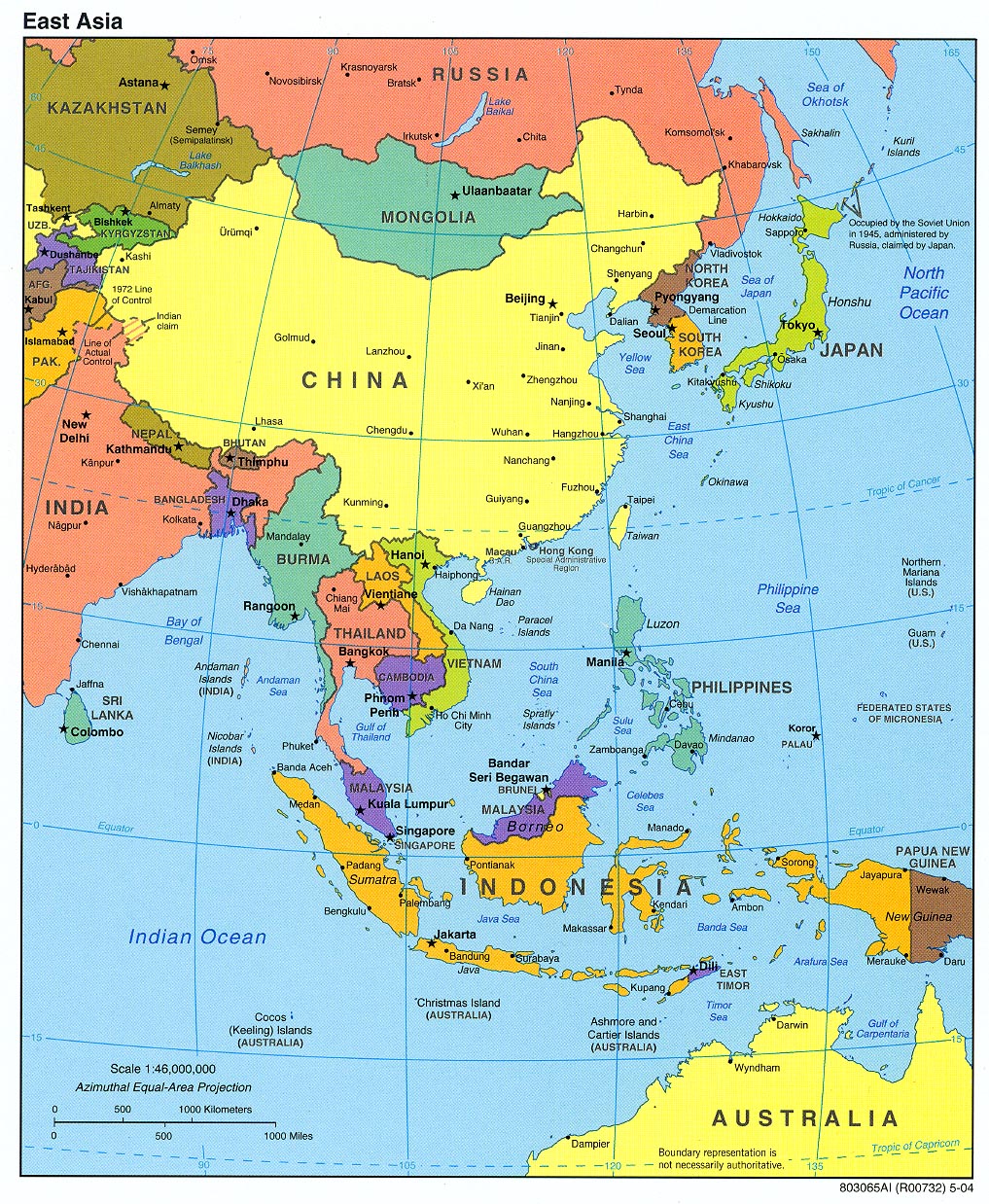
China: All Your (East and Southeast Asia) Seas Belong to the PRC

Defense News Reports "General Says Chinese Patrols In Asian Seas 'Legitimate' ":
“Why are Chinese warships patrolling in East China Sea and South China Sea? I think we are all clear about this,” Qi told the annual Shangri-La Dialogue security conference in Singapore.

“Our attitude on East China Sea and South China Sea is that they are in our Chinese sovereignty. We are very clear about that,” he said through an interpreter.

“So the Chinese warships and the patrolling activities are totally legitimate and uncontroversial.”
I guess they are "uncontroversial" to him and to his friends - in the PRC.

I can only believe the Philippines, Japan and a few other concerned residents of the area feel differently.


Hat tip: USNI News Room.

Friday, December 07, 2012

Southeast Asia: India, China and Sea Power

Interesting piece at the Foreign Policy website, "India's Ocean" by Dhruva Jaishankar, posing one of those fundamental questions, "What is the role of the Indian Navy as China asserts dominance to India's east?":
For its part, China needs to appreciate that its aggressive pursuit of maritime territory compels India to cooperate more closely with Vietnam and the Philippines. Beijing's issuing of passports this November featuring a map showing the fullest extent of its territorial claims was a remarkably clumsy gesture, provoking simultaneous outrage in India, Vietnam, the Philippines, and Taiwan. China may have only itself to blame if these states find greater common cause with one another, and with other regional maritime powers.
The map above indicates key Chinese sea lines of communication. You might take note of India's position relative to them.

You also might take a look at the Thomas X. Hammes piece, Offshore Control: A Proposed Strategy for an Unlikely Conflict (pdf), which suggests a "distant blockade" (or "Offshore Control") of China as a possible strategy:
The strategy of Offshore Control works with willing Asia-Pacific nations to ensure that the United States can interdict China’s energy and raw material imports and industrial exports, while protecting our partners.
Col. Hammes's thoughts are also set out in December 2012 U.S. Naval Institute article, "Offshore Control is the Answer":
Offshore control would deny China the use of the sea inside the first island chain, at the same time defend those islands, and dominate the air and sea outside that theater. It envisions a stand-off military campaign focusing on a war of economic strangulation rather than on penetrating Chinese airspace to physically destroy its infrastructure. It seeks to force China to fight in ways that maximize U.S. strengths while minimizing China’s. In essence, OC provides a strategic context for an operational approach that goes beyond Air-Sea Battle to use the U.S. geographical advantage to maximize the effectiveness of a campaign using our air, sea, and land assets.
Oh, and if you were wondering about the value of a strong U.S. Navy - this discussion is right on point. Being able to project power even when it needs to be done without local help - that's a big chunk of the Navy's job description.

Keep in mind that it is the job of the military strategist to work through "unlikely" scenarios just in case. Next time some idiot media hack reports on secret U.S. plans to re-take Midway Island based upon some outlandish event occurrence, it shouldn't really be a shock to you.

UPDATE: There has been some notice of the fact I used an "oil flow" map to illustrate this post. Here is a more recent map that shows vital sea lanes (click on it to enlarge), followed up by a closer view in the China region:


Monday, June 11, 2012

China: A Maritime Strategy

From the China Daily, a Chinese view of maritime strategy in "Safeguard maritime rights and interests":
. . . China's maritime strategy should focus on the following:

First, it should clarify its maritime strategy based on the three pillars of traditional and non-traditional maritime security; marine economy and technology; and its diplomatic strategy, making full use of international law, including the Convention on the Law of the Sea.

Second, it should strive for an understanding with the US and explore a bilateral coordination mechanism to maintain a dynamic balance of competition and cooperation. China has no intention of challenging the US' maritime hegemony, so the US should respect China's maritime rights and interests "on its doorstep".

Sino-Russian and Sino-Indian cooperation should be expanded and Sino-Japanese competition controlled.

China and Russia are making efforts to safeguard their legitimate maritime rights and interests and held a large-scale joint military exercise in the Yellow Sea in April.

Third, it must avoid getting isolated while dealing with the territorial disputes with Japan, the Philippines and Vietnam.

Fourth, China must resolutely and effectively defend its maritime territorial sovereignty and core interests. It must resolve disputes caused by overlapping exclusive economic zone and fishery and oil, gas and mineral resources disputes through negotiations and consultations, and safeguard the security of sea-lanes through regional multilateral cooperation.

Fifth, China should establish an institutional mechanism to develop its marine economy and integrate the use of law enforcement, diplomatic, military and other means, strengthen department coordination, and coordination between the central government and coastal provinces, and set up a national institution specifically responsible for dealing with marine affairs.
Earlier in the piece is this:
. . . [T]he specific territorial disputes between China and some neighboring countries, which have been aggravated by the lack of strategic trust between the United States and China. The maritime sovereignty disputes between China and Japan, Vietnam, and the Philippines are complex and troublesome, and the last thing China wants is to see these countries and the US joining hands against China. In fact, China and the US have no maritime sovereignty disputes, they are contending for sea power and influence.
Hmmm "lack of stratgic trust?" Does that mean standing up for allies with those claims contrary to China's?

"Sea power and influence" . . . time to dig out my Mahan again.

Wednesday, April 04, 2012

Strategy in Southeast Asia and Australia: The U.S. Marines Land

An Australian Broadcasting Corporation look at the strategic move of sending in the Marines to the Northern Territory.
A continuation of a 60 year alliance and a message.

ALAN DUPONT, INT. SECURITY STUDIES, UNSW: It's not so much the Marines themselves but it's the symbol - the signal it sends to the region that Australia is - and the United States are working together to meet these common challenges. So I think it's quite an important shift.
UPDATE: Robert Kaplan has a related analysis at Stratfor America's Pacific Logic:
Were the United States not now to turn to the Indo-Pacific, it would risk a multipolar military order arising up alongside an already existent multipolar economic and political order. Multipolar military systems are more unstable than unipolar and bipolar ones because there are more points of interactions and thus more opportunities for miscalculations, as each country seeks to readjust the balance of power in its own favor. U.S. military power in the Indo-Pacific is needed not only to manage the peaceful rise of China but also to stabilize a region witnessing the growth of indigenous civil-military post-industrial complexes.
UPDATE2: Related - a port visit of a couple of U.S. Navy ships reported as Louisville Visits Malaysia During Western Pacific Deployment:
U.S. Navy photo by MCS 1st Class David R. Krigbaum
The Los Angeles-class fast-attack submarine USS Louisville (SSN 724) arrived in Malaysia April 3 for a visit as part of its deployment to the western Pacific.

Louisville moored alongside USS Emory S. Land (AS 39) to receive tended support for [sic- from?] the submarine tender.

"We anticipate performing a variety of submarine support services for Louisville to ensure all systems are fully functioning and operational when she returns to sea," said Lt. Cmdr. James Hicks, Emory S. Land's production maintenance officer.

***

Measuring more than 360 feet long and weighing more than 6,000 tons when submerged, Louisville is one of the most advanced and stealthiest attack submarines in the world. Louisville uses her stealth, mobility, endurance, and firepower to perform missions in undersea warfare, surface warfare, strike warfare, mine warfare, battlespace preparation including intelligence surveillance and reconnaissance, and combat search and rescue.

Tuesday, November 01, 2011

Maritime Security: Report: "Pentagon may shift focus to Asia-Pacific"

Reported as Pentagon may shift focus to Asia-Pacific at TheHill.com:
The evolving shift will place a premium on military capabilities like ships and long-range aircraft, defense sources told The Hill, and make armored vehicles and lightly armored ships less important.

This will have “negative implications” for the Army’s slice of the Pentagon budget pie down the road, one defense source said, while making the Navy and Air Force more relevant.
***
The review means weapon programs like a new Air Force long-range bomber and the Navy’s new nuclear-powered submarine should survive the $400 billion in cuts the military must make under the August debt deal, defense sources said.

But the strategy review might not produce all good news for the Navy, with several sources saying a ship designed for conflict in shallow waters might fall under the budget knife.

“Programs that are not suitable for the Western Pacific environment, such as heavy armor and the lightly armored Littoral Combat Ship,” said Lexington Institute analyst and industry consultant Loren Thompson, “are getting a close look as possible sacrificial lambs in the push for savings.”
Well, someone seems to be awake over at DoD.

The LCS? Some people have been suggesting that it is not the "do all" it was advertised as for some time. See, CDR Slamander and his extensive archives on the LCS.

Saturday, July 30, 2011

Maritime Security: Arctic Unpreparedness

The U. S. Coast Guard Commandant points out a problem with our ability to operate in the Arctic, where vast new resources may lie as noted in Admiral Papp: USCG Not Ready for Arctic:
“Operations in the Arctic’s extreme cold, darkness and ice-infested waters require specialized equipment, infrastructure and training. Our current Arctic capabilities are very limited. We have only one operational ice breaker. We do not have any coastal or shoreside infrastructure. Nor do we have a seasonal base to hanger our aircraft or sustain our crews.”
Refreshing honesty. If the U.S. Navy had a rep there, he or she would have had to echo and add to Admiral Papp's comments because the Navy lacks even a single ice breaker . . .

This has been looked at before on this site. See The Northeast Passage -Shorter, Faster, Avoids Somali Pirates and Adds to Maritime Security Concerns and Land rush under the ice and the links therein.

You may note that the U.S., Canada, Denmark, Norway and Russia all border the Arctic Ocean.

Full text of Admiral Papp's comments:
Papp

In a perfect world, everyone would play nice in the Arctic and there would never be any accidents or other events that the Coast Guard should respond to. However, . . .