VertRep

VertRep

Thursday, July 20, 2006

Meanwhile, Sri Lanka fighting goes on

The Tamil Tigers remain active as reported here:
Two Sri Lankan army personnel have been killed and at least 12 injured in a landmine attack by suspected Tamil Tiger rebels, officials say.
"An army bus was hit by a Claymore mine on the Jaffna peninsula," military spokesman Brigadier P Samarasinghe is quoted as saying by Reuters.

The attack comes after one person was killed in a similar attack on Tuesday.

Violence has spiralled in Sri Lanka in recent months, claiming about 700 lives and undermining a 2002 truce.
The Tigers are generally recognized as innovators in their terrorist - er- guerrilla tactics.

Sri Lanka has paid a heavy price:
The conflict has killed about 64,000 people, displaced one million and held back the island's growth and economic development.

Some estimates suggest that the government has spent up to 5% of gross domestic product on defence in recent years.
An earleir post on the Tamil Tiger Maritime force, which many believe could be a model for other terrorist organizations, here.

Ethiopia moves into Somalia


Reported here:
A column of Ethiopian trucks, more than 100-strong and including armoured cars, have crossed into neighbouring Somalia.
A BBC reporter has seen Ethiopian troops in uniform in Baidoa, the base of the weak interim government.

Ethiopia denies it has sent in troops, but had warned it would crush Islamists who had moved to within 60km of Baidoa.

The Union of Islamic Courts (UIC), which control much of southern Somalia, say they never intended to attack Baidoa and have pulled troops back.
***
Ethiopia's Information Minister Berhan Hailu told Reuters news agency in Addis Ababa that they would use "all means at our disposal to crush the Islamist group if they attempt to attack Baidoa".

Mr Bereket told the BBC's Focus on Africa programme that "Ethiopia is in a position to defend itself to ensure the stability of the Horn of Africa".

"If the Islamic courts led by the Jihadists are attacking Baidoa, we have told them we will not let them do it.
In case there was any doubt, Somalia is still a mess.

Hezbollah's surprising military skills


LA Times report:
Hezbollah's ability to use relatively advanced weapons in the last week of fighting against Israel, as well as the variety of its armaments, has surprised U.S. military experts, current and former officials involved in Middle East policy said.

Hezbollah has gained attributes more often associated with a national military — fixed training bases, rocket-launching facilities, well-trained artillerymen — than with a guerrilla or terrorist group, they said.

The officials, speaking on condition of anonymity because intelligence matters are involved, said Hezbollah fighters, once viewed as a ragtag group of guerrillas, appear to have received training by Iran in sophisticated missile technologies. Some of the training may have taken place in Iran, they said.

"The analysis around here is they have more expertise than the Lebanese military," a senior U.S. military official said.
***
One Israeli intelligence official said there was new evidence that Iran had stepped up arms shipments through Camp Zabadani, a longtime base that the Iranian Revolutionary Guard maintains in Syria, near the Lebanese border.

"The order to increase assistance" to Hezbollah fighters came "directly from Tehran with the approval of the bureau of the leader Khamenei," the official said, referring to Ayatollah Ali Khamenei, Iran's supreme leader. He asked to remain anonymous for security reasons.

"The assistance mainly includes a large amount of weapons as well as ammunition, cash, field rations," he said.

Iranian assistance could extend Hezbollah's ability to sustain the current fighting. During the last three days, Israel has detected the movement of several shipments of weapons and supplies from Iran to the Revolutionary Guard base as well as to nearby warehouses, where arms have been stockpiled in recent years, Israeli officials said.

An Israeli air raid Tuesday destroyed an arms-laden convoy of trucks that had originated at Camp Zabadani, entered Lebanon and was bound for the militants, the Israeli intelligence official said. He cited a summary of intelligence gathered through surveillance technology and other means.

The shipments from Iran to Lebanon via Syria in the last few days included FL-10 naval missiles, which are based on Chinese technology and have a range of nine to 18 miles, as well as Katyusha short-range artillery rockets and Iranian-made Fajr 3 and Fajr 5 missiles, the Israelis allege.

The strongest evidence of Iranian involvement with Hezbollah involves the missile used to cripple an Israeli ship off the coast of Beirut on Friday. U.S. officials also point to Hezbollah rocket attacks deep inside Israeli territory.

If the missiles that struck the ship and landed in Israeli cities were "fired by Hezbollah themselves, they would have had to have training in these missile technologies," the senior U.S. military official said, noting that such training probably would have come from Iranian military schools.

"If not Iranians, surely they were people trained in Iran," said the Israeli intelligence official, speaking of the personnel who launched the anti-ship missile. That rocket was believed to be a C-802, Iranian-produced and based on Chinese technology.

China holds security conference

As Taiwan holds a Coastline Security Conference, China holds a regional security conference, as reported here:
More than 30 senior defense officers of China and the Association of Southeast Asian Nations (ASEAN) on Tuesday gathered in Beijing to discuss Asia-Pacific regional security.

"The first-ever workshop between Chinese and ASEAN defense departments aims at probing into the security opportunities and challenges facing China and ASEAN countries in Asia-Pacific region," said Jia Xiaoning, deputy director of Foreign Affairs Office of Chinese Defense Ministry.

The four-day workshop will cover a wide range of topics, ranging from China and ASEAN influences on Asia-Pacific security, east Asian maritime security cooperation to militaries' role in international humanitarian aid, anti-terror and peace-keeping operations.

While hailing enhanced cooperation between the armed forces in China and ASEAN countries, Jia said that "this workshop will particularly explore the prospects and ways to promote military and security cooperation between China and ASEAN countries."

"China and ASEAN have more and more common security interests during the process of the regionalization," said Han Feng, deputy director of Institute of Asia-Pacific Studies of Chinese Academy of Social Sciences.

As this year marks the fifteenth anniversary of the establishment of China-ASEAN dialogue, a series of commemorative events have been planned and launched, including the ongoing security workshop.

Development of China and ASEAN is a parallel rather than running against each other, so cooperation will be more important than "threat", Han said.

ASEAN groups Brunei, Cambodia, Indonesia, Laos, Malaysia, Myanmar, the Philippines, Singapore, Thailand and Vietnam.

Coastline protection conference


Noted here, an international conference on "Coastline Security":
A two-day conference on securing international coastlines kicked off on Tuesday in Taipei, with over 90 military officials and experts from Taiwan, Japan, South Korea, India, the Philippines and the United States presiding over discussion panels focusing on maritime security in the Southeast Asian region.

Noting that the theme of this year's conference is "Maintaining the Coastlines of World Peace," the Ministry of National Defense stated in a press release that the participants in "The 24th Annual International Coastline Security Conference" will discuss topics such as the U.S.' global military strategy, the situation in the Indian Ocean, the conflict between North and South Korea, and last but not least, relations between Taiwan and China.

The MND noted that Taiwan's participation in the conference was especially important as the nation is located in the middle of a chain of islands in the West Pacific Ocean and between two of Asia's most important waterways -- the Taiwan Strait and Bashi Channel -- giving it strategic command over the sea lanes in East Asia.
That last sentence is an important reminder.

Philippines, US in joint anti-terror exercise


Reported here<\:
United States and Philippine military officials have lined up a first wide-scale excercise, including a counter-terrorist training, under the recently-established RP-US Security Engagement Board, Defense Secretary Avelino Cruz said.
***
"Kapit Bisig has many components, there are socio- economic, security and security assistance and other support activities that they (US) will give to the AFP to enhance the capability of the AFP for counter-terrorism, transnational crimes, disaster preparedness and even possible pandemic," said Cruz.

Cruz said the exercise might be held nationwide, including Mindanao where terrorist, secessionist and even communist groups are operating. "Of course Mindanao is included when it comes to socio-economic projects," he said.

Wednesday, July 19, 2006

Destroyer fun


Small ship, big rough ocean USS STEMBEL (DD-644) goes for a pleasure cruise.

All the peanut butter sandwiches you care to eat. And you get paid to enjoy the ride, too.

UPDATE: Battleships do it, too! Here, USS Mississippi (BB-41) goes whitewater rafting in the North Atlantic, 1941:

Lebanon: Evacuation totals by country

Found here: -- CANADA: 40,000 nationals.
-- PHILIPPINES: 30,000
-- UNITED STATES: 25,000 nationals.
-- AUSTRALIA: 25,000 nationals.
-- BRITAIN: 22,000 nationals.
-- FRANCE: 20,000 nationals.
-- BANGLADESH: 10,000
-- SWEDEN: 4,500 nationals.
-- GERMANY: 3,000.
-- EGYPT: 2,300 evacuations
-- RUSSIA: 1,500.
-- ARMENIA: 1,200.
-- ITALY: 1,000.

US donates boats, doubles size of Dijbouti navy


Reported here:
Nearly doubling the Djiboutian navy and vastly expanding its capabilities, the U.S. government on Thursday handed over four refurbished patrol boats designed to boost security in the region’s most vital waterways.

The 44-foot boats are part of the Foreign Military Financing program, through which the U.S. government equips and arms its allies.
***
“But before these new boats, we had no capability to go out in heavy seas. These boats, they give us the capability to spend five days at sea,” said Lt. Ahmed Daher Djama of the 300-man Djiboutian navy.

“They have night vision, GPS (Global Positioning System), all the new naval systems. So they are very useful for patrol.”
You might note that Djibouti occupies an important spot on a major sea lane.

Iwo Jima Strike Group to Lebanon for NEO


Reported here:
The USS Iwo Jima Strike Group and its 2,200 Marines and sailors have been dispatched to help evacuate U.S. citizens from Lebanon, according to the U.S. Navy.

The five-ship strike group and the 24th Marine Expeditionary Unit are expected to assist with evacuation efforts later this week, the Navy news release says.

The 24th MEU is currently aboard the Iwo Jima along with the amphibious ships USS Nashville and USS Whidbey Island, all of which recently completed exercises in Jordan.

Nine ships, including three from Europe, are expected to take part in the evacuation, said Vice Adm. Patrick Walsh, commander of 5th Fleet.

The plan is to use helicopters and landing craft to transport Americans from Lebanon to amphibious ships in the strike group, Walsh told reporters Tuesday.

The Marines onboard the amphibious ships include a “ground element that we will have in ready reserve in the event that we need them,” Walsh said.
***
“However we’re very much aware of the movement of weapons into the area and how the situation can change rapidly, so the benefit of having the Marines Expeditionary Unit on board is that we can adjust to changing conditions on the battlefield,” Walsh said.

U.S. Ambassador Jeffrey D. Feltman has said 320 Americans would leave Lebanon by the end of Tuesday and 1,000 the following day.

On Tuesday evening, a Greek cruise ship chartered to evacuate U.S. citizens arrived in Beirut and was expected to leave early Wednesday with between 800 and 1,000 passengers, Walsh said.

Officials are looking to hire four or five additional commercial ships to ferry Americans to Cyprus, said Pentagon spokesman Bryan Whitman.

To complement ship evacuations, six helicopters were expected to be part of evacuation efforts by the end of Tuesday, Whitman said. Combined, the helicopters have the capacity to transport up to 300 people per day, he said.
Estimates of 10,000 to 15,000 Americans who want to get out of Lebanon would indicate that this process may take some time given the assets available. Logistics, logistics, logistics. UPDATE: More here, including info on the use of an HSV.

Latest ICC CCS Piracy report (to 17 July 06)


Latest ICC Commerical Crime Services piracy report here. Highlights:

-15.07.2006 at 1200 LT in posn: 05:16.00S - 106:07.80E, enroute to Batam from Merak, Indonesia. Six pirates armed with pistols approached a tug towing a barge. Four pirates boarded and assaulted crew causing injuries. They stole crew belongings and ship's equipment and escaped in a speedboat.

-13.07.2006 at 1020 UTC in posn: 10:12S - 112:15E, south of Java island, Indonesia / Indian Ocean.
Six boats (2 boats - white hull, 4 four boats - black hull) approached a bulk carrier from stern. Each boat had five masked persons dressed in black clothes. Boats came close to stern and alert crew mustered and ship altered course. Boats aborted attempt and moved away.
The latter incident, involving 30 masked men is noteworthy for that reason and the location, the approximate location of which is marked on the map.

Dock fire caused by lightning but gas tanker safely moves off

Reported here:
Fire engulfed a dock area at the Port of Providence on Tuesday night when lightning struck as a tanker was unloading gasoline, sending large plumes of smoke and fireballs into the air.

Officials said the ship was able to safely pull away from the dock.

Assistant Fire Chief Mark Pare said the 600-foot tanker was unloading gas when lightning struck nearby and set off a fire. He said no injuries were reported.

Cruise ship "lurch"


Reported here:
A cruise ship listed sharply off Port Canaveral, Florida, injuring at least 93 passengers, 16 of them seriously, according to the Cape Canaveral Fire Department.

Two victims were airlifted to local hospitals, according to paramedics that the Coast Guard transported to the ship as it returned to port. Ten ambulances, three helicopters, four buses and mass-casualty trailers were on hand as the vessel arrived at the port.
***
The New York-bound ship developed a problem with its rudder, causing it to take a "heavy roll," listing hard to one side about two hours after its departure from Port Canaveral, the Coast Guard said.
UPDATE: Video interview with some passengers available here in which they describe a "hard right turn" with an attendant left roll (ships do that). On board a destroyer it is sometimes done to check whether the ship is secured for sea. On a 113,000 ton cruise ship it seems odd that your steering would fail in a "hard right rudder" position instead of simple maintaining heading.

Standby for lawsuits.

Tuesday, July 18, 2006

Important article on military money

Go here, read and call your Congressperson.

Israel's sea blockade of Lebanon


Israel, early in the current activities against Hezbollah. announced an air and sea blockade of Lebanon. For the sea blockade, Israel placed a number of its surface ships (and, presumably, its submarines) in what seeem to be picket positions off the ports of Lebanon. The surface ships provide a visual and physical deterrant to potential blockade runners.

Why would Israel act to blockade Lebanon?

First, let's get "blockade" defined. Here are some cogent thoughts from a Lieutenant Commander C. Troedson, United States Navy:
An offensive blockade is directed toward physically denying the movement of commodities to or from the belligerent nation. The offensive blockade provides strategic leverage for negotiation of disputes by inflicting hardship and inconvenience which weaken the belligerent resolve and works in partnership with a military offensive by cutting off the supply of materials and revenue necessary for continued conduct of war. The naval blockade imposed against Iraq by the United Nations following Iraq's invasion of Kuwait on 02 August l990 is an example of an offensive blockade.
The defensive blockade is a protective measure established in order to prevent the movement of unwanted commodities, contraband, or enemy personnel into that nation's territory or to prevent enemy warships from going to sea where they would present a threat to friendly shipping. The introduction of air and naval forces in the "War on Drugs," though not sufficient in numbers to be totally effective, is an attempt to form a defensive blockade to prevent the flow of illegal drugs into the United States. (source)
What was Israel trying accomplish with its blockade? Two things, in my view, only one of which is specified by LCDR Troedsen: (1) Prevent the removal of the captured Israeli soldiers from Lebanon by sea (and by air) and (2) prevent the resupply of Hezbollah by sea (perhaps from Syria).

What form of sea blockade was chosen by Israel? Well, you've got a couple of choices. One choice is the "near blockade" defined by Mr. Troedson as:
The near blockade, off the coast or outside the port of the enemy was popular when weapons were limited in range and the only threat was coastal artillery. In the near blockade enemy activity could be monitored full time. With the advent of mines, torpedoes, and missiles the use of the near blockade became too dangerous and costly to use.
As you might guess, if you decide against the "near", you might instead implement a "far" or "distant" blockade, which is one that you hope places you beyond any threat that may be posed by the blockadee. Sometimes, as the experience of the Sa'ar 5 corvette struck by a missile demonstrates, you can only discover the true threats by testing the waters.

However, I doubt that Israel was all that concerned about "near" and "far" blockades. Instead, in deciding where to place their ships they would probably focus on time and distance problems that might be posed by vessels attempting to run the blockade. For, even though Mr.Troedson asserts that "new technologies such as radar and radio communications make distant blockades nearly as effective as near blockades once were," that is only true if your ships can catch what they see on radar or if you have sufficient ships to have one available to vector to a target in a timely manner. If you lack speed or ships, I think that a "distant" blockade, while safer for the assets you do have, will probably not be very effective. Of course, having your blockading ships sunk because they are within enemy weapons range won't help keep the blockade established, either.

Obviously, for an effective balance to be maintained, a fine line needs to be sailed. Underestimate your foe's weapon ranges and you pay a price. Act in an overly cautious manner and you can't set up a really effective blockade.

I assume Israel is using a combination of its corvettte (Saar 5 and Saar 4 in photos) and its patrol boats (Super Dvora Mk III shown) to maintain that line.

UPDATE: Beirut Spring calls it a "useless blockade" here:
Just to be clear, the blockade is NOT intended to prevent the smuggling of the two Israeli soldiers by sea. Had Hezbollah wanted to smuggle the soldiers outside of Lebanon, the easiest way would be to do it through the more-than-happy-to-help Syria.

The blockade has one clear purpose: To make life miserable for the Lebanese in order to exert pressure on Hezbollah.

Somalia: Transitional Federal Government in trouble

Just like the laws of matter dictate, Somali Islamic Courts Union and the Transitional Federal government probably can't exist in the same space, as set out here:
THE EXPANSIONIST TENDENCIES OF THE Islamic Courts Union are now a clear threat to the survival of the Somali Transitional Federal Government (TFG).

After taking control of the war-weary Mogadishu from the US-backed warlords on June 5, the Islamists are itching for more conquests and the question is whether they see themselves as an alternative to the ineffective TFG led by President Abdullahi Yusuf.

Somalia's neighbours, such as Kenya, are also uneasy, given that years of hard work to constitute a semblance of a government in Somalia could go to waste. In view of the latest development, the question is whether Somalia will ever have peace as the international community hesitates to intervene.
Of course, the world is otherwise occupied right now, which probably helps the ICU.

UPDATE: StrategyPage has some thoughts on the ICU aand a recent "aid" request:
Meanwhile, the Islamic Courts are trying to pitch themselves as a worthy recipient of foreign aid. That won't last long, even if the current information war campaigns attracts some donors. Many of the Islamic Courts leaders are simply warlords that got religion, and not much religion according to the way some of them are acting. Any foreign aid going through the Islamic Courts will get pilfered before it gets to the "suffering Somalis" it was intended for.
It's hard to be too cynical about Somalia.

Port Security: Eight banana boat stowaways caught


Reported here:
Eight Ecuadoran men attempting to enter the country illegally were found Monday hiding on a banana boat docked at the Port of Hueneme, one of the largest such incidents in the port's history.
***
Dan Hultgen, president of the Local 46 International Longshoremen's & Warehousemen's Union, said he has seen more stowaways or signs of them in recent years. Longshoremen will find buckets of urine or feces or other traces of humans living aboard ships, he said.

"It seems to be something that is being swept under the carpet. Who is to say these stowaways couldn't be terrorists? They could be bringing a bomb in. That's the scary part," he said.
***
The port was closed last month after longshoremen found a potential terrorist threat aimed at President Bush scribbled on the walls of a ship. After four hours, the port was reopened when it was determined that there was no viable threat.
Port of Hueneme homepage.

Monday, July 17, 2006

CNO: US committed to Malacca Strait security

Reported here:
'It is a vital strait not just locally but internationally. It is one that we all have an interest in,' the chief of US naval operations, Admiral Michael Mullen, told reporters.

'As we are developing future capabilities, certainly we are willing to share those with the Malaysian navy,' he said.

Mullen said he had earlier met his Malaysian counterpart, Ilyas Din, to discuss the challenges faced in enforcing security in the strait which borders Malaysia, Indonesia and Singapore.

'I spent a considerable amount of time with Ilyas to review (security in the strait) and where we can help do that -- whether it is training or the kinds of procedures that might be beneficial to both of us,' he said.

Ship chartered to remove US citizens from Lebanon


Reported here:
The State Department has hired the cruise ship Orient Queen to evacuate U.S. citizens from Beirut starting Tuesday, according to the Pentagon.

An American Navy destroyer, the USS Gonzales will escort the ship for security reasons.

The Orient Queen can carry about 750 passengers for the approximate five-hour crossing from Beirut to Cyprus, according to Pentagon spokesman Bryan Whitman.

At least 8,000 of the estimated 25,000 American citizens in Lebanon registered with the American embassy prior to the war between Israel and the terrorist group Hezbollah. Several hundred have expressed interest in being evacuated.
Gonzalez is the correct spelling for USS Gonzalez (DDG-66).
UPDATE: USS Gonzalez is named after Medal of Honor winner Marine Sergeant Freddy Gonzalez. SGT Gonzalez's MOH citation here.

UPDATE: Photo of helicoptered evacuees arriving on Cyprus:

Caption:
U.S. citizens exit a U.S. Marine Corps CH-53 helicopter assigned to the 24th Marine Expeditionary Unit (24 MEU) in Cypress, following their departure from the U.S. Embassy in Beirut, Lebanon. At the request of the U.S. Ambassador to Lebanon and at the direction of the Secretary of Defense, the United States Central Command and U.S. Marines are assisting with the authorized departure of U.S. citizens from Lebanon. U.S. Marine Corps photo by Staff Sgt. Demetrio J. Espinosa
UPDATE2: More on the helo evac:
Two Marine Corps CH-53E Sea Stallion helicopters aided in the voluntary departure of 42 American citizens from the U.S. Embassy in Beirut, Lebanon, July 17.

The citizens were transported here where processing and accommodations were coordinated with the U.S. Embassy in Cyprus.

Working in cooperation with U.S. Embassies in Lebanon and Cyprus, Commander, Task Force 59, U.S. Marine Corps Brig. Gen. Carl Jensen, is leading joint U.S. military coordination efforts from Cyprus.

The Marine helicopters are part of the 24th Marine Expeditionary Unit (Special Operations Capable) currently in the middle of a six-month deployment to the European and Central Command theaters of operation.

American forces are in the operating in the area at the request of the U.S. Ambassador to Lebanon. The mission of U.S. forces here is to assist American citizens who wish to voluntarily depart Lebanon. In addition to their primary mission, the safety and security of both American citizens and forces is a top priority. (source)
UPDATE3: Many photos of the Orient Queen here.
UPDATE4: More on the evacuation here.

Lebanon & Hezbollah Rockets

A map for to assist in understanding the current crisis.

Previous post on the rockets of Hezbollah here. Given that the world has known (or should have known) of the possession of FADJR rockets for 4+ years, it seems surprising that the news reports seem shocked that Haifa is being struck.

What looks like a FADJR-5 sales page. Note comparison in size between FADJR-3 and FDJAR-5:

UPDATE: Commenter Shadow points to Spook86's post here relating to the C-802 attack on the Sa'ar 5 corvette. Spook 86 makes some good points:
What's surprising about the attack is that Hizballah and/or Iran managed to pull off the strike, despite a heavy Israeli ISR (intelligence, surveillance and reconnaissance) presence. In support of air strikes in Lebanon, the Israelis are using significant numbers of UAVs and intelligence collection aircraft. Yet, these assets failed to detect preparations for the attack, including establishment of firing positions, and (possibly) radar emissions that may have preceded the strike. In most cases, the C802 utilizes a sea surveillance radar for target acquisition, helping the crew sort through local sea traffic. The surveillance radar gives the crew an initial "line of bearing" for launch; once fired, the missile has its own on-board radar to lock onto the target, and guide it to the ship.

If an acquisition radar was used, Israeli ELINT collectors should have detected it, and provided some sort of threat warning to vessels in the area. If an acquisition radar was not used, there's still the question of how Israeli surveillance drones missed the movement of the missile to coastal areas, launcher set-up, and other preparations. While a skilled crew can complete these tasks in only a few minutes, the Israelis pride themselves on their employment of UAVs and ability to maintain persistent surveillance over the battlefield. Obviously, the Israeli ISR system failed on Friday, and there will almost certainly be an inquirty to find out what went wrong. There are a number of potential explanations; in some cases, information developed in ISR channels doesn't always flow to the operators in a timely manner. Additionally, there's the very real possibility that the launcher was effectively concealed prior to the operation, and may have been camouflaged until just before the launch. If that was the case, it would suggest that Hizballah (and the IRGC) are much more adept at camouflage that previously believed.

Friday's missile attacks have clear implications for the U.S. With a non-combatant evacuation operation (NEO) getting underway in Lebanon, U.S. vessels will have to move closer to the Lebanese coast, possibly within range of the C802. American naval vessels are well-equipped to defend themselves against a missile attack, but with the large numbers of U.S. citizens and dependents scheduled for evacuation (25-70,000, by some estimates), commercial vessels--such as cruise ships--may be used. Saying that cruise ships would present an inviting target is an understatement, to say the least. On the other hand, keeping those huge ships out of missile range would mean longer flights for helicopters, and a longer evacuation process.
I note that he uses the phrase "in most cases" to describe the use of a sea surveillance radar to set up a C-802 shot, and I wonder if an exception can be made when there are only a couple of ships in range and if the crew knows at least one of them is a desired target. Instead of lighting them up with radar, I wonder if you can fire the missiles off on a line of bearing and count on its internal guidance system to hit something. Such a "cold" shot might explain the two missile hits, miles apart and one attack being on a commericial ship.

I guess one question that needs to be answered is how crowded the area was with shipping after the Israelis declared an embargo on Lebanon's ports... my theory falls apart if the sea space was crowded.

UPDATE: CDR Salamander has excellent thoughts here and great links on cruise missile defense here. And don't forget to check Sid's input in the comments here and at Salamander's site - well worth the time.

UPDATE2: DefenseTech has some comments on the press coverage of Hezbollah missiles here.

Somalia- the summary 17 July 06


Found here.

UPDATE: A rejection of peacekeepers for Somalia here:
One of Somalia's Islamist leaders has warned the international community against sending peacekeepers, as diplomats meet to discuss the issue.
Sheikh Hassan Dahir Aweys said there was no need for peacekeepers, as the Union of Islamic Courts have reunited the capital under their control.
***
Mr Aweys said the question of peacekeepers was distracting the government from what he said was the more important question of peace talks.

"We are urging them to come to the negotiating table to avoid further confusion," he said.

The UIC controls much of southern Somalia but another Islamist leader, Sheikh Sherif Sheikh Ahmed has been quoted denying reports the Islamist forces were planning to attack the government at its base in Baidoa, 200km from Mogadishu.

"We are making it clear that we are not planning to attack Baidoa, Kismayo or any other third region in the country. We want to work with whoever who wants to return peace to Somalia," he said, according to the Somalia's Puntlandpost website.

Some fear that Somalia could descend into renewed conflict between the UIC and the government, possibly involving regional and international players.
Remember Somliland and Puntland are working to be independent of Somalia.

Sunday, July 16, 2006

Gulf of Guinea security discussions


Reported here:
Nigeria and U.S. security personnel at the weekend began discussions on security and safety issues in the Gulf of Guinea.
The meeting was held under the auspices of the Presidential Implementation Committee on Maritime Security and Safety (PICO-MSS) and a U.S. technical committee on maritime security.
The U.S. had in recent times stepped up operations in the Gulf of Guinea to enhance security in the strategic and resource-rich region.

Singapore and South Korea do joint anti-piracy drills

Reported here, some more training against pirates in Southeast Asia.

Bangladesh Navy and Coast Guard go pirate hunting


As set out here:
More than 3,000 members of the Coast Guard and the Navy have launched joint operations to capture pirates in the Bay of Bengal in the wake of increasing criminal activities at sea.
Some 17 naval vessels along with over 3,000 coast guards and naval forces are participating in the joint operations.
***
In the last one month, pirates attacked over 500 fishing trawlers and looted fishing nets, fish and other goods worth about Tk 100 million (10 crore).
An earlier report on the Bangladesh pirates here.

Somali pirates release some captives


Reported here:
Twenty Filipino seamen held hostage since March 29 by pirates in Mogadishu, Somalia have been released, ABS-CBN News learned.

In the report, Ambassador Roy Cimatu, special envoy to the Middle East, said that after nearly four months in captivity, the sailors led by a certain Captain Bwaya are now on board a ship, M/T Lin, being escorted out of Mogadishu.

Cimatu said that as of 8 p.m. Sunday, the ship is already 56 nautical miles away from Mogadishu. The ship is already in international waters and will soon be met by another ship to escort them back to the United Arab Emirates.

Sunday Ship History: The Not So Lowly Floating Dry Docks


Warships. World War II. Sleek battleships, high powered cruisers and dashing destroyers. Aircraft carriers carrying the planes that fight the war hundreds of miles ahead. Submarines sliding silently through the water.

But one weapon was not sleek, dashing or high powered in the least- it just helped speed the war along and allowed more efficient use of the fleet the U.S. did have.

That "weapon" was the "floating drydock." Here's what Fleet Admiral King's Third Report to the Secretary of the Navy said about these drydocks:
An essential element in the facilities of our advance bases were floating drydocks, which were capable of receiving vessels ranging from small craft to the battleship Missouri. One hundred fifty two of these docks were produced. They proved their special value in the speed with which damaged ships could be returned to combat.
How?
In this evolution advance bases have played a vital role. The 1940 Navy had no properly equipped advance bases other than Pearl Harbor. More than 400 have since been established in the Atlantic and Pacific areas in order to maintain the fleet and air forces in the forward areas where there was fighting to be done. As we progressed across the Pacific, islands captured in one amphibious operation were converted into bases which became spring boards for the next advance. These bases were set up for various purposes depending upon the next operation. At first they were mainly air bases for the support of bombers and for the use of protective fighters. This gradually changed to the establishment of staging bases for the anchoring, fueling and refitting of armadas of transports and cargo ships, and for replenishing mobile support squadrons which actually accompanied the combat forces and serviced them at sea. Further advances made necessary the development of repair and refitting bases for large amphibious forces. As we progressed further and further across the Pacific, it became necessary to set up main repair bases for the maintenance, repair and servicing of larger fleet units. The first of such large bases was set up at Espiritu Santo in the New Hebrides and was followed by a main repair base at Manus in the Admiralty Islands. It was then determined that so long as ships were in condition to function in the battle line, minor battle damage and derangements should be rectified in the forward area, thus eliminating the necessity of returning ships to continental bases or even to the Hawaiian Islands.
***
As these bases were gradually pushed forward, assault forces were brought two to five days steaming nearer the enemy. By proper selection of the strategic points necessary to accomplish the advance, we were able to by-pass and ignore many bases established by the Japanese which they could no longer use because their loss of command of the sea.

But for this chain of advance bases the fleet could not have operated in the western reaches of the Pacific without the necessity for many more ships and planes than it actually had. A base to supply or repair a fleet 5000 miles closer to the enemy multiplies the power which can be maintained constantly against him and greatly lessens the problems of supply and repair. ***
There you go- the floating drydocks were part of a system that took the fight to the enemy sooner with great effectiveness. On each of these drydocks were crews that took care of them and helped the U.S. and its allies win the war.

The drydocks were at Pearl Harbor.

And these drydocks have continued to serve since the war, operating as maintenance facilities for our nuclear submarine force

They provided their services to ports overseas, such as Subic Bay in the Philippines, without requiring the investment in fixed drydock capacity which would have had to be abandoned when the Navy withdrew to other areas. When the Navy left Subic, the big drydock from Subic was towed to Guam and put back into use there.

The docks came in different sizes, some where one piece and other consisted of sections (advance base section dock). ABSD-7, one such advance base section dock originally had seven "advance base docks."


But ABSD-7 became AFDB-7:
Early in 1961, sections "A", "B", "C", and "D" of AFDB-7 were towed across the Atlantic Ocean to Holy Loch, Scotland, where on 3 March 1961 the Navy established an important base for fleet ballistic submarines. A detachment of Seabees from MCB-4 erected and assembled the four sections. Completed 10 November, the auxiliary floating drydock was placed in service as Los Alamos (AFDB-7).

Assigned to SubRon 14, Los Alamos began drydock service for the FBM boats. Converted for use by submarines, she had the following characteristics: dp. 18,795 (lt.); l. 513'; b. 246'5"; dr. 9'3" (lt.), 67'4" (subm. max.); s. NSP; cpl. 143; a. none. Late in 1961 she carried out her first SSBN drydocking of George Washington (SSBN‑598). Since then, she has served submarines of the "Highland Squadron"at Holy Loch, and in doing so has strengthened the security and defense of the Nation and the free world. She has supported refit and repair operations by submarine tenders Proteus (AS‑19), Hunley (AS-31), and Simon Lake (AS-33). In February 1964 she completed successfully the first "off center" docking of a Polaris submarine. By providing keel bseperateeset for two seperate classes of SSBN boats, Los Alamos "added immeasurably to the site's repair flexibility." Into 1969 she continues to provide docking services for Polaris submarines, whenever needed in weather foul or fair.
Some things we take for granted, but shouldn't.

AFDM navy info medium

AFDB navy info large

ARD tale and photos other

Saturday, July 15, 2006

Iran: Anti-ship missile off Lebanon? Not one of ours

Aljazeera says:
Nehushtan said Hezbollah had launched an Iranian-made missile at the vessel.

"This shows very profound thumbprints of Iranian involvement in Hezbollah," he said.

An Israeli military source separately said that a C802 radar-guided missile with a range of 100 kilometres had been fired at the ship as it sat off the coast, enforcing a blockade on Lebanon's ports after two Israeli soldiers were abducted on Wednesday.

"This is sophisticated weaponry," the Israeli military source said. "This is advanced weaponry that is being supplied by one terrorist state [Iran] to another."

It was thought that a second land-to-sea missile had hit and sank an Egyptian merchant ship but it has since emerged that it was a Cambodian merchant vessel that was hit.

The 12 Egyptian sailors on board survived the attack and were collected from the water by other passing ships.

Iran has denied involvement and their embassy in Beirut has released a statement saying: "These accusations by Israeli officials are baseless and constitute an attempt to escape reality and cover up the impotence of this regime in the face of resistance and the Lebanese people."
Call in CSI.

Missile- not UAV- hit Israeli and Egyptian ships

First reports almost always being wrong, new reports clarify that an Israeli corvette was struck by a missile, as was an Egyptian merchant ship, as reported here:
A missile fired by Hezbollah, not an unmanned drone laden with explosives, damaged an Israeli warship off Lebanon, the army said Saturday.

The attack late Friday alarmed Israel because initial information indicated the guerrillas had used a drone for the first time to attack Israeli forces.

But the army's investigation showed that Hezbollah had fired an Iranian-made missile at the vessel from the shores of Lebanon, said Brig. Gen. Ido Nehushtan.

"We can confirm that it was hit by an Iranian-made missile launched by Hezbollah. We see this as very profound fingerprint of Iranian involvement in Hezbollah," Nehushtan said in an interview with The Associated Press.

Another Hezbollah missile also hit and sank a nearby merchant ship at around the same time, Nehushtan said. He said that ship apparently was Egyptian, but had no other information.
There is a great deal of media confusion over the sorts of missiles and rockets being used by Hezbollah, which is understandable in that Iran appears to have a number of missiles and rockets with the same name (see, for example, this). Bill Roggio at the CounterTerrorism Blog has more here, in which he suggests that the Israeli ship was struck by an anti-tank missile fired from a UAV. Israeli forces report that the ship was struck by a shore-based missile. In this case, I suspect that the latter report is correct.
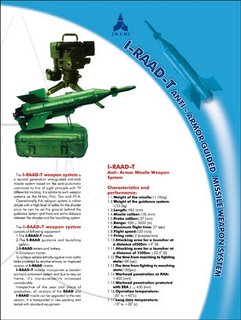
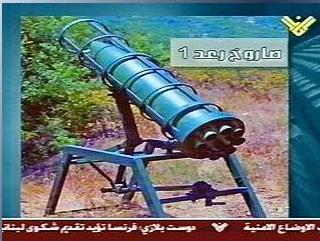
However, based on the photo at DefenceTech (second photo), I suspect that the RAAD involved in the ship attack was the wire-guided anti-armor missile
Iran makes a copy of the Russian AT-3 9M14M (Sagger or Ra’ad) anti-tank guided missile. An improved version of RAAD missile, RAAD-T missile, incorporates a tandem warhead armament system and due to new airframe, its maneuverability increased considerably. Irrespective of the year and place of production, all versions of RAAD missiles can be upgraded to the new version. The RAAD-T weapon system is a portable anti-tank guided missile, which is used to attack any armored fighting vehicle including those with Explosive Reactive Armor (ERA). In field operations, only by one ground guidance equipment, up to four missiles on their launchers can be shot, each in every 30 seconds. The system Safety and Arming Device (SAD) provides a high level of safety during the transportation and handling besides a reliable arming in operation. It is transported in new packing and tested with new equipment. By impacting the target, even at high angles of attack, explosion of the front charge, will remove the Explosive Reactive Armor (ERA) and after a delay time, the main charge will be exploded and the tank distrusted.
This RAAD is a variation on the Russian Sagger AT-3 which has an effective range of up to 3000 meters.


If the Israeli ship was engaged in shore bombardment, it may have been that close to shore. My guess is that the damaged ship was not one of the SAAR-5 missile corvettes, but an older Hetz class equipped with a 76mm gun which has a maximum range of about 18,000 meters. In order to do shore bombardment, this class of ship would have to close to shore, probably within range of the anti-tank RAAD. I also doubt that the cruise missile RAAD was in play. Of course, I'm just guessing.

UPDATE: Fox News asserts that the ship was a SAAR-5 and the missile was a "radar-guided C-102":
The army would not confirm if the ship was arriving, but the Saar 5-class missile ship, named the "Spear," could clearly be seen on television sailing into port.

The ship was severely damaged Friday night after it was struck by an Iranian-made, radar-guided C-102 missile.
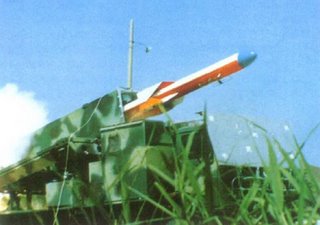
I can't find a C-102 missile, but Iran did acquire some C-802 missiles from China. This missiles can be sea or land launched (see photo), but given their profile C-802 seem like a bit of overkill to me.
Cruise missiles are "much cheaper to build than ballistic missiles, do not present the problem of high reentry velocities, and can strike a specific target within 10-20 meters." Their introduction with terminal command guidance promises to make Iranian biological and chemical weapons even more usable.35 Iran reportedly possesses the HY-2 Silkworm cruise missile, and China is reported to have built a plant in Iran to assemble the Silkworm. China is also reportedly helping the IRGC to increase the Silkworm's range to over 400 kilometers36. There is also evidence that Iran is deploying the Chinese C802 antiship cruise missile. The C802 has a 120-km range with an "adequate guidance system and a 700-km warhead." It's serious weapon, but I would be very surprised if Iran were crewing some on the Lebanon coast.
UPDATE2: StrategyPage has a nice chart of Iranian artillery rockets here. Note that the Shahin-1 is a multi-nozzled rocket like the image capture above.

UPDATE3: Commenter Sid offers up some more info in the comment section. He argues SAAR-5 (and has good reason to do so) also points to an Iranian manned C-802 launcher in West Beirut. His take may well be right. Feel free to join in the discussion.

UPDATE4: Color me surprised. Latest FoxNews TV report asserts "Chinese designed, Iranian made missile" and says Israel asserts Hezbollah would require help from Iranians to make it work. More as it breaks.

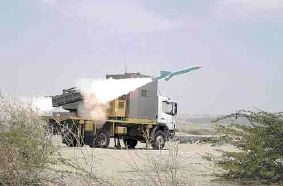
UPDATE5: Truck mounted double box launcher for the C-802. Could explain firing on two ships in same area. Probably easy to hide and make look like an cargo truck until firing time, which, in the video provided by Sid, seems to have been night so that prying overhead eyes might just observe a truck until the last minute. Photo from a Chinese language site.
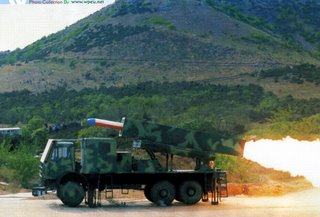
UPDATE6: An earlier post that features the C-701 and a Iranian truck mounted box launcher. Note the commericial looking front end.
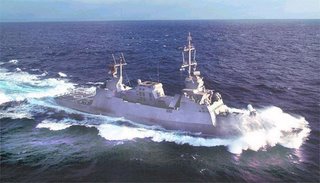
UPDATE7: C-802 mentioned here by Navy spokesman. SAAR-5 Corvette:
UPDATE8: THe CounterTerrorism Blog has a new post on the missile attack here and points to a C-802.

Friday, July 14, 2006

Drone hits Israeli warship off Lebanon


Reported here:
- Israel says one of its warships was hit by an unmanned aircraft rigged with explosives.

A military official says it was sent up by militants in Lebanon, aimed at the ship which was off the coast of that country. Israel isn't saying anything about the condition of the ship, or about a report that four of its sailors are missing.

The drone was apparently developed by Hezbollah, putting yet another weapon at its disposal. At least twice in recent years the militants have flown unmanned drones over northern Israel, an area they spent much of the day blasting with rocket fire. One of those rockets hit a house, killing a woman and her grandson.
I note that in this post the following was stated:
Moreover, Hezbollah no longer depends exclusively on human intelligence. The group now has access to Iranian-designed and controlled Mirsad One unmanned aerial vehicles. While crude and rudimentary, the Mirsad is able to transmit live video footage, a capability instrumental in scouting targets that were previously inaccessible to Hezbollah human intelligence agents.
According to this site, Hezbollah has been flying UAVs over Israel for a couple of years. There are reports that the ship was damaged and four sailors are missing

UPDATE: Op-For has more, even if John got it wrong on the ship to begin with here. And his commentors have some theories of how the UAV snuck in...low, slow and made of non-radar reflecting parts. Might be one of the weapons that the Iranians were bragging about back in April including a "stealth" anti-ship airplane weapon as set out here.

UPDATE: (7/14/006) New info here. Probably a missile and not a UAV did the damage.

Taking out Iran's Defenses

A May 2006 StrategyPage article republished in the Persian Journal:
...[T]he Iranian air-defense system needs to be destroyed first. Iran did a lot of shopping in the 1990s, during the post Cold War "yard sale at the end of history", and reportedly came away with a variety of modern air-defense systems, including the Russian SA-10, SA-11, and SA-15 anti-aircraft missile systems. Iran also has at least two dozen SA-6 launchers and over 100 American HAWK launchers on inventory, giving it a weapon that is capable against the F-16s used by the United States Air Force and the UAE.

Backing up the anti-aircraft missiles is an air force that has at least 25 MiG-29s (unconfirmed reports put the Iranian total as high as 62), 24 Mirage F-1s (courtesy of Saddam's regime in 1991), 25 F-14s, and 65 F-4s. All of these can carry radar-guided missiles, primarily older versions of the AIM-7 Sparrow or the Super 530.
Now, I have no way of knowing if any of this is accurate but it may be of some interest...you know for idle speculation around the water cooler and that sort of thing.


It should be noted that Russia has committed to supply Iran with 29 Tor M1 air defense systems, described as:
The Tor-M1 is a fifth-generation integrated mobile air defense system designed for operation at medium, low and very low altitudes against fixed/rotary wing aircraft, UAVs (unmanned aerial vehicle), guided missiles and other high-precision weapons.
And that Iran says its Defenses Can Withstand Any Invasion. Also, Syria and Iran seem to have some sort of joint defense agreement.

Somalia: Taxes or death

Somalia continues to be deadly:
Several Somali traders have been arrested by Islamist militiamen after a protest over new taxes, in which one person was shot dead.

About 100 people staged the protest in the town of Jowhar, captured by the Union of Islamic Courts last month.
***
In Jowhar, about 40 young men with plastic bags to collect cash began levying the taxes on the orders of the Islamist administration, reports Reuters news agency.

"I am not in a position to pay the taxes. Whatever I get from my small business, I feed my family with," said trader Fatuma Ahmed, mother of three.

She had been asked to pay 2,000 shillings (14 US cents).

The UIC has been consolidating its grip of the capital, by taking control of the port on Wednesday.

Mogadishu's main port had been closed for the last 15 years, because rival factions failed to agree who should run it.

One week ago the city's main airport was handed to the Islamic courts by militia who previously dug up the runway to resell cheap gravel for other construction work.
Meanwhile, the increasingly irrelevant "President" says the the Islamists cheat, break promises and use foreign fighters. He wants the African Union to come restore order. I hope that he is not holding his breath, because I cannot imagine that they want to step into that hornets nest anytime soon.

Update: More here.

Thursday, July 13, 2006

Hezbollah's Rockets


An older (2002) report on the rocket forces of Hezbollah:
Israeli officials have been complaining about massive Iranian airlifts to Hezbollah since March 2001, when Prime Minister Ariel Sharon warned that Iran, "in full cooperation with Syria," was providing Hezbollah with large numbers of rockets capable of hitting "the center of the country."1 By late January 2002, Foreign Minister Shimon Peres was declaring before the Knesset that Iranian airlifts had expanded Hezbollah's arsenal to 10,000 "missiles" (this frequently-used term is technically incorrect, as even the long-range rockets lack in-flight guidance systems).2

Although Tehran issued repeated denials and Hezbollah Secretary-General Hassan Nasrallah carefully avoided confirming the airlift, other Hezbollah officials were less reserved. In May 2001, a member of the group's political bureau, Nawaf Moussawi, declared during a rally that "2.5 million Israelis are now in range of our missiles," a boast which appeared to confirm Sharon's claim.3 A February 2002 report by the Christian Science Monitor quoted a "well-connected . . . Hezbollah insider" as saying that "truckload after truckload" of military equipment had been arriving in the border district since the Israeli withdrawal in May 2000.4

After a New York Times article in September cited American officials as confirming that Hezbollah had received long-range Iranian-manufactured Fajr-3 and Fajr-5 rockets,5 even Nasrallah could not resist alluding to them. While careful to speak in hypothetical terms, he boasted of the suffering that such an arsenal could inflict on Israeli civilians. "In 1996 . . . with Katyushas alone, the resistance was able to displace two million people and [the Israeli government] had to look for places in central Israel to settle them," he declared last month. "[If] Hezbollah's missiles can now reach all population centers in Israel, then where can they flee?"6

Notwithstanding Nasrallah's wishful claims, most of Hezbollah's arsenal consists of old stand-byes (albeit in unprecedented numbers): 122mm Katyushas with a range of 12 miles (20 km) and 107mm Katyushas with a range of 5 miles (8 km). However, it also includes several hundred 240-mm Fajr-3 rockets and 333-mm Fajr-5 rockets.

The Fajr-3, with a range of 25 miles (40 km), and the Fajr-5, with a range of range of 45 miles (72 km), each carry a 200-lb warhead and can be launched from vehicles, making them relatively easy to move and conceal. The Fajr-5 would allow Hezbollah to hit targets south of Haifa, a range that covers about a third of Israel's population, around half of its industry, and its main oil refinery. Some Israeli analysts believe that the Fajr-5 may have some form of rudimentary guidance capability. Both the Fajr-3 and the Fajr-5 would likely evade Israel's Tactical High-Energy Laser (THEL), currently under development, which is designed to intercept projectiles with a range of 5-7 miles (8-11 km).

There have been reports that Syria has shipped rockets to Hezbollah. Israeli security officials have recently accused Damascus of providing the group with 220mm rockets. While the New York Times cited Israeli officials as saying that the Syrian-supplied rockets have a range of 12 -18 miles (20-29 km), the Washington Post cited an Israeli estimate of 45 miles (72 km).7 The only imported weapons in the Syrian arsenal with this caliber are 70s-era Soviet-manufactured BM-27 220mm rockets with a range of about 25 miles (40 km), but some reports have said the rockets supplied to Hezbollah are domestically-manufactured imitations of the BM-27 (which could explain the low range estimate reported in the New York Times). Other reports have said that Damascus supplied Hezbollah with rockets that have a range of up to 50 miles (80 km).
FAS report on Iranian short-range missiles here. And The Middle East Quarterly report Hezbollah's Strategic Threat to Israel:
Adding the Fajr rockets to the mix, however, raises the threat. Haifa, Israel's third largest city with a population of some 270,000 people, now lies within Hezbollah range. Even a modest barrage of 75 Fajr-5 rockets hitting the city would represent 15,000 pounds of high explosives detonating in the midst of a densely populated cosmopolitan area. The coastal cities of Acre and Nahariya—with populations of 55,000 and 41,000 respectively—might expect an even heavier assault due to Hezbollah's ability to target them with both the Fajr-3 and Fajr-5 models. While the Fajrs are not very precise—the sheer number of rockets at Hezbollah's disposal makes Israel vulnerable.

Any Hezbollah barrage will not likely be random, however. The group's external intelligence service has concentrated recently on targets and trajectory algorithm selection. In January 2005, Israeli security detained Danish citizen Iyad ash-Shua after he was caught filming northern Israeli military installations on behalf of Hezbollah.[9] The arrests of other Hezbollah agents have indicated the group's special interest in fuel refineries and military bases around Haifa.

Moreover, Hezbollah no longer depends exclusively on human intelligence. The group now has access to Iranian-designed and controlled Mirsad One unmanned aerial vehicles. While crude and rudimentary, the Mirsad is able to transmit live video footage, a capability instrumental in scouting targets that were previously inaccessible to Hezbollah human intelligence agents.[10] In addition to the Mirsad, Hezbollah planners now have access to commercially available, high-resolution satellite photographs and open-source geographical imagery offered by companies such as GlobeXplorer and Google. These may enhance Hezbollah's targeting ability.

While Hezbollah would launch its rockets with the goal of causing mass casualties to shock and demoralize the Israeli population, they would also likely attempt smaller but more devastating infrastructure assaults. High-value targets would include the industrial section of Haifa, whose sprawling petrochemical plants and oil refinery would be vulnerable to bombardment. The loss of the Haifa refinery, one of only two such installations in Israel, would threaten Israel's economic security. Hezbollah could also launch rockets against the city's port and Matam Park, a hub of Israeli high-tech development. Even minor damage could lead to serious disruptions in Israel's delicate economic framework. The vulnerability of the Israeli economy to a Hezbollah rocket attack was demonstrated by events in 1996 when the group fired over 500 Katyushas into northern Israel; Israeli officials placed the cost of the relatively minor two-week assault at approximately US$100 million.[11]
Photo is of Iranian Fajr-5. (updated from Fajr-2 photo, both from GlobalSecurity.com

UPDATE: Haifa has been hit by rockets as reported here, though someone seems to have missed the above threat warnings:
Two rockets have struck the Israeli city of Haifa, hours after a threat by the militant Lebanese group Hezbollah.
Hezbollah denied firing any rockets at the northern port city. There were no reports of injuries or damage.

Haifa, Israel's third largest city, is more than 30km (18 miles) from the Lebanese border and was thought to be out of Hezbollah's range. (emphasis added)


UPDATE2: And just to drive home Iran's role, from The Middle East Quarterly report cited above:
The Hezbollah missile threat to Israel has expanded not only in quantity but also in quality. In recent years, the group's operational artillery reach has grown. Experts and analysts generally put the Hezbollah rocket force somewhere between 10,000 and 12,000 missiles.[3] The heart of this arsenal remains rooted in Hezbollah's massive stocks—perhaps 7,000 to 8,000—of 107mm and 122mm Katyusha rockets, virtually all of which were supplied directly from existing Iranian army stocks.[4] (emphasis added)

Aye, President and the Ship of State in new light

Scott Ott reports "Bush to Start Era of ‘Pirate Diplomacy’"

Surrounded by a sea of troubles, it might not be a bad idea.

The Ship of State seems to have a few leaks that ought to be patched and some plank walking done by the perps.

Weapons turn-in in Somalia?


Apparently in some areas:
Islamic militiamen struggled to keep up with a flow of former rivals ready to surrender prized weapons Thursday, further cementing the radical Muslims' position as the undisputed power in the Somali capital.

The Islamic group seized large parts of southern Somalia from rival warlords in June, and has since used force, its status as arbiter of Islamic law, and negotiations to consolidate power.

The arms handovers came days after the militia attacked one of the last holdout warlords in Mogadishu, killing at least 70 people in clashes that ended Tuesday, when the rivals surrendered. On Wednesday, some 300 Islamic militiamen peacefully took Mogadishu's disused, rusting seaport from another secular warlord who was resisting the group's strict religious rule.

The rise of the Islamic militia has raised concerns about the establishment of Taliban-style, hard-line rule in the Horn of Africa country. The Islamic militia has grown increasingly radical since seizing Mogadishu, replacing a moderate leader with a radical cleric the U.S. has linked to al-Qaida.

Some 200 fighters loyal to warlord Bashir Rageh, a member of the group defeated last month, on Wednesday surrendered their weapons - including 15 trucks mounted with heavy weapons - to the group known as the Islamic Courts Council.

"We have been working with the warlords for a long time, so now it is time to give the chance" to the Islamic group, Yusuf Iyow, one of the militia commanders, told The Associated Press on Thursday. "We are committed to forget the past hostilities and to work with them."

"The only power in Mogadishu is the Islamic Courts Union, so there is no other option open for us but to surrender. Defiance only kills people and does not create opportunities" for peace, Iyow said.

Some 200 militiamen loyal to another secular warlord, Abduqadir Mohamed Bebe, unexpectedly surrendered light and heavy weapons Thursday.

The move disrupted plans to collect weapons from combatants loyal to another once powerful warlord, Muse Sudi Yalahow, whose fighters are expected to hand over arms on Friday. Their cooperation follows two weeks of negotiations mediated by elders from the Abgal clan, to which both Yalahow and Rageh belong, said their commander, Ali Daladle.

Clan elders also were negotiating a peaceful handover of Villa Somalia - the presidential palace and a stronghold of Interior Minister Hussein Farah Aideed, who is also one of several deputy prime ministers.

"From now on, people should feel secure now that Islamic courts have almost all the weapons in the capital," said Uqtar Abu Mansour, one of the leaders of the Islamic group. "We shall do the same in other parts of the country where arms other than the Islamic courts' exist."
Consolidation of power...

UPDATE: More thoughts on Somalia here:
Former U.S. ambassador to Ethiopia and State Department coordinator for Somalia David Shinn says the United States' policy of working with international and regional partners to bring peace to Somalia is the right way to proceed.
***
"A unilateral U.S. policy in Somalia is almost guaranteed to fail or achieve little. The only long-term strategy that has any hope for success must be coordinated carefully with key countries in the region, European allies, the African Union, Intergovernmental Authority for Development, United Nations, and the Arab League," the Horn of Africa expert told lawmakers.

Assistant Secretary of State for African Affairs Jendayi Frazer told the same Senate hearing, "President Bush and Secretary [Condoleezza] Rice have made it a priority to confront the ongoing turmoil in Somalia with a multilateral coordinated strategy."
***
Frazer told the Senate panel a group consensus has formed to view the Transitional Federal Institutions (TFI) as "the legitimate governing body in Somalia." She added, "We will work to strengthen its capacity and continue to urge dialogue" between the TFI and Court of Islamic Council (CIC). The CIC was formerly known as the Islamic Courts Union (ICU).
***
Militias backed by the Islamist-based movement CIC recently defeated warlords that had dominated Somalia's former capital of Mogadishu. On the question of the CIC's radicalism, Shinn told the lawmakers, "as sections of Somalia, especially greater Mogadishu, have become increasingly subject to the influence of extremist elements, the prospect increases for linkages to terrorism."

"This does not mean, however, that Somalia is likely to become a major al-Qaida base or that it is headed towards a Taliban form of government," Shinn said. "The vast majority of Somalis follow a moderate form of Islam and they are highly suspicious of foreign influence."

"Although there are some worrying developments coming from some of the Islamic courts, the situation is much too fluid to jump to conclusions," the former diplomat added.

Shinn said the CIC's structure is highly decentralized. "Some of the courts are led by extremists, others by moderates. They all agree on their goal to create an Islamic state. It is not clear, however, that they have the same vision for that state."

Perhaps most important, he said, is that the courts have developed so far largely on a clan and sub-clan basis. "Their power resides in the Hawiye clan, one of Somalia's five major clans. Their support among the Hawiye seems to be broad, but not especially deep. At least one Hawiye warlord in Mogadishu continues to hold out against the court militias. It remains to be seen if their authority will extend significantly to other clans."

Wednesday, July 12, 2006

Been there, done that

Iran's "oil weapon"


A Persian Journal analysis:
Can Iran block the Hormuz Strait?

The Strait of Hormuz is the narrow sea passage that connects the Persian Gulf to the Oman Sea. This is the only sea-passage for the export of oil from the Persian Gulf states. The Iranian forces have done several maneuvers aimed at closing the Strait of Hormuz at the time of crisis and the Western forces in the region (in cooperation with the some of the littoral countries or independently) have conducted several maneuvers aimed at deterring such plans. Peter Brooks, a senior fellow at the Heritage Foundation, writes: "Iran could temporarily wreak havoc in the Persian Gulf, using sea-skimming, nears supersonic Chinese C-801 anti-ship cruise missiles (and older Silkworm missiles), quiet Russian Kilo diesel and mini-submarines, stealthy mines, high speed patrol boats 'swarm' tactics...". (6)

Also, Kenneth R. Timmerman writes: "...Iran plans to begin offensive operations by launching successive waves of explosives-packed boats against U.S. warships in the Gulf, piloted by "Ashura" or suicide bombers. The first wave can draw on more than 1,000 small fast-attack boats operated by the Revolutionary Guards navy, equipped with rocket launchers, heavy machine-guns and possibly Sagger anti-tank missiles�A second wave of suicide attacks would be carried out by "suicide submarines" and semi-submersible boats, before Iran deploys its Russian-built Kilo-class submarines and Chinese-built Huodong missile boats to attack U.S. warships, the source said. The 114-foot Chinese boats are equipped with advanced radar-guided C-802s, a sea-skimming cruise missile with a 60-mile range against which many U.S. naval analysts believe there is no effective defense...The Iranians also plan to lay huge minefields across the Persian Gulf inside the Strait of Hormuz, effectively trapping ships that manage to cross the Strait before they can enter the Gulf, where they can be destroyed by coastal artillery and land-based "Silkworm" missile batteries. Today, Iran has sophisticated EM-53 bottom-tethered mines, which it purchased from China in the 1990s. The EM-53 presents a serious threat to major U.S. surface vessels, since its rocket-propelled charge is capable of hitting the hull of its target at speeds in excess of 70 miles per hour. Some analysts believe it can knock out a U.S. aircraft carrier..." (7) More recently, the semi-official Iranian news agency has reported: "...Iran successfully test-fired a super-modern flying boat on Tuesday during war games at the Strait of Hormuz, the Mehr News Agency correspondent in the region reported. The boat is capable of moving at high speeds of up to 100 knots in the Persian Gulf waters and the Oman Sea. Because of its advanced design, no radar at sea or in the air can locate it. It can lift out of the water and can launch missiles with precise targeting while moving....A new land-to-sea missile called Kowsar was also tested successfully on Tuesday..."(8)

Therefore, it seems that Iran has actually enough power to block the Strait of Hormuz by sinking several big ships in the main channels of the traffic (although most of the traffic separation lines are in the side of the Strait which are technically, i.e. according to the international law of Seas, part of Oman's Territorial waters. Also, Iran may interrupt the shipping in the Strait of Hormuz by mining the international waterway or directly attacking the target vessels. Such actions are enough to stat a full-scale war between the regime of Iran and all other concerned force.
Also of note is an article on the energy relationship between China and India titled, "Iran's mullahs promise to cover China's demand for energy."
UPDATE: Added art. Prior post on "Silkworms on the Hormuz" here.

UPDATE2: Timmerman article from NewsMax.

UPDATE3: Reminds me, for some reason, of North Korea's threat of a Sea of Nuclear Fire.

Malacca Strait piracy to pick up?


IMB warning here:
Pirates armed with AK-47 automatic rifles and grenade launchers attacked two vessels leased by the UN in separate incidents in the northern part of the Straits last week, according to the International Maritime Bureau.

"We are very concerned because pirates are not normally so heavily armed, and these attacks happened in a daylight" in what was a "hot spot" for kidnappings before an Indonesian government campaign last year, Noel Choong, the head of the IMB, saidWednesday by telephone from the agency's headquarters in Kuala Lumpur.

"When robbers attack during the day with such arms, normally their interest is in kidnapping the crew for ransom," Choong said. The IMB is part of the International Chamber of Commerce's Commercial Crime Services unit.

"The number of attacks decreased drastically in the Malacca Straits" after the Indonesian government began a system of patrols in July 2005 known as Operation Gurita, Choong said. "It may be that people think Gurita ended."
UPDATE: Malaysia and armed merchant escorts here. UPDATE2: A little clearer explanation on the armed escorts:
The Southern Region marine police have not detected any armed escort ships encroaching Malaysian waters while providing protection for merchant ships in the Melaka Strait.

Its chief ACP Isa Munir said the armed escort service, based in Singapore and manned by ex-elite members of the armed forces, was being closely monitored.

"Maybe now they have stationed their security personnel on the ships and no longer on escort ships," he told Bernama, here Wednesday.

The armed escort vessels in the narrow strait are unwelcomed by the littoral states - Malaysia, Indonesia and Singapore - on grounds that their presence undermines national sovereignty and laws. They are supposed to provide protection from pirate attacks.

Tuesday, July 11, 2006

On the Erie Canal- the Continental Sloop Providence is locked out


Here's a historical tale that begins with the announcement that the sloop Providence won't be visiting Bay City, Michigan for a festival of "tall ships" as reported here. Why? Because of flood damage to the Erie Canal.

Amazing. Like many who grew up in the West and Midwest, I learned a little about the Erie Canal when I was a wee lad in school, but thought that the Canal had long fallen into disuse. I was wrong. It seems that the Canal (although altered from the original 1825 version) has experienced a rebirth and is quite the attraction for vacations and touring. And a history that reminds us of how much of the Midwest was opened through the canal's links to the Great Lakes.

Now, after some severe flooding caused by recent storms, a portion of the canal is closed for repair, and that has created some issues for those businesses that have grown along the reborn canal as well as creating some detours for canal users:
hile state Canal Corp. officials say that 90 percent of the 524-mile system is reopened after a series of storms and floods, Lock 10 in Schenectady County, along the Erie Canal, could be closed for as long as two months.

That means one long detour for folks using the waterway — at the height of its tourist season.

The areas that sustained the heaviest damage, mostly in the Mohawk River Valley, reopened at the end of last week after workers removed debris that disrupted travel along 300 miles of the system, said canal spokeswoman Jennifer Meicht.

Officials closed 45 of the canal's 57 locks in response to end-of-June storms that left some locks under several feet of water. The locks remained closed during the July 4 weekend, a popular time for boating.

So far, the damage appears to not have taken as badly a toll on the system as officials had feared.

Boat operators and state transportation officials agreed that it was one of the worst storms to ever hit the canals.

"The actual locks and the gates themselves came through with flying colors," Meicht said. "They're really designed to withstand the harshest conditions."

But the lock in Cranesville near Schenectady will remain closed for six to eight weeks because of ongoing dam construction that was disrupted by the storm, officials said.

As a result, westbound boaters must head north from Albany through Lake Champlain and take the St. Lawrence Seaway through several Canadian canals.

Want to get to the Hudson River? Take the Oswego Canal channel to Lake Ontario. To the St. Lawrence. To the Champlain. To the Hudson.

Meicht said the detour — adding about 400 extra miles — would take about two weeks. Many boaters are expected to use trailers to haul their vessels overland and avoid the closed lock, she added.

Meanwhile, locks 11 through 15 in parts of Seneca, Cayuga and Oswego counties are expected to open by next week.

Officials estimate the damage so far will cost between $50 million and $60 million and cleanup in the surrounding areas is far from over.

About 13,000 privately owned tour boat operators use the Erie Canal a year, according to the Canal Corp.

Nearly half of all boating activity takes place in July and August, according to its figures.
and
Fourth of July weekend wasn’t all firecrackers and bottle rockets for Ray Faville.

For the Whitehall business owner, the holiday was called on account of rain, as surly, brown floodwaters forced the closure of 45 of the New York State Canal System’s 57 locks.

"July Fourth weekend, we had a ton of reservations, and they all canceled," Faville said. He owns the Finch & Chubb Restaurant & Inn and the Lock 12 Marina. "A lot of boats tied up at the south end (of the Champlain Canal) were waiting to come through, and we had quite a few tied up here who canceled their plans and went home to Montreal."

And Faville isn’t alone. Shutting down so much of the canal system, which includes the Erie, Oswego and Champlain canals, had some less-than-positive consequences for other local businesses that depend on tourism revenue from summer boaters.

"I think it’s been dead, to be truthful," said Marjorie Mohn, owner of The Times Emporium in Whitehall. "It’s really effected my business because people couldn’t get through."(source)
It has probably "affected" her business, too.

And, as noted at the top, it has had an impact on events off the canal. The Continental Sloop Providence is a
110' traditionally rigged sailing vessel is the faithful replica of John Paul Jones' first command. During her distinguished Naval career, the 12-gun Providence sank or captured 40 British enemy ships!
And, probably more important to the modern age, is a movie star, having played two roles in the "Pirates of the Caribbean: Dead Man's Chest" movie.

Called "a sort of floating classroom," the Providence fufills that role by reminding us of the once great stream of commerce that was the Erie Canal. And it serves to teach of the new use of the Canal.