VertRep

VertRep

Monday, February 28, 2022

U.S. Navy Office of Naval Intelligence Worldwide Threat to Shipping (WTS) Report, 26 January to 23 February 2022

U.S. Navy Office of Naval I... by lawofsea

Attacks of ships in the Black Sea as part of the Russian invasion of the rest of Ukraine (remember they already grabbed Crimea) reflected here:

Russia’s invasion of Ukraine has brought turmoil to commodities markets as the conflict ensnares merchant shipping.

At least three merchant ships have been reportedly hit since Russian forces began the attack on its neighbor this week. Insurers are either not offering to cover vessels sailing into the Black Sea, or they’re demanding huge premiums to do so.

A discussion of the situation in the Black Sea form Midrats on 27 Feb 27 (I was flying home from a family visit and was unable to join the conversation):

Thursday, February 24, 2022

Ukraine and CDR Salamander's Comments

Better that you read this than any of my meanderings Second Russo-Ukraine War D+0 Quicklook

Remember, the Russians hold the Presidency of the UN Security Council. The UN is a joke. OSCE is a joke. The EU is little more than a nest of rent-seeking, clock-watching grift-fest. NATO is, well, dysfunctional but better than nothing. Nations must take ownership of their own security. Yes, Taiwan and Japan I am talking to you. Study history. Be ready.

***

Is everyone clear what Russia is now? She has a small GDP and apocalyptic demographics, but she is taking what she has and is invading her neighbors, killing people, and taking land. If your nation, company, or neighbor is buying anything from them – they are paying for this military adventurism. If the press wants to do its job, start pulling that string.

The U.S. needs to restart its energy independence efforts and reverse the course of what the current administration has done so that we can offer Europe energy security and cut the flow of energy dollors and Euros to the thugs in Moscowland.

As Mao said, "Political power grows out of the barrel of a gun." Putin is seeking political power, not only over Ukraine, but over Western Europe. His approach is not subtle diplomacy.

Tuesday, February 22, 2022

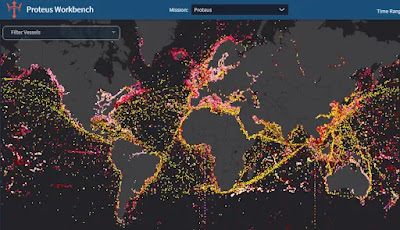
Cooperative Technology - PROTEUS


"U.S. forges maritime technology collaborations to improve domain awareness" from Indo-Pacific Defense Forum

To safeguard maritime borders, the United States military is promoting cooperative technology efforts to provide near-real time global maritime situational awareness to combat everything from illegal fishing and human trafficking to sovereignty threats.

Recent successes include the U.S. Naval Research Laboratory’s (NRL’s) new program, called Proteus, to identify, query and filter maritime vessels based on user-defined criteria and the Defense Innovation Unit’s (DIU’s) international competition, known as xView3, to create machine learning models to locate and distinguish maritime vessels with synthetic aperture radar.

The U.S. Navy and U.S. Coast Guard, in particular, are also pushing for broader collaborations among allies and partners to apply advanced military technologies, including surveillance satellites, high-resolution radar and data-sharing software, to maritime security challenges, experts said.

Advanced maritime capabilities are in high demand as security threats such as illegal, unreported and unregulated (IUU) fishing continue to worsen worldwide and contribute to broader stability issues.

The People’s Republic of China is “obviously high on the list … when talking about state-sponsored IUU and the way that they use it as both a tool for … economic purposes, but also increasingly for the purposes of influencing bilateral relationships,” Whitley Saumweber, director of the Center for Strategic and International Studies’ Stephenson Ocean Security Project, said in December 2021, according to National Defense magazine.

More about Proteus here:

PROTEUS is an exciting new U.S. government Maritime Domain Awareness (MDA) system providing a powerful array of MDA information and analysis tools,” said Cameron Naron, Director of Maritime Security, US Maritime Administration. “This system enables MDA stakeholders to collaboratively discover and investigate suspicious and illegal maritime activity throughout the world in ways never before possible.”

Additional actions supported by PROTEUS include:


  • Counter Illegal, Unreported, and Unregulated Fishing (IUUF)


  • Maritime Protected Areas (MPAs)


  • Search and Rescue (SAR)


  • Critical Infrastructure Protection


  • Environmental Protection & Response


  • Maritime Law Enforcement


  • Counter smuggling (drugs, weapons, money, people)

Sunday, February 13, 2022

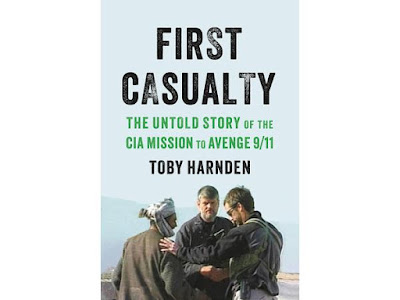
On Midrats 13 February 2022 at 1130am EST- Episode 616: First Casualty: The Untold Story of the CIA Mission to Avenge 9/11 with Toby Harnden


Note the special time - please join us at 1130AM (EST)on 13 Feb 2022 for MidratsEpisode 616: First Casualty: The Untold Story of the CIA Mission to Avenge 9/11 with Toby Harnden

As described on Amazon, "Eight CIA officers are dropped into the mountains of northern Afghanistan on October 17, 2001. They are Team Alpha, an eclectic band of linguists, tribal experts, and elite warriors: the first Americans to operate inside Taliban territory. Their covert mission is to track down Al- Qaeda and stop the terrorists from infiltrating the United States again."

Most may be familiar with one member of that team, Mike Spann. This Sunday we will spend the hour talking about that Team, the first few months of the Afghanistan conflict, and what the war and its future looked like early on as described in the recent book, First Casualty: The Untold Story of the CIA Mission to Avenge 9/11.

The author Toby Harnden will be with us for the full hour to discuss the book and the story it tells.

Toby is an author, journalist, and a winner of the Orwell Prize for Books. A former foreign correspondent for the Sunday Times of London and the Daily Telegraph who reported from thirty-three countries, he specializes in terrorism and war. Born in Portsmouth, England, Harnden was imprisoned in Zimbabwe, prosecuted in Britain for protecting confidential sources, and vindicated by a $23 million public inquiry in Ireland. A dual British and US citizen, he spent a decade as a Royal Navy officer before becoming a journalist. He holds a First Class degree in modern history from Oxford and is the author of Bandit Country: The IRA & South Armagh and Dead Men Risen: An Epic Story of War and Heroism in Afghanistan. Previously based in London, Belfast, Jerusalem, Baghdad, and Washington, DC, he lives in Virginia.

If you miss the show live, you can pick up this episode and others and add Midrats to your podcast list simply by going to you use Apple Podcasts here. Or on Spreaker. Or on Spotify.

Monday, February 07, 2022

On Punitive Expeditions


As some of you might have gathered over the years, I am a fan of the punitive expedition. More particularly, the form of punitive expedition as so well defined by Kevin Benson, Col (ret) in his short 2019 essay Bringing Back the Punitive Expedition
A punitive expedition results in a measured, relatively swift, focused response. It can be of some duration but only long enough to achieve the policy ends of punishing the group that threatened US interests or caused US casualties. There is no regime change, no re-ordering of the existing power structure in a region. A punitive expedition demonstrates the will and ability of the US government to act with violence. Especially when striking into ungoverned areas there is no Phase V (enable civil authority) as there is no civil authority to reestablish. The purpose of the punitive expedition is to act with violence and return to home station. The linkage to policy is straightforward. In ungoverned or poorly governed spaces, a punitive expedition is measured, focused, and not open-ended. A punitive expedition acts with diplomatic and informational efforts, each reinforcing the other. Indeed strategists and planners must bear in mind the political object irrespective of the development of use of force options. Again we return to Clausewitz: “The political object—the original motive for the war—will thus determine both the military objective to be reached and the amount of effort it requires.”

I commend the rest of his essay to your reading.


We have a lot of units in our military that would be excellent at carrying out such missions. The problem is keeping our focus in applying what can be an effective deterrent to actions that would harm our country.


Cartoon shows General John J. Pershing stamping out a nest of rattlesnakes (labeled "Villista," "Bandit," and "Cutthroat"). In 1916, President Wilson sent a Punitive Expedition commanded by Pershing into Mexico to capture the rebel and bandit leader Francisco "Pancho" Villa, who had been raiding American towns. Villa and his band eluded the American force. Contributor Names Pease, Lute, 1869-1963, artist

Saturday, February 05, 2022

Saturday Is Old Radio Day - Exploring Tomorrow: "First Men on the Moon" (1958)

Exploring Tomorrow: First Men on the Moon from The Radio Ghost on Vimeo.

On Midrats 6 February 2022 - Episode 615: Gaming Out WWIII with Michael Cee


Please join us at 5pm EST on 6 February 2022 for Midrats Episode 615: Gaming Out WWIII with Michael Cee:

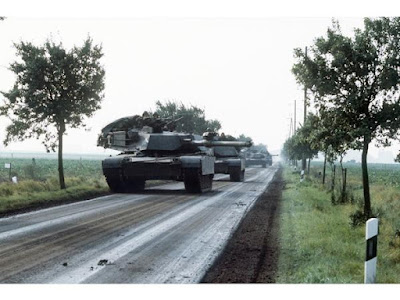
Decades of peace and relative stability in Europe is suddenly shattered as armies start to mobilize on a scale not seen since WWII.

No, not 2022...but 1987.

What is there to learn for today from what could have happened at the end of the Cold War?

In addition to the above teaser questions, this Sunday from 5-6pm Eastern with our guest Michael Cee we will dive into the research, tools, wargaming, and art of creating alternative historical fiction about what may have happened with the wrong people in the wrong positions of power at the wrong time in the late 1980s.

Michael is the creator and author of World War III 1987, a blog that takes a detailed look at a hypothetical Third World War set in 1987, as well as several topics related to the NATO-Warsaw Pact military balance in the later years of the Cold War. He is also the author of a second blog, Today’s Defense and International Relations Topics that’s centered on contemporary geopolitical and defense issues and news. He is a 44-year-old former Air Force officer who has also spent time in government service and as a senior member of a research institute. He has earned an MSFS from the Edmund A. Walsh School of Foreign Service at Georgetown University, as well as an MPA and PhD in Politics from Princeton University. Over the summer of 2019, Michael signed a two-book deal with a New York City publishing house. At present he is making final edits on his first novel, which is also based on a hypothetical global conflict set in 1987.

If you miss the show live, you can pick up this episode and others and add Midrats to your podcast list simply by going to you use Apple Podcasts here. Or on Spreaker. Or on Spotify.

Monday, January 24, 2022

The Real Top Gun - Professionals Teaching Professionals

Hey, lots of those guys look familiar . . .and one especially so.

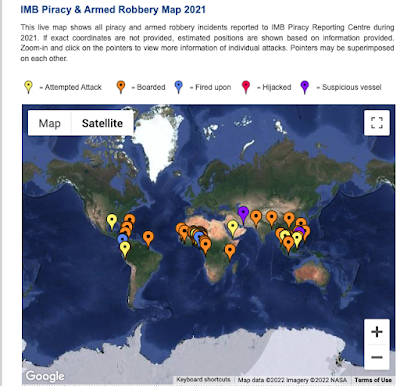
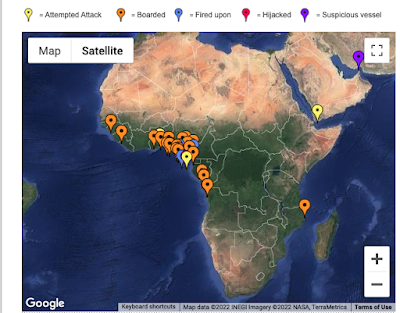
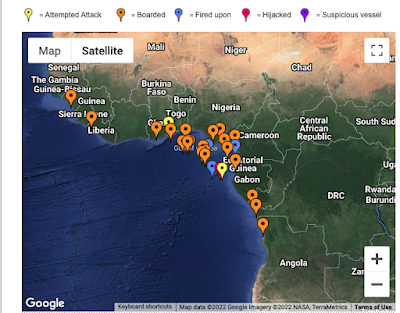
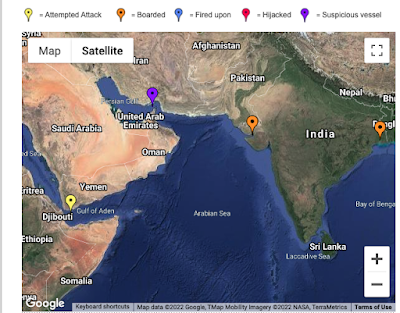
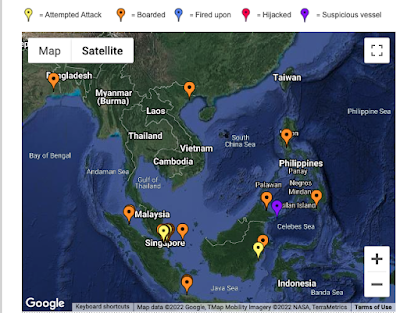
Piracy, Sea Robbery, and Threats to Shipping in 2021

As always, the International Chamber of Commerce's Commercial Crime Service International Maritime Bureau Piracy Reporting Centre (PRC) does a great job of carrying out its mission:

PRC acts as a single point of contact for shipmasters anywhere in the world whose vessels have been attacked or robbed by pirates. All information received is immediately relayed to the local law enforcement agencies requesting assistance. Information is also immediately broadcast to all vessels in the Ocean region, providing vital intelligence and increasing awareness.

We share information with the IMO, governmental, inter-governmental and law enforcement agencies including industry bodies to understand the nature of piracy and reduce its effects on crew, vessel and cargo.

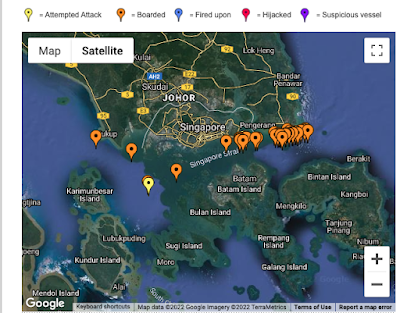
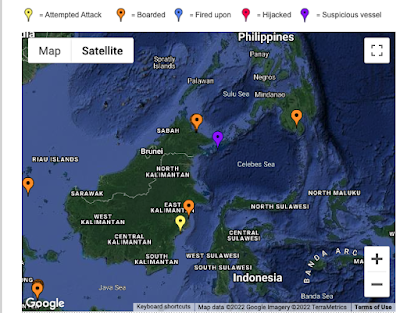
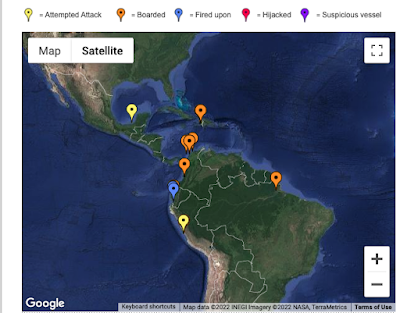
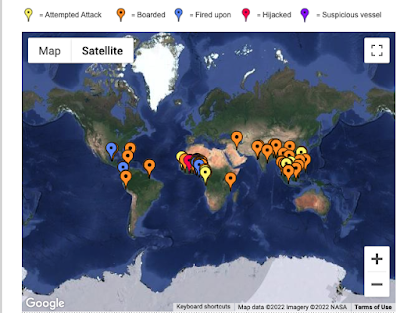
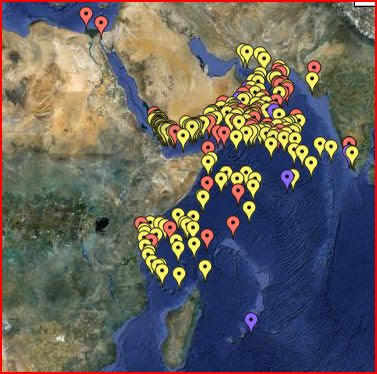
Not the least of these functions is its Live Piracy Map service including an annual look at where such event took place, the images that follow are screen captures of the 2021 map:

All oceans:


Africa and Gulf of Guinea


North Arabian Sea/Indian Ocean


Southeast Asia/Singapore Strait


Americas


2020 World


Not like the heyday of the piracy off Somalia, but it's a steady problem for shipping.

From 2011 - off Somalia


Saturday, January 22, 2022

Saturday Is Old Radio Day - Orson Welles in The Shadow "The Hospital Murders" (1938)

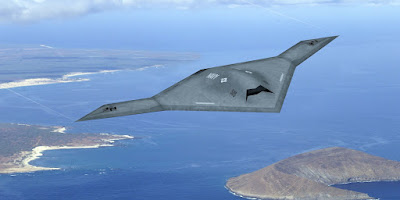
On Midrats 23 January 2022 - Episode 614: Big Navy vs. Reconnaissance & Strike-Capable Drones


Please join us at 5pm EST, 23 January 2022 for Midrats Episode 614: Big Navy vs. Reconnaissance & Strike-Capable Drones

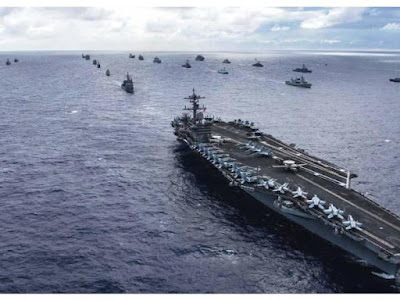
We live in an era where in the blink of an eye we've gone from flip-phones to smartphones with the capabilities of both supercomputers a generation ago and entire movie studios in your back pocket. In that same time frame, what happened to the promised integration and operational utilization of aircraft carrier based drones - or Unmanned Aircraft Systems, or whatever we are calling them this week?

This Sunday we are going to dive deep in to the topic and problem with our guests Trevor Phillips-Levine, Noah Spataro, and Andrew Tenbusch.

We will use as the starting point for our conversation their recent article in War on the Rocks, "Winged Luddites: Aviators are the Biggest Threat to Carrier Aviation."

If you miss the show live, you can pick up this episode and others and add Midrats to your podcast list simply by going to you use Apple Podcasts here. Or on Spreaker. Or on Spotify.


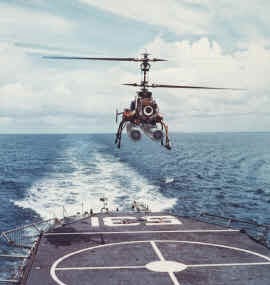
Oh, that lower photo? Why that's the Drone Anti-Submarine Helicopter (DASH). A drone that was first operated by the fleet in 1963 and used for a myriad of purposes until it left the U.S. fleet in 1970. See here. Just in case it might be discussed during the show.

Saturday, January 15, 2022

On Midrats 16 January 2022 - Episode 613: The Afghanistan Papers, with Craig Whitlock


Please join us at 5pm EST on 16 January 2022 for Midrats Episode 613: The Afghanistan Papers, with Craig Whitlock

Five presidents from both political parties oversaw the two decade debacle in Afghanistan that ended in the national humiliation at the end of August 2021 at the airport in Kabul where we retreated under fire following a negotiated surrender - leaving up to a thousand Americans behind and untold thousands of Afghan nationals who fought with us to their fate as the Taliban returned to the power we took from them in 2001.

People in the executive branch, Department of Defense, Department of State, Congress, media, and the well credentialed chatterati said they were "shocked," "surprised," and otherwise unprepared for what unfolded. Should they have been, or was this the inevitable outcome warned of in official government lessons learned and historical interviews dating from the beginning of the conflict?

Our guest for the full hour this Sunday will be Craig Whitlock, and we will be using his book “The Afghanistan Papers: A Secret History of the War” (Simon & Schuster, 2021) as a starting point for our conversation.

Craig has been a staff writer for The Washington Post since 1998. He is assigned to the Investigative Desk, where he specializes in national security.

At The Post, he's covered the Pentagon beat for the National Desk from 2010 until 2016. Before that, he was a foreign correspondent and served as the Berlin bureau chief for six years. While overseas, his primary assignment was investigative reporting into terrorism networks and counterterrorism policy in Europe, North Africa, the Middle East and South Asia. He has reported from more than 60 countries.

If you miss the show live, you can pick up this episode and others and add Midrats to your podcast list simply by going to you use Apple Podcasts here. Or on Spreaker. Or on Spotify.

Saturday, January 08, 2022

Saturday Is Old Radio Day - Sam Spade Detective "Sam and Psyche" (1946)

On Midrats 9 January 2022 - Episode 612: Jackson's Navy, with Claude Berube


Please join us at 5 pm EST on 9 January 2022 for Midrats Episode 612: Jackson's Navy, with Claude Berube:

We're going to kick off Midrats' 13th year with someone who has been with us from the start, best friend to the show Dr. Claude Berube!

If you care about American history in general, and US Navy history in particular, you won't want to miss a minute of this Sunday's show.

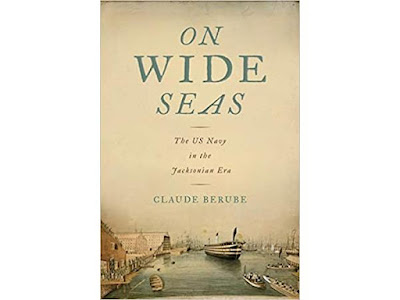
Claude will be with us for the full hour to discuss his latest and 4th non-fiction book, On Wide Seas: The US Navy in the Jacksonian Era, just released by University of Alabama Press.

Claude earned his PhD in Military History from the King's College, London and holds two master's from Northeastern and the Naval War College. In his 30-year career, he has worked as a defense contractor for Naval Sea Systems Command and the Office of Naval Research, as a staffer on Capitol Hill for two U.S. Senators and a member of Congress, and teaching at the U.S. Naval Academy in the Political Science and History Departments. A Commander in the U.S. Navy Reserve, he has served at the Office of Naval Intelligence, CNO's Deep Red, at Joint Task Force Guantanamo Bay, Joint Analysis Center Molesworth England, and deployed on USS Bunker Hill to the Middle East.

In addition to his four non-fiction books, he is the author of more than 60 articles, and this third novel in the Connor Stark series will be published this fall.

If you miss the show live, you can pick up this episode and others and add Midrats to your podcast list simply by going to you use Apple Podcasts here. Or on Spreaker. Or on Spotify.

Wednesday, January 05, 2022

Ship Naming

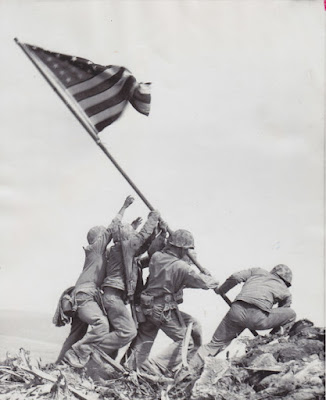
Lincoln M. Cushing who wrote a piece on World War II Kaiser ships named for labor leaders from which I quoted extensively here, pointed me to an effort to have a Navy ship named after Joe Rosenthal.

If you can't recall who exactly Mr. Rosenthal was, let me point you to his most memorable work:


You can support this effort here at part of the site of the "Fellowship of the Lens" which has as its purpose "To promote the understanding and awareness of the role of the First Amendment in American society." If you are so inclined, pay them a visit and perhaps support their efforts.

U.S. Navy Office of Naval Intelligence Worldwide Threat to Shipping (WTS) Report, 1 - 29 December 2021

U.S. Navy Office of Naval I... by lawofsea

Saturday, January 01, 2022

Saturday Is Old Radio Day - Jack Benny TV Show "New Years Day" (1956)

New Year's Prayer and a Hope for a Happy New Year!

After the fireworks and the champagne, we are left to ponder what 2022 may bring. For some of us, this calls for a simple prayer:

A prayer for the New Year:

Most gracious and merciful God, you have reconciled us to yourself through Jesus Christ your son, and called us to new life in him. Grant that we, who begin this new year in his Name, may complete it to his honor and glory; who lives and reigns, now and for ever. Amen.

For those of you who do not share in this belief, may this year be as good as your best hopes!

In either case, there is always this sound advice:


Friday, December 31, 2021

Friday Film" "Star Identification" (1942)

Celestial navigation depnds on knowing which stars you are looking at through the sextant . . .

Tuesday, December 21, 2021

Denial


I deny that this is an accurate portrait of me.


I don't have such nice boots.

Sunday, December 19, 2021

Sunday Ship History: U.S. Army Vietnam Riverine Operations 1966-1969

Interesting U.S. Army discussion of river operations at When a River Runs Through It: Riverine Operations in Contemporary Conflict:

The purpose of riverine operations may be to facilitate or prevent river traffic, or the river may be ancillary to the main purpose which is on the banks, not the river itself. Missions may include: naval combat; fire support; landing assault; mine and obstacle removal; reconnaissance; line of communication security; logistics support; ground force movement; line of communication interdiction; raids; patrolling; presence; piracy suppression; smuggling and contraband suppression; suppression of human trafficking (prostitution, slavery, illegal immigration); police support; fishing support; host nation training; vessel recovery; medical support/evacuation; humanitarian aid; and liaison with naval/ground units and local civilians. Trans-axial riverine operations may be categorized by the situations above and include most of the above missions. Historically, the U.S. Army has devoted more thought to crossing rivers than controlling them until confronted with the opportunity to exploit terrain for maneuver, advantage, and supply.

***

Waterways and population centers will be factors in future war. Frequently they will be collocated and will become operational key terrain. They won’t be just the Navy’s, Army’s, Air Force’s, or Marine Corps’ problem. They will affect all services and other departments, bureaus, and agencies of government. Riverine operations will be a part of future military actions and will be an Army problem. The best way to prepare for a future problem is through study, training, and equipment design and development.

Technology will not readily resolve the difficulties of future riverine operations. A major challenge will be developing the leadership that can function effectively in a joint or combined environment and understands the language, culture, employment, capabilities, and limitations of the sister services or international forces involved in riverine actions. Success in future riverine operations begins in the school house of today.(emphasis added)

As is noted in the article, the U.S. has a long history of riverine operations dating back to the Revolutionary War. In places where virtually the only means of access to the interior of a contested land mass is via a river system, knowing that history and learning from it are vital for success of a necessary missions that cannot be accomplished by other means.

While the above- referenced article looks at such operations in the Iraq conflict, an earlier document looked at such operations during the Vietnam War, the most recent large scale such operations undertaken by the U.S. military.  That monograph is below, but can also be found at the Army History site. Other discussions of riverine  and inshore operations have been part of the Sunday Ship History series, see Operation Game Warden and Operation Market Time.

A reminder of how large rivers can carry fairly large ship is "With the Yangtze Patrol" (1938)

Sunday, December 12, 2021

Sunday Ship History: U.S. Navy Salvage Operations

The following document ties in with a previous look at the salvage operation that followed the attack on Pearl Harbor in December 1941 Sunday Ship History: After Pearl Harbor - Down but not out. The importance of recovering ships and equipment in the early days of U.S. involvement in WWII is noted there:

On October 25, 1944, at the seminal battle of Surigao Strait, the battleships USS Mississippi, USS Maryland, USS West Virginia, USS Tennessee, USS California and USS Pennsylvania "crossed the T" of a Japanese fleet in the last great surface ship engagement.

Of the six battleships of the U.S. Navy involved in the action, five had been either sunk or damaged during the Japanese attack on Pearl Harbor.

Salvage operations deserve a much longer look, and happily, the U.S. Navy's History and Heritage Command published a such a treatment in 2009, Mud, Muscle, and Miracles: Marine Salvage in the United States Navy by Captain Charles A. Bartholomew, USN and Commander William I. Milwee, Jr., USN (Ret.).

U.S. Navy Salvage History a... by lawofsea

You can also find this publication at the Internet Archive here.

Saturday, December 11, 2021

Saturday Is Old Radio Day - "The Virginia Beach Matter" from Yours Truly, Johnny Dollar - Edmond O'Brien (1950)


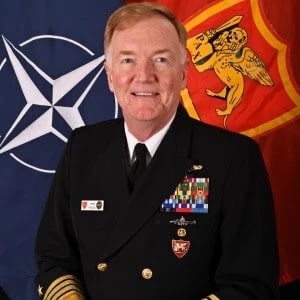
On Midrats 12 December 202 - Episode 611: Making the Case for Maritime Power with ADM Jamie Foggo, USN (Ret.)


Please join us at 5pm (EST) on 12 December 2021 for Midrats Episode 611: Making the Case for Maritime Power with ADM Jamie Foggo, USN (Ret.)

Just a cursory glance at any map will tell you the United States of America is a maritime nation whose economic power and national security is intimately linked to the sea.

This simple reality is not as well understood as one would expect. Command of the sea and access to the world’s oceans has never been easy or an entitlement for any nation. It is something that each generation must understand, resource, and be a steward of for the next.

With domestic distractions and competing priorities combined with the accelerating challenge by the People’s Republic of China, bringing the topic of maritime power above the natsec ambient noise has never been more important.

This fall a new voice joined the conversation, the Navy League of the United States’ Center for Maritime Strategy.

Our guest for the full hour to discuss the message it will bring to the conversation will be its inaugural Dean, Admiral Jamie Foggo, USN (Ret.).

Admiral Foggo is a 1981 graduate of the U.S. Naval Academy. He is also an Olmsted Scholar and Moreau Scholar, earning a Master of Public Administration at Harvard University and a Diplome d’Etudes Approfondies in defense and strategic studies from the University of Strasbourg, France.

If you miss the show live, you can pick up this episode and others and add Midrats to your podcast list simply by going to you use Apple Podcasts here. Or on Spreaker. Or on Spotify.

Tuesday, December 07, 2021

The Other Part of Dec 7, 1941 "Disaster in the Philippines"


Due to the International Dateline, the attack on the Philippines took place on Dec 8 - Philippines time, but on Dec 7 in the U.S. and Hawaii. From Air Force magazine Disaster in the Philippines:


Almost all of the American airplanes at Clark—45 miles north of Manila and the main operational base of the Far East Air Force in the Philippines—were lined up neatly on the ground when the strike came at 12:40 p.m. Japanese A6M Zero fighters followed the bombers, dropping down to strafe the ramp. The fighter base at Iba on the western coast of Luzon, 42 miles from Clark, was struck almost simultaneously.

By end of the first day, the strength of Far East Air Force was reduced by half, and it was eliminated as an effective fighting force. The FEAF response was scattered and ineffective. Of approximately 200 aircraft in the Japanese strike force, all but eight returned to their bases on Formosa.

Air superiority established, the land invasion began. The fighting continued for several months, but the Japanese victory was inevitable, leading to a surrender of US forces on May 6, 1942.

It was not as if US commanders in the Philippines had no warning. Ten hours had elapsed since the devastating Japanese attack on Pearl Harbor, where in addition to the naval losses, the US air forces were caught on the ground. Now, it had happened again.

When Pearl Harbor was struck at 7:55 a.m. on Dec. 7, 1941, in Hawaii, it was 2:25 a.m. on Dec. 8. Reports reached the Philippines soon afterward. In addition to warning messages received, the movement of Japanese aircraft was detected by radar and ground observers and there were several preliminary attacks.

Maj. Gen. Henry H. “Hap” Arnold, chief of the Army Air Forces, called FEAF commander Maj. Gen. Lewis H. Brereton to ask, “How in hell could an experienced airman like you get caught with your planes on the ground? That’s what we sent you out there for, to avoid just what happened. What in the hell is going on there”

The question has never been answered satisfactorily. Pearl Harbor generated 10 official investigations. The senior officers in Hawaii, Adm. Husband E. Kimmel and Gen. Walter C. Short, were relieved of command and forced into retirement. By contrast, there was no official investigation of events in the Philippines, and no one was held accountable.

(emphasis added)

More at Pacific Eagles:

At 0300 local time on the 8th of December, the famous ‘Air Raid Pearl Harbor’ message was received in the Philippines. The FEAF was instantly put on alert, with pilots ordered to stand by their aircraft. Within 30 minutes, unidentified aircraft were detected by Iba’s SCR-270 radar set and P-40s were sent to intercept, but they failed to find the incoming aircraft (probably reconnaissance patrols) in the darkness. At 0500, official word came from the US that the war was underway. When notification of the Pearl Harbor raid was received, the FEAF’s commander Lt.Gen. Lewis H. Brereton immediately requested permission to send his B-17s to attack Japanese airfields in Formosa. He was unable to talk to MacArthur to gain authorisation, so as a precaution had his B-17s take off to prevent them being caught on the ground. Shortly afterwards a large formation was aircraft was discovered coming in from the north.

This formation was a strike that had been launched in the early hours. Japanese Army bombers arrived over northern Luzon around 0800, as the 8th Sentai attacked Tuguegarao airfield and the 14th Sentai’s Ki-21s bombed Baguio barracks. As with the earlier contacts Iba’s radar set had detected the intruders but Brereton’s P-40s were deployed to protect what were deemed the most important facilities in the Philippines – Manila and Clark Field – not Baguio, and so the bombers were able to complete their attack unmolested. Davao on the southern island of Mindanao was also bombed by aircraft from the small carrier Ryujo, with two of PatWing10’s PBYs destroyed on the water. Thick fog covering Japanese Navy airfields on southern Formosa delayed the launch of the 11th Air Fleet’s own bombing raid by several hours, the planes not departing until 0930 – less one bomber which crashed and exploded during the takeoff.

Eventually, MacArthur contacted Brereton and authorised the strike on Formosa. The B-17s were recalled to Clark to refuel and bomb-up for the mission. Most of the fighter aircraft that had been launched before the 5th Air Group’s raids were also running low on fuel and had to land, and the 3rd Pursuit Squadron which had been sent on a fruitless hunt over the South China Sea was ordered to return. Therefore the vast majority of the FEAF was on the ground when the 11th Air Fleet’s bombers arrived just after 1pm. Flying in perfect V formations the Japanese bombers were completely unopposed.

And more from here:

According to the Japanese plan for the capture of the Philippine Islands, naval air units would assume the initial responsibility for destruction of defending air and naval forces and for cover of the landings. When beachheads had been established and Philippine airfields had been captured, army air units would move in for the purpose of supporting the ground forces. The first air assault was scheduled for early morning on the same day of the attacks in Hawaii.18

Preparations had been well under way by the opening of November. During the first two weeks of the month, land-based naval air units of the 11th Air Fleet were transferred to Formosa, where with approximately 300 planes they entered into intensive training in day and night bombing, long-range reconnaissance, air coverage, and strafing attack. As December came in, the Third Fleet was engaged in assembling its main forces at Formosa for the amphibious invasion of the Philippine; and to the naval air strength deployed at Formosan bases were added 150 to 175 planes of the Fifth Army air force. The main weight of army aviation was deployed in the south for support, initially from Indo-Chinese bases, of the conquest of Malaya.19

For defense of the Philippines, the Far East Air Force had in commission thirty-three B-17's, of which sixteen were at Del Monte and the rest at Clark Field, and approximately ninety pursuit aircraft.20

The 3e Pursuit Squadron at Iba and the 17th at Nichols each had eighteen P-40E's; the 20th at Clark was equipped with the same number of P-40B's. The 21st and 34th Squadrons, respectively based on the Nichols and Del Carmen fields, had arrived in the Philippines only in late November and did not receive their planes until 7 December, when the former was assigned approximately eighteen hastily assembled P-40E's and the latter took up its duties with P-35's, each of which had an average flying time close to 500 hours.l Also available were a miscellaneous assortment of noncombat aircraft and twelve P-26's flown from Batangas by pilots of the Philippine Air Force.21

Had the Japanese been able to keep to their schedule, the attack on the Philippines would have coincided much more closely than it did with that at Pearl Harbor. But inclement weather above Luzon delayed execution of the plan for an early morning attack, and gave the Americans advance notice of several hours.22 In fact, the major attack on Clark Field, where virtually half of our total bombing force was destroyed on the ground, did not develop until after noon, some nine hours following the initial bombing of Oahu.

In the Philippines, which lie on the other side of the international date line, it was Monday, 8 December, when shortly after 0300 (0830 in Hawaii) a commercial radio station picked up a report of the Pearl Harbor attack.23 Though no official confirmation was immediately available, base commanders received prompt notification and all units were placed on combat alert. Within thirty minutes of this first warning, the radar set at Iba plotted a formation of aircraft about seventy-five miles offshore headed toward Corregidor. The 3d Pursuit Squadron immediately sent out planes for interception. As the radar followed the course of the outgoing P-40's, it showed them making contact with the approaching aircraft, after which the latter swung off to the west and their plots disappeared. It was later learned that our pursuits actually had made no interception. Apparently, the P-40's in the darkness had passed underneath the enemy planes.24 There were not other alarms prior to receipt of official confirmation of the outbreak of hostilities with Japan by 0500.

A plan of action which had been considered for this eventuality by the Far East Air Force was an American air attack against Formosa, the natural point of concentration for a Japanese invasion of the Philippines.25 Objective folders, although without calibrated bomb target maps or aerial photographs, had been prepared,26 and Col. Francis M. Brady, chief of staff to General Brereton, promptly took the initial step toward mounting the operation by ordering the B-17's at Clark Field prepared for the mission.27 Brereton himself reported at about 0500 to General MacArthur's headquarters at Fort Santiago, where he requested permission of Brig. Gen. Richard K. Sutherland, chief of staff, to carry out offensive action as soon as possible after daylight.28

That request, unhappily, has become a subject of controversy. Conflicting statements have been made and the historian is left to find his way without the aid of a complete record. Indeed, only a few fragments of the official records of the Far East AiR force survived the initial engagements and movements of the war, with the result that chief reliance must be placed on the recollections of its personnel. It would appear that the files of General Headquarters, Southwest Pacific Area, are also incomplete.29

Since the question turns so largely on evidence drawn from the memory that men carry of the first hectic hours of war, it seems pertinent to observe here that there can be little doubt that to the airmen of General MacArthur's command the logical defensive use of the long-range heavy bomber in the circumstances existing was to strike at the enemy's concentration of air and naval power on Formosa, and to strike before the enemy could attack.30 Not only would this have been in accord with standard AAF doctrine and with the mission in defense of our own shores for which the B-17 originally had been designed, but Formosa lay well within the range of the plane, which incidentally had been built for missions extending beyond the distance for which fighter escort could be provided by current models of pursuit aircraft. It is true that the number of planes available was nowhere near that required for a decisive striking force, but the defensive value of the B-17 lay almost entirely in its offensive power and the alternative to its use in that manner was to save it for possible destruction on the ground. Moreover, the mission presumably would serve useful purposes of reconnaissance, and it would have been accordance with the recent revision of RAINBOW No. 5. [See above, pp. 184-85.] If General Brereton did not propose an early undertaking of offensive action against the enemy on Formosa, as both officially and publicly he has stated he did, it would be surprising indeed.

Following the publication in 1946 of The Brereton Diaries, in whichfor the first time General Brereton publicly stated the facts as he recalled them, General MacArthur announced that he had received no such recommendation and that prior to that publication he knew "nothing of such a recommendation having been made."* This statement lent special weight to the testimony of General Sutherland, who during the preceding year had stated in an interview that the responsibility for holding the bombers on the ground that morning was entirely Brereton's.

It was Sutherland's recollection that the air commander agreed that there would be no point in attempting a bomber mission without advance reconnaissance. The interview did not indicate whether the question of an immediate reconnaissance mission was considered, but General Brereton, in reply to a request for information on that point, has indicated that no authorization for reconnaissance was received until later. "At the first conference," he wrote, "General Sutherland approved my plans for an attack immediately after daylight, instructed me to go ahead with preparations and that in the meantime, he would obtain General MacArthur's authority for the daylight attack."31

The record of an interview by Walter D. Edmons with Lt. Gen. Richard K. Sutherland in Manila on 4 June 1945 (copy supplied the author through the courtesy of Mr. Edmonds) reads on the question of "Why was Formosa not bombed?" as follows:

Gen. Sutherland began by saying that all the B-17s had been ordered to Del Monte some days before. On a check it was found that only half had been sent. GHQ wanted the planes in Del Monte because they would there have been safe from initial Jap attacks--they could not have been reached at all--and they could themselves have staged out of Clark Field to bomb Formosa. This direct order had not been obeyed. And it must be remembered that GHQ gave out general orders and that the AFHq were supposed to execute them. As Sutherland recalls, there was some plan to bomb Formosa, but Brereton said that he had to have Photos first. That there was no sense in going up there to bomb without knowing what they were going after. There were some 25 fields on Formosa. On December 9th and 10th, photo missions were dispatched--Carpenter going on the first and returning with generator trouble; Connally going on the second but being turned back by fighters. Holding the bombers at Clark Field that first day was entirely due to Brereton. (Italics mine, WDE.)

General Sutherland's statement that all B-17's had been ordered to Del Monte (subsequently confirmed in MacArthur's statement of September 1946) and General Brereton's account of the move have been discussed above in Chap. 5, pp. 188-89. On the immediate question of the employment of the planes at Clark Field on 8 December, the question of a prior order for their transfer is a side issue.

[The official US Army history, published in 1952, gives greater weight to Brereton's version that the Sutherland/MacArthur version! Note particularly, the discrepancy in MacArthur's supposedly holding back the bombing attack in favor of a reconnaissance mission, then later the same day authorizing the bombing mission in spite of the lack of reconnaissance. Considering other events, and MacArthur's non-appearance throughout the morning of that critical day, this student believes that a plausible explanation is the MacArthur suffered at least a mild nervous breakdown upon receiving the news of Pearl Harbor--and realizing his inevitable defeat in the Philippines--and that Sutherland's primary task that morning was to get the "boss" to pull himself together and assume effective command. After the efforts that MacArthur had initiated to repudiate the long-standing strategy of 'delay-and-defend until the fleet could arrive to reinforce', in favor of an aggressive forward defense relying largely on the striking power of the B-17s he demanded, it boggles the mind to discover another believable explanation for his failure to even meet face-to-face with his air force chief that morning. Further evidence of his tenuous response to events is the continued commitment to a forward defense of the beaches, until precipitously abandoning those plans in favor of the retreat to Bataan immediately after the Japanese landing at Lingayen Gulf--too late to move the mountains of material needed to feed and support his army. HyperWar] (emphasis added)

Sunday, December 05, 2021

On Midrats 5 December 2021- Episode 610: Presence & Command of the Sea, with Robert “Barney” Rubel

Please join us on 5 December 2021 for a special 4pm (EST) edition of Midrats for Episode 610: Presence & Command of the Sea, with Robert “Barney” Rubel

Both history and common practice show that the most fundamental role of a major power’s naval forces is to “show the flag.” The world’s premier naval power has additional responsibilities if it wishes to remain the premier power; command of the seas.

From material condition of our ships to failures of basic seamanship, the last few years have signaled that whatever we are doing, it isn’t being done in the best service of the nation or its Navy.

As we face an accelerating challenge from the People’s Republic of China at sea, do we need a fundamental re-look at how we run our Navy?

Our guest for the full hour to discuss this and related topics he raises in the article, “Think Differently about Naval Presence” in the December 2021 Naval Institute Proceedings, will be Robert C. “Barney” Rubel, CAPT, USN, Ret.).

Captain Rubel served 30 years on active duty from 1971-1991 as light attack/strike fighter aviator. He commanded VFA-131 1990-91 and ashore served three tours at Naval War College teaching planning and decision making. After retirements, he was brought on as a civilian analyst in wargaming 2001 and was Director of Wargaming 2003-2006, Dean of the Center for Naval Warfare Studies 2006-2014, and Advisor to CNO 2015-2021.

He directed the 2006/7 NWC research effort that supported development of CS21 and is the author of over 30 journal articles, book chapters, and more.

If you miss the show live, you can pick up this episode and others and add Midrats to your podcast list simply by going to you use Apple Podcasts here. Or on Spreaker. Or on Spotify.

Sunday Ship History: Operation Game Warden South Vietnam 1965- 1973


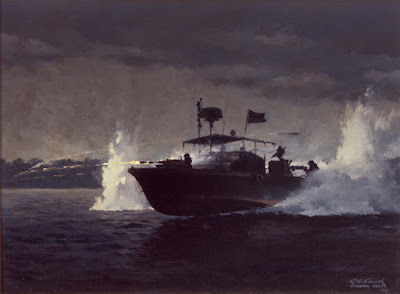
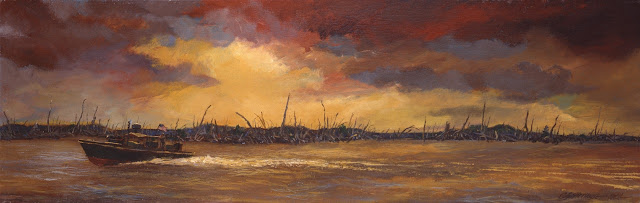
"Firefight" by R. G. Smith; 1968


In an earlier post, we took a look at Operation Market Time which was meant to halt the influx of weapons and other supplies by sea into South Vietnam. Operation Game Warden was initiated to cover the inland waters of parts of South Vietnam, as set out at the Navy History and Heritage Command Operation Game Warden: Keeping Shipping Channels Open

In 1965, the Military Assistance Command, Vietnam (MACV) recognized that the enemy was supplying Viet Cong units via the Ho Chi Minh Trail and Cambodia. In December of that year, the Navy established the River Patrol Force (Task Force 116) to keep shipping channels open, search river craft, disrupt enemy troop movements, and support special operations and ground forces. Operation Game Warden limited the enemy’s use of South Vietnam’s larger rivers.

Below is a study of Game Warden prepared at the Navy's request by the Center for Naval Analysis in 1976. Before reading that report, it is worth reviewing some comments on the nature of the U.S. Navy's involvement with riverine warfare as set out here:

To our small initial Navy section of the Military Assistance and Advisory Group, Vietnam, we gradually added stronger coastal forces, rapidly increased the number of river patrol and minesweeping craft, and introduced a river assault force to give three major U.S. Navy combatant task forces in Vietnam. Also during the period of build up of U.S. Navy strength in Vietnam, the Vietnamese Navy itself was growing in coastal and river patrol, river assault, and logistics capabilities with the help of U.S. Navy advisors. In late 1968 operations were begun that combined the capabilities of all three major U.S. Navy task forces, the Vietnamese Navy, and other Free World ground and air forces to strike at enemy strongholds and interdict enemy supply routes. In addition to the combat operations on the many waterways of Vietnam, hundreds of large and small U.S. and Vietnamese Navy logistics craft form a vital link in the flow of supplies to allied forces at remote bases.

Riverine warfare is an extension of sea power. By controlling the high seas the Navy can project its strength along the inland waterways into the heart of enemy territory.

Operation Game Warden by lawofsea


PBR on Patrol by Charles Waterhouse


More on Game Warden here

.