The agreement on pre-notification of missile tests was signed by Foreign Secretary Shyam Saran and his Pakistani counterpart Riaz Mohammad Khan, whereas Director General, Coast Guard, Vice Admiral A K Singh and his Pakistani counterpart singed the agreement on establishment of communication links between Coast Guard and Pakistan Maritime Security Agency.
The agreement on pre-notification of ballistic missile tests entails that both countries provide each other advance notification of flight tests that intend to undertake any surface-to-surface ballistic missile tests.
External Affair Minister K.Natwar Singh also handed over a draft MoU on measures to reduce risks of accidental and unauthorised use of nuclear weapons under the control of both countries.
The MoU on establishment of communication link between maritime security agencies will lead to an early exchange of information between the two sides regarding apprehended fishermen who inadvertently stray into each other’s countries.
VertRep

Monday, October 03, 2005
Move to more peace: India, Pakistan sign agreements on pre-notification of missile test & more
Reported here, India and Pakistan take some toddling steps toward peace or at least keeping things a little more under control.


Harriet Miers: One simple thought
Look, we just put in place the smartest guy in the room as Chief Justice. And the extremes on both sides were restless.
I suspect that Ms. Miers is quite capable of distinguishing the difference between legislating from the bench and doing judge work, and plans to do judge work.
All the rest is noise.
Let the extremes be restless.
I suspect that Ms. Miers is quite capable of distinguishing the difference between legislating from the bench and doing judge work, and plans to do judge work.
All the rest is noise.
Let the extremes be restless.
Terrorism cost: Port visit cancelled
Reported here, a cruise ship with 600 university students embarked, cancels a port visit to Kenya because of a terrorism threat.
The state department alert, a re-issuance of an earlier advisory not set to have expired until late December, warned US citizens to the threat of terrorist attacks throughout East Africa and a surge in piracy along the coast of lawless Somalia.The loss, of course, is to the education of the students and to the local economy where the ship would have visited. The US State Department warning reads, in part:
Although the language was nearly identical to that in earlier warnings - advising Americans that al-Qaeda followers and other extremists are active in East Africa - it added commercial shipping to the list of potential terrorist targets.
"Terrorist actions may include suicide operations, bombings, kidnappings or targeting maritime vessels," it said, adding that US citizens should review "carefully" any plans to travel to East Africa.
East Africa has been the site of several al-Qaeda-linked terrorist attacks over the past seven years, including the near simultaneous bombings of the US embassies in Kenya and Tanzania in August 1998.
Then in November 2002, al-Qaeda-affiliated attackers bombed an Israeli-owned resort hotel near the Kenyan port city of Mombasa and unsuccessfully attempted to shoot down an Israeli airliner there with rockets on the same day.
September 23, 2005You can find it here.
This Public Announcement is being reissued to remind Americans of the continuing potential for terrorist actions against U.S. citizens in East Africa, particularly along the East African coast, and to note the dangers of maritime piracy near the Horn of Africa and the southern Red Sea near Yemen. This supersedes the Public Announcement of July 01, 2005, and expires on December 30, 2005.
Supporters of Al-Qaida and other extremists are active in East Africa. Americans considering travel to the region and those already there should review their plans carefully, remain vigilant with regard to their personal security, and exercise caution. Terrorist actions may include suicide operations, bombings, kidnappings or targeting maritime vessels. Terrorists do not distinguish between official and civilian targets. Increased security at official U.S. facilities has led terrorists to seek softer targets such as residential areas, clubs, restaurants, American commercial interests, western-oriented shopping centers, places of worship, hotels, schools, outdoor recreation events, resorts, and beaches. In particular, terrorists may target civil aviation and seaports. Americans in remote areas or border regions where military or police authority is limited or non-existent could also become targets.
Americans considering seaborne travel near the Horn of Africa or in the southern Red Sea should exercise extreme caution, as there have been several incidents of armed attacks and robberies at sea by unknown pirates in the last year. When transiting around the Horn of Africa or in the Red Sea near Yemen, it is strongly recommended that vessels travel in convoys, and maintain good communications contact at all times.
Sunday, October 02, 2005
More Sunday Car Blogging

Sure, I know I started this Sunday post on Saturday, but it was probably Sunday on Guam, where America's Day Begins. After looking at Euro micros and Japanese Micros, I remembered the Nash Metropolitan as presented here.
And don't forget the kit cars, such as the King Midget:

Saturday, October 01, 2005
Kosovo getting messier?
StrategyPage says here:
UPDATE: The NY Times provides a timely article, which contains some interesting statistics used in interesting ways. For example,
September 30, 2005: The worst thing about Kosovo is that there has been no progress in the last six years. After NATO military force got Serbia to pull their troops out of the province, because of Serb attempts to expel the Albanian majority population, the Albanians came back and successfully forced out most of the Serb minority in Kosovo. Now, only about five percent of the population is Serb, and they live in enclaves guarded by 17,000 NATO peacekeepers. Violence and crime are common, and jobs are not (about two thirds of the workforce are unemployed.) The only big business is crime, with organized gangs heavily into smuggling, drugs, prostitution and whatever else will earn money. Islamic charities have set up religious schools, and are turning thousands of young Albanians into enthusiastic haters of all things Christian. Because it's bad for business, the Albanian gangsters let it be known that Islamic terrorism is not welcome in Kosovo. But the groundwork is being done.Well. It was predictable.
UPDATE: The NY Times provides a timely article, which contains some interesting statistics used in interesting ways. For example,
At first glance, the province appears relatively thriving today - particularly when compared with the war devastation of 1999. New houses can be seen everywhere, the result of a postwar construction boom. In the regional capital, Pristina, the streets are filled with cafes, restaurants and stores. Only the ubiquitous white four-wheel drive vehicles of the United Nations mission and the infrequent military checkpoints hint at another reality.Well, there are other hints, auch as
Today, most Kosovo Serbs remain in enclaves and in small rural communities, often fearful of venturing out. Albanians steer clear of the Serb-dominated northern part of the province, for fear of attack.
Estimates of unemployment range from 30 to 70 percent. The regional government is close to bankrupt, and the United Nations expects the economy to shrink by 2 percent this year...
What money has been invested in economic development appears to have had a marginal impact. The province's two power stations suffer daily power cuts, despite more than $700 million in capital spending.
Kosovo's banking and payments authority report for 2004 states that the economy has been disinvesting since 2000, despite substantial international aid. United Nations officials here note that Kosovo was the poorest part of the old Yugoslavia, even before tensions exploded in the late 1980's and Slobodan Milosevic rode nationalist tensions to seize and consolidate power and to bring Kosovo under direct rule from Belgrade.
China confirms sending warships to E. China Sea
Reported here:
The Chinese government confirmed it sent warships to a disputed area of the East China Sea on Sept. 29, a day ahead of talks with Japan over territorial claims to waters in which both sides want to drill (OGJ Online, Sept. 27, 2005).It's all about...oil and gas.
"I can now confirm that in the East China Sea, a Chinese reserve vessel squadron has been established," said Foreign Ministry spokesman Qin Gang. "The establishment of this vessel squadron is aimed at handling emergency situations like rapid mobilization and assistance at sea during peacetime, while also raising the ability of the navy."
Chinese state media earlier said the warships would be ready for combat if necessary, being equipped to "eliminate obstacles at sea" in war or peace...Under the United Nations Convention on the Law of the Sea, which Japan and China have signed, countries can claim economic zones extending 200 nautical miles from their coastlines. In the case of the East China Sea, however, the disputed site lies within the 200-mile area claimed by both countries.
Sunday Dumb Car Blogging
Oh, where to start? Let's try with Nissan's latest:

FromNissan unveils car with cabin revolving 360 degrees: I guess it was easier to engineer a rotating cab than to install a reverse gear? A car for people who don't know whether they are coming or going? Something for very narrow streets?
Vaguely reminds me of this:
UPDATE: As fuel economy becomes more important again, you might like to vist The Microcar Museum with more on the small cars of post-WWII. BMW
 BMW
 Avolette
 Heinkel
Would I drive a "micro" today? Maybe to the office, if everyone else was driving one...but not in a world of Ford Excursions and other mega-SUVs... But I wouldn't need a rotatiing cabin or 4 speeds in reverse...
UPDATE 2: Actually, on further examination, I see a connection in design-- Cinderella's coach
 Nissan Pivo

FromNissan unveils car with cabin revolving 360 degrees: I guess it was easier to engineer a rotating cab than to install a reverse gear? A car for people who don't know whether they are coming or going? Something for very narrow streets?
Vaguely reminds me of this:

In early Spring, 1955, Messerschmitt unveiled a new model, the KR200. Though similar to the KR175, it featured a larger 200 cc engine, wider front track, more sophisticated suspension, and numerous mechanical changes, including a clever system for starting the engine backwards, giving 4 speeds in reverse! KR200s can be distinguished from KR175s by their open front fenders, wraparound windscreen, and radically different dome configuration. In a year and a half, 16,000 KR200s came out of the Regensburg plant. (source)A backwards starting engine?
UPDATE: As fuel economy becomes more important again, you might like to vist The Microcar Museum with more on the small cars of post-WWII.
 BMW
 BMW
 Avolette
 Heinkel
Would I drive a "micro" today? Maybe to the office, if everyone else was driving one...but not in a world of Ford Excursions and other mega-SUVs... But I wouldn't need a rotatiing cabin or 4 speeds in reverse...
UPDATE 2: Actually, on further examination, I see a connection in design--
 Cinderella's coach
 Nissan Pivo
The First Report Is Always Wrong
Major K affirms The First Report Is Always Wrong and has a great quote from General Sherman to kick it off: 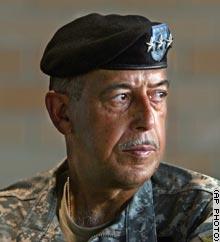
General Honore keeps telling the MSM to move on and adapt to the new reality, instead of trying to justify their original erroneous reports. However, as Major K notes they continue to honor themselves for being very wrong. Slow learners.
My own take on "first reports" here.
"I hate newspapermen. They come into camp and pick up their camp rumors and print them as facts. I regard them as spies, which, in truth, they are. If I killed them all there would be news from Hell before breakfast."Now, there was a general who didn't mince words. Like this one:

General Honore keeps telling the MSM to move on and adapt to the new reality, instead of trying to justify their original erroneous reports. However, as Major K notes they continue to honor themselves for being very wrong. Slow learners.
My own take on "first reports" here.
Heroism: Captain Dabney and Hill 881 South

Courage under fire?
Read this and learn about more heroism in one small area than the media ever reported for the entire Vietnam war.
When Dabney recalled the bravery of the helicopter crewmen, he also remembered the Shore Party Marines serving as HST. "I have always thought of them as my HSTs. They did, as a matter of routine, what would have, in any other circumstances, been deserving of many heroic awards. I do not recall any medevac, resupply or external load hook-up where the zone was not 'hot.'
"The antiaircraft rounds were always whipping by and the 120 mm mortar rounds were often 'on the way,' and they knew it, yet they did their duty till the bird was gone, then ran like hell and dove into the nearest hole. (I often thought that the way they stood, with their backs to the NVA guns as they guided the helos in, was a superb gesture of disdain.)"
Hat tip: NOSI.
Hail to the new Chairman
The new braintrust: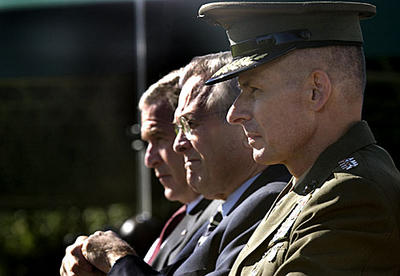
And a fairwell to Gen Myers -Well Done, Sir! Fair winds and following seas!:
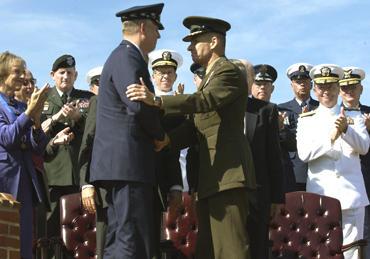
Gen Pace's Speech

And a fairwell to Gen Myers -Well Done, Sir! Fair winds and following seas!:

Gen Pace's Speech
Marine Gen. Peter Pace vowed today that as he gives his best military advice to the president and other members of the National Security Council, he "will remember not only the mission, but the impact it will have on the lance corporals and the airmen and the lieutenants junior grade and the captains."
Pace became the first Marine to serve as chairman of the Joint Chiefs of Staff during an Armed Forces "hail ceremony" here today. He succeeds Air Force Gen. Richard B. Myers, who swore him into office.
"We have a lot of work to do," Pace said. "This moment in history is one where we have an enemy whose stated public intent is to destroy our way of life; 2.4 million American men and women in uniform say, 'Not on our watch.'"
Friday, September 30, 2005
Probably not good news: Indonesians involved in southern Thailand unrest, general claims
Report says Indonesians involved in southern Thailand unrest, general claims. The general quoted is Thai, of course. He will probably not win the Nobel Peace Prize.
A security adviser to the prime minister said Thursday that Indonesian fighters are involved in Thailand's Muslim insurgency, contradicting the official view that the bloody separatist movement was strictly a home-grown affair.Jeff over at GeoPolitical Review has been keeping track of Muslim attacks in Thailand and here is an example and here's another.
"I have warned the authorities concerned several times about Indonesian fighters sneaking into the region but they have ignored it," Gen. Kitti Rattanachaya told The Associated Press, saying the militants infiltrated from the Indonesian province of Aceh.
Although there have been rumours of Indonesian Muslims joining their Thai co-religionists in the country's southernmost provinces, no substantial evidence has yet emerged to back the claim. Most analysts still regard the insurgency as domestic, but with a strong potential to attract foreign Muslim militants including adherents to the al-Qaeda linked regional terrorist network, Jemaah Islamiyah.
Deja vu all over again: Somali Pirates Release World Food Program ship?

Once again, the Somali pirates allegedly have released the World Food Program vessel M/V Semlow (and one other seized since) as reported here.
Reports from Harardhere town in central Somalia say the hijackers who held two ships in that area finally released them and all crew. This sudden move happened after town and area elders persuaded them to do the right thing. Both ships are now on their way to a makeshift port near Mogadishu. The main Mogadishu port has been close for many years.The last time a release was alleged, it was not true. That was 15 days ago.
Well, I hope it's true.
But remember, just STAY AWAY FROM SOMALIA!!!!
Latest ONI World Wide Threat to Shipping (28 September 2005)
For latest ONI WWTS, go here and click on the date.
Highlights:
1. The continuing saga of the M/V Semlow, World Food Prgram ship, now being used by Somali pirates to capture more ships.
2. This bit of fun from Indonesia, where subsidized fuel has opened the door to smuggling, which the government is trying to close:
3. French union troubles:
4. Fun off Nigeria. Question: How, exactly, do 20 people seize a port?
5. This from "BANGLADESH: Firefight between pirates and enforcement
authorities 27 Sep, Monpura, in Bhola. A 16 member joint forces
team encountered two trawlers with pirates onboard and challenged
them. The pirates opened fire and the joint forces retaliated.
Authorities estimate 15 of the 70 pirates were killed in the
Firefight. Five members of the joint forces team were injured.
The authorities arrested three wounded pirates and confiscated
one of the trawlers."
6. And a lot of "sea robberies" and more...
Highlights:
1. The continuing saga of the M/V Semlow, World Food Prgram ship, now being used by Somali pirates to capture more ships.
2. This bit of fun from Indonesia, where subsidized fuel has opened the door to smuggling, which the government is trying to close:
According to police reports, authorities have
impounded 17 ships, including at least five foreign flagged
vessels, since February in anti-fuel smuggling operations, per 21
Sep reporting. About 6000 tons of fuel have been confiscated,
including 3,000 tons on 27 Aug from the Korean flagged oil tanker
(TIOMAN). Five foreigners are among 58 people detained, all
believed to be captains or crew. In a recent speech, the
Indonesian president explained fuel smuggling has resulted in
losses amounting to $8.74 million each year. He indicated that
officials from state-owned oil and gas giant Pertamina could be
involved. Smugglers have siphoned fuel from Indonesia for decades,
but the problem has received increased attention because of moves
to cut fuel subsidies and hike by at least 40% from 01 Oct. ONI
NOTE: In the past Indonesian anti-smuggling activity has resulted
in use of force that has been misinterpreted and wrongly reported
as Piracy. Indonesian authorities have not always acted to clear
up such misinterpretations
3. French union troubles:
Ro-pax ferry (PASCAL PAOLI) hijacked 27 Sep,(see my post here)
Marseille. The hijackers are striking SNCM seafarers outraged by
the French government’s sale of the state-owned ferry operator
SNCM to an investment company. Members of the Corsican trade
union STC said they had seized the vessel with the intention of
reclaiming it for the island of Corsica. No passengers were
reported onboard. On 28 Sep, French police special
intervention forces regained control of the ferry off Bastia,
Corsica and are reportedly taking it to either Toulon or Marseille
escorted by three French naval vessels. Clashes between police
and striking union activists have ensued in Marseille and the
Corsican port of Bastia. Per 28 Sep reporting, the passenger port
at Marseille as well as the oil and container terminals at Fos and
Lavera were all shut down
4. Fun off Nigeria. Question: How, exactly, do 20 people seize a port?
5. This from "BANGLADESH: Firefight between pirates and enforcement
authorities 27 Sep, Monpura, in Bhola. A 16 member joint forces
team encountered two trawlers with pirates onboard and challenged
them. The pirates opened fire and the joint forces retaliated.
Authorities estimate 15 of the 70 pirates were killed in the
Firefight. Five members of the joint forces team were injured.
The authorities arrested three wounded pirates and confiscated
one of the trawlers."
6. And a lot of "sea robberies" and more...
Military Recruiting
Doubts about how military recruiting is going? Read this and be comforted.
Got to love the MSM, though, they keep trying... and trying... and trying...
Got to love the MSM, though, they keep trying... and trying... and trying...
Oregon Proposed LNG terminal meets opposition, ignorance

Reported here, the NIMBY, "scaredy-cat" approach taken by some members of the Oregon public near a proposed LNG terminal on the Columbia River near Bradford Landing.
The crowd of several hundred at Knappa High School was heavily dotted with people in red T-shirts with the slogan "I am NOT an LNG "acceptable risk."The "possibility remains" that Mr. Pile could be struck by lightning or hit by a meteorite, too, but the article is silent on his precautions against such events.
Many were from Puget Island in the Columbia River, a tip of which is about a half mile from where the tanks would be placed.
A fireball from the tanks, residents said, could cause second-degree burns to some islanders.
LNG ships, which can be 1,000 feet long, would discharge their cargoes there about twice a week.
"If it goes ahead," said area resident Robert Pile, "the natural setting of the lower Columbia would change radically and for practical purposes forever."
He said while there is an assumption that a disaster will not take place, "the possibility remains."
Presumably some member of the red t-shirt brigade managed to drive themselves safely to the meeting despite occupying vehicles of the type that routinely result in over 50,000 Americans per year being killed in their operation and countless thousands being maimed and injured. Each such vehicle also carries a highly flammable liquid with the potential explosive power of a large brief case full of dynamite.
But wait, there's more:
But there was wide skepticism Thursday night that the Coast Guard, try as it might, could not guarantee there would not be a terrorist attack on the ships or on the storage site, whose two tanks would hold the liquefied equivalent of 7 billion cubic feet of gas.Perhaps he should ask his insurance agent if his life insurance rates will go up if the terminal is built. I'll bet the answer would be "No" given the low level of risk involved.
Skepticism runs high among many of the 800 or so residents of Puget Island, connected to the Oregon side of the river by a small ferry. The island, part of Washington, is the nearest populated area to the proposed site.
Bill Coons, who retired to the island of small farms and, increasingly, other retirees, 13 years ago said the system probably is safe if it works as it is intended to.
"But if there's an attempt by a terrorist to set one of these off, oh man..."
He said he asked Northern Star, which insists on the safety of the tanks, if they would give island residents life insurance policies.
"I didn't get an answer," he said.
Previous post on LNG Danger here
UPDATE: Another report, more balanced here. And a different view.
U.S. Envoy Denies Plan to Invade Venezuela- Dang!

In what will come as surprise to many, the US has denied it has plans to invade Venezuela, pointing the finger at Spain instead:
The United States is not planning to invade Venezuela, the U.S. ambassador to Venezuela said Thursday, disputing claims by President Hugo Chavez.No one can escape the Spanish Inquisition - er- Armada...
Chavez has said his government has documents showing Washington has a "Plan Balboa" to invade his oil-producing countrywide aircraft carriers and planes.(sic) He said Venezuela is preparing to repel any attack.
"No 'Plan Balboa' exists," Ambassador William Brownfield said.
Brownfield told reporters that Spain, not the United States, had included Venezuela in a simulated military exercise titled "Operation Balboa" more than four years ago.
Previous wacky invasion theory here and my post here. AP probably meant "country with aircraft carriers and planes."
We are waiting for a further list of other countries the US does not plan to invade. If the ambassador to each country has to announce US plans, it make some time to complete.
Thursday, September 29, 2005
An Andaman Sea Sea lane?

New sea lanes are hard to come by, but India is planning ahead (as is China, the US, Thailand...) for the possibility of a canal dug through Thailand, as reported here
"But the fact with things like the Kra canal, the Andaman and Nicobar islands will come into play," he said.Hmmm.
Plans to dig a canal across the narrow Kra isthmus in southern Thailand have been bandied about for more than 300 years.
The idea has some support among Thai politicians but has stalled over the huge potential costs and environmental impact. A railroad to carry oil across the isthmus has also been discussed.
Singh, who visited tsunami-hit areas of Thailand last week with his Thai counterparts, did not disclose any knowledge of fresh plans for a Kra canal.
But a report prepared for U.S. Defense Secretary Donald Rumsfeld, leaked to the Washington Post in January, said China was willing to underwrite construction of the $20 billion canal, complete with port facilities, as part of its "string of pearls" strategy of forward bases and energy security.
"So then you have an alternate route for shipping," Singh said in the interview held late on Wednesday at his headquarters atop a hill in Port Blair, capital of the Andaman and Nicobar islands. "It will be like another Suez Canal."
Red arrow on map points to area under discussion.
An effect of piracy- victims quit
Reported here:
Fishermen hunting for fish have now become the hunted with pirates robbing them of their catch at gunpoint. In the face of this danger, many fishermen already struggling to cope with the soaring oil price are hanging up their nets and turning to other means of livelihood.Law enforcement, anyone?
Ports after a storm: Post-Katrina testimony by New Orleans port chief

Must read here on post-disaster port operations and a request for meaningful federal aid to what, after all, are national assets:
(testimony of Gary P. LaGrange, President and Chief Executive Officer of the Port of New Orleans and Chairman of the American Association of Port Authorities) Within a one-month span, Hurricanes Katrina and Rita have impacted over twenty ports in the Gulf of Mexico that are members of AAPA, and many additional private and public ports in the region. The impact of these hurricanes has varied, with the largest impact on the ports of Louisiana, Texas, Alabama and Mississippi. For several ports, including New Orleans, the impact has been considerable; some of the facilities may need to be relocated, and it will take months if not years to fully recover. In New Orleans, for example, we are only 20% operational...If we are going to spend billions upon billions of federal tax receipts on rebuilding, early money should go to getting the affected Gulf Coast ports back into business.
...This nation is heavily dependent on maritime trade. America’s ports are our gateways to the world and a critical component in the nation’s economic health and national defense. When ports are impacted, there is a quick and sizable ripple effect throughout the economy. U.S. ports and waterways handle over 2 billion tons of cargo annually. Much of that commerce flows through the impacted ports in Louisiana, Texas, Alabama and Mississippi. These ports are heavily linked to this nation’s petroleum, grain and farm products, fruit, poultry, coffee, chemical and steel trades. The Port of New Orleans serves as the focal point for waterborne transportation of cargo to 28 states. That cargo activity supported $37 billion in economic benefits to the country and generated $2.8 billion in federal tax revenue.
Agricultural products from 17 Midwestern states flow through the Mississippi River. Over half of the grain exports for this nation depart from ports impacted by Katrina. Oil, agriculture and chemicals rely heavily on the infrastructure provided in these port areas. Additionally, these Gulf ports serve as one of the nation’s largest gateways for poultry exports, and the inability to handle frozen poultry products through unique dockside facilities would affect the industry worldwide. Estimates for the Port of New Orleans shows that relying on less efficient means to transport these products would increase costs by $7-to-$8/ton, thus making U.S. poultry products extremely noncompetitive in the international marketplace.
Steel is another commodity handled by the Port of New Orleans. The cost of diverting steel imports from New Orleans would increase the cost of such products by an estimated $80-to-$90/metric ton because of reduced access to inland barge and rail transportation systems and associated delay costs.
Cruises are also an important component of many ports activities, including the Port of New Orleans, which prior to Katrina was the fastest growing cruise port in the World. Cruises provide significant tourist trade, jobs and income for New Orleans and the region, and their rebound will depend heavily on the ability of New Orleans to rebuild.
Federal Assistance Important
Catastrophic events, whether natural or man-made, can greatly impact maritime trade. Hurricanes are especially dangerous and are the most frequent threat since ports are located in coastal areas. Ports also are impacted by other disasters, such as earthquakes and terrorist events. My written testimony today also includes some examples of lessons learned by ports from disasters prior to Katrina and Rita.
For Katrina and Rita, the impact on New Orleans has been considerable. There are several key things that are important to the port’s recovery: quickly reopening the channel; restoring communications; getting a power source (electrical or fuel-generated); manpower; and repairing facilities and intermodal connections (reliable truck and train traffic).
The Maritime Administration also should be commended. It took the historic step of diverting the military ready reserve ships to help ports get open quickly. Marad provided a ship in New Orleans where workers could live, since much of the city is still uninhabitable. The ship also had cranes and the ability to generate power for the port.
Several other federal agencies stepped in quickly to help out affected ports, and were critical to the ports’ ability to reopen quickly. The Coast Guard, the Corps of Engineers, and NOAA should especially be commended for their vital and timely assistance provided to ports by surveying channels, identifying any obstructions, reinstalling aids to navigation, and providing emergency dredging. These agencies worked quickly and cooperatively to reopen the channels.
FEMA is also an important partner. They direct many of the federal activities and help reimburse ports for rebuilding.
What are the challenges?
Hurricane Katrina completely shut down the Port of New Orleans. The port has limited electricity, water, sewage and other services, and its terminals and facility were severely damaged by both storms and subsequent flooding. The total closure of the port not only affected the economy of Southeast Louisiana, but also the entire nation. In 2004 alone, more than 380,000 jobs in the U.S. were dependent on the cargo activity at the port.With all the other issues swirling around the hurricanes, this one, to my mind, should be put front row center.
In the immediate aftermath of Hurricane Katrina and Rita, the Port of New Orleans has been working non-stop to restore its facilities and services. The port is currently operating at only 20 percent of its pre-Katrina level. The Port of New Orleans is still struggling with a limited workforce and the ability to move the cargo in and out of the port. Intermodal connections, such as truck and train, are still a challenge. Mississippi and some Texas ports face similar problems. The roads and rails need to be repaired and/or rebuilt, and workers need basic housing in order to work long-term. The recovery of the Port of New Orleans is tied to the problems of restoring the entire city. Without adequate infrastructure for longer term housing and family needs, workers will not be able to return. Cruises will wait to return until hotels and tourist attractions are restored.
Another challenge will be cleaning up the ports. In addition to wind damage, several ports impacted by Katrina and Rita have spoiled cargos that must be disposed of and storage sheds that must be replaced or repaired.
The port is a major economic engine for the city and the region. Quickly getting the port back in operation more fully will help return economic vibrancy to the area. The port will also be a critical part of rebuilding the city. It can provide a means of bringing in the materials needed for the major repair and reconstruction needed. Should port services not be restored, any rerouting of traditional port cargoes would increase related supply chain costs, includes those associated with trucking and rail services, barging, distribution and warehousing, and ocean freight.
Based upon post-Katrina engineering and other studies, the Port of New Orleans estimates that $1.7 billion will be required to rehabilitate, replace and/or improve port facilities damaged by Hurricanes Katrina and Rita. Other ports in Louisiana, Alabama, Texas and Mississippi also have costs to repair facilities. The Port of New Orleans is the primary economic engine for the region – and if the port returns to full operations, the region will soon follow. With repaired port and intermodal infrastructure and a return of the workforce, the port will be a major factor in the business and economic revitalization so desperately required for the Gulf Coast region.
Drawing is from Port of New Orleans website and show geographic distribution of American goods shipped from New Orleans. Previous posts on importance of the port: here, here, here, here, here, and here. It's like I think its important or something...
Wednesday, September 28, 2005
Latest ICC Commercial Crime Services Piracy Report (to 26 September 2005)
Piracy report of the ICC-CCS here: Highlight:
Marco! Polo!
10.09.2005: missing tug and barge
Tug Marco Polo 43 and barge Marco Polo 48 in tow from Gresik Java, Surabaya to Jakarta have gone missing since 10.09.2005.
Description:
Tug: Marco Polo 43, POR- Batam, callsign: YD3907, grt: 148, nrt: 88 Built-1992, loa: 23.34 m, breadth: 7.00 m, depth: 2.9 m
engine: Niigata - 1 x 1300hp, colour: superstructure/accommodation: beige/yellow, hull: blue
Barge: Marco Polo 48, flag: Indonesia, grt: 1704, loa: 68 m,
dimensions: 67.3 x 20.12 x 4.88 m, colour: sideboard – blue hull: black / rust
Anyone sighting the tug and or barge are requested to inform the piracy reporting centre.
Marco! Polo!
Subscribe to:
Posts (Atom)