VertRep

VertRep

Sunday, August 13, 2006

Littoral Combat Ships on parade


Reported here:
"There's a lot of appeal about what it can do," said Navy Cmdr. Joe Chiaravallotti, the Navy's littoral combat ship section head.

"Its concept is new and foreign to anything we've ever done before, and ... that, by its very nature, causes controversy. Until we put these ships out in numbers, that controversy is going to be there."

Independent analysts tend to give the program high marks, even with the increasing concern over cost. "The littoral ship is the star of the Navy's shipbuilding program," said Loren Thompson with the Lexington Institute in Arlington, Va.

John Pike, director of GlobalSecurities.org in Alexandria, Va., says the ship will be "fiendishly fast" and "certainly seems like a good idea right now."

But yet to be tested, he said, is how its unusual design will handle in rough waters.

"The crews aren't going to do you much good if they're all barfing," he said.

With the emergence of new threats after 9-11, Clark and other Navy leaders pushed for a light, high-speed ship that could ply shallow waters off-limits to larger, more conventional ships. Clark also wanted a ship that could be produced much faster than the normal cycle, which typically spans years.

"I didn't think we had the right kind of force structure to deal with the threats and challenges we were going to face in the 21st century," Clark said in a recent telephone interview.

Potential adversaries in the coastal environment, he said, could include "pirates, terrorists, who knows. You don't know if you're not there, and that's the whole point."

One of the most striking features of the emerging line of ships is what the Navy describes as "plug and play." The ships can be easily refitted for new missions with modules that enable it to switch between three main tasks -- mine warfare, anti-submarine warfare and surface combat.

They will be equipped with unmanned air and sea drones, an attack helicopter and smaller watercraft. Littorals are also designed to reduce -- though not completely eliminate -- detection by radar.
Like a lot of innoative sea concepts, the proof will be at sea.

UPDATE: A plan to have the LCS sailors qualified to do their jobs before they report aboard here. What a concept:
Commander, Naval Surface Forces, is overseeing the development of a revolutionary training process for the Littoral Combat Ship (LCS) called Train to Qualify (T2Q) that will enable LCSís hybrid Sailors to be fully trained before reporting to the ship.

The new system of preparation and evaluation for LCS is necessary because of its unique crew size and billets aboard. Each LCS will have a core crew of about 40 Sailors for a ship about the size of a frigate. The core crew will be joined by a mission package crew and an aviation detachment, bringing the total crew size to approximately 75. To perform any one of several missions, an LCS seaframe can be configured with mine warfare, anti-surface or anti-submarine mission modules.

"With Train to Qualify, everyone has to report aboard the LCS ready to fulfill all the duties of their watches and their jobs, both individually and as an integral part of the crew," said Dr. Carl Czech, head of the Human Performance Center Detachment at Commander, Naval Surface Forces.
I guess the opportunity for leave for the crew might be limited, too, given that even have 4 sailors ashore means a 10% reduction in crew available...

Or maybe there'll be "ready LCS" crews to provide spare sailors...

Transportation system interrption and terrorists

Some interesting points raised here:
"'Five years ago, during Sept. 11, I and other analysts wondered how we were ever going to bounce back from this,' Klaskin said. 'But the fact is that aviation is having one of its best years ever. More people are flying. More commercial cargo is being shipped. If a terrorist wants to have a damaging effect on aviation, they'd be better off going after oil fields than airplanes. It's jet fuel costs that threaten the industry most.'

There have been major attacks involving non-transportation sites, such as the bombing of the federal building in Oklahoma, the first World Trade Center bombing, the school siege in Russia by Chechen guerrillas, and the endless bombings of restaurants and cafes in Israel.

But these often involve indigenous networks trained to study routines, procure explosives or seize territory. By comparison, foreign-based jihadists can more easily board U.S.-bound planes and destroy them using relatively fewer resources, terrorist experts say.

For those who see the United States as the primary target of Islamic holy war, the choice is irresistible.

'These are symbols of the United States that are outside of the United States, which makes them easier to get to,' said Randolph Hall, founder of the University of Southern California's Center for Risk and Economic Analysis of Terrorism Events. 'You look at the carriers -- United, American, Continental -- that were targeted, and you have two names that automatically communicate America.

The best way to protect against terrorism, Hall said, is how it was done in London. 'Taking these precautions against liquids or electronic devices is all well and good, but the best protection is good intelligence,' said Hall. 'You have to stop these people well before they get to the airport, because by then, you have them in a crowd of people which is part of the goal.'(emphasis added)

The nagging worry of piracy

As set out here, piracy at sea is a continuing worry:
Chris Horrocks, secretary-general of the International Shipping Federation, says the current position worldwide is better than in some recent years, particularly 2000, when attacks peaked at more than 450 a year.
But piracy can emerge suddenly in any area.
"When attacks hit a peak in 2000, at that time Somalia was just a blip on the radar screen," Mr Horrocks says. "Then it becomes a big problem. Piracy tends to be a feature of areas where there is either lawlessness or real economic deprivation and it's very difficult to eradicate."
Attacks in some areas have also become more sophisticated. Mr Horrocks compares the shift with a progression from mugging to organised crime. Attackers in the Malacca Strait now often kidnap crew or hijack vessels because they know owners will pay a ransom.
The pirates that attacked the Seabourn Spirit, meanwhile, appear to have launched their fast boats from a larger mother ship. The cruise ship's master had thought that, at 100 miles off the coast, he was out of their small boats' range.
Yet the shipping industry, Mr Horrocks admits, can do little about the risks except ensure that ships keep a good lookout and press governments to act. Improved intergovernmental co-operation has reduced the Malacca Strait problems, while better international naval patrols have helped to control the Somali problem.
"Piracy is a constant concern of the shipping industry," Mr Horrocks says. "If things are somewhat better now, we should be thankful for that. But we should not be in any sense encouraging governments to drop their guard."

Sunday Ship History: AOGs- gas pipeline at sea


Napoleon said, "An army travels on its stomach," referring to the need to keep an army in the field fed so it can keep moving. By World War Two the saying had expanded to include the "beans, bullets and black oil" needed to keep a fleet at sea. The logistics work behind keeping thousands of ships, hundreds of thousands of men and tens of thousands of aircraft fueled and supplied is, perhaps, not as exciting a tale as the landings at Iwo Jima, but it is an important story. A tiny portion of that tale should be carved out for the men who sailed and worked on the ships known as "AOGs"- or gasoline tankers.

Unlike the big fleet oilers designed to replenish carrier task forces at sea, the AOG was designed to transfer fuel to shore stations, though some could conduct replenishment at sea.

Not generally considered "front line" duty, the role of AOGs during wartime has been underreported. For example, off Iwo Jima, some AOGs carried potable water for use by the Marines ashore, a job which required the AOG to close the beach in close proximity of the fighting. One such ship was USS Tombigbee (AOG-11):
Her tanks filled with fresh water instead of the oil for which she was designed, Tombigbee began replenishing the tanks of the ships of the Fleet and worked out of Guam and Ulithi as she continued this duty for the remainder of the year. The ship's first taste of combat came while she lay anchored at Ulithi on 20 November 1944. A Japanese midget submarine slipped into the anchorage area and torpedoed the oiler Mississinewa (AO-69) which was anchored less than 1,600 yards from Tombigbee.

The tanker remained on the Guam-Ulithi "express" water supply run through January 1945. On 7 February, while she was steaming toward Guam, orders rerouted Tombigbee to Saipan. Subsequently removed to Tinian, with a full load of water, she supplied water until 19 February, when she joined Task Group (TG) 60.9 and got underway for the Volcano Islands. At 0924 six days later, Tombigbee was detached from the task group and entered the harbor at Iwo Jima. There, the water carrier lay-to and kept out of the line of fire of the supporting battleships, cruisers, and destroyers. Rough seas hampered her water-discharging operations, but the need for fresh water overrode considerations such as the desire to avoid minor hull damages caused by the ships bumping and scraping each other in the tossing waves.

After remaining in the Iwo Jima area until 9 March, the ship proceeded to Guam where she reloaded her holds with more of her precious liquid cargo. Later in the month, Tombigbee joined the invasion force heading for the Ryukyus. (source)
She took part in the invasion of Okinawa.

During the Vietnam War, AOGs played a very important role, as set out in "How AOGs Fueled the Vietnam War" by Paul Gryniewicz in the Feb 2005 edition of Sea Classics and found here:
To their crews, the gasoline tankers were "Always On the Go," but to the GIs, airmen and sailors fighting the Viet Cong, the AOGs were the most popular - and important - ships in the entire Navy.

In his Report on the War in Vietnam, Gen. William Westmoreland observed that, "We were utterly dependent upon the sea logistical line."

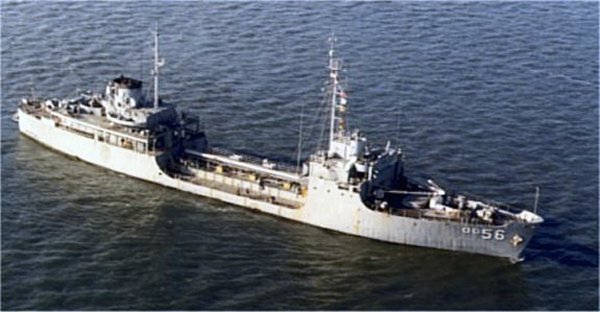
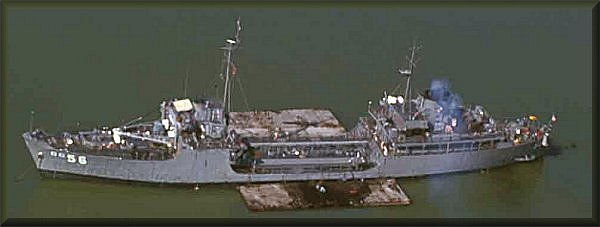
A critical link in Westmorland's supply chain was made up of six, small slow, 22-year-old US Navy gasoline tankers: USS Patapsco (AOG-1), USS Elkhorn (AOG-7), USS Genesee (AOG-8). USS Kishwaukee (AOG-9), USS Tombigbee (AOG-11) and USS Noxubee (AOG-56). Their mission was to deliver fuel to US forces in the I Corps Tactical Zone, the five most northern provinces of South Vietnam that ran from the Ben Hai River in the center of the DMZ south to Sa Hyuhn. Thirty to 70-miles wide, I Corps was bordered on the west by Laos and on the east by the South China Sea. With the exception of a low, narrow coastal plain, jungle and mountains covered the region. Land-based transportation was practically non-existent. Route One was a narrow winding road running the length of the zone. A single narrow-gauge railroad ran parallel to it. Both were frequently out of commission due to enemy action and monsoon storms. The only established port in the zone was Da Nang.

I Corps' physical condition meant that the only way to practically and consistently move large quantities of supplies around was by water. Without fuel, planes and helicopters could not fly, tanks and trucks could not move, and PBRs and swift boats could not patrol the waterways. In December 1968 alone, shore-based forces consumed 1.7 million gallons of fuel daily. On average, the six AOGs pumped over 15 million gallons of fuel per nine-month deployment. Noxubee set the record by pumping 20 million gallons in 1968, earning a Meritorious Unit Commendation in the process.
***
For seven hard years, beginning in March 1965 and ending early 1972, at least one AOG was constantly deployed in Vietnamese waters. Tombigbee arrived in Vietnam on 8 March 1965, supporting the Ninth Marine Expeditionary Force as they waded ashore at Red Beach near Da Nang. Tombigbee became the first AOG to pump fuel ashore during the Vietnam War.
***


Using both bow and stern anchors to keep from swinging with the current, AOGs anchored 1500 to 2000 yards offshore alongside a buoy marking the seaward terminus of an assault pipeline. One of the ship's boats or a boat from shore would float a fourinch hose from the tank deck to the buoy. A swiveling gooseneck connection on top of the buoy gave the AOGs a secure point to attach the refueling hoses. First, a crewman would hop onto the buoy and connect the hose. Once the connection was secure, the AOG would begin pumping fuel ashore. Due to their limited pumping capacity and small-diameter pipelines, it could take as long as 72 hours to unload all 680,000 gallons of fuel.
The job was not without danger, and the AOGs came under attack at various times:
Tan My was in the cross hairs of the Communists' 1968 TET offensive. The fuel farm was destroyed along with several landing craft and barges. River cargo operations were interrupted for ten days, and 18 men belonging to NSAD Tan My were killed. During one 72-hr period of nonstop operations, Kishwaukee pumped 1.7 million gallons ashore at Cua Viet and Hue. While anchored in the lagoon at Tan My on 28 February, unloading into bladder boats and barges, she came under small-arms fire, quickly got underway without any casualties, re-anchored out of range and resumed pumping. The need for fuel was so critical during the TET Offensive that Kishwaukee spent 144 out of 168 days on the line.
***
On 28 October 1968, Noxubee (Lt. J.R. McCall) was pumping cargo through the underwater pipeline and to a bladder boat alongside when North Vietnamese artillery opened fire on the ship. Ensign Richard Bland was at the pumping station on the port side of the tank deck when the first rounds came in, sending up plumes of water along the starboard side. Bland called away the sea detail, and ordered the engine room to stand by for an emergency underway. BMC Franklin and the two fantail sentries quickly yanked the stern anchor up, while at the same time, Ens. Andy Bavarik, hauled in the bow anchor.

Meanwhile, Bland and the tank deck crew cast off the bladder boat and grabbed fire axes to cut away the fueling hoses. All the while, the enemy's artillery was bracketing the ship. By the time the fuel hoses were cut free and the bow anchor hoisted off the bottom, Noxubee was underway at 14-kts and safely got out of range. After a few hours, Noxubee returned to the anchorage and resumed pumping.
***
(Attack on Genesee) The first round was short, the next long, and the next four or five walked down the length of the ship as near misses. The XO, Lt(Jg) Michael Haines, from his GQ station on the signal bridge, directed the crew of Mt. 33 to cut the stern mooring line. He also ordered all exposed topside personnel below and darkened ship. Cutting the stern line enabled the ship to swing about ten feet, just enough to keep from taking a direct hit on the tank deck loaded with JP-4 jet fuel that could have incinerated the ship and all those aboard.

Rounds were exploding all around. It was only a matter of time before the enemy gunners found their mark. The first hit was on the 01 level port side aft. A second round struck the outboard engine on the ammi barge. Both hits sent lethal shrapnel flying up and down the port side of the Genesee and started fires on the ship and the barge. Internal communications throughout the ship were knocked out. Chunks of flying steel perforated Genesee's stack and exploded an acetylene tank stored along the passageway outside the wardroom. Shrapnel sliced through the high frequency antennas, limiting Genesee's ability communications to the outside world. One chunk hit a 55-gal gasoline drum stored on the 02 level aft. Fire flowed down the scuppers and down the side of the ship near the JP-4 cargo tanks. hot metal tore through the tops of empty cargo tanks B-2 and B-4 without causing any additional fires or explosions. The most serious damage occurred forward. As SF3 Art Ball was securing the watertight door from the tank deck, shrapnel blasted through the door, striking Ball in the left chest and abdomen. SA Theodore Perkins, who was standing near Ball, was also wounded.
***
(Noxubee limpet mine attack) Noxubee (Lt. Dudley Cass) anchored off the Cua Viet fuel farm at 0855 on 8 September 1969. At 1640, YOG-76 moored astern and began filling her cargo tanks. About four hours later, pumping secured and YOG-76 got underway. An hour later, at 2137, fantail sentries SN Paul Gryniewicz and SN Sam Profit and OOD Lt.(jg) Clare Brooks, sighted two swimmers in the water only ten to 15 yards astern of Noxubee. They immediately took the swimmers under rifle fire and tossed concussion grenades at them. Noxubee hoisted her anchors and got underway.

At 2215, Noxubee re-anchored about 1200 yards off the beach so divers could inspect the hull. By 2350, the divers reported that, because of the dark conditions, strong current and rough sea, they could only inspect the stern area and did not find anything. A more complete inspection would have to wait until first light. The divers did speculate that if there was a mine it would probably be a Soviet-made BPM-2 with a 64-1b TNT charge, equipped with a six-hour timer, and magnetically clamped to the hull. With that less-than-encouraging report, Lt. Cass decided to move further out from the beach and anchor for the night.

At 0201 the mine exploded. The swimmers had placed the mine not at the stern by the engine room or the tank deck where it would have done lethal damage, but forward on the port side by the dry cargo hold in a relatively "safe" spot. The blast opened a three-ft by five-ft hole in the hull, flooding spaces underneath the cargo hold and the hold itself with two- to three-ft of water. It also ruptured a fire main causing the Number 2 magazine to flood with over six feet of water. Before the dust from the blast settled, damage control parties under the experienced direction of SFC Eskel Wolf went into action, working in knee-deep water to stem the incoming flood by plugging the hole with mattresses and lifejackets. They also secured the fire main and pumped out the Number 2 magazine.
Even without enemy fire, handling the nototiously dangerous AVGAS made for dangereous work:
On 1 May 1968, Genesee arrived at Tan My and anchored alongside the pipeline buoy. US Army LARC-801 came out to assist Genesee connecting to the pipeline. Genesee crewmen SA Donald Shafer and DC2 Harley Cowans climbed aboard the LARC and hooked the ship's hoses to the connection on the buoy. Those on board Genesee witnessed the LARC explode and burst into flames. The stunned observers saw one of the men blown through the air and into the water.

The LARC was completely engulfed by a lake of fire as the motor whaleboat from Genesee got underway to rescue the crew. SF3 Tony Neil, aboard the whaleboat, dove into the flame-covered water to attempt a rescue. Swimming under water and pushing the flames away with his hands when he surfaced for a breath, Neil located the LARC's driver, SP4 Tommy Miller, who was without a life jacket and badly burned. Neil managed to get the burned driver back to the ship. The others on the whaleboat fished Cowans and another LARC crewman out of the water but could not locate Schafer. By this time LCM-92 and 18 other LARCs were on site searching for the missing seaman but without any luck. Army units recovered Shafer's body a week later. An investigation determined that a spark from the LARC's exhaust caused avgas from the leaking hose line to ignite, destroying the LARC, killing Shafer and injuring three others.
As you may have gathered, these ships during the Vietnam War were Lieutenant commands. And very hard working ships they were, indeed.

Modern war planning still includes getting petroleum products from the sea to the beach (see here, for example). But the AOGs are no longer with us. Many of their brave crews are, however, and they deserve a big salute!

Thought you might like to know.


(Top photo: USS Tombigbee, lower photos USS Noxubee)

Saturday, August 12, 2006

Navy Tug Fights Freighter Fire in Liberia


USNS Apache (T-ATF-172) helps out a commerical freighter which was on fire in Monrovia as reported here:
The engine room of Tahoma Reefer, an Estonian commercial freighter also paying a call on Monroviaís port, burst into flames in the early hours of the day. Later that morning, just as smoke from the burning vessel was spotted from Apacheís bridge, the U.S. Embassy in Liberia phoned the ship and asked the crew to respond.

Using the shipís rigid hull inflatable (RHIB) boat, Apache Chief Mate Troy Bruemmer and Chief Warrant Officer 3 Pete Sharpe, officer-in-charge of the 12-member embarked Mobile Diving and Salvage Unit 2 and three other crew members, rushed to the scene.
All photos fronm US Navy.
Crew members aboard the Military Sealift Command (MSC) fleet ocean tug USNS Apache (T-ATF 172) evacuate personnel from the commercial freighter Tahoma Reefer, while rendering assistance at sea. The fire broke out in Tahoma's engine room in the early morning hours of Aug 10, 2006. Apache rescued the freighter's crew and was able to bring the fire under control. Apache is in Liberia to conduct a harbor survey and do repair work on the port of Monrovia's pier as an ongoing effort to strenghten the United States emerging partnership with this nation. U.S. Navy photo
BZ Apache!

Going to the mothball fleet


Off to mothballs. Companion story here.

Former USS Robin (MHC 54) is towed from the Naval Station Ingleside, Texas, wharf enroute to Beaumont, Texas. It is the first of the four decommissioned Osprey Class coastal mine hunters to be towed to where it will be stored for logistical support.

Thanks to Glenn Geramine of Seaward Services (that's his tug moving the Robin)!

Friday, August 11, 2006

Want to take a chance on Venezuela?


Got your offshore natural gas blocks right here - who'll make a bid? 65% ownership... Come on which rich Western big energy companies will take a chance?

Nigeria: Oil field turmoil

A couple of foreign workers kidnapped as reported here:
Gunmen in military fatigues seized two foreign oil workers here yesterday in the latest violence targeting the petroleum industry of Africa's largest producer, authorities said.
***
Southern Nigeria, where most of the country's crude oil is pumped, has seen an increase in violence against the petroleum industry in recent days. The attacks have forced a nearly 20 percent reduction of Nigeria's usual 2.5 million-barrel daily production, helping send crude prices soaring in international markets.
The abductions came a day after gunmen stormed a supply boat in the Gulf of Guinea heading to offshore oil rigs, kidnapping four Norwegian and Ukrainian workers in a raid on the vessel owned by a Norwegian shipping firm.
Reportage of earlier seizure here:
Gunmen kidnapped four Norwegian and Ukrainian workers from a boat heading to oil rigs in the latest violence targeting the petroleum industry in Nigeria, the continent's largest exporter of crude oil, officials said Wednesday.
***
ndy Oputa, a security official for Nigeria's Bayelsa State, confirmed the kidnappings and said negotiators had been sent to the Niger Delta region, where most of the crude is pumped. Another state official said the capture took place nearly 30 miles from shore, with gunmen boarding the ship as it headed to oil rigs off the West African coast.
***
The kidnappings came less than a week after militants wearing camouflage uniforms took a German oil industry worker hostage, spiriting him away on a boat into Nigeria's troubled oil-rich delta region. A group calling itself the Movement for the Niger Delta People has claimed responsibility for that kidnapping, but police said the group was unknown.

China wants more supertankers


Reported here:
China needs to drastically expand its supertanker fleet to safeguard the security of its oil supplies, sources said Friday.

China is now the world's second largest crude oil importer. Imported crude accounts for 43 percent of its consumption. But over 90 percent of its imports are currently transported by foreign oil tankers, the Shanghai Securities News reported Friday.

The setup is both economically and strategically unsound, it said.

China has begun to build a strategic oil reserve system, but a strategic transport system is equally important, the newspaper said.

Li Lianzhong, an official with the central policy research institution, said, "To safeguard the security of national oil supplies, at least 50 percent of crude imports must be transported by our own supertankers."

Citing Japan as an example, he said Japanese ship owners have more than 20 million tons of supertanker capacity, equal to 80 percent of their annual oil imports.
***
The plan calls for a 75-million-ton capacity Chinese supertanker fleet by 2010, which will be expanded to 130 million tons by 2020.

China is the world's third largest shipbuilding country and faces no particular technical difficulties in building supertankers, or Very Large Crude Carriers (VLCCs).
But over 90 percent of its imports are currently transported by foreign oil tankers... Hmmm. That does seem like a strategic vulnerability. I'm very interested in the timeline they are projecting and what they see on the horizon that might cause them a problem...

When could their friends in Iran get a nuke?

UPDATE: MilBlogs comment from Eric Blair:
I'm not seeing a good connection between Iran having nukes and Chinese having nationally flagged supertankers.

I don't think it really change the issue, as most supertankers are flagged by countries 'not involved' so to speak.

Maybe the Chinese just want a better shipping rate, since they'll be charging themselves and not some shipping company out of Sinapore or Japan or someplace like that.
Comment response:
Good comment.

My thought was that many of the "flags" of the current ships being used by China could be susceptible to being forced out potential war zones (say the Persian Gulf) due to high insurance rates and threat of loss. Having your own hulls frees you to sail where regular commercial vessels might not dare to go.

China has significant oil trade with Iran.

In the event of a West v. Iran war over the Iranian nukes (use or possession thereof) and assuming these Chinese tankers are then available and also assuming an agreement between China and Iran, Chinese flagged ships might not draw Iranian fire while posing an interesting diplomatic and military challenge to the West... Non-Chinese flagged ships could be threatened by Iran in the Strait of Hormuz or the Persian Gulf with some economic impact on the West.

How long before Iran might have a nuke plays a role in determining when China might want to have the flexibility offered by having its own hulls available.

Another factor might include that many of the oil tankers now being used by China are owned or controlled by U.S. companies or by allies and may be requested/directed not to sail for China should the need arise to, in essence, "embargo" or threaten to embargo China's oil supply... say over some issue with Taiwan...

If the Chinese fully own and control their own tanker fleet then they eliminate this embargo threat. It also allows for escorting by the PLAN if need be. Lessening the embargo threat would help free her to act (with Taiwan say) with lessened concern of an economic shutdown imposed by outside forces.

It may still be an excess of caffeine at work.

Thursday, August 10, 2006

2,996: A Tribute to the Victims of 9/11

Sign up to honor the fallen of 9/11 at2,996: A Tribute to the Victims of 9/11.

Hat tip: Argghhh!!!

Somalia: Rearranging the deck chairs on the Titanic


The non-functioning and increasingly irrelevant Transitional Federal Government of Somalia "consults over cabinet composition":
The prime minister of Somalia's Transitional Federal Government (TFG), Ali Muhammad Gedi, is consulting widely as he tries to form a new cabinet that would reflect the diversity of Somali society, a government official said on Thursday.

Gedi has been consulting "different groups from all political persuasions to form a government of national unity", Abdirahman Dinari, the government spokesman, said.

President Abdullahi Yusuf dissolved Gedi's previous cabinet on Monday, accusing it of incompetence. This followed a day after three top officials of the TFG agreed to resolve their differences and reshuffle the cabinet.
As noted yesterday, the Islamist forces are on the march while the TFG fiddles with organization.

Third Law of Sea Treaty Not in US interests?

Some interesting points about the Third United Nations Convention on the Law of the Sea, or UNCLOS III raised here. UNCLOS was adopted in 1982, but the U.S. Senate has not ratified the treaty. David A. Ridenour, Vice President of The National Center for Public Policy Research, expresses concerns over portions of UNCLOS III that would interfere with the Global War on Terror.

More specifically:
Among the flaws cited in the report is a provision that specifies that boarding of ships at sea is justified only if "there are reasonable grounds to believe that" the ship is engaged in piracy, engaged in the slave trade, or engaged in unauthorized broadcasting. It makes no mention of those ships engaged in the transportation of terrorists or weapons of mass destruction.

"As objectionable as unauthorized broadcasts - or even authorized broadcasts -- of Jessica Simpson or Brittany Spears might be, shutting them down isn't as important as apprehending terrorists and WMD," said David Ridenour, Vice President of The National Center for Public Policy Research. "Under the treaty, the U.S. wouldn't be able to act on intelligence information that Syrian, Iranian or North Korean ships is carrying terrorists or WMD without having to answer to the International Tribunal of the Law of the Sea (ITLOS). And since the majority of ITLOS judges come from countries that are either openly hostile to the U.S. or are at best unreliable allies such as Russia, China, Brazil, Tanzania and France, the prospects for rulings in the U.S.'s favor would be poor."
***
The "Ratification of the Law of the Sea Treaty: A Not So Innocent Passage" report also suggests that treaty could harm the United States' ability to set its own environmental standards and may even provide the means of forcing the U.S. to comply with the Kyoto Protocol, a treaty the U.S. has rejected.

"The Law of the Sea Treaty requires states to 'adopt laws and regulations to prevent, reduce and control pollution of the marine environment from or through the atmosphere,'" said Ridenour. "Since environmentalists argue that human emissions of greenhouse gases - 25% of which are generated in the U.S. - are causing climate change damaging to coral reefs, some environmentalists could use the treaty to compel the U.S. to comply with the Kyoto Treaty."
***
* The treaty would for the first time require all unmanned ocean vessels, including those used for mine detection to protect ships exercising the right of innocent passage, to navigate on the surface in territorial waters - effectively eliminating their value for such purposes.

* Potentially impede routine U.S. military operations at sea by stipulating "the high seas shall be reserved for peaceful purposes" and requiring that all parties to the treaty refrain from "any threat or use of force against the territorial integrity or political independence of any state." Under the Law of the Sea Treaty, the principal would enforcement body would not be the U.N. Security Council, where the U.S. holds a veto, but such bodies as the International Tribunal of the Law of the Sea and International Seabed Authority (ISA). The ISA's membership, like ITLOS's, does not favor the U.S. as it includes such countries as Sudan, China, Malaysia, Russia, Namibia and Myanmar (the name given Burma by its military junta).(source)
Some of the concerns expressed are a little overwrought in my opoinion. However, the sort of changes proposed in UNCLOS III appear to be mainly effective against the larger, more powerful maritime nations and continue a trend of chiseing away at the powers of such states to conduct legitimate military operations on the sea.

Recall the recent restrictions placed on RIMPAC naval exercises by a court injunction on the use of sonar and the settlement that followed? It appears that UNCLOS III would open the door to further litigation.

The economic side of the treaty is interesting, too as noted here in the Southeast Asian Programme in Ocean Lae, Policy and Managment SEAPOL Newsletter (MAr/April 2000):
One of the most active of the many “special interest” blocs at UNCLOS III was the grouping of landlocked and geographically disadvantaged states (LLGDS). The equitable redistribution of wealth was taken seriously as one of the primary purposes of that conference, and the developing LLGDS countries were intended to rank high among the beneficiaries of reform. Above all, the equity of UNCLOS III was concerned with the need to assist those landlocked countries that belong to the “least developed” category of nations, whose lack of a sea-coast aggravates their economic and commercial frustrations.
H.E.Phao Bounnaphol, Amb.Chaleune Warinthrasak & Dr.Phiphat Tangsubkul at the Opening Ceremony
The most conspicuous contribution of UNCLOS III to the cause of landlocked developing states was Part X, whose eight articles (Articles 125-132) re-affirm the principle of “freedom of transit” and their entitlement of access to the sea. Those familiar with Part V on the regime of the exclusive economic zone (EEZ) will also recall the purpose of Article 69, which is to affirm a landlocked country’s right to share surplus fishing stocks in the EEZ of coastal states of the same region or sub-region. It was also hoped that landlocked developing countries would benefit from the revenues generated from deep ocean mining beyond the limits of national jurisdiction and from the provisions concerned with the transfer of technology. But as the prospect of a deep ocean mining industry keeps receding, and with the dissipation of most of the energy associated with the New International Economic Order, hopes of ocean-based relief for landlocked developing countries rest more than ever with Part X and Article 69. Unfortunately, these provisions bristle with difficulties, so heavily qualified that enjoyment of the access-to-the-sea entitlement seems to depend on the benevolent discretion of the neighbouring transit country or countries.
The terms "equitable redistribution of wealth" and the "sharing" of "fishing stocks in the EEZ of coastal states of the same region or sub-region"- seem to pose the question of why national borders exist at all?

Who benefits from a "sharing" of coasts?
Human populations have a tremendous impact on the quality of coastal and oceanic environments. A full two-thirds of the world's population - 4 billion people - live within 400 kilometres of a seacoast. Just over half the world's population - around 3.2 billion people - occupy a coastal strip 200 kilometres wide (120 miles), representing only 10 per cent of the earth's land surface. With this population distribution, increasing human numbers and mounting development pressures are taking a grim toll on coastal and near-shore resources.

Of Asia's total population of 3.8 billion, 60 per cent live within 400 kms of a coast. Roughly 1.5 billion live within 100 kms of the sea. The exceptions are India, Pakistan, and, of course, the land-locked countries of Central Asia. The population of Latin America and the Caribbean is even more clustered on the coasts. The region's coastal states have a total population of around 510 million (in 2001); a full three-quarters of them live within 200 kilometres of a coast.

Among continents, only in Africa do more people live in the interior than along or near ocean coasts. But even in Africa demographic patterns are shifting. Over the past two decades, for example, Africa's coastal cities, as centres of trade and commerce, have been growing in population by 4 per cent or more a year, as they attract people from the countryside. Cities such as Lagos, Mombassa, Dar es Salaam, Accra, Abidjan, and Dakar have seen their populations expand greatly from in-migration and local population growth.(source)


Take a look a the maps. The vast majority of humankind live in countries and locations near the greatest highways of mankind, the oceans. However, what is often overlooked is that people, even in those "landlocked" countries of Africa, also tend to cluster along navigable waterways. See the map on population density along the watersheds of the world (bottom map). The people are not "landlocked" in the sense implied by UNCLOS III in that they have access to the seas through the river highways. And they do thrive. As the site from which the watershed map comes states: "In Africa, the most densely populated basin is Lake Victoria, a subbasin of the Nile watershed."

Uh, is the proof in the pudding?

See here:
New Zealand's indigenous Maori population reacted angrily on Wednesday to a researcher's findings that Maori have a high representation of a gene linked to aggression, as the nation faces a domestic violence crisis.
And, based on this research, how would you expect the Maori to have reacted to this news?

Looks like I picked a good week to go out of town- A Negative piracy report from the ICC Commercial Crime Services Weekly Piracy Report


Slow week for piracy: See here:
Suspicious crafts
None reported.

Recently reported incidents
No attacks were reported during this period.
Week of 1 August - 8 August 2006.

Remarkable.

That's Blackbeard's flag there, Matey!

How Iranian rockets end up with Hezbollah


Reported here:
It's this uninterrupted flow of weapons, mostly made in Iran, under the nose of the Lebanese Government, that has allowed Hezbollah to stockpile some 12,000 Katyusha rockets. Over the past 29 days of conflict, Hezbollah has fired more than 3000 rockets into Israel.

Syrian-made rockets, including mid-range 220mm units, have also fallen on Nazareth and Haifa, Israel's third-largest city. The warheads were filled with ball bearings to maximise civilian casualties.

Aside from rocket launchers, armoured personnel carriers, night vision goggles, aerial drones and motorised gliders make up the hardware for a 3000-strong guerilla unit that some say is in fact a well-organised and fierce military force.

"The fact that Hezbollah is difficult to dislodge from their positions is not a surprise for the Israelis or anyone else," David Schenker, a specialist in Middle East affairs at the Washington Institute for Near East Policy, tells The Australian. Schenker also worked for four years at the Pentagon as a Middle East specialist. "Hezbollah fighters are well trained and highly motivated and they are dug in," he adds.
Not so "stateless" terrorists, are they?

Wednesday, August 09, 2006

Alaska pipeline down? BP wants more ships...


Reported here:
BP said it had contingency plans to replace the lost output including chartering ships to move oil from different operational centers.

"We are certainly looking at options to replace the lost oil from the North Slope," a BP spokesman said. "I'm sure other companies are doing the same."

Leading ship brokers said BP had made enquiries for VLCCs from West Africa, Arzew in Algeria and the Gulf.
You know, it makes me wonder how long they think the pipeline repairs will take...

An angry opinion piece from the Houston Chronicle here:
Such is the state of the world's oil markets. After five weeks of fighting in the Middle East, amid recurring violence in Nigeria and Iraq, one company's lax maintenance can roil the markets.

BP's shutdown comes after a leak in March spewed 267,000 gallons of crude onto the Alaskan tundra and sparked a criminal investigation of BP's practices.

The U.S. Transportation Department ordered inspections of BP's Alaskan pipelines after the leak. It told the company that the absence of a technique known as "smart pigging," which monitors pipelines for corrosion, was a significant lapse, a company spokesman said in a front-page story Tuesday. Until then, BP was using other testing methods it thought were adequate but hadn't smart pigged the lines since 1998, a senior company official in Alaska told the trade publication Petroleum News in May.

The results of the government-ordered tests, completed last week, were a "real eye-opener," the spokesman said.

BP says it will repair 16 miles of pipe that have corroded. The process could take weeks or even months.
Like angry talk? Try this slap:
The company's recent performance makes its ads touting its alternative fuel research and environmental friendliness seem like a self-parody. Vanity Fair's naming of Browne as a "green" executive a few months ago, which looked like shameless puffery then, now seems unconscionable.

As prices rise at the pump, BP's green and yellow flower becomes a symbol that stands not for "beyond petroleum" but "below par."
Ouch.

UPDATE: About a "smart pig" here.

And I probably need to mention again that I was an inhouse counsel for a couple of major oil & gas companies in Houston for several years.

Somalia Islamists on the move, capture important town


Reported here:
Islamic militia have taken control of the central Somali town of Beletuein.

The strategic town changed hands after fighting erupted in between the town's previous pro-government rulers and the militia of a local Islamic court.
***
...Beletuein is especially important for the Islamists, as they can now move their militias and supplies from south to north without hindrance.

It indicates that the courts are trying to spread their influence throughout the country,...
***
Meanwhile, correspondents say residents in Galkayo, 600km north west of the capital, are divided about whether to support the UIC.

Galkayo borders Puntland, an effectively autonomous region believed to be against the courts.
***
In Baidoa, Prime Minister Ali Mohamed Ghedi is attempting to form a new 31-member cabinet after the previous cabinet was dissolved on Monday.

President Abdullahi Yusuf has given him a week to form a new government.

The two agreed on Monday to put aside their differences, after divisions on the question of possible talks with the Islamists sparked a crisis in the government.

Cougar Ace Update: Towed to calmer place


Reported here:
As of Sunday morning, the ship was located approximately ten miles northwest of Umnak Island in calm seas. The Cougar Ace has been listing since problems arose during a required open-sea transfer of ballast water on July 23rd, approximately 230 miles south of Adak.

The Coast Guard reports that the ship's salvage team will continue efforts to rig pumps on-board the ship to remove water from the vessel's number nine cargo deck. They also will adjust the ship's ballast condition to right the ship and restore its upright stable condition.


UPDATE: Added art. Umnak has some history here and here.

Tuesday, August 08, 2006

Those evil oil companies: Investing profits in the future

As reported here:
Big Oil's record profits attract attention and outrage, but an independent study has found that oil companies do exactly what economic textbooks say they should do with all that money: They invest it in oil exploration and development efforts that eventually should relieve pressure on prices.
The top 20 U.S. and Canadian oil companies actually invested 50 percent more than they earned in the past 10 years in efforts to produce more oil, but adverse geopolitical developments conspired to give them fewer opportunities to expand production while fading oil fields in the U.S. and elsewhere forced them to spend substantially more just to maintain current production, according to the study by the Ernst & Young accounting firm.
***
The study found that the top companies -- including Exxon Mobil, ConocoPhillips and Chevron, among others -- took in a mind-numbing $5 trillion in revenue from sales of oil and related products between 1995 and 2005. After subtracting the cost of equipment, leases, labor and other operating expenses, the companies posted whopping profits of $336 billion.
Over the same time span, however, the companies spent even more than they earned -- $550 billion -- on oil exploration and development. Some of them went deeply into debt to finance new ventures, especially during times of lean profits.
***
A shortage of petroleum engineers has prevented some companies from expanding production. Worker shortages developed in recent years after drastic job cuts during industry downsizings in the early part of the decade. Moreover, most of the engineers available are baby boomers, with an average age of 49, and are heading toward retirement, said Jeff Johnson, chief executive of Cano Petroleum, an independent oil producer in Fort Worth, Texas.
Ah, who'd want to work for an evil oil company?

Hat tip: Power Line.

Monday, August 07, 2006

Hold the press- a "good news" story about LNG!

Wow! One of many reasons to like Texans as seen here:
Dredging to make room for deep-water ship berths needed for new liquefied natural gas terminals will lead to a side benefit of stronger wetlands a few miles west in an area popular with fishermen and duck hunters.

With the addition of the Golden Pass LNG terminal, which started construction last week, and other potential projects on the way, the character of the area north of Sabine Pass could change drastically in the next few years - many believe for the better.

"It's going to benefit everybody. We're just as delighted as we can be," Jefferson County Commissioner Waymon Hallmark said.
Compare to this fear-mongering in The Malibu Times:
As Malibu continues to debate the construction of Cabrillo Port, a liquefied natural gas facility proposed to be built 14 miles off the coast of Leo Carrillo State Beach, news from the Middle East brings up some of the potential hazards of such an installation.

In Jordan last Thursday, a liquid gas tanker caught fire as its cargo was being unloaded. One of the pumping lines exploded. Nineteen were injured. The ship was evacuated and towed a kilometer offshore where the fire was brought under control after a couple of hours.

Although initial reports from the Associated Press described the ship as being filled with liquefied natural gas, another account by the Jordan Times said the vessel was carrying liquid gas or propane, which can be compressed to a liquid state by applying pressure alone.
Not even sure if the cargo was LNG? Didn't stop the story from being written.

Not me- I was nowhere near the Jersey Coast


At the rate I've gained weight, though, the "giant squid" description might apply.

North Korean missile tests- successful?

China Confidential says they might have here and here.

Couple that thought with the success of some Chinese-designed weapons in the current fracas in Lebanon and it makes you want your own CIWS.

"War Risk" for Ships transiting Strait of Malacca dropped


Reported here:
The London insurance market's powerful joint war committee has removed a war-risk rating for merchant ships transiting the Malacca Strait sea lane because of an improvement in security, an insurance official said on Monday.

Neil Roberts of Lloyd's Market Association (LMA) told Reuters the designation was dropped after "significant improvement" in security in the area.

"There is no question that there has been a dramatic change on the Malaysian and Singaporean side of the Strait including naval and air patrols -- they have spent a fortune on improving things," Roberts said.

"Any transit is no longer subject to conditionality," he said.

Roberts said, however, that ships calling at ports in northeast Sumatra would still be subject to war-risk charges.

Least surprising headline from the WaPo: "Suspected Somali pirate accuses US of torture"


Remember those Somali pirates captured by the U.S. Navy?
Ten suspected Somali pirates captured by the U.S. Navy early this year will stand trial in Kenya in a hearing intended to deter rampant piracy off Somalia's coast, a Kenyan magistrate said on Thursday.
***
Piracy is endemic off Somalia's coastline, but more foreign patrols and the anti-piracy stance of Mogadishu's newly powerful Islamists have stemmed a wave of attacks in Somali waters.

U.S. Navy sailors captured a ship near Mogadishu in January with 10 pirates on board and 16 Indians believed to be hostages.

Defense lawyers said they planned to appeal the decision and reiterated the Somalis' innocence.

The 10 men pleaded not guilty in late January after U.S. officials handed them over to Kenyan authorities.

Washington has praised Kenya for taking custody of the suspects, but relatives of the arrested Somalis have warned the east African nation against cooperating with the Americans.(source)
Threats by relatives aside, one of the pirates says he was tortured in some unspecified way by the U.S. Navy:
One of ten suspected Somali pirates captured by the U.S. Navy early this year accused on Thursday the United States of torture at the opening of a trial intended to deter rampant piracy off Somalia's coast.

"We were arrested by the U.S. Navy and forced to board the American ship. Inside the ship we were tortured by the Americans who could not understand our language," defendant Hassan Mahamud Mohamed told the court in Kenya's coastal town of Mombasa.

He did not give details on the alleged torture.
However, I love their story of how they came to be on the Indian dhow:
Mohamed said he and the nine others were stranded fisherman who boarded an Indian-owned ship looking for refuge, and were not pirates.

"We had gone fishing when our engine boat stalled and we got stranded in the high seas. Then we saw an Indian vessel and we sought help from the crew by raising our hands. We boarded the Indian vessel then we saw an American ship," he said.
A variation on the theme of breaking into the jewelry store so that you could use the phone to report an emergency?

Back in the saddle

A few days in the boonies...sunlight was available, as were great star-gazing nights, but the world of electrons hasn't penetrated some parts of our country even today.

Of course, some among us take advantage of these rustic back areas...creating some startling sights as you round a curve in the road.

Sunday, August 06, 2006

On the Road


On the road again.

Will post as time and cirmcumstances allow.

Should be back in harness Sunday evening.

Feel free to wander around. Check out the links to the right.

Tuesday, August 01, 2006

Tamil Tigers say they destroyed Sri Lankan navy boat

The battle continues in Sri Lanka, as set out here:
Tamil Tiger rebels attacked a government troop ship and killed eight sailors Tuesday, a pro-rebel Web site said, as Sri Lanka’s military pounded rebel positions in an attempt to seize control of a key reservoir from the guerrillas and restore water to government-controlled villages. Amid the escalating violence, Sweden announced it would withdraw its 15 observers from a Nordic cease-fire monitoring team in Sri Lanka, joining Finland and Denmark, which announced similar moves last week. Norway and Iceland remain in the mission.

The rebels fired at the troop ship, carrying more than 850 soldiers, as it sailed to the strategic port of Trincomalee, sparking a sea battle, the government said.

The pro-rebel Web site TamilNet said the rebels destroyed a navy boat in the battle, killing eight sailors. But navy spokesman D.K.P Dassanayake denied the report, saying sailors destroyed three rebel attack boats. He said he was unaware of rebel casualties.

The troop ship sailed to safety, but the sea battle was continuing, he said.

Maritime Monday on Wednesday (I mean Tuesday)

Fred Fry got it done on Monday, but I've been busy so go visit Maritime Monday even if it is Wednesday.

UPDATE: I mean -ur- Tuesday.

My how time seems to fly...

Latest ICC CCS Weekly Piracy Report (to 31 July 06)

Latest ICC Commercial Crime Services Weekly Piracy Report ( to 31 July 06) here. Highlights: Two robberies in Chittagong anchorage, Bangladesh, one robbery at an anchorage in Indonesia, and some kidnapped fishermen in the Malacca Stait (same incident as reported here).

A odd fisherman's tale from Trinidad and Tobago

The first headline: Coast Guard Shoots Fisherman:
Shazard Mohammed was a coward who braved fishing at sea during the night to provide an extra income for his wife and infant child, said his relatives.

So when he heard the throbbing engine of a boat approaching in the dark, he reacted as he always did.

He weighed anchor and fled.

Mohammed, 25, of Francis Lalla Road, Charlieville, was chased and shot by a Coast Guard patrol off Trinidad's west coast in a predawn incident yesterday. He is now a patient in the Intensive Care Unit of the Port of Spain General Hospital.

The Coast Guard said yesterday that Mohammed was shot when he rammed their boat.

There were two other people on Mohammed's pirogue.

Mohammed's crewmates, brother-in-law Adesh Ramkissoon, 17, and friend Avinash Ryan, 14, were witnesses to the shooting.

They told police that their boat was hit by the Coast Guard vessel, and Mohammed shot by an officer who boarded the pirogue
The second headline Cops seize Coast Guard gun:
Police officers investigating the shooting of Charlieville fisherman Shazard Mohammed at the Gulf of Paria on Friday night, have seized a gun believed to have been used in the shooting by a Coast Guard officer.

The gun will be taken to the Forensic Science Centre today for a ballistic expert to carry out tests on the weapon as part of the investigation.

One of the two Coast Guard officers quizzed in connection with the shooting of Mohammed underwent a CT scan on Saturday.

He was treated for injuries to the head.
The third headline
Family of fisherman slams Ministry apology
:


The National Security Ministry yesterday apologised to the family of Shazard Mohammed, for issuing a weekend press release reporting that the young fisherman had been killed by Coast Guard officers.

Up to late yesterday, he was still critical at the Intensive Care Unit of the Port of Spain General Hospital.

However, his family has rejected the apology. They also want the ministry to retract the claim that Mohammed was shot because he tried to ram the Coast Guard patrol boat while trying to get away.

The gun used in the shooting was yesterday sent for ballistics tests at the Forensic Science Centre in St James.

Two Coast Guard officers are subjects in the investigation.

Doctors do not believe that Mohammed, 25, will live.

He was shot in the arm and head, in a still not clear incident in the Gulf of Paria in the pre-dawn hours of Saturday.

He was aboard his pirogue with his brother-in-law, Adesh Ramkissoon, 17, and friend Avinash Ryan when the incident occurred.

The ministry said on Saturday that the Coast Guard patrol challenged a suspicious boat that sped off and the vessel was shot at when it tried ramming the patrol. The ministry said Mohammed died.
Clear as mud.

Cougar Ace claims a life


Sad news in that a naval architect taking part in the salvage survey of the Cougar Ace has died from injuries incurred when he fell on the stricken vessel as reported here and here:
"They were on the covered main deck and he slid down a considerable distance, somewhere in the range of 80 feet," said Charles Nalen, vice president of environmental safety quality assurance for Crowley Maritime, owner of Titan Salvage

Members of the salvage team were equipped with safety harnesses and clipped onto a safety line as they moved along the deck. "For some reason, he became disconnected from the safety line," Nalen said.
Our sympathy to his family.

Photo caption:
Salvage personnel board the COUGAR ACE to assess the condition of the vessel. 7/30/2006 Photo Credit: USCG
Photo source: State of Alaska, Prevention and Emergency Response Program, Incident Home, Unified Command: M/V Cougar Ace.

Logistics costs- Going up!

A report on a report on the State of Logistics here:
Now in its 17th year, the annual State of Logistics Report, which is sponsored by the Council of Supply Chain Management Professionals, provides an accounting of the nation's total logistics bill and tracks trends in transportation costs, inventory-carrying costs and total logistics costs. And last year, those costs moved in just one direction: up. Collectively, business logistics costs climbed to record levels last year, topping $1.18 trillion. "This represents an increase of $156 billion over 2004, almost double last year's rise, and the largest year-to-year change we've seen since we launched this annual report," reported Wilson, who is the author of the study."
***
After running through the numbers, Wilson turned her attention to the future, outlining the challenges the profession faces in the next decade. She began with the nation's deteriorating transportation infrastructure. "The physical transport network—the roads, rail lines, ports, airports, freight yards, etc.—is the backbone of our nation's freight system and economy," she said. "Its continued health, or lack thereof, will determine our position in the global economy—and we are losing ground."

Part of the problem is a lack of investment, she noted. State and federal funding has fallen far short of the levels needed to maintain the existing infrastructure, never mind expanding it to accommodate population, economic and freight volume growth. "We face capacity constraints at virtually all major freight gateways and congestion and bottlenecks throughout the systems," she said. As for the infrastructure's condition, she noted that when the American Society of Civil Engineers recently issued a "report card" on the nation's transportation infrastructure, the grade was a D+. "If we do not respond with immediate and long-term investment ..., we will begin to experience regular failures in the system."

Another threat to supply chains is the heightened risk of terrorist- and weather-related disasters worldwide, she continued. "More disruptions are occurring, and [they] are having a more significant impact," she said. The globalization of our economy has only heightened the risk. Nowadays, a natural disaster anywhere in the world, not just in the United States, can have a profound and negative impact on a company's supply chain. "With each piece of the global transportation network increasingly tied to every other part," she said, "the cascading impacts from adverse events can now extend further than ever before."
Okay, you can start singing "It's a Small World" now.

Monday, July 31, 2006

Hezbollah says it has hit another Israeli warship; Israel issues denial

Ship strike/non strike reported here:
Israel says all of its ships are accounted for.

Israel is disputing Hezbollah claims that it attacked an Israeli war ship.
***
A Lebanese official says security forces in the coastal city of Tyre heard "the din of an explosion in the sea" and saw "plumes of smoke billowing" from a burning ship.

Israel says none of its ships has been hit.

Modern warfare: the second front is the media

A nation at war must either be better at propaganda than their enemy or ignore the media and win the battles on the ground. In either event, it's no place for half measures. See here:
The Israelis are losing this war because their government is fighting indecisively on one battlefield and not at all on the other. Because the Israelis aren't fighting the media war, the press is slashing at the Israelis hourly in a manner previously reserved for President Bush. Like the president, the Israelis are losing politically because the enemy is fully engaged on both fronts.
Hezbollah is playing the media like a fine instrument, and despite Israel's post-event explanations, videos of dead babies trump videos of rockets being launched from the building housing the children.

In a weird way, one of the factors that hurts Israel is that its people are protected from the unguided rocket attacks by their civil defense preparation- bomb shelters and safe rooms, anti-missile defenses. If Israel had lost 50 kids when a rocket had hit a school early in this skirmish, the world might be more sympathetic to Israel. But....when the rule is "if it bleeds, it leads" then the reprehensible tactics of Hezbollah in using human shields work.

Navy Mine Warfare & ASW to merge commands

Reported here:
San Diego will become the hub of Navy mine-hunting this fall under a controversial plan to merge the program with a much bigger command.

The Mine Warfare Command – including 10 ships and about 1,200 sailors – is to be moved from Ingleside, Texas, to Point Loma.

The program's aircraft will be stationed in Virginia. The Texas base is being closed.
***
Supporters of the planned merger say it will align two parts of the Navy that have similar missions. They maintain that a merger will give the mine-warfare program access to high-tech wizardry, allowing it to replace an aging fleet of ships geared toward Cold War-era threats that no longer exist. Last month, the Navy decommissioned the first four of a dozen mine-hunting ships it intends to scrap by 2008.

“The time has come to put it all under one roof so we can leverage the technologies that are compatible,” Rear Adm. John Waickwicz told the San Diego Military Advisory Council in April.

Waickwicz is commander of the recently formed Fleet Anti-Submarine Mine Warfare Command.
***
Waickwicz sees mine warfare fitting nicely under the anti-submarine wing. After all, he said, both types of combat involve the detection and destruction of undersea weapons.

“There are a lot of technologies that can be used for hunting mines and anti-submarine warfare,” Waickwicz said. “We don't want to dilute capabilities. We want to increase capabilities.”

Those concerned about the merger said the opposite would occur.

Placing an independent command within a larger command inevitably would degrade it, they said. Critics cite the inclusion of the Federal Emergency Management Agency within the Department of Homeland Security, and the weaknesses exposed by Hurricane Katrina.

“They are turning back 15 years of planning and exercises,” said Truver, the naval analyst. “(Mine warfare) will truly become a backwater of the United States Navy.”

Mine warfare has always existed on the Navy's fringes, its slow-moving, coast-hugging vessels dwarfed by the bigger, faster oceangoing fleet.
Given the Navy's typical resistance to any changes, the reaction is about what I'd expect. I suspect there's a lot of synergy that could make both ASW and mine warfare better.

Sunday, July 30, 2006

Hezbollah has a maritime force?

The Counterterrorism Blog cites to this report concerning a Hezbollah maritime force that has yet to be revealed in the current skirmish with Israel:
According to a senior officer in the Revolutionary Guards, who himself trained Hezbollah's navy units, the Party of God still has a number of surprises for the Israelis. The bombing of an Israeli navy vessel with two C802 missiles, with the assistance of Revolutionary Guards commanders present in Lebanon, was not a direct confrontation. Hezbollah, he said, has a submarine unit and a navy commando unit that operates Chinese-manufactured speed boats, capable of targeting the Israeli navy.
Into the realm of pure speculation: Submarine unit? Naval commandos? What if Hezbollah has a version of a North Korean midget submarine? One site has a drawing here with the following characteristics:
M100-D Midget SubmarineLength : 18.8m
Width : 2.7m
Displacement : 76t
Displacement (Under Water) : 88t
Draught : 2.5m
Main Engine : Electric Motor X 2 (Single Shaft : 68hp)
Max Speed : 6Kn
Max Speed (Under Water) : 7.4Km/h
Crew : 4 + 8
Special hatches were equipped in the bottom of M-100D Midget Submarine.
M-100D was able to take out the special attack team outside with no appear
on the surface of the sea.
(emphasis added)
See also SpecWarNet.

UPDATE:
Of course, the Iranians have been building some mini submarines, as posted about by Bubblehead over at The Stupid Must Be Punished a few months ago here with photos from a Free Republic thread here. As noted in the various links Bubblehead has collected, the Iranian boat may be a copy of a North Korean design. One link Joel cites is Lawhawk who cites a newspaper article as reporting:
However, a closer examination of the story, indeed from the Tehran Times itself, shows that the AP story overstates the capabilities.

A closer reading of the Newsday article would not find the following statement made in the Tehran Times article:
Iran has started to manufacture midget submarines that can land troops and fire rockets, state media reported on Tuesday.

That's right - midget submarines that could land troops and fire rockets. Scary stuff. Not entirely. The subs would only work in littoral waters, not in open water, and their size would indicate that their primary use would be terrorist missions or covert operations.
Which is exactly where Hezbollah wants to be operating and what they want to be doing.

Keep an eye on this.

I suppose it would be easy enough to ship a small sub to Lebanon...

Yachts with pirate protection


For the rich and paranoid, one more extravagence as reported here :
In a June attack in St. Lucia, documented on www.noonsite.com, a Web site for boaters, pirates boarded a yacht, beat one of the occupants until he lost consciousness, and raped his wife. In another attack off the coast of Venezuela, a yachtsman who tried to stop pirates from stealing his dinghy was beaten and left for dead, although he survived.

Far from the scenes of carnage, Wisconsin yacht companies are playing a role in fighting piracy. Burger Boat Co., for example, has formed an alliance with SAFE, a Los Angeles firm that specializes in high-end residential and yacht security systems.
***
Burger officials won't disclose the security features of individual yachts. But the company's options list includes things such as bulletproof glass, "safe rooms" for hiding from pirates and high-tech weapons meant to kill intruders.
***
"In some areas, pirating is more likely to happen than not. You wouldn't take a boat there unless itwas fully armored and fortified," said Al Corbi, SAFE president.

Corbi has installed security systems in homes and yachts for more than 35 years. His clientele range from sports stars to royalty.

"Most of my clients are the types that have their seven homes and three yachts and two jets," he said.

Corbi has dozens of ways to make a yacht more secure, most of which he won't publicly disclose. His firm uses technology such as unmanned aerial drones and remote surveillance devices for identifying threats from a distance.

"We have been using things that the federal government is just now buying to test," Corbi said.

His firm also doesn't hesitate to arm yachts with lethal force, subscribing to the theory that sometimes it's necessary to kill your attackers and worry about the legalities later.

Yachts are easily big enough to be equipped with electrified fences as well as machine guns and lots of other weaponry.

"Let's just say that our company is one of the few that will do whatever it takes to protect the client," Corbi said.
***
SAFE's weapon systems are encoded with biometrics so that only very specific people can use them. That way, the weapons can't be used against the crew and passengers they're supposed to protect. It also leaves a permanent record every time a weapon is used.
Burger Yachts for those with the money.

Somalia gets a commercial flight

Gun smugglers is one thing, but a commercial aircraft flying intoSomalia?
The first commercial flight in a decade departed Mogadishu's newly reopened international airport Sunday, demonstrating how Islamic militants have pacified the once-anarchic capital and much of southern Somalia.

Local airlines had been operating from private airstrips outside the capital.

Now, Islamic militiamen are guarding the airport for commercial passengers, said Sheik Muqtar Robow, deputy defense chief for the Islamic group.


Who'd thunk it? Wonder what sort of passengers are arriving? Somalia as a new tourist attraction? After all, Shar'ia law is fun for all...

At rest: Master Diver Carl Brashear


Taps for Master Diver Carl Brashear:
Brashear’s son Phillip, a Chief Warrant Officer 4 in the U.S. Army, who returned from service in Iraq on emergency leave to be at his father’s bedside when he passed away, spoke candidly about his father’s courage and character.

“He taught people world-wide that your race, your gender, your religion, none of that makes any difference,” said Phillip. “You can achieve your goals, you can be held accountable to your characteristics as a person not by the color of your skin.
I had the pleasure of meeting Master Chief Brashear in Norfolk a few years ago when I was up there on Navy business.

I was wandering through the Navy Exchange looking at clothes when I was approached by a man who told me that he was looking for a suit that he could wear to the premiere of a movie that they had made about his life and asked my opinion about the choices at the Exchange. He introduced himself and even gave me a business card. We had a nice long conversation. We discussed a few divers we both knew and left on my promise to keep an eye out for his movie.

His story, as his son says, should be a lesson to all of us. My short discussion with him left me impressed with his quiet confidence.

A brush with greatness.

Rest in peace, Master Chief.

Cougar Ace Update: Salvage tug arrives, another enroute


Reported here:
The Alaska Coast Guard has said that a salvage tug has reached the Cougar Ace, a disabled ship adrift 127 miles south of the Aleutian Islands.
Cougar Ace adrift

The ship, loaded with nearly 5,000 Mazda automoblies, was still listing sideways about 60 degrees in relatively calm seas 127 miles south of Amlia Island.
Photo is of typical ocean-going salvage tug - not of the one on scene.

Sunday Ship History: The Battling Barracks Barge


Somewhere in my past I spied the USS Benewah (APB-35) and thought her to be an ugly little ship. But that was before I learned more of the history of this "Battling Barracks Barge"...

The Navy built and used several types of barracks barges over the years, some self-propelled and others towed into place. In choosing to focus on a single unit no slight is intended to others ships and crews who served their country well and honorably. But choose I must, and I was vaguely familiar with USS Benewah, so this Sunday Ship History focuses on her.

Benewah started out on the planning board with the flat-bottomed hull of an LST (Landing Ship, Tank). The LST concept is said to have started with Winston Churchill. Benewah's official history does not refer to the inventor of the concept of the "Barracks Barge, Self-Propelled." Commissioned in 1946, too late for WWII, Benewah, served only a few months before being decommissioned herself. Her role, as might be gathered from her name, was to serve as living quarters for crews of ships and boats that, for a variety of reasons, could not stay on their own vessels. She was brought back to life in 1952, and deployed to the Mediterranean providing berthing for SeaBees. In 1953, Benewah became a flagship - for Commander, Fleet Air, Eastern Atlantic and Mediterranean, a role she played for a couple of years.

Soon laid up again, Benewah was brought back for use as berthing for precommissioning crews. But in 1967, Benewah joined the fighting Navy:
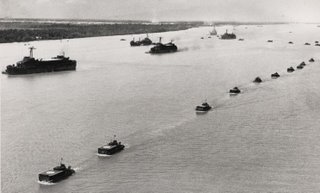
Following a week of training at the Naval Amphibious Base, Little Creek, Va., the ship put to sea for the Far East. After stops at Rodman in the Canal Zone and at Pearl Harbor, Benewah reached Vietnam on 22 April. Upon arrival, she became flagship for the Commander, Task Force (TF) 117, the Mobile Riverine Force operating in the Mekong Delta. Except for an occasional trip to Japan for repairs, Benewah spent the next 44 months at various locations in the Mekong Delta. In addition to serving as headquarters, she provided barracks space, medical facilities, stores issue, and a myriad of other services to the sailors and soldiers operating with the Mobile Riverine Force and with the similar formations that succeeded that organization when it was disestablished late in August of 1968. The barracks ship frequently suffered enemy fire, and her guns went into action on numerous occasions. In May and early June of 1970, Benewah participated in the incursion into Cambodian territory to support forces interdicting the Viet Cong supply lines running through that country.
Much more on her Vietnam service is told here, at a website devoted to her Vietnam service with the Mobile Riverine Force . How well did she serve? A list of her awards gives some indication:
She received many awards and decorations for her Vietnam service: the Vietnam Service Medal; Vietnam Campaign Medal; three Presidential Unit Citations; four Navy Unit Commendations; four Meritorious Unit Commendations; three Republic of Vietnam Presidential Unit Citations; and the Republic of Vietnam Unit Gallantry Citation. In addition, she earned fourteen Battle Stars for her service "in country" Vietnam, making her one of the most decorated ships of the Vietnam War.
Not to mention the Combat Action Ribbon...
Additional information here at the Mobile Riverine Force website:
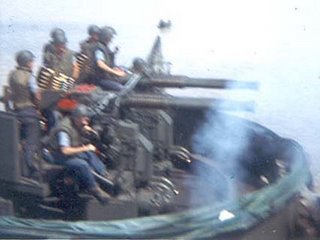
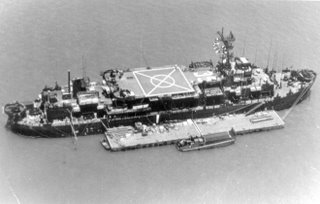
Although she was obviously not a candidate for cruiser or destroyer duty, she was a far cry from the commissioned in 1946. An APB’s original armament consisted of two 20 millimeter gun mounts. In 1967, Benewah was outfitted with two quad-barreled 40 millimeter mounts, two 3’/50 installations and 20 strategically placed 50 and 30 caliber machine guns. In addition, she was equipped with 25 fiberglass assault boats, which were utilized by Army troops who made her their base of operations. A large helicopter landing platform was also built over her superstructure which was used for deploying troops and receiving casualties.
***
She became the Flagship for Commander, River Assault Flotilla One, Mobile Riverine Force Task Force-117 and Commander, 2nd Brigade, 9th Infantry Division. After a short stay in Vung Tau, the Benewah moved up river and began a series of combat riverine assault operations in the Mekong Delta. When the Navy Boat Crews and the Riverine Infantry embarked, the ship’s company increased from 160 to 1150 personnel on board. She participated in all Coronado Operations from I-XI, and played a large role during the TET offensive in 1968, moving from one spot to another. The 10,000th helicopter landing was made on her deck in the Fall of 1968 by the 9th Aviation Battalion.
***
Though the Benewah was the first "Green Ship" to serve in the Mekong Delta, as part of the Mobile Riverine Force, she wasn't alone. There were three more APB's - USS Colleton (APB-36), USS Mercer (APB-39) and USS Nueces (APB-40). There were 5 ARL's - USS Satyr (ARL-23), USS Sphinx (ARL-24), USS Askari (ARL-30), USS Indra (ARL-37) and USS Krishna (ARL-38) and many APL's and YRBM's. (quoted from Albert Moore at MRFA site)
Heck, even John F. Kerry spent some time on an APB (shown with Willam Rood. Kerry has the RPG launcher).
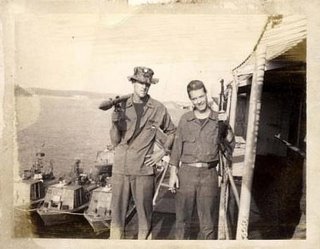
Nice bit of oral history here:
It was much more exciting when I shifted over to the Mobile Riverine Force The staff was headquartered afloat on a barracks ship in the middle of the My Tho River, about six miles west of My Tho. In addition to the CTF117 staff and the River Squadron (RivRon) 9 and 11 officers and boat crews, the barracks ship was the berthing ship for a few hundred U.S. Army troops of the [Second Brigade of the] 9th Division out of Ft. Hood, Texas.

The ship was the USS Benewah (APB-35). Positioning in the exact middle of the approximately 1,000-yard wide river was critical, because the banks and jungle along the river was not free of Viet Cong infiltration. Of course, in South Vietnam nothing was VC-free. The navigator and quartermasters on the Benewah learned their "positioning" lesson well, due to a life-threatening attack on the night of March 20, 1968. Because of suspected underwater sapper (VC intruder) activity, the Benewah had just been moved to what was deemed to be a safer location closer to the large U.S. Army base at Dong Tam, northeast of My Tho. The My Tho River was a bit narrower there, but thought to be safer. I was asleep, and awakened by a loud explosion. It was a little after midnight when the Benewah was struck by two 75-mm recoilless rifle rounds; one below the waterline and the other impacted on the 4th deck portside forward. The armor-piercing shell penetrated through four, steel bulkheads and exploded in the mess hall. The Benewah with its magazines loaded with ammunition and highly volatile fuel storage tanks was a juicy target, but on that night it was spared catastrophic damage.

In one of those miracles or quirks of war, no one was injured, because no one was having midnight rations at that time. This was unbelievable because the duty watch had just rotated, and most sailors usually cycle through the mess decks for coffee or a sandwich. But not on this night. There were no casualties. It didn't take very long to reposition Benewah to a wider and safer part of the river.
In retrospect, the "ugly little ship" I saw in Subic in the early '70s was a real fighting ship. And one whose crew deserve a salute for their service.

Photo of gun in action by Tom Duthie 4th/47th 1967 from the MRFA website. The photo of the "parade of ships" is of a pass-in-review honoring the awarding of the Presidential Unit Citation.

USS Neuces (APB-40) history.

UPDATE (8/1/06) And the battling YRBM-18.

Saturday, July 29, 2006

"Sudden turn" lawsuits begin


As predicted, the lawsuits in the "tilting" cruise ship matter, as reportedhere.


Additional info: here.

Malacca Strait Pirates kidnap Thai fishermen, demand ransom


Reported here:
Three Thai fishermen based in Kuala Perlis were abducted by pirates in the Straits of Malacca last Thursday.

The pirates have demanded a RM144,000 (400 million Rupiah) ransom for the fishermen who were kidnapped from two boats about 67 nautical miles from Langkawi.

UPDATE: Langkawi location map:

I'm shocked: "Pirates are real"


What is about piracy that it doesn't seem to sink in with people that it is a real menace to commerce and to lives? A report from the front lines here:
Attacks by all-too-real modern pirates have increased by 168 percent in the past 10 years. Armed with ship tracking systems, speedboats and rocket-propelled grenades (RPGs), these seagoing bandits are enjoying an unlikely renaissance.
***
Modern pirates use intelligence (often tip-offs from corrupt port officials), satellite phones and tracking technology to plan attacks on valuable cargo, but one tool of modern pirates remains the same: the rope and grappling hook. Storming a ship in motion requires special forces-style skills and many in the shipping industry believe some of the more sophisticated modern pirates are rogue military units. A relative absence of risk is also behind the rise in piracy, according to Newton.

"We don't carry armed guards and nobody is going to pursue you because it is international waters and no one has jurisdiction," he says. "Once they get on board, there is nothing you can do if they are armed and you are not. As captain, the last thing I want is for my crew to get hurt."

Another reason why piracy is so risk-free is that many victims fail to report the crime. Shipping companies would rather bear the loss of US$20,000 stolen from a safe than report it to their insurers and face a hike in premiums. Insurance premiums rose by 300 percent for vessels entering Yemeni waters after a suicide boat rammed into the Limburg, a French oil tanker, in October 2002.
***
According to Mukundan, naval vessels are willing to discourage pirates with a show of force, but rarely want to capture and detain pirates in international waters. The US navy recently caught and detained pirates who attacked a Thai fishing vessel near Somalia, but eventually had to release the men because neither the Thai government nor any other would put them on trial. Where ships have been seized and crews kidnapped off Somalia, shipping companies simply pay the ransom demands of pirate militia.

Just as traditional pirates can symbolize the inequalities of the early imperial era, so modern pirate activity is founded upon economics. About 90 percent of world trade is carried by sea. Cost-cutting has made modern cargo ships more vulnerable than ever to attack, according to Numast, the ship officers' union in London's East End.

Pay the Somali pirates; get crew released


Somali pirates release South Korean crew after ransom paid, it says here
Somali pirates released a South Korean fishing boat with 25 Asian crew, on Saturday, after a ransom of hundreds of thousands of dollars was paid.

"The illegal fishermen who unlawfully entered into the territorial waters of Somalia were released after they paid a fine of $800 000," elder Abdi Ilmi told AFP from Haradere, about 300km north of Mogadishu.

The released crew of the 351 ton Dongwon-ho No628, owned by Dongwon Fisheries, were kidnapped in April.
The effect of paying huge ransoms was not discussed, but I suspect it encourages more piracy.