VertRep

VertRep

Saturday, March 18, 2006

US CENTCOM 2006 Posture Statement


Email from CENTCOM suggested I take a look at the United States Central Command Posture for 2006. I have, and you can too, by clicking on the link.

Some highlights:
- U.S. forces will also continue to maintain an unmatched naval and air presence in the region that deters destabilizing activities by Iran, while safeguarding the region’s vital links to the global economy. As always, we must guard against and be ready to respond to the potential for strategic surprise and unwelcome developments, such as a major terrorist strike against oil infrastructure, a closure of one of the region’s strategic sea lanes, escalating political strife, or nation state expansion or support of terrorist activity. Given the ongoing volatility in the Middle East, the Horn of Africa, and Central Asia, these areas will continue to require considerable regional and international political, diplomatic, and military effort and focus in the years ahead.

-IV. GLOBAL COUNTERTERRORISM AND THE LONG WAR
Defeating al Qaida and associated ideological movements will require significant counterterrorism cooperation among our allies and partners not only within the CENTCOM AOR, but throughout the globe. It will also require the dedication of military, intelligence, and many other components of national power. Our network of allies and agencies will eventually defeat the al Qaida network, but we have yet to master the integration of national and international power to achieve success against this ruthless, borderless enemy. We have long experience with nation state warfare. We must, in the years ahead, learn to organize ourselves to defeat a stateless enemy capable of delivering state-like destruction without having state-like vulnerabilities. Defeating such an enemy requires a careful study of its clearly articulated strategy and vision.

-B. PRINCIPLES OF GLOBAL COUNTERTERRORISM AND THE LONG WAR
For the first time in our history, the principal enemy facing the United States is not another nation state – it is an ideologically-driven, borderless network. Such an enemy requires new thinking on how we organize and fight. Militarily, we will continue to kill and capture al Qaida leaders, shut down training camps, destroy operational cells, and prevent al Qaida and associated movements from exploiting ungoverned spaces. Certainly, such action requires precision targeting and highly sophisticated intelligence networks of our own. Nonmilitary measures to defeat al Qaida will be increasingly decisive in ultimately bringing about the network’s defeat. In order to counter its fanatical ideology and diminish its sources of strength, all elements of international and national power – diplomatic, political, economic, financial, the private sector – must be used to pressure the entire al Qaida and associated movement network over time.

-(Concerning Iraq) The terrorists and foreign fighters are the smallest but most lethal group. The al Qaida in Iraq (AQI) network, led by the terrorist Zarqawi, is the dominant threat within this group. AQI’s objective is to create chaos in Iraq by inciting civil war between Sunni and Shia through terrorist acts such as the recent bombing of the Golden Mosque in Samarra. Such mayhem, they believe, will topple the elected government of Iraq and drive Coalition forces from the country. This could enable AQI to establish safe havens for Islamic extremism within Iraq from which to launch terrorist attacks against other moderate regimes in the region. Zarqawi has pledged his allegiance to Osama bin Laden, and the goals of AQI support bin Ladin’s broader objective of establishing a Caliphate throughout the Middle East. AQI’s network is well-organized and funded. Its cellular structure permits recovery and retention of lethality even when key Zarqawi lieutenants have been killed and captured.

-(Concerning Afghniastan) The Taliban operates primarily in the southern and eastern provinces and Kabul. Its core supporters, mostly Pashtun, seek its return to power. The Taliban has demonstrated resilience after defeats. They appeared tactically stronger on the battlefield this year, and they demonstrated an increased willingness to use suicide bomber and IED tactics. While the Taliban remain very unpopular in most parts of the country, pockets of hard-core support remain. Taliban activities remain clearly linked to al Qaida funding, direction, and ideological thinking. The Taliban do not have the capability to exercise control over large areas of Afghanistan, but they are disruptive to reconstruction and reconciliation efforts. It is increasingly clear that Taliban leaders also use Pakistan’s FATA to organize, plan, and rest. Pakistani efforts to deny this safe haven, while considerable, have yet to shut down this area to Taliban and al Qaida use.

-(Concerning the Horn of Africa) The Horn of Africa is vulnerable to penetration by regional extremist groups, terrorist activity, and ethnic violence. Al Qaida has a history of planning, training for, and conducting major terrorist attacks in this region, such as the bombings of U.S. Embassies in Kenya and Tanzania. The volatility of this region is fueled by a daunting list of challenges, to include extreme poverty, corruption, internal conflicts, border disputes, uncontrolled borders and territorial waters, weak internal security capabilities, natural disasters, famine, lack of dependable water sources, and an underdeveloped infrastructure. The combination of these serious challenges creates an environment that is ripe for exploitation by extremists and criminal organizations.
More specifically, Somalia, a failed state in the heart of HOA, is a safe haven for East Africa al Qaida associated cells. There is also an increasing number of piracy operations that have been planned and launched from Somalia. In January 2006, our naval forces seized a vessel in the international waters off the Somali coast engaged in piracy. We will continue to monitor and, when necessary, take action against such destabilizing activities in the region.
Sudan remains a flashpoint of violence, particularly in the volatile Darfur region where over two million people have been displaced and an estimated 200,000 have been killed in the past three years. Ongoing peace talks there remain a challenge, and the potential for ungoverned space in Sudan to be exploited by terrorist groups is high. Additionally, the festering border conflict between Ethiopia and Eritrea has the potential to escalate into a full-scale war that would destabilize both of these countries, while potentially spreading instability throughout the Horn of Africa.

(Concerning Iran and Syria)
-A. IRAN
The situation with Iran is tense, and the possibility for miscalculation with U.S. forces remains high. CENTCOM forces in the region continue to watch Iran carefully to prevent any destabilizing activities that contribute to internal Iraqi or Afghan frictions, or threaten regional stability. Iran’s quest for nuclear weapons capability is particularly troubling. Iran seeks “creeping normalcy” that will permit international acceptance of its nuclear fuel cycle, while buying time for potential covert nuclear activities. We believe that Iran's declared objective of self-sufficient nuclear fuel production is coupled with the ulterior goal of weapons production. Iran’s withdrawal from the IAEA’s Additional Protocol or the NPT could decrease the timeline necessary to produce a weapon. A nuclear-armed Iran would dramatically increase instability in the region and could pressure other countries in the CENTCOM AOR to consider acquiring such weapons.
Iranian-sponsored activities in Iraq continue to be unhelpful. Iran is pursuing a multi-track policy in Iraq, consisting of overtly supporting the formation of a stable, Shia Islamist-led central government while covertly working to diminish popular and military support for U.S. and Coalition operations there. Additionally, sophisticated bomb making material from Iran has been found in improvised explosive devices (IEDs) in Iraq.
While generally thought to be for defense, Iran continues to build a credible military capable of regional power projection. It has the largest military capability in the region and a record of aggressive military action in and around the Arabian Gulf. Its power projection capabilities stem primarily from its navy and ballistic missiles. Iran’s military consists of over 350,000 personnel with an additional 300,000 trained reserve/Basij Forces that could be mobilized in times of crisis. The Iranian Armed Forces include two distinct, parallel military organizations – the Islamic Revolutionary Guards Corps (IRGC) and the Regular military forces. Each controls its own ground, naval, air, and air defense forces and equipment.
In addition to defending against external threats, the IRGC also focuses on an internal security mission and is the lead Iranian agency for supporting terrorism. Competition between the IRGC and Regular forces for limited resources and competing chains of command make Iranian military intentions difficult to decipher. This heightens our concern for the potential for miscalculation with U.S. forces in the region.
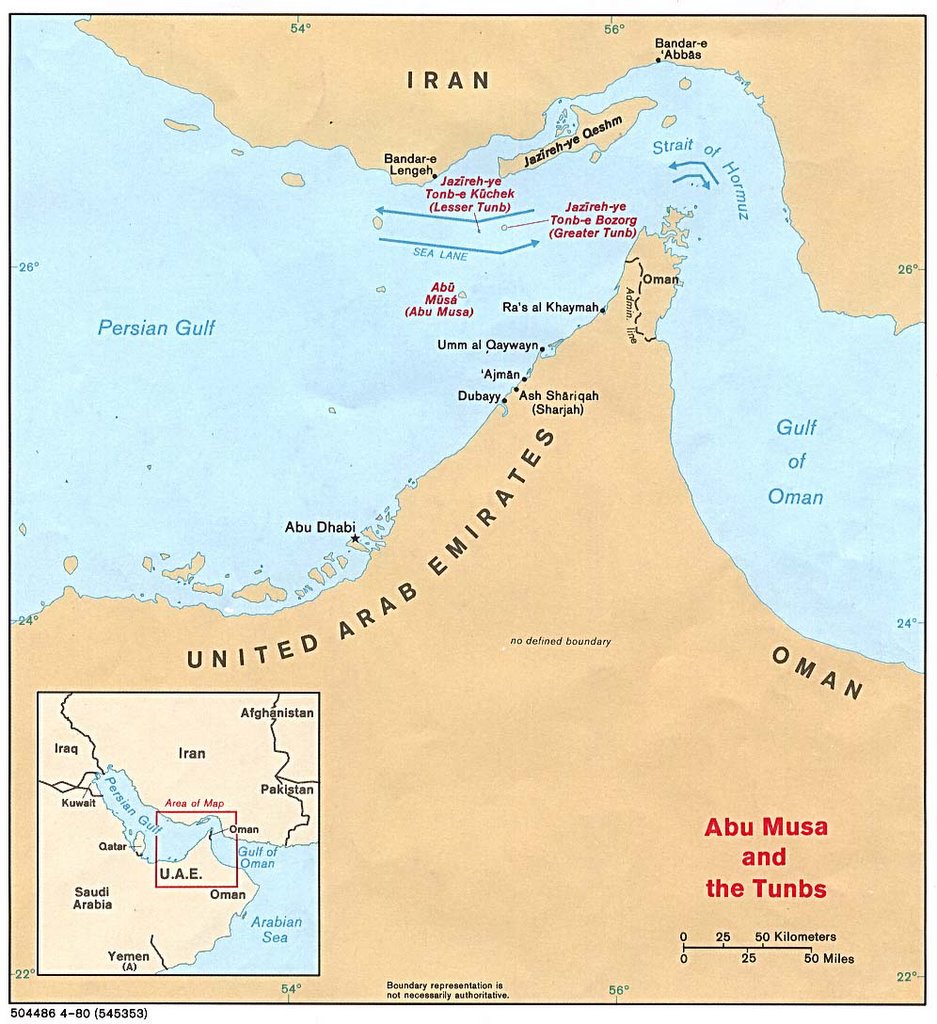
Iran’s ground forces are arrayed across the country with the majority of combat power along the Iran-Iraq border. The Iranian navies continue their rapid growth. The IRGC Navy has been developed primarily for the Strait of Hormuz scenario in which Iran would attempt to "internationalize" a conflict by choking off oil exports through the Strait. To disperse large quantities of recently purchased small boats, high speed missile boats, torpedo fast attack craft, and midget submarines, Iran has embarked upon an expansion project for naval bases throughout its littoral. Asymmetric military strategies and naval force modernization, a key national priority, enhance Iran’s capability for power projection in the region.
The IRGC Air Force maintains control over most of Iran’s ballistic missiles and rockets. The accuracy and reliability of its rocket systems vary, but Iran is capable of targeting all Gulf States, the Arabian peninsula, Israel, and U.S. and Coalition forces in the region with little warning.
In addition to Iran's conventional and ballistic missile capabilities, another lethal aspect of Iran's power projection is its ties to regional and global terrorism. Iran remains on the U.S. State Department's list of state sponsors of terrorism and provides extensive support to the Lebanese Hezbollah and several Palestinian rejectionist groups. Along with this support comes influence. Additionally, Iran's own intelligence elements are stationed throughout the CENTCOM AOR and beyond and are trained and prepared to execute terrorist attacks at the direction of Tehran.

-B. SYRIA
Despite reports of stepped-up activities by Syria’s security establishment to interdict foreign fighters moving into Iraq, Syria remains the central transit point for al Qaida’s foreign fighter and suicide bomber network, which is responsible for the deaths of thousands of Iraqi civilians. As a repressive authoritarian state, the Syrian government has the capacity to do more to pressure the extremist network moving through its country. Moreover, it has done little to suppress the Iraqi Baathist insurgent and financial networks that continue to attack Iraqi government officials, infrastructure, and military forces. Syrian support for Iranian meddling in Lebanon, and its own intelligence and intimidation activity in Lebanon, show Syria’s establishment to be unwilling to play a constructive role in regional security.
CENTCOM has a lot on its plate and it all is dangerous.

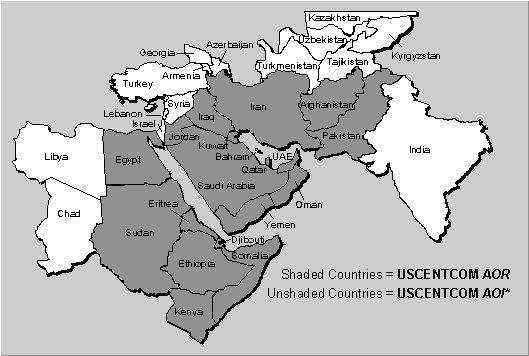
CENTCOM map from here.

UPDATE: I see Lex posted on this a couple of days ago, which goes to show that I should (a) check my email more often and (b) visit Lex's site more often. On the other hand, I am but a retired SWO reservist and I included a free map (liberated for your benefit). By the way, Lex is always worth reading...

Familiar headline: "UN ship attacked off Somalia"

Somalia's pirates are attacking food relief shipping again, as reported here:
"About five pirates armed with machine guns and rocket-propelled grenades tried to hijack the UN-chartered ship."

He said the attack took place off the Somalian coast on Monday after the ship had discharged its cargo.

The MV Rozen, which was on its way to Kenya, transported food rations for the World Food Programme (WFP) to drought victims in Somalia. Choong said the ship managed to out-run the pirates and also rammed their vessel.
I believe this is the same attack reported here.

Meanwhile the UN urges action, but falls short of doing something useful. Like, say, organizing something...

Port security: Now that we see a problem, let's throw money at it

Peported here:
Citing a critical lack of security against terrorism at the nation's ports, two members of Congress on Friday outlined a $4 billion plan to conduct background checks on port workers and inspect all container cargo coming into the nation, among other measures.
Rep. Dan Lungren, R-Sacramento, a Long Beach native, toured the Port of Long Beach with a delegation of local, state and federal officials to study current security measures and push his SAFE Port Act, which earmarks $800 million annually over five years to increase security...

Lungren, who represented Long Beach's 34th District for 10 years before becoming California Attorney General under former Gov. Pete Wilson, said the recent controversy over the failed takeover of several East Coast ports by a Dubai-owned company increases the chances of the SAFE Act being passed.

"Perhaps the only good thing to come out of that controversy is a refocus on the issue of port security," Lungren said. "It re-injects a sense of urgency to this task."

The bill does not address fishing vessels, pleasure boats and other small watercraft, Sanchez said.

Thursday, March 16, 2006

India to expand presence in the Andamans


Reported here:
India will soon start a major expansion of its military presence in the remote Andaman and Nicobar Islands, a year after the Asian tsunami wrecked defence bases there, a top commander said on Thursday.

The plans include construction of three new air bases to add to the one existing base, increasing coast guard troop levels and strengthening infrastructure at old facilities in the strategically vital archipelago in the Bay of Bengal.

"Our expansion plans are totally transparent and the defensive measures are being taken to ensure the safety and security of the islands only," said Vice-Admiral Arun Kumar Singh, commander-in-chief of the Andaman and Nicobar Command.

"We have found an unused 3,000-feet (900-metre) World War Two runway in very good condition in Kamorta (island), which we are planning to develop soon," Singh told Reuters by phone from Port Blair, capital of the island group, referring to one of the three new air bases planned.

Two other air bases would be built in Diglipur and Campbell Bay after small airstrips there are lengthened to handle large transport and fighter aircraft, he said.

The Andaman and Nicobar islands are located about 1,200 km (750 miles) east of the Indian mainland, close to the Malacca Strait, the main sea lane between the Indian Ocean and the South China Sea leading to the Pacific.

India has an air and naval bases and listening posts across the archipelago as it considers the sea routes vital to its security and to guard against what some defence experts say is China's increasing interest in the region.

Sea routes in the region are known to be used to ship weapons destined for rebels in northeastern India, Myanmar or Bangladesh and drug smuggling. They are also prone to smuggling, piracy, poaching and illegal immigration.
And India is not alone in securing some outlying posts. Indonesia is sending some marines to secure islands it claims as reported here:
The Navy is ready to dispatch marines to secure six outlying islands it fears could be claimed by Indonesia's neighbors or be sold illegally to foreigners.

Marine Corps commander Maj. Gen. Safzen Noerdin said Wednesday forces were ready to be dispatched to the islands at any time should Indonesian Military chief Gen. Djoko Suyanto give the order.

The troops would be deployed at Rondo island north of Aceh; Berhala island bordering Singapore and Malaysia; Sekatum in the Strait of Malacca; and Marore and Miangas islands in Northern Sulawesi, Antara reported.
Common thread? Sea lanes, especially the Strait of Malacca.

Earlier post on the Andaman Sea sea lane here. Red arrow on the map points to Andaman and Nicobar Islands area.

But the State of North Carolina is good...

Got to love the headline: State of Pig Farms is Awful, Says CM.

Actually, the State of North Carolina has it own issues with hog waste.

Contest winner?

I wonder if someone at UPI won a contest over whether it was possible to put the UN and "international intelligence" in the same piece as was done here?

Oh, and by the way, Somalia has a parliment. Sorta.

UN. Intelligence. Tee hee.

Tuesday, March 14, 2006

Some good thoughts on bad ideas for port security

Smart observations here.

Another bad idea is to let Senator Schumer anywhere near anything related to a port. As if he could find one on his own.

Remember the "manifolds!"

Radio Netherlands notes upcoming Dutch handoff of CTF 150 to Pakistan

As found here:
For the first time an Islamic country is taking command of one of the units of operation 'Enduring Freedom'. On 24 April the Dutch hand over control of the multi-national naval unit 'Combined Task Force 150' (CTF 150) to Pakistan. CTF 150 is an important part of 'Enduring Freedom', the US-led coalition operation against al-Qaeda and related terror networks.

Shortly after the attacks of 11 September 2001, CTF 150 was set up and since 12 December has been under Dutch command. The area of operation is huge: from the Strait of Hormuz and Pakistani territorial waters in the north, via the Red Sea, the Gulf of Aden and southwards to Kenya and the Seychelles.

The most important task is to prevent terrorists using the sea to launch attacks or transport people and weapons. One important second goal is for the countries in the region to become involved with CTF 150. However, formal participation in this unit is still sensitive in the domestic politics of most Islamic countries.

It's hoped that after Pakistan, other Islamic countries will follow. The current command-holder of CTF 150, Dutch commodore Hank Ort, sees Saudi Arabia as a good example of a country with whom they are going to have discussions. Another country that has expressed an interest is Kenya, and there will also be talks with countries like South Africa, Egypt and the United Arab Emirates.

Somali pirate target fights back- rams pirates

Briefly noted here:
THE master of a general cargo ship attacked by pirates off Marka, east coast of Somalia, yesterdays rammed the gang’s boat as it tried to come alongside..

According to the latest weekly report from the ICC International maritime bureau the armed raiders chased the cargo ship underway and fired at the vessel leaving bullet holes in the bridge, lifeboat and superstructure. There is no information on what happened to the pirates.
Also noted in the ICC CCS Weekly piracy report here.

Ethiopia: Food aid troubles

A challenge for the successful countries of the world is how to assist without doing more harm, as reported here about Ethiopia:
Woldu - and now the aid community - have generally accepted that while vast sums of international support are needed to save lives, that help carelessly applied can make things worse rather than better over the long term.

There are two problems: firstly, that any large-scale intervention by definition distorts local economics.

"We import huge amounts of grain from abroad. So this will inevitably affect the internal production and markets," said the Deputy Prime Minister Addisu Legesse.

When foreign aid lands, local prices collapse, and farmers who have managed to produce a surplus find their crop is virtually worthless.

They have no money to pay for seed or fertiliser for the following year.

The US government's Agency for International Development (USAid) is one of the main suppliers of food aid.

Yet privately even senior officials within the department recognise its negative impact.

"But we can't change without congressional approval, and Congress doesn't want to lose the support of Kansas farmers who sell to the government," said one who spoke off the record.
Obviously, more nuance is needed.

UPDATE (3/15/06): Chap has more on "aid" programs here and at the links he provides. I am not sure, based on my experience, that Africa is really all that different than other aid recipients scattered about the earth. Kosovo comes to mind...

New advisory from Maritime Liaison Office Bahrain

Found as MARLO Advisory Bulletin 03-06� - 14 March 2006:
Although the frequency of pirate attacks off the Somali coast has diminished, they are still occurring. Below we have provided some information not previously provided in MARLO Advisories, as well as some reminders from earlier advisories.

Pirates have operated at night and have cued in on ship's lights. Vessels traveling off of the coast of Somalia should use the minimal lighting that will ensure compliance with International Rules of the Road and safe navigation practices.

History of attacks suggests that: primary danger area is between latitude 0200N and 0400N, secondary danger area between 0400N and 0800N. Recommend increase in vigilant watch standers when transiting these latitudes off Somalia.

Merchants should keep their Automated Identification System (AIS) on during transits.

Merchants should keep their radar on, and should open the distance when they detect any approaching vessels on radar.

The pirates have used small boats / skiffs as well as captured dhows and fishing vessel as motherships to serve as a floating base to launch pirate attacks. Avoid all close approaches from any small boats, fishing vessels or dhows.

The Pirates have operated as far as 210 NM from the Somali Coastline by employing a mothership to stage from.

It is believed that in earlier operations, the pirates used distress calls to attract good-natured mariners to the area of attack, they could return to this tactic.

Vessels with a freeboard greater than ten feet (3.5 meters) have a much greater chance of successfully escaping a piracy attempt...

Sierra Leone gets some Chinese help


Reported here, some undemocratic concerns and:
The president said that Sierra Leone has been having problems with piracy, which makes the country's marine resources insecure to pirates.

He described the arrival of the Chinese donated gunboat as timely, adding that it will help reduce smuggling of fish noting that the boat has the capacity to protect the entire zone at high sea, running from Guinea to Liberian borders.

He said this is not the first time the Chinese government has donated gunboats to Sierra Leone and described the former as a true friend and reliable partner.

The donated boat has military fatigues, spear parts (sic) and other military gadgets.

Chinese Ambassador to Sierra Leone on behalf his government, handed over the boat to the government of Sierra Leone.

He said China would always be a close friend and reliable partner to Sierra Leone.

Security heating up in Southeast Asia sea lanes


Reports from Malaysia - Navy to test missile and the Philippines - Philippines says plans to tighten southern border- point out the ongoing security challenges and improvements in the vital sea lanes off those countries.

The Philippines initiative is pretty broad:
The Philippines plans to force all vessels to use designated sea lanes along the borders with Malaysia and Indonesia to deny Islamic militants easy access to its restive Muslim areas, the defence secretary said on Monday.

Avelino Cruz said the Australian government was also helping Manila establish a coastal watch system in the southern Philippines to improve border controls around its 7,100 islands.

"Our Philippine Navy and Coast Guard ships would board and inspect all vessels and watercraft that would be passing outside a delineated maritime route," Cruz told a briefing for foreign journalists.

"We would be putting up a system to monitor all ships in the area."

At more than 36,000 km (22,300 miles) long, the Philippine coastline is seen as a weak link in the Asian war on terror with militants exploiting a multitude of private inlets and the navy's lack of equipment to evade capture.

"It's all about OIL!" Nigeria as quagmire prediction from "liberal" media

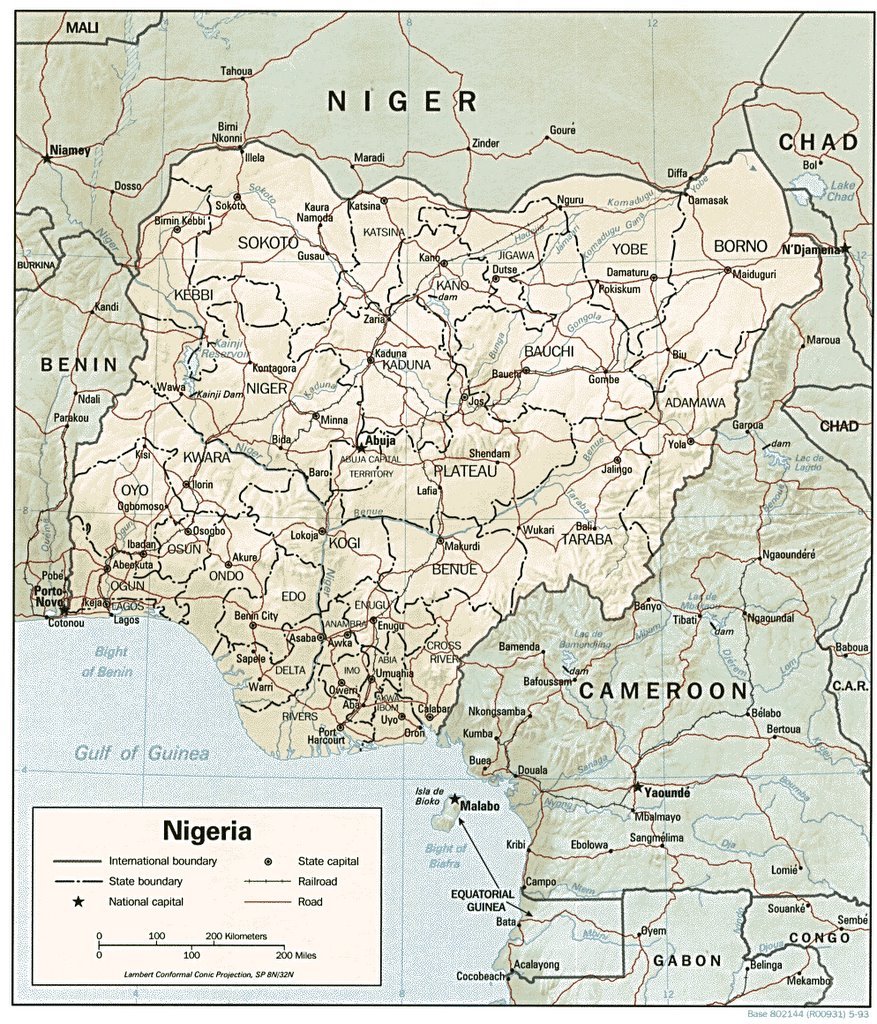
Alternet poses the question: Nigeria: The Next Quagmire?. After all, it's all about OIL!
If U.S. troops go to Africa, it won't be for a humanitarian intervention; it will be to protect American oil interests in the troubled Niger Delta.

...Nigeria might be the next Iraq.
Or, as the piece warns, an "African Vietnam." I sure wish the left would get some new anologies.

However, ponder these paragraphs:
Putting American troops at risk in Africa would be a big change -- and speaks volumes about the new relationship between America and the sub-Saharan Africa. Ever since American troops were killed in Somalia early in the presidency of Bill Clinton, a firm rule of U.S. policy toward Africa has been to never put U.S. soldiers on African ground. For more than 10 years, American troops have studiously avoided intervening directly in African conflicts. This policy prevented the United States from trying to halt the genocide in Rwanda in the mid-1990s. More recently, this stance stopped the United States from using troops to restore order to Liberia. The policy may also stop the United States from sending troops to Nigeria.

But maybe not, because the purpose of an intervention in Nigeria would be to protect American oil -- not save lives in a humanitarian spirit. Oil drives American foreign policy as never before, and the Middle East isn't the only troubled oil-producing region. Nigeria is already one of the top-five largest exporters of oil to the United States, and the country's oil-producing region, the Niger Delta, is beset with insurgencies and criminality, some of which is directed by factions in Nigeria's own government. Two Nigerian rear admirals were court-martialed last year for their part in the attempted theft of thousands of tons of Nigerian oil by an international crime syndicate operating in Russia and eastern Europe.
Rwanda genocide occurred in 1994. Somalia "Balckhawk Down" 1993. An interesting take on the lessons of Somalia here:
Arguably, Somalia does not offer an ideal test of either the Bush concept of limited humanitarian intervention or the evolving concepts of expanded peacekeeping and peace enforcement based on the use-of-force authority provided in Chapter VII of the U.N. Charter. The Somalia "failure" was less a failure of either humanitarian intervention or muscular peacekeeping than a failure to apply them steadily and wisely. The failure was of another order: strategic confusion followed by a collapse of political will when the confusion led to combat casualties.

In Cambodia, Central America, Namibia, and now Mozambique, U.N. operations have unquestionably given war-torn lands a chance to get on their feet. These were complex operations conducted successfully under wide-ranging mandates. But the United Nations' attempt at a militarily challenging "peace enforcement" operation shows that it cannot manage complex political-military operations when its own structure is an undisciplined and often chaotic set of rival fiefdoms that resist unified command and control in the field at both the civilian and military levels. Basic change is needed on the issues of delegation to the field, unity of command in the field, and professional military backstopping and oversight from U.N. headquarters. We already knew these things about U.N. reform. After Somalia, we know them even better.

Equally important, Somalia underscores the need for improvement in the way the United States -- the United Nations' leading member -- defines missions, reviews and approves peacekeeping mandates, and approves U.N. force levels and budgets. The United States and the United Nations overreached in Somalia when they expanded the initial mandate without providing the means to carry it out. They failed to resolve a raging debate over whether and how to disarm the Somali factions. In the end, of course, the United States refused to take on that task before handing it off to the U.N. command. UNITAF probably could have done much more to demilitarize and disarm Somalia if the United States had been prepared to make the necessary forces available for a longer period and had maintained effective working relationships with the Somalis.
Also some "lessons learned" here.

More to the point, it will come as a surprise, I assume, to the US troops at work in the Horn of Africa today that the US has completely avoided Africa since Somalia.

Further, it begs the question of the number of US interventions in Africa prior to Rwanda (to which we ultimately did send some troops, by the way). Historically, the US has not been active in Africa.

However, when some activity was beginning, at least one article from 1998 suggested that the US might be "stumbling toward neo-colonialism."

Strait of Malacca safer

Reported here:
The Strait of Melaka, among the world's busiest shipping route, has been free of crime since last October and is the testimony that the waterway is now safe.

The Director of the Maritime Enforcement Coordination Centre (MECC) Admiral Abdul Hadi A. Rashid said only 11 maritime crimes occurred up to September 2005 compared to 37 cases for the whole of 2004.

Abdul Hadi attributed the crime free scenario for the last five months at the 900 kilometer long strait as the outcome of concerted enforcement efforts taken by various maritime enforcement agencies.

Monday, March 13, 2006

Al Qaeda warning?

Well, we've been warned again. See here and here ("chatter on AQ net is high"). Blah. Blah. Blah.

Anyone panicked about the attacks who has tickets to the NCAA Final Four or regional games and is afraid to use them because of this latest threat is invited to donate their tickets to the USO or some other organization that might get them to deserving troops or to other first responders...

Just a thought.

UPDATE: Much deeper thinking over at ThreatsWatch with this thought:
All analysis aside, the observable public reaction thus far to this threat has not been one of deep introspection as the author may have hoped, though surely did not expect. Similar to the reactions to the beheadings referred to above, the reaction to this threat has been one of defiance, similar to the reaction in London where people made signs and wrote internet postings saying simply, “We are not afraid”. This is important, as nothing can replace firm resolve in the face of threats.
Cautious, but unafraid, that's the ticket.

UPDATE2: ROFA Six suggests an outcome of an attack at the end of this.

UPDATE3: InstaPunk offers up a choice of dooms. Bon chance!

Gasp! Foreign ownership of defense-related hulls

Reported here:
Three-fourths of the cargo ships in a special fleet carrying vital supplies to US military forces are owned by foreign companies, raising concerns about the lack of American-owned vessels to help the Pentagon in a global crisis, according to government records reviewed by the Globe.

The foreign ownership of cargo ships that deliver rocket launchers, attack helicopters, high-tech safety gear, and other equipment to US troops around the world has received relatively little notice. But the arrangement, under which each ship receives a $2.6 million annual subsidy, is coming under new scrutiny as a result of the furor over the now-canceled plan to have a Dubai-based company take over management of six US ports.

Representative Gene Taylor, a Mississippi Democrat whose district includes major shipbuilding facilities, said Pentagon officials offered assurances when the subsidy program began a decade ago that few of the cargo ships in the US Maritime Security Program would be foreign owned.
But with so many vessels in the program now under the control of four foreign companies, Taylor said he wants Congress to require all cargo ships that supply US military forces to be owned by US companies. Taylor said the military would be vulnerable to a cutoff of crucial supplies if a foreign-owned vessel suddenly pulled out of the program.
Hmm. Rep Taylor is from a shipbuilding area? Hmmm.

UPDATE: More on prepositioned ships here. Some are under long term charter by the US and, in fact, the owners may be foreign corporations, like Maersk, which is Danish in origin, but world-wide in operation. Last time I checked, the Danes were considered our allies. US-Maersk contract info here.

Yemen worries about piracy

Reported here:
Continued piracy in the Gulf of Aden and in the Arabian Sea is threatening Yemen's fishing industry, said a high ranking official.
"Sea piracy is threatening the stability of the Gulf of Aden and the Arabian Sea," said Foreign and Migrants Affairs Minister Abubakr al-Qirbi. "Our coast guard and marine forces are on the alert to take necessary action against such piracy."
Al-Qirbi pointed out that pirates represent a threat to both tourist cruises and international shipping in the region. "Our problem is the threat they pose to our fishermen as well, and their role in the trafficking of people, drugs and weapons," he added.
Earlier post on the Yemeni Coast Guard here.

Thomas Barnett in a nutshell

Interested in the Pentagon's New Map or Blueprint for Action by Thomas Barnett? An interview that contains a quick summary and more here . I'm reading through BFA now.

Sea lanes and the Philippines, Malaysia and Indonesia


Sea lanes and the threat of terrorism are on some regional minds as reported here:
The Philippine navy and its counterparts of Indonesia and Malaysia are set to establish securesea lanes in a bid to strike terrorists, pirates and international criminals in international waters, Defense Secretary Avelino Cruz said on Monday.

Cruz told reporters that a "close watch south" program will be launched in the next few months, using the traditional sea routes linking Mindanao Island, southern Philippines to Indonesia and Malaysian archipelagos.

"If any sea vessel get out from the required sea lanes linking Philippines, Malaysia, Indonesia down south to Australia and New Zealand, it will be strictly inspected and searched," said Cruz, as he stressed the importance of tight joint sea border patrol to apprehend potential terrorists and pirates preying on big commercial and passenger ships in international waters.
An older post on vital sea lanes for Asia here.


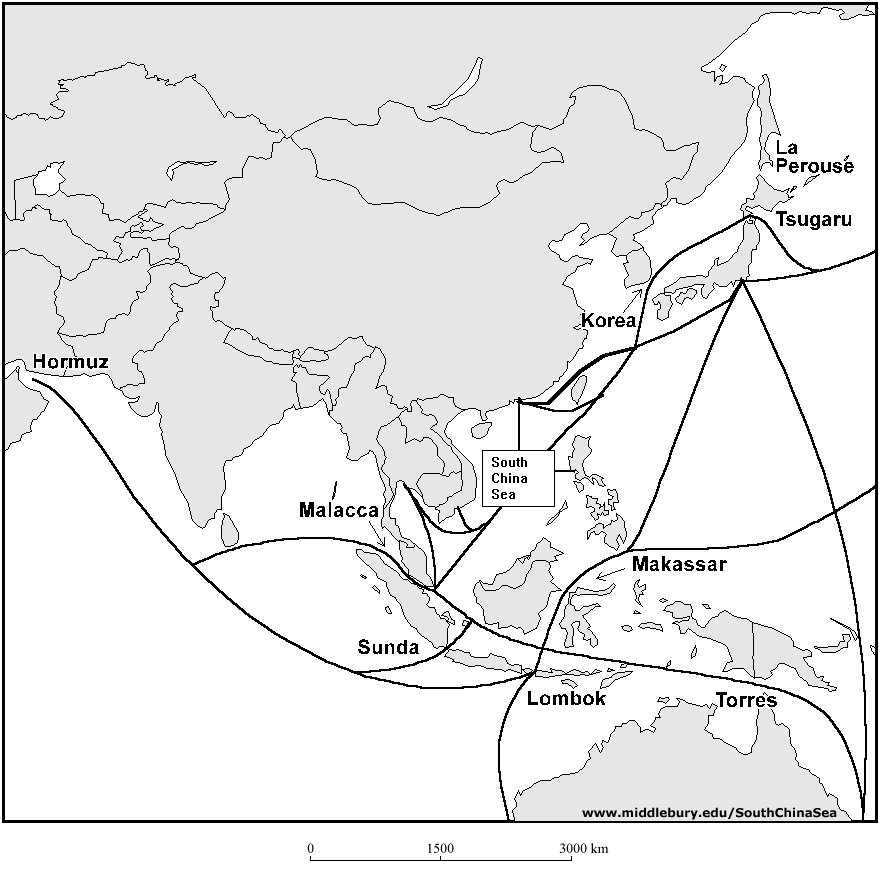
Top map is of major Asian sea lanes (attributed to US Pacific Command). Lower map is of vital sea lane areas in dispute in the region. Links to both found here. China, of course, is very interested in keeping its vital sea lanes open...

Click on maps to enlarge.

The war with Iran: Iran as terrorism central

Article here sets out the case of Iran as the international center of terrorism.
Since the 1979 Islamic Revolution and the establishment of a conservative theocratic government, terrorism has been a key part of Iranian attempts to foster revolution within the Muslim world. 'For Iran, revolutionary terrorism has been the business of the state since 1979,' Dr. Christopher Harmon, Marine Corps University, said.

The Iranian promotion of terrorism incorporates a range of strategies. The cultivation of close-bilateral relations with other dubious states has been of central importance.

During the 1990s, Tehran deepened its political and military involvement in Sudan. The country has served as a convenient bridgehead for the transportation of Iranian fundamentalism into Africa. According to James Phillips, Research Fellow for Middle Eastern Affairs at the Heritage Foundation, Sudan 'became a new Lebanon where Iranian Revolutionary Guards trained Sunni revolutionaries in acts of violence.'

More recently, Iran has increased its links with the isolated North Korean regime, a fellow member of President Bush`s `axis of evil`. Pyongyang has sold Tehran ballistic missile technology which could be used to deliver weapons of mass destruction.

In addition, Iran is also directly funding militant Islamic groups. Tehran has long allied itself with the militant Palestinian group, Hamas. Indeed, in a viewpoint displayed on his official website, Ayatollah Khamenei states, 'the Palestinian problem is the problem of the Muslim world. Whether we know it or not, the fate of Palestine is the fate of us all.'
Not much of a surprise, but we're a little slow in recognizing the war being waged by Iran.

Sunday, March 12, 2006

Semi-annual report: North Korea says U.S.planning invasion

About every six months, the DPRK announces that the US is planning an invasion. Ho hum.

Video: Four pound (2 kilo) UAV in action


Okay, this is way cool. Wish we'd had this when I was a young pup.

From the friendly folks at Centcom...

More on the Raven UAV here.

USS Ardent lends a hand


Reported here:
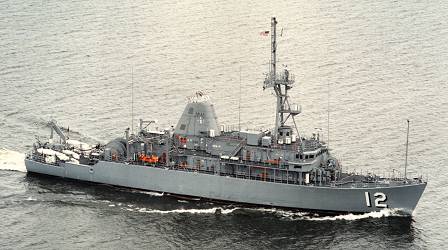
While conducting maritime security operations (MSO) in the Arabian Gulf, March 6, USS Ardent (MCM 12) responded to a distress call by an Iraqi-owned commercial vessel.

Ardent arrived on scene after the crew of Motor Vessel Gulf Queen reported via bridge-to-bridge radio that the vessel was dead-in-the-water with no topside or navigational lighting visible. The Avenger-class mine countermeasure ship deployed two rescue and assistance teams (RNA), which performed a security sweep of the crippled ship and conducted an assessment of its electrical and engineering conditions as well as the welfare of the crew.

According to Engineman 2nd Class (SW) John Porter, Gulf Queen's engine equipment was extremely degraded.

“The ship had no means to repair itself due to the lack of personnel, technical knowledge and few spare parts,” said Porter, who hails from Salina , Kan.

Saturday, March 11, 2006

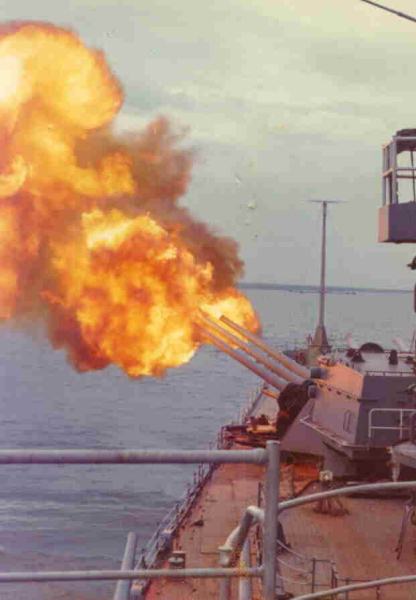
USS Newport News (CA-148)


A heavy cruiser in action. "Thunder" was her call sign and her eight-inch guns could light it up.

Vist her webpage here. Donate some money to the crew of a fine ship.

Where is the military headed?

Read this. The Navy rediscovers the world of shipping:
The Navy has the expeditionary model of warfare ingrained in its culture, but it is far from perfect and is also looking at major changes in the future, said Navy Rear Adm. Peter H. Daly, commander of Carrier Strike Group 11.

More than ever, the Navy is recognizing the importance of sea power, Daly said. People tend to assume ships at sea will be unmolested by enemies, he said, but the amount Americans depend on the sea requires leaders to be more vigilant.

"The fact is, is that a huge proportion of U.S. trade -- over 90 percent -- travels by sea," he said. "(About) 2.2 billion people in this world live 100 kilometers from the shore. Fifty thousand tankers out there carry 60 percent of our oil, and if we had to live without it, we'd be having a very, very bad day."

Americans shouldn't have to worry about the maritime environment, and that's where the Navy comes in, Daly said. But the key to the Navy's success is cooperation and help from partners inside and outside the U.S., he said. "For the first time, we're seeing synergy with other nations that we've talked about having for 10 or 15 years," he said.

The international community is coming together to deal with maritime issues like piracy, illegal drugs, human smuggling, weapons of mass destruction, and environmental issues, Daly said. It's sometimes hard to match the capabilities of the U.S. Navy with other countries, but cooperation is important, so Navy leaders have been developing partnerships and trying to increase other nations' capabilities, he said.

The Navy also is shifting from doing mostly sea-based operations to other areas, Daly said. In the Central Command area of operations, 10,000 Navy personnel are on the ground, performing missions such as detainee operations, air ambulance support, provincial reconstruction teams, and intelligence operations, he said. The Navy also is expanding its ability to do expeditionary operations, such as river operations, and civil affairs, he said.

The Marine Corps will be partnering with the Navy to provide an important joint capability to all the services, said Marine Col. Timothy C. Hanifen, director of the capability development directorate at Marine Corps Combat Development Command.

Sea-basing is a naval and national capability that will give the U.S. an option to enter an area when access to air bases or ports is not available, Hanifen said. A Marine pre-positioning force will join with an amphibious force to form a sea base from which personnel and equipment can be flown to an advance base, he said. This will be an important capability to make the force even more versatile to meet the changing threats of the 21st century, he said.

Chinese to build a new aircraft carrier?

Maybe. Reported here.

Earlier post on possible conversion of Russian carrier Varyag here.

Mystery diver causes stir in Australian port

Reported here:
VICTORIA police were placed on security alert today as a mystery diver swam near the Spirit of Tasmania, triggering an evacuation of a Port Melbourne pier.

The scare occurred just four days before the opening of Melbourne's Commonwealth Games, in which organisers have stepped up the monitoring of terrorist threats.
A Victoria Police spokesman said an unknown diver was spotted about 3.50pm AEDT swimming near Station Pier.

Water Police and a search and rescue squad were called in to investigate the "security incident", police said.

The Spirit of Tasmania, the ferry travelling between Melbourne and Devonport in north Tasmania, was searched by Australian Federal Police (AFP) as well, Christina Koullas, the ferry's spokeswoman, said.

People near Station Pier were evacuated as police swept through the ferry and a neighbouring ship, the Saga Rose.

"It was a security precaution that was undertaken after the diver was seen in the water," the police spokesman said.
Hmmm.

Pirate gangs in Malacca crippled by law enforcement

Reported here:
Police have crippled four gangs of pirates preying on ships in the Melaka Strait in ongoing operations to maintain security in the waterway, said Deputy Inspector-General of Police Datuk Seri Musa Hassan.

He said the enforcement efforts had reduced the incidence of piracy in the strait.

Milosevic Found Dead

SIxty-four years old and the architect of the "purification" of Serbia and the chaos that ensued, Slobodan Milosevic dies.

I am not in mourning.

Friday, March 10, 2006

The war with Iran and the new "Oil War"


In case you hadn't noticed, it's already here! See here:
Iran is already in a war against the United States, an unconventional conflict that is largely overlooked or unacknowledged amid the growing friction over Tehran’s efforts to obtain nuclear weapons.

And, not too surprisingly, it ties into the al Qaeda plan for an "oil war." Read this:
In the manifesto, which was recently posted on an Islamist website, Enezi said disrupting oil supplies was the best way to hurt the US economy and destabilise the Saudi royal family.

The document said Saudi state-owned refineries and oil pipelines and Iraqi facilities were “all in the hands of infidels”.

“It is permissible to target oil interests held by infidels ... including American and Western oil tankers,” Enezi said.
Iran threatens to close the Strait of Hormuz if it doesn't get its way in international relations (today's issue is the nuclear one, tomorrow's issue will be- whatever it wants). Nigeria's oil area is under terroristic attack that may be related to al Qaeda. Attacks (however weak) on Saudi oil facilities begin. A French oil tanker is attacked in what may have been a "proof of concept" attack. Venezuela, headed by a full bore whack job, threatens oil production cuts and urges OPEC to do the same.

Of course, our Congress is too busy protecting our "security" at the ports to really look after our security by offering up serious incentives for alternaitve fuels, opening ANWR, encouraging oil shale development, and demanding the Navy quit lusting after multi-billion dollar useless ships and get serious about a lean, substantial and very mean littoral force to help check Iran in the Arabian Gulf.

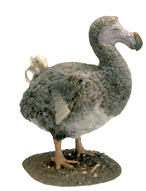
Congress wins an EagleSpeak Dodo award


Read the editorial titled Happy Now?, add a few more degrees of disgust and cynicism and you'll come close to my feelings on the UAE port terminal operations deal and our Congress's role in it.

And, by the way, could we just insult our moderate Arab allies a little more? Our troops are not having too easy a time trying to build trust... (UPDATE4: CDR Salamander offers up this quote from General Abizaid:
"I am very dismayed by the emotional responses that some people have put on the table here in the United States that really comes down to Arab and Muslim bashing that was totally unnecessary," Abizaid, who just returned from Iraq for meetings in Washington, told reporters.)
As the Post editorialist put it:
But our brave new Congress has achieved more than the irrational spiking of one business deal. It has also sent a clear message to the Arab world: No matter how far you move along the path of modernization and cooperation, Americans may be unable to distinguish you from al-Qaeda. Dubai welcomes hundreds of ship visits every year from the U.S. Navy and allied ships. It has worked with U.S. agents to stop terrorist financing and nuclear cooperation. But none of that mattered to the craven members of Congress -- neither to the Democrats who first sensed a delicious political opportunity nor to the Republicans who then fled in unseemly panic. As to long-term damage to the United States' security, economy and alliances? Not of concern to the great deliberative body.

No one should underestimate the potential damage. Any government in a Muslim-majority country will have to ask itself: Why take the risk of friendship? If governments find no good answer to that question, the fight against radical Islamic terrorism will suffer. Meanwhile, Arab investors may think twice before putting their money in a country where their companies risk expropriation. With the price of oil so high, Arabs are rapidly becoming a major supplier of foreign capital. This isn't a good moment for Americans to discourage foreign investment, given the nation's dependence on foreign capital (see: Congress, drunken spending by). Nor will the message -- that foreign ownership was unobjectionable when it was British but intolerable when it was Arab -- do much to advance U.S. efforts to promote equitable investment rules for its own companies abroad.
It's not often I agree with the WaPo editorial page, but this one they got right.

For their short-sighted and ill-considered actions in this matter, the entire collection of modern "Know Nothings" in the US Congress who decided that the way to "protect" national security was to play politics with it, I award an EagleSpeak Dodo award, with an honorable mention to the members of the press who misrespresented exactly what Dubai Ports World would be operating and how little effect that would have on anything related to US security.

Morons.

UPDATE: More on potential fallout here:
John Castellani, the president of the US Business Roundtable, has warned that renewed political attempts to block the takeover of port facilities could jeopardise both foreign investment and forthcoming trade negotiations.

The Roundtable, which represents 160 chief executives, used its strongest language yet to criticise Congress, saying the backlash against Dubai Ports World's acquisition of five container terminals was "just another iteration of economic isolationism like the outsourcing debate was".

***
"It is a big worry if legislation starts being driven by emotion," said a senior logistics manager for a large US consumer products manufacturer. "This economy relies on smooth movement of goods and it would be disastrous if that was disrupted."

Importers such as Wal-Mart and Nike have broadly supported efforts to protect port security and embraced many of the proposals being pushed by senators, including increased federal funding for maritime security and greater rewards for importers who meet stringent security standards.

But delegates at the Long Beach conference feared that the legislation would become tougher as Republicans and Democrats vie for the most populist stance in an election year. "There is concern that some legislators will call for legislation that just won't work," said Michael Laden, the former head of customs brokerage for Target, the retailer, and a government adviser. "There are people on Capitol Hill who are not well educated on this topic."
I certainly agree with the last quote...

And more from the WaPo here:
But foreign firms remain deeply embedded in nearly every major port in the country. And transferring ownership of those operations to U.S. companies could cause serious problems in an industry in which nearly all of the shipping is controlled by foreign interests. An immense amount of capital from those foreigners will be required to expand the nation's port system in coming years as global commerce continues to burgeon.
***
Because of the Dubai ports flap, the public has learned that the majority of terminals at U.S. ports -- especially big ones such as Los Angeles and Long Beach in California, and New York and New Jersey -- are managed by companies from Singapore, Taiwan, Denmark, South Korea and other countries. And as President Bush pointed out in defending the Dubai Ports World deal, the port-management company targeted for takeover, Peninsular and Oriental Steam Navigation Co., is British.

In this highly globalized business, crews typically come from Southeast Asia or Eastern Europe, flags are often Liberian or Panamanian, and few large container ships are owned by U.S. interests. (A 1920s-era law called the Jones Act requires ships plying routes between U.S. ports to be U.S.-owned, but they are minor exceptions.)

There is an important reason why terminals are usually managed by foreigners: The shipping companies themselves are largely foreign, and they have generally sought to control terminals so that they can be certain of having the most reliable, efficient facilities possible for loading and unloading their vessels quickly to reduce costly time in port. That arrangement has suited local port authorities; they want to ensure that their ports will draw enough traffic to generate revenue and employment.

"Why are there so many foreign terminal operators? There are no global American liner companies anymore -- that's really the crux of it," said Peter Shaerf, managing director of AMA Capital Partners LLC, a merchant bank that specializes in transportation.
And, given the way the world works, it is unlikely there will be any global American liner companies. Especially given some of the laws previous Congresses have passed that helped kill them to begin with...

UPDATE2: The NY Times continues the misrepresentation but hopes for a silver lining:
DP World's decision yesterday to transfer a handful of American port terminals, rather than chilling interest in investing in the United States, may actually have made it safer for foreigners by relieving some of the political pressure that was building up against them.


UPDATE3: Decline of the US merchant fleet? See here for an interesting article on the need for more merchant hulls for strategic sealift:
As a result of a national lack of understanding of ships at sea, the United States faces a fundamental crisis at sea. Our US-flag merchant marine is experiencing heavy weather for reasons economic, political, and international. (9:29) The US is the biggest international trader in the world, importing and exporting the greatest volume of goods of any nation. Yet, this maritime nation, biggest of all shippers, has little or no direct control over the transportation used to move its goods. More importantly, providing the strategic sealift required to support our national objectives and interests in time of conflict is steadily declining.


UPDATE5: Maybe it's just me, but I wonder if there is a Maritime Union lurking behind this?
"Thousands of foreign-controlled ships manned by many tens of thousands of foreign personnel visit our many ports and navigable waterways -- many of which are registered under "flags of convenience" with owners, operators, and multinational crews that have no national relationship to the country where the ship is registered," stated Captain Dan Fuller, U.S. Merchant Marine Shipmaster and respected maritime consultant. "More American ships carrying a larger proportion of our foreign trade give the U.S. greater control over our trade, as well as significantly increased security for our ports, waterways, and adjacent communities."

Even more alarming is that with only a skeletal U.S. flag fleet left, the U.S. military has been forced to ship sensitive mission-essential cargo aboard foreign-flagged vessels with foreign crews from countries like the Philippines and Indonesia where there is support for Al-Quaeda and other terrorist organizations. The GAO has concluded, "There may be an increased risk of the equipment being tampered with, seized or destroyed by individuals or groups whose interests run counter to those of the United States, and an increased chance that those weapons or equipment might be used against military or civilian targets."

Many in the industry feel this trend must be reversed. "Laws, regulations, and tax policies must be thoroughly addressed and adjusted as practical and necessary to allow American citizen mariners and American ship owners and operators to effectively compete against foreign counterparts who operate under much lighter legal and tax burdens," commented Captain Fuller.
Get them while they are scared and ignorant, I suppose...

UPDATE6: President Bush suggests that the effects of rejecting the port deal might be harmful to the US here:
"I'm concerned about a broader message this issue could send to our friends and allies around the world, particularly in the Middle East," said Bush during an appearance before a conference of the National Newspaper Association. "In order to win the war on terror, we have got to strengthen our friendships and relationships with moderate Arab countries in the Middle East."

The United Arab Emirates, of which Dubai is a part, is just such a country, Bush said.

Dubai services more U.S. military ships than any other country, shares useful intelligence about terrorists and helped shut down a global black-market nuclear network run by Pakistani nuclear scientist A.Q. Khan, the administration says. This week, though, the State Department's annual human rights report called the UAE's performance "problematic," citing floggings as punishment for adultery or drug abuse.

The president said he would now have to work to shore up the U.S. relationship with the UAE and explain to Congress and the public why it's a valuable one.

"UAE is a committed ally in the war on terror," he said.

En route Friday to a presidential inauguration in Chile, Secretary of State Condoleezza Rice echoed Bush. The failed ports deal "means that we are going to have to work and double our efforts to send a strong message that we value our allies, our moderate allies, in the Middle East," she said.

Thursday, March 09, 2006

India's Navy to free Somali pirate hostages?

There was a recent report of an Indian ship being seized off Somalia (see here).

Now India says it is ready to act against the Somali pirates/kidnappers as reported here:
Negotiations having failed so far, the Indian Navy is ready with a contingency plan to rescue the 21 Indian and 11 other sailors held hostage on a cargo ship by Somalian sea pirates since late last month. Only sketchy details are known about the February 26 hijack. The fate of the Indians is also unclear.

It seems around 10 armed pirates forced their way on to the Bhaktisagar while it was passing Haradare, north-east of Mogadishu, the Somalian capital. After taking the sailors hostage, the pirates dropped anchor off the coast near Haradare. A $3,00,000 ransom demand has allegedly been made.

The navy was informed about the incident earlier this week. "We've been told that negotiations are currently on among the ship's Dubai-based agent, the Indian High Commissioner in Kenya and the hijackers," said a naval officer. "If we're asked to act, we will."

A navy ship will take two days to reach Haradare. "There is a laid down procedure to carry out such an operation," said the officer. "It's called VBSS (visit, board, search and seizure). We'll also need a green signal from Somalian authorities because it's not exactly a piracy on the high seas. The incident took place within the territorial waters of Somalia."

Two ships can be dispatched and can be parked at a distance away from the hijacked ship. "That itself could soften the pirates," said the navy officer. "After that, it's a game of psychology."
Perhaps the pirates will be lowering their demands...

Wednesday, March 08, 2006

Nigeria: al Qaeda behind the oil terrorists?


Maybe. See here (Hat tip: to The Counterterrorism Blog):
Internet forums close to the al-Qaeda network have claimed responsibility for guerilla operations against foreign oil companies in the Niger Delta in Nigeria. In an apparent link between international jihadi groups and the ongoing unrest in the oil-rich African nation, the websites have published photos of nine employees of the US petrol company Willbros, kidnapped on 18 February. Their captors are guerillas fighting to force foreign oil companies to abandon the area and ensure the income from the industry is detinated to the local Ijaw ethnic group.
Kinda fits into the "attack the oil" plan laid out by al-Zawahiri as reported in this interesting piece here:
In a third theme, al-Zawahiri urges Muslims to attack the West. He says that those attacks should hurt the West economically: "[Muslims have to] inflict losses on the crusader West, especially to its economic infrastructure with strikes that would make it bleed for years." Al-Qaeda has for some time focused on the West's economy as one of its key areas of vulnerability. See, for example, the video that bin Laden released just before the 2004 election, in which he trumpeted his "bleed-until-bankruptcy plan" for defeating America.

A fourth theme emerges naturally from that: the importance of oil. Al-Zawahiri describes the alleged theft of Muslim oil by Western countries as the "biggest robbery in history." I've written in the Weekly Standard about al-Qaeda's interest in disrupting the oil supply; since then, al-Zawahiri expressly called for attacks on Gulf oil facilities in a December video. (See also Evan Kohlmann's post on al-Qaeda in Saudi Arabia issuing rules for attacking oil facilities.)
Earleir posts on the impartance on Nigerian oil to the US here and here (with more links in the latter).

Weekly ICC CCS Piracy Report (to 4 March 06)

For the latest ICC-CCS piracy report go here. Highlights:
05.03.2006 at 0500 UTC in position 14:42N - 051:42E, Gulf of Aden.
Six fast crafts doing over 20kts, yellow-red coloured hull with four persons in each craft approached a bulk carrier underway. Coalition warships in the vicinity tried to contact the crafts but received no response. Master sounded alarm and crew mustered and crafts sped towards northern Somali coast.

02.03.2006 at 1722 LT in position 01:28N - 052:42E, 350 nm from east coast, Somalia.
A white-hulled trawler doing 12.6 knots followed a general cargo ship underway. Master took evasive manoeuvres and trawler moved away.
In the first incident, the proximity of "coaltion warships" does not seem to be a deterrent...

And the latest ONI reports are found here. Just click on the date.

Nigeria: General reassigned -sop to rebels?

Reported here:
The general leading Nigeria's fight against rebels in the oil producing Niger Delta has been replaced.
Removing Brigadier General Elias Zamani had been one of the demands of the militant group still holding three foreign oil workers hostage.

However, an army spokesman said the general's redeployment was "routine".

The militants want a greater share of the region's oil wealth for local Ijaw people. Their attacks have led to a 20% drop in Nigeria's oil exports.

****

The militants say they are pleased Gen Zamani is going.

The Movement for the Emancipation of the Niger Delta (Mend) had accused Gen Zamani of escalating the crisis by using helicopter gunships to attack barges used to smuggle stolen oil near one of their strongholds.

Some info on an Indian ship hijacked off Somalia

Reported here:
An Indian ship Bhaktisagar, which was sailing from Porbandar to Dubai via Somalia, has been hijacked in the Somalian waters along with its 22 crew members including captain Razzak Isak.

"It was hijacked between February 23 and 24," the owner of the ship, Hiren Desai, said, adding that the hijackers have demanded a ransom of Rs 4 lakh for its release.
And here:
Alleged Somalian pirates have set a ransom of $400,000†to release Indian cargo ship Bhaktisagar and its 21-man crew.

The cargo ship, which left Porbandar early February, was scheduled to reach Mogadishu in Somalia by February third week, but nothing was heard from it since then till its owner Udaybhai Natwarbhai Bhabha received an e-mail message from Somalia asking for the ransom money.

When contacted,†Bhabha told UNI Tuesday that the identity of pirates or the senders of e-mail was not known so far.

He said he had informed the police and other law enforcement agencies in Delhi and has sought the assistance of other agencies too. He has intimated his associates in Dubai to help locate the ship.

Bhabha has not heard a word from the ship's captain Abdul Razaq or any of the 20 crew members.

The ship, belonging to Keyur Shipping Company, was carrying 15,000 bags of rice, 16,000 bags of cement and 5,600 bags of glucose, worth Rs 10000000. It was registered at Veraval.

Not a ferry tale of piracy

I guess some pirates will go after anything as reported here:
A Korean-built ferry destined for service in the Channel managed to shake off a gang of pirates in the Gulf of Aden last month.

The 36,500-tonne Norfolkline ferry was travelling from Korea to begin service on the Dover to Dunkirk route when speedboats approached, it was revealed yesterday.

Staff reported seeing men in the boats holding what appeared to be weapons.

The ferry's skipper increased speed and lost the pirates after a 10 minute chase.

The ferry went into service last week.

Tuesday, March 07, 2006

Volcano risk for Naples area


Having spent some time in the volcano dense area that is Naples, Italy, I take this Vesuvius risks 'underestimated' very seriously.

In my view, Naples is not ready for the next "big one."

I'm not so sure we're ready in San Franciso or LA for something big either...

Photo is from here. You might note the urban build up around the volcano and the limited paths out of the area...

Photo caption:
This Advanced Spaceborne Thermal Emission and Reflection Radiometer (ASTER) image of Mt. Vesuvius, Italy was acquired September 26, 2000. The full-size false-color image covers an area of 36 by 45 km. Vesuvius overlooks the city of Naples and the Bay of Naples in central Italy. (Popocatepetl and Mount Fuji are other volcanos surrounded by dense urban areas.) In 79 AD, Vesuvius erupted cataclysmically, burying all of the surrounding cites with up to 30 m of ash. The towns of Pompeii and Herculanaeum were rediscovered in the 18th century, and excavated in the 20th century. They provide a snapshot of Roman life from 2000 years ago: perfectly preserved are wooden objects, food items, and the casts of hundreds of victims. Vesuvius is intensively monitored for potential signs of unrest that could signal the beginning of another eruption.

Sunday, March 05, 2006

Iran threatens the Strait of Hormuz and its neighbors--and this time they've got a plan!


Iran is thinking big and looking to take advantage of its strategic geographic position to plan tactics that may close the Strait Hormuz as reported by Kenneth Timmerman here (hat tip to El Jefe at Kingdom of Chaos). Mines, missiles, minisubs, Oh, my!
The Iranian contingency plan is summarized in an "Order of Battle" map, which schematically lays out Iran's military and strategic assets and how they will be used against U.S. military forces from the Strait of Hormuz up to Busheir.

The map identifies three major areas of operations, called "mass kill zones," where Iranian strategists believe they can decimate a U.S.-led invasion force before it actually enters the Persian Gulf.

The kill zones run from the low-lying coast just to the east of Bandar Abbas, Iran's main port that sits in the bottleneck of the Strait of Hormuz, to the ports of Jask and Shah Bahar on the Indian Ocean, beyond the Strait.

Behind the kill zones are strategic missile launchers labeled as "area of chemical operations," "area of biological warfare operations," and "area where nuclear operations start."

Iran's overall battle management will be handled through C4I and surveillance satellites. It is unclear in the documents shared with NewsMax whether this refers to commercial satellites or satellite intelligence obtained from allies, such as Russia or China. Iran has satellite cooperation programs with both nations.

The map is labeled "the current status of military forces in the Persian Gulf and the Strait of Hormuz, 1384." 1384 is the Iranian year that ends on March 20, 2006.

Iran plans to begin offensive operations by launching successive waves of explosives-packed boats against U.S. warships in the Gulf, piloted by "Ashura" or suicide bombers.

The first wave can draw on more than 1,000 small fast-attack boats operated by the Revolutionary Guards navy, equipped with rocket launchers, heavy machine-guns and possibly Sagger anti-tank missiles.

In recent years, the Iranians have used these small boats to practice "swarming" raids on commercial vessels and U.S. warships patrolling the Persian Gulf.
Of course, there is more and that "more" includes specific references to missiles, submarines and mines that have been identified in a variety of sources as being owned by the Iranians. On the other hand, there isa vast difference between having a plan and the ability to carry out that plan (for an amusing example, almost any episode of "Pinky and the Brain" -plans for world domination don't always work out) . Especially if your plan has been leaked. Or maybe this is just one more step in a disinformation campaign akin to the North Korea recurring threat to create a "nuclear sea of fire" against their daily enemy list.

In fact, the whole approach of the rogue governments of the DPRK and Iran seems strangely similar and designed to sow panic in the camp of the enemies.

However, just to keep track, I offer up some older posts that have dealt with Iran. Here is a post on the Silkworm missile threat to the Strait of Hormuz. This is a starter on the possible Iranian use of merchant hulls for nefarious purposes like weapons delivery. A brief note on the Russians upgrading Iran's KIlo class subs to launch cruise missiles from torpedo tubes here, Bubblehead has info on the Iranian minisubs here (with pictures). Chap has a nice piece on how messy this situation is here (H/T: Bubblehead). And a post on the same threat, made in January, but with some important links and things here. UPDATE: Iran's new missiles? And some thoughts on "speed boat" terrorists here. (Somewhere in my archives was a reference to the Japanese using suicide boats along with their suicide airplanes in WWII, but I can't find it right now and I've got a whole lot on my plate...maybe later.)

I trust the leadership of Iran has paid up their life insurance premiums so that their families might be taken care of if this situation escalates...

Challenges of the Yemen Coast Guard

Reported here:
Trolling some of the world's wildest waterways, Yemen's nascent Coast Guard really has its work cut out for it.
First, there are the gunrunners. Then there are the immigrant smugglers, the drug traffickers, the illegal fishers, and the Somali pirates, not to mention any potential terrorists. Some sights are truly strange.
Maj. Shugaa al-Maadi, the Coast Guard's operations officer, recalls several dhows stuffed with illegal immigrants crossing the Red Sea and the Gulf of Aden from Africa.
"They tried to hide the illegal immigrants in hiding places in the boats and store them with cattle or sheep," he says. "The smells of the animals cover the smells of the people."
The Coast Guard's reach, however, is still very limited. The two-year-old force has only about 1,000 people and 40 boats to cover some 1,500 miles of Yemen's coastline. (The U.S. Coast Guard has about 36,000 in uniform; the lower 48 states have 6,000 miles of coastline.)
Not surprisingly, the issues faced are hampered by lack of money and personnel.

UNC attack

In the "Thank God no one was killed" category a report on the attack by some whack job on innocents on the University of North Carolina campus:
A UNC-Chapel Hill graduate told investigators he intentionally drove into a crowd of students on campus Friday to "avenge the deaths of Muslims around the world," UNC Police Chief Derek Poarch said Saturday.
Mohammed Reza Taheri-azar, 22, told detectives to go to the Carrboro apartment he shared with two other men, saying authorities would find evidence there that would explain his decision to hurt students. Poarch declined to say what, if anything, was found, but emphasized that Taheri-azar appears to have acted alone.

It does not appear that Friday's attack had anything to do with a recent editorial criticizing Arabs and a cartoon depicting the prophet Muhammad in the campus newspaper, both of which angered many Muslim students, Poarch said at a news conference Saturday.

But because Taheri-azar's statements to police suggested a political motive, campus authorities contacted the Federal Bureau of Investigation, he said.

Taheri-azar was charged Friday night in the Orange County Magistrate Court in Chapel Hill with nine counts of attempted first-degree murder and nine counts of assault with a deadly weapon inflicting serious injury with intent to kill. There were no federal charges Saturday.

He is being held in Central Prison in Raleigh in lieu of a $5.5 million bail because he's considered a high-profile prisoner and because of the size of the bail, Poarch said.
I understand that the incident occurred in the "Pit" a space in between the Student Union and the main Undergraduate Library. It is not directly on any streets or roads:
The area has broad walkways that can be used as fire lanes, but it has no streets. Taheri-azar drove a Jeep Cherokee from a parking lot in almost a U-shape through a cluster of off-street buildings, looping past the dining hall and veering between it and one of the libraries before he reached a side road and sped away, (source)

NATO seagoing counterterror patrol boards 100th ship

Reported as NATO Mediterranean patrols board 100th ship. They might be a little busier if they would set up shop off Somalia...

Proof that the system works: "Most people aren't radioactive."

One bit of good news in this article is that it shows that at least one US anti-terrorism system is capable of doing what is supposed to do. Nice quote at the end:
"You figure on the interstate highways people are going to ship things that shouldn't be shipped," the doctor said. "Most people aren't radioactive. If they are, you'd probably want to know why. Are you carrying weapons grade plutonium, or did you just get a stress test?"
Obviously, the woman involved got a couple of stress tests in one day.

A group to take on fishing pirates

Reported here:
A six-country group backed by three environmental watchdogs unveiled a plan for cracking down on illegal fishing, an activity estimated to bring in up to nine billion dollars a year.

The package was approved by fisheries ministers from Australia, Britain, Canada, Chile, Namibia and New Zealand, with the support of the WWF, the World Conservation Union (IUCN) and the Earth Institute.

They said they would beef up monitoring of suspected rogue trawlers, urge tougher policing of these ships by states which give them a flag and home port, and lobby countries to uphold international accords on fishing.
irtish governemnt news release on the group here:
Fisheries Minister, Ben Bradshaw said:

"It is vitally important that the international community tackles the serious problem of illegal, unreported and unregulated (IUU) fishing. We must have united action to help stop the destruction of fish stocks and marine habitats.

"IUU fishing is one of the main obstacles to achieving sustainable world fisheries. It leads to the serious depletion of the world's fish stocks and also affects dramatically the economies of developing countries. By working together we can conserve fish and give developing countries a chance to develop their own sustainable fishing industry."

***
Gareth Thomas, Minister for International Development said:

"Pirate fishermen are freeloaders who are robbing some of the poorest people in the world of their livelihoods. Countries such as Somalia and Sierra Leone are each losing over US$100 million a year from illegal fishing. That is money that could help fund medical centres, schools, clean water or new jobs. We are here today to turn recommendations into action and help put these criminals out of business for good.
Greenpeace points to Europe as a major source of a fishing problem here:
A GREENPEACE report published yesterday (Friday) warned that European governments are turning a blind eye to the daily destruction of deep-sea marine life by unregulated 'pirate' fishing vessels flying European flags.

The report "Murky Waters: hauling in the net on Europe's high seas bottom trawling fleet" documents the destructive activities of high seas bottom trawlers observed fishing in the North Atlantic by Greenpeace in 2004 and 2005. All of the vessels observed were either owned by European nationals or fly the flags of European states.

Thursday, March 02, 2006

Out of Pocket

Will be out of pocket for a couple of days as I head south for a family funeral.

Thanks for stopping by and come back in a couple of days!

Hmmm! An internet global piracy magazine..

Found at GLOBALPIRACY.COM. Mission:
...provide the world's best and most comprehensive information on marine piracy ...

Wednesday, March 01, 2006

Nigerian militants free six of 9 hostages

Reported here:
Six of nine foreign oil workers being held by militants in Nigeria's southern delta were released by their captors on Wednesday, local officials said.

The militants, whose campaign of kidnap and sabotage in the oil-producing Niger Delta has already crippled a fifth of output from the world's eighth largest crude exporter, warned of further, bigger attacks.
***
The six hostages released -- one American, two Egyptians, two Thais and a Filipino -- were freed after 11 days in captivity in the jungle swamps of the delta.

This left two U.S. nationals and one Briton still in the hands of militants of the Movement for the Emancipation of the Niger Delta, which carried out the kidnapping.

"I feel great ... In the next few days, I will be going home to visit the family. That was a happy birthday present," American Macon Hawkins, who turned 69 on Wednesday, told Reuters after his release.

Hawkins, who is from Kosciusko, Texas, and suffers from diabetes, was freed to U.S. and British journalists, while the other five were released to Nigerian authorities in a separate operation.

The foreign oil workers had all been abducted on February 18 from a boat operated by U.S. oil services company Willbros.

"This was a humanitarian gesture," the Movement for the Emancipation of the Niger Delta said in a statement.

But it added the release of the remaining two Americans and one Briton was "not contemplated in the near future."
More show from the"militants" for the media. Seems to be right out of the terrorist handbook... "Now, if we were really bad people, you be getting ears back..." So the press will be sympathetic.

Back to the future: Navy to have "Flying Warrant Officers"

The US Navy announces New Opportunities for Sailors to Sit in the Cockpit:
According to Vice Adm. John C. Harvey's naval message in January, the new program is called the Flying Chief Warrant Officer (CWO) Pilot program and is “designed to harness the strengths of our Sailors today and shape the Navy of tomorrow.”

The Flying CWO Pilot program will select 30 highly-qualified E-5 through E-7 Sailors over the next two years, commission them as CWO2 prior to Limited Duty Officer/CWO indoctrination, and subsequently place them in flight training as student pilots or naval flight officers (NFO). As newly winged aviators, they will receive fleet replacement squadron training and then report to the fleet.

***
The Flying CWO Pilot program targets the VP (Patrol Squadron), VQ (Fleet Air Reconnaissance Squadron), HSC (Helicopter Sea Combat Squadron) and HSL (Helicopter Anti-Submarine Squadron Light) communities, and will select 10 pilots and four naval flight officers in July 2006 and then 10 pilots and six NFOs in 2007.

The Navy had enlisted/non-commissioned (CWO2s are commissioned officers)pilots at the start of WWII, but that program was abandoned. Someone is in a creative thinking mode in the CNO side of the house...

Flag of convenience


The Republic of Georgia may have some concerns over being a "flag of convenience":
According to basic estimates, 35 percent of the world's merchant shipping vessels are registered under flags which are different from their country of origin. In these cases there is no genuine link between the vessel's owner and the flag that the vessel flies.

For a variety of reasons - including tax breaks, cheap registration fees and the freedom to employ cheap labor - ship owners often find it lucrative to fly a flag other than that of their own country.

This practice is known as flying a "Flag of Convenience" and, although legal, it is generally associated with unethical practices and murky financial practices. For example, fishing boat owners who use a flag of convenience can ignore their home countries' conservation agreements.

Certain countries have taken advantage of this situation by marketing themselves as tax havens for ship owners. The perennially war-torn West African nation of Liberia, for example, has operated a flag registration since 1948 and now boasts a merchant fleet that is more than three times the size than that of the United States.

Georgia is one of thirty-two nations which appear on the International Transport Workers' Federation list of "flag-of-convenience" states. Perhaps proving the dubious nature of this practice, two landlocked countries - Bolivia and Mongolia - are also on this list...

...Because of this more-or-less officially sanctioned process of selling Georgian flags to certain maritime vessels it has recently become clear that a number of these ships, or their owners, are of suspicious reputation. Consequently, there are currently ships that are sailing under the Georgian flag that operate beneath commonly accepted safety standards, and which may engage in smuggling or other illegal activities.

All of this negatively influences Georgia's international reputation. According to a United Nations Office on Drugs and Crime report the "availability of a flag-of-convenience shipping registry" is one of the characteristics necessary for creating an ideal environment for money laundering.

According to Deputy Chairman of Georgian State Border Guard Department David Gulua, 730 ships that were sailing under Georgian flag were stopped for spot inspections by the Georgian Coast Guard last year.

"Plenty of ships sailing under Georgian flags have been detained. If Georgia's flag-bestowing process is not reformed and made more stringent then it's quite possible that, sometime in the near future, a ship flying under the Georgian flag could be used to transport an atomic bomb," Gulua warned in an interview with the newspaper Rezonansi.
At least, unlike some other countries, Georgia seems to have people concerned with the issue.

Al Qaeda's legacy to Somalia -"Piracy slows food aid for hungry Somalians"

More here on the impact that the pirates of Somalia are having on their fellow Somalis (see prior post here):
Piracy is a growing problem along Somalia's long coastline, slowing efforts to feed as many as 2 million Somalis left hungry by severe drought, U.N. Secretary-General Kofi Annan said on Tuesday.
Due to the threat of pirate raids on food shipped by boat, the World Food Program has had to move some aid overland to southern Somalia through Kenya for the first time in five years, Annan said in a report to the U.N. Security Council.
U.N. officials estimate that 1.5 million to 2 million people are in need of food in the northeast African nation, one of 11 countries in the region hit hard by prolonged drought.
The situation is so dire there that some Somali children are drinking their own urine, international aid group Oxfam reported this month.
Warlords. pirates and desparation. Not a good combination. Some of this mess lies at the feet of Osama bin Laden and al Qaeda, who managed to make the idea ofa humanitarian intervention in the area by the major powers unlikely, thereby possibly condemning hundreds of thousands to death, disease and despair. See here for some background, and this advice which argues against "nation-building:"
Keep the focus on fighting al-Qaeda and avoid mission creep. Washington must remain tightly focused on battling al-Qaeda, whose far-flung network already has required U.S. intervention in Afghanistan, the Philippines, and Georgia. U.S. military forces, already spread thin, must prepare for the contingency that al-Qaeda forces seek sanctuary in Iraq or are not expelled from Iran in a timely manner. The United States cannot afford to commit substantial military forces to action in Somalia unless there is solid evidence that al-Qaeda has moved its leadership or major portions of its operations there.

Faced with the prospect of a looming confrontation with Iraq over weapons of mass destruction--the ultimate terrorist weapon--the Defense Department cannot risk getting bogged down in operations against AIAI absent a growing al-Qaeda threat in Somalia. The United States should try to contain and defeat AIAI by giving diplomatic, economic, and intelligence support to Somali factions that oppose it and to Ethiopia and Kenya, which it also threatens. But the United States should reserve the use of military force for cases in which vital national interests are at stake. Those interests are not at stake in Somalia unless al-Qaeda greatly increases its lethal activities there.

Washington cannot repeat the mistake of getting involved in nation-building in Somalia, this time under the guise of fighting terrorism. America's experience in Lebanon, Somalia, and the Balkans demonstrates that nation-building efforts often draw U.S. forces into internal power struggles that actually create incentives and targets for terrorism. 30 U.S. soldiers should be employed to capture or kill terrorists, not to function as social workers.