VertRep

VertRep

Thursday, February 12, 2009

Somali Pirates: Photos of Capture by U.S. Navy

Photos taken during the USS Vella Gulf capture of suspected pirates from here:

090211-N-1082Z-146 GULF OF ADEN (Feb. 11, 2009) An SH-60B helicopter assigned to Helicopter Anti-submarine Squadron Light (HSL) 42 assigned to the guided-missile cruiser USS Vella Gulf (CG 72) keeps watch on suspected pirates as the visit, board, search and seizure (VBSS) team prepares to apprehend them. . . U.S. Navy photo by Mass Communications Specialist 2nd Class Jason R. Zalasky/Released


090211-N-1082Z-209 GULF OF ADEN (Feb. 11, 2009) Visit, board, search and seizure team members (VBSS) in a rigid-hulled inflatable boat (RHIB) from the guided-missile cruiser USS Vella Gulf (CG 72) close in to apprehend suspected pirates. . . (U.S. Navy photo by Mass Communications Specialist 2nd Class Jason R. Zalasky/Released)

Wednesday, February 11, 2009

Ouch! A Not-So-Gentle Reminder

The Skeptical Bureaucrat: Check His Pockets Before He Leaves the Office about the bad habits of a former CIA director who has been named to another government panel that just might need some security.

Somali Pirates: CTF-151 Nabs 7 Suspected Pirates

Reported as New Anti-Piracy Coalition Makes First Arrest in Gulf of Aden:
The U.S. Navy says it has detained seven suspected pirates in the Gulf of Aden.

The detentions are the first made by a multi-national force patrolling the waters off Somalia.

The Navy's Bahrain-based 5th Fleet says the suspected pirates were detained Wednesday after a merchant ship sent a distress call.

The Navy says the crew of the Marshall Islands-flagged ship Polaris reported that gunmen had tried to board the vessel from a skiff.

The Navy says a team from the USS Vella Gulf, a guided missile cruiser, intercepted a skiff matching the description given by the merchant vessel and detained the seven men on board.

It says the suspects will be transferred to a temporary holding facility on a military supply ship.
Supply ship "holding facility" as set out here.

Port Security: Port of Long Beach's new security center

Reported as Port of Long Beach Fusion Center Opens:
The center, which sits on a narrow strip of land within the harbor, controls an assortment of cameras, motion sensors, and security teams that monitor the port's 3,200 sq. ft. and acts as a fusion center for hundreds of local, state, and federal agents that provide security for America's second biggest port, according to the Press-Telegram (of Long Beach).

Inside the center, highly trained security officers from Long Beach mix with port police, divers, Coast Guard officers, federal agents and Navy personnel in a maze of offices and meeting rooms.
Some of the port's 115 cameras are so powerful, operators can read the badge number of someone standing two miles away, said Cosmo Perrone, the port's director of security. Other cameras are armed with facial recognition technology, reports the BBC. The most technologically advanced cameras cost $80,000, paid for by federal funds.

But the most astounding feat may be the port's access to private surveillance networks from other organizations and businesses.

Harbor officials have also linked into hundreds more private security cameras deployed at truck sites, warehouses and rail corridors, a move Perrone championed in recent years as port authorities established unprecedented levels of cooperation between the public and private sectors.
A video about the center is available here.

Tuesday, February 10, 2009

Somali Pirates: Time for some new attacks?

As noted in this report, the winds in the Gulf of Aden are down, the pirates have released a whole bunch of ships and they probably will be on the prowl agsin, soon:
"What we've seen in the recent past, as many as 15 or 16 vessels held hostage or hijacked and under ransom negotiation, we're down to seven now, or the pirates are down to seven vessels held, so the indications are they've got plenty of space down there for some more," Cdr Northwood told the BBC.

"So if you look at that in terms of the numbers held against what they can do and achieve in terms of ransom negotiations, there's every expectation that you would expect them to go out there and try and bring in some more vessels."
***
The pirates, say naval officers, tend to station themselves out to sea overnight, often chewing the narcotic qat leaf, then between first light and mid-morning they close in and attack the first vulnerable looking merchant ship they spot.

Their favoured approach is to come up from behind on the port side, often choosing the point where the ship's freeboard - the distance between the deck and the waterline - is at its lowest.

Frequently, they are deterred by non-lethal methods like water cannons or even barbed wire but when they do manage to climb aboard they often fire their assault rifles, and even their rocket-propelled grenades, indiscriminately.
Good article from the BBC and worth reading in its entirety.

Wave height forecast of 1 to 2 meters in the Gulf of Aden and off Somalia from here:

Monday, February 09, 2009

Stopping Iran from getting "go-fasts"

MarineLink notes Export Privileges Denied to Iranian Co.. Links to a Holland & Knight report that export of a high speed boat for the Iranian Republican Guards has been forbidden by the Department of Commerce Bureau of Industry and Security ("BIS") here. Useful information: Tadbir Sanaat Sharif
Technology Development Center (TSS hereafter) and Icarus Marine (Pty) Ltd. are essentially defendants and there was a scheme to smuggle a high speed boat to South Africa and then to Iran and the ruling herein is aimed to prevent that. The ruling
In its request, BIS has presented evidence that the Respondents are about to engage in conduct prohibited by the EAR by re-exporting U.S.-origin items, which are subject to the Regulations and classified as Export Control Classification Number (‘‘ECCN’’) 8A992.f and .g, from South Africa to a Specially Designated National (‘‘SDN’’)located in Iran using a specially designated blocked vessel, owned by a
Specially Designated National, to complete the transaction. Specifically, BIS has reason to believe that TSS has been attempting to procure a Bladerunner 51 powerboat, a vessel known as the ‘‘Bradstone Challenger,’’ for use by the Iranian Revolutionary Guard Corps (‘‘IRGC’’), specifically the IRGC Navy, to be transported to Iran on an IRISL vessel. The Bradstone Challenger will imminently be re-exported from South Africa on an IRISL vessel called the M/V ‘‘Diplomat,’’ also known as the ‘‘Iran Diplomat,’’ with a vessel registration identification number IMO 8309701. IRISL and its entire fleet, including the Diplomat, is also listed in the
Department of the Treasury, Office of Foreign Assets Control (OFAC)
Specially Designated Nationals list as is the IRGC, pursuant to Executive Order
13382 and as identified by OFAC in Appendix A to 31 CFR Chapter V. The
designation identifies those parties determined to be weapons of mass destruction proliferators or their supporters as well as blocked vessels. Under Section 744.8(a) of the Regulations,2 no person may export or re-export an item subject to the
Regulations to any person designated pursuant to that Executive Order without a license from BIS. The Bradstone Challenger is powered with two U.S.-origin Caterpillar C18 engines and two Arneson surface drives, items subject to the Regulations and classified under Export Control Classification Number (ECCN) 8A992.g. Because it contains greater than a 10 percent de minimis of U.S.-origin items, the Bradstone Challenger is also subject to the Regulations if proposed for export or re-export to Iran and is classified as ECCN 8A992.f. According to publicly
available sources, the Bladerunner 51 has top speeds from 55 knots to in excess of 65 knots (or 74 miles per hour). No license was obtained from BIS for export or re-export of the U.S.-origin parts contained within the powerboat, nor the vessel itself.
Nonetheless, BIS has produced evidence that TSS is purchasing the powerboat, which is intended to be sent from Durban, South Africa. Icarus Marine is attempting to send the Bradstone Challenger to Iran. TSS is believed to be purchasing the Bradstone Challenger for use by the IRGC Navy. There is publicly available evidence of prior dealings between the two entities. The TSS Web site, under its ‘‘About Us’’
section, lists an affiliate of Icarus Marine as a company with whom TSS has had
‘‘prosperous cooperation.’’ In this transaction, Icarus Marine is attempting to send the Bradstone Challenger from the port in Durban to Iran on the IRISL vessel Diplomat, with the end-user to be the IRGC Navy. Multiple public sources indicate that Iran and its military have invested substantially in developing its naval forces. The IRGC Navy has been involved in enhancing its asymmetric naval warfare capabilities. These capabilities include exploiting enemy vulnerabilities through the use of ‘‘swarming’’ tactics by well-armed small boats and fast-attack craft, to mount
surprise attacks at unexpected times and places. Accordingly, BIS has a significant concern that the vessel will be utilized by the IRGC as a fast attack craft. According to published reports, similar vessels have been armed with torpedoes, rocket launchers, and antiship missiles.
More on the Bladerunner 51 here:
The all new Bladerunner 51 is the current flagship model to the Bladerunner Series. Powered by twin 1000hp Caterpillar C18 inboard engines combined with a pair of Arneson surface drives, with a top speed in excess of 65 knots (74 mph) in full leisure format, the all new Bladerunner 51 is one of the fastest luxury high performance sports cruisers in production in the world today. In late 2005, this remarkable boat smashed the Round Britain World Record in an astonishing 27hrs and 10mins at an average speed of 63.5mph, proving its astounding offshore capabilities.
More:
Bladerunner is an ‘Air entrapment monohull’ or AEM

Pioneered by ICE Marine the AEM is radically different to a conventional monohull, with dramatic twin tunnels that flare out either side of the extremely slender twin stepped hull finishing with sharp knife like sponsons at the sides.
While I would hope the U.S. Navy was looking into such vessels for itself, I say to the Department of Commerce BIS, "Nice catch!"

Not in My Country, Senator


Somehow the braying jackass image fits this Democrat: Leahy calls for truth commission:
South Africa used one to try to get past apartheid after the end of white-minority rule.

Now, Senator Patrick Leahy of Vermont is proposing one to sift through all the wreckage of the Bush administration.

Leahy, chairman of the Senate Judiciary Committee, said in a speech today at Georgetown University that a "truth and reconciliation commission" could investigate abuses of detainees, politically inspired moves at the Justice Department, intelligence before the Iraq war, and other matters, according to the Associated Press.

Leahy said the primary goal of the commission would be to learn the truth rather than prosecute former officials. "I'm doing this not to humiliate people or punish people but to get the truth out," he said.

Human Rights First, which has been calling for an investigation of US detention of terror suspects, applauded Leahy.
Show trials do not belong in my country and I will fight them to the end of my strength. Further, if I have to move to Vermont to vote against Senator Leahy, I will do so.

Count me in as defense counsel and, I promise, that there will be a hell of fight before my services would be needed at that table, Senator.

Vice-President Chaney was right on with respect to Senator Leahy.

Military Sealift Command Ship Converted to Anti-Pirate Ship - Floating Brig

A Military Sealift Command ship, USNS Lewis and Clark has been adapted for pirate fighting, according to this:
A civilian cargo ship drafted by the U.S. Navy to fight high-seas piracy has been equipped as the first U.S. vessel that can temporarily hold captured suspects, officials said.

The USNS Lewis and Clark, usually used to haul cargo and ammunition, has been reconfigured to hold as many as 26 suspected pirates — signaling a paradigm shift in the Navy’s counterpiracy missions, which previously did not allow for the capture of such suspects.

An agreement between the U.S. State Department and the Kenyan government signed in mid-January supplied "the missing link" that now lets U.S. military and coalition nations capture suspected pirates and then turn them over to Kenya for prosecution, said Lt. Nathan Christensen, a spokesman with U.S. Naval Forces Central Command/5th Fleet.

The Lewis and Clark joined Combined Task Force 151 as "a staging platform," from which the Navy can launch either of the SH-60 Navy helicopters now assigned to the ship, or serve as a temporary holding center for suspected pirates.

Currently, no one is being held onboard.

The ship’s crew, reduced from 158 to 118 civilian and military mariners to accommodate its new mission, reconfigured part of the ship as a holding area. Crews set down matting and blankets, and the ship’s steward set aside foods like rice and beans, the ship’s master, civilian mariner Capt. William McCarthy, said Monday in a phone interview.

"Although this mission is unique, it’s not unique to support a military operation," McCarthy said. "Military Sealift Command operates ships around the world, and we’re quite frequently asked to support military missions."
I assume that representatives from People for the Ethical Treatment of Pirates or some such group will be up in arms about a diet of rice and beans.

Latest ONI Worldwide Threat to Shipping Report (to 6 Feb 09)

The latest ONI Worldwide Threat to Shipping Report (to 6 Feb 09) can be found
here. Highlights:
1. ONI SPECIAL ADVISORY: A suspicious skiff was reported in location 13:52N –
050:12E at 0636 UTC on 27 Jan 09, approximately 75 NM southeast of Al Mukalla, Yemen. The suspicious skiff was described as a blue hull speed boat, 10 meters in length with five to six people onboard, heading 358 degrees with a speed of 14 knots. The sighting was reported to a naval warship in the area, which proceeded to investigate the skiff. The warship reported having seized five pirates and their ammunition and weapons. Another speed boat was also sighted in the area. ONI Comment: Somali pirates have recently released multiple vessels after receiving ransom payments. Past reporting suggests efforts to hijack additional vessels increase as previously hijacked vessels are released. Past reporting also suggests efforts to hijack vessels increase as wind speeds decrease. Over the next 48 hours, wave heights are only expected to reach 1 ft., with wind speeds averaging 10 kts, which is very condusive to piracy operations. Pirates appear to be most active and successful when average wind speeds are between 0 to 10 knots. Activity is also reported when winds are between 10 to 15 knots but pirates appear to be less successful under these conditions. Little to no incidents are reported when winds average between 15 to 20+ knots. This time of year, when prevailing monsoon winds are out of the Northeast, wind speeds are lower and more conducive to piracy operations closer to the Yemeni coast and less favorable in the central Gulf of Aden. Information on current wave heights for the Gulf of Aden and east coast of Somalia can be found here. (NB E1: Wind forecast for Gulf of Aden from here and added by me - you might note that some of the winds are in the 5-10 knot range).
***
4. NIGERIA: Vessel attacked, captain killed 5 Feb 09 at 0200 UTC while operating in an oilfield off the coast of southern Nigeria’s Akwa Ibom state. Two private security groups working in the sector said a gang in two boats attacked the vessel. The captain of the vessel was killed and one other crewmember was injured, according to sources (AP, Reuters).
.
5. NIGERIA: Loading vessel (LAMNALCO WAXBILL), tanker (FRONT CHIEF), tug
boat attacked 18 Jan 09, early morning at a crude loading platform in the Bonny oil terminal, owned by Shell and the Nigerian National Petroleum Corporation. According to sources, Nigerian militants attempted to board the tanker (FRONT CHIEF) but were unable to do so, then turned their attention to the (LAMNALCO WAXBILL) as it was loading crude oil. The militants abducted eight Nigerians from a nearby tugboat, killing another, and wounding the captain. The militant group MEND later claimed its affiliates were behind the attack (AFP, Reuters, LL).
.
6. NIGERIA: Tanker (MEREDITH) attacked 21 Jan 09, early morning while underway in the Bonny Fairway Buoy in the Niger Delta. Heavily armed assailants riding in four speedboats hit the tanker with dynamite at around dawn as it was in transit to Port Harcourt with approximately 4,000 tons of diesel fuel. A Romanian crewmember was taken hostage but later released according to Nigerian military officials. An official said the unidentified gunmen inflicted “massive” damage on the tanker’s engine and superstructure. The militant group MEND later claimed its affiliates had carried out the attack (UPI, Reuters, AP).
.
7. NIGERIA: Cable ship (VIKING FORCADOS) fired upon 13 Jan 09 while underway in the Niger Delta. Gunmen reached the ship on two or three swift boats and managed to climb aboard its deck but were unable to get inside. Crew members barricaded themselves in the superstructure. The gunmen shot at the craft before disappearing after approximately two hours. None of the 52 crewmembers were injured, and ship suffered material damage (AFP, LM: Norway Post).
.
8. NIGERIA: Oil platform attacked 7 Jan 09 off the coast of Akwa Ibom. Gunmen in a flat-bottomed vessel raided the oil platform, and also attacked a nearby oil services vessel. According to a witness, the gunmen shot into the air and ordered everyone into one room, threatening to kill them. The raid lasted for approximately two hours. A private security contractor said the gunmen had stolen phones, valuables, and money. They were initially thought to have taken three hostages, but all the occupants of the three locations had since been accounted for (Reuters).
.
***
.
1. GULF OF ADEN: Bulk carrier reported suspicious approach 29 Jan 09 at 0620 UTC while underway in position 12:27N – 044:10E. Gunmen in six speed boats surrounded the vessel underway. The master raised the alarm, took evasive maneuvers and the crew activated fire hoses. One of the speedboats chased the vessel for about one mile. Seeing the alert crew and the aggressive maneuvers the men stopped chasing the ship. Later, the master noticed another five boats waiting in the vicinity of the ship. The master immediately activated SSAS and contacted the coalition forces. A Chinese helicopter arrived at 0710 UTC and the men eventually abandoned their pursuit. Later, a German coalition warship arrived at the location. The ship continued on its voyage (IMB).
.
2. GULF OF ADEN: Tanker reported suspicious approach 2 Feb 09 while underway in position 12:21N – 043:58E. A total of approximately 14 skiffs approached the vessel with armed persons onboard. Some of the men in the boats were dressed in camouflage military style uniforms. Four of the skiffs crossed the bow of the vessel to the port side while four others were on the starboard side. The master increased speed and raised the alarm while the crew activated fire hoses. The incident lasted approximately 15 minutes before the suspicious craft gave up their pursuit (Operator, IMB).
.
3. GULF OF ADEN: Vessel (AFRICAN RUBY) reported suspicious approach 27 Jan 09 at 0636 UTC while underway in position 13:52N – 050:12E. The captain spotted a blue hull speed boat, 10 meters in length with five or six people onboard bearing 358 degrees with a speed of 14 kts. The captain reported the craft to a nearby naval warship which deployed a helicopter to investigate. Fourteen pirates were later ceased along with weapons and ammunition (IMB, AFP).
.
4. GULF OF ADEN: Tanker (LONGCHAMP) hijacked 29 Jan 09 at 0340 UTC while
underway in position 14:10N – 049:58E. The tanker was reportedly en route from Norway to Vietnam when it was attacked and boarded by seven pirates, according to a spokesman for the ship’s company. There are 13 crew members onboard including 12 Filipino and one Indonesian (IMB, UPI, Reuters).
***
N. ENVIRONMENTAL AND ECONOMIC NON-STATE ACTIVIST GROUPS:
.
1. SEA SHEPHERD: Sea Shepherd’s anti-whaling vessel (STEVE IRWIN) collided with Japanese whaler on 6 Feb 09, in the Southern Ocean near Antartica. The (STEVE IRWIN) collided with the (YUSHIN MARU 2) as the harpoon vessel tried to block its attempt to prevent the transfer of a dead whale up the slipway of the factory ship (NISSHIN MARU), according to the captain of the (STEVE IRWIN), Paul Watson. The collision crushed a railing at the back of the Japanese ship, but there were no reports of injuries. In a statement, the Japanese research group condemned the protesters’ actions. The day before, members onboard the (STEVE IRWIN) tbrew bottles of butyric acid (rancid butter) and prop fouling devices at the Japanese
ships. The whalers reportedly responded by hurling pieces of blubber and whale meat at the ship. Earlier in the week, activists from Sea Shepherd accused Japanese whalers of injuring members onboard the (STEVE IRWIN) by using long range acoustic devices against the protesters. A spokesman for the research group denied these claims and insisted any actions taken were in self defense (AFP, AP, Reuters).

Monday Reading

Fred Fry's Maritime Monday 148 at gCaptain.com, covering the water front including the demise of Senator Lines due to container shipping declines caused by economic downturns (and over capacity).

CDR Salamander looks at the last draftee serving in the U.S. military and the guy is a keeper under any circumstances.

Betsy Newmark sees some Congressional egos at work. I mean even more than usual. Maybe they see themselves as heroes instead of servants of the people . . . just maybe.

Yes, I know there's was a Navy cruiser hard aground off Oahu. But in keeping with my belief that first reports and hasty analysis are almost always wrong, I'm not posting about it. If you crave speculation, go here and read the post and comments. And don't get caught in the "what if it was a nuke" trap. UPDATE: Reports indicate she's free and headed into the yard for examination.

The Jawa Report links to an "explanation" of the Somali pirates. The linked to interview is by Shaun Assael at The Daily Beast:
Sounds like quite a racket. Have things become more sophisticated lately?

They are starting to use decoy boats. That happened [on January 29] when the German boat Long Champ was taken. The pirates used a decoy to signal it was in trouble, and when the Long Champ answered its distress call, another boat that was hiding attacked it.
***
What is the most dangerous hijacking you’ve seen?

The Cheng Fong Hwa was a fishing vessel from Taiwan that was taken on April 18, 2007. It had 168 seamen aboard and was held for more than six months. Early in the hijacking, the ship owner was not cooperating so one of the pirates put a gun to the back of a Chinese seaman’s head and shot him. He died instantly. Then the pirate took a phone and gave it to another crewman. He said, “OK, call home. Call your wife and say that they have started killing us.”

When we reported that information back to the Chinese Embassy in Nairobi, we said, “The pirates are killing these people. Please make the owners come out and talk to these gunmen.”
Keep Australians in the line of their fires in your thoughts and prayers.

UPDATE: USS Vella Gulf (CG-72) assumes duties as flagship for counter-piracy task force, as set out here:

The CTF 151 flagship transition to Vella Gulf brings a fresh crew of Sailors who will assume the responsibilities of the mission. The multi-mission platform provides unique and valuable capabilities to the task force charged with detecting and deterring piracy in the region.

"We are very strong in developing and maintaining a recognized maritime picture (RMP) because of our training during workups as the Iwo Jima Amphibious Readiness Group Sea Combat Commander, and we will be able to use this experience during the counterpiracy mission," said Capt. Mark Genung, Vella Gulf's commanding officer.

He added that the air detachment on board which flies the SH-60B helicopter brings an "unparalleled" organic capability to detect and identify potential pirate ships and skiffs beyond the line of sight of the ship.

"On board Vella Gulf I have significant radar, [signal intelligence] and electro-optical capabilities that, coupled with my SH-60B, provide Rear Admiral McKnight the best possible RMP. We're also capable of providing a broad spectrum of kinetic and non-kinetic options to CTF 151."


UPDATE2: Following the tanks and other goodies on the recently released (see also here) M/V Faina? Daniel Sekulich points to a speculative piece that says South Sudan may be the intended recipient and if you are surprised at that, I have some future sea front property available for you in Nevada...)
UPDATE3: Stupid liberal tricks set out by Lex here. "Truth and reconciliation" by Patrick Leahy? Not in my country, bub.

Three Fables

There were once three fables that were taught in school.

One was about a little red hen and her hard work and it went like this:
The little Red Hen was in the farmyard with her chicks, when she found a grain of wheat.

"Who will plant this wheat?" she said.

"Not I," said the Goose.

"Not I," said the Duck.

"I will, then," said the little Red Hen, and she planted the grain of wheat.

When the wheat was ripe she said, "Who will take this wheat to the mill?"

"Not I," said the Goose.

"Not I," said the Duck.

"I will, then," said the little Red Hen, and she took the wheat to the mill.

When she brought the flour home she said, "Who will make some bread with this flour?"

"Not I," said the Goose.

"Not I," said the Duck.

"I will, then," said the little Red Hen.

When the bread was baked, she said, "Who will eat this bread?"

"I will," said the Goose

"I will," said the Duck

"No, you won't," said the little Red Hen. "I shall eat it myself. Cluck! cluck!" And she called her chicks to help her.
And the other fable from Aesop and was about a man with an amazing goose:
A Man and his Wife had the good fortune to possess a Goose which laid a Golden Egg every day. Lucky though they were, they soon began to think they were not getting rich fast enough, and, imagining the bird must be made of gold inside, they decided to kill it in order to secure the whole store of precious metal at once. But when they cut it open they found it was just like any other goose. Thus, they neither got rich all at once, as they had hoped, nor enjoyed any longer the daily addition to their wealth.

Moral: Much wants more and loses all.
Those fables taught hard work, responsibility, stewardship and the danger of greed. Then there was the fable about fear:
Chicken Little was in the woods one day when an acorn fell on her head. It scared her so much she trembled all over. She shook so hard, half her feathers fell out.

Chicken Little was so scared she started shouting: "Help! Help! The sky is falling! I have to go tell the king!"

So she ran in great fright to tell the king. Along the way she met Henny Penny.

Henny Penny asked, "Where are you going, Chicken Little?"

Chicken Little yelled, "Oh, help! The sky is falling!"

Henny Penny asked, "How do you know?"

Chicken Little replied, "I saw it with my own eyes, and heard it with my own ears, and part of it fell on my head!"

Henny Penny yelled, "This is terrible, just terrible! We'd better hurry up."

So they both ran away as fast as they could. Soon they met Ducky Lucky.

Ducky Lucky asked, "Where are you going, Chicken Little and Henny Penny?"

Chicken Little & Henny Penny yelled, "The sky is falling! The sky is falling! We're going to tell the king!"

Ducky Lucky asked, "How do you know?"

Chicken Little replied, "I saw it with my own eyes, and heard it with my own ears, and part of it fell on my head."

Ducky Lucky joined in the yelling, "Oh dear, oh dear! We'd better run!"

So they all ran down the road as fast as they could. Soon they met Goosey Loosey walking down the roadside.

Goosey Loosey seeing the group said, "Hello there. Where are you all going in such a hurry?"

Chicken Little shouted, "We're running for our lives!"

Henny Penny shouted, "The sky is falling!"

Ducky Lucky yelled, "And we're running to tell the king!"

Goosey Loosey asked, "How do you know the sky is falling?"

Chicken Little yelled, "I saw it with my own eyes, and heard it with my own ears, and part of it fell on my head!"

Goosey Loosey joined in the yelling and shouting, "Goodness! Then I'd better run with you."

And they all ran in great fright across a field. Before long they met Turkey Lurkey strutting back and forth..

Turkey Lurkey said, "Hello there, Chicken Little, Henny Penny, Ducky Lucky, and Goosey Loosey. Where are you all going in such a hurry?"

Chicken Little screamed, "Help! Help!"

Henny Penny shouted, "We're running for our lives!"

Ducky Lucky quacked, "The sky is falling!"

Goosey Loosey yelled, "And we're running to tell the king!"

Turkey Lurkey asked, "How do you know the sky is falling?"

Chicken Little yelled, "I saw it with my own eyes, and heard it with my own ears, and part of it fell on my head!"

Turkey Lurkey joined in the noise, "Oh dear! I always suspected the sky would fall someday. I'd better run with you."

So they ran with all their might, until they met Foxy Loxy.

Foxy Loxy slyly asked. "Well, well. Where are you rushing on such a fine day?"

Chicken Little, Henny Penny, Ducky Lucky, Goosey Loosey, Turkey Lurkey (together) all yelled, "Help! Help!" It's not a fine day at all. The sky is falling, and we're running to tell the king!"

Foxy Loxy was surprised, but asked, "How do you know the sky is falling?"

Chicken Little shouted, "I saw it with my own eyes, and heard it with my own ears, and part of it fell on my head!"

Foxy Loxy saw an opportunity and said, "I see. Well then, follow me, and I'll show you the way to the king."

So Foxy Loxy led Chicken Little, Henny Penny, Ducky Lucky, Goosey Loosey, and Turkey Lurkey across a field and through the woods. He led them straight to his den, and they never saw the king to tell him that the sky is falling.
As the latest "Economic Stimulus Plan" is being urged to end our current alleged economic "sky is falling" catastrophe, it might be a good idea to keep these three fables in mind.

Hard work, patience and courage will win the day over laziness, greed and fear. Especially fear mongered by foxes.

Don't panic. And don't follow any sly foxes offering quick solutions.

Sunday Ship History

Since my laptop decided for reasons yet undetermined to connect to the wireless network but not to the internet, the Sunday Ship History for this week is a re-run. Enjoy!

From August 2006: "AOGs- gas pipeline at sea"
Napoleon said, "An army travels on its stomach," referring to the need to keep an army in the field fed so it can keep moving. By World War Two the saying had expanded to include the "beans, bullets and black oil" needed to keep a fleet at sea. The logistics work behind keeping thousands of ships, hundreds of thousands of men and tens of thousands of aircraft fueled and supplied is, perhaps, not as exciting a tale as the landings at Iwo Jima, but it is an important story. A tiny portion of that tale should be carved out for the men who sailed and worked on the ships known as "AOGs"- or gasoline tankers.

Unlike the big fleet oilers designed to replenish carrier task forces at sea, the AOG was designed to transfer fuel to shore stations, though some could conduct replenishment at sea.

Not generally considered "front line" duty, the role of AOGs during wartime has been underreported. For example, off Iwo Jima, some AOGs carried potable water for use by the Marines ashore, a job which required the AOG to close the beach in close proximity of the fighting. One such ship was USS Tombigbee (AOG-11):
Her tanks filled with fresh water instead of the oil for which she was designed, Tombigbee began replenishing the tanks of the ships of the Fleet and worked out of Guam and Ulithi as she continued this duty for the remainder of the year. The ship's first taste of combat came while she lay anchored at Ulithi on 20 November 1944. A Japanese midget submarine slipped into the anchorage area and torpedoed the oiler Mississinewa (AO-69) which was anchored less than 1,600 yards from Tombigbee.

The tanker remained on the Guam-Ulithi "express" water supply run through January 1945. On 7 February, while she was steaming toward Guam, orders rerouted Tombigbee to Saipan. Subsequently removed to Tinian, with a full load of water, she supplied water until 19 February, when she joined Task Group (TG) 60.9 and got underway for the Volcano Islands. At 0924 six days later, Tombigbee was detached from the task group and entered the harbor at Iwo Jima. There, the water carrier lay-to and kept out of the line of fire of the supporting battleships, cruisers, and destroyers. Rough seas hampered her water-discharging operations, but the need for fresh water overrode considerations such as the desire to avoid minor hull damages caused by the ships bumping and scraping each other in the tossing waves.

After remaining in the Iwo Jima area until 9 March, the ship proceeded to Guam where she reloaded her holds with more of her precious liquid cargo. Later in the month, Tombigbee joined the invasion force heading for the Ryukyus. (source)
She took part in the invasion of Okinawa.

During the Vietnam War, AOGs played a very important role, as set out in "How AOGs Fueled the Vietnam War" by Paul Gryniewicz in the Feb 2005 edition of Sea Classics and found here:
To their crews, the gasoline tankers were "Always On the Go," but to the GIs, airmen and sailors fighting the Viet Cong, the AOGs were the most popular - and important - ships in the entire Navy.

In his Report on the War in Vietnam, Gen. William Westmoreland observed that, "We were utterly dependent upon the sea logistical line."

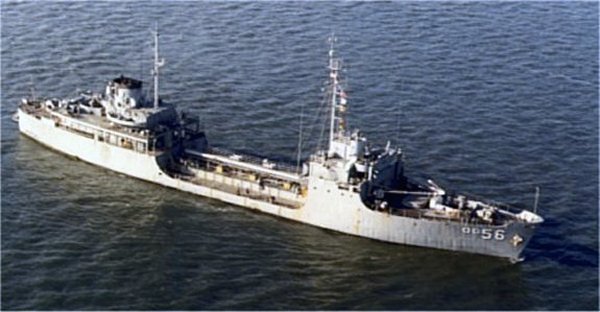
A critical link in Westmorland's supply chain was made up of six, small slow, 22-year-old US Navy gasoline tankers: USS Patapsco (AOG-1), USS Elkhorn (AOG-7), USS Genesee (AOG-8). USS Kishwaukee (AOG-9), USS Tombigbee (AOG-11) and USS Noxubee (AOG-56). Their mission was to deliver fuel to US forces in the I Corps Tactical Zone, the five most northern provinces of South Vietnam that ran from the Ben Hai River in the center of the DMZ south to Sa Hyuhn. Thirty to 70-miles wide, I Corps was bordered on the west by Laos and on the east by the South China Sea. With the exception of a low, narrow coastal plain, jungle and mountains covered the region. Land-based transportation was practically non-existent. Route One was a narrow winding road running the length of the zone. A single narrow-gauge railroad ran parallel to it. Both were frequently out of commission due to enemy action and monsoon storms. The only established port in the zone was Da Nang.

I Corps' physical condition meant that the only way to practically and consistently move large quantities of supplies around was by water. Without fuel, planes and helicopters could not fly, tanks and trucks could not move, and PBRs and swift boats could not patrol the waterways. In December 1968 alone, shore-based forces consumed 1.7 million gallons of fuel daily. On average, the six AOGs pumped over 15 million gallons of fuel per nine-month deployment. Noxubee set the record by pumping 20 million gallons in 1968, earning a Meritorious Unit Commendation in the process.
***
For seven hard years, beginning in March 1965 and ending early 1972, at least one AOG was constantly deployed in Vietnamese waters. Tombigbee arrived in Vietnam on 8 March 1965, supporting the Ninth Marine Expeditionary Force as they waded ashore at Red Beach near Da Nang. Tombigbee became the first AOG to pump fuel ashore during the Vietnam War.
***

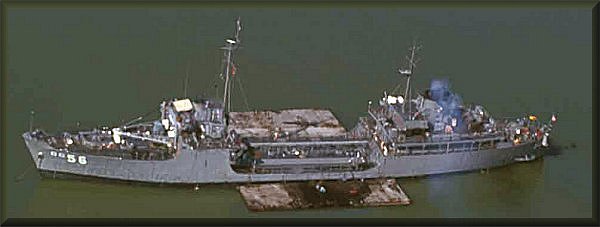
Using both bow and stern anchors to keep from swinging with the current, AOGs anchored 1500 to 2000 yards offshore alongside a buoy marking the seaward terminus of an assault pipeline. One of the ship's boats or a boat from shore would float a fourinch hose from the tank deck to the buoy. A swiveling gooseneck connection on top of the buoy gave the AOGs a secure point to attach the refueling hoses. First, a crewman would hop onto the buoy and connect the hose. Once the connection was secure, the AOG would begin pumping fuel ashore. Due to their limited pumping capacity and small-diameter pipelines, it could take as long as 72 hours to unload all 680,000 gallons of fuel.
The job was not without danger, and the AOGs came under attack at various times:
Tan My was in the cross hairs of the Communists' 1968 TET offensive. The fuel farm was destroyed along with several landing craft and barges. River cargo operations were interrupted for ten days, and 18 men belonging to NSAD Tan My were killed. During one 72-hr period of nonstop operations, Kishwaukee pumped 1.7 million gallons ashore at Cua Viet and Hue. While anchored in the lagoon at Tan My on 28 February, unloading into bladder boats and barges, she came under small-arms fire, quickly got underway without any casualties, re-anchored out of range and resumed pumping. The need for fuel was so critical during the TET Offensive that Kishwaukee spent 144 out of 168 days on the line.
***
On 28 October 1968, Noxubee (Lt. J.R. McCall) was pumping cargo through the underwater pipeline and to a bladder boat alongside when North Vietnamese artillery opened fire on the ship. Ensign Richard Bland was at the pumping station on the port side of the tank deck when the first rounds came in, sending up plumes of water along the starboard side. Bland called away the sea detail, and ordered the engine room to stand by for an emergency underway. BMC Franklin and the two fantail sentries quickly yanked the stern anchor up, while at the same time, Ens. Andy Bavarik, hauled in the bow anchor.

Meanwhile, Bland and the tank deck crew cast off the bladder boat and grabbed fire axes to cut away the fueling hoses. All the while, the enemy's artillery was bracketing the ship. By the time the fuel hoses were cut free and the bow anchor hoisted off the bottom, Noxubee was underway at 14-kts and safely got out of range. After a few hours, Noxubee returned to the anchorage and resumed pumping.
***
(Attack on Genesee) The first round was short, the next long, and the next four or five walked down the length of the ship as near misses. The XO, Lt(Jg) Michael Haines, from his GQ station on the signal bridge, directed the crew of Mt. 33 to cut the stern mooring line. He also ordered all exposed topside personnel below and darkened ship. Cutting the stern line enabled the ship to swing about ten feet, just enough to keep from taking a direct hit on the tank deck loaded with JP-4 jet fuel that could have incinerated the ship and all those aboard.

Rounds were exploding all around. It was only a matter of time before the enemy gunners found their mark. The first hit was on the 01 level port side aft. A second round struck the outboard engine on the ammi barge. Both hits sent lethal shrapnel flying up and down the port side of the Genesee and started fires on the ship and the barge. Internal communications throughout the ship were knocked out. Chunks of flying steel perforated Genesee's stack and exploded an acetylene tank stored along the passageway outside the wardroom. Shrapnel sliced through the high frequency antennas, limiting Genesee's ability communications to the outside world. One chunk hit a 55-gal gasoline drum stored on the 02 level aft. Fire flowed down the scuppers and down the side of the ship near the JP-4 cargo tanks. hot metal tore through the tops of empty cargo tanks B-2 and B-4 without causing any additional fires or explosions. The most serious damage occurred forward. As SF3 Art Ball was securing the watertight door from the tank deck, shrapnel blasted through the door, striking Ball in the left chest and abdomen. SA Theodore Perkins, who was standing near Ball, was also wounded.
***
(Noxubee limpet mine attack) Noxubee (Lt. Dudley Cass) anchored off the Cua Viet fuel farm at 0855 on 8 September 1969. At 1640, YOG-76 moored astern and began filling her cargo tanks. About four hours later, pumping secured and YOG-76 got underway. An hour later, at 2137, fantail sentries SN Paul Gryniewicz and SN Sam Profit and OOD Lt.(jg) Clare Brooks, sighted two swimmers in the water only ten to 15 yards astern of Noxubee. They immediately took the swimmers under rifle fire and tossed concussion grenades at them. Noxubee hoisted her anchors and got underway.

At 2215, Noxubee re-anchored about 1200 yards off the beach so divers could inspect the hull. By 2350, the divers reported that, because of the dark conditions, strong current and rough sea, they could only inspect the stern area and did not find anything. A more complete inspection would have to wait until first light. The divers did speculate that if there was a mine it would probably be a Soviet-made BPM-2 with a 64-1b TNT charge, equipped with a six-hour timer, and magnetically clamped to the hull. With that less-than-encouraging report, Lt. Cass decided to move further out from the beach and anchor for the night.

At 0201 the mine exploded. The swimmers had placed the mine not at the stern by the engine room or the tank deck where it would have done lethal damage, but forward on the port side by the dry cargo hold in a relatively "safe" spot. The blast opened a three-ft by five-ft hole in the hull, flooding spaces underneath the cargo hold and the hold itself with two- to three-ft of water. It also ruptured a fire main causing the Number 2 magazine to flood with over six feet of water. Before the dust from the blast settled, damage control parties under the experienced direction of SFC Eskel Wolf went into action, working in knee-deep water to stem the incoming flood by plugging the hole with mattresses and lifejackets. They also secured the fire main and pumped out the Number 2 magazine.
Even without enemy fire, handling the nototiously dangerous AVGAS made for dangereous work:
On 1 May 1968, Genesee arrived at Tan My and anchored alongside the pipeline buoy. US Army LARC-801 came out to assist Genesee connecting to the pipeline. Genesee crewmen SA Donald Shafer and DC2 Harley Cowans climbed aboard the LARC and hooked the ship's hoses to the connection on the buoy. Those on board Genesee witnessed the LARC explode and burst into flames. The stunned observers saw one of the men blown through the air and into the water.

The LARC was completely engulfed by a lake of fire as the motor whaleboat from Genesee got underway to rescue the crew. SF3 Tony Neil, aboard the whaleboat, dove into the flame-covered water to attempt a rescue. Swimming under water and pushing the flames away with his hands when he surfaced for a breath, Neil located the LARC's driver, SP4 Tommy Miller, who was without a life jacket and badly burned. Neil managed to get the burned driver back to the ship. The others on the whaleboat fished Cowans and another LARC crewman out of the water but could not locate Schafer. By this time LCM-92 and 18 other LARCs were on site searching for the missing seaman but without any luck. Army units recovered Shafer's body a week later. An investigation determined that a spark from the LARC's exhaust caused avgas from the leaking hose line to ignite, destroying the LARC, killing Shafer and injuring three others.
As you may have gathered, these ships during the Vietnam War were Lieutenant commands. And very hard working ships they were, indeed.

Modern war planning still includes getting petroleum products from the sea to the beach (see here, for example). But the AOGs are no longer with us. Many of their brave crews are, however, and they deserve a big salute!

Thought you might like to know.


(Top photo: USS Tombigbee, lower photos USS Noxubee)


Friday, February 06, 2009

Air Force offers recall program for some retirees

Interesting - get some experience for 1/2 price (they're already getting at least 1/2 pay as retirees) - and add to your experience base, as set out in Air Force offers recall program for rated officers
The rapid expansion of unmanned aircraft systems and other emerging missions and rated officer requirements has created an Air Force demand for experienced, rated officers. To meet these critical shortages, the secretary of the Air Force has initiated a Voluntary Retired Rated Recall Program.

Pilots, navigators, and air battle managers who retired as a lieutenant colonel or below, and who are younger than 60, may apply for the program. Officers recalled under this program will be used in myriad positions including intelligence, surveillance and reconnaissance, rated staff, and other rated requirements. Officers will be recalled for between 24 and 48 months depending upon the requirement.

Officers recalled will not be eligible to receive aviator continuation pay. Also, by volunteering for recall, officers become eligible for deployment. Retired Regular and retired Reserve officers are eligible to apply, and officers who retired via a Selective Early Retirement Board may also apply. Officers permanently retired for a physical disability are ineligible.

The application period runs through Dec. 31, 2009. For details, go to the Air Force Personnel Center's "Ask" Web site and enter "Retired Rated Recall Program" in the search function. Applicants having additional questions after reviewing this information should contact the Air Force Contact Center at (800) 616-3775. After Feb. 22 call (800) 525-0102. The commercial number is (210) 565-5000, and DSN is 665-5000. People may also send queries via e-mail to afpc.recall@randolph.af.mil.
UPDATE: I should have noted that any retired reserve officers who volunteer will be getting full pay since they don't qualify for retired pay until age 60.

Idiots on a Ship

There is no excuse for this sort of behavior.

The skipper of the anti-whaling ship should be in jail and the ship seized and put up for sale. If he kills or injuries someone, he and all his "sponsors" should be liable for entrusting a ship to an idiot and his idiot crew.


Video from here.

UPDATE: Watson says the collision was because he was disoriented by the defenses used by the Japanese ships. See here.

There is some apparently argument that the acoustic device used by the Japanese is a military weapon. So? Ramming another ship is a military tactic and has been since men first went to sea - is it now a military weapon?

USNS Catawba Offers Up Water and Food to Ship Released by Somali Pirates

Rendering aid to fellow sailors, as reported here:
Sailors from the Norfolk-based destroyer, USS Mason (DDG 87), went aboard Faina to conduct a health and comfort inspection of the crew as well as provide Faina's crew with food, water and medical support. The U.S. Navy fleet ocean tug USNS Catawba (T-ATF 168) also provided fuel and fresh water to the merchant vessel.
Faina is currently anchored off the coast of Somalia, near Hobyo, and is making engineering preparations to get underway.

Somali pirates released the Motor Vessel Faina after holding it for more than four months. The U.S. Navy has remained within visual range of the ship and maintained a 24-hour, 7-days a week presence since it was captured.

Motor Vessel Faina was attacked off the coast of Somalia Sept. 25. The roll-on/roll-off ship is Belize flagged and operated by "Kaalbye Shipping Ukraine."

While the ship initially had had a crew of 21, the ship's captain reportedly suffered a heart-attack shortly after being taken hostage. The pirates refused all requests to turn over the captain's remains. The ship's remaining crew includes 17 Ukrainian citizens, as well as two Russians and one Latvian.
Photo caption:
The U.S. Navy fleet ocean tug USNS Catawba (T-ATF 168) provides fuel and fresh water to Motor Vessel Faina following its release by Somali pirates Feb. 5, after holding it for more than four months. The U.S. Navy has remained within visual range of the ship and maintained a 24-hour, 7-days a week presence since it was captured. The Belize-flagged cargo ship is owned and operated by "Kaalbye Shipping Ukraine" and is carrying a cargo of Ukrainian T-72 tanks and related equipment. The ship was attacked on Sept. 25 and forced to proceed to anchorage off the Somali Coast. U.S. 5th Fleet conducts maritime security operations to promote stability and regional economic prosperity. (U.S. Navy photo by Mass Communication Specialist 1st Class Michael R. McCormick/Released)
UPDATE: Photo of ransom being dropped, arrows point to parachuted money:
Ransom money is dropped in the vicinity of the MV Faina off the coast of Somalia near Hobyo while under observation by a U.S. Navy ship. Pirates did not actually leave the ship until Feb. 5, more than 24 hours after this photo was taken. The Belize-flagged cargo ship is operated by Kaalbye Shipping Ukraine and is carrying a cargo of Ukranian T-72 tanks and related equipment. The ship was attacked Sept. 25, 2008 by pirates and forced to proceed to anchorage off the Somali Coast. (U.S. Navy photo by Mass Communication Specialist 1st Class Michael R. McCormick/Released)

Friday Reading

CDR Salamander: Fullbore Friday.

UPDATE: Steeljaw Scribe on that Iranian satellite launch.

Michael Totten and another guy who believes in a free press and had to go a ways to find it. (H/TL Chap.

Fred Fry goes to Washington. Time for a few million of us to join him there in visiting the best government money can buy.

Thursday, February 05, 2009

You Might Want to Update Your Link

I'm not sure what message you got from Blogger, but I get one saying they no longer host my blog. This is true, although I do everything on Blogger. However, my blog's address is www.eaglespeak.us, so you might want to update your link.

Somali Pirates: MV Faina "free"

The merchant ship full of tanks and ammo has been freed, according to this report:
Early on Thursday groups of pirates began leaving the vessel, reports from Haradhere said. Representatives of the pirates then told journalists that the ship had been freed.

"We have released MV Faina. There were only three boys remaining and they delayed the release for one hour, but now the ship is free," one of the pirate leaders, Sugule Ali, told AFP news agency by phone.

"No huge amount has been paid, but something to cover our expenses," he added

The crew - 17 Ukrainians, two Russians and a Latvian - were healthy and safe, a statement from the Ukrainian presidency said, and the ship would head to Mombasa under the protection of the US navy.

A number of warships from foreign navies had been diverted to the area to monitor the situation, in part to ensure that the cargo of weaponry did not get into the hands of Somali insurgents.

Once the ship is under way, the focus is likely to shift to its cargo of weapons and its final destination, reports the BBC's Peter Greste from the Kenyan capital, Nairobi.
Yes, you can bet that attention will be paid to the cargo delivery.

Weather Memories

This morning driving my younger son to high school swim practice (next to last time!) it was cold for this part of North Carolina - about 16 degrees F (-8 C). I mentioned to him that I had lived in places where it got much colder.

But it got me thinking. Was this one of those memories that when investigated turns out to be wrong?

Had I really walked to school 3 miles uphill (both ways) against the wind (both ways) barefoot in the snow in 20 degree below zero weather or what?

So I did a little research.

I lived in Bellevue, Nebraska from 1961 to 1965. How cold did it get there during that period?

From here I see that it got down to -17F (-27C) on 23 Jan 1963, -16F (-26C) on 30 Jan 1965, -14F (-25C) on 28 Feb 1962. That's cold enough, so I won't bother you with the years I lived in Wyoming.

Now, about that snow . . . according to this site, the years between 1961 and 1965 were snowy in the Omaha area with over 50 inches of snow in the 1961-1962 and 1964-1965 snow seasons. Only in a couple of years were those snow totals topped. I think in 1965 we got one of those 24-inch + snow falls that bumped up the total. It was good for sledding. Not so good for that uphill walk to school. (Update: "THE HEAVIEST 24 HOUR SNOWFALL FOR THE OMAHA METRO AREA IS 18.3 INCHES WHICH OCCURRED ON FEBRUARY 11 1965.")

So, my memory was correct and it was not one of those "wrongly remembered" senior memories.

Of course, the wind, uphill and barefoot stuff you'll just have to take on faith.

Brrrr.

UPDATE: Of course, it's supposed to get up to about 70F (21C) here in a couple of days.

Wednesday, February 04, 2009

Lesson Learned "How to Stave Off Pirates"

First hand experience offered up before Congress and reported Marine Log:
Though "well constructed dummies placed at strategic intervals around the ship" may be a useful counter piracy measure, firearms are considered unsuitable, particularly for tankers and LNG ships.

Those are among "lessons learned" that the Oil Companies International Marine Forum (OCIMF) is recommending to shipowners.

Captain Phil M. Davies, Director of OCIMF, was among witnesses testifying today at a hearing of the House Subcommittee on Coast Guard and Maritime Transportation on international piracy on the high seas.
All about the hearing here.

Somali Pirates Get Big Ransom, Soon to Release Russian Ship with Ukranian Tanks

Reported here"
A ransom has been delivered to Somali pirates who seized a Ukrainian ship carrying tanks, heavy weapons and about 20 crew members, a spokesman for the ship's owners said Wednesday.

Mikhail Voitenko did not say how much was paid, but Russia's ITAR-Tass news agency put it at $3.2 million. The pirates originally demanded $20 million.

The MV Faina carrying a cargo of tanks, other weaponry and about 20 crew members was seized by bandits in September off the Somali coast. The hostages include 17 Ukrainians, two Russians and a Latvian.

"The ransom has been delivered to the Faina. The owners of the ship so far don't want to comment on this, but I'm getting information on this just about every half-hour," Voitenko said in comments on Russian TV. "A pile of pirates are counting the haul on the Faina. I hope that nothing will be disrupted and the sailors will soon be able to disembark."

Voitenko did not answer repeated phone calls seeking further comment.

A person involved in the negotiations told The Associated Press that a plane carrying the ransom left Kenya's capital, Nairobi, Wednesday afternoon and dropped it on the Faina. The man spoke on condition of anonymity because of the sensitivity of the issue.

Normally Somali pirates take time to confirm their ransom, using money-counting machines and verifying the cash is genuine. Once they do that, they then release the vessel they are holding.

The person involved in the negotiations said the ship could be released Thursday. But the pirates holding the Faina have in the past given dates for releasing the vessel, only for those to pass without any word or explanation.
More here:
After having received a ransom of $3.2 million, Somali pirates will finally release within hours the Faina, a Ukrainian cargo ship captured off the coast of Kenya in September.

It is expected that the Faina will be heading for Kenyan port of Mombasa for unloading soon.

“There are about a hundred pirates onboard Faina now. They came to count money and to share it. As for the final release of the ship, we have to wait for several hours more, and after that Faina will proceed to Kenya’s Mombasa,” said Mikhail Voytenko, one of the negotiators.

Somalia: Where is the MV Jaikur II?

Have Somali pirates nabbed a World Food Program ship? Maybe, as reported at Missing UAE ship feared seized by pirates off Somalia:
A Comoros-registered cargo ship is missing off Somalia with 14 Indian crew aboard and a Kenyan maritime official said Tuesday he feared it had been seized by pirates.

Andrew Mwangura, East Africa's Coordinator of Seafarers Assistance Program (SAP), said the MV Jaikur II, owned by Al Rashid Shipping Dubai went missing while sailing on Somali waters from Kenya.

"The vessel left Mombasa a week ago with 14 Indians headed for Somalia but its missing on Somali waters. We fear the pirates might have seized it," Mwangura told Xinhua by telephone.

If confirmed, the MV Jaikur II would be the fourth vessel being held by pirates this year in one of the world's most dangerous waterways.
An earlier report of the MV Jaikur II being escorted on a WFP mission by a Dutch frigate here.

UPDATE: And, on the other hand, as politely noted by Eric in the comments, the ship seems not to be missing - see here. Or in the immortal words of Emily Litela:

Somali Pirates: Captured LPG Ship Not "Registered" for EU cover

Thanks to Fred Fry for forwarding this to me: Longchamp 'not registered for EU protection':
While the vessel’s operator, Hamburg-based Bernhard Schulte Shipmanagement, had access to the transit schedule via the EU Navfor website, the 4,316 dwt Longchamp was not expected by EU naval commanders overseeing the operation.

”While the ship was in the corridor, it was 20 miles behind the transit,” a Navfor spokesman said. “The company was registered with us, but the vessel was not.”

The spokesman, who asked not to be named, said the vessel would have been considered high risk had operators notified Navfor, headquartered in Northwood, England. “We grade ships according to risk.

Given the Longchamp’s low freeboard and cargo of LPG and chemicals, it would probably have been considered a higher risk,” he said.

EU Navfor is operating with a fleet of around four frigates in the Gulf of Aden region, one of which is dedicated to World Food Programme vessels. Companies which succeed in registering with the Navfor website - around half are approved for access to the restricted area - receive information on transit points, times and speeds.

EU frigates do not necessarily accompany vessels through the transit corridor, hence Navfor’s reluctance to define the transits as convoys. “But if we know where they are we can keep an eye on them,” said the spokesman. “If everybody is blobbed together they can all help each other.”
Initial report of capture here, according to which the ship was somewhat under the eyes of the Indian and Chinese navies, if not the EU force.

India v. China: Sub v. Destroyers Round 1

As Chinese ships transited to the waters off Somalia to engage in piracy prevention, the Indian navy did a little intelligence gathering, as set out in Indian submarine spooked Chinese warship:
An Indian Kilo class submarine spooked Chinese warships that were sent to patrol pirate infested waters in the Gulf of Aden and the two navies engaged in an hour long game of 'hide and seek' in international waters last month, Chinese media reports have said.
***
"It is a routine procedure. We do keep track of warships transiting near Indian waters through all means possible. However, the reports of the Indian submarine having surfaced are incorrect," a senior Navy Officer said.
More here:
The Chinese report, which first appeared Tuesday, had been picked up by numerous mainland Chinese websites a day later. Chinese warships have been patrolling in the waters off the Gulf of Aden, one of the world’s busiest sea routes, to prevent piracy attacks.

China has not officially commented on the incident, which reportedly ended when the Indian vessel left without further confrontation.

The Chinese ships had picked up sonar signals of an unidentified submarine, which the Chinese navy identified as a submarine armed with around 20 torpedoes belonging to the Indian navy, the South China Morning Post said in its report on the incident.

The submarine moved into deeper waters but was tracked by an anti-submarine helicopter, cornered and forced to surface. The submarine had been trailing the Chinese ships since they entered the Indian Ocean on its way to the Gulf of Aden, the paper said.
Welcome to the big leagues, China. I would guess the Indian navy was not the only group monitoring your deployment . . .

Some more at Bravo Zulu.

UPDATE: Just thinking - not much reason for the sub to be blasting away with sonar under these circumstances. . . you know, unless the skipper wanted to see what the reaction would be . . .

Tuesday, February 03, 2009

Latest ONI Worldwide Threat to Shippping Report (to 29 Jan 09)

The latest ONI Worldwide Threat to Shippping Report (to 29 Jan 09) can be found here. Highlights:
1. ONI SPECIAL ADVISORY: A suspicious skiff was reported in location 13:52N –050:12E at 0636 UTC on 27 Jan 09, approximately 75 NM southeast of Al Mukalla, Yemen. The suspicious skiff was described as a blue hull speed boat, 10 meters in length with five to six people onboard, heading 358 degrees with a speed of 14 knots. The sighting was reported to a naval warship in the area, which proceeded to investigate the skiff. The warship reported having ceased [sic] five pirates and their ammunition and weapons. Another speed boat was also sighted inthe area. ONI Comment: Somali pirates have recently released multiple vessels after receivingransom payments. Past reporting suggests efforts to hijack additional vessels increase aspreviously hijacked vessels are released. Past reporting also suggests efforts to hijack vesselsincrease as wind speeds decrease. Over the next 48 hours, wave heights are only expected to reach 1 ft., with wind speeds averaging 10 kts, which is very condusive to piracy operations. Pirates appear to be most active and successful when average wind speeds are between 0 to 10 knots. Activity is also reported when winds are between 10 to 15 knots but pirates appear to beless successful under these conditions. Little to no incidents are reported when winds average between 15 to 20+ knots. This time of year, when prevailing monsoon winds are out of the Northeast, wind speeds are lower and more conducive to piracy operations closer to the Yemeni coast and less favorable in the central Gulf of Aden. Information on current wave heights for the Gulf of Aden and east coast of Somalia can be found here: weatheronline (ONI, IMB).
There's more, most of of it previously reported on EagleSpeak.

To simplify matters, here's the latest Gulf of Aden wind forecast, indicating a decrease in winds to 10-15 knot max in most of the GOA:
This may indicate an increase in pirate activity is pending.

Wind barb info from here.

Coasties: Training to fight terrorists

Reported here:
In what looked like one of those action movies on late-night television, the Coast Guard showed off its new weapon Monday in a simulated air-and-sea, small-boat gunbattle in the choppy and windy San Pablo Bay in a training exercise.

Two small black boats, manned by crews dressed all in black and carrying simulated rocket-propelled grenades, were intercepted by an orange-colored Coast Guard H-65C Dolphin helicopter. The sinister-looking black boats were "playing the role of the adversary," a Coast Guard officer said - pretending to be terrorists on a raid against a cruise ship, a tanker or one of the bay bridges.

The Coast Guard helicopter was out to stop them. The black boats twisted and dodged, throwing up clouds of spray, and the helicopter swooped down on them like a bird of prey. A marksman aboard the copter fired blank rounds, the sound echoing across the water: rata-tat-tat.
***
"The terrorist raiders in Mumbai in November came by sea," said Cmdr. Sam Creech, the officer in charge of the Coast Guard's Air Station San Francisco.

"An attack by a small boat on a cruise ship, or a tanker, or one of the bridges here could be devastating."

The Coast Guard's biggest fear is terrorists on a small boat coming out of a marina and firing a missile at a cruise ship carrying thousands of passengers, or a loaded tanker, causing a huge oil spill.

Or an attack on one of the famous bridges - "hitting an icon like the Golden Gate Bridge, for example," he said - "could cause a lot of damage to the American psyche."
More here:
Training includes more than just Coast Guard units. Photo:
SAN FRANCISCO -- Members of the U.S. Coast Guard Maritime Safety and Security Team 91105 descend from a U.S. Air Force HH-60G Pave Hawk from the 129th Rescue Wing, California Air National Guard, Moffett Federal Airfield, Calif., onto the Coast Guard cutter Tern in the bay here Jan. 28, 2009. Crewmembers conducted vertical insertion training, which is a fast-paced technique used to effectively deploy law enforcement teams to a high-risk situation. (U.S. Coast Guard photo/Petty Officer 3rd Class Melissa Hauck)