VertRep

VertRep

Tuesday, February 18, 2014

About "Sea Blindness"

Butch Bracknell and James Kraska wrote in Ending America's 'Sea Blindness':
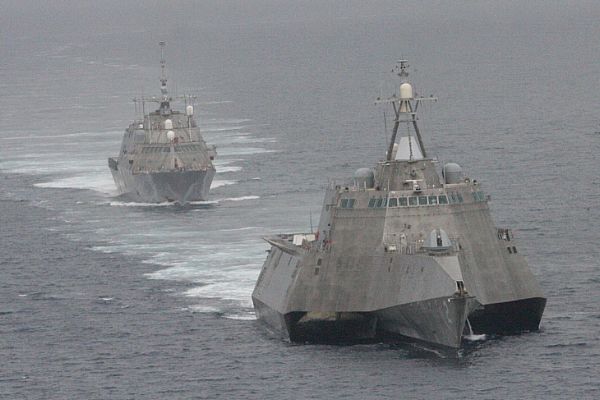
U.S. Navy photo by MC3 Class Karl Anderson
The United States suffers from a kind of "sea blindness" — an inability to appreciate the central role the oceans and naval power have played in securing our strategic security and economic prosperity. One symptom of this bipartisan malady has been that the country is failing to take an active role in shaping the world order of the oceans to promote our national interest.

This sea blindness is manifest in a number of policy choices, including the Pentagon's fiscal struggle to fund a powerful naval fleet and a national oceans policy that has virtually ignored the importance of sea power. ***
The U.S. is not alone in suffering from this odd sort of failure to see the obvious - Britain has been accused of suffering the same infliction. "Ministers accused of 'sea blindness' by Britain's most senior Royal Navy figure":
In an interview with The Daily Telegraph, Sir Jonathon Band, First Sea Lord, says there is a pressing need to hold a debate on Britain’s defence priorities. He discloses that he has even had to remind ministers - keen to set more missions for the Royal Navy while simultaneously culling the fleet - a ship can’t be in two places at once. The admiral, stepping down after three and a half years, even warns that Britain is “losing the ability to think strategically”.

“I think government could continue to learn,” says Band, known in senior defence circles as “T1SL”. “Until recently there’s been sea blindness. Is it because people get into politics for domestic rather than international reasons? There are a whole bunch of issues, some of it is background.”

And he warns politicians who see defence as ripe for cuts: “You don’t need to be an economist to realise major countries face a challenging outlook, but just because things are tough, don’t stop insuring your house. We have to have a strategic debate. Looking round the world, I don’t see it calming down; I don’t see any argument for Britain doing less.”
One would think that Britain, an island nation, would be keenly aware of the value of the maritime domain. But, as noted here:
The reality is that people have short memories – while they remain keen of the concept of the Royal Navy as an institution, and there is a keen sense of national pride in the values, history and tradition of what it represents, there does not seem to be a groundswell of popular support to pay to maintain a large standing navy.
***
More broadly, this author would argue that ‘Sea Blindness’ when it comes to understanding the maritime domain is not a new condition – people have historically not understood the dependency that humanity has on the sea. In reality, although the UK is an island, very few people relatively speaking actively involve themselves in maritime matters. Outside of the small fishing / trading community, or those who work in the maritime support sector, it is probably fair to argue that most people simply don’t have the professional links to see the sea for what it is – an essential gateway to prosperity and survival.
While the U.S. is not quite an island nation, it is a nation deeply dependent on the seas and the free flow of commerce across them.

Our neighbors to the north have also raised the "sea blindness" flag (or perhaps the "maritime blindness" flag), set out in this Canadian Naval Review editorial (pdf):
It seems that the primary symptom of sea blindness is political and public apathy to the economic importance of the oceans. A secondary factor is the lack of consensus on the size and type of naval forces needed to maintain order at sea and how it should be done. Ironically, environmental threats to the oceans are widely viewed with concern while the economic argument seems far less important.
The Canadians raise the issue of whether "sea blindness" is a matter of indifference or of ignorance - both of which require those in favor of a strong navy to engage their fellow citizens in explaining the value of naval forces. Then the same editorial contains a challenge to the naval proponents:
Assuming that it is the navy’s role to educate, perhaps there is a requirement to return to the question Professor Samuel P. Huntington raised in the 1950s, when he asked of the US Navy “[w]hat function do you perform which obligates society to assume responsibility for your maintenance?”
You can read Professor Huntington words at the U.S. Naval Institute blog post, From Our Archive: NATIONAL POLICY AND THE TRANSOCEANIC NAVY by Samuel P. Huntington. Of interest is this opening salvo:
The fundamental element of a military service is its purpose or role in implementing national policy. The statement of this role may be called the strategic concept of the service. Basically, this concept is a description of how, when, and where the military service expects to protect the nation against some threat to its security. If a military service does not possess such a concept, it becomes purpose-less, it wallows about amid a variety of conflicting and confusing goals, and ultimately it suffers both physical and moral degeneration.
It appears that, as cuts loom, there are those who understand the purpose of the fleet and warn about the future that budget choices push - Acting Deputy Secretary Fox's remarks at the 2014 USNI/AFCEA WEST Conference, San Diego, California are to the point - first she points out that the U.S. is a "maritime nation" and then discusses future trends:
With defense dollars, investment dollars in particular, growing scarcer, it is all the more of an imperative for defense leaders to make strategically sound choices when it comes to the military's modernization priorities. The U.S. Navy is unique amongst the military services in never having been seriously challenged in direct at-sea combat since the end of the Second World War. The U.S. enjoys a margin of military superiority today in the Pacific, but we cannot ignore the reality that American dominance on the seas, in the skies, and even in space can no longer be taken for granted going forward.

As we confront the implications of this new reality, I'd like to share two major points. First, as the military transitions from a decade of fighting insurgents and terrorists, we don't have the luxury going forward of assuming a permissive environment for U.S. naval air or sea assets, whether for fighters, close air support, UAVs, amphibious landings, or surface combatants.

With respect to the Navy, as I alluded to a moment ago, the threats to surface combatants continue to grow, not just from advanced military powers, but from the proliferation of more advanced, precise anti-ship munitions around the globe. Clearly, this puts a premium on undersea capabilities, submarines, that can deploy and strike with relative freedom of movement.

For aerial platforms, we need the ability to strike from over the horizon from secure locations, whether that capability comes from missiles, bombers, tactical aircraft, manned or unmanned.

But with limited resources and global responsibilities, we simply can't afford to build a Navy tailored for one region or one kind of fight. We need a flexible portfolio of capabilities that can operate along the full spectrum of conflict and military operations.

Nonetheless, given more advanced anti-ship munitions being developed by potential adversaries, I believe it is an imperative to devote increasing focus and resources to the survivability of our battle fleet. Niche platforms that can conduct a certain mission in a permissive environment have a valuable place in the Navy's inventory, yet we need more ships with the protection and firepower to survive against a more advanced military adversary. Presence is important, presence with a purpose and with capability.

Second, when defense budgets decline, there is a natural tendency to hang on to combat forces at the expense of enablers, yet we all know that enablers can be decisive force-multipliers. With the U.S. Navy able to outgun any and all comers, potential adversaries will look to take away our inherent military advantages, to include the use of electronic warfare and other countermeasures. Capabilities that can overcome these threats represent critical enablers that we neglect at our peril.

In many respects, the U.S. Navy has been so dominant for so long at sea that I worry we never really embraced these solutions at all. The time to start investing in the next generation of electronic warfare is now.

However, the resources will be only available to buy these and other modern capabilities our military needs on land, sea and in the air if we start reshaping and rebalancing all of America's defense institutions, and soon. Let me provide some context.
***
All of these factors -- the strategic environment, the fiscal environment, the political environment, and bureaucratic realities of the defense enterprise point to the conclusion that the military must get smaller over the next five years.

It is not an ideal course of action. It contains real risks. A smaller force, no matter how ready or technologically advanced, can go fewer places and do fewer things. But given current realities, it is the only plausible way to generate the savings necessary to adequately fund training, readiness, modernization, and avoid the prospect of a hollow force in the future. It also puts the department in the best position to accomplish the highest priority military missions associated with the current defense strategy.
The U.S. Navy has a mission: Protect the United States of America.

That mission has subsets: Maintain freedom of the seas. Assist our friends and allies as they assist us. Choose assets wisely. Remind those in high places that a single ship cannot be in two places at once.

How to prevent sea blindness? Tell the story of the importance of freedom of the seas to our nation. You can leave out the "Global Force for Good" stuff.

Monday, February 17, 2014

Admiral Raymond Spruance said it

As quoted in The Quiet Warrior: A Biography of Admiral Raymond A. Spruance:

I can see plenty of changes in weapons, methods, and procedures in naval warfare brought about technical developments, but I can see no change in the future role of our Navy from what it has been for ages past for the Navy of a dominant sea power - to gain and exercise the control of the sea that its country requires to win the war, and to prevent its opponent from using the sea for its purposes. This will continue so long as geography makes the United States an insular power and so long as the surface of the sea remains the great highway connecting the nations of the world.
Help prevent sea blindness, quote a naval thinker to a friend and suggest they do the same.

Sunday, February 16, 2014

On Midrats 16 Feb 14: Talking About USNI's "West 2014 Conference" and more

So, the U.S. Naval Institute holds a conference in San Diego just before the weekend and there's so much interesting stuff that came up that CDR Salamander and I decided to hash it over on Midrats Episode 215 live at 5pm Eastern U.S.

Just click here to get to the live show (you may have to click again on a show page, but what are two clicks among friends?). Call in during the show with comments or thoughts or join us in the chat room if you think your voice is not yet ready for radio.

I think Cyber, Russia, Christine Fox's comments, Coalition Warfare, budget constraints, the JSF, retention of our best talent, and the future of warfare will come up at some point. Plus more.

Join us live or listen later.

Thursday, February 13, 2014

Disaster Prep Wednesday: Postponed Due to Bad Weather

Yesterday's Disaster Prep Wednesday was overcome by a snow/freezing rain event.

We're about to get hit by Phase 2.

Yes, I know, wherever you live or have lived that gets snow all the time you would have handled it better.

But we don't live there and make do with what we have on hand.

Which is sometimes very interesting.

UPDATE: See here. Now, nothing but blue skies and slush.

Tuesday, February 11, 2014

China finds a large natural gas reservoir in Sichuan Province

In what is good news both for the Chinese and the rest of the world's energy users, the Chinese National Petroleum Corporation has declared a major natural gas reservoir find:
A major breakthrough was made by CNPC in natural gas exploration in the Sichuan Basin. As certified by the Ministry of Land and Resources, the newly added proven gas in place in the Longwangmiao formation of Cambrian system in the Moxi block of Anyue gas field is 440.385 billion cubic meters, with technically recoverable reserves hitting 308.2 billion cubic meters.

This is the largest monomer marine uncompartmentalized carbonate gas reservoir discovered in China up to now, featured by large reserve scale, broad gas-bearing areas, high formation pressure, high gas flow, and superior gas components. The production test has obtained average per well daily output of 1.1 million cubic meters, and the wells in production yield at 0.6 million cubic meters per day averagely.

The Anyue gas field is located at the paleo uplift of central Sichuan. Since 2011, CNPC has drilled two exploration wells — Gaoshi-1 and Moxi-8, both obtaining high-yield gas flows of one million cubic meters per day from the Simian system and Cambrian system respectively.

It only took CNPC less than two years to find the Longwangmiao gas reservoir, identify its reserves, and make a successful production test with 1 billion cubic meters capacity. The phase-I capacity building project of 4 billion cubic meters is now on full swing, and the phase-II capacity building project of 6 billion cubic meters has already been kicked off. At present, gas production test at Moxi block has cumulatively yielded more than 600 million cubic meters.
That ought to last them a couple of years or so.

Internal Chinese development of its natural resources ought to ease some of their concerns over their sea lines of communication being threatened.

There is much to be said about near energy independence as a calming factor in international relations.

A Little Joke

In one of my volunteer jobs the ability to e-mail plays a key role, just as it does in most everything else in our lives.

Today one of the other volunteers was concerned that her e-mails were taking forever to send. I naturally responded, "Probably the electrons are holding a work slowdown in hopes of being able to charge more."

Groans ensued.

You may now return to your normal lives.

Saturday, February 08, 2014

Oh my gosh! Iran's Navy to threaten to sail into the Atlantic Ocean

The ever awesome Iranian navy is venturing forth to touch the waters of the Atlantic Ocean, thus striking dread and fear in the hearts and minds of  . . . well, exactly who is impressed? Story here.
Must be intended for the naive and clueless, because a force like that described is mostly a threat to international navigation.

Friday, February 07, 2014

Gulf of Guinea Pirates: Flag State Liberia says ‘Kerala’ hijacked

For a couple of weeks, the saga of the gas oil tanker Kerala has been drifting along. From the early reports hijacking, there have been allegations by the Angolan Navy that the hijacking was faked by the crew.
of a

Now, Tanker Operator has a follow-on report, "Tanker Operator Liberia says ‘Kerala’ hijacked":
Liberia has entered into the controversy surrounding the alleged hijacking of Dynacom’s LR1 ‘Kerala’ off Angola on 18th January, 2014.

The flag state said that although the investigation is still ongoing, the evidence gathered thus far by an INTERPOL-led incident response team has allowed the Liberian Registry to conclude that the vessel was hijacked by pirates.
***
During the incident, the registry said that the pirates disabled the vessel’s AIS and other communication equipment so that the vessel could not be tracked from shore or satellite. The pirates also painted over the identifying features of the vessel, including funnel, name and IMO number and undertook three separate ship-to-ship transfers unloading about 12,271.5 tonnes of oil in total.
***
On arrival at Tema, all crew members received immediate medical treatment. During the hijacking, one crew member was stabbed by the pirates and others were beaten.
Liberia, of course, is not the "operator" of the vessel but rather the nation which provides the flag of convenience for ships. The operator of the vessel is Dynacom, which asserts it was a hijacking all along. Angola might just have an interest in claiming that its waters are safe which might have clouded their initial reaction.

A noted in prior post, this will be an interesting legal mess to sort out. There are lots of players:
Liberia will continue working with the authorities in Ghana, Nigeria and Angola and elsewhere in the region in order to bring to justice the perpetrators of this crime, the registry stressed.
Good luck with that.

You might note that shutting off the AIS and the painting indicates a modicum of sophistication in the purported hijackers. Three offloads? Wow.

Friday Fun FIlm: USS Nautilus Under the North Pole

Was there anything those new nuclear submarines couldn't do?

From PeriscopeFilm, USS Nautilus: Operation Sunshine:

Thursday, February 06, 2014

Forest and Tree Confusion

Phil Carter is bright guy. He just got the important part of the story of a town honoring a soldier returning from a war zone very, very wrong in "Bad Bud":
The ad ignores the complicated relationship that veterans have with alcohol, obscuring how much harm booze does to veterans when they come home.
You know, I worked in the military drug and alcohol counseling system and it seemed to me that there were some small percentage of people - civilians, college students, sailors, Marines and the like, who could not handle alcohol. On the other hand, there was a very large number who had (and have) no difficulty with it. To paint all veterans and, by extension, all military personnel with such a broad brush of a "complicated relationship" is simply wrong.

It was just a very nice way to say "thanks," and far better than another ad with a puppy and a horse.

Here, judge for yourself:


Update: I meant to add that there are so many things we are concerned about that we are beginning to not be able to move at all.

For example, suppose this ad had been sponsored by a doughnut company. Would the complaint then be that so many veterans are overweight that they have a "complicated relationship" with food? Can only tofu makers and Pilates studios welcome back our troops?

I hope not.

Wednesday, February 05, 2014

Disaster Prep Wednesday: "Managing Worker Fatigue During Disaster Operations"

During disaster recovery operations (and possibly during the period leading up to a disaster - the period while watching a hurricane track in, for example) there is a tendency for disaster workers to spend too much time on the job. Caught up the events, too many workers and leaders fail to take care of themselves in terms of rest and sleep.

A "technical assistance document" from the Center for Disease Control addresses this problem: Guidance for Managing Worker Fatigue During Disaster Operations (pdf):

NRT Fatigue for Emergency Workers


If you want the shorter version, here's a Navy video that makes the point - at some point, overly tired workers might as well be drunk:


It is also vital that those victims affected by the storms and other disasters be given quiet places to rest as part of their disaster recovery. The importance of quiet shelters, the availability of food, water, showers and friendly faces cannot be overstated.

Monday, February 03, 2014

Energy News: "No major environmental impact from Keystone XL, DOS says"

Well, if we really, really want to work to free ourselves from the many problems of the Persian/Arabian Gulf and a long sea line of communication carrying crude oil through often troubled waters, then this ought to be good news: "No major environmental impact from Keystone XL, DOS says", as set out in the Oil and Gas Journal,
“This final review puts to rest any credible concerns about the pipeline’s potential negative impact on the environment,” American Petroleum Institute Pres. Jack N. Gerard said. “This long-awaited project should now be swiftly approved. It’s time to put thousands of Americans to work.”

“The State Department has once again found nothing in its environmental analysis that would prevent the Keystone XL pipeline from moving forward,” US Chamber of Commerce Pres. Thomas J. Donohue declared. “It’s time for the administration to stop playing politics with a project that will create good-paying American jobs, improve our energy security, and strengthen relations with our closest ally, Canada.”

Obama vowed to approve Keystone XL if it was proven to be environmentally safe, according to American Fuel and Petrochemicals Manufacturers Pres. Charles T. Drevna. “Today’s release of the pipeline’s supplemental EIS provides the irrefutable evidence sought by the president, and he should waste no further time in delivering on his promise,” he said.
Of course, there are the nay-sayers:
Environmental organizations and other opponents immediately dismissed the supplemental EIS’s findings as corrupted by oil industry influence and seriously flawed.

“[DOS’s] environmental review of the Keystone XL pipeline is a farce,” declared Friends of the Earth Pres. Erich Pica. “Since the beginning of the assessment, the oil industry has had a direct pipeline into the agency. Perhaps most frustrating is the apparent collusion between [DOS], the oil industry, and the Canadian government.”

“Even though [DOS] continues to downplay clear evidence that the Keystone XL pipeline would lead to tar sands expansion and significantly worsen carbon pollution, it has, for the first time, acknowledged that the proposed project could accelerate climate change,” said Susan Casey-Lefkowitz, international program director at the Natural Resources Defense Council. “President Obama now has all the information he needs to reject the pipeline. This is absolutely not in our national interest.”

Sierra Club Executive Director Michael Brune, meanwhile, said, “The president has two choices before him: fighting climate disruption, or promoting an energy policy that includes the expansion of dirty fossil fuels like tar sands. The Keystone XL tar sands pipeline fails the basic climate test, and it’s not in the interest of the American people. The president should reject the tar sands pipeline once and for all.”
So, months of study and delays which, once again, find "no major environmental impact" are a "farce" because they don't coincide with the agendas of FOE and the Sierra Club.

Noteworthy, too, is that no adverse decision to their positions can be simply characterized as "in error" but always must be demonized. That's a very old debating trick.

And a tiresome one.

UPDATE: About those oil ocean shipping routes ("sea lines of communication"), here's a nice graphic:

Source: U.S. Government Accountability Office
Note: Circles represent millions of barrels per day transported through each chokepoint. Arrows represent common petroleum maritime routes.


Friday, January 31, 2014

Friday Fun Film: "Saga of The USS Franklin"


Perhaps you've had a tough week?

Here's a tale to help put that into perspective:

Before dawn on 19 March 1945 Franklin who had maneuvered closer to the Japanese mainland than had any other U.S. carrier during the war, launched a fighter sweep against Honshu and later a strike against shipping in Kobe Harbor. Suddenly, a single enemy plane pierced the cloud cover and made a low level run on the gallant ship to drop two semiarmor piercing bombs. One struck the flight deck centerline, penetrating to the hanger deck, effecting destruction and igniting fires throughout the second and third decks, and knocking out the combat information center and airplot. The second hit aft, tearing through two decks and fanning fires which triggered ammunition, bombs, and rockets. Franklin, within 50 miles of the Japanese mainland, lay dead in the water, took a 13 degree starboard list, lost all radio communications, and broiled under the heat form enveloping fires. Many of the crew were blown overboard, driven off by fire, killed, or wounded, but the 106 officers and 604 enlisted who voluntarily remained saved their ship through sheer valor and tenacity. The casualties totaled 724 killed and 265 wounded, and would have far exceeded this number except for the heroic work of many survivors. Among these were Medal of Honor recipients, Lieutenant Commander Joseph T. O'Callahan, S.J., USNR, the ship's chaplain, who administered the last rites, organized and directed firefighting and rescue parties, and led men below to wet down magazines that threatened to explode, and Lieutenant (junior grade) Donald Gary who discovered 300 men trapped in a blackened mess compartment, and finding an exit returned repeatedly to lead groups to safety. Santa Fe (CL-60) similarly rendered vital assistance in rescuing crewmen from the sea and closing Franklin to take off the numerous wounded.

Franklin was taken in tow by Pittsburgh until she managed to churn up speed of 14 knots and proceed to Pearl Harbor where a cleanup job permitted her to sail under her own power to Brooklyn, N.Y., arriving on 28 April. Following the end of the war, Franklin was opened to the public for Navy Day celebrations and on 17 February 1947 was placed out of commission at Bayonne, N.J. On 15 May 1949 she was reclassified AVT-8.
From the folks at PeriscopeFilm.

Wednesday, January 29, 2014

Disaster Prep Wednesday: Your Traffic Jam Disaster Kit

So, it's one of those days. You at are work and there's a storm blowing in. You tune into the radio and there is an announcement that the school system is closing your child's school 3 hours early. Your boss decides to close the office early. Suddenly everyone one is trying to crowd onto the highways all at once. A couple of wrecks later and some snow and ice fall later, well you are stuck in the middle of an Interstate highway with no possible exit and miles from . . . anywhere. Help can't get to you because the roads are . . . blocked. You might be there for a couple of days.

Heck of time to find out you really should have packed that mobile disaster kit in the car. You know, the one with blanket or sleeping bag, a couple of days worth of food, some water, hand warmers, flashlight, a book you bought at the second hand book store, cell phone charger, baby wipes, trash bags, toilet paper, etc.

Or like this one that Allstate suggests.

You know, it just could happen.

Tuesday, January 28, 2014

A "faked" pirate attack off Angola? Or perhaps not . . .

So, a few days ago, there was a report of a tanker going missing off Angola - see here:
The Angolan navy and air force is hunting suspected pirates after an oil tanker went missing in its waters.

Navy Captain Augusto Alfredo told the BBC that an unknown vessel had been seen near the Greek-owned 75,000 tonne MT Kerala as it lay off Luanda's port.

But he said he could not confirm it was a pirate attack, which would be the first in the country's waters.
and here:
A fuel tanker is suspected to have been hijacked by pirates off the coast of Angola, the ship's owners said on Wednesday, in what would be the most southerly attack to date by pirates off West Africa.
***
The 75,000 deadweight tonne Liberian-flagged fuel tanker MT Kerala lost contact with its Greece-based owner Dynacom on January 18. The ship was last seen around seven nautical miles from the Angolan capital Luanda, according to a security source.

"It is suspected that pirates have taken control of the vessel," Dynacom said in a statement, adding it had no confirmation.

If true, it would be hundreds of miles (kms) further down the coast than the previously most southerly reported attack, when pirates hijacked a tanker off Gabon last year. They were suspected of siphoning oil from the vessel.

One security source said the MT Kerala was loaded with gasoil.
Well, now. Comes the Angolan Navy and denies the "piracy" as set out in this Reuters report, "Angola navy says missing tanker located, crew faked pirate attack":
Angola's navy said on Sunday the crew of an oil tanker that vanished off its coast on January 18 had turned off communications to fake an attack, seeking to calm energy sector fears that the vessel had been hijacked by pirates.

Unconfirmed reports that the tanker had been seized raised concern that piracy off West Africa was spreading south from the Gulf of Guinea, near Africa's biggest oil producer Nigeria, where most hijacking gangs are believed to originate.
***
Captain Augusto Alfredo, spokesman for the Angolan navy, said the missing Liberian-flagged MT Kerala has been located in Nigeria and that reports of a hijacking were false.

"It was all faked, there have been no acts of piracy in Angolan waters," he told Reuters. "What happened on January 18, when we lost contact with the ship, was that the crew disabled the communications on purpose. There was no hijacking."

Alfredo declined to comment on how the navy had established the behaviour of the MT Kerala's crew, saying only that other authorities may provide further details later.
And now from the shipowners, a denial of the denial, :
The Greek owners of an oil tanker that vanished off the Angolan coast on Jan. 18 said on Sunday that pirates had hijacked the vessel and stolen a large quantity of cargo, contradicting the Angolan navy's denial that such an assault took place.

Greece-based Dynacom, owners of the 75,000 deadweight tonne Liberian-flagged tanker MT Kerala, said it had managed to contact crew on the vessel who reported the pirates had left.

"Pirates hijacked the vessel offshore Angola and stole a large quantity of cargo by ship-to-ship transfer. The pirates have now disembarked," the company said in a statement.

It did not provide any further details on the attack or the ship's current location but added that all crew were safe.

Dynacom's version of the events contradicted an account from the Angolan navy, which alleged the crew had turned off the ship's communications to fake a pirate attack.
Just to add to the fun, let's look at the definition of piracy. The following definition of piracy is contained in article 101 of the 1982 United Nations Convention on the Law of the Sea (UNCLOS):

“Piracy consists of any of the following acts:

(a) any illegal acts of violence or detention, or any act of depredation, committed for private ends by the crew or the passengers of a private ship or a private aircraft, and directed:
(i) on the high seas, against another ship or aircraft, or against persons or property on board such ship
or aircraft;
(ii) against a ship, aircraft, persons or property in a place outside the jurisdiction of any State;
(b) any act of voluntary participation in the operation of a ship or of an aircraft with knowledge of facts making it a pirate ship or aircraft;
(c) any act inciting or of intentionally facilitating an act described in sub-paragraph (a) or (b).”

Sooooo .... a crew that hijacks its own ship commits an act of piracy, if the hijacking took place on the high seas. If it took place, say, in Agolan waters - well, perhaps it is grand theft or something. And if the ship then was moved to Nigerian waters? Well, there will be some fun sorting all of this out.

As with many odd sea-related events, the question of most concern is where the insurance, if any, comes into play.

Hat tip to Bryan.

Friday, January 24, 2014

On Midrats 26 Jan 14 - Episode 212: "NATO in Afghanistan" with Stephen M. Saideman

Please join us Sunday 26 Jan 14 at 5 pm (Eastern U.S.) for Midrats Episode 212: NATO in Afghanistan with Stephen M. Saideman
Lost to many whose news sources in the USA consists of the major newspapers and the standard networks, for most of the last dozen+ years, the conflict in Afghanistan has not been a USA-Centric battle; it has been a NATO run operation.

When the Commander of the International Security Assistance Force has been an American 4-star, the visuals can be misleading.

For most of the last decade, American forces were dominate in only one region of Afghanistan, the east. Other NATO nations from Italy/Spain in the west, Germany in the North, and Commonwealth nations and the Dutch in the south.

More important than the actual numbers involved, it was the Rules of Engagement, caveats, and the fickle nature of national politics that drove what effects those forces had on the ground.

The good, the bad, and the ugly of modern coalition warfare was all in view for all in Afghanistan, but outside small circles, has yet to be fully discussed.

Our guest for the full hour will be Stephen Saideman.

Stephen holds the Paterson Chair in International Affairs at Carleton University’s Norman Paterson School of International Affairs. He has written The Ties That Divide: Ethnic Politics, Foreign Policy and International Conflict and For Kin or Country: Xenophobia, Nationalism and War (with R. William Ayres) and NATO in Afghanistan: Fighting Together, Fighting Alone (with David Auerswald), and other work on nationalism, ethnic conflict, civil war, and civil-military relations. Prof. Saideman spent 2001-02 on the U.S. Joint Staff working in the Strategic Planning and Policy Directorate as part of a Council on Foreign Relations International Affairs Fellowship. He writes online at OpenCanada.org, Political Violence at a Glance, Duck of Minerva and his own site (saideman.blogspot.com). He also tweets too much at @smsaideman.
Join us live or pick the show up later by clicking here.

If you have had the pleasure of participating in coalition warfare you should find this interesting. If you haven't, you might find it instructive.

Navy Target Practice? or "Cannibal Rat-Infested Ghost Ship Headed For The UK?"

Yahoo report: Cannibal Rat-Infested Ghost Ship Headed For The UK?

A "Tomo News" video:


The BBC is more restrained:
The abandoned Russian cruise liner, named Lyubov Orlova, has been missing since it was cut loose while being towed from Canada almost a year ago.

There had been fears that winter storms could have been pushed it across the Atlantic Ocean and towards the UK.

But coastguards have reported no sightings.

A spokesman for the UK Maritime and Coastguard Agency said: "We have received no reported sightings of the vessel since April last year, but we will respond accordingly."

Sounds like the time to unlimber some naval guns and torpedoes and put this thing down if anyone can find it.

Way down.

Friday Fun Film: "The Rise of the Soviet Navy" (1968)

Another Periscope Film save, The Rise of the Soviet Navy (1968):


Notes from the Archive.org site:
Made by the U.S. Navy at the height of the Cold War, this informative film chronicles the history of the Soviet Navy from the Czarist era through WWI, the Revolution, WWII, and the Cold War. The film begins with shots of the helicopter aircraft carrier Moscow / Moskva on its maiden voyage in the Mediterranean Sea in 1968.

The Kashin class guided-missile destroyers, the world's first major ships built with gas turbine propulsion, are also shown along with Soviet nuclear submarines. These sophisticated warships are seen to epitomize the Soviet naval threat to the West. . .


Thursday, January 23, 2014

This May Be the Dumbest Thing I've Read in Some TIme: "DOD TOPGUN Fights For Navy To Fight Like It Is 1986" by Craig Hooper

Well, I read a lot of truly dumb stuff, but this piece of - um- work by Dr. Craig Hooper, DOD TOPGUN Fights For Navy To Fight Like It Is 1986, is almost too silly for words.

I don't remember the great wars of 1986*, but his "analysis" leaves much to be desired. I suggest reading one of the comments to his blog post before reading the post so as to better understand Dr. Hooper's line of baloney. Comment is by "Chris":
Chris January 22, 2014 at 9:58 am

In may be technically accurate to say the LCS is not defenseless, but that is all. SeaRAM has a range of 5 nm. Foreign navies operate without air coBy way of comparison, Australian FFG-7, using that obsolete Mk 41 VLS carries ESSM with a range of 27 nm. Which would you prefer? Taking the comparison further, the FFG-7 also has a bigger gun (very passé) as well as carrying Harpoon. Harpoon’s 67nm range is also a lot bigger than the LCS anti-surface module’s Griffin or Hellfire range of about 3 nm. Which would you prefer?

VLS may date from the eighties, but the missiles it carries do not. That’s one of the central advantages of VLS. You can easily upgrade (i.e. it is modular) the missiles. Unfortunately, LCS is too small to carry it. Lockheed or Raytheon I am sure would be more than happy to try and invent a smaller, lighter, but more powerful missile to squeeze onto an LCS. Given enough time and money this magic missile might eventually materialize. Smaller missiles have smaller amounts of propellant and smaller warheads. It is physics. BTW, a technical point, all modern guns are breechloaders. Being a breechloader has nothing to do with the argument surrounding the efficacy of large caliber main batteries vs carrier aviation.

No reporting that I have seen, certainly not the Navy Times article, has said anything to back the hysterical comment that the Navy is abandoning rail guns and lasers. The LCS does not have the space or power margins for either of those systems. The Freedom variant has already had weight and stability issues that required bolt-on buoyancy fitting at its stern. The Independence variant cannot even accommodate a 76mm gun, so in what reality would a railgun be squeezed in? Furthermore, neither variant has an integrated power system that would be key to energy based weapons, only a DDG-1000 currently has that.

Perhaps the real story is that OSD finally threw the BS flag on buying upgunned Coast Guard cutters to form 1/6 of the fleet. If modularity and affordability are the goals, and laudable ones at that , look at the Danish STANFLEX system. STANFLEX was developed in dreaded 1980s, but it works and module swaps are a lot faster than those conceived under LCS’ reported CONOPS. The LCS is an example, like the JSF, of acquisition mal-practice. The Navy attempted to cross a frigate replacement with the Street Fighter concept mixed a little Rumsfeld transformation secret sauce to create two ships designs that can hunt pirates and make nice with small navies. Hardly key components for the battle fleet “pivoting” to the Pacific.
And then, after another person comments in agreement with Chris, Hooper offers up:
admin January 22, 2014 at 12:19 pm

Thanks for commenting.

I am always amused at how the advocates for a robust Navy always seem to forget logistics. They always come at you with a laundry list of cool stuff, but those peksy mundane (and vital) things like, oh, T-AO(X)s or the need for wide-ranging diplomatic support or wider presence never seem to get on the list.

Look, banging stuff up from an awesome, horribly-beweaponed cruiser is great fun. I’d love to have a Navy you describe. But, unfortunately, a lot goes into supporting the pointy end we both love.
Golly gee, Dr. Hooper, I guess the LCS, being "horribly un-beweaponed" is a marvel of not needing logistics because of it long sea legs and ability to change modules at sea? If we are going to drag along at 10 knots to get better mileage, we wasted a heck of a lot of money creating a ship that can do 40 knots. Which is, after all, just a little faster than an old style Fletcher-class destroyer, except the Fletchers and the follow-on Gearings out gunned the LCS, carried torpedoes, had indigenous sonar and could operate UAV's from their FRAM'd flight decks. Of course they were designed 60 years ago, so you've got that going for you. Further, suppose your LCS is rigged for mine ops and you discover a sub threat? Are you gonna go back home for the ASW package? Send out another LCS with the ASW package?

And what on earth does this mean, ". . .the need for wide-ranging diplomatic support or wider presence never seem to get on the list." It seems to me that diplomatic support is on every nice to have Navy list I've ever seen - except we once had a Navy that could cut itself free from foreign shores even when we didn't have that support. In fact, It still can, so long as we have the logistics train to support it. What we did was we transferred that logistics support force to MSC, which has done a bang up job.

I have no idea what "wider presence" means in the context you used it.

I can tell you that the LCS is the epitome of a ship that needs both local shore support (can't change those modules at sea) and an armed escort to go into harm's way. You might look at SecNav's comments here:
“One of the things the CNO said the other day is one of the things the LCS can do is help prevent warfare,” Mabus said – by doing the day-to-day work of maritime policing and partnership building in accordance with the new global strategy, for example. But, he went on, “if there is a war, we aren’t going to have the LCS out there by itself.” Other, more robust vessels can provide cover against enemy warships, cruise missiles, and aircraft while the LCS conducts its specialized shallow-water missions sweeping mines, hunting submarines, or fending off swarms of small boats.
Well, hell, under those conditions, I could send a pontoon boat to sea for "policing" and "partnership building."

However, if the balloon goes up, I like something a little more "beweaponed" and a little more robust under my feet.

*In fact, 1986 was a relatively peaceful year. If any warship ever was designed to operate in such relatively benign period, it's the LCS.

Wednesday, January 22, 2014

Disaster Prep Wednesday: Preparing for Winter Weather

Back in the olden days, the Little House on the Prairie The Long Winter days, when what we used to call a "blue blizzard"* could sneak up on you, you really had to make sure you had a good emergency kit to tide you over in car or home until the weather changed or help arrived.

While sneak weather assaults are mostly a thing of the past, this short FEMA video has some good tips- especially the part about having plans for communication:


More info here. Look out for your elderly neighbors, too. Clearing an older person's driveway, sidewalk and doorways may be a life-saver.


*A blue blizzard in my Western vernacular meant usually the day started with bright sun and then a blizzard storm front would blow in "without warning." Now the NOAA weather service, Weather Channel and the local weather guessers who read NWS warnings pretty much let you know well in advance about the possibility of dangerously bad weather coming at you.

Tuesday, January 21, 2014

Swarming Undersea Drones

At NAVALDRONES: Swarming Underwater Vehicles, an Update
Autonomous vehicles cooperating across various ocean depths will be useful for real time hydrography and to characterize acoustic propagation - a critical factor in antisubmarine warfare. Mine countermeasures is another obvious mission, along with autonomous swarmed attack against surface or sub-surface platforms.

Research being conducted by CcCoRo - here, one AUV detects an object and invites others to join it:


Ah, the possibilities. A lot of problems in the inshore areas might be addressed using this concept.

Sunday, January 19, 2014

On Midrats 19 Jan 14- Episode 211: 4th Anniversary Free For All


Please join us at 5pm Eastern U.S. on 19 Jan 14 for Episode 211: 4th Anniversary Free For All :
That's right ... Midrats has been on the air four years. This week we aren't having guests, just the two hosts and any listeners who want to take the opportunity to call in or throw a question or topic to us in the chat room. Breaking news, regular topics, or whatever you pull out of your seabag - we're going to cover it

Green range, as it were.
As usual, you can join us live or download the show for later listening here.

By the way, did you know it is possible to watch football with the sound on mute?

Just sayin' . . .

Friday, January 17, 2014

Friday Fun Film: "River Patrol (1967)"

Well, it ain't "Apocalypse Now" - just sailors doing hot work ("It's hot. Damn hot! Real hot! Hottest things is my shorts. I could cook things in it. A little crotch pot cooking." ) a long time ago in a land far, far away:

Wednesday, January 15, 2014

Disaster Prep Wednesday: "Safest Place During Tornado"

A well done Weather Channel video for those of us who don't live in basement/storm cellar country:

Safest Place During Tornado

(modified from earlier because it was an "auto-start" video - now you have to go to the link)

More later on some other ideas.

I've got to go clear out that closet under the stairs . . .


Tuesday, January 14, 2014

"The Business of a Seafaring Man is Ships"

 Why we have a Navy - as described in 1968, but timeless in import.


". . . [T]his free world alliance must be stitched together with ships . . .


"Often as not, the overt expression of the United States' intent was those steel gray ships that took station on the horizon . . ."

The current question is how much Navy is enough to to the job.

You might know my answer:


Monday, January 13, 2014

Monday Second Guessing: "Hydrofoil Development by the United States Navy"


Okay, back in the days before we decided "payloads" trump "platforms" somebody saw the need for small, high speed, heavily armed (per their size) ships to fight in the littorals or in island chains.

So, there was: Hydrofoil Development by the United States Navy:


They did look cool.


Now, just suppose we'd decided not to kill these programs? Where would we be? Where could they have been useful? Where could we use them now?

Sunday, January 12, 2014

One thing to ponder

From Powerline:
Another scandal, even more important, was revealed by former Defense Secretary Robert Gates in Duty. Obama ordered an intensification of our effort in Afghanistan, while admitting privately that he expected it to fail. Approximately 80% of the fatalities our military has suffered in Afghanistan have taken place on Obama’s watch, not because he was pursuing a strategy that he sincerely believed to be in America’s interest, but because he cynically calculated that sending Americans to die in a useless campaign (as he assessed it) would benefit him politically. This is a scandal approximately a billion times more newsworthy than the Christie administration’s closing a lane on a bridge.
So, exactly how many of those who knew of this "cynical calculation" resigned rather than be a part of this debacle?

I suspect that the answer is somewhere less than 1.

From Napoleon
Maxim LXXII. A general-in-chief has no right to shelter his mistakes in war under cover of his sovereign, or of a minister, when these are both distant from the scene of operation, and must consequently be either ill informed or wholly ignorant of the actual state of things.
Hence it follows, that every general is culpable who undertakes the execution of a plan which he considers faulty. It is his duty to represent his reasons, to insist upon a change of plan--in short, to give in his resignation rather than allow himself to be made the instrument of his army's ruin. Every general-in-chief who fights a battle in consequence of superior orders, with the certainty of losing it, is equally blamable.
In this last-mentioned case, the general ought to refuse obedience; because a blind obedience is due only to a military command given by a superior present on the spot at the moment of action. Being in possession of the real state of things, the superior has it then in his power to afford the necessary explainations to the person who executes his orders.
But supposing a general-in-chief to receive a positive order from his sovereign, directing him to fight a battle, with the further injunction, to yield to his adversary, and allow himself to be defeated -- ought he to obey it? No. If the general should be able to comprehend the meaning or utility of such an order, he should execute it; otherwise, he should refuse to obey it.
So, yeah, we all know about politicians and political calculations. What do we know about our generals and other leadership who could have put a stop to this abuse by a timely and public resignation?

Friday, January 10, 2014

On Midrats 12 Jan 14 - Episode 210: John Kuehn and Joint Operations from Cape Fear to the South China Sea

Well, we had a little trouble with the technical side of live podcasting last week (and, as my old Macintosh computer used to say, "It's not my fault") but CDR Salamander and I are, if nothing else, persistent.

So please join us on Sunday, as we fight with electrons and, uh, other things in our presentation of Midrats Episode 210: "John Kuehn and Joint Operations from Cape Fear to the South China Sea"
Though nations for thousands of years have been wrestling with the challenge of Joint operations, as an island nation with significant global interests ashore, the USA has a rich history of doing Joint right, and blind parochialism. (Note by E1: Sal wrote this and your guess is as good as mine in what he meant in that last part there. Or, just maybe the electrons have struck again - Red Lectroids?)

Using this as a starting point, this Sunday for the full hour we will have returning guest, John Kuehn.


Dr. John T. Kuehn is the General William Stofft Chair for Historical Research at the U.S. Army Command and General Staff College. He retired from the U.S. Navy 2004 at the rank of commander after 23 years of service as a naval flight officer in EP-3s and ES-3s. He authored Agents of Innovation (2008) and co-authored Eyewitness Pacific Theater (2008) with D.M. Giangreco, as well as numerous articles and editorials and was awarded a Moncado Prize from the Society for Military History in 2011.

We will also discuss his latest book, just released by Praeger, A military History of Japan: From the Age of the Samurai to the 21st Century.
Please join us live at 5pm Eastern U.S. on 12 January 2014 or pick the show up later by clicking here.

Every listen is a strike against the Lectroids!

Friday Fun Film: ASROC - "Anti-Submarine Rocket" Stuff and Big Boom!

Back in the day:


Oh, and about that ASROC nuclear warhead:


In case you missed it - you didn't want to fire one of these things upwind from your position:
 " . . . as the base surge spread to its full size, it began to drift downwind, a feature which needs to be taken into careful account in the tactical use of this weapon."
Well, yeah.

Thursday, January 09, 2014

The Decline of Somali Pirates and the Rise of Private Security


As is now well-documented, Somali pirates had an awful 2013 - recording no hijackings. Perhaps they are "lying doggo" waiting for all the naval patrols and armed security teams to go away when the providing states and shipowners decide the cost of maintaining them is too high.

In any event, there is this:
Undoubtedly shipping industry adherence to industry Best Management Practices (BMP) has been vitally important, so too has been the reassurance of patrolling navies. However, the single most effective protection and deterrent against pirates has been the widespread deployment of privately contracted armed security personnel (PCASP) onboard vulnerable vessels.

Enhanced professionalism within the private maritime security industry has acted as a catalyst for the protection of vessels, and it still remains that no armed merchant vessel has yet been hijacked. Despite successes, piracy clearly remains a danger with pirates still operating, and all stakeholders are urged to avoid complacency.

Of course, if you are Iranian, this "war on piracy" has been a singular victory, as set out here, dated 8 Jan:
An attempt by pirates to hijack an Iranian oil tanker in international waters was foiled by the timely action of the Iranian warships present in the region.

Lieutenant Commander of the Iranian Navy for Operations Admiral Siyavash Jarreh announced on Wednesday that the Navy's 28th fleet of warship saved the Iranian tanker from pirate attacks in the Gulf of Aden.

"The Iranian oil tanker was attacked by 12 pirate boats this morning but they failed due to the timely action of the 28th flotilla of warships and the pirates fled the scene," he added.

The admiral underlined that the Iranian oil tanker was escorted by the Navy flotilla through the waterway and continued its path towards its destination fully safely.

In relevant remarks last month, a senior Iranian commander praised the exceptionally good performance of the country's naval forces for maintaining security to the international waters by escorting thousands of vessels in the high seas.

“In the last three years, around 3,000 cargo ships and oil tankers have been escorted by the Navy’s commandos and vessels,” Commander of the Iranian Navy’s Missile Program Admiral Ali Vafadar told FNA in December.

He also said that pirates' attempts to hijack 147 cargo ships and oil tankers in international waters have been aborted due to the timely action of the Iranian warships deployed in the region.

Vafadar said that the Iranian naval forces have also managed to seize control of a number of pirate boats and vessels, arrest their crews and transferred them to Iran to stand trial for their crimes.
From THE NAVAL INSTITUTE GUIDE TO COMBAT FLEETS OF THE WORLD, 16th Edition Their Ships, Aircraft, and Systems by Eric Wertheim
It appears the Somali pirates have not disappeared from the seas, instead, they are focusing on Iranian ships in great numbers.

I wonder how those "trials" are going . . .

Odd, though, the last time (20 Dec 2013) we heard of the "28th Flotilla," it in Sri Lanka, as set out here:
“The 28th Flotilla of this force comprising Alborz warship, Bandar Abbas warship and semi-heavy Younus submarine as well as a 212 combat helicopter berthed at Colombo port, Sri Lanka, after departing from India’s Mumbai port and travelling thousands of kilometers,” Lieutenant Navy Commander for Operations Siyavash Jarreh said on Friday.
The pictures show the ships of the "Mighty 28th."

They made pretty good time from Colombo to the "Gulf of Aden" traveling all those "thousands of kilometers."

A veritable fast task force.

Wednesday, January 08, 2014

Disaster Prep Wednesday: "Survival Stress"

Surviving a disaster is hard - physically and mentally. Here's a AF/DoD film from 1961 that makes that point:


Lots of good info available for free on the internet.

Also some not so useful.

Monday, January 06, 2014

Great Barrier Reef Pirates

A fascinating report of Chinese crime gangs, fish pirates and the "plundering" of Australia's Great Barrier Reef:
PIRATES are pillaging the tip of Australia's Great Barrier Reef in an illegal fishing blitz backed by Chinese-organised crime syndicates.

Thousands of tonnes of marine life including sea cucumber, abalone, turtle and shark have been plundered at levels not seen since fleets of hundreds of foreign fishing boats raided northern waters five years ago.

Chinese organised crime syndicates operating out of Indonesia's port town of Merauke in West Papua are understood to be behind the spike in cross-border sorties by mostly PNG locals.
Read the whole thing.

The Chinese appetite for their "delicacies" does not make them good people to leave unattended in your near seas.

Saturday, January 04, 2014

On Midrats Sunday 5 January 14, Episode 209: "Kenya and East Africa with Alexander Martin"

Please join us at 5pm (Eastern U.S.) on Sunday 5 January 2014, for Midrats Episode 209: "Kenya and East Africa with Alexander Martin":
Many continue to focus on the "Pacific Pivot" and/or IndoPac, but the news seems to keep finding its way back to Africa.

This Sunday we're going to leave IndoPac and all that in order to focus the full hour discussing the eastern part of Africa with a returning guest Alex Martin who will give us a first hand report from a personal and professional perspective.

Alex graduated with distinction from the U.S. Naval Academy and went on to lead infantry, reconnaissance and special operations units in multiple combat deployments. Upon leaving active duty, Alex started a private maritime security company that served commercial shipping interests in the Indian Ocean. In July 2013 Alex joined Nuru International and currently serves as a Foundation Team Leader in Kenya.
The last time we talked to Alex was shortly after he and his Marines were involved in retaking a ship from Somali pirates.

Join us live if you can (or pick us up later if you can't) by clicking here.

Thursday, January 02, 2014

Frickin' Navy Laser Beams in 2014?

It's a start:


Back in Apri of 2013, there was this: Navy Leaders Announce Plans for Deploying Cost-Saving Laser Technology:
Citing a series of technological breakthroughs, Navy leaders announced plans Apr. 8 at the Sea-Air-Space exposition to deploy for the first time a solid-state laser aboard a ship in fiscal year 2014.

"Our directed energy initiatives, and specifically the solid-state laser, are among our highest priority science and technology programs. The solid-state laser program is central to our commitment to quickly deliver advanced capabilities to forward-deployed forces," Chief of Naval Research Rear Adm. Matthew Klunder said. "This capability provides a tremendously affordable answer to the costly problem of defending against asymmetric threats, and that kind of innovative approach is crucial in a fiscally constrained environment."

The announcement to deploy the laser onboars USS Ponce (AFSB[I] 15) comes as Navy researchers continue to make significant progress on directed energy weapons, allowing the service to deploy a laser weapon on a Navy ship two years ahead of schedule. The at-sea demonstration in FY 14 is part of a wider portfolio of near-term Navy directed energy programs that promise rapid fielding, demonstration and prototyping efforts for shipboard, airborne and ground systems.

"Our conservative data tells us a shot of directed energy costs under $1," Klunder said. "Compare that to the hundreds of thousands of dollars it costs to fire a missile, and you can begin to see the merits of this capability."
Ponce is an interesting choice, n'cest pas?

Of course, we also have that "rail gun" thingie:


Zap!

Books to Read in 2014

Recommended books and things to add to your saddle bag for a starting reading list for 2014:
  1. Corbett: Some Principles of Maritime Strategy. This link and the next two are to free electronic versions at Project Gutenberg. Formats include Kindle. The on-going naval discussion over the "dispersed force" concepts of Corbett and the theories of Mahan color our world today.
  2. The Influence of Sea Power Upon History, 1660-1783 by A. T. Mahan. I would couple this with B.J. Armstrong's 21st Century Mahan: Sound Conclusions for the Modern Era because Mahan can be tough sledding and BJ has done a nice job dishing up the best bits. But you should still read the original.
  3. On War — Volume 1 by Carl von Clausewitz
  4. Wired for War: The Robotics Revolution and Conflict in the 21st Century by Peter W. Singer. If drones are the next RMA, this is a good book to start looking at it.
  5. The Guns of August by Barbara Tuchman. If you ever want to study how back into a war, this is a great read.
  6. The Zimmermann Telegram, Barbara Tuchman's other great book about WWI, as the Amazon blurb puts it,"The Zimmermann telegram was a top-secret message to the president of Mexico, inviting him to join Germany and Japan in an invasion of the United States."
  7. "The Liberation Triology" by Rick Atkinson which consists of An Army at Dawn, The Day of Battle and The Guns at Last Light. WWII war in Europe.
  8. This Kind of War by T.R. Fehrenbach. Korean War. Has the great line, "Americans in 1950 rediscovered something that since Hiroshima they had forgotten: you may fly over a land forever; you may bomb it, atomize it, pulverize it and wipe it clean of life—but if you desire to defend it, protect it and keep it for civilization, you must do this on the ground, the way the Roman legions did, by putting your young men in the mud. ” We seem to have trouble remembering this "rediscovery."
  9. Neptune's Inferno: The U.S. Navy at Guadalcanal and The Last Stand of the Tin Can Sailors: The Extraordinary World War II Story of the U.S. Navy's Finest Hour by James Hornfischer. Excellent books about epic sea battles and some very brave men.
  10. Once an Eagle by Anton Myer. Yes, it's a fictional Army book, but it's about leadership and character. It's a really thick paperback, but now there is a Kindle edition. Yes, it is a little black and white in its depiction of a warrior versus a bureaucratic staff weasel. Well, sometimes life in the military is like that.
  11. Catch-22 by Joseph Heller. In great war machines, people get caught in the gears. There is no more cynical and realistic look at that situation than this book. I am biased - on one of my ships, my ball cap had "Yossarian" embroidered across the back. But, hey, everyone owns a share.
  12. Lessons from the Hanoi Hilton: Six Characteristics of High Performance Teams:. Character, leadership and courage. This time in real life by real heroes. The only book I gave as gifts for Christmas.
I could on and on, but that's a start. Add your suggestions to the comments.